

If you're trying to get telecom services in Atlanta, you're probably already dealing with two pressures at once. The business wants better connectivity, cleaner voice performance, or lower recurring cost. Your team wants to avoid a messy cutover that creates downtime, finger-pointing, and a pile of retired hardware nobody planned to handle.
That combination is common in Atlanta. It's a city with serious network depth, plenty of provider options, and enough building-by-building variation to make a simple purchase surprisingly technical. The work isn't just choosing a carrier. It's defining the right service, validating that your address can get it, negotiating terms that protect operations, and planning what happens to the old telecom stack after the new circuit goes live.
Assessing Your Business Telecom Needs for Today and Tomorrow
Most telecom buying mistakes happen before the first quote. Teams ask for “more bandwidth” when the actual problem is voice quality, poor Wi-Fi design, aging edge hardware, or an application mix that doesn't match the service they bought.

Start by writing a telecom profile for the business. Keep it practical. List your sites, the number of active users by location, the systems that depend on stable connectivity, and the business processes that break first when the network struggles.
Build the profile from business activity
A law office, a logistics operation, a medical practice, and a multi-floor corporate office can all ask for the same internet speed and still need very different services.
Use questions like these:
- Who uses the network all day: Count not just employees, but guest devices, conference room systems, warehouse scanners, security systems, and remote users who terminate through your environment.
- Which applications are sensitive: Cloud ERP, hosted voice, video meetings, VPN traffic, file sync, and remote desktop sessions behave differently under congestion.
- When traffic spikes: Some businesses are steady. Others surge during opening hours, shipping windows, financial close, or large file transfers.
- What can't fail: Payment systems, customer support lines, scheduling platforms, and site-to-site links usually deserve more protection than general browsing.
If you don't know your traffic pattern, don't guess. Pull reports from your firewall, SD-WAN platform, or existing ISP portal and look for recurring peaks, not just average use.
Practical rule: Buy for the traffic you actually generate under load, not the marketing language on a provider's rate card.
Separate bandwidth from service class
A common procurement error is solving every problem with a larger circuit. More capacity helps only when congestion is the actual issue. It doesn't fix poor routing, unstable last-mile media, weak support, or a voice deployment riding over the wrong connection type.
A useful internal review looks like this:
| Business condition | What to clarify first | What often works |
|---|---|---|
| Video calls break up | Is the issue bandwidth, jitter, or local LAN congestion | Better service class plus internal QoS review |
| Cloud apps feel slow | Is latency consistent, or only bad at certain times | Measure traffic by time window before upgrading |
| One site is unreliable | Is the problem local loop quality or inside wiring | Address-specific provider check and site survey |
| Teams need resilience | What happens during a carrier outage | Add secondary path or failover design |
Atlanta gives buyers access to a deep telecom environment. A 2026 Atlanta telecom industry overview reports Thoroughbred Technology & Telecommunications at $11.4 billion in revenue, and notes that Southern Telecom, headquartered in Atlanta since 1997, provides long-haul and metro dark fiber. That matters because it signals a city with real wholesale and enterprise infrastructure behind the sales pitches.
For organizations that need help translating business requirements into circuits, demarc planning, and hardware retirement workflows, teams often start with telecom solutions for businesses near Atlanta.
Plan for near-term change, not fantasy growth
Future-proofing is useful. Overbuying isn't.
Project only the changes you can defend, such as a pending floor expansion, a warehouse opening, a cloud migration, or a shift from on-prem phone systems to hosted voice. If leadership says the company may “grow fast,” turn that into operational terms. Will that mean more employees at one site, more branch locations, or heavier application use from the same headcount?
Write those assumptions down. They become your filter later when a provider tries to upsell premium bandwidth that won't improve the actual user experience.
Navigating the Crowded Atlanta Telecom Provider Market
Atlanta is one of those markets where broad availability headlines can mislead buyers. You'll hear that the city has many providers, and that's true at a market level. It's not the same as saying your specific suite, floor, warehouse, or suburban address is quote-ready.
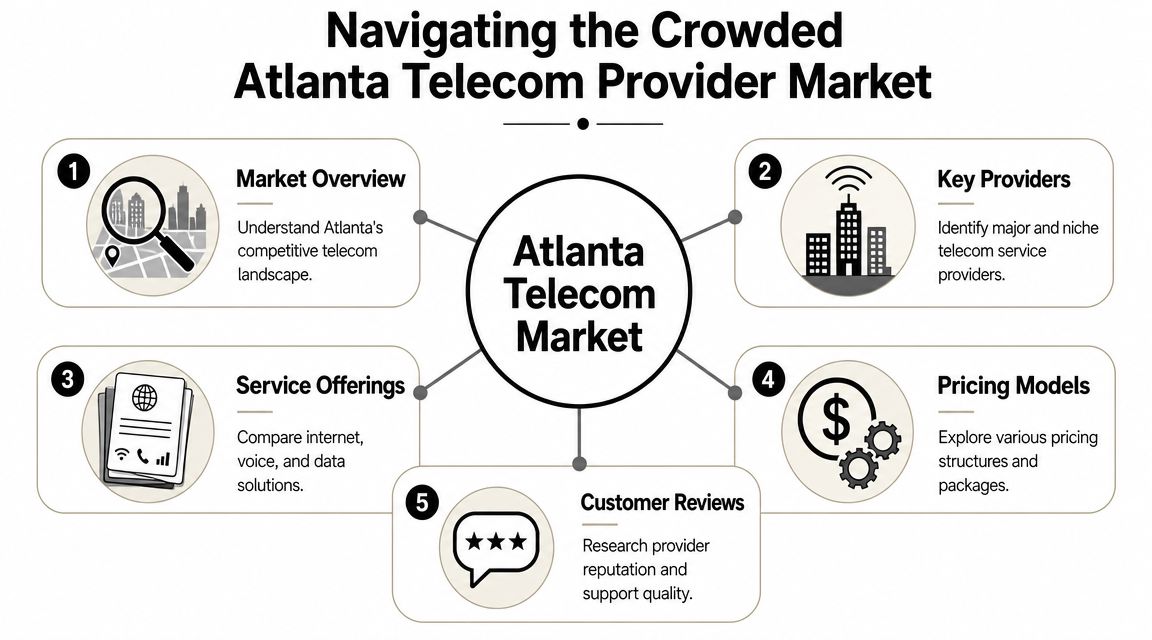
Independent network-intelligence data compiled in this Atlanta Ethernet private line market summary lists an estimated 54 Ethernet private line providers in the city and describes Atlanta's connectivity score as “High.” That's good news for buyers. It usually means stronger vendor choice and more room to negotiate. It also means you need discipline, because citywide provider counts do not guarantee serviceability at your exact address.
Know what kind of provider you're talking to
Not every telecom seller controls the same part of the service.
Some are large incumbents with deep local infrastructure. Some are national carriers with broad commercial reach. Others are competitive providers that lease portions of access or focus on specific building clusters, corridors, or enterprise products. You may also encounter brokers, agents, and technology advisors who help source service but don't own the network.
That affects four things:
- Installation control: Providers with stronger local plant access often move faster through design and turn-up.
- Troubleshooting boundaries: Resellers can be useful, but support may involve handoffs.
- Service fit: Dedicated fiber, Ethernet private line, business cable, and fixed wireless all solve different problems.
- Building outcomes: A provider may serve the street but not your riser, floor, or demarc path.
Check the address, then check the building
For Atlanta buyers, building logistics often matter as much as carrier availability.
A downtown office tower may already have several carriers in the riser but strict access rules, limited conduit options, or required coordination through property management. A warehouse or industrial facility may have easier physical access but fewer fiber-ready options. Multi-tenant properties can also create delays when building ownership, cabling contractors, and carrier field teams aren't aligned.
Use this sequence when shortlisting providers:
- Run an address-specific qualification with the exact service address.
- Ask if the provider is already in the building or nearby.
- Confirm handoff type and demarc location so your network team knows what's being delivered.
- Ask what dependencies remain, including construction, access approvals, and inside wiring.
Don't treat “service available in Atlanta” as a deployment answer. Treat it as the start of technical due diligence.
If you're comparing local firms that support procurement, hardware transitions, and end-of-life planning around connectivity changes, it helps to review Atlanta telecommunications company support options.
Match the service to the site
A few practical pairings usually hold up:
- Headquarters or latency-sensitive office: Dedicated fiber or Ethernet service is often easier to justify when voice, cloud access, and uptime matter.
- Warehouse or light industrial site: Business-class broadband may be adequate if usage is predictable and failover is in place.
- Temporary or hard-to-reach site: Fixed wireless can be useful as an interim path or secondary circuit.
- Multi-site environment: Standardization matters. It's often better to have a consistent support model across sites than to chase a different low-cost option for each one.
Atlanta's market density is an advantage. The mistake is assuming competition eliminates planning. In practice, it raises the value of a clean requirements document and a careful site-by-site review.
Negotiating Service Levels and Pricing Like a Pro
The cheapest telecom quote is often the most expensive one to live with. If a provider wins on price but loses on support responsiveness, contract flexibility, installation accountability, or service restoration, your monthly savings can disappear the first time a critical location goes down.
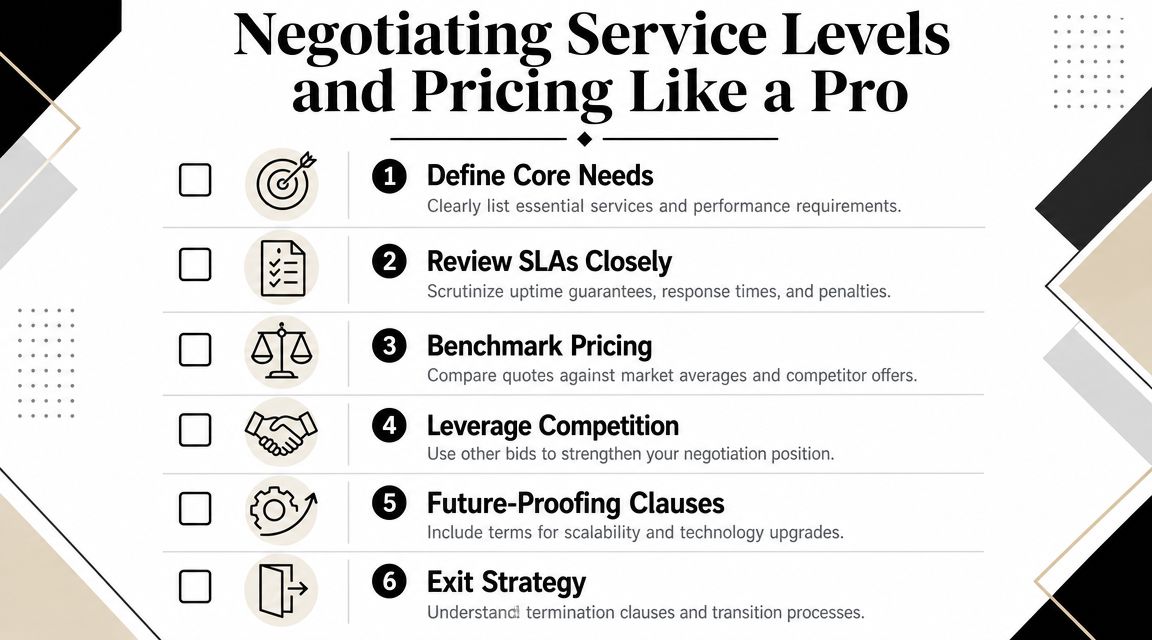
The strongest negotiation posture comes from evidence. That means understanding your current invoices, your actual traffic behavior, and the business consequence of poor performance.
Don't negotiate from list price
Before you ask for bids, audit what you already have. Pull current contracts, invoices, service orders, usage reports, and trouble history. Then reconcile them.
Guidance in this telecom cost audit review recommends a process of data collection, analysis, negotiation, implementation, and ongoing management. It also advises mapping data at granular intervals such as hourly, daily, or monthly and validating outputs against operational benchmarks before automation. That matters because billing discrepancies and underused services often show up only when contracts, invoices, and traffic records are compared side by side.
If you skip that step, you lose your advantage. You also risk buying the wrong service class because nobody measured the traffic pattern before shopping.
Make providers bid on the same scope
An RFP doesn't need to be long. It needs to be structured.
Give every provider the same set of facts: site address, desired handoff, target go-live window, current environment, support expectations, term preference, and any required redundancy. If one vendor prices managed router support and another doesn't, those aren't comparable proposals.
A simple comparison table helps:
| Contract area | What to ask for in writing |
|---|---|
| SLA terms | Uptime commitment, response process, and restoration targets |
| Support model | Named escalation path and how carrier coordination works |
| Install scope | Site survey, inside wiring assumptions, and customer dependencies |
| Pricing | Monthly recurring charges, one-time charges, and add-on exclusions |
| Exit terms | Renewal language, termination conditions, and transition support |
Focus on the terms that affect operations
Monthly recurring cost matters. It just isn't the only line that matters.
Push on these points:
- Service levels: If the circuit supports customer-facing operations, require clear performance commitments and a documented escalation path.
- Repair expectations: Ask what happens during a fault, who owns updates, and how support changes after business hours.
- Growth clauses: If you may need more capacity or an additional site, ask how upgrades are handled.
- Renewal language: Auto-renewal and notice windows create avoidable friction when teams aren't tracking dates.
- Install accountability: Clarify who owns coordination with the building, local access, and testing at turn-up.
A good telecom agreement protects the day after install, not just the day finance approves the quote.
Teams that want outside help benchmarking service terms, reconciling bills, and coordinating the procurement side of a carrier move often look at managed telecom services in Atlanta.
One final point. If your provider can't explain the practical difference between acknowledgment, meaningful triage, and actual restoration, the support language is probably weaker than it looks.
Ensuring a Smooth Installation and Go-Live Day
A signed order is where many buyers relax too early. Installation is the point where commercial promises meet building reality, cabling paths, technician scheduling, and your own internal readiness.
Treat installation as a project, not an appointment
Before the carrier arrives, confirm the demarc location, access rules, power availability, rack space, patching expectations, and who will be onsite from your side. If you're in a managed building, involve property management early. Delays often come from access approvals, riser coordination, or confusion about who owns inside wiring.
Create one cutover sheet that covers:
- Site contacts: Building management, your IT lead, your telecom contact, and any cabling contractor.
- Circuit details: Service ordered, handoff expected, and equipment being installed.
- Dependencies: Firewall changes, LAN prep, voice system updates, and failover steps.
- Rollback decision: Who makes the call if testing fails.
Control the go-live window
Don't schedule cutover casually. Pick a window that matches business tolerance for disruption.
If phones, cloud applications, or customer-facing systems depend on the new service, notify internal teams in advance and define what “success” means before anyone touches production traffic. For some locations, that means a same-day cut. For others, it means turning up the new circuit, testing it in parallel, and moving traffic only after validation.
A strong local implementation partner can help coordinate carrier field work and site logistics. When Atlanta businesses need support around physical rollout and turnover activities, they often review telecom network installation in Atlanta.
Validate before sign-off
Post-install validation is where disciplined teams separate themselves from rushed ones.
Test what matters to the business, not just whether link lights are on. Verify that voice quality is stable, cloud applications behave normally, VPN sessions hold, and any failover path works as intended. If the circuit is meant to carry critical traffic, run validation during actual operating conditions, not only during a quiet maintenance window.
If you don't test against real business use, you're accepting the install on faith.
Don't close the ticket until documentation is updated. Capture circuit IDs, support contacts, handoff details, rack locations, and any config changes made during turn-up. That record becomes essential when there's a fault later or when the old hardware needs to be retired.
The Final Step Secure and Sustainable Telecom Hardware Decommissioning
This is the part most telecom guides skip. The new circuit is live, users are stable, and everyone moves on. Then the old routers, switches, VoIP phones, firewalls, racks, patch panels, UPS units, and cabling get left in a closet, stacked in a comm room, or sent out with general surplus.
That's a mistake.
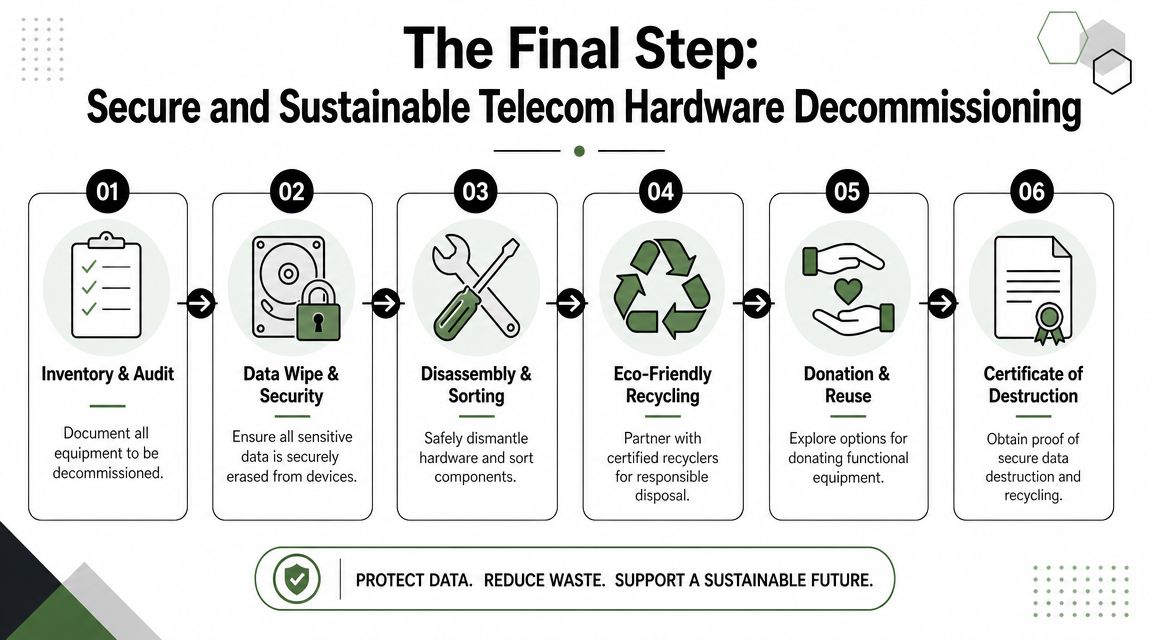
A market note on Atlanta dark fiber and provider density points out a major content gap around decommissioned equipment. That blind spot is real in practice. Provider changes can leave businesses with stranded, data-bearing hardware that requires secure handling and a defined reverse-logistics process.
What usually gets overlooked
Telecom transitions don't retire only the obvious gear.
Old equipment often includes:
- Network edge devices: Routers, firewalls, SD-WAN appliances, and switches that may retain configurations, credentials, and logs.
- Voice hardware: Desk phones, session border devices, gateways, and conferencing equipment.
- Physical infrastructure: Racks, cable bundles, patch hardware, and legacy power components that complicate office cleanout and facility cleanout projects.
- Storage-bearing systems: Telecom appliances that look harmless but still contain recoverable operational data.
If nobody owns this phase, three things happen. Sensitive equipment sits unsecured. Asset records drift out of sync. Facilities or operations teams are left to solve an IT asset disposition problem without the right controls.
Build a decommissioning workflow before the cutover
The best time to plan disposal is before the install, not after.
A practical workflow usually includes:
- Inventory what is leaving service and mark anything that contains data or configuration state.
- Define chain of custody from rack removal to staging, transport, and final disposition.
- Separate reuse from end-of-life so potentially redeployable assets aren't mixed with scrap.
- Choose data destruction method based on device type and your internal policy.
- Document final outcome for audit, security, and sustainability reporting.
Electronics recycling, secure data destruction, and IT equipment disposal transition from side tasks to integral components of the telecom project.
Connect security, sustainability, and community impact
A responsible decommissioning plan should satisfy more than one stakeholder. IT wants secure retirement. Facilities wants space cleared and risk removed. Sustainability leaders want sustainable recycling instead of landfill leakage. Finance may want value recovery on selected assets. Leadership may also care whether usable equipment can support broader social impact.
That combination is why a structured IT asset disposition (ITAD) process matters. It turns a pile of retired devices into an auditable workflow.
For Atlanta organizations handling telecom upgrades, office relocations, data center decommissioning, product destruction, computer recycling, laptop disposal, or broader electronics recycling, one local option is telecom equipment disposal near Atlanta. Reworx Recycling is a Smyrna-based social enterprise that provides telecom equipment disposal, secure data destruction, pickup support, and donation-based recycling for retired technology assets.
Old telecom gear is still a security asset until it's inventoried, sanitized, and removed through a controlled process.
That matters beyond compliance. Donation-based recycling and social enterprise recycling models can support corporate donation programs and digital inclusion goals when equipment is still suitable for reuse. Equipment that has reached end of life can move through sustainable recycling channels instead of becoming unmanaged e-waste.
The same planning discipline also helps on more complex projects. If your telecom refresh is tied to a headquarters move, a facility consolidation, or a broader refresh that includes servers, user devices, lab systems, or medical technology, your decommissioning process may overlap with office cleanout, laboratory equipment disposal, medical equipment disposal, and secure product destruction workflows. Those workstreams shouldn't compete with each other. They should be coordinated under one chain-of-custody model.
Businesses that handle this well don't treat disposal as cleanup. They treat it as the final control point in the telecom lifecycle.
Your Complete Telecom Strategy for Atlanta
To get telecom services in Atlanta without creating downstream problems, treat the work as one connected project. Define the core requirement first. Then validate which providers can serve your address, negotiate terms that protect operations, and manage installation like a controlled change, not a routine service call.
The last phase deserves the same attention as the first. A telecom upgrade isn't complete until the legacy hardware is removed, data risk is addressed, and the retired equipment moves through a documented disposition process. If your project also includes a larger site transition, this guide to Cubicle By Design for decommissioning is a useful reference for coordinating office shutdown tasks alongside network and facilities work.
For environmental handling standards and broader guidance on responsible end-of-life electronics management, many teams also review the EPA's e-waste information.
When you plan procurement and decommissioning together, the outcome is cleaner. Fewer surprises on go-live day. Less stranded hardware. Better documentation. Lower security risk. Stronger alignment between IT, facilities, procurement, and sustainability.
If your Atlanta business is upgrading circuits, replacing phones, clearing a telecom room, or preparing for a broader office or facility transition, Reworx Recycling can help you close the loop responsibly. Donate old equipment, schedule a pickup, or explore a partnership for secure data destruction, electronics recycling, and donation-based IT equipment disposal that supports both operational cleanup and community impact.