A sustainability manager opens a spreadsheet, an IT director opens a disposal log, and both realize the same thing. The company has a reporting mandate, but the data sits in different systems, different teams, and different formats. That is where ESG reporting requirements stop feeling like a policy topic and start looking like a systems problem.
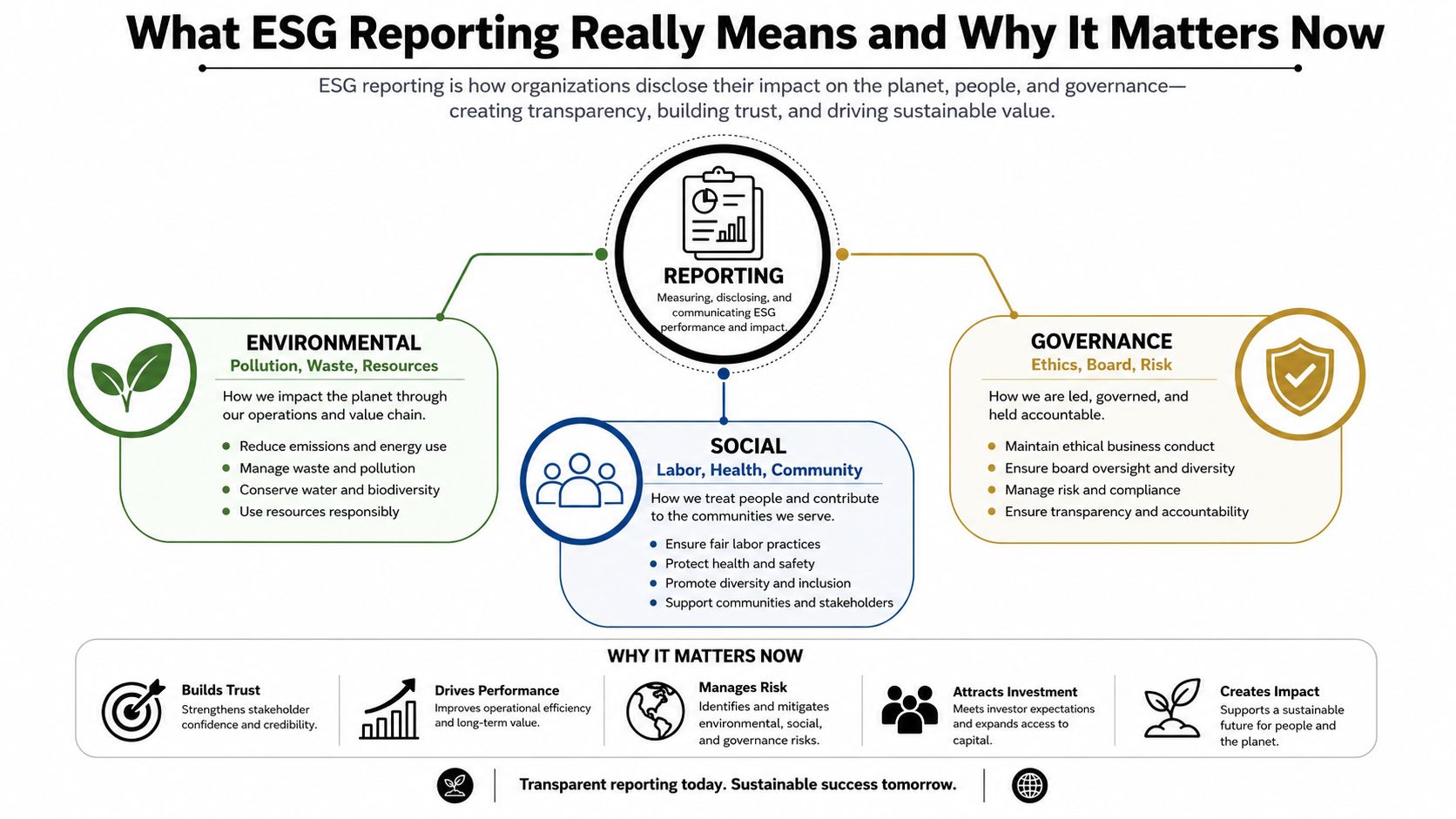
At its simplest, ESG reporting means disclosing how a business performs on Environmental, Social, and Governance topics. In practice, that means reporting on emissions, energy, waste, labor practices, board oversight, risk controls, and other issues that regulators, investors, customers, and lenders want to compare across companies. A useful plain-language primer for business teams is the guide on ESG for business leaders, because it frames the topic in terms that finance, operations, and compliance teams can all use.
For first-time reporting teams, the key shift is this. ESG reporting is no longer just a communications exercise, it's a data and control discipline that reaches procurement, IT, facilities, HR, legal, and finance. If you're trying to understand the broader sustainability context inside your organization, Reworx Recycling also keeps a practical overview on what sustainability reporting means in business.
What ESG Reporting Really Means and Why It Matters Now
The plain-English version
A company can know its energy use, employee turnover, and board oversight separately, yet still struggle to explain how those pieces fit together in a report. ESG reporting brings those threads into one disclosure system. Environmental disclosure covers the way a company uses energy, manages waste, and tracks emissions. Social disclosure covers people topics like labor, health and safety, training, and human-rights practices. Governance disclosure covers board oversight, ethics, controls, and risk management.
A common assumption among first-time reporting teams is that ESG reporting lives inside sustainability. It usually does not. The work depends on master data, document trails, approvals, and calculations that can be traced later.
That structure matters because regulators are widening the group of companies that must report. Under the EU's Corporate Sustainability Reporting Directive, roughly 50,000 companies are expected to report, compared with about 11,700 under the earlier non-financial regime, so the reporting net has widened by more than four times. The EU also ties reporting to European Sustainability Reporting Standards, and its taxonomy-related disclosure rules made additional environmental objectives, including circular economy, pollution prevention, and biodiversity, mandatory from January 2023, as set out in the EU ESG reporting guidelines.
That matters even if your company is not headquartered in Europe. If you operate in Europe, sell into European supply chains, or rely on European capital, you are increasingly expected to produce auditable data rather than broad statements. ESG reporting has started to sit much closer to financial reporting than to brand storytelling.
Practical rule: if a metric affects procurement, payroll, facilities, or IT asset records, it can also become an ESG reporting input.
Why teams get stuck early
A reporting team often starts with sustainability language, then discovers the hard part is evidence. ESG numbers usually come from inventory systems, policy records, invoice trails, and sign-off workflows, not from a single summary spreadsheet.
That is why electronics disposal matters so much. End-of-life devices can generate evidence for waste, circularity, and even social-impact disclosures when the disposition records are clean. A laptop, for example, may start in IT asset inventory, move through a transfer or wipe record, and end with a recycling certificate or resale document. If any step is missing, the reporting team has a gap in the audit trail.
Companies looking for a broader explanation of how these disclosures fit together can also use Reworx Recycling's overview of what sustainability reporting means in business. That context helps separate general sustainability messaging from the records that auditors, customers, and lenders ask to see.
The pressure is increasing from several directions at once. Investor scrutiny, customer questionnaires, supply-chain requirements, and regulatory exposure all push the same direction. For a first-time team, the challenge is not just writing the report, it is proving that each claim rests on a record someone can inspect later.
The Global Regulatory Map from the EU to the US
Where reporting is mandatory and where it is still uneven
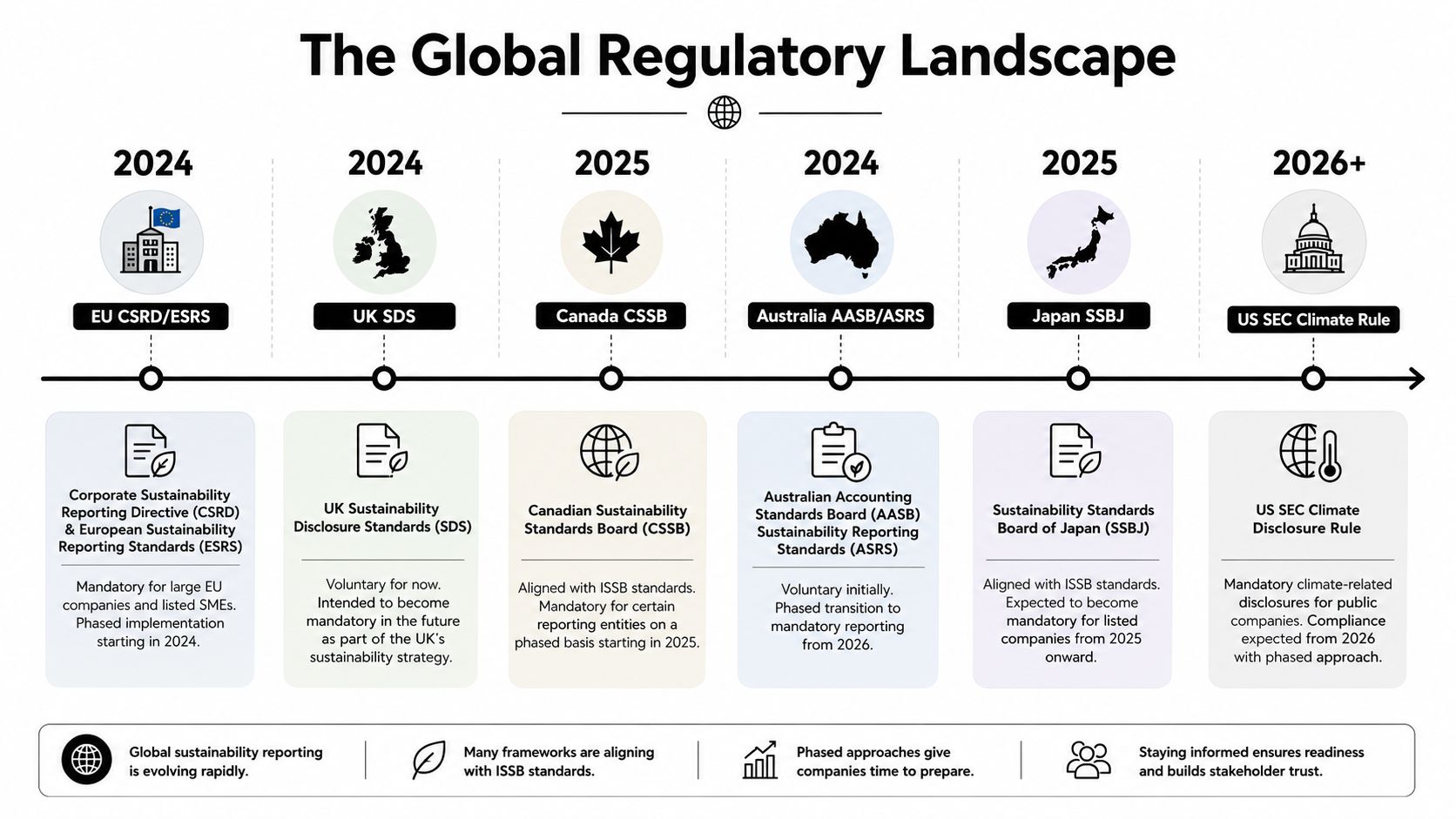
A reporting team usually notices the pattern first in supplier requests, then in legal memos, and only later in the actual filing rules. The clearest shift is that many major markets have moved from voluntary sustainability statements to mandatory disclosure for large companies. The EU leads that shift, but it is not the only place. Major markets such as the EU, UK, Canada, Australia, Japan, and Singapore are described as having mandatory ESG reporting obligations for many large enterprises, especially listed companies and growing numbers of large private firms (US ESG reporting overview).
The United States works differently at the federal level. The SEC adopted climate-related disclosure rules on March 6, 2024, with an effective date of May 28, 2024, and implementation was originally intended to begin in fiscal year 2025, but later developments stalled federal enforcement, leaving the U.S. framework largely shaped by materiality-based disclosure and state-level rules (US ESG reporting overview).
For a multinational, the practical question is usually not, “Do we report ESG?” It is, “Which entity, subsidiary, or contract triggers the duty first?” A company can have one reporting obligation in Europe and a very different set of expectations in the U.S., depending on where the legal entity sits and which customers or regulators are asking for evidence.
Why the EU model keeps setting the tone
The EU model carries so much weight because it asks for more than narrative claims. Under CSRD, in-scope companies must disclose both how sustainability factors affect the business and how the business affects people and the environment, with the reporting scope explicitly covering environmental, social and human-rights, and governance factors, including Scope 1, Scope 2, and Scope 3 emissions, water and marine resources, circular economy, pollution, and biodiversity (Harvard Law School forum summary).
That standard changes how teams collect evidence. A recycled laptop, a wiped server, or a certified resale batch is no longer just an operational record, it can become auditable support for waste, circularity, and supply-chain disclosures when the disposal paperwork is complete. The same logic is why companies outside Europe still align their reporting processes with EU expectations. Their customers, investors, and auditors increasingly want records they can inspect, not polished language they have to trust.
This also explains why geography matters so much in reporting design. Two companies in the same industry can face different disclosure setups because one is caught by an EU rule set while the other is answering to U.S. materiality rules and state requirements. Finance teams trying to connect those obligations to close and controls often use HireAccountants' 2026 accounting insights to see how disclosure standards affect audit readiness, policy design, and recordkeeping.
Comparing the Major ESG Frameworks Side by Side
The frameworks that most teams confuse
The same company can end up using several frameworks at once, and that's where first-time teams get tangled. GRI, SASB, TCFD, ISSB, and ESRS are related, but they're not interchangeable.
GRI is built for broad stakeholder reporting. SASB is industry-specific and investor-focused. TCFD shaped climate governance and risk disclosure, and its principles now sit inside modern climate reporting. ISSB provides a global investor baseline through IFRS S1 and S2. ESRS is the detailed EU standard used under CSRD, with a double-materiality approach that covers both financial impact and the company's impact on society and the environment. The 2026 accounting insights from HireAccountants are a helpful companion for finance teams that need to see how disclosure standards affect close, controls, and audit readiness.
| Framework | Primary Audience | Scope | Assurance Expectation | Adoption Status |
|---|---|---|---|---|
| GRI | Broad stakeholders | Environmental, social, governance, impact topics | Often used with external review, depending on company policy | Widely used voluntarily |
| SASB | Investors | Industry-specific financially material metrics | Often layered into investor reporting and assurance programs | Embedded in ISSB, still widely referenced |
| TCFD | Investors and risk leaders | Climate governance, strategy, risk, metrics | Commonly used as a climate-risk structure | Influential, absorbed into ISSB S2 |
| ISSB | Investors | General sustainability and climate baseline | Designed for decision-useful, auditable disclosure | Emerging global baseline |
| ESRS | Regulators, investors, stakeholders | Detailed ESG topics under CSRD | Mandatory assurance expectations are part of the regime | Mandatory for in-scope EU reporters |
How companies usually combine them
Companies often don't pick one framework and ignore the rest. They layer them. A company may use ISSB or SASB for investor-grade material metrics, then use GRI or ESRS for broader stakeholder disclosure and regulatory coverage.
That layering is why accounting and sustainability teams need to coordinate early. The framework determines what counts as a material topic, what data gets collected, and how much explanation the report needs. If the wrong team owns the decision, the company can end up collecting data twice, or worse, collecting the wrong data once.
A good framework choice doesn't start with design software. It starts with asking who will read the report, who will audit it, and which jurisdictions apply.
The KPIs You Will Actually Be Asked to Disclose
The core KPI families
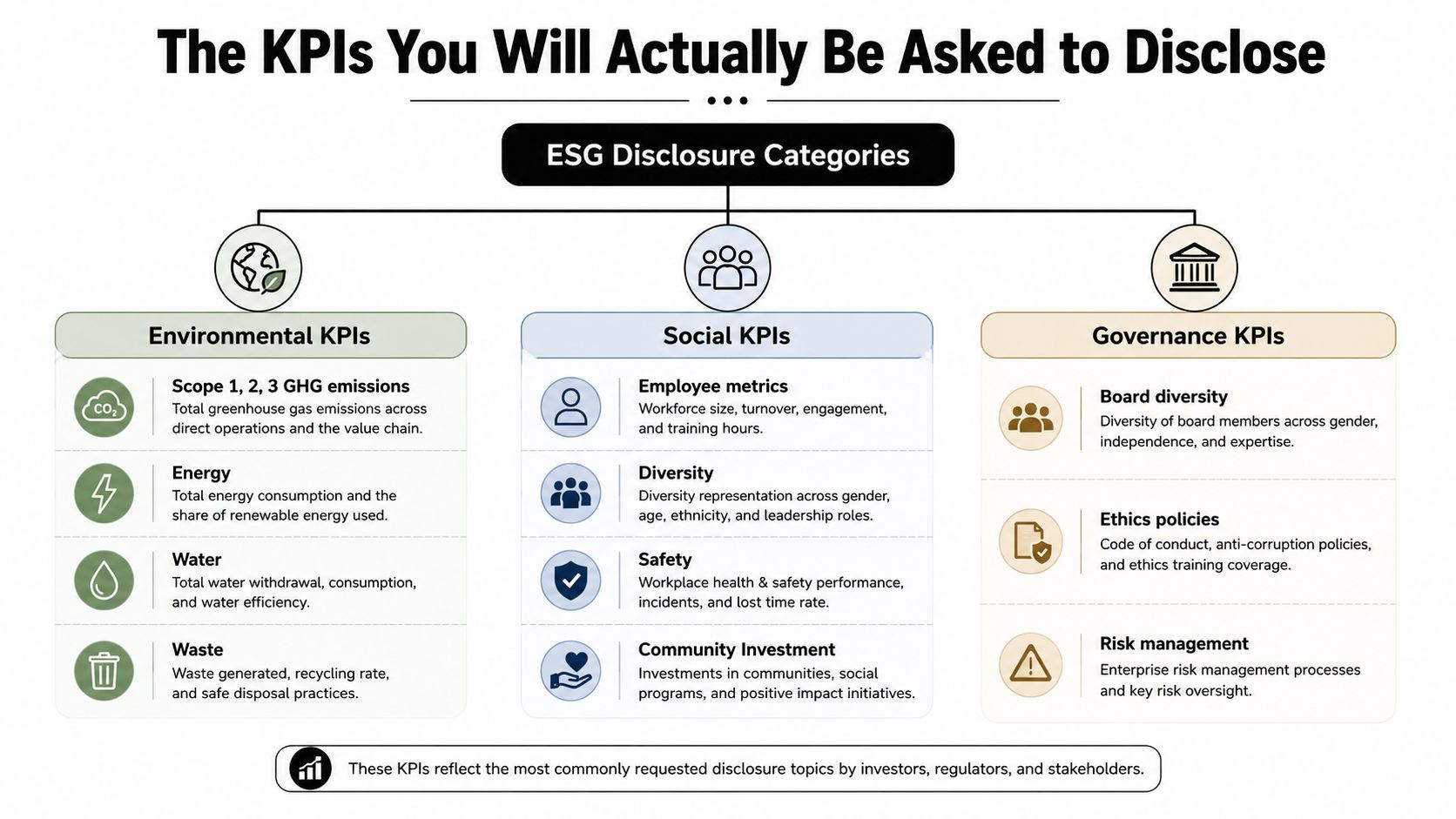
Most ESG reports start with environmental metrics because they're the most standardized. Regulators and investors commonly expect Scope 1 and Scope 2 greenhouse-gas emissions, and many regimes now push for Scope 3 as well, because supply-chain responsibility has become part of climate disclosure (Manifest Climate on ESG reporting requirements). Alongside emissions, teams often need energy use, water use, and waste data, plus evidence that the numbers were gathered with a consistent method (Deloitte on ESG disclosure rules).
Social metrics usually cover workforce diversity, employee health and safety, training, labor practices, and human-rights due diligence (Deloitte on ESG disclosure rules). Governance metrics usually cover board composition, ethics policies, compliance, risk management, and data privacy controls (Deloitte on ESG disclosure rules).
The electronics and IT asset metrics people overlook
For IT-heavy organizations, the most overlooked category is end-of-life equipment. That includes e-waste generated, equipment reused versus recycled, devices securely data-destroyed, landfill diversion, and chain-of-custody documentation. These are not side notes anymore, they are evidence points that can support circular economy, waste, and social-impact disclosure.
- E-waste volume and handling: track retired laptops, monitors, servers, phones, and peripherals separately so the disposition path is clear.
- Reuse and recycling outcomes: distinguish devices returned to service from material sent to downstream recyclers.
- Secure data destruction: keep certificates tied to serial numbers, not just batch totals.
- Donation outcomes: document which assets were redeployed through corporate donation programs and who received them.
- Chain-of-custody records: preserve pickup, transfer, processing, and final outcome records so the trail is auditable.
If you're building this from scratch, Reworx Recycling's impact measurement approach is a useful example of how disposition outcomes can be turned into reporting evidence without turning the process into a spreadsheet mess.
Building the Data Collection and Assurance Workflow
From source systems to auditable numbers
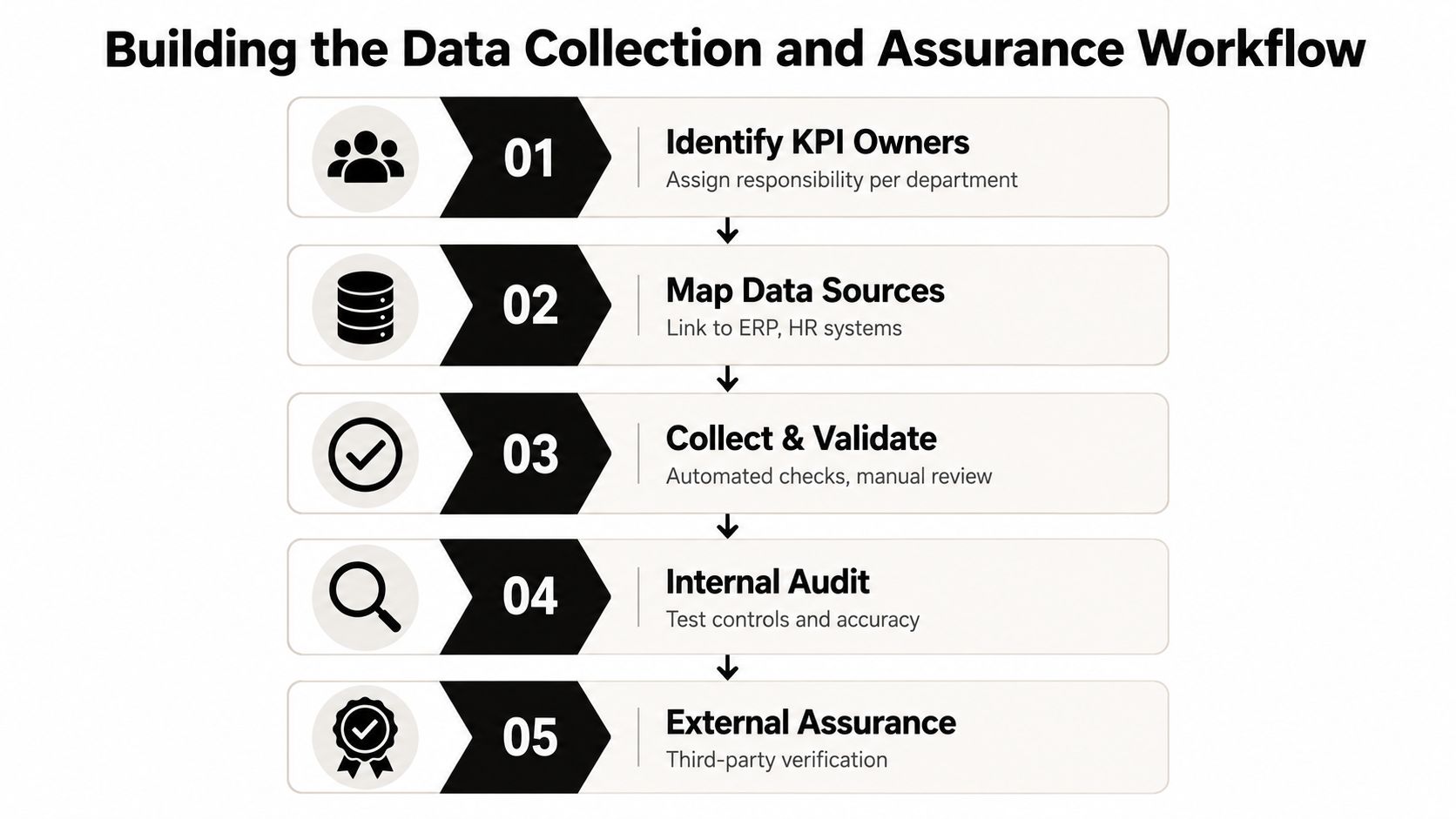
ESG reporting becomes manageable when every metric has an owner and every number has a source. Utility bills, fuel logs, HRIS records, asset inventories, ERP data, and procurement files all feed the final report, but they need to be mapped before anyone starts drafting prose. That is where many programs fail, because teams collect data late and then try to force consistency after the fact.
A workable workflow starts with assigning one owner per KPI family. Facilities might own energy and waste, HR might own people metrics, finance might own consolidation rules, and IT might own asset and disposition data. Once ownership is clear, the team can standardize the calculation method, apply emission factors, and keep the underlying evidence in a form that supports audit review.
Practical rule: if you can't trace a number back to a source document, don't treat it as report-ready.
Assurance is part of the workflow, not an afterthought
Internal controls come first, but external assurance is becoming the norm for climate-related disclosure. Limited assurance tests whether the reporting is plausible and supported, while reasonable assurance is a deeper level of verification with a higher confidence threshold. Mature programs plan for that from the start by keeping methodology notes, boundary decisions, and source evidence together.
The most common failure point is weak master data. If supplier names, asset IDs, or site codes are inconsistent, the error spreads into the emissions total and the business can no longer defend its trend lines. That is why methodology transparency and boundary discipline matter so much. A report is only as strong as the records behind it.
For teams that need a practical evidence trail for retired devices, Reworx Recycling's chain-of-custody documentation shows how operational records can support disclosure and review.
How Electronics Disposition Becomes Audit-Ready ESG Data
A simple IT refresh example
A company starts an office refresh and retires laptops, docking stations, and network gear. The purchasing team can show what was bought, but ESG reporting needs the full path from asset intake to deployment, then to decommissioning, data destruction, reuse, recycling, or donation. That is the difference between a procurement log and report-ready evidence.
Each stage leaves a different kind of proof. Serialized asset inventories show what existed. Decommissioning records show when a device left service. Certificates of data destruction show the security control was completed. Processing records show whether the item was reused, recycled, or disposed. Donation records show whether an asset was transferred for community use. Together, those records support a clearer disclosure story than a vague statement that the equipment was handled responsibly.
What auditors and sustainability teams look for
Auditors and sustainability teams usually want a file that answers a few simple questions, one step at a time:
- Serialized inventory lists show which devices were in scope.
- Pickup and transfer records show who handled the assets.
- Certificates of data destruction show that storage media were sanitized or destroyed.
- Weight tickets and processing summaries support waste and diversion calculations.
- Downstream vendor records show where the material went next.
- Beneficiary records show which donated assets were repurposed in the community.
Each record fills a different gap. An inventory tells you what existed, a transfer form shows custody changed hands, and a destruction certificate shows the security step was completed. If one link is missing, the chain becomes harder to defend during review.
A donation-based electronics recycling partner can fit into that reporting chain. A service provider such as Reworx Recycling can help businesses document IT equipment disposition, secure data destruction, and downstream processing so the end-of-life phase becomes evidence rather than guesswork. For organizations with large refresh cycles, that turns electronics disposal into part of ESG data governance instead of a separate facilities task. For a detailed guide on audit documentation, see Reworx Recycling's audit documentation requirements.
The main point is simple. The physical act of recycling is not the reporting outcome. The documented trail is the reporting outcome. If the documentation is thin, the ESG record is thin too.
A Practical Compliance Checklist and Timeline You Can Use Today
A first-year ESG program works better when the work is staged. A common failure point is trying to collect every metric at once, before anyone has agreed on scope, owners, or evidence. Start with the reporting picture first, then build the file behind it.
A 12-month starter path
In months 1 to 3, complete a materiality assessment, identify key stakeholders, and decide which business units are in scope. That early scoping step matters because it tells the team whether the report needs to cover a single site, a region, or the whole company. If the boundary is unclear, every later data request becomes harder to interpret.
In months 4 to 6, select the reporting frameworks, inventory the KPIs, and map where each data point lives. This is the point where many teams discover that the useful information already exists, but it sits in different systems, emails, or local spreadsheets. A metric only becomes reportable once someone knows the source, the owner, and the rule used to calculate it.
Months 7 to 9 should focus on the data infrastructure itself. Define controls, clean master data, assign owners, and build review steps so the numbers do not depend on one person's memory. For IT-heavy organizations, this is also the stage where retired-device records, asset tags, and disposal certificates should be folded into the same control set as the rest of the ESG evidence.
Months 10 to 12 should produce baseline reporting, internal sign-off, and assurance scoping so the company can see where the gaps still are. That review gives leadership a plain answer to a basic question, which figures are ready for outside review and which ones still need better support. For teams that want a practical starting point, Reworx Recycling's compliance checklist template can help organize the evidence trail for end-of-life devices and related records.
A simple checklist leadership can act on
- Map obligations early: identify which jurisdictions, contracts, and customers create reporting pressure.
- Assign owners by function: finance, IT, HR, facilities, procurement, and legal should each own a slice of the file.
- Document boundaries: state what is included and excluded, and keep that rule consistent.
- Centralize evidence: store source files, calculations, and approvals in one controlled system.
- Test the hard areas first: Scope 3 data, leased assets, supplier records, and electronics disposition usually create the most friction.
A checklist only works if it matches how the business operates. The team that refreshes laptops, wipes drives, and ships old equipment to a recycler often has the paper trail that closes a reporting gap, even if no one thought of it as ESG evidence at the time.
The teams that move fastest are not the ones with the prettiest report. They are the ones that lock down source data before the first draft starts.
The usual stumbling blocks are predictable. Scope 3 supplier data can be incomplete, organizational boundaries can shift mid-year, and assurance readiness always takes longer than a slide deck suggests. Plan for those problems upfront, and the reporting cycle becomes much easier to repeat.
Key Takeaways and How Reworx Recycling Supports Your Reporting
ESG reporting requirements are now a regulated business process in many major markets, not a voluntary sustainability sidebar. The hardest part isn't writing the report, it's proving that the numbers came from reliable systems, consistent boundaries, and documented controls. For IT-heavy organizations, electronics disposition belongs in that same control environment because it produces auditable data for waste, circularity, security, and social impact.
The second takeaway is that framework choice matters, but data quality matters more. A company can layer GRI, SASB, ISSB, and ESRS as needed, yet none of those frameworks will rescue weak asset records or missing destruction certificates. If the business can't trace an old device from desk to destination, it has a reporting gap, not just a recycling problem.
Reworx Recycling supports that part of the workflow by handling electronics recycling, IT asset disposition, secure data destruction, and documented donation-based recycling in a way that fits reporting needs. For teams trying to make end-of-life IT assets measurable, the value is in the paperwork as much as the pickup.
If your team is working through ESG reporting and needs cleaner records for retired devices, Reworx Recycling can help with pickup scheduling, secure data destruction, and documented electronics disposition. Visit Reworx Recycling to start a conversation about your next office cleanout, device donation, or ITAD project, and build reporting evidence you can stand behind.