A Boxborough business owner usually reaches this question at the end of an upgrade, not the beginning. The new laptops are deployed, the old desktop towers are under a conference table, a few monitors are leaning against a wall, and someone asks whether all of it can just go to the local transfer station.
That's a reasonable first thought. The Boxborough Transfer Station is a practical public resource for household disposal and recycling. But once the pile includes retired company laptops, office printers, networking gear, or storage devices, the issue stops being simple trash removal. It becomes a business risk question involving data, chain of custody, and whether usable equipment should be reused rather than dumped into a basic disposal workflow.
For a home office user, the answer may still be local and straightforward. For a company with client files, employee records, or old workstations, it usually isn't. A business needs a process built for electronics recycling, secure data destruction, and responsible downstream handling. If you're sorting through old devices now, this guide to how to dispose of electronic waste will help frame the difference between ordinary disposal and proper business IT equipment disposal.
Managing Waste and Electronics in Boxborough
The Boxborough business community includes small offices, professional firms, labs, and service companies that cycle through technology faster than is typically expected. A server closet cleanup, office move, or refresh of employee laptops can create a surprising amount of material in a single afternoon.
Some of that material belongs in normal municipal channels. Some of it doesn't.
A cardboard box of packaging, breakroom trash, and everyday recyclables fit one kind of process. A stack of company desktops with asset tags, old backup drives, and decommissioned networking hardware fits another. The mistake many organizations make is treating both categories the same way because they all look like “stuff we no longer need.”
Practical rule: If the device ever stored business information, don't treat it like ordinary waste.
That line matters in Boxborough just as much as anywhere else. The transfer station is useful for local residents handling household material. It isn't a complete answer for business electronics, especially when those electronics still contain drives, memory, or regulated information. Even when a device seems dead, the data issue may still be alive.
The better approach is to separate your disposal problem into two tracks:
- Municipal waste and routine recycling for materials the town system is designed to handle
- Business e-waste and IT assets for equipment that needs documented handling, secure disposition, or reuse evaluation
That distinction saves time later. It also prevents a rushed cleanup from becoming a compliance problem.
Your Essential Guide to the Boxborough Transfer Station
If you searched for the Boxborough transfer station, here are the facts you need first.

Core location and access details
According to the Town of Boxborough Transfer Station page, the facility is located at 520 Codman Hill Road, Boxborough, MA 01719. It operates on Wednesdays from 11:00 AM to 7:00 PM and Saturdays from 8:00 AM to 4:00 PM. Access requires a valid Transfer Station sticker, available to residents, and seniors age 65 and older can apply online for a free sticker.
Those details are the starting point. Before loading a vehicle, confirm that the person visiting has the required sticker and that the trip fits the published operating hours.
What residents should know before visiting
For residents, the process is fairly simple when you plan ahead.
- Bring authorized access: The station requires a valid resident sticker.
- Use the published schedule: The site operates on a fixed Wednesday and Saturday schedule.
- Sort before arrival: Separate trash, recycling, and anything that may need special handling before you get in line.
- Think like a transfer site user: The faster you unload correctly, the easier the visit goes for you and for everyone behind you.
The town's system is built around controlled resident access. That matters because the station isn't an open commercial drop zone. It's a local service with defined eligibility and routine operating rules.
When the station is the right tool
For household disposal, the station can be exactly the right answer. It gives residents a predictable place to bring municipal waste and standard recycling. If you're clearing a garage, managing routine household trash, or handling common residential materials, this is the local infrastructure intended for that purpose.
A Boxborough business owner should read that carefully. The transfer station's value is real, but its value comes from doing a specific job well. It's not a substitute for a business disposal program.
Residents should treat the transfer station as a town waste resource, not as a catch-all channel for every kind of material an office retires.
That distinction becomes important once the load includes computers, drives, office electronics, or specialized equipment.
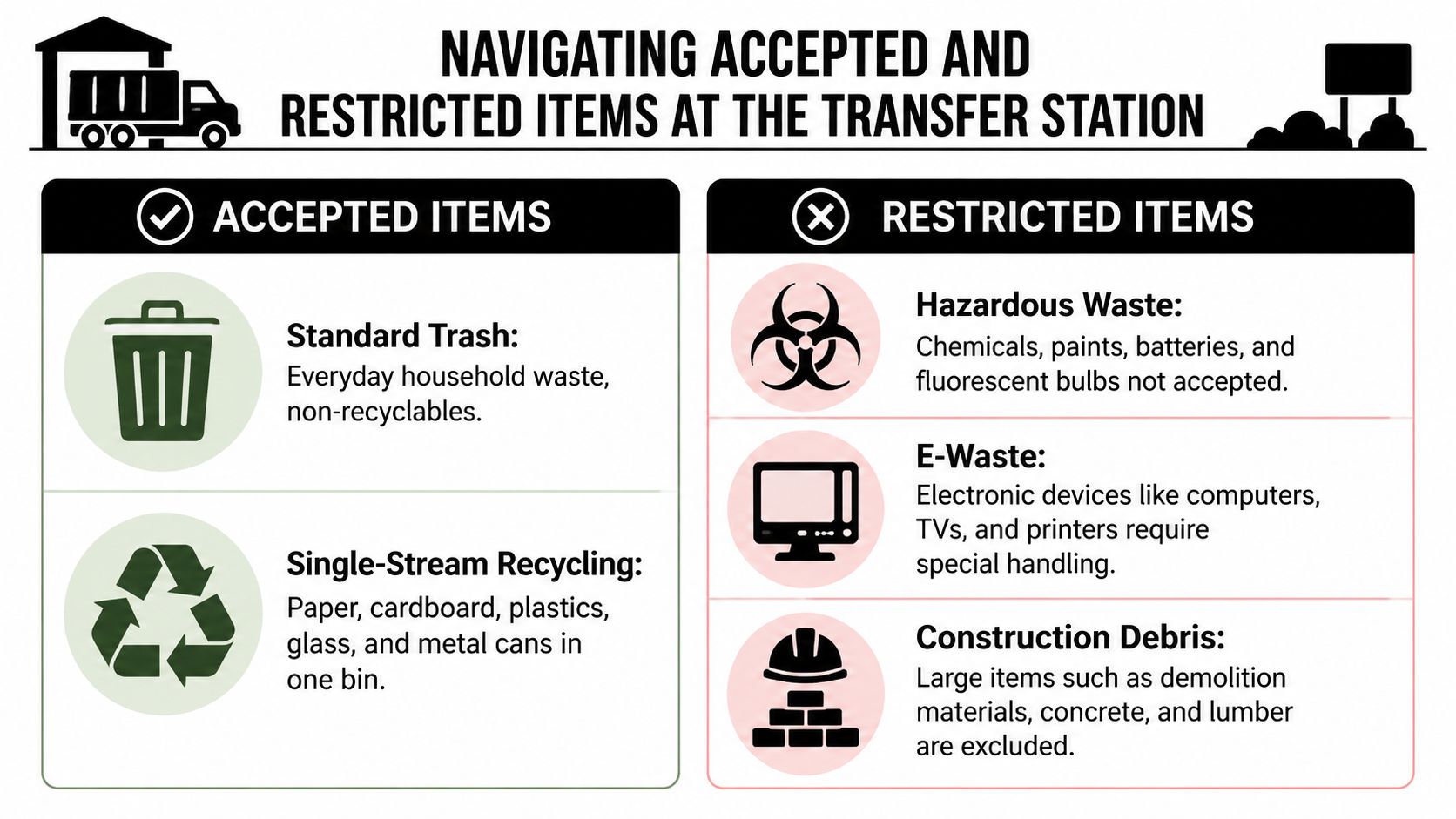
Navigating Accepted and Restricted Items
Sorting matters more than is often believed. Disposal problems at transfer stations usually start with mixed loads, unclear labeling, or assumptions that “recycling” means any item with metal or plastic in it.
Why separation still matters
As far back as the Boxborough 2005 annual environmental reporting referenced by EPA, the transfer station's material separation practices were important enough to be documented. The report noted green bins marked for “Trash” and “recycling” to help manage materials properly and keep contaminants out of the recycling stream.
That's not just administrative detail. It reflects a basic operating truth. When people put the wrong items into the wrong stream, the whole site gets harder to manage.
A practical way to think about materials
Most users should sort items into three buckets before they ever leave home or the office:
| Material type | Best use of the station |
|---|---|
| Everyday household trash | Usually appropriate for normal disposal |
| Common recycling | Usually appropriate when clean and sorted as required |
| Special, risky, or hard-to-recycle items | Often needs separate handling outside standard recycling bins |
That last category is where confusion starts. Electronics, hazardous materials, and unusual business discards don't belong in a generic “we'll figure it out when we get there” pile.
Where businesses run into trouble
For a household, an old device may be a one-off item. For a business, old electronics often arrive in batches and include more than just laptops.
Think about the kinds of assets that show up during an office cleanout:
- Workstations and laptops that may still contain company files
- Printers and copiers with internal memory or storage components
- Network gear such as switches, firewalls, and rack hardware
- Specialized devices tied to lab, medical, or industrial workflows
The station's basic public materials don't fully resolve how businesses should handle many of those items. That's why it helps to review a specialist's list of accepted electronics and equipment categories before moving anything offsite.
If an item is sensitive, reusable, or hard to classify, stop guessing and verify the handling path first.
For Boxborough companies, that simple habit avoids two bad outcomes at once. It keeps restricted materials out of the wrong stream, and it keeps business electronics from being treated like ordinary municipal waste.
Why the Transfer Station Falls Short for Business E-Waste
Municipal disposal systems and business IT disposition solve different problems. A transfer station is built for controlled public waste handling. A company retiring electronics needs a process that accounts for security, documentation, logistics, and reuse decisions.
The gap is real
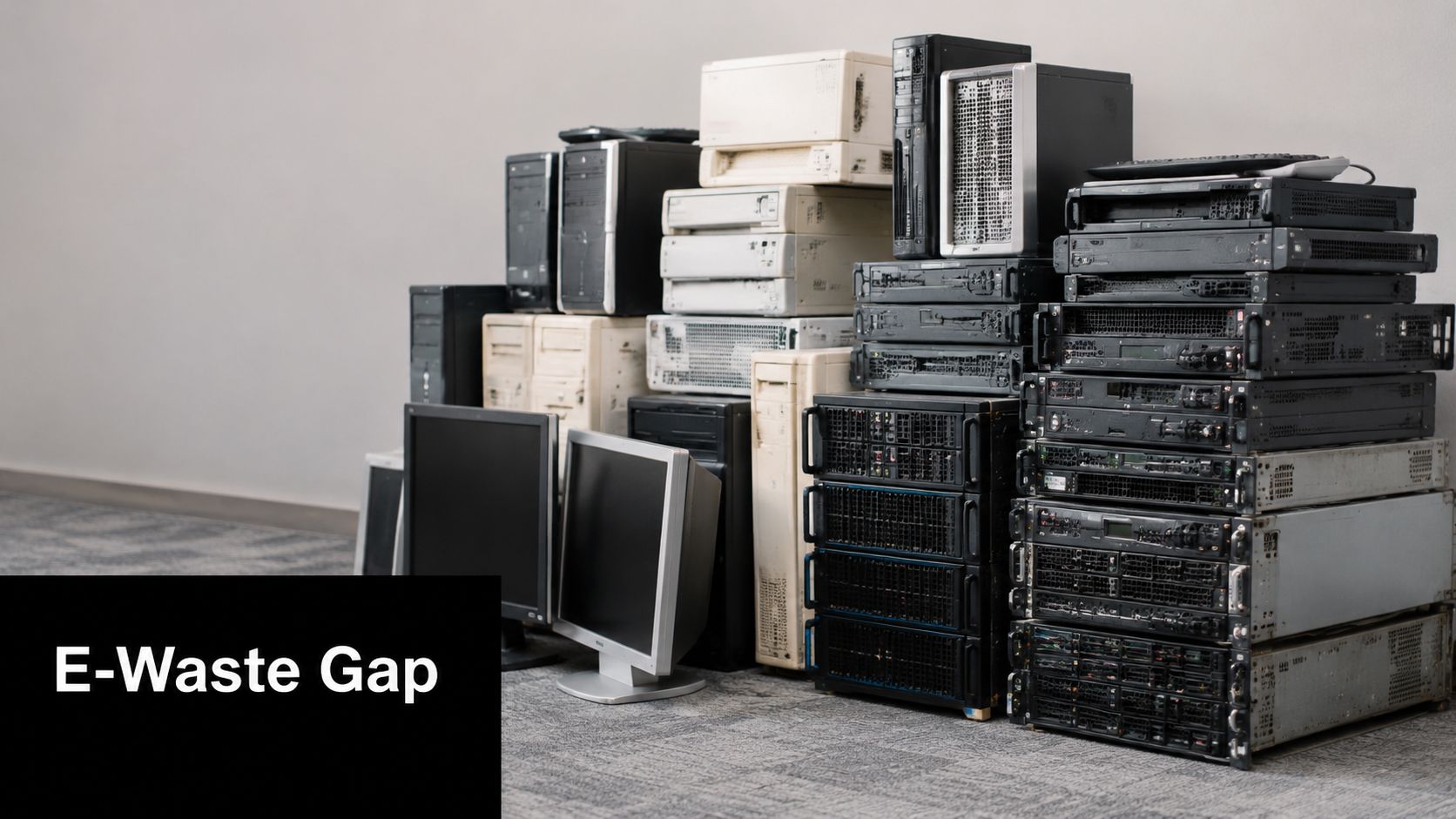
Public discussion around the station already points to that service gap. The town's transfer station is described as self-funding through fees, but there's also a recognized lack of clear service coverage for electronics, surplus office equipment, and reusable goods in the station's basic rules, as noted in this Boxborough reuse and waste-diversion discussion.
That matters because “not fully addressed” is exactly where business risk lives.
A few retired household items are manageable. A cart full of office laptops, phones, docking stations, and backup devices is different. Once a load contains assets with stored information or possible reuse value, disposal decisions need more than a resident sticker and a trip to Codman Hill Road.
What a business actually needs
A company disposing of electronics usually needs several things the transfer station model doesn't promise:
- Secure data destruction: Hard drives, solid-state drives, and embedded storage must be wiped or destroyed under a documented process.
- Pickup and logistics: Offices often need palletization, scheduled collection, or coordinated removal during a move or refresh.
- Asset tracking: IT managers need to know what left the building and where it went.
- Reporting: Sustainability teams and operations leaders often need records for internal policy, customer expectations, or audit readiness.
A municipal site isn't designed to be an extension of your IT asset disposition workflow. That's not a criticism. It's outside its job description.
The hidden cost of using the wrong channel
The immediate temptation is convenience. Someone loads equipment into a vehicle, gets it out of the office, and the space looks clean by lunchtime. But business disposal isn't finished just because the room is empty.
The real endpoint isn't “equipment removed.” It's “equipment handled in a way the business can defend later.”
That's why companies should review the environmental and legal impacts of improper commercial e-waste disposal before treating old hardware like surplus junk. The operational trade-off is simple. A public transfer station is convenient for municipal waste. It isn't built to stand in for secure ITAD, product destruction, medical equipment disposal planning, or data-bearing asset retirement.
Reworx Recycling A Secure Partner for IT Asset Disposition
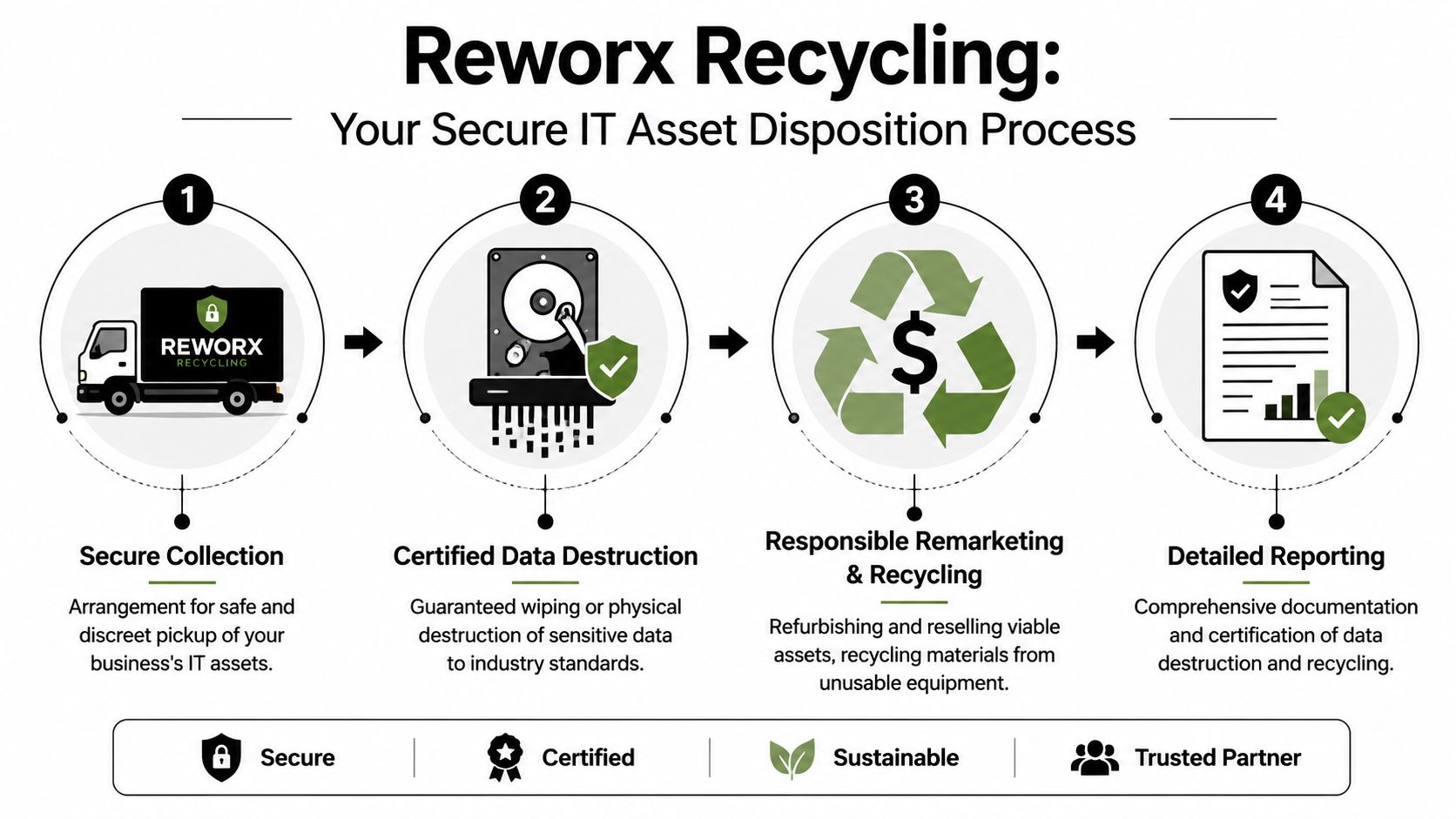
When Boxborough companies need to dispose of technology responsibly, they need a service model that starts where the transfer station stops. That means chain of custody, secure data destruction, computer recycling, and a clear path for reuse or responsible material recovery.
What a professional ITAD partner should cover
A business-ready electronics recycling partner should handle more than drop-off. The process should fit office realities such as staff turnover, relocations, data center decommissioning, and facility cleanouts.
Here's the benchmark I use when advising organizations:
| Business need | What to look for |
|---|---|
| Data security | Documented wiping or physical destruction for data-bearing devices |
| Logistics | Pickup options, containerization, and organized removal from active workplaces |
| Sustainability | Reuse first when appropriate, then responsible recycling for non-repairable equipment |
| Documentation | Asset lists, destruction records, and recycling reporting |
| Social value | Donation-based recycling or community reuse pathways when equipment still has life left |
A company that only “takes electronics” may not cover all of that. For business use, the process has to be operationally clean.
Where donation-based recycling fits
Not every retired asset is junk. Many organizations have laptops, monitors, and peripherals that no longer fit their current standards but still have useful life. That opens the door to donation-based recycling and broader corporate donation programs, especially for schools, nonprofits, and digital inclusion efforts.
That reuse layer is often missing in municipal disposal systems. A transfer station focuses on site operations and waste control. A specialized partner can evaluate whether equipment belongs in refurbishment, redeployment, resale, parts recovery, or end-of-life recycling.
That's also why social enterprise recycling matters. It gives companies a way to align office cleanouts and laptop disposal with community impact instead of treating every retired device as scrap.
A practical fit for Boxborough-area businesses
For organizations dealing with office cleanouts, secure data destruction, product destruction, or IT equipment disposal, Reworx Recycling is one example of a provider built for that specialized workflow. Its service model includes electronics recycling, business pickups, hard drive shredding, and IT asset disposition support, which maps far more closely to business needs than a municipal transfer station does. If your team needs a clearer framework, this overview of IT asset disposition and how the process works is a useful reference.
The practical advantage isn't just that equipment leaves the building. It's that the business has a defined process for what happens next.
A good ITAD process separates equipment into categories before pickup. Reuse candidates, data-bearing assets, damaged devices, and specialty equipment shouldn't all move through the same lane.
That distinction matters for more than standard computers. The same planning logic applies to medical equipment disposal, laboratory equipment disposal, and mixed loads from a facility cleanout. Some items may be suitable for refurbishment. Others may require destruction. Others still may need handling that protects both data and environmental outcomes.
For Boxborough business owners, that creates a sensible division of labor. The town system handles the municipal side. A dedicated ITAD and electronics recycling partner handles the business technology side.
Create Your Sustainable IT Disposal Plan Today
The smart move isn't choosing between the Boxborough transfer station and a business electronics recycler as if they do the same job. They don't.
Use the transfer station for what it is designed to do well. Use a specialized process for company devices, storage media, surplus office equipment, and any load that touches security or compliance. That two-track approach is cleaner for operations and easier to defend later.
A strong disposal policy usually starts with broader IT asset management discipline. When a business tracks what it owns, where it is, and when it leaves service, end-of-life decisions get much easier. From there, the next practical step is to formalize pickup, data destruction, and downstream handling through an internal ITAD strategy framework for retiring business equipment.
If your Boxborough company is planning a laptop refresh, office move, data center decommissioning, or cleanout of stored equipment, don't wait until old devices become a storage-room problem. Build the disposal process before the next upgrade starts.
If your organization needs a practical path for electronics recycling, secure data destruction, donation-based recycling, or a full office cleanout, contact Reworx Recycling to discuss pickup options, responsible IT equipment disposal, and partnership opportunities that keep usable technology in circulation while protecting your business.