A Mesa IT manager opens a storage room after a technology refresh and finds aging laptops, retired servers, tangled networking equipment, displays, UPS units, and hard drives with no reliable record of what happened to them. The equipment may look obsolete, but the data, asset ownership questions, and downstream liabilities haven't disappeared.
That situation is common among small and mid-sized businesses, schools, healthcare organizations, public agencies, and multi-site companies. ITAD Services in Mesa AZ should address more than pickup. A credible program should control the asset from decommissioning through final disposition, document every handoff, protect data, and show how reusable equipment and residual materials were managed.
The Reality of Hardware Retirement in Mesa
A storage closet full of retired equipment usually reflects several unfinished decisions. Someone needs to determine which laptops can be reused, which servers contain sensitive information, which displays belong to a leasing company, and which hard drives require destruction rather than resale. Meanwhile, facilities teams want the space cleared, finance wants asset records reconciled, and security wants evidence that no data-bearing device left the building without authorization.
Basic disposal creates gaps precisely where responsibility changes hands. A truck may collect mixed electronics, but a generic receipt won't tell an auditor which serial-numbered laptop went to testing, which drive was destroyed, or which server entered a recycling stream. It also won't resolve whether a device was remarketed, recycled, donated, or transferred to another processing partner.
Practical rule: If your vendor can't connect the physical asset to a final disposition record, you don't have a complete ITAD process. You have a pickup.
Mesa organizations face a particularly practical version of this problem because office technology, healthcare equipment, education hardware, and commercial facilities often retire equipment on different schedules. One department may send laptops to a storage room, another may replace network switches during a site project, and a facilities contractor may remove copiers or UPS units during an office cleanout. Without one controlled workflow, equipment becomes difficult to locate and harder to defend during an internal review.
IT asset disposition, or ITAD, treats retirement as a managed operational function. The service can include inventory, secure transport, data sanitization, testing, refurbishment, resale, recycling, product destruction, and reporting. That broader approach matters for businesses that need to balance security with recovery value and sustainability.
The market context reinforces that ITAD isn't a niche junk-removal category. One estimate places the global ITAD market at about USD 17.5 billion in 2025, with a projection of USD 18.6 billion in 2026 and USD 40.1 billion by 2035, at a projected 8.9% CAGR. The same source places the U.S. market at USD 5.3 billion in 2025, up from USD 5.0 billion in 2024. These figures are reported in the global IT asset disposition market overview.
For a Mesa business, the takeaway isn't that every retirement project needs an elaborate enterprise contract. The point is that hardware retirement has become a repeatable discipline with established logistics, security, recovery, and environmental expectations. A local electronics recycling and IT equipment disposal partner should help you select the controls that fit the sensitivity, volume, and destination of your equipment.
Organizations starting with a local assessment can review electronics recycling in Mesa as part of that planning process. The right first step is to inventory the problem, not to move it out of sight.
Core ITAD Services for Local Organizations
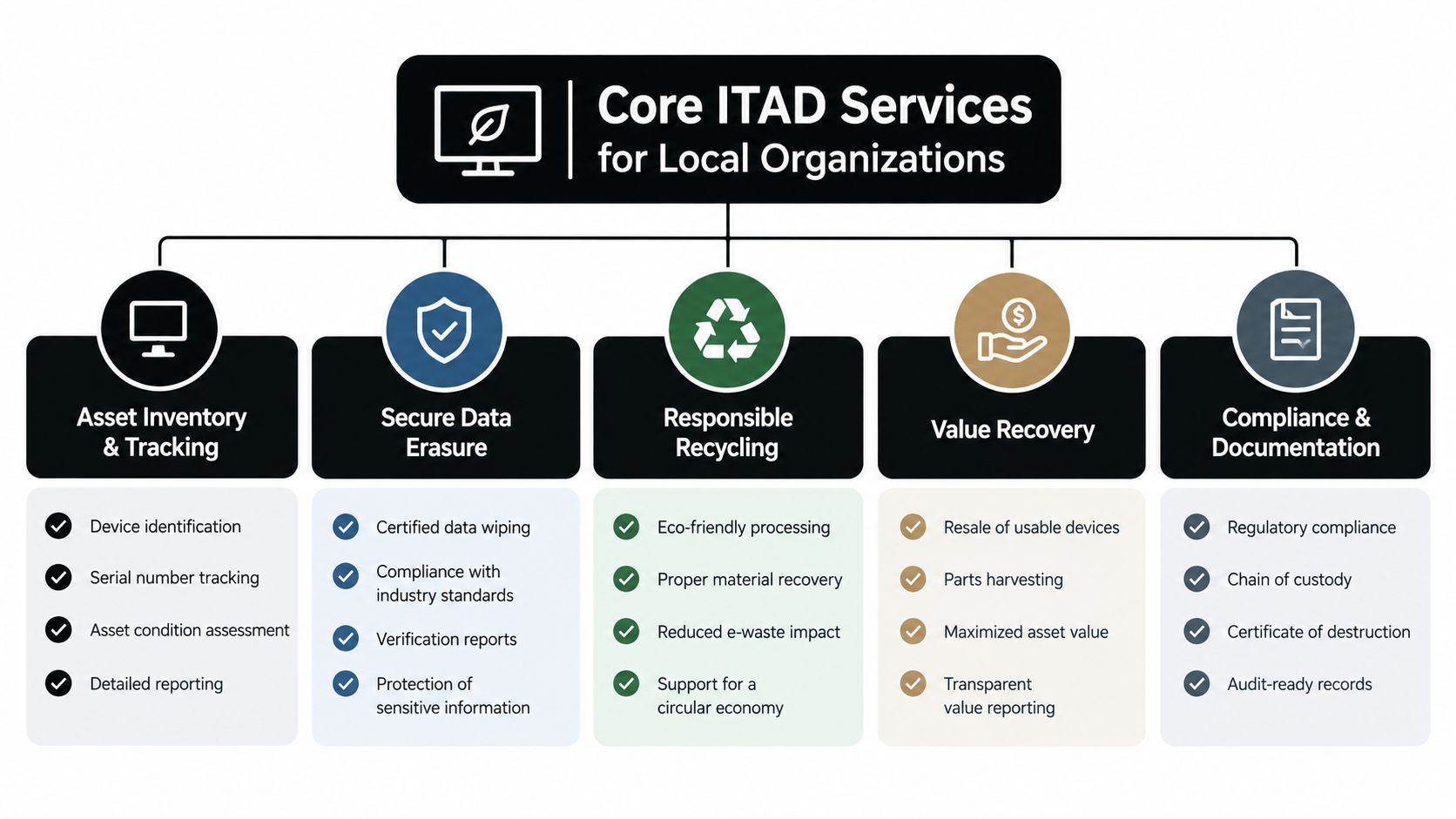
A mature ITAD program separates four activities that basic pickup services often blend together: control, security, recovery, and recycling. That distinction helps a Mesa procurement team compare vendors without paying for features that don't apply or overlooking controls that do.
Basic collection versus managed disposition
A basic recycler may accept computers, monitors, printers, and miscellaneous electronics at a drop-off point or through a scheduled pickup. That can work for non-sensitive material that has already been separated and documented internally. It doesn't automatically provide serialized tracking, data destruction evidence, remarketing controls, or downstream processing proof.
A managed ITAD engagement usually begins before the truck arrives. The provider helps define the equipment scope, prepares a manifest, secures the load, records the assets, and assigns a final pathway to each category. That pathway may include reuse, refurbishment, buyback, recycling, or product destruction.
For Mesa and Maricopa County organizations, route-based business pickups commonly cover the Phoenix metro area and can include desktops, laptops, servers, displays, networking gear, UPS units, hard drives, SSDs, and backup tapes. Route consolidation lowers per-unit handling cost and helps providers sort mixed hardware streams efficiently, as described in this Phoenix-area electronics recycling guidance for financial services.
Matching service depth to the project
A small office cleanout may need scheduled pickup, inventory, secure data destruction, and recycling certificates. A multi-site refresh may also require location-level manifests, serialized chain-of-custody records, secure containers, coordinated loading, and reconciliation reporting. Data center decommissioning adds rack equipment, storage arrays, servers, cables, backup media, and the need to preserve a precise relationship between equipment removed from each area and its final disposition.
The provider should also explain how it tests reusable equipment. Testing and refurbishment can recover value from functional laptops, desktops, servers, and networking gear, while damaged or obsolete devices move into sustainable recycling. A buyback or remarketing program can offset some service expense, but only when the vendor documents what was accepted, what value was assigned, and what happened after resale.
- Inventory control: Record make, model, asset identifier, serial number, location, and disposition status.
- Secure logistics: Use scheduled pickup routes, controlled loading, and transport procedures that reduce loss during transfer.
- Data protection: Apply an approved sanitization or destruction method to every data-bearing device.
- Recovery and reuse: Test eligible equipment and separate resale, donation, and recycling pathways.
- Downstream documentation: Provide records that show final processing rather than stopping at the first transfer.
SMEs shouldn't assume that chain-of-custody documentation is reserved for large enterprises. Industry coverage describes ITAD as an integrated service combining collection, reverse logistics, testing, refurbishment, resale, recycling, and compliance reporting, with SMEs identified as a fast-growing customer segment. The IT asset disposition market analysis also highlights the buyer's need for inventory controls, certified data destruction, chain-of-custody documentation, and recycling certificates.
Navigating Arizona Regulatory and Compliance Requirements
Arizona's framework doesn't operate as a mandatory statewide landfill-ban system for electronics. The state uses a combination of voluntary recycling and manufacturer responsibility rules, while its electronics legislation requires manufacturer plans to support environmentally sound collection, transportation, and recycling. The Arizona legislative text for SB 1357 provides the relevant statutory context.
A 2026 Arizona legislative bill would move the system toward more formal statewide participation. Under the bill, manufacturers of covered electronic devices would register annually beginning January 1, 2027, submit a recycling plan, provide environmentally sound collection and recycling, and maintain convenient service in every county. The bill also calls for at least one collection site in any city with 50,000 or more residents. Those dates and requirements are legislative provisions and should be monitored for changes before a business treats them as final obligations.
What the direction means for Mesa buyers
The most important business impact is operational rather than theoretical. As statewide expectations become more structured, organizations will face stronger pressure to show how covered electronics were collected, transported, recycled, or destroyed. A vendor's ability to produce records becomes part of your own compliance posture.
The bill also states that participating manufacturer programs or collectors may not charge covered entities for collection, transportation, or recycling of covered devices. That provision could affect how ITAD providers structure services for Mesa and the broader Phoenix metro area, although buyers should confirm the status and implementation details of any legislation before relying on it in a contract.
Use a practical compliance checklist:
- Define the equipment scope. Separate data-bearing devices, displays, networking equipment, medical equipment, batteries, and materials that may require special handling.
- Assign internal ownership. IT, facilities, legal, procurement, security, and sustainability teams should agree on who approves release and who receives the final records.
- Require documented handoff. The pickup manifest should identify the assets or categories transferred and the responsible parties.
- Specify final evidence. Ask for serialized Certificates of Destruction, recycling certificates, resale records, or other disposition reports that match the project.
- Review downstream controls. Understand whether the provider processes equipment directly or uses downstream recyclers and remarketing partners.
A documented program also supports corporate sustainability goals. Sustainable recycling isn't a statement that equipment was kept out of a dumpster. It means the organization can explain which assets were reused, donated, recycled, or destroyed, and can retain evidence for procurement, governance, and environmental reporting.
Businesses looking for a statewide service framework can review Arizona electronics recycling services while confirming the legal requirements that apply to their own equipment and industry.
The Step-by-Step ITAD Process and Chain of Custody
Chain of custody is the bridge between a pickup and an audit-ready disposition record. It answers a simple question: who had control of each asset at every stage? Without that answer, even an honest recycling outcome can leave the original owner unable to prove what happened to a particular laptop, drive, or server.
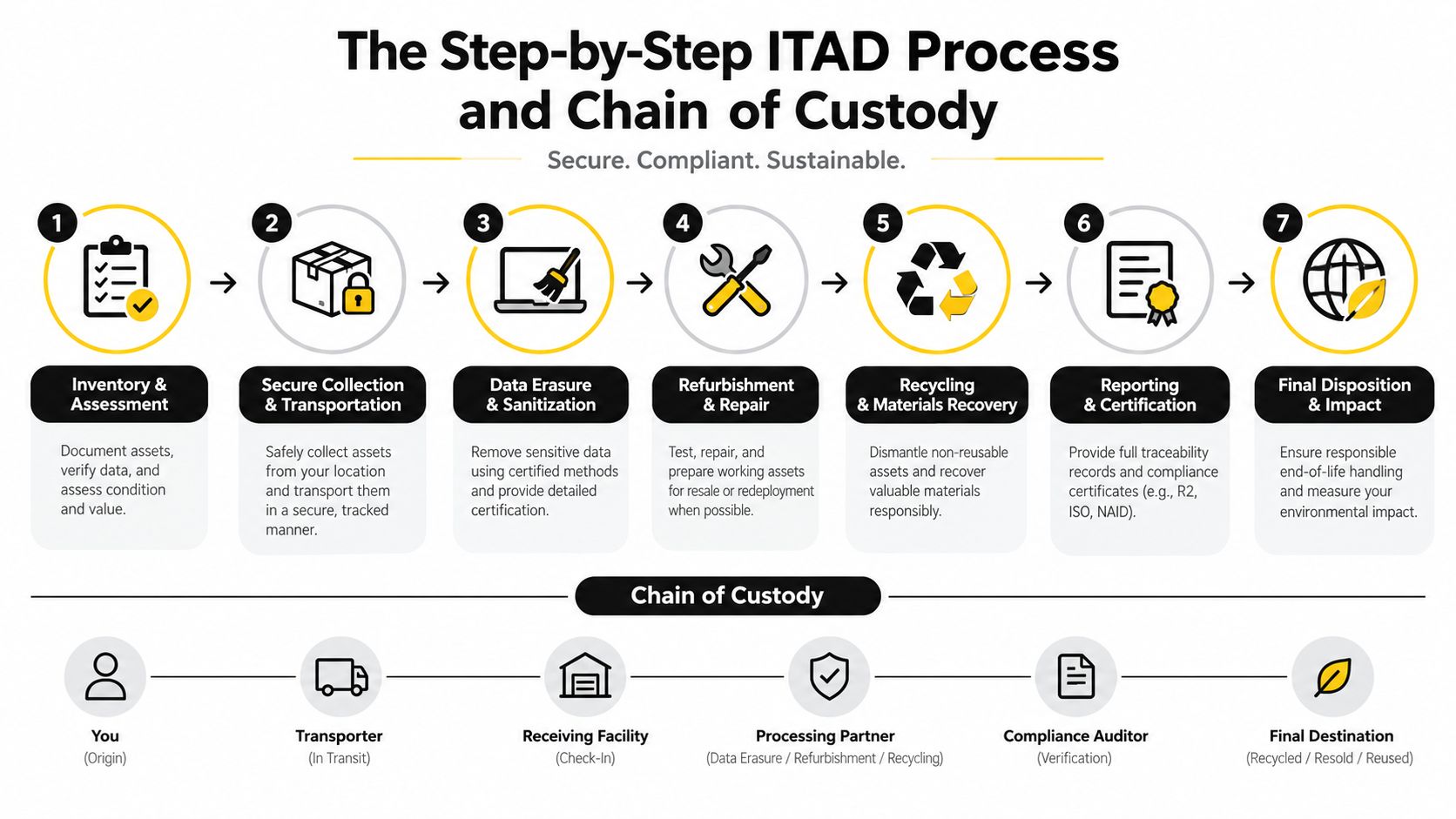
From decommissioning to pickup
Start with an approved asset list. The list should identify the equipment being retired, the business unit or site, the responsible contact, and whether the device contains storage media. Don't rely only on a room count or pallet description when the equipment carries regulated, confidential, or proprietary data.
At pickup, the provider should reconcile the physical load with the manifest. Secure containers, controlled loading, and a signed transfer record reduce attribution risk between your facility and the vendor's receiving location. Route-based collection is useful here because mixed hardware can be consolidated and sorted efficiently, but route efficiency doesn't replace asset-level accountability.
A server may move through the process like this:
- Release: The IT team removes the server from production, records its identifiers, and approves it for disposition.
- Manifest: The provider records the serial number, equipment type, origin site, and intended handling category.
- Handoff: Staff load the server under controlled conditions and document the transfer.
- Transport: The asset travels to the processing location with the manifest and custody record.
- Intake: The receiving team scans and reconciles the server against the pickup documentation.
- Disposition: The server is sanitized, destroyed, refurbished, resold, donated, or recycled according to the approved pathway.
- Reporting: The provider returns the final evidence, including a serialized Certificate of Destruction where destruction occurred.
The records that close the gap
The technical baseline for an audit-ready program is chain-of-custody tracking paired with NIST 800-88 sanitization and a serialized Certificate of Destruction for each device. This combination supports office, data center, and multi-site projects because it ties the action taken to the specific asset rather than to a generalized batch.
The National Institute of Standards and Technology's media-sanitization guidance requires documentation of who processed the asset, which method was used, and which specific device was handled. A practical documentation package should therefore include the pickup manifest, asset reconciliation, transfer record, sanitization or destruction result, and downstream disposition evidence when applicable.
A certificate that says only “all equipment destroyed” may confirm a service category, but it doesn't prove what happened to the missing laptop in your inventory.
Ask vendors to show a sample chain-of-custody documentation package before signing. The sample should make clear whether the provider can report by serial number, site, department, disposition type, and destruction method.
Security Standards and Data Destruction Protocols
Deleting files, emptying a recycle bin, or resetting a laptop isn't a complete business data-destruction policy. The method must match the media, the sensitivity of the information, and the planned destination of the device. A drive that remains inside a controlled environment may follow a different path from one leaving the organization for resale or recycling.
NIST SP 800-88 Rev. 2 is the relevant media-sanitization benchmark referenced by major ITAD sources. It defines three levels, Clear, Purge, and Destroy, and requires documentation of the person, method, and specific device processed. The NIST SP 800-88 overview for IT asset disposition explains how the standard informs vendor processes.
Choosing the right method
Clear uses standard read and write commands to remove information from accessible storage areas. It may fit a controlled internal reuse scenario, but organizations should be cautious about using it when the device will leave their custody.
Purge applies a stronger logical or physical technique intended to make recovery impractical. Depending on the media, that can include validated software overwriting, cryptographic erasure, or degaussing. Degaussing applies to magnetic media such as traditional hard disk drives and some backup tapes. It isn't an appropriate method for SSDs or flash storage.
Destroy physically renders the media unusable through methods such as shredding or crushing. It provides the most definitive outcome for highly sensitive information, failed drives, damaged media, and equipment whose history can't be verified.
| Sanitization Level | Target Media | Verification Requirement |
|---|---|---|
| Clear | Media suitable for controlled internal reuse | Record the specific device, method, responsible technician, and result |
| Purge | Functional media leaving controlled reuse, including applicable HDDs, SSDs, or encrypted media | Document the approved technique, device identity, operator, and verification outcome |
| Destroy | Media requiring irreversible physical disposition, including failed or high-sensitivity devices | Record the destruction method, device identity, responsible technician, and Certificate of Destruction |
Match the protocol to the risk
A Mesa healthcare, finance, government, or education organization may need different treatment for standard laptops, SSDs, servers, and backup tapes. A mixed-media project often benefits from a decision matrix approved before collection, rather than allowing technicians to choose methods informally after equipment arrives.
Secure data destruction can include software overwriting, cryptographic erasure, degaussing, and physical shredding. The vendor should identify which method applies to each media category and return serial-specific evidence. For a service overview, review secure data destruction services and compare the documentation against your internal data classification policy.
Evaluating Vendors and Understanding Cost Factors
The lowest pickup quote isn't necessarily the lowest-cost ITAD option. It may exclude sorting, serial-number capture, data destruction, secure storage, certificates, downstream reporting, or liability provisions. Those omissions often surface later, when the IT team needs evidence and discovers that the original receipt can't support an audit or an asset reconciliation.
A better comparison separates price, recovered value, risk reduction, and administrative effort. Ask each provider to price the same scope, then identify which services are included and which trigger additional charges. Compare pickup, labor, containers, transportation, data sanitization, physical destruction, testing, resale, recycling, reporting, and downstream management as distinct line items.
A practical vendor matrix
| Evaluation area | Questions for the vendor | Why it matters |
|---|---|---|
| Asset control | Will you record serial numbers and reconcile the load at intake? | Prevents gaps between the internal inventory and the vendor report |
| Data security | Which NIST 800-88 method applies to each media type? | Connects the destruction action to the risk profile |
| Documentation | Can you provide a sample serialized Certificate of Destruction? | Shows whether the evidence will support an audit |
| Logistics | How are assets secured during pickup and transport? | Reduces exposure during the custody transfer |
| Downstream handling | Who receives recyclable or reusable materials after intake? | Clarifies the final processing chain |
| Recovery value | Do you test, refurbish, remarket, or buy back eligible equipment? | May recover value from functional assets |
| Contract protection | When does liability transfer, and what insurance applies? | Defines responsibility if equipment is lost or mishandled |
A vendor that offers resale should explain how it protects data before remarketing. It should also separate reusable assets from material that requires recycling or product destruction. A higher recovery return isn't useful if the vendor can't show that the device was sanitized before it changed ownership.
Industry coverage describes ITAD as a bundled service that can include asset collection, reverse logistics, testing, refurbishment, resale, recycling, and compliance reporting. That model is especially relevant to SMEs, which may need audit-ready controls without constructing an internal processing operation. The trade-off is straightforward: more service depth can add cost, but an incomplete record can create administrative, security, and legal exposure that a low quote never captured.
For Mesa procurement teams, the ITAD vendor selection criteria can help structure an RFP. Require sample reports, clarify downstream processing, and ask how the provider handles equipment that arrives without a readable asset tag or with damaged storage media.
Next Steps for Procurement and Partnering with Reworx Recycling
Start with an internal hardware audit, not a vendor call. List each facility, department, equipment type, approximate condition, storage media, ownership status, and preferred disposition. Separate ordinary electronics recycling from projects that involve data center decommissioning, medical equipment disposal, laboratory equipment disposal, laptop disposal, office cleanout, facility cleanout, or product destruction.
Then prepare a short procurement package:
- Project scope: Describe sites, equipment categories, access requirements, and target pickup conditions.
- Security rules: Identify which assets require sanitization, physical destruction, witnessed handling, or special documentation.
- Reporting needs: Request serial-level manifests, Certificates of Destruction, recycling records, and recovery summaries.
- Commercial terms: Ask about pickup charges, buyback treatment, labor, transport, downstream partners, and liability transfer.
- Mission requirements: Include sustainability, donation, digital inclusion, and workforce development goals where they matter to your organization.
Reworx Recycling is a donation-based electronics recycling and IT asset disposition social enterprise that supports business pickups, equipment decommissioning, secure hard drive shredding, data destruction, equipment recovery, and responsible recycling. Its donation-based model can connect usable technology with community needs while supporting digital inclusion and workforce development. For a Mesa organization, that creates a way to combine secure retirement controls with a visible social and environmental purpose.
The right ITAD partner won't ask you to choose between compliance and impact. It should give your IT, legal, procurement, facilities, and sustainability teams a shared record of what happened to each asset and a practical path for the next technology refresh.
Reworx Recycling helps Mesa businesses manage electronics recycling, secure data destruction, equipment pickups, ITAD projects, and responsible donation pathways with documented handling from collection through final disposition. Visit Reworx Recycling to start a pickup conversation, request project guidance, or explore a partnership for your next office cleanout or hardware retirement.