If you're lining up a load of retired laptops, a few rack servers, and a stack of battery-powered peripherals, the hard part usually isn't getting the pallets out the door. The hard part is proving that every label, document, handoff, and destination matches the rule set that applies to that shipment. In transportation compliance, the shipment itself is only one piece, because the exposure comes from how the load was classified, who touched it, and where the records ended up.
For electronics, that challenge gets messy fast. A single outbound move can touch DOT hazmat rules, EPA waste handling expectations, and state e-waste transport requirements at the same time. If the equipment contains lithium batteries, mixed components, or data-bearing devices, the paperwork trail matters as much as the truck.
Why Electronics Transport Is a Compliance Minefield
The first mistake is treating electronics transport like a normal carrier booking. A bulk pickup of decommissioned laptops can look routine on the operations calendar, but once the load contains batteries, mixed-use components, or devices headed for recycling rather than resale, the compliance picture changes. The shipper still owns the risk, even if a third-party carrier physically moves the freight.

Where the trouble starts
The overlap is what catches people off guard. One department thinks in terms of asset retirement, another thinks in terms of waste handling, and the carrier thinks in terms of pickup timing and route efficiency. Those are different lenses, and they do not automatically produce a compliant shipment.
In practice, electronics often sit near the edge of multiple rule sets. A device may be moving as reusable equipment, universal waste, or regulated material depending on its condition, content, and destination. That means your internal classification has to happen before the pallet gets sealed, not after someone asks for a manifest.
Practical rule: if your team can't explain why a load is being shipped, what it contains, and who accepts it on the other end, the shipment isn't ready.
The most reliable way to reduce confusion is to separate intent from assumption. If a load is going to a downstream processor, recycler, or refurbisher, document the intended pathway and the condition of the items before they leave the site. That's also where a clear labeled workflow like UN 3481 labeling guidance becomes useful, because battery-related shipments need disciplined identification from the start.
The Regulatory Landscape for Electronics and E-Waste Transport
Electronics transport isn't governed by one neat rulebook. It runs through three layers that often overlap in the same shipment, and the safest programs treat those layers as connected rather than separate. The result is a more controlled handoff between shipper, carrier, and receiver.
DOT, EPA, and state rules do different jobs
DOT rules focus on how regulated material moves on public roads, with special attention to lithium-ion batteries, packaging, labeling, and safe conveyance. EPA universal waste rules are more about managing certain waste streams in a way that still protects handling integrity, labeling, and destination tracking. State rules can tighten the process further with landfill bans, registration requirements, and added manifest expectations.
That's why two shipments that look identical to the warehouse team may not be treated the same way by the compliance team. A load moving across state lines can satisfy federal baseline requirements and still trigger extra obligations at the destination. For that reason, route planning is part of compliance, not just logistics.
The key operational point is that federal rules do not erase state variation. A team can't rely on one national SOP if it ships to facilities in different jurisdictions. The policies need enough flexibility to account for destination-specific requirements without letting local exceptions break the whole process.
For a solid external primer on the logistics side of regulatory discipline, the compliance workflows for logistics teams resource is useful because it frames control points the same way transportation managers do, at pickup, transit, and receipt. That mindset fits electronics transport well.
If you need a baseline internal model for universal waste handling, universal waste guidance is the right place to anchor the operational side of the conversation.
Compliance Obligations for Shippers and Receivers
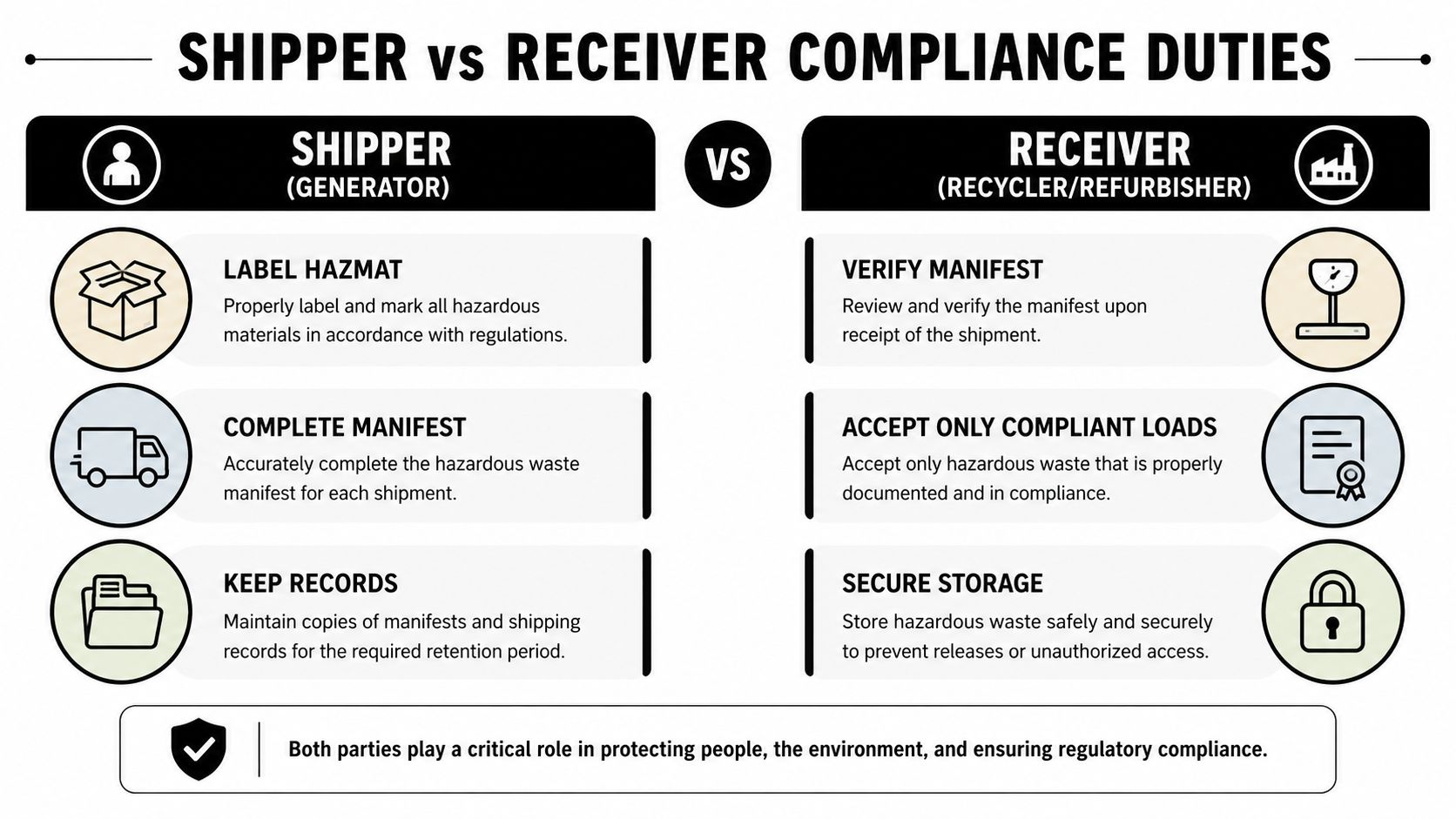
The shipper and the receiver do not share identical duties, and that distinction matters when a shipment goes sideways. The generator has to classify, package, and document the load correctly before it leaves. The receiver has to confirm what arrived, maintain its own records, and make sure the material goes where the paperwork says it should.
What the shipper has to get right
Shippers need to classify the load before pickup, not after a carrier starts loading pallets. That means checking whether the items are reusable assets, regulated waste, or a mixed load that needs special handling. It also means matching packaging to the item type, especially where batteries or fragile electronics can create a transport hazard if boxed carelessly.
Shipping papers need to tell the truth in plain terms. A carrier can't correct a bad description once the load is already in motion, and a downstream recycler can't fix a missing identifier retroactively. The safer contract language names who prepares the documents, who confirms accuracy, and who flags exceptions before dispatch.
What the receiver has to confirm
Receivers should verify what arrived against what was expected. If the shipment is being accepted as universal waste or for refurbishment, the receiving team needs a process for inspection, entry into records, and secure staging. If the load is off-spec, the receiver needs a documented refusal or exception path rather than informal phone calls.
Shared custody is where many programs get weak. The best programs track transfer logs, signoff records, and downstream acceptance in a way that survives an audit and a personnel change. That's where chain of custody documentation becomes a control, not a file folder.
Keep the receiving dock just as disciplined as the shipping dock. If the receiver can't prove what it took in, the shipper's paperwork won't save the chain.
The practical takeaway is simple. Write the contract so the documentation burden is explicit, then make the receiving checklist match that contract. If both sides use the same naming conventions and exception process, disputes get smaller and audits go faster.
Practical Controls and Compliance Checklist
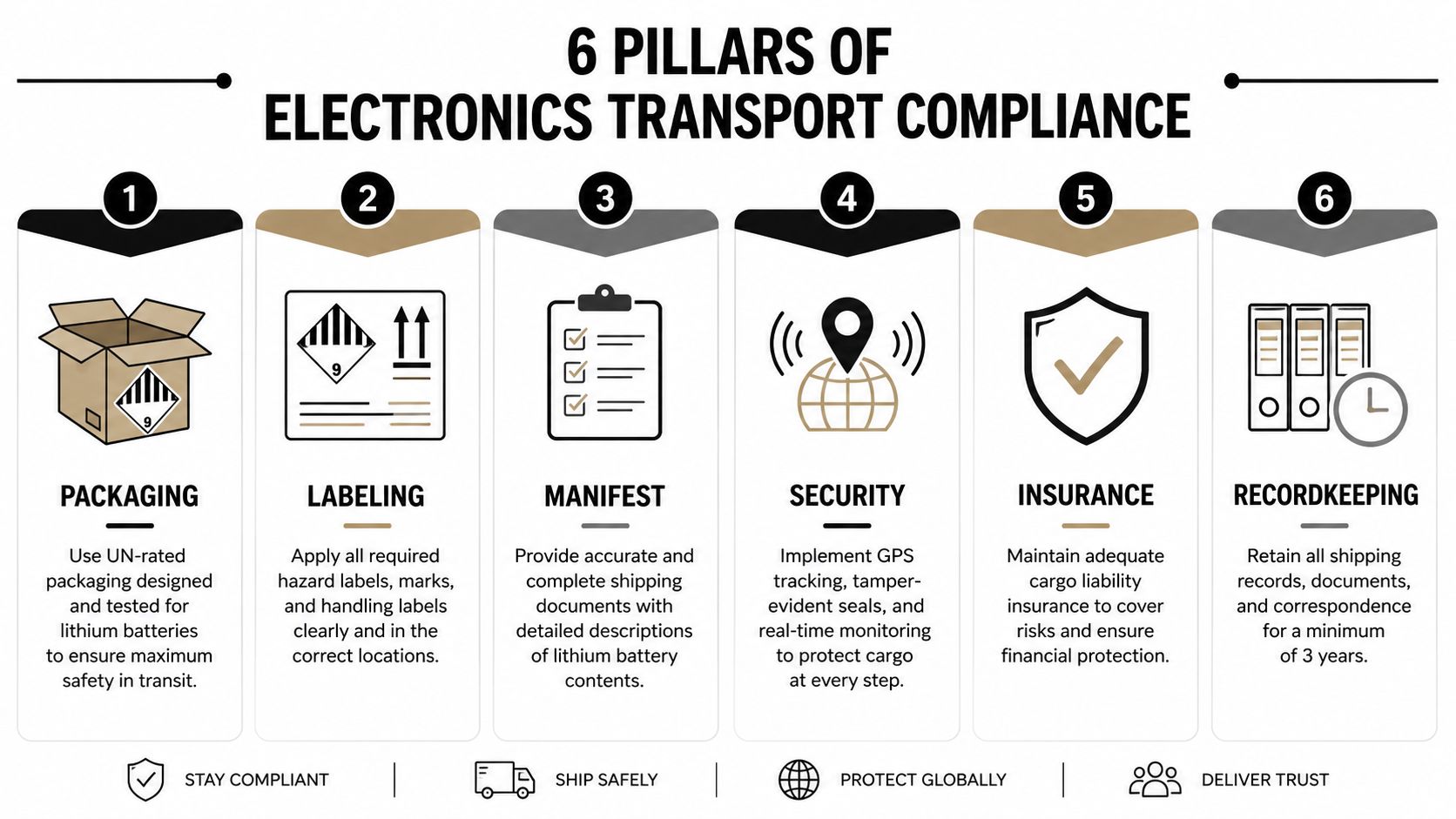
Most failures in electronics transport are boring, not dramatic. Someone used the wrong box, the label was incomplete, a carrier wasn't vetted, or a file was never retained after pickup. The fix is a control set that operators can repeat every time, even when volumes spike or personnel change.
Packaging and labeling
Use packaging that matches the condition of the equipment and the hazards it contains. Lithium batteries need stricter handling than boxed accessories, and anti-static materials are worth the effort when devices still carry sensitive internal components. Loose packing creates preventable damage, and damaged packaging creates avoidable questions during inspection.
Labeling has to be visible, consistent, and tied to the actual contents. If the load includes regulated material or universal waste, the markings can't be an afterthought on a handwritten sticker. Carrier drivers and receiving teams both use those marks as a first-pass verification tool.
Manifesting and records
Shipping papers need enough detail to identify the load, the origin, the destination, and the responsible parties. Don't build a process where the warehouse keeps one version and compliance keeps another. A single source of truth is the only version that survives a review.
For a more practical field reference, the My Safety Manager DOT checklist is a useful way to compare internal controls against standard DOT expectations. It's especially helpful if your team rotates among different shipment types and needs a fast review tool before release.
Training, carrier selection, and retention
Employees who package, sign, or release shipments need role-specific training, not a generic annual slide deck. The people handling the load should know what triggers escalation, who can approve exceptions, and when a shipment is not ready to move. Training matters because a clean process collapses fast when one person improvises.
Carrier selection should include proof of authority, insurance review, and a quick vetting of safety and compliance history. If a carrier can't explain how it handles regulated electronics, it probably shouldn't be on your approved list.
Operational standard: if a control can't be checked at pickup, it's not really a control.
If you want a ready internal format for building this out, compliance checklist template gives teams a starting structure for packaging, signoff, and record retention without rebuilding the process from scratch.
Penalties and State Nuances That Catch Shippers Off Guard
Compliance failures get expensive because they rarely stay inside one rule set. A bad shipment can trigger DOT issues on the road, waste-handling problems at receipt, and a state-specific violation once the load crosses a line that was never reviewed. That is why reactive cleanup costs more than the original control work.
Why enforcement risk differs by route
FMCSA enforcement data shows how active the roadside environment is. In 2022, FMCSA reported 573,211 traffic enforcement inspections and 2,879,966 driver inspections, which produced 1,094,979 driver violations. The agency's 2023 Pocket Guide also notes 5,340 fatal crashes involving large trucks and buses in 2021, which is why compliance programs focus on roadside inspections, driver qualification, and hours-of-service controls as core risk-management tools. Those figures show that inspections are not a rare edge case, they're part of the operating environment. FMCSA Pocket Guide 2023
The practical lesson is that enforcement intensity matters. FMCSA's Safety Measurement System uses roadside inspections, crash data, and investigation findings to target carriers through BASIC categories, so managers should care about violation density, not just inspection volume. If your internal controls don't reduce the specific weaknesses regulators use to prioritize intervention, the program isn't doing enough. FMCSA CSA system overview
State differences that change the playbook
| State | Landfill Ban | Registration Required | Additional Manifest Rules |
|---|---|---|---|
| California | Yes, stricter e-waste transport expectations are common | Often yes for applicable handlers | Yes, stricter tracking can apply |
| New York | Yes, electronics recycling restrictions are active | Yes for certain participants | Additional documentation may apply |
| Texas | Rules can add transport-specific obligations | Varies by handler type | Yes, unique manifest obligations can apply |
That table is the reason generic compliance manuals fall apart. Teams that ship nationwide need route-aware controls, because the same pallet may be low-risk in one place and documentation-heavy in another. When a single shipment crosses layers of regulation, the exposure compounds quickly.
A lot of operators only discover that during an audit or a rejected load. The cheaper move is to screen routes before the truck is booked, not after the paperwork is challenged.
How Reworx Recycling Reduces Transportation Compliance Risk
A good ITAD partner removes the weakest links in the chain. Instead of asking your internal team to guess at classification, packaging, handoff, and downstream handling, the partner can run those steps as part of the pickup workflow. That's a real compliance advantage, especially for multi-site organizations that don't want every location inventing its own process.
What a managed workflow should cover
A controlled pickup should include proper classification of the equipment, DOT-aware packaging where needed, accurate labels, and complete transfer documentation. It should also include carrier vetting, chain-of-custody tracking, and records that can be pulled later for audit support. Those are the same points where most DIY programs break.
That is where Reworx Recycling's reverse logistics approach fits naturally into the conversation. Reworx Recycling handles electronics recycling and IT asset disposition with pickup coordination, documentation-oriented handling, and secure logistics, which reduces the number of handoffs your internal team has to police.
For donations and reuse streams, the compliance logic changes a bit, but the documentation discipline still matters. Equipment headed for reuse often needs different treatment than pure waste, so the partner has to separate recovery pathways cleanly and preserve the records that prove what happened. That's a useful distinction for businesses balancing sustainability goals with audit readiness.
The practical value is not just convenience. It's fewer unknowns, fewer exceptions, and less risk that a site manager makes an off-label decision under pressure. If the partner can support multiple jurisdictions, the whole program gets easier to defend.
Your Next Steps for Compliant Electronics Transport
Start with a simple inventory of how electronics leave your sites today. Identify who classifies the load, who approves the pickup, what labels get used, and where the records go after the truck departs. Then compare that process against the checklist in the earlier section and mark every handoff that relies on memory.
After that, pressure-test your carrier and partner list. Ask whether they vet routing, verify documentation, preserve chain-of-custody records, and understand state-specific e-waste rules. If they can't answer those questions clearly, they're not ready for regulated electronics work.
The next step is to build one repeatable standard for all locations. That usually saves more time than trying to manage separate exceptions for every office, warehouse, or campus.
Reworx Recycling helps businesses manage electronics recycling, IT equipment disposal, and secure data destruction with transportation and documentation discipline that supports compliance at pickup and receipt. If your team needs a cleaner process for regulated electronics moves, visit Reworx Recycling to review options for pickups, donation-based recycling, and partner support for your next asset retirement project.