Your team probably has one. A locked storage room, a spare rack in the server closet, or a corner of the warehouse full of retired laptops, dead monitors, phones from the last mobile refresh, and a few servers nobody wants to touch because the drives were never wiped.
That pile isn't harmless. It's latent data exposure, stranded asset value, and an audit problem waiting for the wrong question from legal, finance, or a customer security review. Every month those devices sit there, resale value drops, chain of custody gets fuzzier, and the odds go up that someone treats business-grade hardware like office trash.
For business leaders, electronics recycling isn't a janitorial task anymore. It sits right in the overlap between IT asset disposition, secure data destruction, procurement discipline, and sustainability reporting. If you still treat it as an occasional cleanup project, you're almost certainly losing value and carrying avoidable risk.
The Storage Closet Full of Old Laptops
A familiar scene plays out after every refresh cycle. IT swaps out a batch of laptops, facilities finds temporary shelf space, and everyone agrees to “deal with it later.” Later usually turns into quarters, not weeks.
By then, nobody remembers which devices came from HR, which came from finance, which hard drives failed in the field, or which units still have resale potential. The problem stops being clutter. It becomes a control failure.
Why the closet is a business problem
A retired laptop can still hold credentials, cached files, browser sessions, customer data, payroll records, or regulated information. A dead machine is not a safe machine. If the storage process is informal, your disposal process is already weak.
There's a second problem most companies miss. Surplus hardware is a depreciating inventory class. If your team delays triage, you're shrinking recovery options before an ITAD partner ever sees the equipment. A clean, recent laptop fleet has one economics profile. A dusty, untracked pile with unknown drive status has another.
Practical rule: If a device has business data or residual market value, it shouldn't sit in unmanaged storage.
Disciplined intake matters. Teams that move quickly usually separate assets into three lanes: redeploy, remarket, and destroy. Teams that don't usually default to “scrap it all,” which is the most expensive lazy decision in the room.
What good looks like
A defensible program starts with inventory, data classification, and timing. You don't need fancy theory. You need a repeatable operating rule for end-of-life equipment, especially for assets like old laptop disposal for business fleets.
Ask three blunt questions:
- What is it worth now: Working laptops, phones, and newer network gear may still have reuse value.
- What data touched it: Finance, legal, healthcare, and customer-facing departments need tighter handling.
- Who owns disposition: If nobody owns the last mile, the pile keeps growing.
The companies that handle this well don't wait for spring cleaning. They treat electronics recycling like part of the asset lifecycle.
What Electronics Recycling Actually Covers
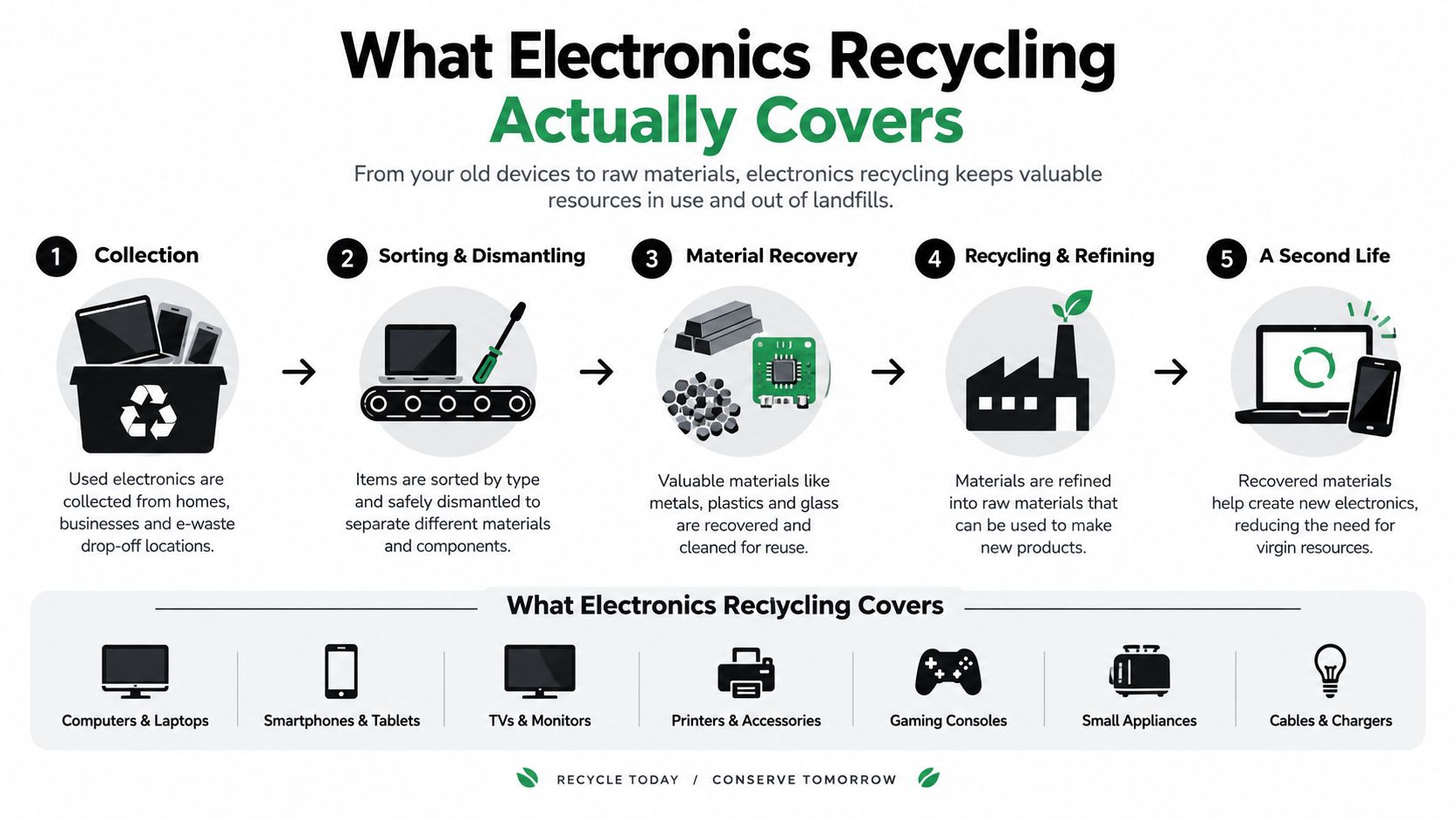
A common description of “electronics recycling” treats it as shorthand for hauling away old equipment. That's too narrow. In practice, it's the managed end-of-life handling of IT and electronic assets through one auditable chain.
A proper program links collection, transport, sanitization, reuse, and final materials recovery. Break any link and the whole process becomes harder to defend.
Collection and inventory
Start by identifying what's at end of life versus what can be redeployed internally. Every unit should be logged with an asset tag or serial number, device class, condition, and data sensitivity.
That sounds basic because it is. It's also where weak programs fail first. If you can't tell a wiped spare from a finance laptop with an intact drive, you don't have an electronics recycling process. You have accumulation.
For teams building the basics, this overview of what electronic waste recycling includes is a useful framing tool.
Secure transport and chain of custody
Once equipment leaves your office, your exposure doesn't magically disappear. You need documented custody from pickup through final disposition. That usually means sealed containers, pickup manifests, insured logistics, and a clear handoff record.
If a vendor is casual about transport, expect the same attitude downstream.
Data destruction
This is the point where IT and compliance need to pay attention. The National Institute of Standards and Technology defines media sanitization methods as clear, purge, and destroy, and states that destroy methods such as disintegrating, pulverizing, melting, and incinerating are designed to make media permanently unusable for data storage, according to NIST SP 800-88 Rev. 1.
That matters because not every asset needs the same treatment. Functioning drives may be sanitized for reuse. Failed drives, damaged media, and high-sensitivity assets usually belong in the destruction lane.
Sanitization is not one action. It's a decision tree based on media condition, data sensitivity, and intended downstream use.
Refurbishment and materials recovery
Working assets should be tested, wiped, repaired if economically sensible, and remarketed. That's where a lot of business value lives.
Non-reusable equipment moves into dismantling and commodity recovery. Boards, wiring, aluminum, steel, and batteries all require different handling. The point isn't to “recycle something.” The point is to know exactly what happened to each class of material.
Why It Matters for the Environment and for Data
A storage room full of retired laptops is not a sustainability footnote. It is a balance-sheet problem and a risk register problem sitting in the same pile.
In 2022, the world generated 62 billion kilograms of e-waste, or about 7.8 kilograms per person, and only 22.3%, or 13.8 billion kilograms, was formally collected and recycled in an environmentally sound manner, according to the 2024 Global E-waste Monitor. That tells you two things fast. Recovery systems are not keeping up, and any company that treats retired electronics as office junk is leaving value and control on the table.
Two risk buckets, one executive problem
| Risk Category | Source | Likely Consequence |
|---|---|---|
| Environmental | Unmanaged devices, informal handling, poor downstream controls | Hazardous components leave formal recovery channels, and recoverable metals never make it back into use |
| Data | Retired laptops, drives, phones, and servers without verified sanitization | Breach exposure, compliance scrutiny, and expensive legal review |
| Brand and governance | Weak documentation and unclear vendor oversight | Failed customer questionnaires, procurement delays, and weak sustainability reporting |
Treat these as one program, not two. The same device that contains copper, aluminum, lithium, and circuit boards may also contain customer files, credentials, HR records, or internal IP. If your process breaks at intake, transport, inventory, wipe verification, or downstream reporting, you absorb both kinds of damage at once.
The environmental case is simple. Electronics contain materials worth recovering, but they also contain batteries, boards, and other components that need controlled handling. Waste keeps growing faster than formal recovery, which means process quality matters more than collection slogans.
That is why smart sustainability teams look past tonnage. Pickup volume is easy to report and easy to misuse.
A review of environmental impacts in copper smelter recovery found that transport distance and electricity supply are major drivers, and that a 10% reduction in electricity use produced the largest benefit across most dominant impact categories in one thermodynamic life-cycle assessment, according to this smelter-focused LCA summary. For a business program, the implication is practical. Ask how assets are sorted, where they are sent, how far they travel, and which fractions are refurbished versus shredded. Those decisions affect both emissions and commodity recovery.
For local planning, many teams also use guides on the environmental impact of electronic waste to translate broad sustainability goals into operating rules for pickup, sorting, battery handling, and downstream accountability.
A weak recycler does not just reduce recovery. It can also create fresh environmental claims, audit gaps, and data exposure you did not have before pickup.
On the data side, the rule is even simpler. If you cannot prove what happened to the media, you still own the risk.
That is the standard to use internally. Do not ask whether assets left the building. Ask whether you can show chain of custody, sanitization status, final disposition, and value recovered by asset class. That is what turns electronics recycling from a green afterthought into a disciplined risk and value program.
Regulations and Certifications That Shape the Industry
U.S. electronics recycling compliance is a patchwork. That's annoying, but it's manageable if you stop looking for one magic rule and start checking the parts that create exposure.
At the federal level, some electronics components trigger specific handling rules. The U.S. EPA says it amended electronics regulations in 2006 to streamline recycling requirements for used CRTs and CRT glass when specific conditions are met, and it finalized CRT export rule revisions on June 18, 2014, as outlined on the EPA electronics stewardship regulations page. CRTs are older technology, but the principle still matters. Certain device categories carry specific obligations.
The U.S. Government Accountability Office also reported that since January 2007, exporters of CRTs for recycling must notify EPA at least 60 days before shipment and obtain the importing country's consent, under the GAO report on CRT export controls. Export controls are not a detail you want to discover after a shipment leaves.
What certification actually tells you
The EPA says there are currently only two accredited certification standards for electronics recyclers: the Responsible Recycling (R2) Standard and the e-Stewards Standard, both based on third-party auditing, according to the EPA overview of electronics recycling standards.
That's the baseline. Certification does not mean “trust blindly.” It means there's a real audit framework behind the claims.
| Standard | R2 (Responsible Recycling) | e-Stewards |
|---|---|---|
| Recognition | One of the two EPA-recognized accredited certification standards | One of the two EPA-recognized accredited certification standards |
| Core function | Third-party audited framework for safe recycling and management practices | Third-party audited framework for safe recycling and management practices |
| What buyers should request | Current certificate and scope document | Current certificate and scope document |
What to ask for before signing
Don't settle for a logo on a slide deck. Ask for:
- Current certificate: Verify it's active and applies to the facility handling your material.
- Scope document: Confirm the covered services match what you need, such as data-bearing devices, logistics, or dismantling.
- Audit trail expectations: Require documented downstream controls and sample reporting.
- Data handling language: Make sure contract language matches your sanitization requirements.
If you're screening vendors, a page on electronics recycling certification requirements can help your team build the right checklist.
Building the Business Case and ROI
Most companies still budget electronics recycling as a disposal line item. That's lazy accounting. A real program should be evaluated as value recovery plus risk reduction.
Here's the first hard fact finance teams should keep in mind. The 2022 e-waste stream contained about 31 billion kilograms of valuable metals worth around USD 91 billion, including USD 19 billion in copper and USD 15 billion in gold, while only about 1% of rare earth element demand is met by e-waste recycling, according to the ITU media release on the 2024 Global E-waste Monitor. End-of-life electronics are not just waste. They are a materials stream with real supply-chain relevance.
Where the return comes from
There are usually three recovery buckets:
- Reuse and resale: Working laptops, tablets, phones, and some network hardware may carry residual resale value if processed quickly and documented properly.
- Parts harvesting: Non-working assets can still contain usable screens, memory, power supplies, rails, processors, or specialty components.
- Commodity recovery: Boards, cabling, steel, aluminum, and precious-metal-bearing fractions still hold extractable value.
The trap is accepting a flat scrap quote for a mixed load. When vendors price everything by weight, you lose the upside on reusable assets and often get weak reporting in return.
The avoided costs matter more than most teams admit
The business case isn't just about what you recover. It's also about what you avoid:
- Storage drag: Old equipment consumes secured space and staff time.
- Internal handling cost: Every move, recount, and rebox adds labor.
- Breach exposure: Unverified data destruction leaves open-ended liability.
- Compliance friction: Customer due diligence gets harder when disposition records are thin.
- ESG reporting gaps: Sustainability claims are weaker when downstream documentation is vague.
Buyback value is nice. Defensible documentation is usually what wins internal approval.
A practical ROI model is simple. Start with the number of devices retired per quarter. Split them into remarketable, harvest-only, and scrap streams. Then compare current storage, handling, and ad hoc disposal practices against a formal process with serialized tracking and verified sanitization.
What a smarter approval memo includes
Strong internal proposals usually include:
- A clear asset inventory baseline.
- A timing rule for pickups after refresh events.
- Recovery terms by disposition type, not one blended scrap rate.
- Required documentation, including chain of custody and destruction certificates.
- A short risk statement tied to legal, procurement, and sustainability needs.
That's the difference between “please approve recycling spend” and “approve a controlled ITAD process that returns value and reduces exposure.”
Choosing an ITAD Partner You Can Trust
Vendor selection is where a lot of otherwise smart companies get careless. They compare pickup pricing, glance at a brochure, and assume the recycler owns the risk once the truck leaves. It doesn't work that way. If the downstream chain breaks, your company name is still attached to the assets.
The right way to think about an ITAD partner is simple. You are transferring custody, not responsibility. That's why procurement alone shouldn't run the decision.
What separates a competent partner from a risky one
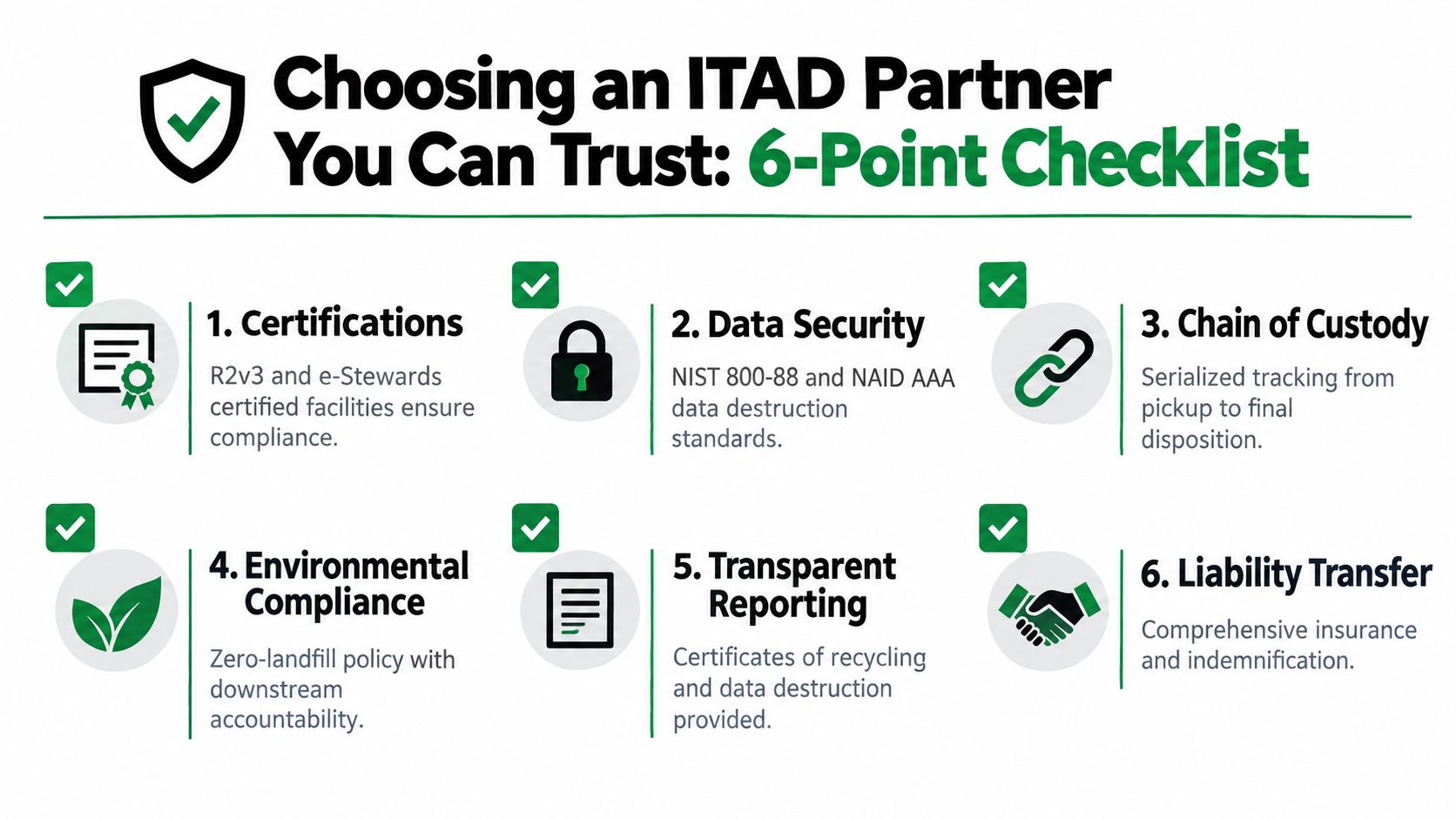
Use a checklist that forces proof, not marketing:
- Certification with scope: Ask for current R2 or e-Stewards documentation and verify the covered services.
- Data destruction specifics: Require language that distinguishes wiping, purge methods, and physical destruction options.
- Chain of custody: Insist on serialized tracking from pickup to final disposition.
- Downstream transparency: Ask who receives commodities and residuals, and whether those downstream vendors are audited.
- Insurance and liability terms: Match coverage to the value and sensitivity of what's being handled.
- Reporting discipline: Require sample certificates, audit-ready summaries, and defined turnaround times.
One practical option businesses can evaluate is Reworx Recycling's vendor selection guidance, especially if your team is building criteria for office cleanouts, laptop disposal, data center decommissioning, or secure product destruction workflows.
Red flags that should stop the process
Some warning signs are obvious once you know where to look.
If a recycler won't show current certification scope, downstream controls, and sample reporting, move on.
A few specific red flags matter more than the rest:
- Unclear data language: “We destroy data” is not enough. Ask how, where, and under what documentation.
- Broker behavior: If the company mainly arranges pickups and pushes material elsewhere, you need to know exactly who the processors are.
- All-scrap pricing: That usually means weak asset triage and poor value recovery.
- No facility visibility: If site visits or audit questions make them uncomfortable, trust that instinct.
What your due diligence file should contain
Keep a vendor file with the certificate, scope, insurance summary, sample chain-of-custody form, sample destruction certificate, and contract language on exceptions. If legal ever asks how you vetted the recycler, that file should answer the question in minutes.
Your 90-Day Action Plan for an E-Waste Program
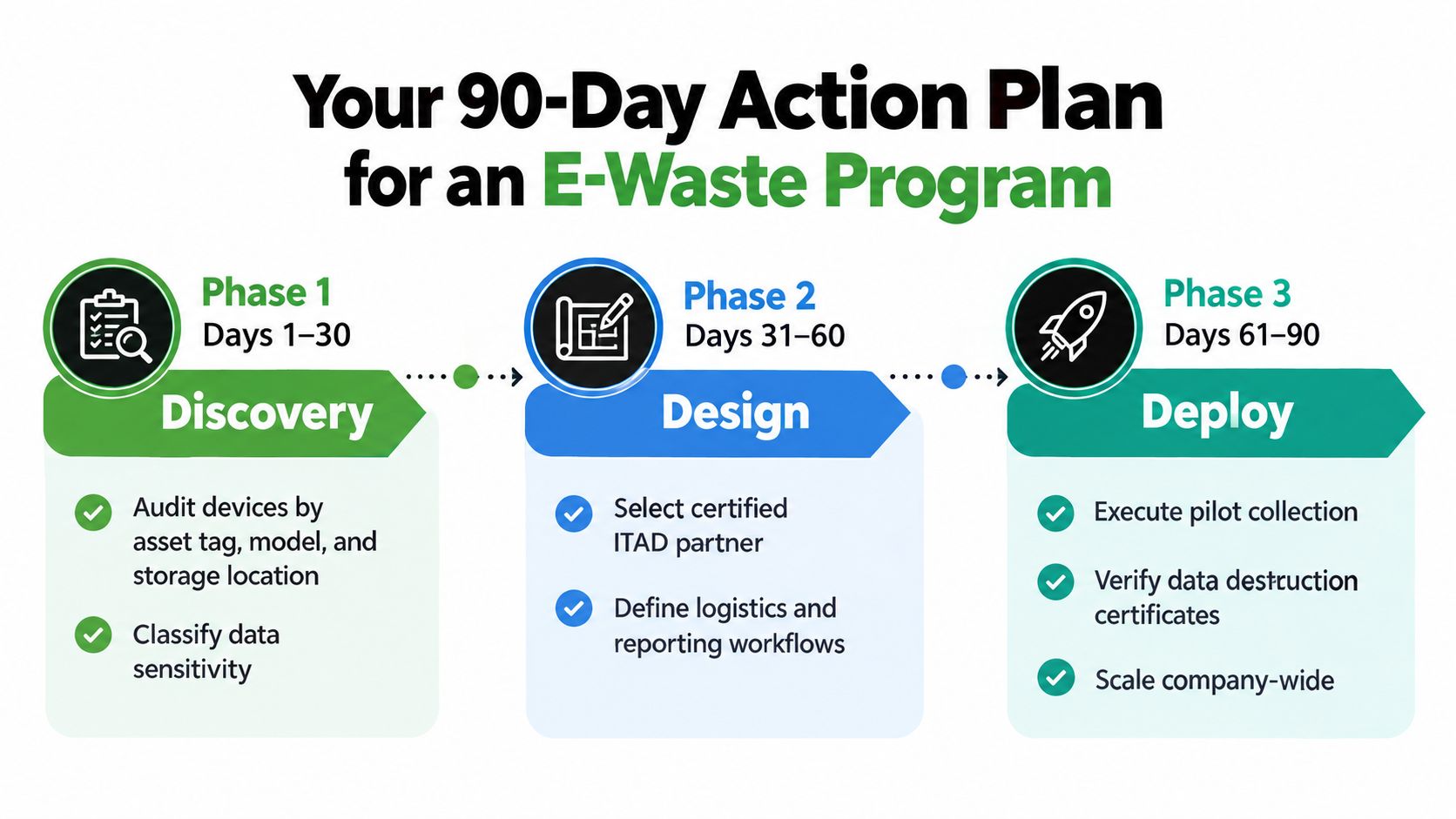
If your company already has a pile of retired devices, don't start with policy language. Start with control. A workable electronics recycling program can be built in one quarter if you sequence the work correctly.
Days 1 to 30 with discovery first
Audit what you have. Don't guess. Pull devices by asset tag, serial, model, physical location, and business owner where possible. Separate laptops, desktops, servers, phones, printers, networking gear, and specialty equipment such as laboratory devices or medical electronics.
Then classify data sensitivity. A conference-room PC is not the same as a finance laptop or a failed server drive from a production environment. Your handling rules should reflect that reality.
Use the first month to document operational friction too:
- Storage points: List every closet, cage, room, or trailer where retired electronics sit.
- Trigger events: Note what creates surplus, such as lease returns, office moves, refresh cycles, mergers, or facility cleanouts.
- Cost leaks: Capture labor, space use, rehandling, and emergency disposal workarounds.
This first step is where many programs get honest for the first time. Teams usually discover they aren't dealing with one pile. They're dealing with five disconnected mini-piles and no single owner.
Days 31 to 60 with partner and policy design
Once inventory is visible, issue a focused RFI. Keep it practical. Ask vendors how they handle collection, transport, sanitization, refurbishment, commodity recovery, exceptions, and reporting. Require proof of certification and examples of the documents your team will receive.
Run a pilot pickup before you lock in a broader workflow. Pick one office, one department, or one recent refresh batch. Track the handoff carefully and review the reporting package afterward.
Your written policy should be short and enforceable. Include:
- Roles and ownership: IT, facilities, security, finance, and sustainability should each know their part.
- Disposition rules: Define what gets redeployed, sold, destroyed, donated, or recycled.
- Data controls: Spell out sanitization requirements by device and risk level.
- Escalation path: Failed drives, unknown assets, and untagged equipment need a defined exception process.
- Reporting outputs: Decide what finance and sustainability need to see each quarter.
Good policy is operational. If a technician or office manager can't follow it on a busy day, rewrite it.
This is also the phase where donation-based recycling and corporate donation programs can fit, but only after data handling, ownership transfer, and asset condition standards are clear.
Days 61 to 90 with rollout and governance
Now embed the process into normal operations. Don't leave it as a one-time cleanup. Tie pickups to the IT lifecycle so retired devices move out on schedule after refreshes, office consolidations, and decommissions.
Set a review cadence. Quarterly is usually enough for most business programs. Review chain-of-custody records, destruction certificates, recovery summaries, exception logs, and any assets that missed the normal process.
Track outcomes in business terms:
- Recovery value: What came back through resale, buyback, or commodity streams.
- Cycle time: How long assets sat before disposition.
- Control quality: Whether records, certificates, and exception handling stayed clean.
- Program scope: Which departments, locations, and equipment classes are now included.
If you operate across multiple sites, standardize the intake form and pickup request process early. That's what keeps one disciplined location from being surrounded by five chaotic ones.
A mature program doesn't need drama. It needs cadence, documentation, and a vendor that can support electronics recycling, secure data destruction, office cleanouts, product destruction, computer recycling, and broader IT asset disposition without turning every pickup into a custom project.
If you need a practical partner, Reworx Recycling handles business electronics pickups, secure hard drive destruction, equipment decommissioning, and donation-based recycling workflows that support community impact alongside compliant disposition. Visit Reworx Recycling if you want to tighten chain of custody, recover more value from retired assets, or build an electronics recycling program that finance, IT, and sustainability can all defend.