Your retired laptops are piling up in the basement, the help desk keeps asking when the old storage arrays will move out, and procurement still wants a clean chain of custody before the next refresh goes live. That's the moment many teams start shopping for recycling technology consultants, and it's also where bad engagements begin. The wrong vendor sells you a polished deck, a vague recycling rate, and a promise that someone else will “handle the rest.”
The right consultant does something much harder. They tie operations, compliance, data security, and downstream reporting into one working process, so the project survives contact with reality. That matters because e-waste is the fastest-growing waste stream in the world, expanding at 3 to 4% annually, and only 22.3% of e-waste was recycled globally in 2022 source. If your program is built on guesswork, you're already behind.
What Recycling Technology Consultants Actually Do
The first test is simple. If your server room has a stack of retired laptops, a compliance deadline is coming, and nobody in IT or facilities has bandwidth to manage secure disposal, inventory reconciliation, and downstream paperwork, you don't need a cheerleader. You need someone who can turn a messy asset exit into a controlled process.
Strategy, delivery, and downstream processing are different jobs
A real recycling technology consultant doesn't just “advise on sustainability.” They decide what happens to equipment from the moment it leaves the floor to the moment it's documented as reused, recycled, or destroyed. That can include asset inventory, routing decisions, media sanitization, vendor coordination, and reporting for finance or ESG teams.
The mistake buyers make is collapsing three roles into one. A strategy consultant designs the program. An implementation partner runs the workflow. A downstream processor handles the physical treatment. When one company claims it does all three, ask who owns each handoff and what proof you'll get at each step.
Practical rule: If the consultant can't show you where the data starts, where the asset goes, and who validates the final outcome, they're not selling a process. They're selling confidence.
That process discipline matters more now because digital tools are already embedded in the recycling sector. One industry dataset says 78% of recycling companies have adopted digital platforms, IoT sensor use in recycling facilities rose 45% between 2020 and 2023, and digital recycling solutions are projected to reach $8.5 billion by 2027 at a 14.2% CAGR source. The same source says 90% of recycling-industry respondents see digital data security as a top concern, which is exactly why consultants need to treat security as an operating requirement, not a side note.
What good advisors actually improve
A useful engagement usually tightens diversion, makes the chain of custody audit-ready, and removes friction from ITAD, facilities, and procurement. It should also help you measure what happened to the material, not just prove that a pickup occurred.
If you want a practical companion for tracking waste movement inside the building, a tool like waste docket tracking software can help organize documentation before assets reach the downstream vendor. That's the sort of support that keeps the consultant focused on process, not paperwork theater.
The strongest firms understand that this is an operational transition, not a recycling lecture. They ask how equipment gets retired, who signs off, where sensitive media sits, and which department will own the exception cases when the standard workflow breaks.
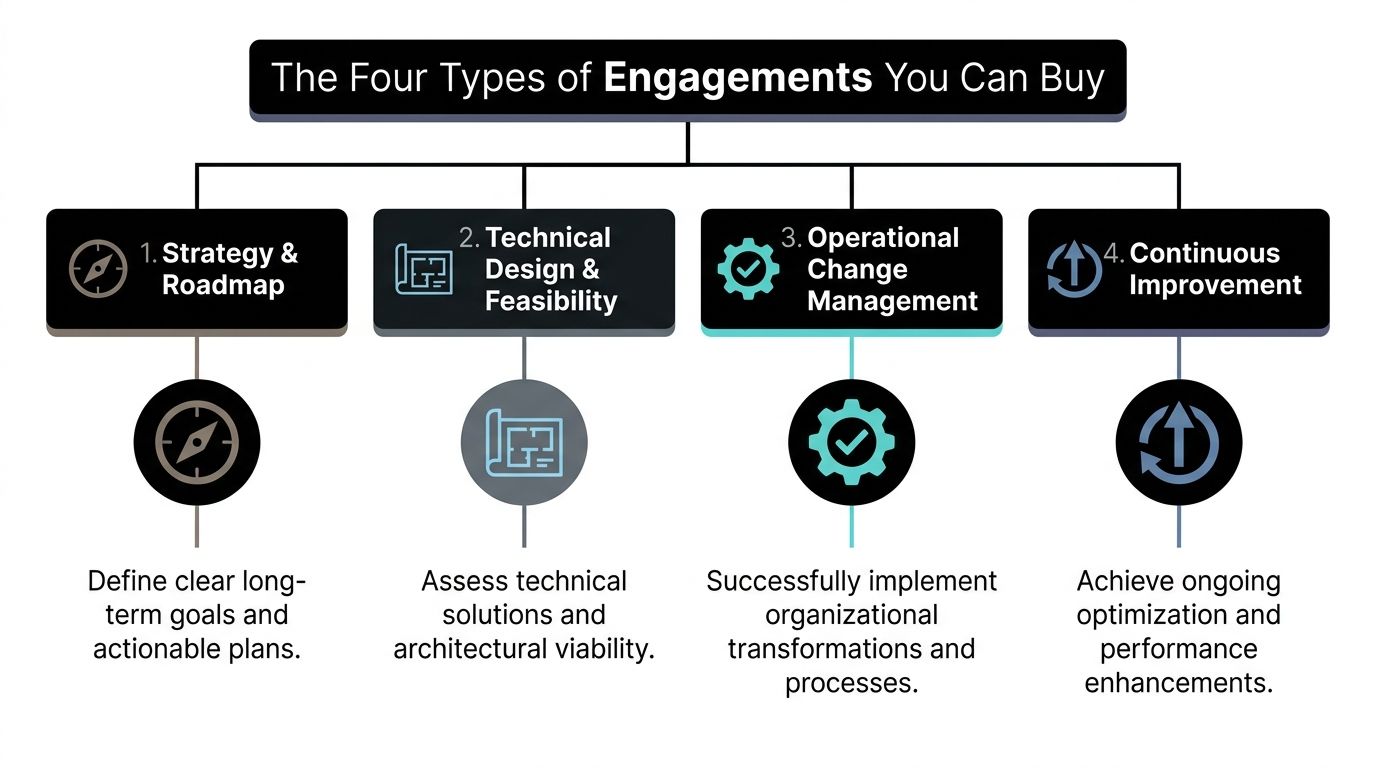
The Four Types of Engagements You Can Buy
The market likes to blur categories, but buyers shouldn't. A school district cleaning out offices, a manufacturer sorting mixed plastics, and a data center decommissioning racks are not buying the same thing. They need different expertise, different deliverables, and different risk controls.
Strategy and roadmap work
This is for organizations that know they have a problem but don't know the sequence. The consultant maps the current state, defines the target state, and sets priorities. The deliverable is usually a roadmap, not a machine spec.
Buy this when leadership wants direction, not equipment. If the consultant starts recommending software before they understand your waste streams, they're skipping the hard part.
Technical design and feasibility
This lane is for projects where process choice matters. Mixed plastics, contaminated streams, office-to-warehouse changeovers, and site-specific material handling all live here. The consultant should compare options and explain why one route preserves yield better than another.
A useful benchmark from a 2025 global assessment is that point-to-point yields were about 60% for mixed-plastic mechanical recycling, about 95% for single-material mechanical recycling, and around 99% for short-loop chemical recycling, while long-loop chemical routes were much lower at about 34% for gasification and 49% for pyrolysis source. That's a blunt reminder that feedstock quality drives the result. If a consultant ignores contamination, they're designing around a fantasy stream.
Operational change management and continuous improvement
Most engagements live here. The consultant works with staff, trains users, changes handoffs, and fixes the workflow after the pilot. The point is to make the new process stick.
This is also where many projects fail. Consultants oversell dashboards and underplay behavior change. They forget that the facilities team, IT, security, and finance each touch the process differently. The right partner helps those teams land on one standard.
Mixed or contaminated streams don't forgive sloppy intake. If the front end is weak, the best technology in the middle won't rescue the yield.
The U.S. market is large enough to support serious specialization. IBISWorld places the U.S. recycling-facilities industry at 1,029 businesses and $9.5 billion in 2026 source, which tells you this is an established but fragmented service market. Buyers need to choose the right lane, not just the loudest vendor.
Vetting Criteria Before You Sign Anything
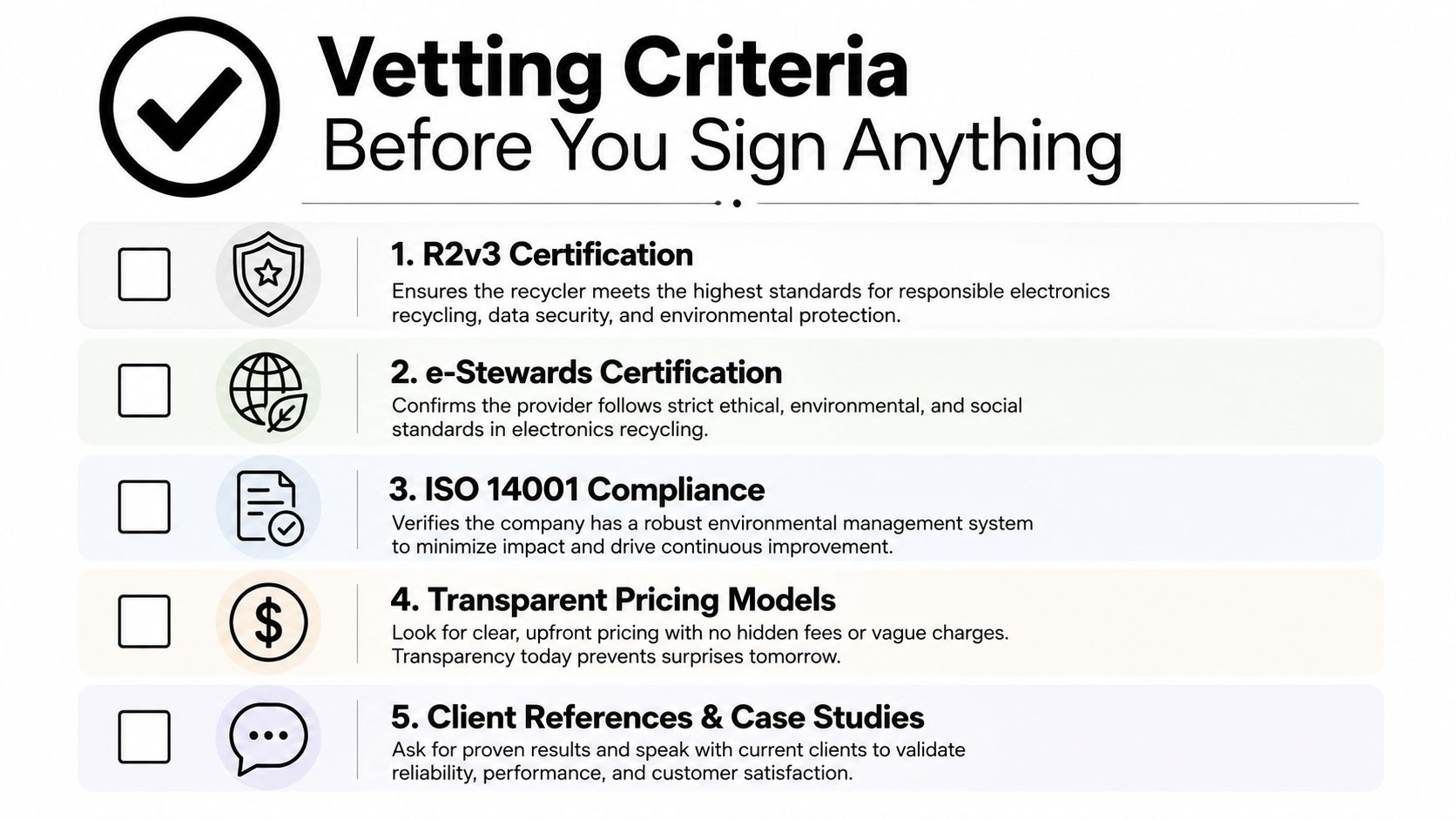
Use a checklist, not instinct. If a consultant can't answer these questions cleanly, you're buying marketing, not operational control. One internal reference point worth reviewing is Reworx Recycling's vendor selection criteria, because the right vendor review should force clarity on scope, downstream handling, and reporting.
Ask for proof, not promises
Start with certifications, but don't stop there. R2v3, e-Stewards, and ISO 14001 matter because they signal process discipline, environmental management, and oversight. Then ask how those standards show up in the actual workflow.
A serious consultant should show chain-of-custody documentation, downstream vendor transparency, and the exact method used for data destruction. If you operate in a regulated environment, that conversation needs to be in writing, not in a sales call.
For buyers comparing advisory firms, best IT consulting for Canadian SMBs is a useful reminder that good consultants are judged by fit and implementation discipline, not by how broad their service page looks. The same standard applies here.
Watch for the single biggest red flag
A consultant who quotes one blended recycling rate is usually hiding the weak spots. You want material-specific recovery, not a vague average that masks mixed outcomes across different fractions. The European Commission/JRC guidance for WEEE-style projects recommends a staged workflow that starts with a bill of materials and end-of-life scenario, then moves through batch analysis and validated downstream reporting source.
That's the right model because it forces measured recovery at the point where material exits the full chain as recycled or recovered. Invoice-level tonnage alone won't tell you whether the project worked.
Three questions that expose weak vendors
- Show me the last audit issue: A real operator can name a failed audit or a corrected finding and explain what changed.
- Prove your destruction method: If they can't explain how serialized media is handled, they're not ready for regulated clients.
- Trace one downstream partner: If custody breaks, who notices first and what happens next?
If you need a procurement reference for the paperwork side, Reworx Recycling's compliance checklist template gives a practical sense of how much detail should sit behind the contract. Short answer, more than most sales proposals include.
Sample RFP Evaluation Scorecard
| Criterion | What to Look For | Weight |
|---|---|---|
| Scope clarity | Exact assets, sites, and exclusions | High |
| Data security | Serialized tracking and destruction proof | High |
| Downstream transparency | Named processors and audit rights | High |
| Reporting quality | Material-specific recovery and final outcomes | Medium |
| Price realism | No hidden pass-throughs or vague fees | Medium |
Your RFP Checklist and Interview Questions
A sloppy RFP gets you polished language and little else. A good one makes the consultant spell out the operating model, the reporting rhythm, the security controls, and the exit terms before anyone signs. Start with a one-page scope summary, then require a line-by-line response so you can compare vendors on real work, not marketing copy.
Put these items in the RFP
- Scope of work: List the asset types, locations, and whether the project covers office cleanout, facility cleanout, data center decommissioning, or ongoing ITAD.
- Reporting cadence: State when you want inventory reports, chain-of-custody logs, and final disposition summaries.
- Data handling: Require the method for media sanitization and the proof delivered per device.
- Downstream rights: Reserve the right to review partner sites, documentation, and audit records.
- Exit terms: Define what happens if the vendor misses a service level or breaks custody.
The point is to remove ambiguity before it turns into a project problem. If a bidder cannot answer each line clearly, they are not ready for the work. That is a useful filter, and it saves your team from spending weeks clarifying basics after the contract is signed.
Ask questions that force specifics
Keep the interview short and make every answer concrete. Ask how they calculate recycling outcomes, how they handle confidential data on retired equipment, and what happens if a downstream partner loses chain of custody. Then ask them to walk through the last project that went sideways and what changed in their process afterward.
That answer tells you more than a polished proposal ever will. Strong operators do not hide failure. They can describe the correction, the documentation, and the controls they added after the problem surfaced.
Use price as a filter, not a decision
The lowest bid often leaves out travel, rush work, certificates of destruction, or downstream pass-throughs. Those charges show up later, after the kickoff call and after the scope feels locked. If two proposals are close, choose the one with clearer deliverables and fewer assumptions.
For the paperwork side, Reworx Recycling's compliance checklist template is a practical reference for how much detail should sit behind the contract. It shows the level of specificity you should demand from any vendor before you commit.
Cost Structures and Realistic ROI
Pricing for recycling technology consultants usually falls into three buckets. Fixed scope, hourly advisory, and gain-share tied to diversion performance. Each one can work, but only if the scope is tight and the reporting rules are clear.

Where the hidden costs hide
Travel, downstream processing pass-throughs, certificates of destruction, and rush fees for accelerated decommissioning are the usual traps. A proposal that looks cheap on day one can become expensive once the vendor starts billing for exceptions. Ask for those costs up front.
The ROI conversation should also be broader than cost avoidance. A good consultant can improve resale recovery, reduce compliance exposure, and produce cleaner sustainability data for reporting. That data has value because it keeps finance, ESG, and IT speaking the same language.
The market context supports that investment logic. One industry summary says the global waste recycling services market is projected to rise from $235.23 billion in 2026 to $321.65 billion by 2031 source. Another says the global recycling technology market is projected to grow from $62.4 billion in 2025 to $103.8 billion by 2034, a 6.4% CAGR source. That doesn't tell you what to buy, but it does show why the service stack keeps getting more advanced.
A practical office refresh example
Take a 1,000-laptop refresh. The consultant's value isn't just arranging pickup. It's reconciling serial numbers, separating working assets from scrap, coordinating secure destruction, and documenting final disposition so the finance and security teams can close the loop. If those steps are missing, the price tag is incomplete.
ROI is real when the vendor reduces internal labor, limits risk, and produces reporting you can actually use. If it only moves boxes, it's a logistics cost, not an operational win.
For buyers comparing fee structures, Reworx Recycling's pricing transparency is the kind of reference that keeps the conversation honest. Clear pricing is not a bonus. It's part of control.
Implementation Milestones and Sample Deliverables
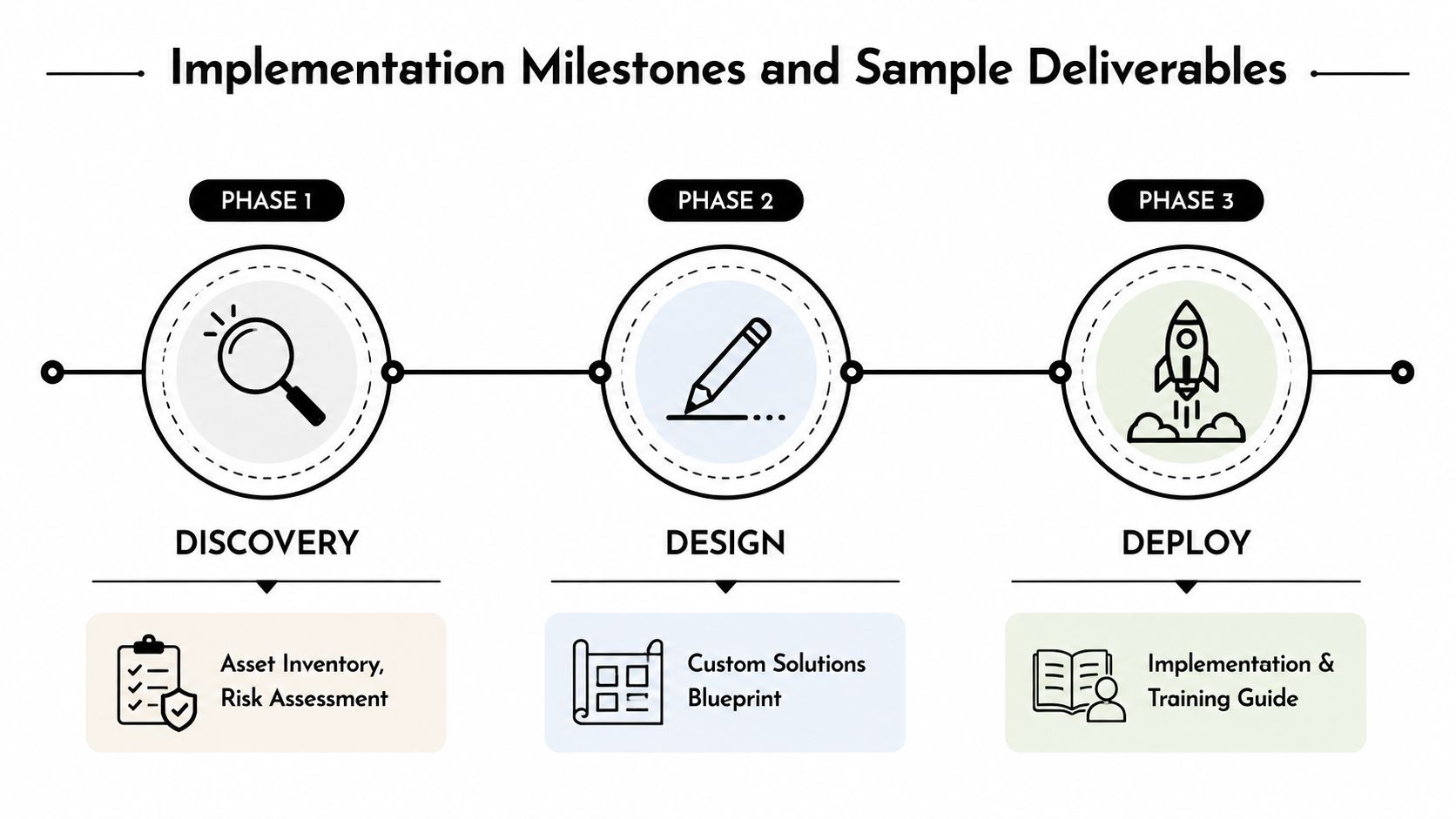
A consultant who vanishes after kickoff is a liability. Break the work into phases, define the handoffs, and tie every stage to a deliverable that IT, facilities, finance, and compliance can review without translation. That is how you keep the project tied to operating reality instead of a glossy plan.
Phase one discovery
Discovery should produce a working asset inventory, a risk classification, and a bill of materials that shows exactly what is in scope. For electronics and WEEE work, that inventory needs to come from plant-level or batch-level data where precision matters, not a rough count pulled together to satisfy a kickoff meeting.
If the consultant skips discovery, the rest of the project starts on weak ground. You cannot design a workflow around unknown volumes, unknown media risk, or unknown downstream constraints.
Phase two design and pilot
The consultant should select vendors, test the workflow, and validate the chain-of-custody template. You should see a pilot plan, a downstream audit log, and a decision record that explains why the selected route won out.
A pilot surfaces failure points before the full rollout. Wrong pickup windows, missing labels, weak destruction proof, and unclear handoffs show up fast when the process is small. That is the point. Fix the process while the stakes are contained.
Phase three rollout and reporting
At rollout, the consultant should train staff, document the process, and lock in the reporting cadence. The final deliverable should include a diversion summary and a reporting package your sustainability team can use without rewriting it. If the reporting still needs cleanup from internal teams, the consultant did not finish the job.
Reworx Recycling's implementation timelines is a practical benchmark for the phase discipline serious operators expect. If a vendor cannot define these milestones, they are not managing change. They are improvising.
Compliance and Data Security Essentials
Compliance isn't a side issue in this work. It's the work. Once equipment leaves the building, a consultant who can't document media handling is exposing your team to avoidable risk.
The obligations change by sector, but the logic doesn't. HIPAA, GDPR, PCI-DSS, and state privacy laws all translate into one basic demand, prove what happened to the data-bearing asset. That means serialized asset tracking, NIST 800-88-aligned media sanitization, and certificates of destruction for every drive.
Ask for the right to audit downstream partners, too. If a consultant can't show the trail after the pickup, they don't have control of the process. If your program also includes donation-based recycling, that can support sustainability and community goals at the same time, but only if the security steps are still intact.
Reworx Recycling's information security standards belongs on the review list for any team that needs both secure ITAD and responsible reuse. The practical test is simple, can the vendor prove custody, prove destruction, and prove final disposition without hand-waving?
Reworx Recycling handles electronics recycling, IT equipment disposal, secure data destruction, and donation-based asset recovery for organizations that need a controlled end-of-life process. If you're comparing recycling technology consultants, use the same standard here, ask for documented custody, clear reporting, and a process that works for IT, facilities, and compliance together. Visit Reworx Recycling to review service details and start a conversation about your next pickup, donation program, or decommissioning project.