You probably inherited the same mess everyone does, a pile of recycling vendors, a separate shredding vendor, a donation partner nobody can fully explain, and a facilities inbox full of pickup requests that don't line up with IT's asset records. That stack feels manageable until an audit, a plant move, or a decommissioning project exposes the gaps. Vendor consolidation is the clean-up move that gives you control back.
The wrong way to think about it is as a cheap procurement exercise. The right way is to treat it as an operating model reset for IT asset disposition, secure data destruction, electronics recycling, and downstream reuse. That matters because the market has already moved in this direction, with 75% of organizations pursuing vendor consolidation in 2022, up from 29% in 2020 in Capgemini's cited research, and 70% of organizations expected to consolidate cloud-native application vendors to a maximum of three providers by 2025 (Capgemini research on vendor consolidation).
The same pressure is showing up in technology organizations. CIO research cited by SAP and Gatekeeper found 68% of technology leaders planned to consolidate vendors, most aiming for a 20% reduction in vendor count, while another CIO survey put that number at 95% planning to consolidate in the next 12 months (SAP and Gatekeeper on CIO trends). In ITAD, the point isn't to slash names on a spreadsheet. It's to reduce chain-of-custody gaps, tighten reporting, and stop leaking time and money across too many relationships.
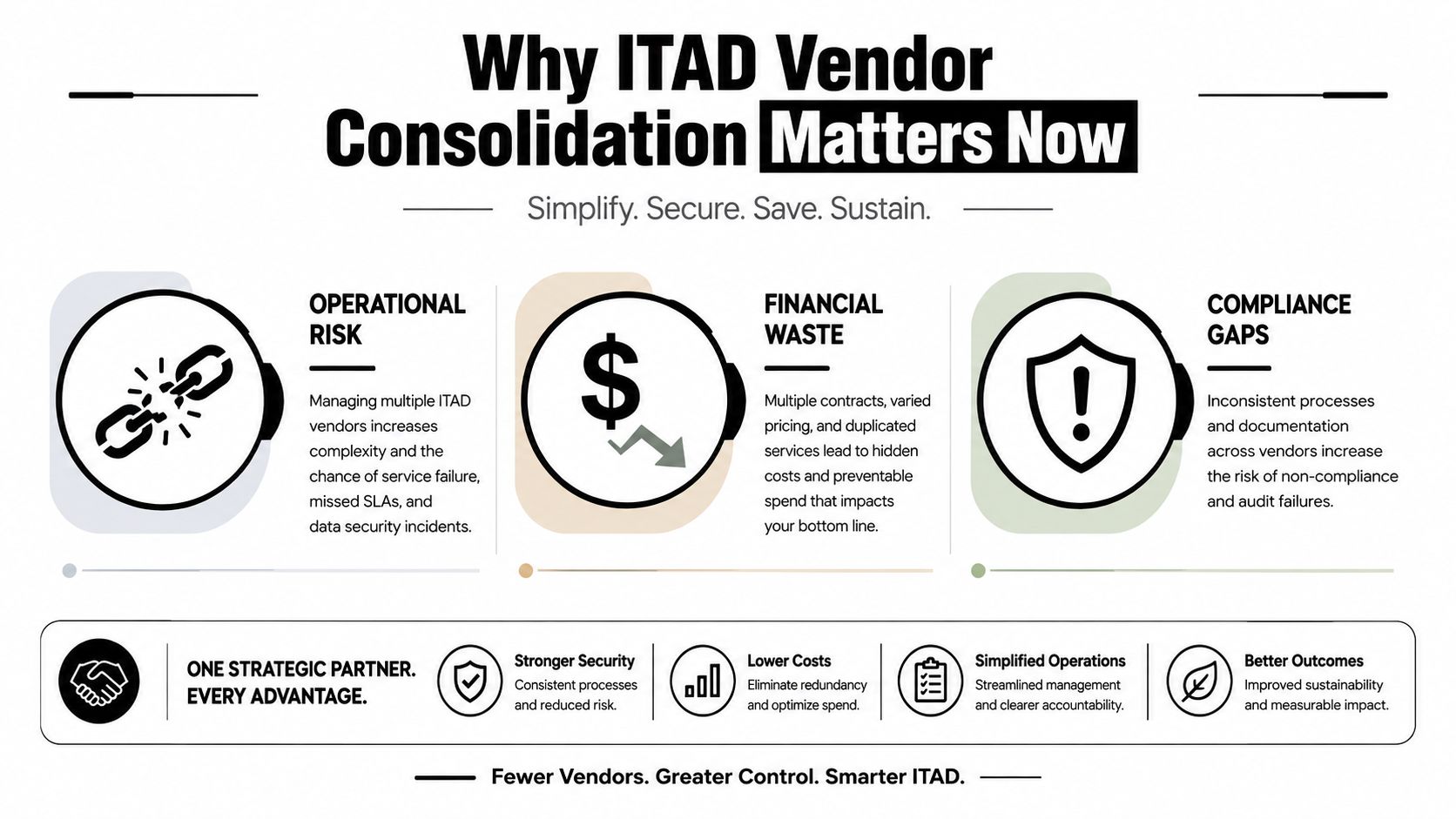
Why ITAD Vendor Consolidation Matters Now
A regional health system with one pickup carrier, two shredders, a donation partner, and a separate lab equipment recycler already knows the problem. Every team thinks it owns a different piece of the workflow, but nobody owns the whole chain. That's how office cleanout, facility cleanout, and data center decommissioning turn into an accountability mess.
Consolidation is an operating reset, not a bargain hunt
In ITAD, too many vendors usually means too many handoffs. Each handoff creates a place where assets can sit untracked, certificates can land late, or a shipment can be handled inconsistently. The operational goal is to build a smaller vendor portfolio that can absorb more of the workload without making your process brittle.
That's also where the financial logic gets real. A fragmented stack forces duplicate admin effort, more vendor follow-up, and more time spent reconciling invoices, manifests, and destruction records. The savings are useful, but the bigger win is control. You want one path for laptop disposal, another for regulated streams, and a clear route for product destruction when the hardware can't be reused.
Practical rule: If your team can't answer which vendor touched a device, when it was transferred, and who signed off on final disposition, you don't have a vendor strategy. You have a pile of exceptions.
The compliance side is just as important. ITAD touches privacy, security, and sustainability at the same time, so chain-of-custody gaps don't stay small for long. One weak point in vendor oversight can undercut the ESG story you're trying to tell and the audit trail you need to defend it.
The most useful mindset shift is simple. Don't ask how many vendors you can eliminate. Ask which ones deserve to remain because they reduce complexity, improve evidence, and support repeatable IT equipment disposal across sites. If the answer isn't obvious, consolidation is overdue. For a broader framing of where ITAD sits in the lifecycle, Reworx Recycling's overview of IT asset disposition is a useful reference point: growing importance of IT asset disposition.
Building the Current-State Spend Audit
Start with the transaction history you can defend, then clean the rest around it. Pull 12 to 24 months of spend from every channel that touched the supplier base, including PO activity, P-card spend, non-PO invoices, freight portals, contract manufacturing draws, and intercompany transfers, as outlined in the Simfoni vendor consolidation guide and the Umbrex supplier consolidation rationalization. Skip one channel and your audit will understate vendor sprawl.
Clean the supplier master before you compare vendors
The first pass is tedious, and that is exactly why it matters. Remove duplicates, merge legal entities under ultimate-parent IDs, and tag each supplier with usable metadata such as commodity code, site geography, diversity status, and exclusivity flags. Once the master is clean, overlap shows up across pickups, shredding, reuse, and downstream processing.
Bring in the operational signals too. Pickup frequency, certificate-of-destruction turnaround, audit findings, and issue escalation history tell you how a vendor behaves under pressure. A supplier can look small in spend terms and still carry heavy operational risk if it owns a regulated stream or handles repeated urgent pickups.
Keep the lens broad: spend data shows where the money goes, but service history shows where the risk sits.
For ITAD, the audit has to start before any recycling decision gets made. A weak asset list turns into missed serials, bad chain-of-custody records, and gaps in downstream accountability, so use a proper inventory review first. Reworx Recycling's guidance on why IT inventory audits before recycling supports that sequence.
The useful output is not a bloated workbook. It is a one-page view that shows category overlap, unused contracts, and the places where multiple vendors are doing the same work. Finance gets a clean challenge list, compliance gets a verification list, and IT gets a real action list instead of a pile of anecdotes.
This audit also needs a hard line on why consolidation exists in the first place. The goal is to separate accidental fragmentation from fragmentation that serves different risk profiles, especially in reverse logistics, donation partners, and data destruction governance. The RNC Group risk mitigation strategy fits that mindset because it keeps the focus on vendor risk, not just price.
Scoring Vendors with an Evaluation Matrix
Spend volume alone is a weak filter. A low-cost vendor that can't handle serialized reporting or downstream due diligence will cost you more later, especially when the assets include medical equipment disposal, lab gear, or sensitive storage media. Use a scoring matrix and make the decision explicit.
What to score and why
Build the matrix around capability, risk, and business upside. That means weighing data destruction capability, downstream reuse pathways such as resale or donation, certification posture, pickup coverage, insurance and liability coverage, and the ability to issue auditable ESG reporting. For due diligence on the risk side, RNC Group's vendor due diligence risk mitigation strategy is a useful external reference because it reinforces the habit of checking more than price and promises.
A practical structure is to score each supplier on value to the business, switching effort, disruption risk, security and compliance fit, and business upside, then bucket them into strategic core, contain, or phase out. That gives you a decision rule instead of a debate. If a vendor can't clear the security and compliance bar, don't keep it just because it's familiar.
| ITAD Vendor Evaluation Matrix | |||
|---|---|---|---|
| Scoring Dimension | Weight | Sample Vendor A | Sample Vendor B |
| Data destruction capability | High | Strong | Weak |
| Downstream reuse and donation pathways | Medium | Strong | Moderate |
| Compliance and certification fit | High | Strong | Weak |
| Geographic pickup coverage | Medium | Moderate | Strong |
| Insurance and liability coverage | High | Strong | Moderate |
| Auditable ESG reporting | Medium | Moderate | Strong |
The matrix protects you from one of the worst consolidation mistakes, cutting a partner that handles a regulated stream better than everyone else. In an ITAD stack, the cheapest vendor is often the one that creates the most work for the next audit.
Decision rule: If two vendors look similar on spend and one has materially stronger reporting, security, and downstream controls, keep the stronger one and phase the weaker one out.
Reworx Recycling's own discussion of vendor selection criteria fits naturally here because the selection phase should already be filtering for reporting discipline, pickup reliability, and end-of-life handling depth. That's the right place to be picky.
Writing the RFP and Contract for Real Accountability
A consolidation program lives or dies in the RFP and contract. If you leave the language soft, the supplier will deliver soft performance. You need clauses that describe exactly what happens to each asset, from pickup to final disposition.
Put the failure modes in writing
The essentials are chain-of-custody documentation, serialized asset reporting, downstream due diligence for resale and donation partners, and clearly stated remediation rights if a shipment is lost or mishandled. If the vendor handles secure data destruction, the contract should also require the destruction standard you expect and the proof package you expect back. For service terms, Reworx Recycling's service-level agreements guidance is a useful parallel because it reinforces the idea that vague language doesn't protect you.
Don't stop at service descriptions. Write consequences for missed pickup windows, late certificates, missing serials, and claims that sound good but can't be audited. That means credits, minimum-volume commitments where they make sense, and explicit audit rights for both operating records and downstream partners.
A contract that sounds flexible often hides the worst traps. Auto-renewals on legacy vendors keep bad habits alive. Broad exclusivity language can block regional partners later, which is a bad trade if you need specialized support for laboratory equipment disposal or a rush decommissioning.
Here's the rule: the contract should make the vendor prove control, not just promise it. If a clause can't be measured, it won't save you when assets go missing or an auditor asks who touched the hard drives.
The strongest RFPs also force the supplier to describe its reuse pathway in plain language. If they donate, resell, refurbish, or recycle, you should know which path applies to which asset class. That's how you keep corporate donation programs credible instead of aspirational.
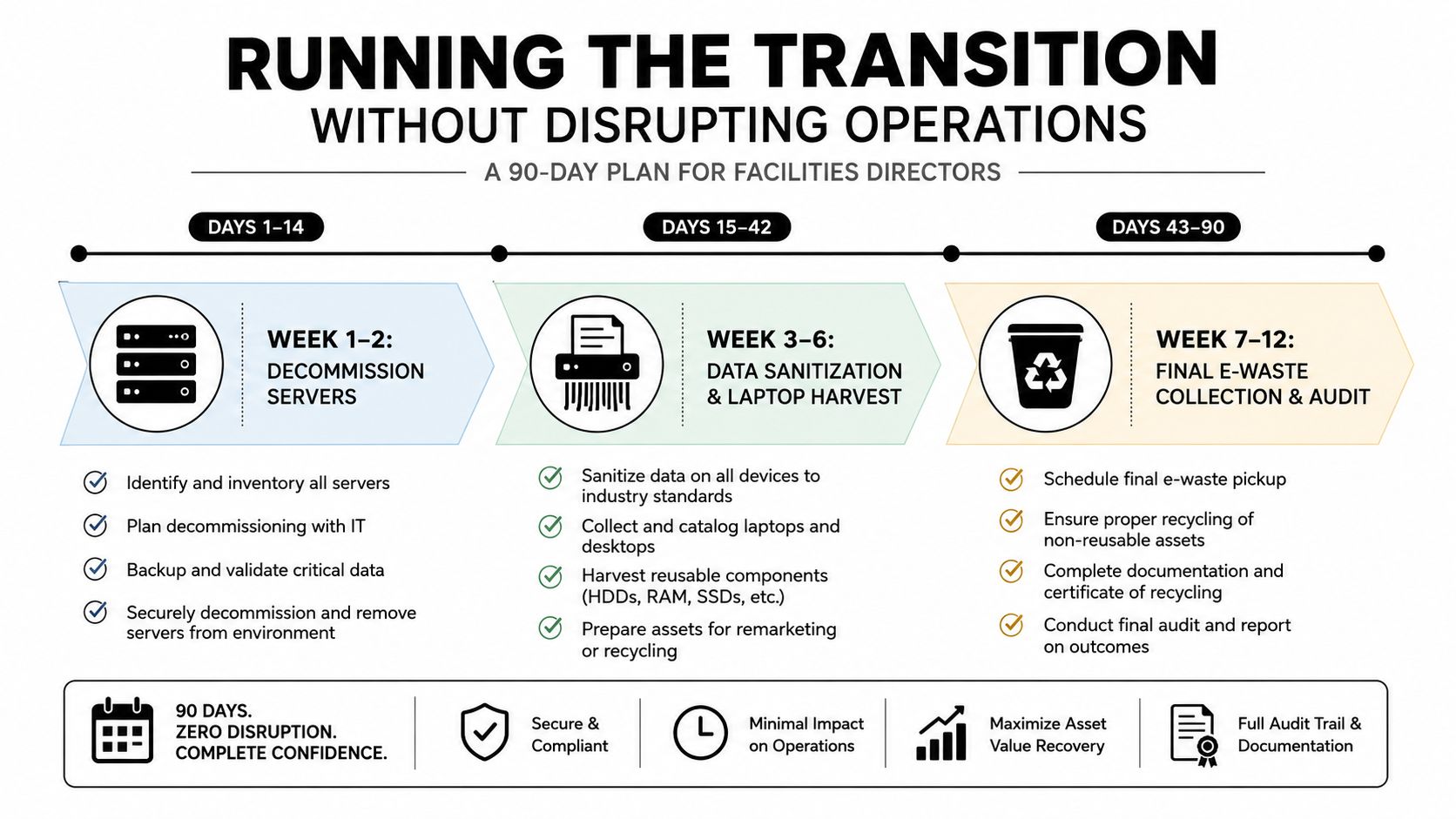
Running the Transition Without Disrupting Operations
A 90-day transition works only when you treat it like a controlled cutover, not a procurement announcement. A 400-person office retiring two server rooms, 600 laptops, and a lab of diagnostic equipment in one quarter is exactly the kind of project that breaks if you try to move everything at once. The incumbent recycler and the new strategic partner should run in parallel during the pilot site until the reporting and chain-of-custody flow match what finance and compliance need.
Pilot first, then expand by site
The first move is to assign a real RACI between IT, facilities, finance, and the vendor. IT owns asset accuracy and data sanitization. Facilities owns access and logistics. Finance owns valuation and invoice reconciliation. The vendor owns pickup execution, certificates, and final disposition records.
Then test the cutover on one site, one asset class, or one low-risk stream. Validate pickup windows, serialized reporting, and the turnaround on destruction certificates before you expand. If the new partner misses the service level in the first 60 days, your rollback plan should already tell you who reverts, which vendor resumes, and how you protect chain-of-custody continuity.
A clean transition also needs internal communication. The help desk should know how to route pickup requests. Dormant vendor accounts should be closed so spend doesn't drift back to old vendors through informal reorders. If people can still use the old path, they will.
Best practice: Never retire the old vendor until the new one has produced a clean pilot, a complete reporting sample, and a signed operational handoff.
The process only looks slow from the outside. In practice, it prevents the kind of disruption that makes teams lose confidence halfway through a consolidation. Once the pilot is stable, expand site by site and keep the old roster out of the workflow.
Governing Concentration Risk After Go-Live
Consolidation removes chaos, but it also concentrates dependency. That's the part vendors rarely emphasize. CGI cites studies showing up to 30% of initiatives fail when governance is weak or speed outruns stability (CGI on strategic vendor consolidation). If you treat go-live as the finish line, you're setting yourself up for a second cleanup later.
Monitor the remaining suppliers like critical infrastructure
Use continuous vendor-risk monitoring on the remaining suppliers and track financial health, not just service tickets. A vendor that handles most of your assets also becomes a concentration point for operational failure, compliance failure, and scheduling failure. That's why an independent guide to risk management stages fits this part of the work, because governance is a cycle, not a one-time review.
Keep a secondary partner pre-qualified for surge capacity and for specialized streams you don't want to learn about during a crisis, including medical equipment disposal. If the primary partner misses the mark or loses capacity, you need a fallback that already understands your sites, paperwork, and security standards. Otherwise, savings turn into delays.
A good dashboard should blend cost, service, and risk. Watch concentration, on-time pickup, certificate turnaround, and reporting completeness together, not separately. If one metric improves while another erodes, consolidation is drifting in the wrong direction.
Reworx Recycling's approach to risk management best practices fits this posture because the point is to preserve flexibility after the stack gets smaller. Fewer vendors should mean better governance, not a bigger blind spot.
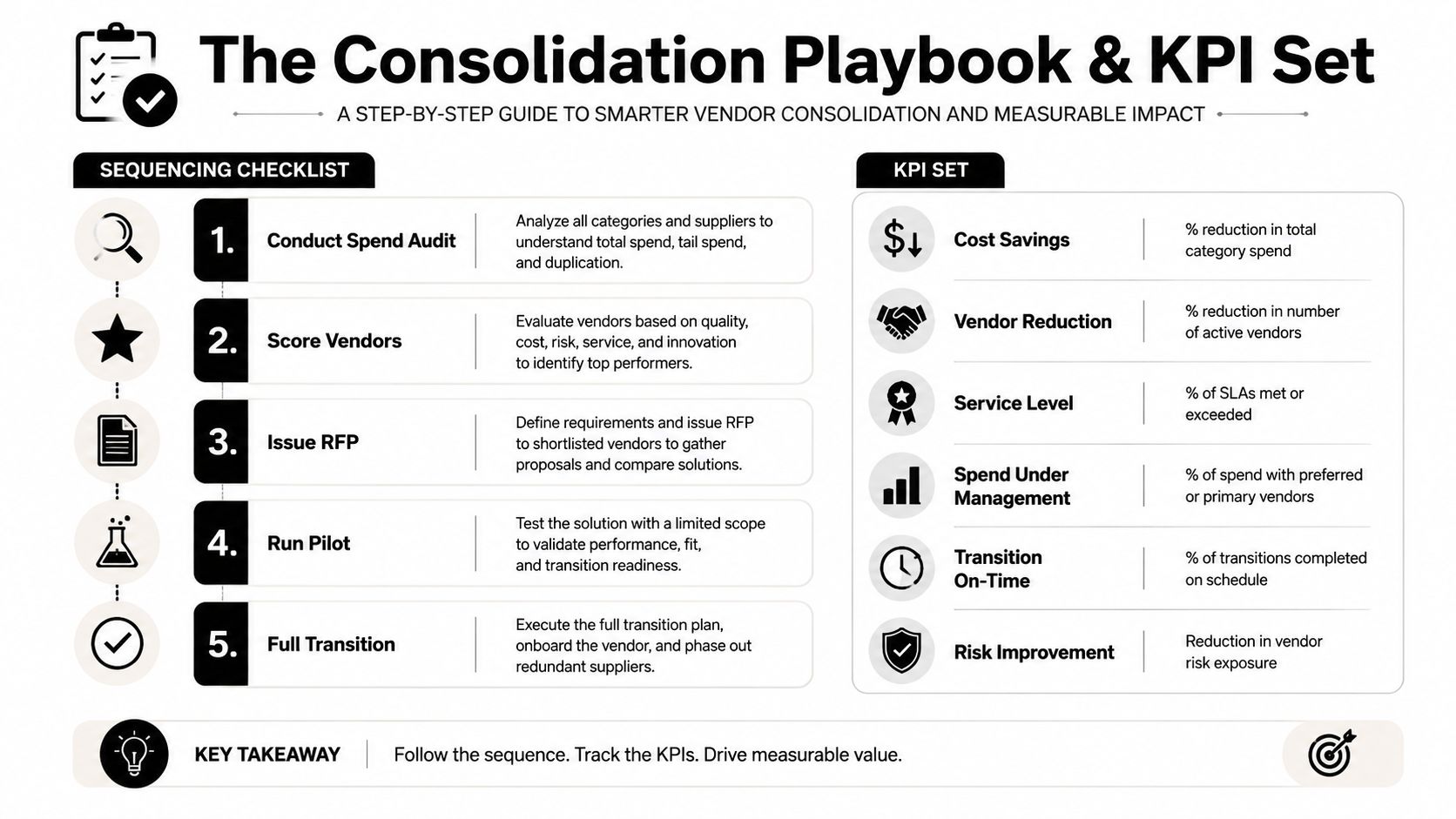
The Consolidation Playbook and KPI Set
Use this sequence and don't improvise around it: audit, score, RFP, pilot, transition, govern. That's the shortest path from messy vendor sprawl to a controlled ITAD portfolio. Anything else is just rearranging names in a spreadsheet.
A practical KPI set that actually tells you something
For cost, track cost per asset retired and the admin time your team spends chasing records. For operations, track on-time pickup rate and certificate-of-destruction turnaround. For governance, track ESG reporting completeness and the percentage of assets that move through the approved chain without exceptions.
If you need a model for thinking about KPIs, Logivo's KPI guide for SCM teams is useful because it reinforces the same principle, measure the flow, not just the bill. In ITAD, that means measuring whether the asset was collected, documented, destroyed or reused correctly, and closed out cleanly.
Three red flags should trigger a review immediately. First, the new vendor is saving money but leaving your team with more manual cleanup. Second, certificates are arriving late or incomplete. Third, the vendor count is down, but the exception rate is up.
Here's the short version:
- Conduct the spend audit first. If the data is dirty, the decision will be dirty too.
- Score for risk and capability, not just cost. Cheap vendors that can't prove control aren't real consolidation targets.
- Write the contract like an auditor will read it. Because eventually, one will.
- Pilot before full transition. Site-level proof beats optimistic promises.
- Govern after go-live. Concentration risk doesn't disappear when the project closes.
If your vendor stack is still split across pickups, shredding, reuse, and destruction, stop letting that sprawl run your program. Reworx Recycling handles electronics recycling, IT equipment disposal, secure data destruction, and donation-based recycling with a focus on environmental responsibility and community impact. Visit Reworx Recycling to see how a tighter ITAD process can support your next office cleanout, decommissioning project, or corporate donation program.