Your phones go quiet for a moment, then the tickets start. A branch office can't place outbound calls. A warehouse loses connectivity to handheld devices. The front desk says customer calls are dropping. Someone searches for telecom support services near me and gets a page full of carrier contact centers, generic ads, and listings that don't answer the core question.
Most businesses aren't looking for a phone number. They're looking for a partner who can diagnose the fault, coordinate with carriers, handle onsite work when needed, and keep aging telecom gear from turning into a recurring outage. That's a different procurement decision from choosing a service provider in the first place.
The smartest teams treat telecom support as part of operational resilience. They define what must be supported, how incidents move from intake to resolution, who owns escalation, and what happens when old routers, switches, VoIP phones, or mixed network hardware need to be retired securely. That's where support quality and lifecycle discipline start to meet.
Beyond the Call Center Decoding Your Real Support Needs
A common failure pattern looks like this. Internet service is technically “up,” but call quality is unstable, conference rooms won't connect reliably, and one location has an old firewall that nobody wants to touch during business hours. The carrier says the circuit tests fine. Your internal team knows the issue is somewhere between voice, network, hardware, and local configuration. What you need isn't a scripted queue. You need someone who can own the problem.

That's the first distinction to make when evaluating telecom support services near me. A carrier support line helps with account issues, service tickets, and limited diagnostics inside its own scope. A local telecom support partner should handle the messy middle. That includes mixed-vendor troubleshooting, onsite checks, structured escalation, and communication with your staff in plain language.
What businesses usually mean by local telecom support
In practice, buyers usually need one of three things:
- Immediate restoration help: A provider who can respond when phones, internet, or connected devices stop working and the issue crosses vendor boundaries.
- Ongoing operational support: A team that monitors recurring trouble spots, documents fixes, and reduces repeat incidents.
- Lifecycle guidance: Advice on when to repair, replace, standardize, or retire telecom-related hardware.
Practical rule: If the provider can only open a carrier ticket, you're still missing the partner layer.
Support quality also isn't just about answering quickly. It's about whether the provider can preserve context across channels, spot recurring patterns, and keep users from having to explain the same issue three times. IBM notes that telecom customer support is increasingly judged on omnichannel responsiveness and proactive issue management, and that personalized experiences can improve customer satisfaction scores by 20% to 40% according to IBM's telecom customer experience analysis.
The strategic version of the search
When I see an IT manager start with a local search, the useful question isn't “Who's nearby?” It's “Who can operate inside our environment without creating more handoffs?” That means someone who can work with your carrier, your network stack, your voice platform, and your internal escalation expectations.
If you're evaluating partners that cover both telecom operations and adjacent planning, it helps to review providers that frame support as part of a broader telecom solutions approach, not just a dispatch service.
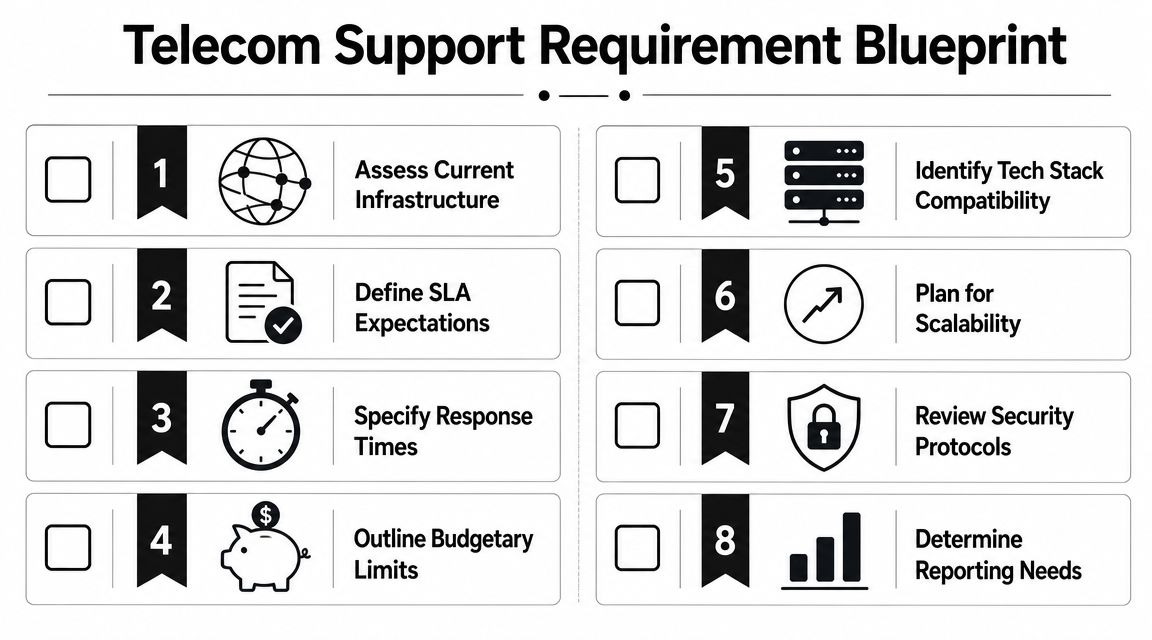
Building Your Telecom Support Requirement Blueprint
Most bad vendor selections happen before the first meeting. The business asks for “telecom support,” the provider replies with a standard package, and both sides discover the gaps during an outage. You can avoid that by writing a requirement blueprint before you start calls.
Start with the support layers
A practical model uses three levels. BeyondTrust describes Level 0 as self-service resources such as FAQs and chatbots, Level 1 as the help desk for basic issues, and Level 2/3 as specialist escalation for more complex incidents in its explanation of IT support and service desk structure. The same source highlights a common failure point. Requests come in through different channels and never get normalized into one ticketing system, which weakens response-time measurement and follow-up.
For telecom support, that model becomes a procurement tool. You need to decide which layers your internal team can own and which must sit with an external partner.
Blueprint questions that force clarity
Use these prompts before talking to vendors:
What exactly needs support
List circuits, VoIP systems, conference room technology, routers, switches, firewalls, mobile devices, branch equipment, and any legacy telecom hardware still in service.
Where the support boundary sits
Decide whether the provider will only troubleshoot incidents or also own carrier coordination, onsite dispatch, move-add-change work, documentation updates, and post-incident reviews.
What counts as business critical
A dropped call in a low-volume office isn't the same as a call-routing failure in a healthcare intake center or a plant floor connectivity issue. Rank systems by business impact.
Which hours matter
Some organizations need business-hours help with after-hours escalation. Others need near-continuous coverage because operations don't stop when the office closes.
Break-fix versus managed support
Teams often either overspend or underbuy. A break-fix model can work if your environment is stable, well documented, and simple. It fails when nobody owns prevention.
A managed support arrangement usually makes more sense when you have multiple sites, recurring voice issues, mixed carriers, aging equipment, or internal staff who can't spend their week chasing telecom tickets.
| Support model | Usually works when | Usually fails when |
|---|---|---|
| Break-fix | Few sites, limited complexity, low change volume | Problems recur, documentation is weak, outages need coordination |
| Managed support | Multi-site environments, mixed vendors, business-critical uptime | Scope is vague and nobody defines ownership |
| Hybrid | Strong internal IT team needs specialist backup | Escalation paths aren't documented |
The cheapest support model often becomes the most expensive one after the second avoidable outage.
Document the operating requirements
Your blueprint should include a short operational checklist:
- Response expectations: Define how quickly someone must acknowledge, triage, and begin work on critical versus routine issues.
- Escalation ownership: Name who contacts the carrier, who updates users, and who approves after-hours changes.
- Tool integration: Ask whether phone, email, chat, and remote support all feed the same ticketing process.
- Reporting needs: Require incident summaries, recurring issue visibility, and asset-level notes that survive staff turnover.
- Security handling: Include remote access controls, admin boundaries, and how credentials are managed during support work.
A final point gets missed often. Support and asset management belong together. If your provider is constantly touching equipment with unknown age, unknown warranty status, and poor documentation, support quality will suffer. That's why procurement teams should align telecom support with disciplined IT asset management practices from the beginning.
Sourcing and Shortlisting Local Telecom Experts
Typing telecom support services near me into a search engine feels efficient. It usually isn't. Search results tend to surface carriers, lead-gen sites, and directories that reward ad spend more than local execution capability.
That mismatch matters because many businesses searching locally aren't asking for remote account support. They're asking for hands-on help with phones, internet, device connectivity, and mixed-vendor troubleshooting. The gap between search results and that need is a real problem, especially for SMBs, and it shows up clearly when carrier contact experiences dominate the journey, as reflected by Spectrum's customer contact approach.
Better places to build a shortlist
A stronger shortlist usually comes from business communities, not just search rankings.
- Chamber and industry groups: Local chambers, manufacturing associations, healthcare IT groups, and property management networks often know which firms show up and solve problems.
- Regional MSP circles: Even if you don't want a full MSP, these communities often reveal which telecom specialists handle escalations, cabling coordination, and carrier disputes well.
- Peer referrals from adjacent roles: Ask facilities managers, operations leaders, and finance teams. They often know which vendors are easy to work with during moves, outages, and invoice disputes.
- Technology councils and business events: Providers who invest in local relationships usually have more staying power than firms built entirely around paid acquisition.
How to tell if “local” is real
Some vendors use local landing pages without local capability. Test that early.
Ask direct questions:
- Do they have technicians who can be onsite in your operating area?
- Can they support legacy hardware as well as current cloud voice tools?
- Will they coordinate across carriers and internal stakeholders?
- Can they produce examples of change documentation, escalation flow, and ticket reporting?
A useful outside example of this kind of buyer mindset appears in Steel City IT's piece on Tailored IT for Sheffield companies. It isn't about telecom procurement in the U.S., but it captures the broader principle well. Businesses often need providers shaped around local operating conditions, not generic support promises.
If a vendor talks mostly about seats, plans, and bundles, keep digging. If they ask about sites, failure modes, and escalation ownership, you're probably talking to the right type of firm.
Local sourcing also gets easier when you separate “carrier support” from “operational support.” The provider you shortlist should fit the second category. For teams trying to widen that search beyond ads, it can help to compare firms that position themselves around managed telecom services in local markets, then pressure-test whether the local delivery model is real.
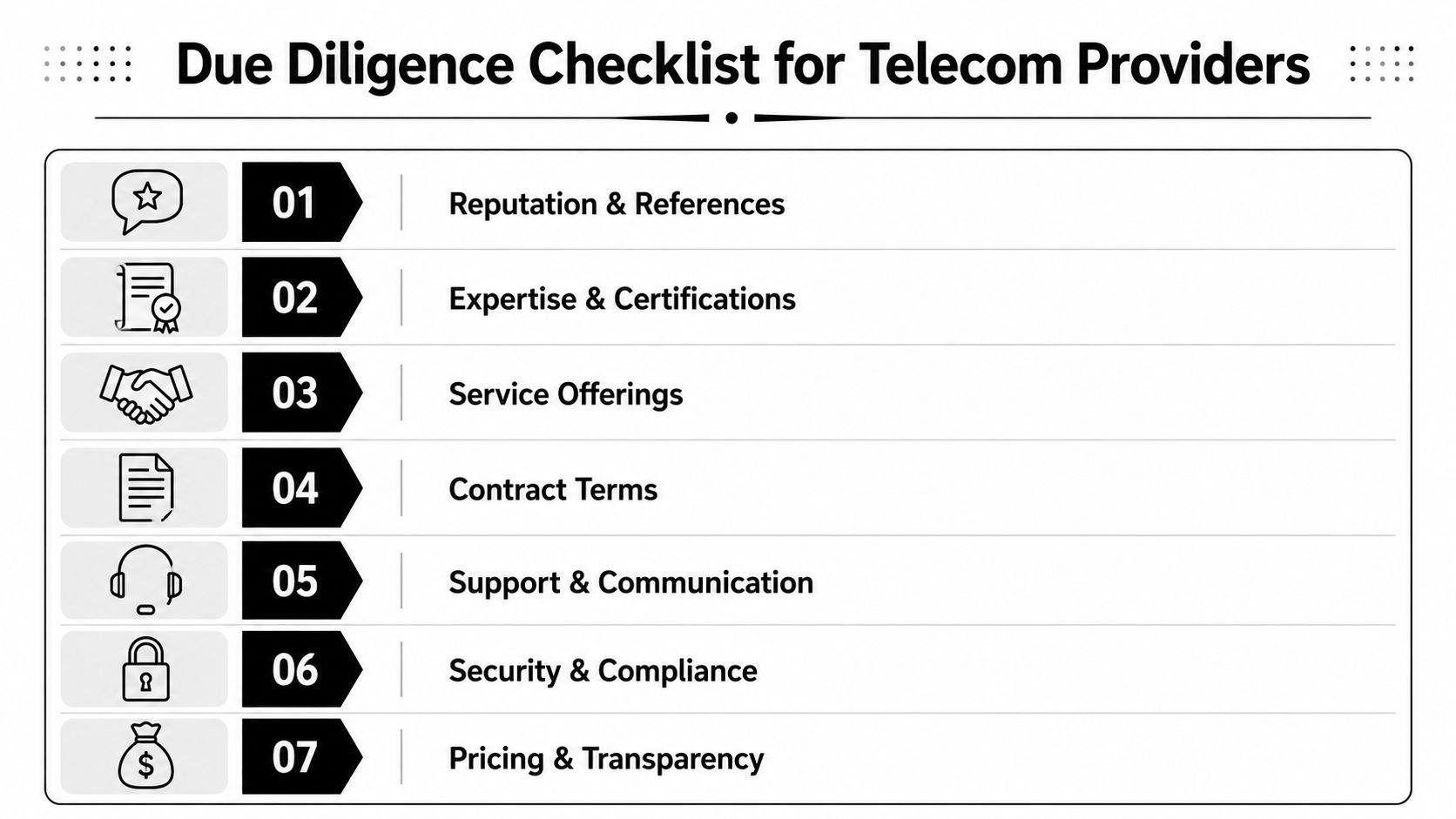
Your Due Diligence Checklist for Vetting Providers
A polished proposal doesn't tell you much. Due diligence starts when you ask for specifics and the provider has to show how work practically moves.
Test the support model, not the sales deck
Modern telecom support is moving toward broader coverage and more automation, but human troubleshooting still matters. A 2026 industry analysis reported that 93% of customers prefer speaking with a live agent rather than AI, according to Ozmo's telecom support trends review. For business buyers, that means one thing. Don't confuse a slick self-service front end with actual diagnostic depth.
Ask providers what happens after the first contact:
- Who answers after normal business hours?
- What can frontline staff resolve without escalation?
- When does an engineer take over?
- Can a customer speak to a person with context, or do tickets restart at every handoff?
The checklist that exposes weak providers
Use a structured scorecard during interviews.
Reputation and operating history
Start with references, but don't stop there. Ask for references from organizations that look like yours in complexity, not just industry. A single-site office and a distributed operation have very different support demands.
Look for:
- Recent reference calls: Ask about communication quality during an outage, not just general satisfaction.
- Evidence of retention: Long client relationships can indicate stable delivery, though you should still validate current staffing and scope.
- Escalation credibility: Find out whether references dealt with carrier disputes, hardware failures, or multi-vendor incidents.
Technical fit and scope discipline
The provider should be able to describe supported technologies plainly. If they use broad language like “all major systems,” ask them to narrow it.
A useful interview table looks like this:
| Area | What to ask | What a strong answer sounds like |
|---|---|---|
| Voice systems | Which platforms do you support directly? | Specific platforms, versions, and support boundaries |
| Network gear | What brands and legacy devices can you handle? | Clear list plus limitations |
| Carrier coordination | Will you own vendor calls and escalation? | Defined process and named responsibility |
| Onsite work | What work requires dispatch? | Honest distinction between remote and field support |
| Documentation | How do you update diagrams, configs, and notes? | Ticket-linked documentation with ownership |
SLA and communication standards
Contracts often conceal risk. Don't settle for “best effort” language if systems are business critical.
Review:
- Acknowledgment versus resolution: Fast acknowledgment is nice. It's not the same as meaningful progress.
- Severity definitions: The provider should define what counts as critical, high, medium, and low.
- Communication rhythm: During an outage, who updates stakeholders and how often?
- Closure discipline: Insist on closure notes that describe root cause, workaround, and follow-up actions.
Ask for a redacted incident report. It tells you more than a brochure ever will.
Security, access, and compliance questions
Telecom support often touches sensitive systems and credentials. The vendor should explain how technicians gain access, how privileged actions are logged, and how credentials are rotated or removed after projects.
If retired drives, phones, or telecom appliances are part of the operating environment, the support relationship also needs a clean end-of-life path. That's where buyers often widen due diligence to include a provider's security posture and any downstream partners used for secure disposal or destruction. For organizations that need stricter chain-of-custody expectations, reviewing practices associated with NAID AAA certified handling can help shape the right questions.
Pricing that won't punish you later
The wrong pricing model creates bad behavior. Pure hourly billing can discourage preventive work. A flat retainer with vague exclusions can lead to constant disputes about what's “in scope.”
Ask each provider to explain:
- What is covered by default
- What triggers project fees
- How after-hours work is billed
- Whether onsite visits are included
- How they price carrier management, MAC work, and hardware replacement coordination
A good provider doesn't just give you a number. They explain where the model protects both sides.
Connecting Support with Responsible IT Asset Disposition
Telecom support usually enters the conversation during an outage. IT asset disposition enters later, often during a refresh, relocation, merger, office cleanout, or carrier change. Treating those as separate tracks is a mistake.
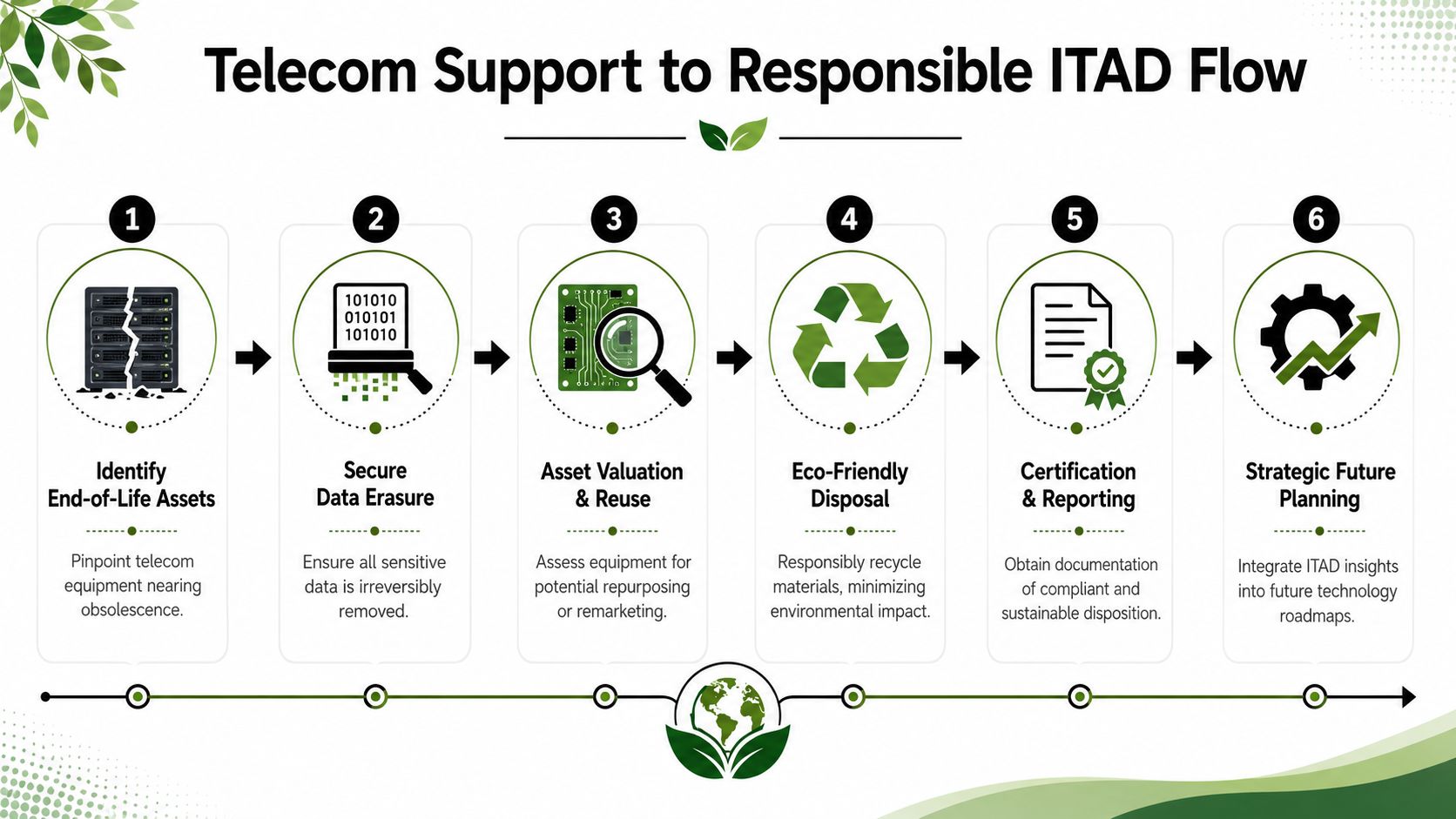
The support partner sees which devices fail repeatedly, which locations still rely on old hardware, and which systems create avoidable ticket volume. That knowledge should inform retirement planning. Once equipment reaches the point where support is mostly preserving fragile legacy infrastructure, the business needs a controlled handoff from maintenance to decommissioning.
What a clean handoff looks like
A useful operating model links support data to disposal planning.
- Identify repeat offenders: Pull devices and sites with chronic incidents, unsupported firmware, or hard-to-source parts.
- Separate reusable from end-of-life equipment: Some telecom assets can be redeployed, held as temporary spares, or remarketed. Others should be retired immediately.
- Control the data risk: VoIP phones, firewalls, routers, and network appliances may hold credentials, logs, or configuration data that shouldn't leave your control untreated.
- Document chain of custody: The retirement process should be traceable from removal through destruction, recycling, or reuse.
Why this matters beyond compliance
When support and ITAD aren't connected, several problems appear fast. Old hardware piles up in closets. Decommissioned devices stay on inventory lists. Facilities teams move or discard equipment without security review. Nobody knows whether drives were destroyed, data was erased, or anything was recycled responsibly.
That's where a specialized ITAD partner belongs in the workflow. Reworx Recycling is one example of a partner that handles telecom-related equipment retirement, including secure data destruction, electronics recycling, computer recycling, office cleanout support, and donation-based recycling programs as part of broader IT equipment disposal and social enterprise recycling work. For buyers replacing routers, switches, VoIP phones, and mixed infrastructure, that kind of support sits naturally beside telecom-focused ITAD planning.
Old telecom gear is still an operational asset until it's documented, sanitized, and removed through a controlled process.
Build the lifecycle into the support contract
You don't need your telecom support provider to become your recycler. You do need them to work cleanly with your ITAD process.
Add a few requirements to your operating model:
- Asset flagging: Require support staff to mark equipment nearing replacement.
- Removal procedure: Define who disconnects, labels, transports, and signs off.
- Secure data destruction: Include standards for drives and storage-bearing devices.
- Environmental handling: Make sure recycling and reuse are documented, especially for bulk refreshes and facility cleanouts.
- Community impact options: If your organization values donation programs or workforce development outcomes, include that in the disposition conversation instead of treating disposal as a last-minute haul-away task.
Responsible lifecycle management assumes strategic importance. Support keeps production stable. ITAD closes the loop with security, documentation, sustainable recycling, and, when appropriate, donation pathways that extend equipment value instead of dumping it into storage.
Building Your Resilient and Sustainable Tech Strategy
Good telecom support reduces downtime. A good procurement process reduces preventable downtime. The difference matters because support isn't a minor line item staffed by interchangeable labor. In the U.S., customer service representatives in telecom earned a median wage of $23.00 per hour, or $47,840 annually, in May 2025, according to the U.S. Bureau of Labor Statistics telecom industry data. That benchmark is a useful reminder that capable support requires real investment.
The right decision usually isn't the cheapest local option or the biggest national brand. It's the provider with a clear support boundary, disciplined escalation, credible onsite capability, and enough operational maturity to work inside your environment without creating extra friction. Businesses feel the payoff in fewer recurring incidents, cleaner communication during outages, and better control over technology change.
There's also a brand and governance dimension. Companies that support equipment properly during use but mishandle it at end of life leave a gap in security and sustainability. Companies that connect support to disciplined decommissioning, secure data destruction, electronics recycling, and donation-based recycling build a stronger operating model. That matters to IT leaders, facilities teams, finance, and sustainability stakeholders alike.
If you're searching for telecom support services near me, treat the phrase as the starting point, not the answer. Define your environment. Shortlist carefully. Vet providers with evidence, not slogans. Then connect support to a responsible asset disposition process so every stage of the technology lifecycle is covered.
If your organization is retiring phones, network hardware, laptops, servers, or mixed office technology as part of a telecom refresh, Reworx Recycling offers a practical next step. Businesses can use Reworx to support secure data destruction, IT equipment disposal, donation-based recycling, office cleanout projects, and pickup coordination while keeping retired electronics out of landfill streams and putting usable technology back into community impact channels. If you're planning a hardware refresh, facility cleanout, or decommissioning project, contact Reworx to schedule a pickup or explore a longer-term partnership.