
A Houston business manager usually calls about telecom equipment liquidation at the same point in the cycle. The new gear is ordered, the migration window is closing, and someone realizes the old routers, switches, radios, servers, and racks are still sitting in a cage, a closet, or a warehouse row that finance wants cleared.
That moment can go two ways. One path treats the pile as waste and pays to make it disappear. The other treats it as an IT asset disposition (ITAD) project with three goals at once: recover value where the market still exists, lock down data and chain-of-custody, and move the rest into responsible electronics recycling or donation-based recycling without creating new compliance problems.
In Houston, that decision matters more than many first-time sellers expect. The local market sits at the intersection of enterprise networking, energy infrastructure, logistics, healthcare, education, and telecom refresh cycles. If you're planning telecom equipment liquidation Houston work for the first time, the operational questions aren't abstract. Who will de-rack it? What still has remarketing value? What needs secure data destruction? What belongs in product destruction or sustainable recycling? And what documentation will your team need after the trucks leave?
The Challenge and Opportunity of Retiring Telecom Assets
A lot of companies still frame retired telecom hardware as a storage problem. That's understandable. Old Cisco switches, carrier transport gear, patch panels, structured cabling components, edge appliances, and backup units take up space fast. They also tend to sit longer than they should because nobody wants to make the wrong call on resale, computer recycling, or disposal.
The better frame is asset strategy. Houston firms in energy, engineering, manufacturing, healthcare, education, and professional services cycle through telecom and network hardware regularly. Some of that gear has secondary market value. Some of it belongs in secure recycling. Some may fit donation-based recycling if it's still usable outside your original environment. But none of those outcomes happen by accident.

Why timing matters in this market
National telecom conditions affect local liquidation. The FCC's high-risk equipment removal effort created a large volume of decommissioned telecom assets. According to reporting on the Rip and Replace funding gap, demand exceeded the initial $1.9 billion budget by over $3 billion, and the same report notes a projected 2% decline in global telecom equipment capex in 2026. For Houston sellers, that means more equipment is competing for buyer attention at the same time.
That doesn't mean liquidation is a bad idea. It means pricing, preparation, and channel selection matter more. In a crowded market, organized lots move better than mystery pallets. Verified configurations move better than unlabeled gear. Clean chain-of-custody moves better than a vague promise that "everything was wiped."
What smart operators do differently
Companies that get good outcomes usually decide early which lane each asset belongs in:
- Resale or buyback: For telecom and network hardware that still has market demand.
- Refurbishment or reuse: For hardware that may not fit your production environment but still has practical life left.
- Electronics recycling: For obsolete, damaged, unsupported, or incomplete equipment.
- Donation pathway: For appropriate equipment that can support community use rather than immediate resale.
Practical rule: If your team can't identify the asset, its status, and who controlled it, don't move it offsite until you can.
That is why a structured asset recovery approach matters. It turns a rushed cleanout into a managed business process. For Houston operations handling office cleanout, facility cleanout, data center decommissioning, or broader IT equipment disposal, that shift is the difference between documented value recovery and a preventable write-off.
Houston context changes the playbook
Houston isn't a single-industry market. A telecom closet in a downtown office tower looks different from one in an energy campus, hospital, warehouse, port-adjacent facility, or university environment. Some projects are tied to mergers, office closures, and lease exits. Others follow network modernization or security refreshes. The common thread is that liquidation has to serve finance, IT, compliance, and facilities at the same time.
That's why the opportunity is larger than "sell old gear." Done well, telecom equipment liquidation Houston projects support budget recovery, reduce storage drag, improve sustainability reporting, and make downstream disposition defensible if legal, audit, or procurement asks questions later.
Before the Pickup Preparing Your Telecom Inventory
Most value is won or lost before pickup day. If your inventory is sloppy, your quote will be conservative. If the receiving team finds surprises, your reconciliation will get worse, not better. The fastest way to reduce confusion is to build a working inventory that someone outside your company can understand without guessing.
A strong inventory does not need to be fancy. It does need to be usable. Spreadsheets are fine. Export files from asset systems are fine. Handwritten notes from the closet wall are not enough.
What to capture on every line item
For telecom equipment liquidation Houston projects, these fields matter because buyers and recyclers use them to sort gear into resale, refurbishment, harvest, or recycling streams.
Inventory checklist
- Manufacturer and model: Cisco, Juniper, Nokia, Ericsson, Dell, HP, APC, and the exact model family.
- Part number: Especially important when similar-looking units have very different resale paths.
- Serial number: Needed for chain-of-custody, audit controls, and data destruction records.
- Quantity: Count actual units, not estimated shelf totals.
- Physical condition: Note cracked bezels, bent ears, missing faceplates, corrosion, missing modules, or heavy rack wear.
- Functional status: Pulled working, untested, powers on only, failed, or for parts.
- Installed components: Power supplies, line cards, optics, supervisor modules, transceivers, drives, rails, and blanks.
- Accessories: Cables, brackets, rack kits, antennas, and original packaging if available.
- Location: Building, room, rack, cage, warehouse bay, or offsite storage.
- Disposition notes: Candidate for resale, secure data destruction, product destruction, or recycling.
That list may look tedious, but it's where recovery starts. A switch chassis without line cards is not valued the same way as a complete, tested unit. A router with missing power supplies creates avoidable friction. An unlabeled pallet becomes a discount.
Separate network gear from everything else
One common mistake is mixing telecom hardware with unrelated surplus in the same inventory. If you blend core switches, VoIP phones, UPS units, desktop monitors, laptops, printers, and lab devices into one bulk list, the project gets harder to price and harder to execute.
Use categories that match how the disposition partner will process the load:
| Category | Typical examples | Why separate it |
|---|---|---|
| Telecom and network core | Routers, switches, firewalls, transport gear | Highest chance of remarketing review |
| Endpoint telecom | Desk phones, conference phones, gateways | Different demand profile and testing process |
| Storage and compute | Servers, arrays, blades | Often handled with separate data destruction workflow |
| Power and rack | UPS, PDUs, cabinets, rails | Heavy handling and low-value bulk if incomplete |
| General e-waste | Monitors, keyboards, broken accessories | Usually recycling, not telecom resale |
| Specialty equipment | Medical equipment disposal or laboratory equipment disposal items | Requires separate review and handling |
Take photos like an operator, not a reseller
Photos don't replace an inventory, but they speed up review. Use wide shots for rack context and close shots for labels, ports, and installed cards. If equipment is still mounted, photograph the front and rear. If there is visible damage, document it directly.
A useful photo set includes:
- Rack overview: Show density and access constraints.
- Label close-ups: Model, serial, and part number.
- Rear panel view: Power supply count, module population, and connector type.
- Damage view: Bent rails, rust, dents, broken latches, or missing covers.
The team quoting your project can't price what they can't identify.
Build an audit file before pickup is scheduled
Your facilities team may want equipment gone immediately. Resist the urge to skip the audit. A short delay for proper documentation is better than a rushed truckload with unclear ownership, mixed categories, and no serialized record.
If you need a reference for how to structure that review, this guide to IT inventory audits before recycling is useful because it aligns operational prep with downstream disposition decisions.
For offices managing laptop disposal, office cleanout, and data center decommissioning in the same quarter, one master inventory with category tabs usually works better than three disconnected lists. Finance gets a clearer reconciliation. IT gets a cleaner device trail. Sustainability gets a cleaner report on what was reused, sold, donated, or recycled.
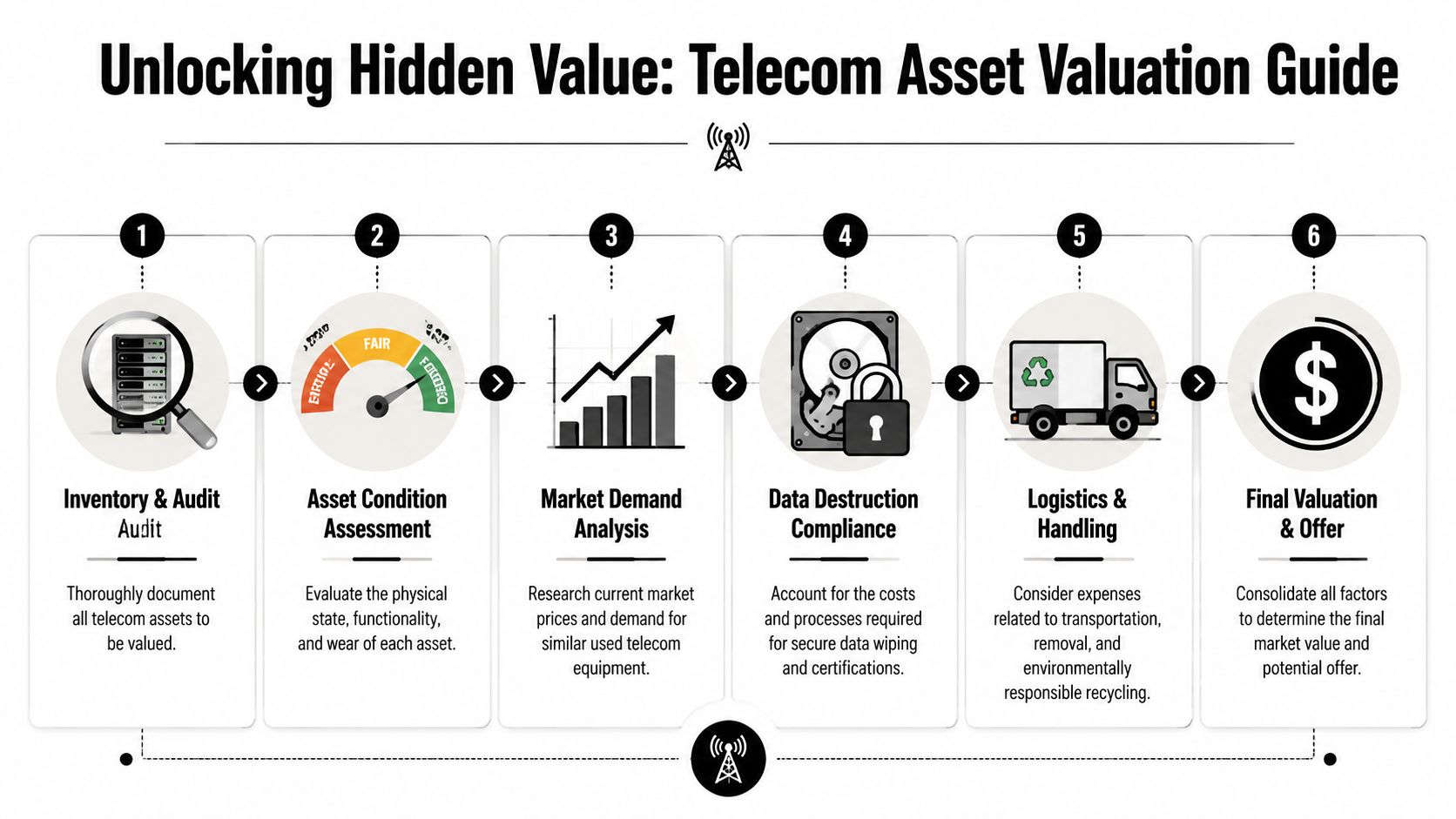
Unlocking Hidden Value A Guide to Asset Valuation
Once the inventory is clean, the next question is simple and uncomfortable. What is this worth?
The wrong answer usually comes from one of two extremes. One is wishful thinking based on original purchase price. The other is surrendering too early and treating everything as scrap. Used telecom hardware doesn't behave like office furniture. Value depends on configuration, demand, completeness, condition, and speed.
Scrap is the floor, not the strategy
Scrap has a place. If gear is obsolete, physically damaged, incomplete, or unsupported to the point that remarketing isn't realistic, recycling may be the right endpoint. But too many first-time sellers jump there because it feels simple.
That shortcut often leaves money on the table. According to industry discussion of telecom equipment sales and liquidation benchmarks, a step-by-step reverse auction methodology can yield a 15-25% higher recovery rate than direct scrap valuation. The same source notes that mid-sized lots of 500 to 5K units see a 68% full value recovery, while a 45-day delay in auditing can erode valuation by 30%.
Those numbers line up with what operators see in practice. Organized, timely, well-described lots give buyers confidence. Delayed, mixed, poorly documented lots invite discounting.
What actually drives telecom value
A practical valuation review usually weighs these factors together:
Market demand for the exact model
Not all Cisco, Juniper, Ericsson, Nokia, or Dell-branded gear moves the same way. Part number matters.Completeness
Chassis-only hardware prices differently from a complete system with cards, power supplies, and accessories.Physical condition
Clean pulls with intact rails and bezels signal lower handling risk.Functional confidence
Pulled from working service is not the same as unknown, and unknown is not the same as failed.Lot structure
Buyers prefer coherent groups. A clean lot of similar switches is easier to remarket than a pallet of unrelated leftovers.
A simple decision matrix
| Asset condition | Likely best path | Common mistake |
|---|---|---|
| Recent, complete, in-demand telecom gear | Buyback or remarketing | Scrapping too early |
| Usable but older hardware | Refurbishment, reuse, or donation | Assuming no one can use it |
| Incomplete or damaged units | Parts harvest or recycling | Spending too much on testing |
| Data-bearing devices mixed into telecom lot | Separate secure destruction workflow | Selling before sanitization |
| Low-value bulk accessories | Bundle selectively or recycle | Paying to store them indefinitely |
Reverse auction works when the lot is ready
Reverse auction sounds complicated, but the logic is straightforward. Instead of accepting the first bulk offer, the seller prepares the inventory, confirms sanitization requirements, and puts a marketable lot in front of multiple qualified buyers. That process tends to outperform a direct scrap quote because buyers can bid on reuse value, not just commodity value.
Operator note: Buyers pay more when they believe your manifest, your photos, and your chain-of-custody.
Disciplined ITAD remains critical in these scenarios. When serial numbers are missing, modules are misplaced in incorrect boxes, and functional status is unclear, the auction process loses its edge. The method only works when the prep work is real.
Buyback isn't the only form of value
Some equipment won't justify extensive resale handling. That doesn't mean it has no value. For certain organizations, donation-based recycling creates a different kind of return. Functional devices can support digital access, training, nonprofit operations, or internal corporate donation programs. Equipment that doesn't belong in donation can still move through sustainable recycling with documented downstream handling.
If you're weighing those paths, this overview on maximizing value in IT asset disposition is useful because it treats resale, reuse, and recycling as a portfolio decision, not a single yes-or-no choice.
That distinction matters in Houston. A fast office relocation might favor immediate buyback on the strongest assets and responsible recycling on the rest. A company with a stronger CSR mandate may choose to reserve certain functional assets for social enterprise recycling outcomes instead of chasing marginal resale dollars. Both can be rational. What doesn't work is letting equipment sit until every option gets worse.
Securing Data and Meeting Houston's E-Waste Rules
The biggest mistake in telecom liquidation isn't usually pricing. It's treating data-bearing equipment like ordinary surplus. Routers, switches, firewalls, unified communications systems, and related appliances may retain configuration data, credentials, logs, and storage media long after they leave production. If your team sells or recycles first and asks sanitization questions later, you've reversed the order that protects the business.
Data protection has to come before value recovery. That applies whether you're handling a small closet cleanout, a larger data center decommissioning, or mixed IT equipment disposal across multiple Houston locations.
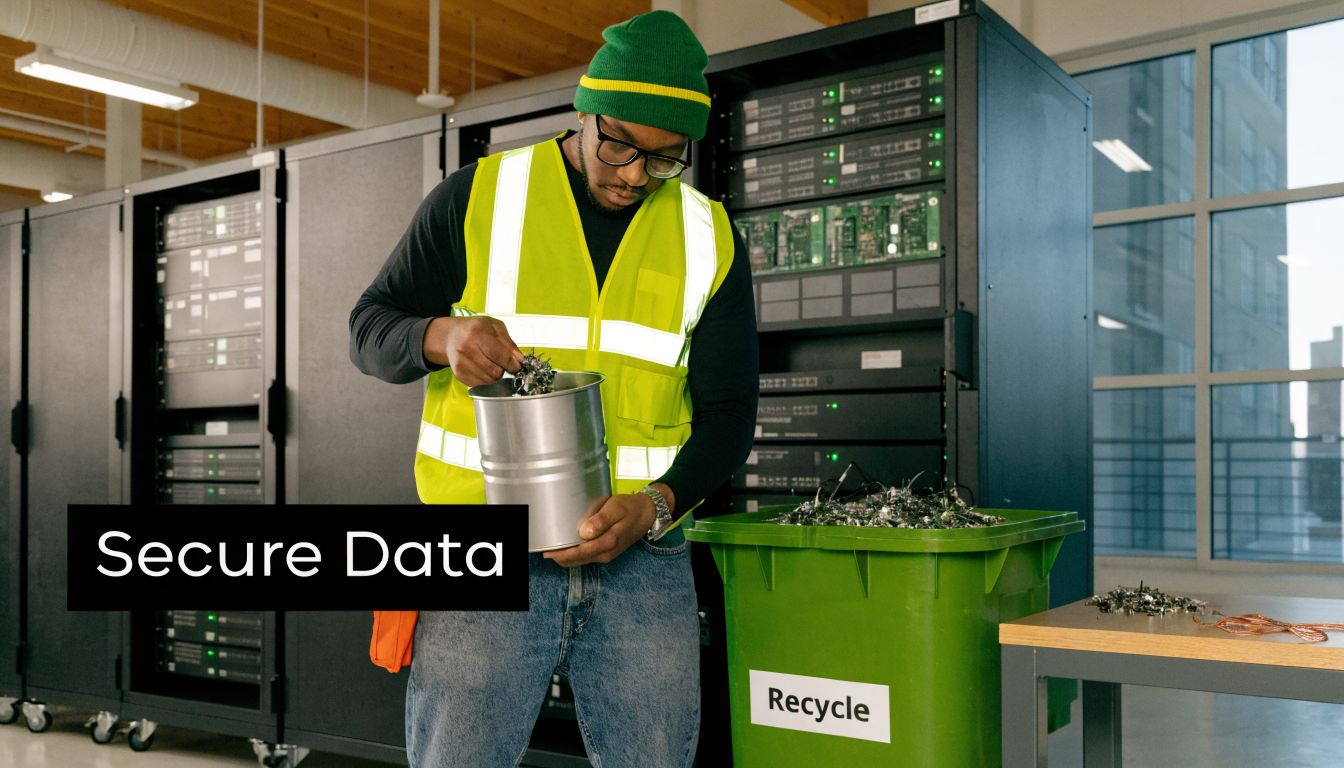
Match the destruction method to the media
Not every asset needs the same treatment. The practical goal is defensible sanitization tied to the actual hardware.
- Software wiping: Appropriate where media can be sanitized and verified through a documented process.
- Physical destruction: Appropriate where media is failed, inaccessible, high-risk, or your policy requires destruction.
- Configuration clearing: Necessary for network gear that stores credentials or operational settings even when no obvious drive is present.
The verified market data for telecom liquidation specifically references DoD 5220.22-M 3-pass wiping, NSA-approved shredding for some media types, and NIST SP 800-88 reporting as part of a robust sanitization workflow in telecom asset recovery. That should tell you something important. Serious disposition work treats sanitization as an auditable process, not a checkbox.
Ask for records, not reassurances
A provider's verbal promise doesn't help much in an audit. Your team needs paperwork that maps to the assets you released. At a minimum, expect a clear chain-of-custody, serialized tracking where applicable, and a certificate or report that confirms what happened to data-bearing media.
If a vendor can't explain how they document sanitization, they probably can't defend it later.
Many managers also benefit from strengthening their internal asset controls before liquidation starts. If you're cleaning up older telecom inventory records or trying to align ITAM with end-of-life handling, this ITAM guide from Finchum Fixes IT is a practical planning resource because it highlights the systems side of tracking devices before they become a disposition project.
Environmental compliance is part of the risk picture
Houston businesses also need to think beyond data. Telecom and network hardware often includes metals, boards, plastics, batteries, and components that shouldn't end up in ordinary trash streams. Responsible electronics recycling means maintaining documented downstream handling and avoiding vague disposal channels.
The Houston liquidation ecosystem already sets a benchmark here. Local providers in this market commonly position EPA-aligned disposal and DoD-style data handling as core services. Your standard should be the same whether the project is telecom liquidation, computer recycling, laptop disposal, medical equipment disposal, or a larger facility cleanout.
A useful rule is to ask the same three questions every time:
- What happens to reusable assets?
- What happens to data-bearing assets?
- What happens to non-repairable material at final recycling?
For Houston teams seeking a documented route for secure chain-of-custody and end-of-life handling, secure IT asset disposition services in Houston are the kind of framework worth comparing against your current process. The names of the certifications matter. The paperwork matters more.
How to Select a Trusted Houston Liquidation Partner
A Houston telecom liquidation project usually looks manageable until the trucks are scheduled and the questions get specific. Who is de-racking the gear. Who signs for each pallet. How will disputed counts be handled. When does the settlement arrive. The right partner answers those questions clearly before pickup day, not after.
Vendor selection gets easier when you stop listening for broad claims and start testing operational detail. A qualified partner should be able to explain labor scope, chain-of-custody, asset reconciliation, resale process, recycling outlets, and final reporting without drifting into sales language. If you need a practical framework for selecting a trusted Houston liquidation partner, use it to compare how each provider documents risk, not just how they price the job.

Questions that separate a serious operator from a pickup vendor
Start with scope control.
Can they manage on-site removal in a live business environment?
Houston offices, hospitals, campuses, and industrial sites often have loading dock rules, access windows, badging requirements, and elevator limits. A partner that has only warehouse capability can create delays fast.Can they handle mixed asset categories without losing accountability?
Telecom projects often include switches, routers, handsets, UPS units, racks, cabling, monitors, and general IT surplus. You want one inventory trail across all of it, even if the disposition path differs by asset class.What does their reporting package include? Ask for sample documents. Look for serialized inventory results, certificates for data-bearing devices, weight or category reporting for recycled material, and a settlement statement that is easy for finance to audit.
How do they price the deal?
A high headline offer can hide labor exclusions, freight deductions, low recovery assumptions, or broad downgrade language for condition disputes. Clear pricing beats optimistic pricing.Can they explain downstream handling by asset class?
Reusable hardware, scrap boards, batteries, and damaged devices should not disappear into a vague "processed responsibly" bucket. Houston businesses need traceability, especially if procurement, legal, or sustainability teams will review the file later.
Compare service models before you compare quotes
Two bids can look close and still represent very different outcomes for cash recovery, timing, and risk.
| Model | Best fit | Trade-off |
|---|---|---|
| Outright purchase | Clean, marketable telecom lots with known demand | Faster close, but buyer usually builds in margin protection |
| Revenue sharing | Assets with stronger resale upside and good audit visibility | Better upside potential, but settlement takes longer |
| Fee-based recycling with selective buyback | Mixed, obsolete, or labor-heavy projects | More accurate for real-world cleanouts, less appealing if you expect a pure sale |
| Donation-oriented disposition | Functional equipment tied to CSR or reuse goals | Lower immediate cash return, stronger community outcome |
For Houston firms, logistics often decide which model makes sense. A downtown office tower with strict dock access, or a suburban campus with multiple telecom closets, may favor a provider that can combine labor, transport, triage, and reporting under one statement of work. That usually costs more upfront, but it reduces disputes and internal project time.
Reputation matters, but proof matters more
A provider's public reputation has value. It signals how they handle communication, follow-through, and problem resolution. Companies that care about brand trust often pay attention to the broader link between operations and perception, which is why this piece on digital growth through online reputation management is relevant background for leadership teams.
Still, reputation should support the decision, not carry it. In liquidation, the stronger test is whether the provider can show sample reconciliation reports, insurance coverage, service terms, and a clear dispute process. Ask who owns loss risk at each handoff. Ask how they handle missing tags, damaged pallets, and non-conforming material discovered after pickup. Experienced firms answer directly because these issues come up in real projects.
Why a social enterprise model belongs on the shortlist
Some Houston businesses want more than resale recovery and compliant recycling. They want a disposition plan that can direct appropriate equipment toward reuse or donation when that fits the asset condition and the company's goals. That option is worth considering during vendor selection, not as an afterthought once the high-value gear is gone.
Reworx Recycling is one example. The organization handles secure data destruction, pickups, IT equipment disposal, and donation-based recycling within a social enterprise model. For a business manager, the practical question is simple. Can this partner sort assets into the right path, maximize recoverable value where the market supports it, and document responsible reuse or recycling for the rest. If the answer is yes, that model can satisfy finance, compliance, and community-impact priorities in the same project.
A short vetting checklist
Use this filter in every vendor call and every proposal review.
- Defined scope: Labor, packing, transport, and asset counting are spelled out.
- Houston execution capability: The team can work within building access rules, site safety requirements, and multi-location pickup plans.
- Financial clarity: The quote explains purchase terms, shared recovery terms, fees, deductions, and payment timing.
- Disposition transparency: Resale, donation, recycling, and destruction paths are identified clearly.
- Audit-ready reporting: Inventory reconciliation and financial settlement documents are suitable for internal review.
If a provider stays vague on those points, expect problems in the field or in the final settlement. In telecom liquidation, those usually arrive together.
Beyond Liquidation Partnering with Reworx for Community Impact
Most telecom liquidation articles stop at resale and recycling. That's incomplete. Businesses don't just retire hardware. They decide what kind of downstream outcome they want tied to that retirement.
For some Houston organizations, the right answer is straightforward asset recovery. For others, the better answer blends value recovery with social impact. That can include donation-based recycling, corporate donation programs, and refurbishment pathways that keep useful technology in circulation instead of reducing every retired asset to scrap.
What changes when community impact is part of the plan
The first change is how you classify equipment. Not everything belongs in the same financial bucket. Some assets should go through buyback. Some belong in secure recycling. Some, if still suitable and properly processed, may support nonprofits, schools, workforce programs, or digital inclusion efforts.
That framework is useful for companies managing more than telecom gear. If your project also includes computer recycling, laptop disposal, office cleanout work, or even specialty streams like laboratory equipment disposal, a mixed-outcome model gives you more flexibility than an all-or-nothing liquidation approach.
The practical benefit for Houston businesses
A social enterprise approach doesn't remove the need for discipline. You still need inventory, chain-of-custody, secure data destruction, and responsible downstream handling. The difference is that usable equipment can continue delivering value after it leaves your balance sheet.
Retired equipment can still do useful work, either through resale, reuse, or carefully managed donation. The mistake is assuming landfill or scrap is the default.
That matters in Houston because many companies are under pressure from multiple directions at once. Finance wants efficient disposition. IT wants risk reduction. Sustainability leaders want measurable diversion from waste streams. Community relations teams want credible local impact, not generic claims.
A thoughtful end-of-life program can satisfy all four if the project is designed that way. Telecom equipment liquidation Houston work doesn't have to be a narrow cleanout exercise. It can also support sustainable recycling goals and strengthen the company's internal story about how it handles surplus technology.
What to do next
Start with a real inventory. Separate data-bearing assets from everything else. Identify which lots are candidates for buyback, which belong in secure recycling, and which could fit a donation pathway. Then choose a partner that can document every handoff and explain the downstream route for each category.
That is how you turn a storage problem into a controlled business process with operational, financial, and community value.
FAQs for Telecom Equipment Liquidation in Houston
How much telecom equipment do we need before liquidation is worth scheduling
You don't need a full data center to start. Smaller lots can still make sense if the equipment is organized and the pickup aligns with a larger office cleanout, facility cleanout, or refresh cycle. What matters most is whether the inventory is clear enough for a partner to determine what should be resold, recycled, or destroyed.
If you only have a few shelves of equipment, bundle the project intelligently. Include related network hardware, phones, servers, and other approved surplus rather than sending out fragmented loads over several months.
Can we liquidate telecom gear if we don't know whether every unit works
Yes, but label the uncertainty clearly. "Pulled working," "untested," and "failed" are different categories, and buyers price them differently. Don't let your team guess just to improve the spreadsheet.
For first-time sellers, accurate unknowns are better than optimistic assumptions. They reduce disputes, protect settlement value, and help the disposition partner route assets correctly.
What should stay out of the telecom liquidation lot
Keep obviously unrelated materials out of the lot unless the provider has agreed to handle a mixed pickup. That includes general trash, furniture, paper records, and anything hazardous outside the approved electronics recycling stream. Also isolate devices that need a different data workflow.
If your project includes medical equipment disposal, laboratory equipment disposal, or product destruction needs, flag those categories early. They often require separate handling, approvals, or packaging instructions.
If your Houston team is planning telecom equipment liquidation, office cleanout work, or broader IT asset disposition, Reworx Recycling is a practical starting point for evaluating donation-based recycling, secure data destruction, pickup coordination, and responsible electronics recycling options. Reach out to discuss your inventory, schedule a pickup, or build a disposition plan that supports both operational goals and community impact.