

A search for a telecom contractor near me typically isn't casual browsing. Something is already pushing the decision. A branch office is opening. A warehouse expansion needs fiber and wireless coverage. A phone system is failing at the worst time. Or a network refresh has turned into a scramble because the old gear, cabling, and documentation don't match what's in the field.
That's why this hire deserves more attention than a quick quote comparison. Telecom work touches uptime, physical infrastructure, security, permits, site access, testing, and handoff quality. If the contractor gets one of those wrong, the problem doesn't stay inside the IT closet. It spills into operations, customer service, and finance.
A good telecom partner also affects what happens after the install. When old switches, phones, routers, access points, and cabling come out, somebody has to manage decommissioning, secure data destruction, and responsible electronics recycling. That last mile gets ignored too often, even though it's part of the overall project cost and risk profile.
Why Your Choice of Telecom Contractor Matters
A telecom project can look small on paper and still create outsized disruption. One missed cutover window, one unlabeled patch panel, or one sloppy handoff can leave a site half-operational while your staff waits for dial tone, Wi-Fi coverage, or circuit activation.

Telecom is no longer a niche utility, a fact reflected in its immense scale. The U.S. telecommunications market serves about 335 million people and is valued at a minimum of $118 billion, and U.S. mobile subscriptions reached 390.99 million in 2024, implying about 115% mobile penetration, according to telecommunications industry statistics compiled from FCC-based estimates. For a business buyer, that scale matters because dense mobile and broadband usage keeps pressure on network builds, upgrades, and maintenance.
The wrong hire creates problems that don't show up in the bid
Cheap bids often hide the hardest costs. You see a labor number. You don't see weak project management, poor test documentation, missing labels, unclear scope assumptions, or a crew that's comfortable with legacy voice work but not modern IP-based infrastructure.
A contractor should be able to explain the entire path from site survey to final activation in plain language. If they can't do that in a meeting, they probably won't do it well in the field.
Practical rule: If the contractor treats testing, documentation, and change control like paperwork, expect rework later.
Business continuity is the real buying criterion
Most companies don't need the fanciest installer. They need a partner who protects continuity while the work is happening. That means realistic scheduling, safe installation practices, clear escalation contacts, and acceptance standards before anyone calls a site complete.
It also means planning for retirement of replaced hardware. If a project includes old storage, handsets, firewalls, or servers, data handling belongs in the same risk conversation as cabling and activation. Teams that need a documented chain of custody for retired devices often look at providers with formal data-destruction credentials such as NAID AAA certified service standards.
Modern telecom work crosses departments
Facilities cares about access, permits, ceilings, pathways, and contractor safety. IT cares about performance, labeling, failover, and cutover risk. Procurement cares about contract terms and change orders. Finance cares about lifecycle cost. A strong telecom contractor works comfortably across all of those conversations.
That's why this isn't just a technical hire. It's an infrastructure decision with operational consequences.
Strategies for Finding Reputable Local Telecom Experts
A search engine query is fine for a starting list. It's a poor method for making the final shortlist. The best local contractors are often found through people who see their work up close, not through whoever bought the most visible ad placement.
Start with the people who see field performance
Commercial property managers, tenant improvement coordinators, electricians, low-voltage consultants, and structured cabling vendors usually know which telecom crews finish cleanly and which ones create call-backs. Ask them direct questions.
Try these:
- Who finishes with complete closeout documents: Not just invoices, but test results, labels, and as-builts.
- Who communicates well during occupied-site work: Especially if your office, clinic, or warehouse stays live during the project.
- Who handles modern infrastructure confidently: Fiber, VoIP, Wi-Fi, wireless backhaul, and IP-based systems.
In major markets like Florida, regulators reported 23 million wireless subscriptions and about 4.6 million VoIP connections in 2022, while traditional wireline access continued to decline, according to the Florida telecommunications industry report. That's a practical reminder to screen for current skills, not just years in business.
Build a shortlist from business channels, not just consumer reviews
Consumer review sites can help you spot obvious problems. They won't tell you much about multi-site rollouts, MDF and IDF work, or carrier coordination. Better channels include local chambers of commerce, commercial real estate networks, facilities associations, and IT peer groups.
A useful cross-check is to compare a telecom specialist with broader external IT management options when your project overlaps managed services, onsite support, or post-install maintenance. That comparison helps you separate pure field-install work from ongoing operational support.
Filter for local relevance
A local contractor should understand your city's practical constraints. Downtown access rules differ from suburban office parks. Hospital campuses differ from manufacturing sites. Historic districts, schools, and municipal buildings each create their own permitting, scheduling, and safety demands.
Use a filter like this when reviewing candidates:
| What to check | Why it matters |
|---|---|
| Similar building type | Office, warehouse, school, clinic, and retail sites all install differently |
| In-house vs subcontracted scope | More handoffs usually mean more coordination risk |
| Carrier and ISP coordination experience | Circuit turn-up often fails on coordination, not equipment |
| Documentation quality | Good closeout reduces future troubleshooting time |
If you're starting from a local search, a page focused on hiring a telecom company near you can help frame the questions before you invite bids.
Ask for one recent project that looks like yours in size, occupancy, and technology. Similarity matters more than a generic project list.
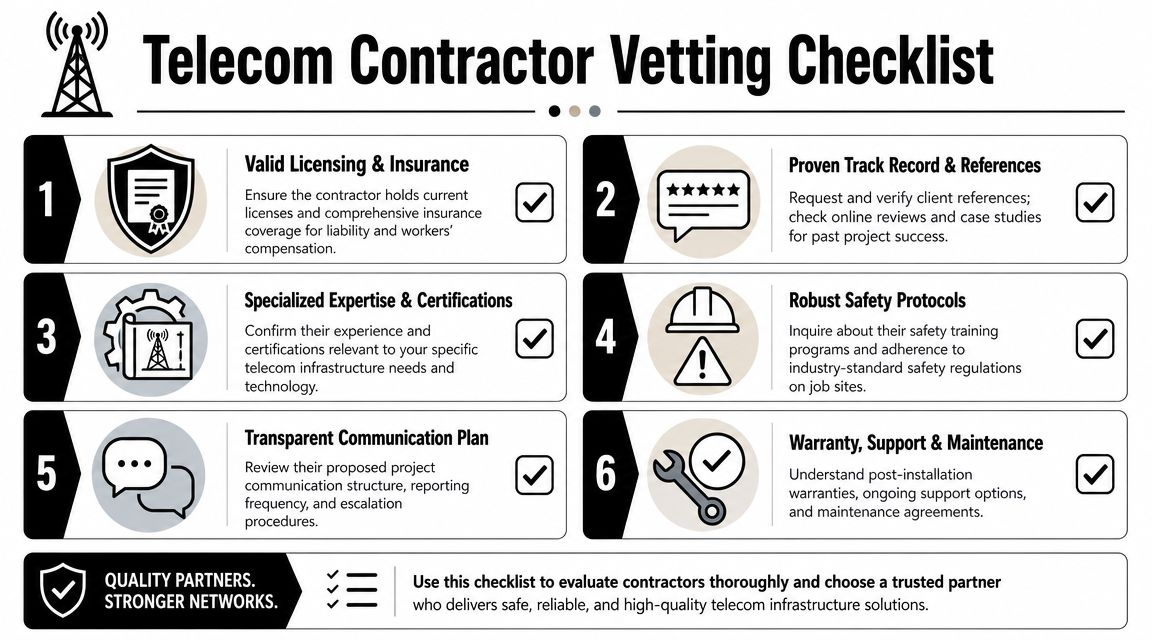
The Essential Contractor Vetting Checklist
A polished proposal doesn't prove execution quality. Vetting does. It allows buyers to separate a firm that can deliver from one that only knows how to estimate.
Confirm legal and risk basics first
Before you discuss pricing in detail, verify the contractor's licenses, insurance certificates, and scope alignment. For telecom and low-voltage work, that means checking that the entity named in the contract is the same one carrying the insurance and performing the work.
Use this baseline checklist:
- Licensing status: Verify that the firm is properly licensed for the work and jurisdiction involved.
- Insurance documents: Ask for current certificates covering general liability and workers' compensation. If the work includes design, engineering input, or advisory responsibility, ask how professional risk is handled.
- Named project contacts: You need to know who owns the field crew, who owns schedule updates, and who can approve changes.
If a contractor hesitates to share paperwork early, treat that as a warning sign, not an administrative delay.
Validate technical fit, not just general experience
A contractor can be solid and still be wrong for your job. Office voice migration, fiber extension, campus Wi-Fi improvements, and outside plant work don't all demand the same strengths.
Ask for evidence tied to your environment:
- test report samples
- labeling standards
- sample closeout package
- manufacturer familiarity where relevant
- explanation of how they handle punch lists and failed acceptance items
This matters even more if the project touches multiple sites or includes decommissioning. If you expect telecom retirement work and downstream asset handling, it helps to understand related telecom support services near you so the field work and post-project cleanup don't get split into disconnected workflows.
The strongest references usually describe how the contractor handled surprises, not how they performed when everything went smoothly.
Check references with sharper questions
Most buyers waste references by asking if the contractor was “good.” That question never gets useful detail. Ask what happened when scope changed, a circuit didn't test cleanly, or another trade caused a delay.
Here are better prompts:
- What did the contractor miss in the original scope?
- How did they document changes and associated cost impacts?
- Were test results delivered before sign-off or only after chasing them?
- How did the site look at the end of each shift?
- Would you trust the same PM on an occupied site again?
Look for process maturity in communication
You're not only hiring installers. You're hiring a communication system. A mature contractor sets meeting rhythm, issue logs, escalation paths, and approval points before work starts.
A simple comparison helps:
| Weak signal | Strong signal |
|---|---|
| “We'll figure it out onsite” | Written meeting cadence and escalation contacts |
| Generic closeout promise | Sample deliverables and acceptance process |
| Loose scope language | Clear inclusions, exclusions, and assumptions |
| Verbal updates only | Written daily or milestone reporting |
A contractor who can't show structure in pre-award conversations usually won't create structure later.
From Project Scope to Smart Bid Comparison
Bad telecom bids usually start with a vague request. If you ask three contractors to “wire a new office” or “upgrade the network,” you won't get comparable proposals. You'll get three different interpretations, three different material assumptions, and three prices that can't be evaluated fairly.

A detailed scope does more than improve estimating. It forces everyone to price the same job.
What your scope should spell out
At minimum, a workable Statement of Work should identify locations, quantities, cable types, rack or cabinet requirements, labeling expectations, testing requirements, schedule windows, and owner-furnished versus contractor-furnished materials.
A practical scope often includes:
- Site details: Building address, floor plans, room IDs, access restrictions, after-hours rules.
- Infrastructure requirements: Data drop counts, cable category, fiber type, pathways, patch panels, racks, grounding, and labeling conventions.
- Testing and handoff: Copper certification, fiber validation, acceptance format, as-built expectations, and turnover package contents.
If the project involves replacement or removal of old equipment, note that too. Otherwise, every bidder will treat decommissioning differently. Some will exclude it quietly.
Why low price alone is a poor decision rule
Industry guidance on telecom sourcing says organizations using a structured process report 15 to 35% savings when the work includes spend analysis, market benchmarking, and a formal RFP process that compares total cost of ownership rather than headline price, according to telecom cost management guidance from Tellennium. That aligns with what experienced buyers see in practice. The cheapest first-year number often becomes the most expensive project after adds, fixes, and support gaps.
Bid comparison works best when every line item maps back to a scope requirement, a testing requirement, or a handoff requirement.
Use a scorecard, not a gut feeling
A scorecard keeps the team from overreacting to one number. Procurement, IT, and facilities may weigh criteria differently, but the framework should stay consistent.
Here's a simple model:
| Evaluation area | What to compare |
|---|---|
| Scope completeness | Did the bidder address every required deliverable and assumption |
| Materials and standards | Are the proposed components appropriate for the environment |
| Testing and closeout | Is acceptance clearly defined and documented |
| Project management | Who runs the job, how often updates occur, how issues escalate |
| Lifecycle cost | Installation, support, change work, future upgrades, disposal impacts |
This is also the point where project-closeout planning belongs in the bid review, not after award. If equipment is coming out, include IT asset disposition, secure data destruction, and electronics recycling in the comparison. One option businesses consider for that downstream scope is telecom solutions near you, including providers such as Reworx Recycling for telecom equipment retirement and related disposal workflows.
Negotiating Contracts and Managing Project Execution
Once you've chosen a contractor, the contract needs to remove ambiguity. Good field teams can still get boxed into bad outcomes when the paperwork is loose. The goal isn't to produce a long agreement. It's to define how money, changes, quality, and risk will be handled when the project stops being theoretical.
Contract terms that protect the owner
Three clauses do most of the heavy lifting.
First, tie payment milestones to actual deliverables. Don't release major payments on mobilization language alone if the meaningful work is testing, documentation, and activation.
Second, define the change-order process in writing. Field conditions change. Scope assumptions fail. That's normal. What causes trouble is undocumented work followed by surprise billing.
Third, write acceptance criteria into the contract, not just the proposal. If uptime, latency, packet loss, response time, restoration targets, or labeling standards matter, they need to be explicit.
Execution discipline separates strong contractors from risky ones
Field guidance for telecom construction emphasizes process discipline across route planning, utility locates, permitting, installation, testing, and activation. It also stresses mandatory utility locates before excavation, OTDR-style validation for fiber before service goes live, and a formal risk register, according to telecommunications contractor field guidance. That's the standard to hold during execution.
Translate that into owner actions:
- Appoint one internal lead: One person consolidates decisions and prevents conflicting instructions.
- Run short recurring check-ins: Weekly is often enough for straightforward jobs. More often if the site is active or the schedule is compressed.
- Inspect before covering work: Ceiling closures and wall finishes make bad installs expensive to revisit.
- Require written issue logs: If there's a permit delay, material substitution, or failed test, document owner action and contractor action the same day.
A project falls behind long before the schedule officially slips. It starts when no one owns unresolved decisions.
Site verification should happen throughout the job
Don't wait until final walkthrough to discover missing labels, incomplete pathways, or hardware mounted in the wrong location. Walk the work at milestones. Verify closets before patching. Verify pathways before ceilings close. Verify test results before activation.
That oversight doesn't slow a good contractor down. It keeps the project from drifting away from the agreed scope.
Project Closeout and Sustainable Equipment Disposal
The closeout phase tells you whether the contractor finished the job or just stopped working onsite. Final payment should follow final verification, not the other way around.

What complete closeout looks like
A proper closeout package usually includes as-built documentation, test results, labeling confirmation, warranty details, open-item resolution, and a final walkthrough. If the contractor touched existing infrastructure, the package should also show what was removed, abandoned, or left in service.
That matters because old telecom assets have a way of lingering. Unused phones remain in storage. Retired switches sit in closets. Circuits appear disconnected but still have hardware attached somewhere onsite. If nobody owns removal and disposition, clutter becomes risk.
Decommissioning should include security and sustainability
Retired telecom and IT hardware can still contain sensitive data, configuration history, or embedded storage. On top of that, dumping old devices into general waste creates environmental and compliance problems that are easy to avoid with a deliberate process.
A clean closeout plan should address:
- Asset segregation: Separate reuse candidates from scrap and data-bearing devices.
- Chain of custody: Track what leaves the site and who received it.
- Secure data destruction: Apply it where devices or components store business information.
- Responsible recycling or donation: Route viable equipment and scrap streams appropriately.
For organizations planning office cleanouts, network refreshes, data center decommissioning, or broader ITAD programs, a dedicated partner for telecom equipment recycling near you can handle the disposal side after installation is done. That's where electronics recycling, donation-based recycling, computer recycling, product destruction, and secure data destruction become part of the same lifecycle conversation rather than an afterthought.
The best telecom projects don't end at activation. They end when the old environment has been retired safely, documented properly, and removed responsibly.
If your business is upgrading network infrastructure, clearing out retired phones and switches, planning a facility cleanout, or coordinating secure IT equipment disposal after a telecom project, consider working with Reworx Recycling. Reworx Recycling supports responsible electronics recycling, secure data destruction, and donation-based recycling programs that help organizations retire equipment without treating closeout like an afterthought. Reach out to schedule a pickup, donate old equipment, or build a repeatable disposal process into your next rollout.