The most common advice for a sustainability director is to improve reporting, refine the ESG narrative, and prepare better board slides. That advice is incomplete. A polished report can't compensate for unreliable asset data, unclear ownership, or a technology retirement process that sends sensitive equipment into an undocumented recycling stream.
In IT and facilities management, sustainability becomes credible when it changes a workflow. A laptop receives a disposition decision, a server leaves a data center with a documented chain of custody, a procurement team sees reuse requirements in a contract, and finance can connect the result to avoided cost, risk reduction, or recovered value. The sustainability director's real job is to build that operating discipline across departments.
The Modern Sustainability Director Mandate
The sustainability director is no longer the person who gathers environmental information from other teams. The role has become a cross-functional operating function, connecting finance, legal, procurement, facilities, IT, human resources, and operations around decisions that can be measured and defended.
That shift matters because sustainability targets often fail at the handoff. Finance may approve a capital plan without lifecycle criteria. IT may replace equipment without a defined reuse route. Facilities may arrange an office cleanout without separating data-bearing devices from ordinary waste. Legal may understand regulatory exposure but lack the operational records needed to demonstrate control.
A practical sustainability director creates the conditions for those teams to act consistently. That means defining who owns each decision, which data must be captured, how evidence is stored, and when an issue must reach an executive or board committee. A sustainability report can communicate the outcome, but the operating model produces it. For context, leaders who need a reporting foundation can review this guide to sustainability reporting, then connect its disclosures to the workflows that generate the underlying evidence.
From narrative management to operating control
The strongest directors I've worked alongside don't begin with a list of every possible ESG metric. They start by identifying the decisions with material operational consequences, such as hardware purchasing, data center decommissioning, fleet management, building energy use, supplier selection, and waste handling.
They then establish a small set of decision rights:
- IT owns asset records and security classification.
- Facilities owns site access, staging areas, and pickup coordination.
- Procurement owns contractual requirements and vendor performance.
- Legal and compliance own retention, privacy, and regulatory interpretation.
- Finance validates cost, savings, recovered value, and capital implications.
- The sustainability director governs the common method and escalates unresolved conflicts.
This approach moves sustainability away from symbolic activity and toward measurable financial value. It also makes the role useful in a small or mid-sized business, where one sustainability leader may coordinate compliance, capital planning, risk management, and community impact without a large ESG department.
Practical rule: If a sustainability target has no named process owner, data owner, and evidence trail, it isn't an operating target yet.
The director should also know what to stop doing. Exhaustive data collection can consume resources without improving decisions. A better standard is to prioritize a limited number of material outcomes, verify the inputs, and explain uncertainty rather than overpromising. In practice, that means treating sustainability as the company's operating system for environmental and social decisions, not as a communications layer placed on top of business activity.
Evolution of the Corporate Sustainability Role
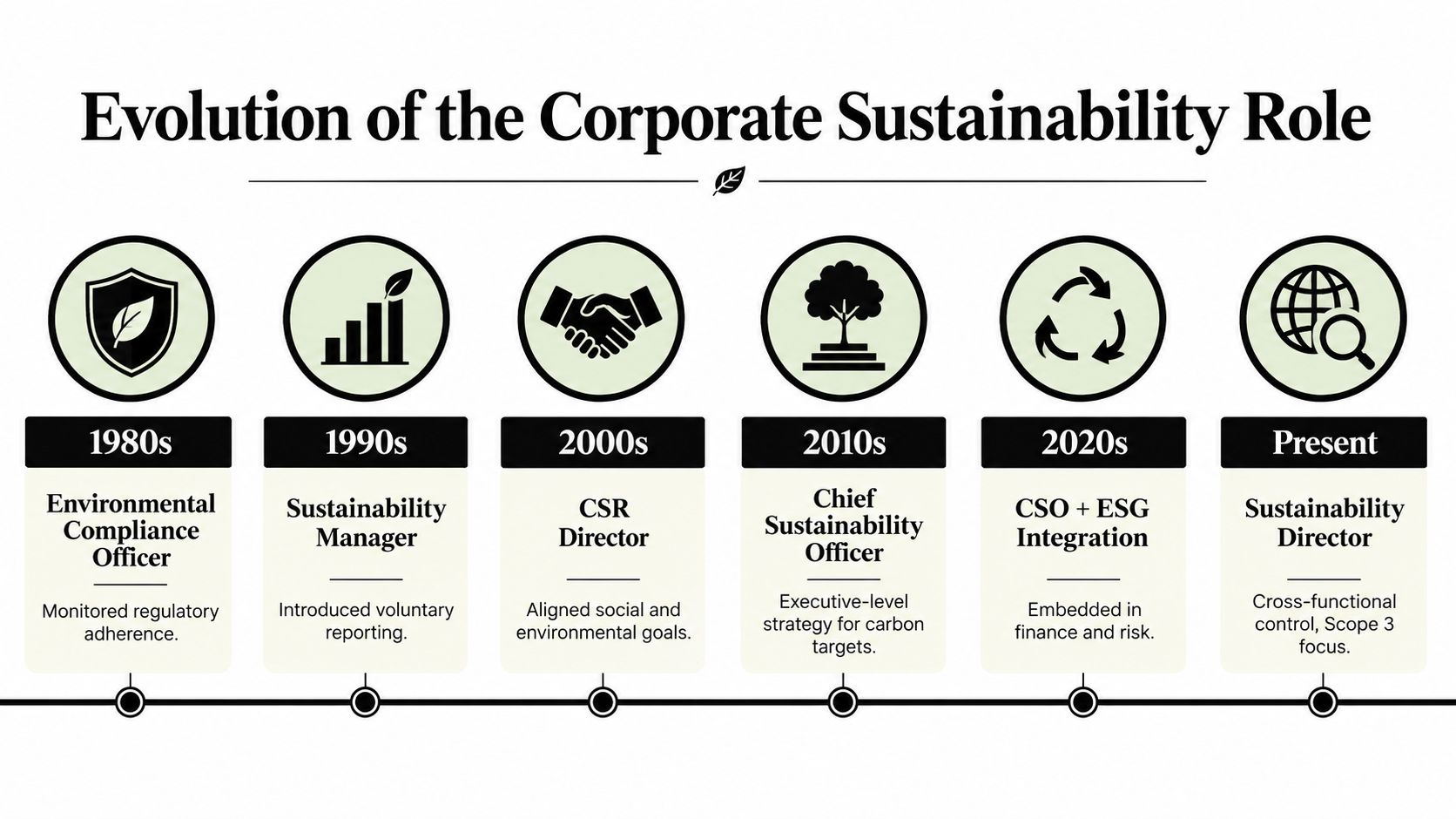
The modern sustainability role grew from earlier environmental compliance work. During the late 1980s and 1990s, organizations commonly treated environmental responsibility as a regulatory and risk-control function. Over time, environmental managers and sustainability specialists began adding voluntary reporting, stakeholder engagement, resource efficiency, and broader social concerns to that mandate.
The role became more visibly executive in the 2000s. A widely cited milestone came in 2004, when DuPont appointed Linda Fisher as the first Chief Sustainability Officer at a publicly traded U.S. company, according to the Weinreb Group history of the CSO role.
Why the title carries institutional weight
The title's growth shows that boards increasingly view sustainability as part of enterprise strategy rather than an occasional communications assignment. In 2011, a survey identified just 29 U.S. public companies with a CSO title. By March 2021, that number had grown to 95, and by 2023 it had reached 183 U.S. public companies, as documented by the Weinreb Group CSO research.
Those figures describe more than hiring activity. They show institutionalization. A function that once sat near environmental compliance now appears in board-level discussions about risk, capital allocation, supply chains, reporting controls, and resilience.
The labor market reflects the same change. In the United Kingdom, average monthly vacancies for sustainability directors reportedly rose from about 10 per month at the start of 2020 to more than 200 per month in 2022. Over six years, average salaries increased 7.7% to a median of £62,200, while top salaries reached £110,000 annually, according to Sustainability Magazine's coverage of senior sustainability roles.
The implication for today's director is direct: the title carries an expectation of execution. Boards may still need clear communication, but they also need assurance-ready evidence, credible targets, and decisions that survive scrutiny from finance, legal, customers, employees, and regulators. A director building that capability can use practical guidance on corporate sustainability goals as a starting point, provided the goals are connected to accountable operating processes.
Cross-Functional Execution and Scope 3 Management
A sustainability director's technical authority begins with the emissions inventory. The role typically includes building Scope 1, 2, and 3 greenhouse-gas inventories, defining organizational and operational boundaries, governing emission factors, maintaining calculation records, and connecting reductions to procurement, engineering, logistics, and facilities plans. The Chief Sustainability Officer role overview describes this work as a central part of the function.
Scope 3 requires particular discipline because it reaches beyond facilities the company directly controls. The GHG Protocol organizes value-chain emissions into 15 categories, with companies reporting them separately by category in metric tons of CO2e, excluding biogenic CO2. The technical description of Scope 3 accounting provides the benchmark for determining where reduction activity should concentrate.
A workable control framework
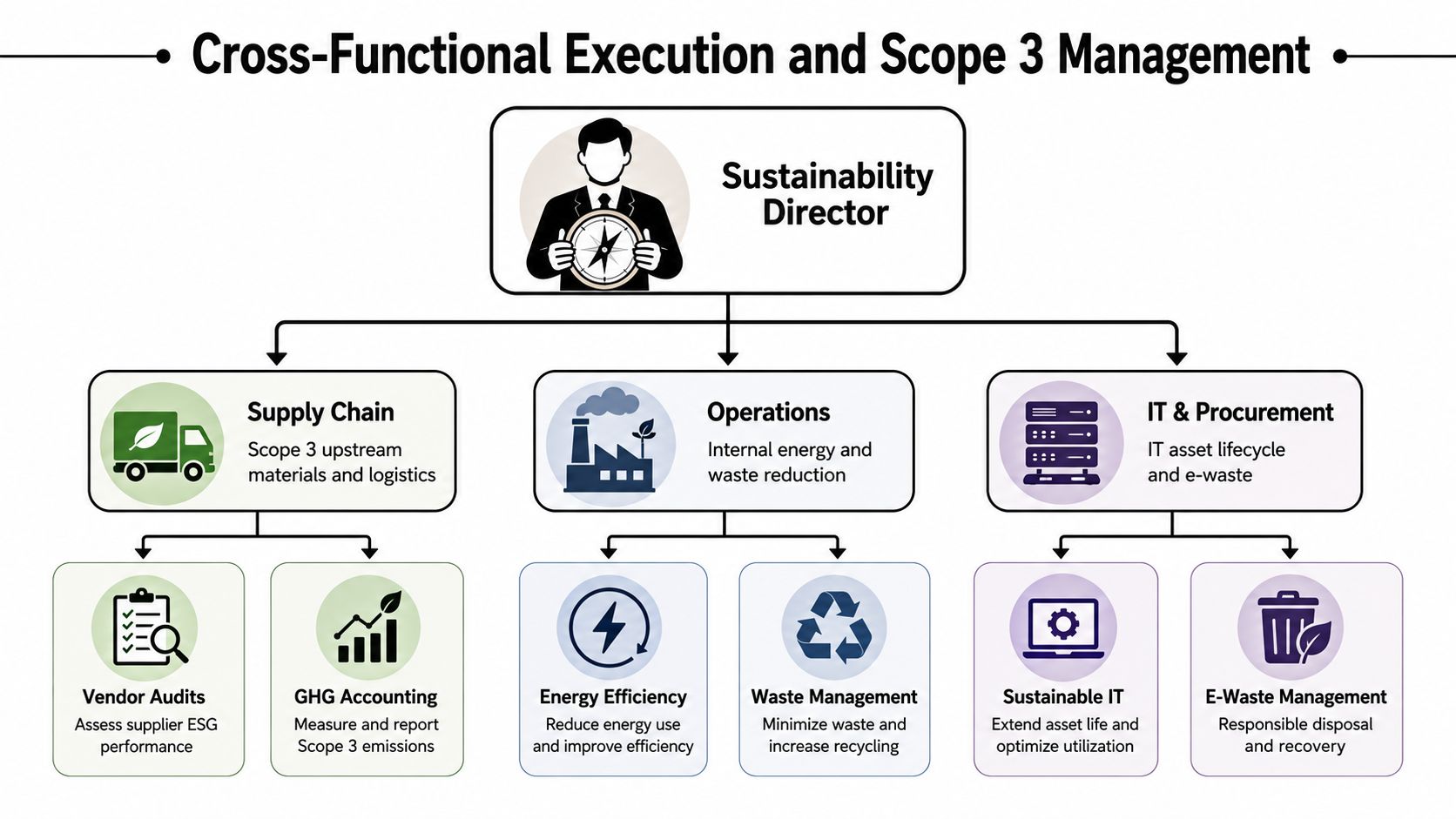
Start by assigning a business owner to every relevant category. Procurement may own purchased goods and services, logistics may own transportation data, IT may own purchased and retired equipment, and facilities may own leased assets or construction-related activity. The sustainability director shouldn't personally generate every number. The director should govern the method and resolve conflicts.
Use a controlled inventory process:
- Define boundaries. Record which entities, sites, leases, suppliers, and asset classes are included, and document exclusions with a reason.
- Set data standards. Specify acceptable source records, units, time periods, estimation methods, emission factors, and approval responsibilities.
- Preserve an audit trail. Keep invoices, asset registers, vendor statements, shipment records, calculations, and version history together.
- Link data to action. Convert each material source into a procurement, engineering, logistics, or facilities decision with an accountable owner.
- Review exceptions. Escalate missing data, inconsistent categories, and unverified supplier claims before they reach external reporting.
The same logic applies to physical operations. Storage layout, packaging, reverse logistics, and material handling can influence both labor efficiency and waste outcomes. Teams planning a warehouse refresh may find useful context in this resource on eco-friendly storage solutions for warehouses, especially when staging reusable equipment or separating devices for controlled disposition.
Decision rights matter more than another dashboard
A dashboard can't fix a dispute over who approves a vendor, who authorizes a data-bearing device for reuse, or who signs off on an emission factor. The sustainability director should publish a responsibility matrix, establish review gates, and require evidence before a team marks a reduction initiative complete. This is the practical purpose of cross-department collaboration, not just scheduling another recurring meeting.
IT Asset Disposition as a Strategic Lever
IT asset disposition, or ITAD, is where sustainability strategy becomes tangible for technology and facilities teams. Every refresh, office cleanout, laboratory equipment disposal project, medical equipment disposal effort, and data center decommissioning event creates a chain of decisions about reuse, resale, recycling, data protection, transportation, and final disposition.
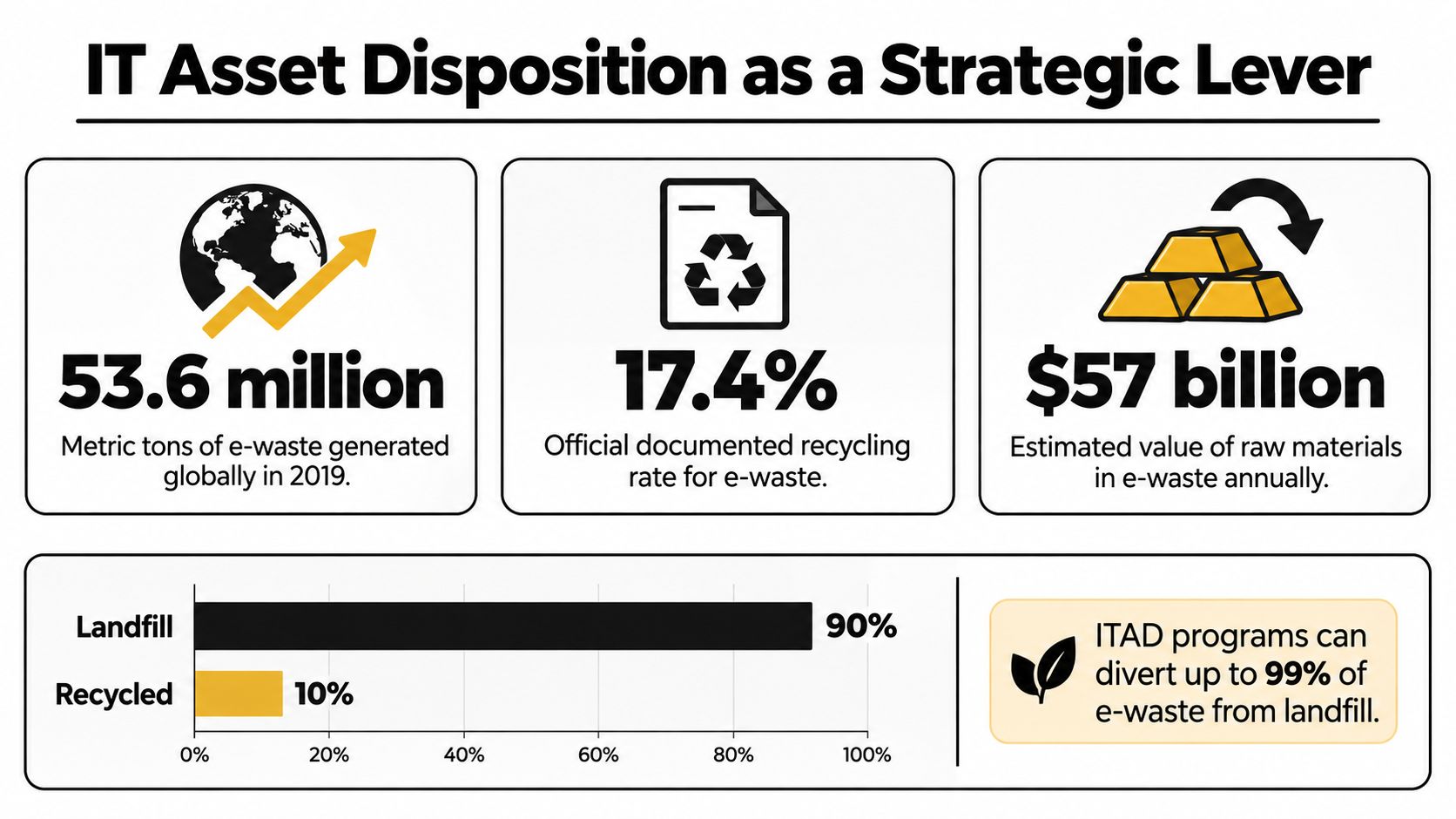
The environmental stakes are substantial. In 2022, the world generated a record 62 billion kg of e-waste, equal to about 7.8 kg per person, while only 22.3% was documented as formally collected and recycled in an environmentally sound manner, according to the Global E-waste Monitor 2024. UN reporting states that global e-waste could reach 82 million tonnes by 2030 if current trends continue, a projection described in the UN agencies' e-waste warning.
The risk sits beyond the loading dock
Informal handling can expose workers and communities to hazardous substances, including mercury, lead, and cadmium, according to the World Health Organization's e-waste guidance. Low formal recycling rates also leave much of the material in landfills or informal recycling streams.
That makes ITAD a governance issue, not merely a waste issue. A defensible program should connect the asset register to the disposition record, record data destruction, identify the downstream route, and preserve documentation that procurement, legal, internal audit, and sustainability teams can review.
Reworx Recycling is one option for this workflow. Its services include electronics recycling, business pickups, equipment decommissioning, IT asset management, secure hard drive shredding, data destruction, equipment buyback options, and donation-based recycling. Its social enterprise model also connects responsible equipment retirement with technology donations, digital inclusion, and workforce development.
The strategic value comes from combining controls that are often managed separately:
- Security: Devices receive an appropriate secure data destruction process.
- Environmental performance: Equipment is directed toward reuse, recycling, or responsible final disposition.
- Financial value: Surplus hardware may qualify for buyback or recovery assessment.
- Community benefit: Usable technology can support donation programs and digital access.
- Evidence: The organization retains records needed for internal and external accountability.
This is why IT asset disposition belongs in the sustainability director's operating portfolio. It gives the director a defined workflow with clear inputs, decision points, responsible departments, and measurable outputs.
Evaluating Recycling and ITAD Partners
Vendor selection should test more than whether a recycler accepts computers. A partner may handle a truckload efficiently while providing weak documentation, unclear downstream controls, or no meaningful route for usable equipment. Conversely, a social enterprise may support donation and workforce goals but still needs to demonstrate rigorous data security, logistics, and environmental controls.
The sustainability director should evaluate both models against the same evidence standard. Ask for written procedures, sample chain-of-custody records, certificates of recycling or destruction where applicable, downstream disclosures, insurance information, and clear explanations of how the partner separates reusable assets from material destined for processing.
ITAD Partner Evaluation Matrix
| Criteria | Traditional Recycler | Social Enterprise, for example Reworx |
|---|---|---|
| Primary orientation | Often centered on material recovery and recycling throughput | Combines responsible electronics recycling with donation and community outcomes |
| Data security | Must demonstrate secure data destruction procedures and documentation | Must demonstrate secure hard drive shredding, data destruction procedures, and documented custody |
| Reuse pathway | May resell or remarket eligible equipment | May combine reuse, equipment buyback, technology donations, and recycling |
| Environmental evidence | Should provide disposition records and downstream controls | Should provide the same records while connecting equipment outcomes to social impact |
| Community impact | May be limited or separate from core service | Can support digital inclusion and workforce development when the program is structured for it |
| Operational fit | May offer scheduled collections, facility cleanout, and material handling | Can offer business pickups, recycling consultations, equipment decommissioning, and IT asset management |
| Procurement questions | Focus on compliance, insurance, security, and final disposition | Apply the same controls, then assess whether social outcomes are verified and relevant |
A social enterprise isn't automatically more rigorous, and a conventional recycler isn't automatically less responsible. The distinction lies in proof. Use this vendor selection criteria to structure due diligence, then ask every finalist how it handles laptop disposal, product destruction, secure data destruction, laboratory equipment disposal, and mixed office cleanout loads.
What to verify before approval
Require the proposed partner to describe who handles equipment after pickup, how serial numbers are reconciled, how exceptions are escalated, and how the organization prevents data-bearing devices from entering an uncontrolled stream. For regulated settings, include legal, privacy, facilities, and information security reviewers in the approval process.
The right partner also makes reporting easier. A useful service record should let the sustainability director reconcile collected equipment with the asset register, separate reuse from recycling, document destruction, and report community outcomes without inflating claims. If the vendor can't provide that evidence, the marketing language shouldn't appear in the ESG report.
Building Your E-Waste Program Roadmap
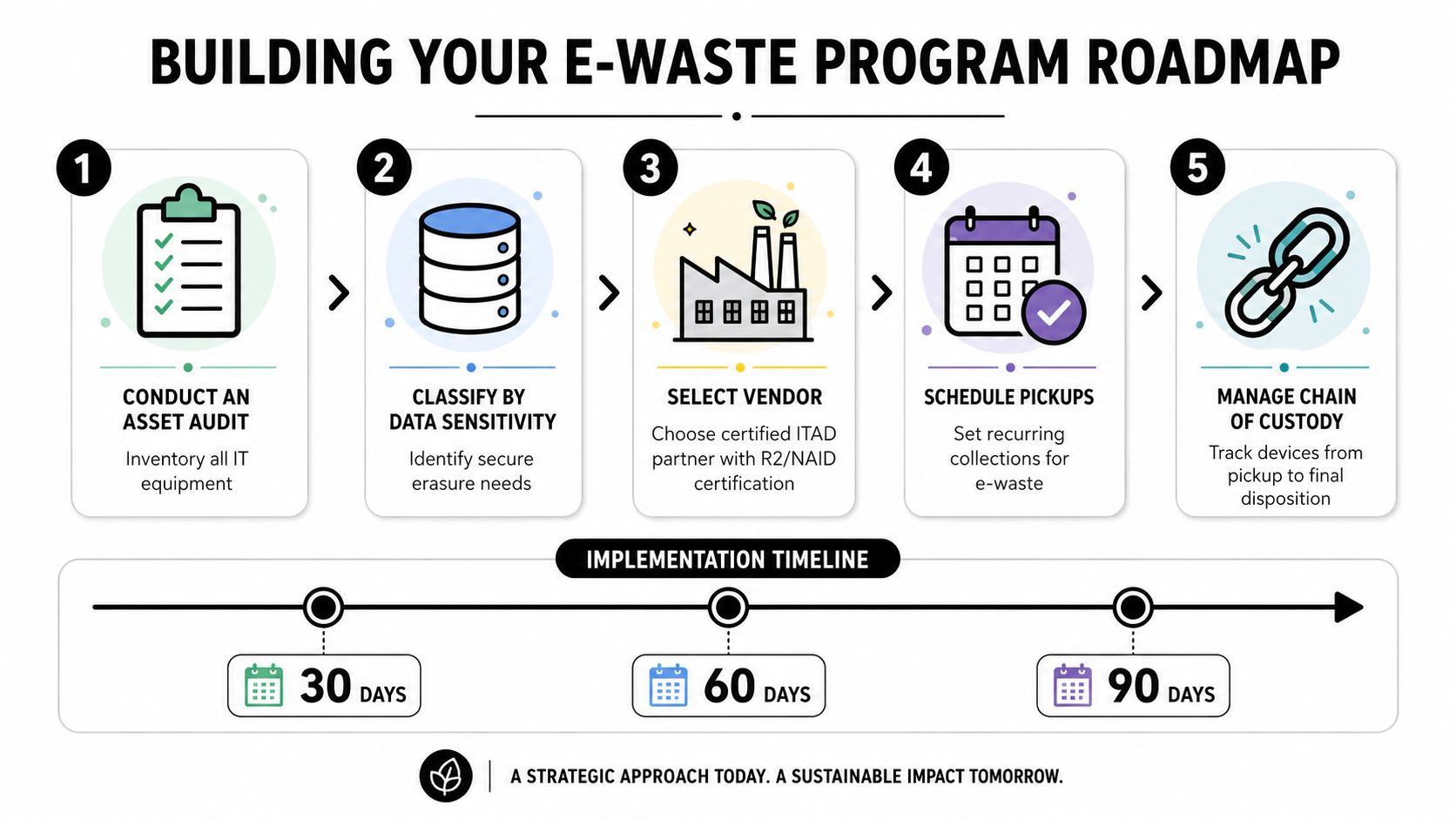
A durable e-waste program starts with an asset picture, not a pickup request. Before contacting a recycler, IT and facilities should identify what equipment exists, where it sits, who controls it, whether it contains sensitive data, and which items may still have operational or community value.
A practical first 90 days
First phase, establish the baseline. Inventory laptops, desktops, monitors, servers, networking equipment, printers, peripherals, medical devices, laboratory equipment, and storage media. Match serial numbers to the IT asset register where possible, identify unknown items, and separate equipment awaiting business approval from equipment ready for disposition.
Second phase, classify risk. Mark assets that contain or may contain sensitive information. Define whether each device requires verified erasure, physical destruction, or another approved method. Security and legal teams should approve the classification before any collection occurs.
Third phase, select and schedule. Choose a partner that can support the required chain of custody, secure data destruction, pickup logistics, office cleanout, facility cleanout, and data center decommissioning. Establish a pickup schedule that matches refresh cycles instead of allowing retired equipment to accumulate in unsecured storage.
Fourth phase, control the handoff. At pickup, reconcile the load against the prepared inventory. Record the date, location, responsible personnel, asset identifiers, container or shipment details, and destination documentation. Exceptions should be logged immediately, not reconstructed months later.
Fifth phase, close the loop. Reconcile final disposition records with the original asset list. Separate equipment reused, donated, resold, recycled, or destroyed. Then provide finance, IT, facilities, legal, and sustainability teams with the records each group needs.
Design the program for repeatability
A one-time office cleanout can create visibility, but recurring controls create performance. Add disposition requirements to procurement contracts, include secure data destruction in offboarding procedures, and assign a facilities owner for staging and access. Schools, government agencies, healthcare organizations, and enterprise IT teams may also need separate procedures for medical equipment disposal, product destruction, and sensitive laboratory assets.
The sustainability director should review the program after the first collection cycle. Look for untracked devices, delayed certificates, unclear ownership, unsafe storage, and avoidable transportation movements. Fixing those process failures will usually produce more defensible value than adding another broad sustainability promise.
Measuring Impact and Driving Financial Value
The board doesn't need every activity. It needs a concise account of material outcomes and evidence. Track assets collected, disposition by pathway, documented secure data destruction, unresolved custody exceptions, recovered value, avoided handling risk, and verified community outcomes. Use a sustainability platform such as the Kagool sustainability platform when the organization needs structured data management across operational teams.
The sustainability director should report fewer, stronger metrics rather than a long list of weakly supported claims. A credible ITAD program can connect environmental responsibility, information security, cost control, and community benefit in one workflow.
Reworx Recycling helps businesses arrange electronics recycling, IT equipment disposal, secure data destruction, equipment decommissioning, business pickups, and donation-based recycling that supports digital inclusion and workforce development. Visit Reworx Recycling to discuss a pickup, donate retired equipment, or build a repeatable ITAD program for your organization.