Proper IT equipment recycling in Montgomery requires more than dropping off old electronics. A documented process should cover data sanitization, chain-of-custody tracking, and certified disposition, especially when organizations manage sensitive devices.
A technology refresh often leaves a warehouse, server room, classroom, or office storage area full of laptops, monitors, printers, networking equipment, and retired drives. The equipment may still have resale or donation value, but it may also contain confidential information, damaged batteries, or components that require controlled handling. The practical question isn't just where to take it. It's how to decide what happens to every unit and preserve evidence that the decision was carried out properly.
Understanding the Landscape of IT Equipment Recycling in Montgomery
“Montgomery” can refer to two different operating environments. Montgomery, Alabama, and Montgomery County, Maryland, have different local programs, eligibility rules, and logistics. Search results that blend them can send a business, school, or public agency to the wrong drop-off location or lead it to assume that a residential service accepts commercial volumes.
Montgomery, Alabama's official recycling page lists desktops, laptops, servers, printers, phones, medical electronics, and televisions among its electronics categories. It doesn't clearly state that every category follows identical drop-off rules, appointment requirements, fees, or business-volume limits, so organizations should verify acceptance before loading a truck. Businesses planning Alabama electronics recycling need a commercial workflow, not an assumption based on a household recycling page.
Montgomery County, Maryland offers a different example. Its Shady Grove Processing Facility and Transfer Station accepts electronics, and the county began phasing in on-call curbside pickup for electronic items and household batteries in April 2022. By 2024, six collection districts had implemented the service, and the county had received more than 2,500 resident requests for electronics or battery collection. County officials reported collecting more than 3,700 tons, equivalent to over 7.4 million pounds, between 2022 and 2024. Montgomery County's program announcement describes a residential service connected to existing collection contracts, not a universal business ITAD channel.
Why ITAD belongs in the plan
IT asset disposition, or ITAD, assigns each asset a controlled route. A working laptop might be redeployed, donated, or resold. A damaged device may move to parts recovery or material recycling. A device with an unverified storage medium may require secure data destruction before it can leave the organization.
That distinction matters because the county's residential collection program excludes multifamily properties and isn't designed to serve every office, school, hospital, or government facility. A local recycling option can be useful for eligible households while remaining unsuitable for a bulk office cleanout. Before transportation, confirm the jurisdiction, customer type, accepted materials, scheduling process, and volume restrictions.
Maryland's broader history reinforces the point. The state electronics-recycling effort began with an EPA Region 3 eCycling Pilot Project in October 2001, and Maryland has maintained its electronics-recycling program since 2005. Yet residential collection declined from 19.2 million pounds in 2013 to 7.8 million pounds in 2021, a decrease of roughly 59%, according to the Maryland electronics-recycling workgroup report. Facilities alone don't guarantee participation. Convenience, awareness, product mix, funding, and access all influence results.
Preparing Your IT Assets for Responsible Disposal
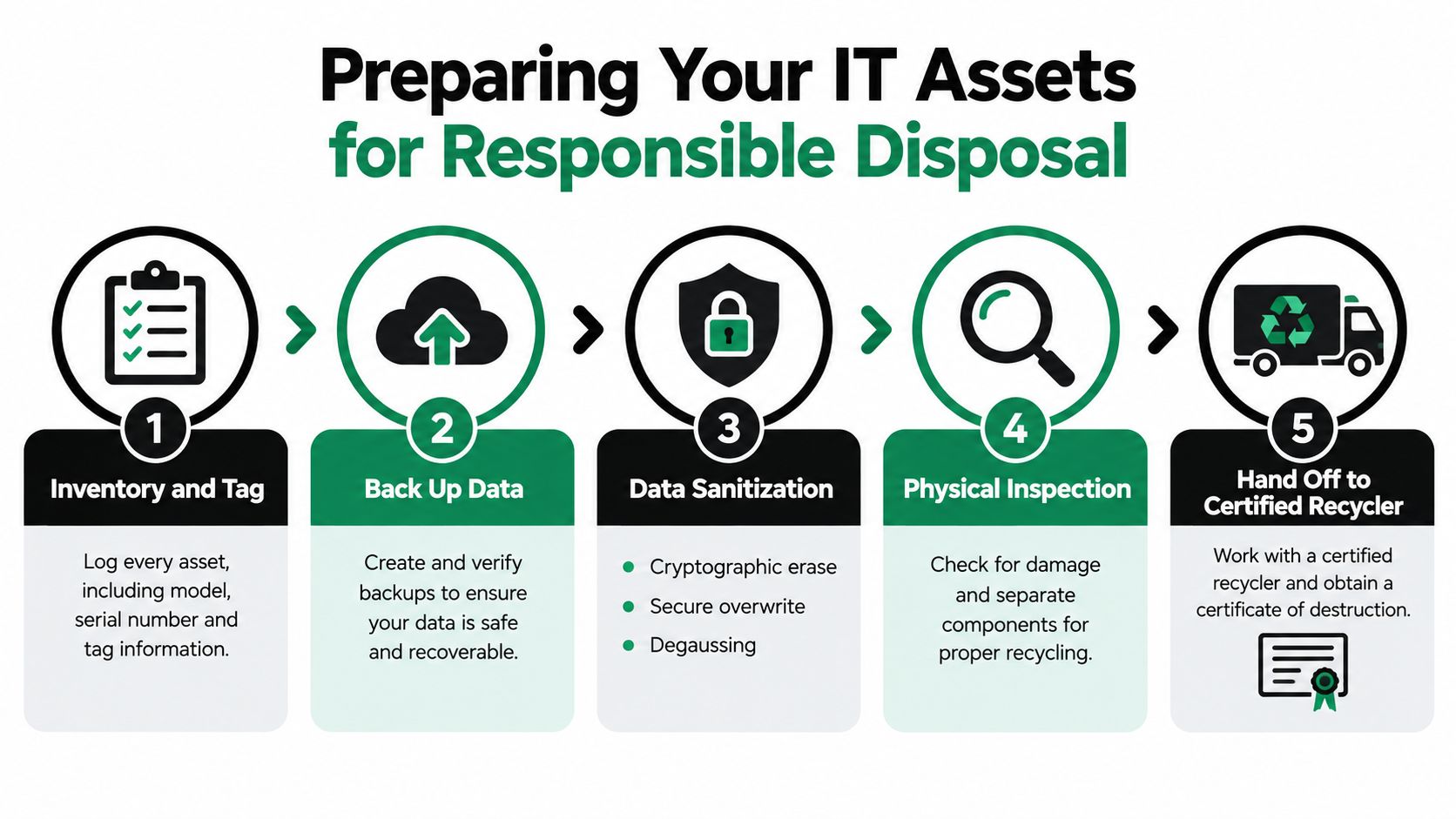
Preparation starts before the recycler arrives. The organization should know what it owns, what information each asset may contain, and which disposition route is appropriate. A mixed pallet with no serial-level records creates avoidable risk and makes final reconciliation difficult.
Build a usable asset record
Export the asset register from your management platform, then reconcile it against the physical equipment. Record the manufacturer, model, serial number, location, owner, storage media, condition, and planned disposition. Include desktops, laptops, servers, printers, copiers, phones, tablets, routers, switches, UPS units, and removable drives.
Classify each unit as reuse, resale, parts recovery, or material recycling. This prevents a functional device from entering a commodity stream before someone evaluates its remaining value. It also gives finance, IT, sustainability, and facilities teams a shared record of the decision.
Before pickup, back up business data through the organization's approved process and document who authorized retirement. Then isolate storage media from general equipment. A printer or copier can contain internal storage just like a laptop or server, so don't limit the review to devices that look like computers.
Apply the right sanitization method
NIST defines sanitization as rendering access to data infeasible for a specified level of effort. NIST Special Publication 800-88 Revision 1 recommends verification whenever sanitization is performed, with representative sampling as a fallback when item-by-item verification isn't practical.
A practical sequence is:
- Identify the media. Record whether the device uses a hard disk drive, SSD, phone storage, removable media, or another technology.
- Select the method. Cryptographic erase may suit properly encrypted laptops and SSDs when key destruction can be demonstrated. Otherwise, use an approved purge or physical-destruction method. Degaussing isn't suitable for every modern storage technology.
- Verify the result. Keep the method, operator, timestamp, and verification outcome. If sampling is necessary, NIST guidance says sampled locations should cover at least 5% of each subsection, using pseudorandom locations across user-addressable and reserved areas without overlap.
- Record exceptions. Failed drives, locked devices, missing serials, and damaged batteries should appear in an exception log rather than disappearing from the manifest.
Physical handling matters too. Remove loose batteries only when your procedure and equipment condition make that safe, segregate damaged lithium-ion packs, and keep CRTs, lamps, and other special components out of ordinary loads. For general guidance on how to protect your electronics during a move, use packing practices that prevent impact, moisture, and shifting during transport.
The handoff should include a signed asset manifest, pickup record, chain-of-custody documentation, destruction certificate where applicable, and final disposition report. Reworx Recycling also publishes a practical guide on how to prepare your company's electronics for recycling.
Choosing the Right IT Recycling Partner and Service Model
The right service depends on the load, the sensitivity of the information, the condition of the equipment, and the organization's reporting needs. A household drop-off, a municipal event, a conventional scrap outlet, and a professional ITAD provider don't offer equivalent controls.
| Service model | Useful for | Main limitation |
|---|---|---|
| Municipal household program | Eligible residents with accepted materials | Often excludes businesses, apartments, or institutional volumes |
| General commercial recycler | Straightforward loads with limited data risk | May offer limited asset-level reporting or reuse evaluation |
| ITAD provider | Data-bearing assets, multi-site projects, and decommissioning | Requires careful review of methods, documentation, and downstream controls |
| Donation-based recycling social enterprise | Organizations seeking secure disposition with community impact | Donation doesn't remove the need for sanitization and disposition evidence |
Montgomery County, Maryland demonstrates why eligibility must be checked. Its curbside service is available to residents receiving county-provided recycling service, while multifamily properties are excluded. An office, school, apartment management company, or public agency shouldn't treat that residential route as its business electronics recycling plan.
Compare the provider before the pickup
Ask for written acceptance criteria, the treatment of batteries and damaged equipment, the data-destruction method, insurance coverage, downstream processor controls, and the documents supplied after processing. Confirm whether the provider can reconcile every data-bearing unit by serial number and explain how it handles missing or unreadable labels.
Certification can support due diligence, but it isn't a substitute for asking operational questions. A certificate that lacks the method, operator, timestamp, and verification result doesn't prove what happened to a drive. Reworx Recycling is one donation-based option for business electronics recycling, secure hard-drive shredding, equipment decommissioning, pickups, and equipment buyback. Its social enterprise model connects end-of-life handling with technology donations, digital inclusion, and workforce development.
Organizations comparing vendors can use this guide to choosing an e-waste recycling partner to structure questions around security, logistics, environmental handling, and reporting.
Ensuring Compliance and Data Security Throughout the Process
The recycler's truck does not end the organization's responsibility. For laptops, servers, phones, copiers, hard drives, and SSDs, the handoff must create a traceable record from collection to final disposition.
Maintain evidence at every transfer
Use one project manifest and update it whenever equipment changes custody. Identify each asset by serial number, record its planned route, and capture signatures or electronic acknowledgements at pickup and receipt. Reconcile the collected and processed counts, then investigate every exception.
Keep an evidence package containing:
- Signed asset manifest: Confirms what the recycler received.
- Chain-of-custody record: Records custody changes, dates, and responsible parties.
- Sanitization or destruction report: States the method and verification result for data-bearing media.
- Disposition report: Shows whether each asset was reused, resold, harvested for parts, materially recycled, or sent to residual disposal.
- Exception log: Explains missing serials, inaccessible drives, damaged batteries, and other deviations.
NIST recommends verification after sanitization. A signed certificate alone does not establish control if the organization cannot connect it to the specific device and approved method.
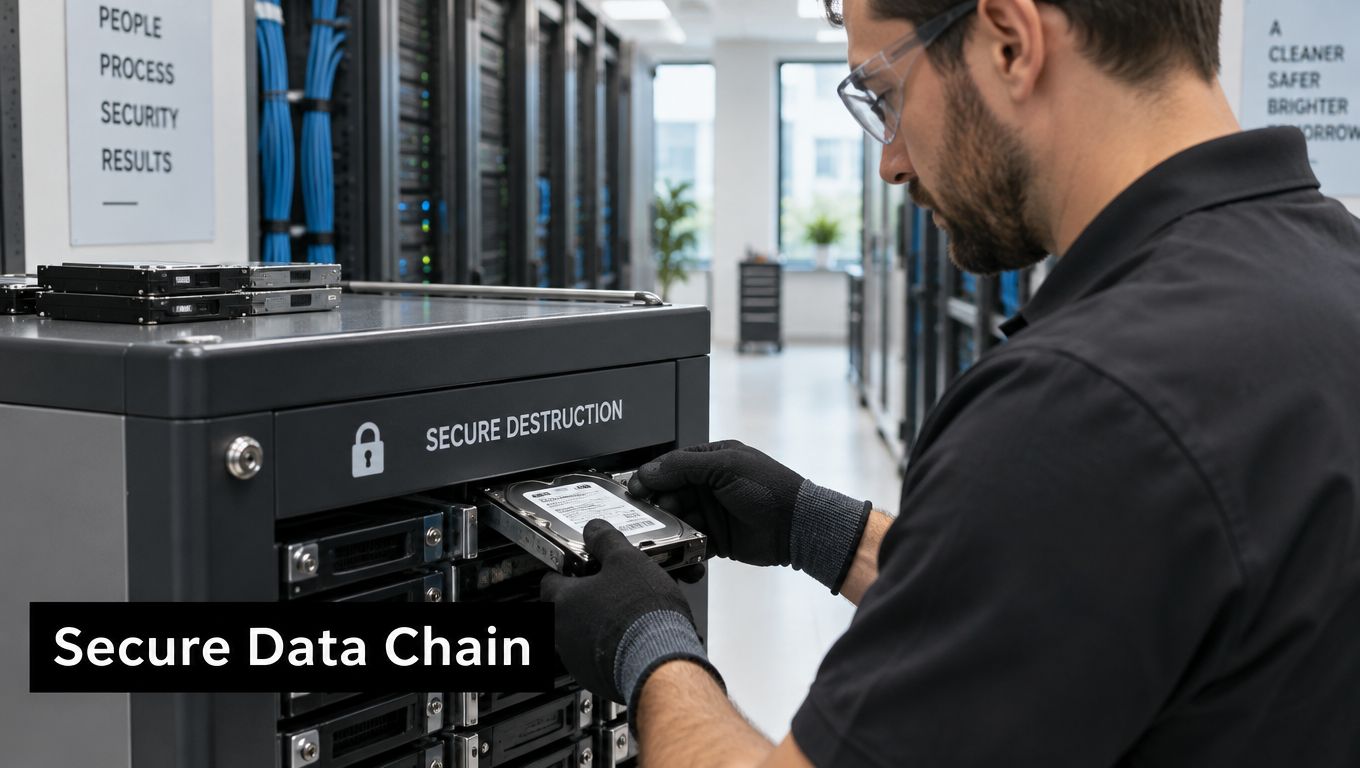
Treat certification as one control, not the whole control
R2 and e-Stewards certification can help screen providers, but procurement teams should also examine operating procedures and downstream relationships. Ask how the vendor controls subcontractors, stores equipment before processing, manages hazardous components, and handles items that cannot be reused.
A factory reset or reformat is not a dependable enterprise sanitization strategy. Guidance on secure data destruction for electronics disposal identifies hard drives, SSDs, phones, tablets, and copiers with internal storage as data-bearing equipment requiring appropriate destruction before or during recycling. Guidance on secure data destruction services in Montgomery can help organizations evaluate the available process. Where sanitization cannot be verified, physical destruction may provide the defensible route.
Practical rule: If the organization cannot reconcile a data-bearing asset to a verified sanitization or destruction result, treat it as an unresolved security exception, not recycled equipment.
Understanding Costs, Buyback, and the Value of Donation-Based Recycling
The quoted price for IT equipment recycling reflects more than transportation. Labor for sorting, serial-number capture, testing, data destruction, packing, storage, compliance reporting, and downstream processing can all affect the service model. A pallet of working laptops requires different handling from a mixed load of damaged monitors, obsolete printers, batteries, and broken servers.
Ask providers to separate the commercial elements of the proposal. A useful quote should clarify pickup terms, labor, packing or palletization, data destruction, testing, resale treatment, recycling, and residual disposal. It should also state whether any buyback credit is provisional until testing and final grading are complete.
Evaluate value before sending equipment to recycling
Working equipment can retain value through redeployment, resale, donation, or parts harvesting. That doesn't mean every old device deserves refurbishment. Testing, missing chargers, locked accounts, unsupported operating systems, damaged batteries, and shipping costs can make material recovery more sensible than resale.
A disposition matrix helps:
| Condition and risk | Suitable route | Evidence to retain |
|---|---|---|
| Working and supported | Redeployment or resale | Test result and transfer record |
| Working but surplus | Donation or corporate donation program | Recipient and asset record |
| Repairable | Parts recovery or refurbishment | Component disposition |
| Irreparable or uneconomical | Material recycling | Processor and weight record |
| Data destruction not verified | Approved physical destruction | Destruction certificate |
Donation-based recycling adds a mission dimension without changing the security requirement. A laptop donated to a community program still needs documented sanitization. A server transferred to a nonprofit still needs an asset-level record. Reuse preserves more embedded value than commodity recycling when the equipment is suitable, while recycling remains appropriate for irreparable equipment.
Measure the material outcome honestly
The Global E-waste Monitor 2024 reported 62 billion kilograms of e-waste generated worldwide in 2022, with only 22.3% documented as formally collected and recycled in an environmentally sound manner. The report projects that the documented rate could fall to 20% by 2030 if collection and recycling capacity doesn't keep pace.
For a Montgomery business, school, or agency, the useful benchmark isn't a claimed universal recycling percentage. Track inbound units and kilograms, complete asset records, reuse, material recovery, isolated hazardous components, sanitized data-bearing devices, and residual landfill disposal. Weigh outbound streams separately and reconcile them to inbound weight, allowing documented adjustments for packaging, moisture, and process loss.
Reworx Recycling's donation-based model can support organizations that want environmental responsibility and community impact in the same program. The meaningful result is a defensible record showing what was reused, what was donated, what was recycled, what was destroyed, and where exceptions remained.
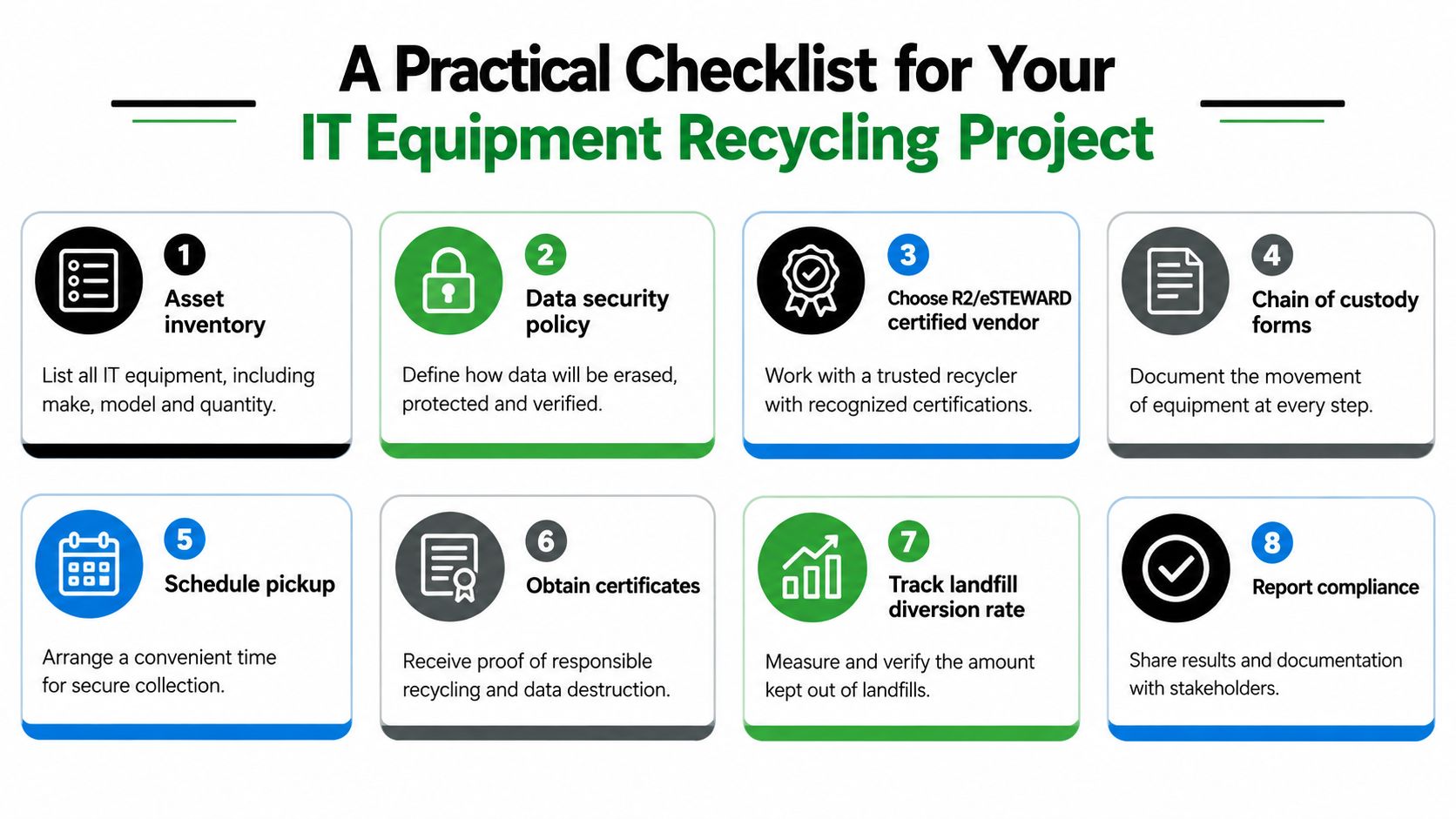
A Practical Checklist for Your IT Equipment Recycling Project
A successful project is easier to manage when IT, facilities, finance, security, and sustainability agree on the workflow before equipment leaves the building. The checklist below is designed for a Montgomery office cleanout, facility cleanout, school technology refresh, medical equipment disposal project, laboratory equipment disposal effort, or data center decommissioning.
Set the scope and select the route
Start by defining locations, equipment categories, owners, access requirements, and target pickup conditions. Separate ordinary electronics from servers, UPS units, medical electronics, laboratory equipment, printers, batteries, damaged lithium-ion packs, CRTs, and lamps.
Then complete these controls:
- Inventory every asset. Record serial numbers, models, locations, storage media, condition, and owner.
- Approve the data security policy. Decide who authorizes retirement, which media require sanitization, and when physical destruction is mandatory.
- Choose a qualified vendor. Review R2 or e-Stewards status where relevant, written acceptance criteria, downstream controls, insurance, and reporting.
- Prepare chain-of-custody forms. Connect the pickup manifest to receipts, transfer records, exception logs, and final disposition.
- Schedule the pickup. Confirm loading access, equipment separation, battery handling, packing needs, and whether the provider accepts the planned volume.
- Obtain certificates and reports. Require destruction certificates for applicable media and asset-level disposition evidence for every unit.
- Track landfill diversion and material flows. Weigh inbound and outbound streams separately, record reuse and recovery, and document residual disposal.
- Report compliance internally. Give IT, security, facilities, finance, and sustainability teams a reconciled record with unresolved exceptions clearly identified.
Use the record after the truck leaves
The closeout review should compare the original inventory, collected units, sanitization results, disposition routes, weights, and exceptions. If a laptop appears in the pickup record but not in the final report, the project isn't complete until someone resolves the discrepancy.
A reusable compliance checklist template can help standardize future office cleanouts and corporate donation programs. The same framework applies whether the project involves a few laptops or a multi-site technology transition. What changes is the scale, not the need for traceability.
The most common failures are predictable: treating a factory reset as secure erasure, accepting a device count without serial reconciliation, mixing batteries into general loads, commingling special components with ordinary electronics, and choosing a vendor based only on a low transport quote. A disciplined project avoids those shortcuts and gives management evidence it can use for audits, sustainability reporting, and security reviews.
Reworx Recycling helps Montgomery-area organizations manage electronics recycling, IT equipment disposal, secure data destruction, equipment pickups, decommissioning, buyback, and donation-based recycling. Visit Reworx Recycling to discuss a documented pickup and disposition plan for your business, school, agency, or facility.