Most advice around asset recovery solutions illinois points you in the wrong direction.
If you are a business owner, IT manager, facilities lead, or sustainability director in Illinois, you may search that phrase expecting help with old laptops, servers, networking gear, medical devices, or office electronics. Instead, search results often lead to debt collection companies. That is a real problem because retiring physical technology requires a completely different process, different compliance standards, and different operational controls.
Illinois organizations need clear guidance on electronics recycling, IT equipment disposal, secure data destruction, and IT asset disposition (ITAD). They also need a partner that can help recover value from usable devices while keeping unusable equipment out of landfills and sensitive data out of the wrong hands.
The Asset Recovery You Need in Illinois
The common assumption is that “asset recovery” always means recovering money. In Illinois, that assumption breaks down fast.
Searching for asset recovery solutions illinois often leads to debt collection agencies like Asset Recovery Solutions, LLC, not ITAD providers. That misdirection leaves businesses trying to retire electronics without guidance on data destruction or Illinois e-waste compliance. Illinois has had a broad e-waste landfill ban since 2012, and national e-waste volumes are growing by 30% annually, according to the BBB profile context referenced here.
Why search results create confusion
Illinois search results are crowded with firms that recover delinquent receivables. Their work matters in finance, but it does not solve these business questions:
- Old laptops with customer data need sanitization or destruction.
- Retired servers need documented chain of custody.
- Office cleanouts need pickup, sorting, and downstream recycling.
- Healthcare and school devices need extra care around records and regulated data.
- Usable equipment may have resale or donation value.
A debt collector handles none of that.
What IT leaders usually mean by asset recovery
In the technology world, asset recovery means recovering value, materials, and usable equipment from devices that have reached the end of their internal life. It also means reducing legal, environmental, and reputational risk.
That is why the right starting point is not a collections agency. It is an ITAD and electronics recycling workflow built for physical assets. Businesses evaluating options can start with Illinois ITAD services to understand what a hardware-focused recovery program should include.
Key takeaway: In Illinois, the phrase “asset recovery” can refer to two unrelated industries. If your problem involves computers, drives, lab gear, phones, or servers, you need ITAD, not debt recovery.
Defining True IT Asset Recovery for Your Business
A clean definition helps.
IT asset recovery is the managed process of retiring business technology in a way that protects data, follows environmental rules, and captures any remaining value. It is broader than computer recycling. It includes inventory review, transport controls, data destruction, refurbishment decisions, resale, donation, and final recycling.
By contrast, the other “Asset Recovery Solutions” in Illinois is a debt collection firm in Des Plaines, founded in 2008 with reported annual revenue of $8.8 million. It specializes in delinquent auto loans and credit card debt, which is entirely separate from the physical disposition of IT equipment that requires EPA and data security compliance, as described in this company profile.
The three pillars of real ITAD
Data security
Before any laptop, desktop, server, or storage device leaves your control, you need a clear decision about the data on it. Can it be sanitized to a recognized standard? Does it require physical destruction? Who documents that action?
Without those answers, “recycling” is incomplete.
Environmental stewardship
Technology contains metals, plastics, circuit boards, batteries, and components that should not be handled casually. A proper ITAD program prioritizes reuse when possible, then responsible materials recovery when reuse is no longer practical.
That is the part many organizations miss when they treat old electronics like ordinary junk removal.
Financial return
Some retired equipment still has market value. Recent business laptops, monitors, servers, mobile devices, and networking hardware may qualify for buyback. Older but working machines may be better suited for donation. Nonfunctional devices may still have commodity recovery value, even if modest.
What this looks like in practice
A useful way to think about ITAD is this:
| Question | Debt recovery firm | ITAD partner |
|---|---|---|
| What is the asset? | Delinquent receivable | Physical device or equipment |
| Main goal | Collect money owed | Protect data, recover value, recycle responsibly |
| Typical workflow | Contact debtor, resolve balance | Inventory, sanitize, transport, refurbish, recycle |
| Compliance focus | Financial collection rules | E-waste, privacy, records, chain of custody |
For a deeper plain-English overview, this guide to what is IT asset disposition is useful because it frames ITAD as an operating process, not just a recycling event.
Navigating Illinois E-Waste Regulations and Data Compliance
Compliance is where many Illinois organizations realize this topic is larger than a pickup request.
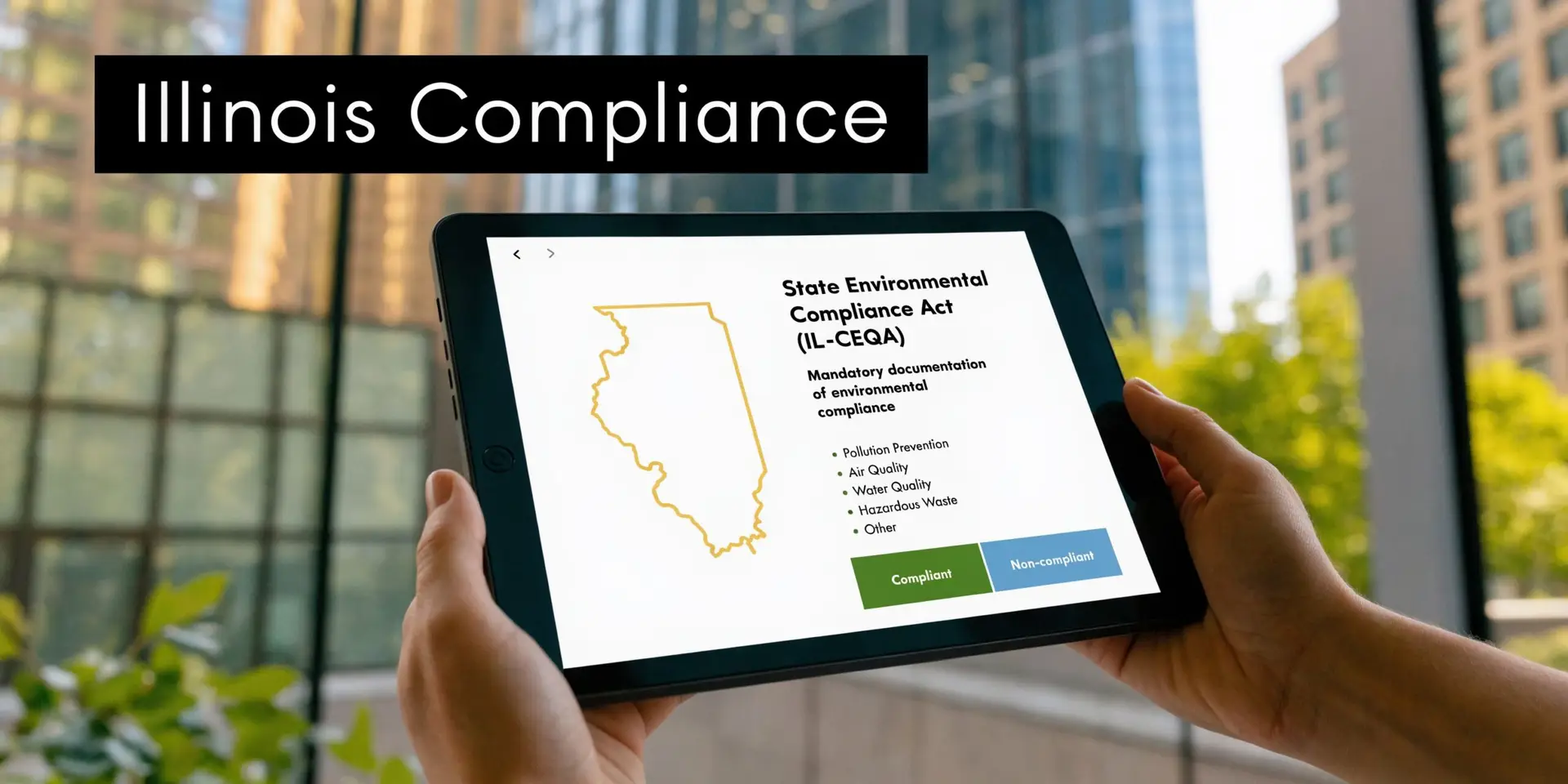
Public sector entities in Illinois face tighter expectations. Recent state-level expansions mandate up to 90% e-waste diversion rates, with potential fines reaching $2.5 million for non-compliance. The same source also notes the importance of understanding rules such as the Illinois Property Control Act when selecting an ITAD partner for schools and government agencies, as described in this reference.
What Illinois businesses need to manage
Illinois organizations usually deal with two compliance layers at once.
The first is environmental handling. Devices cannot be tossed into general waste streams. Pickup, sorting, refurbishment, and downstream processing all matter.
The second is information security. A retired device can still contain employee records, customer files, login credentials, health information, financial data, research material, or internal communications.
That is why many firms pair electronics recycling planning with a dedicated Illinois electronics recycling workflow instead of treating it like surplus disposal.
Data compliance questions to ask before release
A practical review should cover these points:
- What data is on the device. Local files, email archives, cached credentials, shared-drive sync folders, and backups all count.
- What sanitization method fits the media. A desktop hard drive, SSD, smartphone, and backup appliance may require different handling.
- Who signs off internally. IT, legal, compliance, facilities, and department owners may all need a role.
- What proof will you receive. Asset lists, serial tracking, destruction records, and final disposition reporting matter in audits.
Tip: If a vendor can pick up equipment but cannot explain how they document every handoff, you still have a risk problem.
Public sector and regulated sectors need extra care
Schools, municipalities, healthcare groups, labs, and universities often face stricter oversight because devices may hold protected or public-interest information. They also tend to retire equipment in batches, which increases process risk. One mislabeled pallet or one undocumented drive can create a disproportionate problem.
For those organizations, strong ITAD usually includes:
- Pre-pickup inventory review so departments agree on what is leaving.
- Clear chain of custody from dock or office to final processing.
- Recorded data destruction actions tied to device identifiers when possible.
- End-of-project reporting that supports internal governance.
Why simple wiping is not enough
Many companies still believe an employee can factory-reset a laptop and solve the issue. Sometimes that may be one step in the process, but by itself it is not a complete ITAD control.
A modern compliance mindset asks different questions. Was the reset verified? Was every storage component included? Was the device tracked? If the machine fails to boot, what then? If a hard drive was removed earlier for troubleshooting, where did it go?
Those are operational questions, not theoretical ones. They are also the difference between routine retirement and an avoidable incident.
Core Services of a Modern ITAD Program
A sound ITAD program is not one service. It is a chain of services that protect the organization from the moment equipment is tagged for retirement until final disposition is documented.
Secure collection and chain of custody
The first control is simple. Know what you are releasing.
That means asset lists, pickup authorization, packaging or palletization instructions, and a documented handoff. For larger projects such as office closures, facility cleanouts, or data center decommissioning, physical access controls matter as much as paperwork. Teams planning high-security removals can also review guidance on data center physical security because the way equipment leaves a site often determines where the biggest exposure appears.
Data destruction methods
Not every device should be handled the same way.
Some assets may be suitable for logical data wiping. Others may require degaussing or physical shredding. The right choice depends on the media type, the condition of the device, and your internal risk tolerance. A vendor should be able to explain the method in plain language and match it to the device class.
A practical workflow often looks like this:
- Reusable laptops and desktops may go through tested sanitization before remarketing or donation review.
- Failed drives often move straight to destruction because reuse is not realistic.
- Servers and storage arrays may require on-site service if the organization cannot allow media to leave intact.
- Mobile devices need attention to removable media, embedded storage, and account locks.
Reuse first, recycling second
The most responsible ITAD programs follow a hierarchy.
Usable equipment should be evaluated for continued life through internal redeployment, resale, or donation. Equipment that cannot be reused should be dismantled and recycled through responsible downstream channels. This approach supports both sustainability and financial recovery.
Reporting that helps the business
A strong vendor does more than haul equipment away. They provide records your finance, IT, compliance, and sustainability teams can use.
Useful reporting usually includes:
- Inventory confirmation
- Disposition category by asset
- Data destruction documentation
- Weight or material summaries where relevant
- Exceptions that need follow-up
One Illinois-focused option in this category is Reworx Recycling, which provides electronics recycling, secure data destruction, pickups, and ITAD support for organizations retiring business equipment.
Practical rule: If you would not feel comfortable showing the documentation to an auditor, board member, or customer, the ITAD process is not complete yet.
Maximizing Value Through Buybacks and Donations
Many companies treat retired hardware as pure waste. That leaves value on the table.
The financial model for true ITAD is different from the debt collection model that dominates some Illinois search results. While debt buyers acquire portfolios at pennies on the dollar to achieve 20% to 40% recovery rates, a professional ITAD partner focuses on physical assets. A strong ITAD buyback program can recover 10% to 20% of the original value for recent-generation equipment, according to this industry context.
When buyback makes sense
Buyback usually works best for equipment that is still commercially useful.
Think of:
- newer business laptops
- recent monitors
- mobile devices in good condition
- networking gear with active secondary demand
- servers that still fit supported environments
Condition, age, specs, and market demand all affect the outcome. So does the completeness of the device. Missing power supplies, damaged screens, management locks, or poor asset records can reduce recoverable value.
When donation is the better outcome
Donation works well when a device has remaining usefulness but limited resale appeal. That often includes older office computers, peripherals, and classroom technology that may still serve a community purpose after proper processing.
For sustainability leaders, donation can produce a different kind of return. It supports digital access, extends product life, and aligns disposal decisions with community impact goals.
A simple decision framework
Use this quick comparison:
| Asset condition | Likely best path | Main benefit |
|---|---|---|
| Newer, functional, marketable | Buyback | Financial recovery |
| Older but still usable | Donation | Community benefit and extended use |
| Broken, obsolete, or incomplete | Recycling | Risk reduction and responsible material handling |
How business owners should think about value
The best question is not “What can I get for this pallet?” The better question is “What outcome fits each asset category?”
A mixed lot usually needs a mixed strategy. Some devices belong in a buyback stream. Some belong in donation-based recycling. Some need secure destruction and commodity recovery only. If your vendor treats every device the same, you lose either value or social impact, and sometimes both.
Your Illinois ITAD Vendor Selection Checklist
Choosing a vendor is where strategy becomes procurement. Many Illinois organizations ask for a quote before they ask the harder questions. That is backwards.
A low pickup price means very little if the vendor cannot prove secure handling, clear reporting, and lawful downstream processing. The better approach is to screen vendors the way you would screen any operational risk partner. If your team needs a starting framework, consider utilizing a thorough vendor risk assessment template to structure the review.
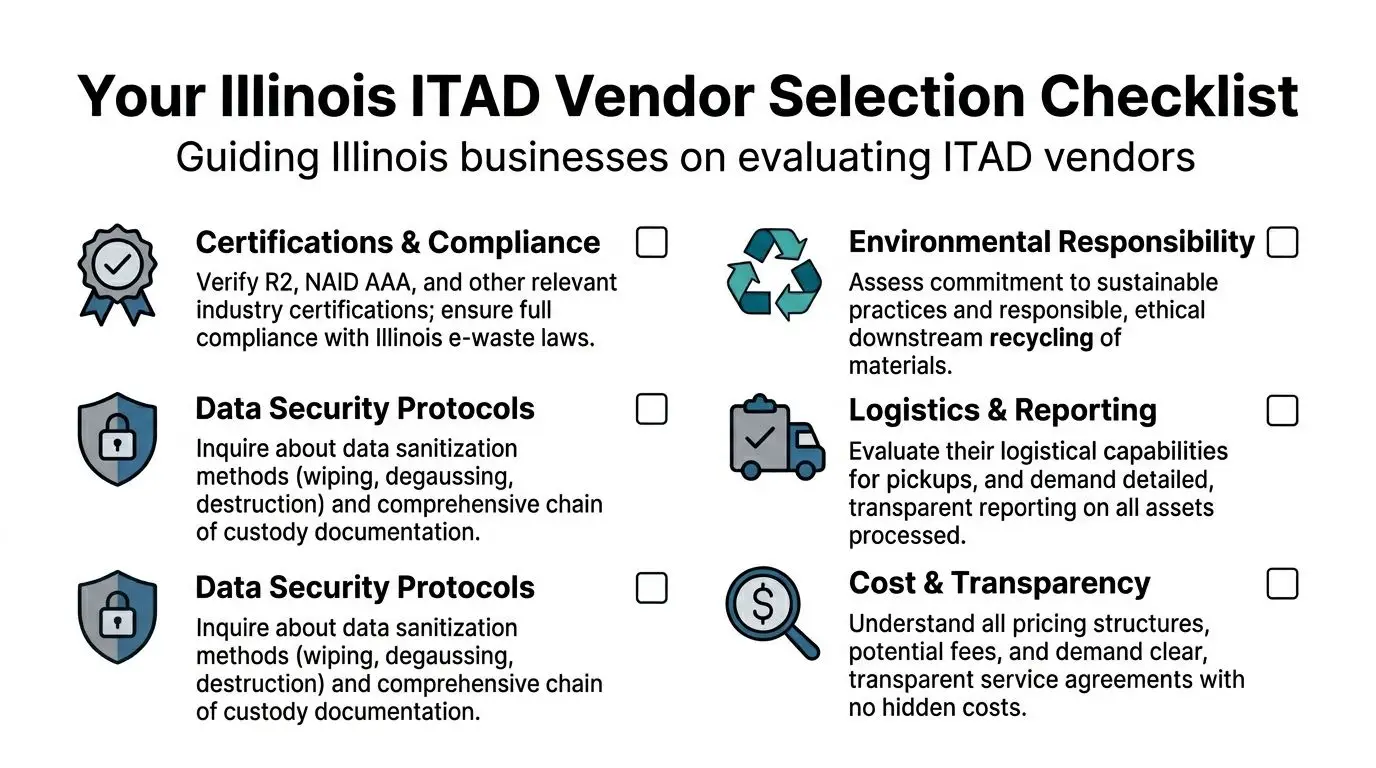
A high-quality vendor using transparent reporting dashboards can help mid-sized entities achieve a 15% greater return on retired assets compared to uncertified recyclers, according to this reference on transparent reporting and process efficiency.
The checklist that matters
Certifications and legal fit
Ask what certifications the vendor holds and how those certifications apply to your project. If you are in healthcare, education, government, finance, or research, make sure the answer fits your actual risk profile.
Do not stop at logos on a website. Ask how they operationalize compliance.
Data security controls
This is not one question. It is a cluster of questions.
- Method fit: How do they handle HDDs, SSDs, mobile devices, and failed media?
- Documentation: What proof do they issue after wiping or destruction?
- Handoffs: Who touches the equipment between pickup and final processing?
- Exceptions: What happens when an asset arrives damaged, locked, or unidentifiable?
Environmental responsibility
You want to know where material goes after the first truck leaves.
Ask about reuse priorities, downstream partners, and how they prevent irresponsible export or disposal practices. If sustainability reporting matters in your organization, ask whether they can support those reporting needs clearly.
Logistics and project management
A vendor can be compliant on paper and still fail operationally.
Look for:
- Pickup coordination that fits office, warehouse, lab, or campus settings
- Project planning for office cleanouts and facility transitions
- Scalable support for recurring pickups or one-time decommissions
- Reporting discipline so your teams are not chasing updates
A practical buyer’s guide on factors when choosing an e-waste recycling partner can help teams compare vendors using operating criteria rather than marketing claims.
Key takeaway: The best Illinois ITAD vendor is not the cheapest hauler. It is the vendor whose controls hold up when legal, audit, and security questions start.
Asset Recovery Workflows for Illinois Organizations
The easiest way to understand ITAD is to see how it works in different settings. Illinois organizations do not all retire technology the same way, and they should not use the same workflow.
A Naperville office cleanout
A small marketing firm replaces staff laptops, docking stations, and a few office printers during a lease refresh. The team’s first instinct is to call a junk hauler because the project looks simple.
IT stops that plan. Several laptops contain client files and local credentials. The better workflow is to inventory the devices, separate reusable equipment from obsolete hardware, and route the lot for secure processing. Some laptops may qualify for donation after data sanitization. Others may be recycled.
This kind of project usually succeeds when the office manager, IT lead, and finance contact agree on one release list before pickup day.
A Springfield school district device refresh
A district upgrades classroom devices and retires equipment from labs, offices, and storage closets. The challenge is not just volume. It is inconsistency. Some devices are labeled well. Others are not. Some still work. Some are broken. Some may contain student or staff data.
The district needs a controlled chain of custody, clear tracking, and documented data destruction. It also needs a repeatable process because school refresh cycles tend to come back again.
In education settings, disciplined staging and serial tracking reduce confusion. They also make it easier to answer questions later from administration or oversight bodies.
A Chicago data center decommissioning
An enterprise in downtown Chicago closes a small server room or edge data environment. The equipment includes racks, servers, storage, switches, UPS units, and loose drives.
This is a different class of project. Logistics, timing, and access rules matter more. The organization may need on-site media destruction, carefully sequenced removal, and a split stream where some newer hardware goes to value recovery while damaged or outdated equipment goes to recycling. Teams preparing for this kind of work often benefit from a server decommissioning checklist because shutdown planning, asset tracking, and final disposition need to stay aligned.
What all three workflows have in common
Even though these organizations are different, the structure is similar:
- Identify assets clearly
- Separate data-bearing from non-data-bearing equipment
- Match each device to the right path
- Document every transfer
- Close the project with reporting
That is the operational heart of asset recovery solutions illinois for technology. Not debt chasing. Not vague “removal” services. A disciplined end-of-life process for business hardware.
Partner with Reworx for Responsible Asset Recovery in Illinois
The phrase asset recovery solutions illinois hides two very different needs. One is financial collections. The other is the secure, compliant, and sustainable retirement of technology.
For Illinois businesses, schools, government agencies, healthcare groups, and enterprise IT teams, the second meaning is the one that protects the organization. You need a process that addresses data security, environmental obligations, workflow discipline, and value recovery at the same time.
That is why vendor choice matters so much. A qualified ITAD partner should help you answer practical questions quickly. What equipment can be remarketed? What should be donated? What must be destroyed? What records will support audit and compliance needs? How will pickup and chain of custody work across one office, several branches, or a full facility cleanout?
This is also where sustainability becomes tangible. Retired electronics are not just a disposal problem. Managed correctly, they can support computer recycling, secure data destruction, donation-based recycling, laptop disposal, medical equipment disposal, laboratory equipment disposal, office cleanout projects, facility cleanouts, product destruction, and broader corporate donation programs. The same decision can reduce landfill risk, support responsible materials management, and create community benefit.
For organizations that want a donation-based, social-enterprise approach, Reworx Recycling aligns IT equipment disposal with environmental responsibility and community impact. That combination matters when leadership wants more from end-of-life technology management than a basic haul-away service.
The right partner helps you retire equipment with fewer unknowns and better outcomes. That means fewer security questions left hanging, clearer documentation, more thoughtful reuse decisions, and a stronger sustainability story backed by process.
If your organization is planning an office refresh, data center decommissioning project, electronics recycling program, or secure IT equipment disposal initiative, visit Reworx Recycling to learn more, schedule a pickup, or explore how donation-based recycling can support both your compliance goals and your community impact.