

A lot of Los Angeles telecom projects start the same way. An office lease is up, a second floor is coming online, a warehouse needs better wireless coverage, or a legacy phone setup finally becomes too brittle to keep patching. The visible problem looks simple. Get better connectivity in place and move on.
The hard part shows up after the kickoff call. In Los Angeles, telecom work rarely stays confined to ordering service. It turns into a coordination exercise across risers, conduits, power, building rules, carrier handoffs, patching windows, and whatever undocumented hardware has been sitting in closets for years. At the same time, the old environment has to come out cleanly. Phones, switches, access points, UPS units, copper runs, and retired edge gear can't just pile up in a staging room.
That combination is why hiring a telecom contractor in Los Angeles needs a different lens than a simple low-bid comparison. You're not only buying installation labor. You're buying planning discipline, field logistics, closeout quality, and a workable decommissioning path.
Navigating Your Next LA Telecom Project in 2026
A realistic Los Angeles scenario looks like this. Your company signs for a new space in Century City, El Segundo, downtown, or the Valley. The ISP quote arrives first, so everyone assumes the main decision is done. Then the building walk reveals the full scope of the job: limited pathway space, an old MDF with unlabeled terminations, cellular dead zones near interior offices, and an unclear handoff point between landlord infrastructure and tenant equipment.
That's where a solid contractor changes the outcome. The work stops being “install internet” and becomes “make the site usable on day one without creating a six-month cleanup problem.”
Los Angeles is entering another layer of change because California's $5 billion middle-mile project is installing over 500 miles of fiber in Los Angeles County, with completion expected by December 2026, according to LAist's reporting on the state middle-mile broadband network. For business buyers, that matters less as a policy headline and more as a procurement signal. Contractors will see more demand around last-mile tie-ins, building entry work, and in-building structured cabling that connects private sites to new backbone capacity.
That shift creates opportunity, but it also creates noise. Some firms will talk confidently about fiber access while glossing over the hard parts inside the property line. Others can pull cable but struggle with carrier coordination, riser approvals, or staged cutovers in occupied buildings. If you're evaluating Los Angeles telecom service support options, keep the full lifecycle in view from the start.
Practical rule: If the contractor only wants to discuss circuits and not closets, pathways, decommissioning, and acceptance testing, the scope is still too shallow.
The strongest projects in 2026 will be the ones that treat network upgrades as an infrastructure transition, not a utility purchase. That means defining what gets built, what gets retired, who owns the handoffs, and what “complete” means before work starts.
Defining Your Project Scope and Technical Needs
Most telecom projects go off track before the first installer arrives onsite. The issue usually isn't workmanship. It's that the buyer never translated business needs into a usable scope.
If your scope says “upgrade network for new office” or “improve connectivity,” every bidder will interpret the job differently. One may assume standard copper drops and reuse of existing pathways. Another may include new fiber backbone runs. A third may leave out decommissioning entirely and price only the visible install.
Start with operating requirements
Write the scope around what the site must support on its busiest normal day. A law office has different traffic patterns than a clinic, school, creative agency, distribution site, or municipal facility. The contractor needs to know how the space functions, not just how many desks it has.
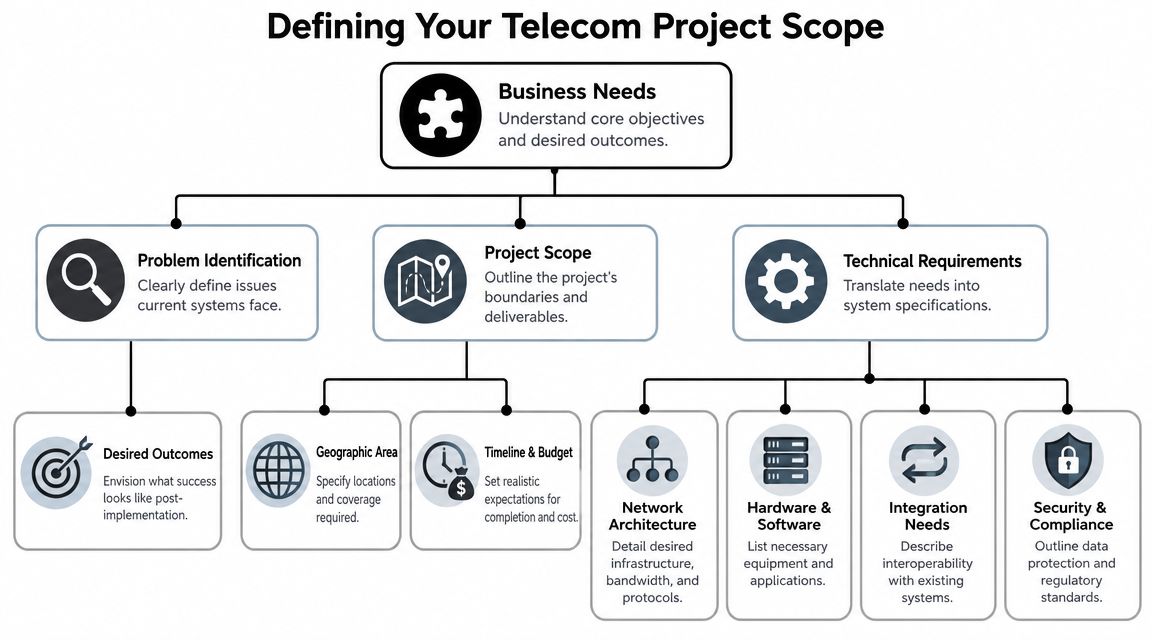
A useful scope usually answers questions like these:
- User density: How many people work onsite at one time, and where do they cluster?
- Critical applications: Voice, video conferencing, cloud apps, guest Wi-Fi, security systems, and access control all place different demands on the network.
- Building constraints: Are there shared risers, restricted ceiling access, after-hours work rules, or landlord-controlled telecom rooms?
- Future use: Will the site stay stable, or will it absorb more staff, more devices, or more departments within the lease term?
Los Angeles adds another wrinkle. As the city expands 5G infrastructure with thousands of small cells, contractor demand is growing for firms that can coordinate pole attachments, fiber backhaul, and in-building wiring, especially on projects linked to broadband equity work in underserved neighborhoods, as described by ASCE's coverage of Los Angeles broadband infrastructure. Even if your project is private and commercial, the practical lesson is the same. Integration work now matters as much as installation.
Define the technical stack in plain language
Many facilities and IT managers know what they want operationally but leave too much room in the technical interpretation. Tighten that up. You don't need engineering drawings at RFP stage, but you do need clear expectations.
Include the following where relevant:
| Project area | What to define |
|---|---|
| Structured cabling | Copper category, drop counts, patch panel expectations, labeling standards |
| Fiber backbone | Single-mode or multi-mode requirements, closet interconnects, termination expectations |
| Wireless | Coverage goals, capacity expectations, AP placement constraints, guest and corporate SSID needs |
| Voice and mobility | VoIP deployment, survivability expectations, cellular coverage issues, DAS considerations |
| Room infrastructure | Rack or cabinet needs, power availability, cooling concerns, grounding, cable management |
| Security and handoff | Segmentation requirements, testing standards, as-built documentation, admin handoff materials |
A contractor can solve a lot in the field, but not if the owner leaves the destination undefined.
Good scopes don't overspecify every part number. They do make acceptance visible before procurement starts.
Build decommissioning into the same scope
This is the part many teams leave until the final week. That's a mistake.
If old firewalls, phones, switches, edge devices, access points, or workstations are coming out, list them early. Identify which assets contain data, which equipment might be redeployed, and which materials should move into a formal IT asset disposition workflow. If your project includes office cleanout work, old server room gear, or retired network hardware, plan telecom infrastructure retirement and removal support in Los Angeles at the same time you plan installation.
One option in this category is Reworx Recycling, which handles electronics recycling, secure data destruction, IT equipment disposal, and related decommissioning workflows for organizations retiring old technology. In practice, that means your project team can treat removal, chain of custody, and sustainable recycling as scoped work instead of an afterthought.
Write a statement of work that a field team can execute
A workable SOW should do more than describe the destination. It should define who provides what, what access windows exist, and how success gets verified.
Use this checklist before issuing bids:
- Site information: Full addresses, floor plans if available, room IDs, access restrictions, parking or freight constraints.
- Owner-furnished items: Any switches, firewalls, access points, handsets, racks, or licenses supplied by your team.
- Contractor deliverables: Installation, testing, labeling, cleanup, documentation, punch-list resolution, and cutover support.
- Retirement scope: Removal of replaced hardware, cable abandonment rules, data-bearing device handling, final disposition path.
- Acceptance criteria: What has to be tested, documented, and signed off before the job is considered complete.
When the scope is this clear, proposals get easier to compare and field surprises become easier to manage.
Vetting Contractors for the Los Angeles Market
A telecom contractor who performs well in a simple suburban office park can struggle in Los Angeles. The city forces different muscles. Dense buildings, older infrastructure, building-management gatekeeping, constrained pathways, and difficult scheduling windows all punish loose planning.
The first thing to understand is that this market rewards execution detail. Los Angeles is a high-complexity telecom environment because contractors often have to account for voice, data, wireless, riser access, conduit congestion, and power constraints during installation. Buyers often judge a contractor less on headline pricing and more on implementation detail, and a qualified firm should provide a network diagram, site readiness review, and support model before signature, according to guidance on telecom services in Los Angeles.

What to verify before pricing matters
A serious screening process starts with legal and operational basics. If a contractor resists standard diligence requests, move on.
Check for:
- Licensing fit: The firm should hold the right California licensing for the scope being performed, and the contracting entity should match the paperwork.
- Insurance readiness: Ask for current general liability and workers' compensation certificates early, not after award.
- Project leadership: Get names for the project manager, field supervisor, and escalation contact.
- Local operating experience: Ask for projects in comparable LA building types, not just a generic client list.
If your internal stakeholders need a refresher on the legal trade-offs around contractor qualification, this overview on making informed contractor choices in California is useful context for procurement and facilities teams.
The questions that reveal field maturity
Most buyers ask broad questions and get polished answers. Better questions create pressure on process.
Try asking these in interviews:
| Question | What a strong answer sounds like |
|---|---|
| How do you handle site readiness in occupied buildings? | Mentions surveys, access constraints, staging, protection of finished space, and building coordination |
| What do you provide before installation starts? | Produces sample diagrams, readiness notes, assumptions, and cutover approach |
| How do you manage riser and conduit surprises? | Explains escalation path, documentation, change control, and alternatives |
| What does closeout include? | Lists test results, as-builts, labels, final inventory, and punch-list process |
Weak contractors stay abstract. Good ones get specific quickly.
If a bidder can't explain what happens between survey, install, test, cutover, and closeout, you're not looking at a management-quality contractor. You're looking at labor with a proposal template.
Why the low bid often becomes the expensive one
In Los Angeles, telecom projects often fail on execution rather than technology choice. That shows up in missed access windows, poor coordination with carriers, undocumented field changes, and closet conditions nobody flagged during preconstruction. Cheap bids often leave room for all of that.
The safer approach is to evaluate value in terms of risk removed. A higher bid can still be the better buy if it includes cleaner assumptions, stronger documentation, better sequencing, and a credible support model. Outside planning help can pay off under such circumstances. Some organizations use telecom consulting support in Los Angeles to pressure-test scope, compare contractor responses, and expose hidden exclusions before contract award.
Red flags worth acting on
Not every concern needs to kill a bid, but some do.
- Vague deliverables: “Install and configure as needed” isn't a scope.
- No readiness package: If there's no site review, no assumptions log, and no diagram, the field team will improvise.
- Reluctance around paperwork: Delayed insurance certs, unclear license details, or incomplete references usually point to bigger process issues.
- Overconfidence in old buildings: Anyone who treats riser access, power constraints, and conduit congestion as routine nonissues probably hasn't looked hard enough.
The best telecom contractor in Los Angeles for your project may not be the biggest brand or the lowest price. It's the one that sees hidden risk before mobilization and can prove it with planning artifacts, not just promises.
Understanding Local Codes Permits and Project Costs
Permitting and pricing are where many otherwise smart projects lose realism. Buyers assume low-voltage work should move quickly because it isn't a major structural renovation. In Los Angeles, that assumption can create bad timelines and worse change orders.
The practical way to think about permits is simple. Some telecom work is straightforward tenant improvement activity inside existing conditions. Some work touches pathways, penetrations, room buildout conditions, firestopping, exterior routes, or other building-controlled elements that trigger more review and coordination. Even when a permit looks manageable, the schedule impact often comes from access approvals, inspection timing, and landlord process rather than the form itself.
Build schedule around approvals, not installer optimism
A qualified contractor should identify permit and inspection responsibilities in writing. Don't accept “we'll handle permits” as a complete answer. Ask what must be submitted, who signs, what dependencies exist, and whether any work can proceed in parallel.
Use this owner-side checklist:
- Landlord approvals: Confirm telecom room access, riser use, roof rules, and after-hours requirements.
- Building documentation: Verify whether existing drawings are available and reliable.
- Inspection sequence: Know which activities require signoff before ceilings close or pathways get concealed.
- Firestop and penetration rules: These often create rework when treated casually.
A lot of project delay comes from waiting on basic decisions. Which riser path is approved. Whether a sleeve can be reused. Whether work has to happen after business hours. Those aren't installation details. They're timeline drivers.
Understand what drives cost in Los Angeles
Labor is one of the clearest cost inputs. The U.S. Bureau of Labor Statistics reports that telecommunications technicians earned a median annual wage of $64,310 in May 2024, or $30.92 per hour, and the field remains labor-intensive even as the occupation is projected to decline overall, with about 23,200 openings per year on average due largely to worker replacement, according to the BLS occupational outlook for telecommunications equipment installers and repairers. In a market like Los Angeles, that labor reality shows up directly in project pricing.
That doesn't mean every higher-priced proposal is justified. It does mean you should treat labor-heavy scopes with respect. Telecom work depends on skilled technicians, and the expensive part is often not the cable. It's the team that installs, tests, labels, troubleshoots, and returns for cutover windows.
What to compare across proposals
Since project-specific pricing varies too much for honest generic benchmarks, compare structure instead of chasing a magic number.
| Cost component | What to look for |
|---|---|
| Labor | Clear separation between standard install work, after-hours work, and cutover support |
| Materials | Named cable and hardware standards, not vague allowances |
| Access constraints | Explicit assumptions about occupied-site work, lifts, parking, or freight handling |
| Testing and documentation | Included as deliverables, not buried or excluded |
| Removal and disposition | Whether legacy equipment removal is included, excluded, or treated as optional |
A bid that looks lean because it excludes cleanup, cable abandonment, patching, or old hardware removal isn't lean. It's incomplete.
If legacy systems are coming out, ask what residual value or downstream disposition options exist for retired equipment. Some teams also review telecom equipment buyer services in Los Angeles when planning removals, especially if surplus hardware, recovery value, or structured disposition is part of the financial picture.
Keep your budget conversation tied to risk
The best budgeting question isn't “What should this cost?” It's “What assumptions is this price built on?”
Ask each bidder to identify exclusions, dependencies, and owner responsibilities in one list. That single document will tell you more about likely overrun risk than a polished cover letter ever will.
The RFP and Contractor Selection Checklist
A good RFP forces clean comparisons. A bad one invites three different scopes, three different assumptions, and one messy award meeting where nobody can tell which proposal covers the job.
If you're issuing an RFP for a telecom contractor in Los Angeles, think less about formatting and more about standardization. Every bidder should respond to the same structure, define the same exclusions, and describe the same closeout obligations.
What your RFP should require
At a minimum, ask for a project narrative, scope response, management approach, schedule assumptions, and cost breakdown. Then force specificity in areas where contractors often stay vague.
Include requests for:
- Named team members: Who manages the project, who supervises the field crew, and who owns escalations.
- Sample deliverables: Readiness review, labeling example, test-report sample, and closeout package outline.
- Assumptions and exclusions: Require these in a separate section so they don't disappear inside the proposal.
- Support model: Define what happens after turnover if defects, punch-list items, or service issues appear.
- Decommissioning language: If you expect removal of retired telecom or IT hardware, say so directly.
Sample Telecom Contractor RFP Checklist
| Category | Item to Request | Why It's Important |
|---|---|---|
| Project overview | Short narrative of your business need and site conditions | Gives bidders context beyond square footage |
| Scope of work | Detailed response to each required deliverable | Reduces interpretation gaps |
| Technical requirements | Cabling, fiber, Wi-Fi, voice, room infrastructure, testing | Forces apples-to-apples pricing |
| Schedule | Mobilization assumptions, milestones, cutover windows | Exposes unrealistic timelines |
| Pricing | Labor, materials, alternates, after-hours work, exclusions | Makes hidden costs visible |
| Team qualifications | PM, field lead, certifications, relevant project examples | Shows whether the assigned team fits the job |
| Safety and site controls | Occupied-site practices, cleanup, access coordination | Matters in active offices and shared buildings |
| Documentation | As-builts, labels, test results, inventory, turnover package | Determines whether closeout is usable |
| Warranty and support | Service-call process, defect correction, response expectations | Prevents post-install ambiguity |
| Legacy equipment handling | Removal, segregation, data-bearing asset process, disposition path | Keeps closeout from becoming a separate emergency |
How to score proposals without drifting into opinion
Use a weighted review sheet internally, even if the numbers are simple. Procurement may care most about contract clarity. IT may focus on testing and handoff quality. Facilities may focus on access, sequencing, and occupied-site behavior. Put those concerns in one scorecard instead of letting them surface informally during meetings.
A practical shortlist conversation usually comes down to four things:
- Scope completeness
- Project control
- Field credibility
- Closeout quality
Everything else supports those four.
Selection advice: Ask each finalist to walk you through one project that went sideways and how they recovered. Recovery process tells you more than polished success stories.
Red flags inside written proposals
You can spot many bad fits before interviews.
- Generic boilerplate: If the proposal reads like it could have been sent to any city and any building, it probably was.
- Thin assumptions log: Contractors who don't identify risk early usually monetize it later through change orders.
- Front-loaded payment terms: Large upfront asks without tied deliverables deserve scrutiny.
- No mention of closeout artifacts: If test results, labels, or as-builts are absent from the proposal, expect friction at the end.
For organizations building a first shortlist, local search intent is still useful. A page focused on finding a telecom contractor near your Los Angeles site can help frame initial vendor discovery, but the final selection should always come back to scope response and field-process quality.
Managing Your Project and Vendor Relationships
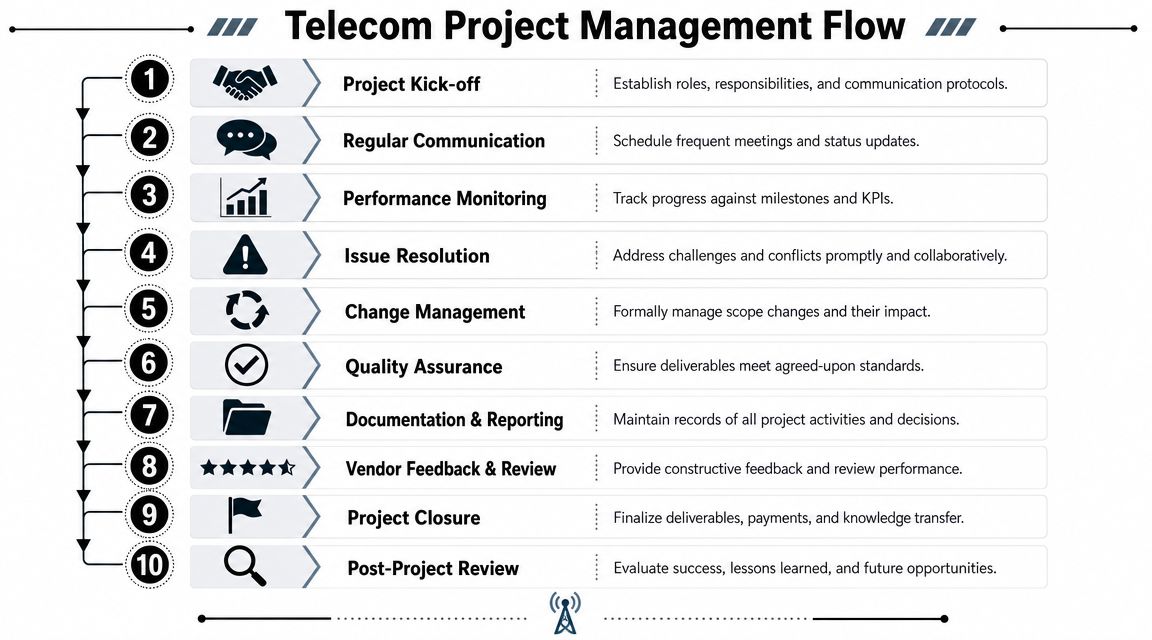
Winning the bid isn't the same as delivering the project. Once the contract is signed, the owner's job shifts from selection to control. That doesn't mean micromanaging installers. It means creating a project rhythm that keeps problems small.
The most effective telecom projects use a phased rollout with frozen baselines and a small pilot group, which reduces measurement error and makes service issues visible before full deployment, according to this telecom consolidation rollout guidance for IT leaders. That operating model matters in Los Angeles because building conditions and access constraints can turn one overlooked issue into a broad outage if you scale too fast.
Set the project cadence early
Start with a real kickoff, not a ceremonial one. The meeting should lock down responsibility, decision paths, access windows, and the change-order process. If facilities, IT, security, landlord reps, and the contractor all hear different versions of the plan, the field team will spend the next month reconciling them.
A strong cadence usually includes:
- Weekly status reviews: Track schedule, blockers, open decisions, and pending owner actions.
- Field issue logging: Document pathway conflicts, material substitutions, and failed tests as they happen.
- Milestone walkthroughs: Inspect closets, pathways, and labeling before the work gets concealed.
- Cutover planning: Assign exact times, rollback responsibilities, and acceptance checks.
Coordinate installation with retirement work
The cleanest projects treat old and new environments as one managed transition. That means timing matters. If old racks, switches, handsets, or cabling are being removed, the decommissioning team should work from the same schedule logic as the installer, not an unrelated pickup calendar.
Many office moves and network refreshes frequently stumble. The new system is ready, but the old hardware is still in the room. Or worse, someone removes equipment that another team assumed would remain live through cutover.
Use a simple coordination model:
| Phase | Owner focus |
|---|---|
| Pre-install | Confirm what stays live, what gets removed, and who approves changes |
| Pilot or first site | Validate service quality, documentation, and onsite workflow |
| Broader rollout | Expand only after the first phase produces clean results |
| Closeout | Match final asset removal, documentation, and signoff to the actual installed state |
Protect the relationship without lowering the standard
Contractors perform better when owners make decisions quickly and document them clearly. That doesn't mean accepting weak output to keep the peace. It means being disciplined on your side so you can hold the line on theirs.
Plainly put, good vendor management is specific. If labels are missing, say so in writing. If as-builts don't match field conditions, reject them and request corrections. If a crew is doing excellent work, acknowledge that too. Long-term vendor quality improves when feedback is immediate and concrete.
The best owner-contractor relationships aren't casual. They're clear.
Conclusion A Holistic Approach to Your LA Network Upgrade
A Los Angeles telecom project succeeds when the owner treats it like infrastructure, not a commodity purchase. The right contractor brings more than installers. They bring planning discipline, local building awareness, workable documentation, and a realistic approach to handoffs, cutovers, and closeout.
That matters even more as contractor demand shifts around new fiber access, in-building connectivity work, and integration across more complicated urban environments. In this market, the safest buying move is usually the one that makes hidden assumptions visible early.
A complete plan also deals with what's coming out. Legacy phones, switches, access points, structured cabling, and data-bearing equipment need the same level of attention as the new installation. If the removal path is vague, your project isn't finished. It's just moved the risk into storage rooms, closets, and disposal decisions no one owns.
The practical standard is simple. Define the scope tightly. Vet contractors for field maturity, not sales polish. Build schedule assumptions around approvals and access. Run the work in phases. Close it out with usable documentation and a documented path for retired hardware.
That approach protects uptime, budget, and accountability. It also aligns the technical upgrade with broader sustainability and security expectations, which is increasingly important for businesses managing office cleanouts, IT equipment disposal, computer recycling, data center decommissioning, medical equipment disposal, laptop disposal, product destruction, secure data destruction, and broader IT asset disposition programs.
If your Los Angeles organization is upgrading network infrastructure and needs a responsible path for retired hardware, Reworx Recycling can support electronics recycling, donation-based recycling, secure data destruction, office cleanout planning, and sustainable IT equipment disposal. Businesses can donate old equipment, schedule a pickup, or build a repeatable social enterprise recycling process into the next telecom rollout.