
Your team signs off on a network upgrade after months of complaints. Video calls freeze at 10 a.m., cloud apps lag, and the old voice setup starts fighting with file sync and security traffic. Then the critical work starts. In Chicago, choosing a business telecom provider is less about who has the biggest name and more about who can effectively serve your building, meet your cutover timeline, and fit the network you need next year, not the one you had two years ago.
Chicago gives buyers plenty of options, but that cuts both ways. Company directories show a dense mix of national carriers, Chicago-based firms, and specialized providers in the metro area, not a single-vendor market, according to Zippia's roundup of telecommunication companies in Chicago. That density helps if you know how to screen providers. It creates delays and budget surprises if your team compares logos before checking on-net availability, local construction requirements, building access, and service handoff options.
The procurement mistake I see most often is treating telecom selection as a standalone purchase. It is a lifecycle project. A new circuit often triggers new firewalls, switches, SD-WAN appliances, phones, racks, or edge gear. That means the provider decision and the retirement plan for old hardware should be built together from the start, especially if you want a cleaner cutover, fewer security gaps, and fewer leftover assets collecting dust in a locked closet.
That is the angle behind this guide. It covers the provider list, but it also ties carrier selection to the full upgrade process, including how to retire replaced equipment through a responsible Chicago telecom equipment recycling and ITAD process. If the new service is live but old routers and phones still sit untracked in storage, the project is still open, and the cost, risk, and operational mess are still yours.
The sections that follow focus on practical trade-offs. Some providers are better for fast installs in specific buildings. Others make more sense for multi-site WAN design, dark fiber access, voice consolidation, or carrier-diverse redundancy. The right choice depends on coverage, contract structure, support model, and what it will take to decommission the equipment you are replacing without creating a second problem for your IT team.
1. AT&T Business
AT&T usually enters the conversation when a Chicago company is replacing more than a single internet circuit. A headquarters move, branch consolidation, SD-WAN rollout, or voice migration often pushes buyers toward a carrier that can cover transport, wireless failover, voice, and managed network services under one master agreement. That convenience is real, but it comes with a trade-off. The quoting process can be slower, and building-specific serviceability matters more than brand recognition.
AT&T's business footprint in Illinois is well established, and the company documents its enterprise service portfolio through the AT&T Business site. For Chicago IT teams, the practical question is less about whether AT&T serves the market and more about how well it serves your exact address, suite, and building pathway.
Where AT&T fits best
AT&T makes the most sense for organizations that want to standardize across multiple sites. That includes firms with a downtown office and suburban branches, healthcare groups, distributed professional services teams, and companies that want one vendor for primary connectivity plus wireless backup.
Its main advantages are straightforward:
- One-provider scope: Internet access, dedicated connectivity, voice, mobility, and managed network options can be sourced through one carrier.
- Procurement familiarity: Larger legal, finance, and security teams often already know how to review AT&T contracts and onboarding requirements.
- Backup flexibility: Wireless failover can be useful when fiber timelines slip or a temporary resilience layer is needed during migration.
What to check before you sign
AT&T can work well in Chicago, but it rewards detailed pre-sales validation. Service availability can change from one floor to another in the same building. Landlord approvals, riser access, demarc location, and construction scope all affect cost and install timing.
Use the street address as a starting point, not the decision point.
I recommend treating AT&T evaluations as an engineering exercise, not just a pricing exercise. Confirm the handoff type, verify install dependencies, and ask what happens if the building needs additional work. That avoids the common mistake of approving a carrier based on a clean proposal, then discovering the actual timeline after the order is in.
The upgrade also affects equipment lifecycle planning. If the AT&T move replaces legacy routers, phones, firewalls, or WAN appliances, retire that hardware as part of the project instead of leaving it in storage after cutover. A documented Chicago telecom equipment recycling and ITAD process keeps decommissioned gear tracked, wiped, and removed before it becomes a security or facilities problem.
2. Comcast Business

A Chicago office signs a lease on Monday and needs internet live before staff arrive. That is the kind of situation where Comcast Business usually gets pulled into the conversation fast. For many small and midsize businesses, Comcast is the practical option when installation speed matters more than custom network design. Comcast also has a visible local presence. The company opened a new regional headquarters in Fulton Market, which reflects how seriously it treats the Chicago business market through Comcast's Chicago HQ announcement.
Comcast makes the most sense for offices that need dependable business internet without waiting through a longer fiber construction process. That can include new locations, branch offices, temporary spaces, and migration projects where a faster circuit keeps operations running while the long-term network is still being built.
Good fits include:
- Fast installs for standard office use: Email, SaaS apps, video meetings, cloud file access, and general business traffic.
- Branch standardization: Smaller sites often benefit from using one carrier and one billing model across multiple locations.
- Interim connectivity during a larger telecom upgrade: Comcast can hold a site over while fiber, SD-WAN, or a more customized WAN design is still in progress.
The trade-off is product selection. Comcast Business broadband, Ethernet, and dedicated internet are not interchangeable services. IT teams get into trouble when they approve the fastest install option without matching it to the actual traffic profile at the site. A sales office with cloud CRM and VoIP may run fine on business broadband. A site moving large files, supporting latency-sensitive applications, or carrying heavier upstream traffic may need a different class of service.
That distinction matters during cutover planning too. If Comcast is replacing older firewalls, cable modems, routers, or voice hardware, include decommissioning in the project scope instead of dealing with the old gear months later. A documented telecom equipment recycling and ITAD process in Chicago helps keep retired equipment wiped, tracked, and out of closets and server rooms after the migration is done.
Visit Comcast Business.
3. Astound Business Solutions
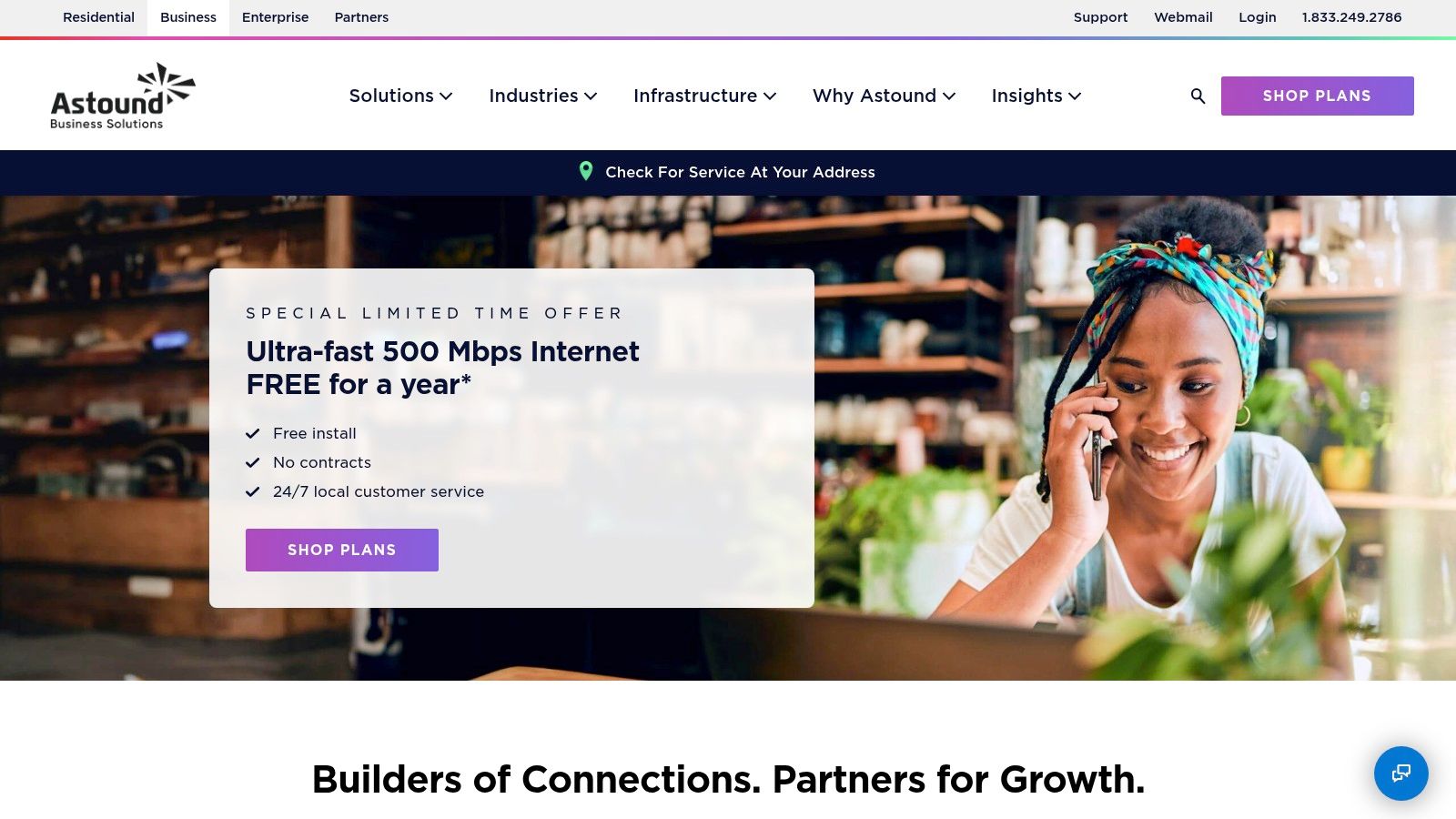
A Chicago business signs a competitive Astound quote, then loses two weeks finding out the building is not lit the way the sales conversation suggested. That happens more often than buyers expect. Astound can be a smart option, but only when the address, building entry, and install path check out early.
Astound is usually strongest for companies that want a serious alternative to the biggest incumbents without jumping into enterprise-grade carrier design. In the right building, it can be a good fit for internet access, voice, and managed Wi-Fi. The buying process also tends to work well for small and mid-market teams that want responsive account handling instead of a one-size-fits-all procurement motion.
Why Astound makes sense
Astound belongs on the shortlist when the requirement is practical and cost-conscious, but still business-grade.
Good fits include:
- Small multi-site operations: Retail groups, medical offices, agencies, and professional firms that need dependable service across a modest footprint.
- Voice replacement projects: Hosted PBX and SIP rollouts where support responsiveness affects the cutover as much as the circuit itself.
- Buildings where Astound is already active: Existing on-net or near-net presence can change both pricing and install timelines.
The main trade-off is coverage. Astound is often attractive at the building level, not automatically across all of Chicago. That means IT teams should validate serviceability by exact address and suite before they treat a quote as a real option.
Building telecom pages are useful for that first pass. The 100 and 150 South Wacker tenant telecom page shows why building-connected vendors can differ from what a citywide provider list might imply. For relocations, consolidations, or voice migrations that leave behind old routers, handsets, firewalls, or switches, include decommissioning in the project scope and use a documented Chicago ITAD and telecom equipment recycling process so retired gear does not sit in the network closet after cutover.
Visit Astound Business Solutions.
4. Zayo
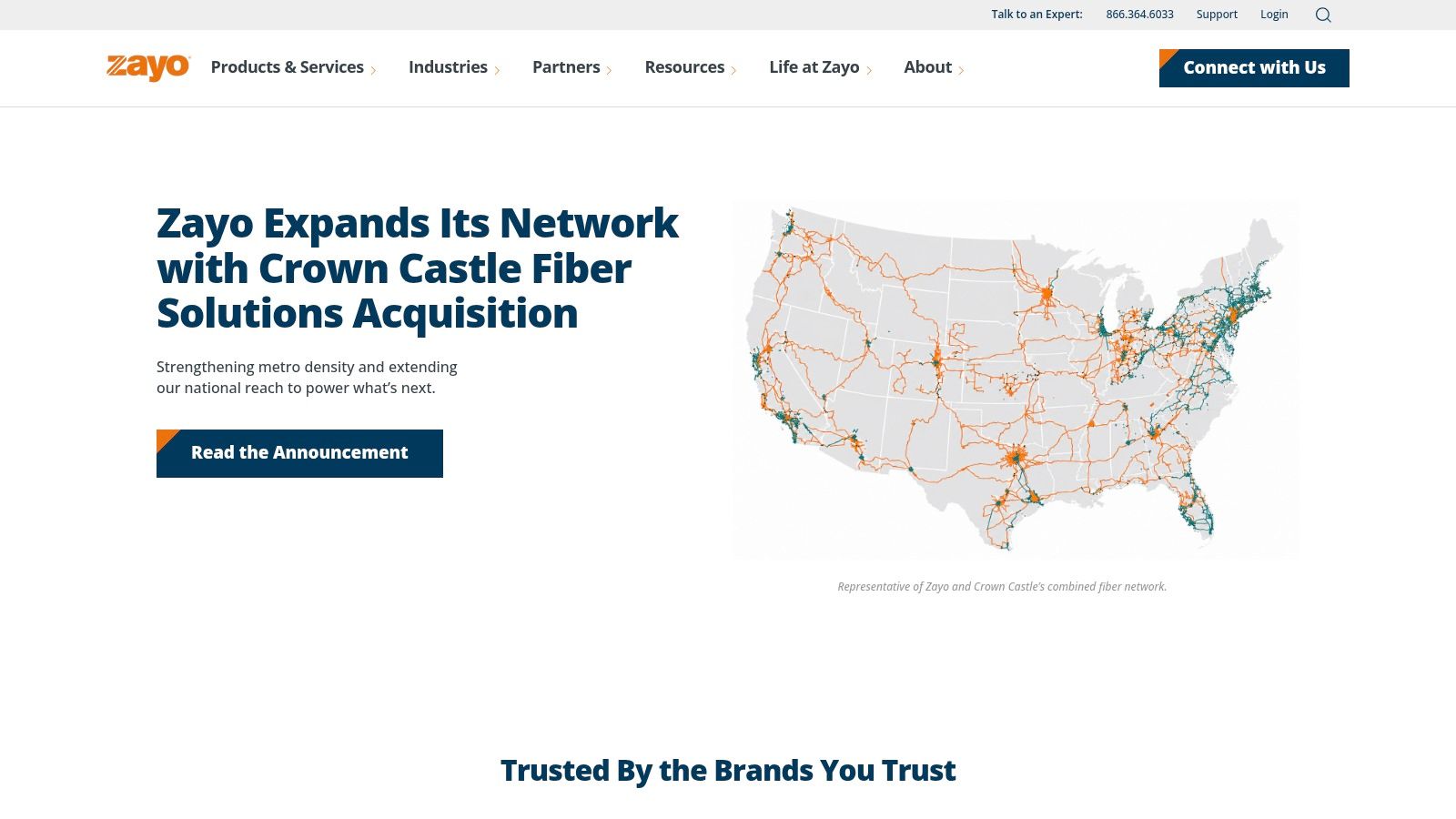
Zayo is not the provider most single-site offices should start with. It is, however, one of the most relevant names in Chicago if your requirements are serious enough to involve route diversity, high-capacity transport, dark fiber, wavelengths, or low-latency private networking.
That distinction matters. Buyers sometimes add Zayo to an RFP because they recognize the name, then discover they're not in the market for the kind of network Zayo is built to deliver. If you need straightforward broadband for a small office, this probably isn't your first call. If you run trading infrastructure, content delivery, inter-data-center transport, or demanding enterprise backbone links, it absolutely should be.
Where Zayo stands out
Zayo's value shows up when technical teams care about network architecture, not just internet access. Chicago enterprises with data-heavy operations often need more than a standard ISP relationship. They need transport options, private paths, and engineering discussions that go deeper than a speed quote.
Strong use cases include:
- Carrier hotel and data center connectivity
- Financial and latency-sensitive operations
- Private fiber and wavelength builds
- Large enterprise WAN backbones
What to watch before signing
Zayo projects can involve longer design cycles and more coordination than mainstream business internet. That's not a flaw. It's what happens when you're solving a more complex problem. But internal stakeholders need to be ready for it.
Ask for the physical path story, not just the logical service story. A second circuit on paper doesn't help much if both services share the same weak last-mile segment.
Visit Zayo.
5. Lumen Technologies

A common Chicago upgrade scenario looks like this: a company has outgrown basic internet, cloud traffic is climbing, branch performance is inconsistent, and security teams want tighter control over how applications move across the WAN. That is the kind of environment where Lumen usually belongs on the shortlist.
Lumen is a better fit for organizations that need coordinated internet, transport, WAN design, and security services under one provider relationship. For IT teams managing multiple sites, cloud on-ramps, traffic prioritization, or segmented environments, that can simplify procurement and reduce finger-pointing during outages.
Where Lumen fits best
Lumen tends to be strongest in businesses where network design still matters at the architecture level, not just at the circuit level. That includes distributed healthcare groups, manufacturers, regional professional services firms, higher education, and mid-market to enterprise organizations with central IT standards.
Its value usually shows up in a few places:
- Multi-site WAN planning: Useful when branch connectivity, routing policy, and application performance need to be managed as one design.
- Internet plus transport options: Helpful for companies mixing public internet with private connectivity between offices, data centers, or cloud environments.
- Security-aligned network projects: A practical option when SD-WAN, secure access, or policy enforcement are tied to the provider decision.
There is a trade-off. Lumen can feel heavy for a small office that only needs a fast, reliable primary circuit. Sales cycles, solution design, and provisioning often make more sense for larger environments than for a single-location business.
That is also why telecom upgrades should include a hardware exit plan. Replacing carrier gear, edge devices, old phones, and network appliances creates disposal, data handling, and logistics work that many teams leave until the last week of cutover. A better approach is to pair the provider selection with enterprise telecom transition and equipment retirement planning, especially if your rollout includes multiple offices or decommissioned infrastructure.
For Chicago businesses comparing enterprise-focused providers, Lumen is usually worth the conversation when the project involves network policy, cloud connectivity, and long-term operational control, not just bandwidth.
Visit Lumen Technologies.
6. Cogent Communications
Cogent has a very specific appeal in Chicago. If your building is on-net and your team wants straightforward, business-grade IP connectivity without buying a broad managed-services bundle, Cogent can be a sharp option.
This isn't the “one vendor for everything” choice. It's often the “give me clean data service at an address where you're already strong” choice. For network teams that know what they want, that can be refreshing.
Why some buyers prefer Cogent
Cogent is often attractive because the proposition is simple. You're generally evaluating internet and transport services, not a giant menu of branch add-ons, bundled security products, and marketing-heavy package names.
That makes it useful for:
- Office locations in on-net downtown buildings
- Secondary circuits for carrier diversity
- Data-centric teams that don't need managed voice
- IT departments that already handle their own edge and security stack
What it won't solve
If you want hosted voice, broad UC tooling, managed Wi-Fi, or white-glove local branch handholding, Cogent probably won't be the cleanest fit. You'll usually need other partners around it.
That doesn't make it limited. It just makes it specialized. In Chicago, specialists can be great purchases if your building and internal support model line up with what they sell.
Visit Cogent Communications.
7. Access One
A common Chicago scenario looks like this. The business is large enough to need reliable voice, internet, and IT support, but not large enough to tolerate three vendors pointing fingers when an install slips or a phone system breaks. Access One tends to appeal to that middle tier.
The company positions itself as a Chicago-based provider focused on business communications and IT services, with offerings that include voice, internet, networking, cloud, and managed services through its Access One business portfolio. That local operating model matters when your team wants one accountable contact who can stay involved from quoting through turn-up and support.
Access One usually makes the most sense for companies that want a practical bundled relationship, not a carrier-only transaction. In my experience, that can work well for firms with limited in-house telecom staff, multi-site professional offices, and growing businesses that still need hands-on guidance during provider changes.
Good fit scenarios include:
- Chicago SMBs that want voice and connectivity under one provider
- Teams that need managed IT or security tied to telecom decisions
- Offices that value local account management during installs and changes
- Businesses replacing aging phone systems and reviewing VoIP phone services in Chicago at the same time
The trade-off is straightforward. Access One may deliver some services over partner infrastructure depending on the address, so buyers should verify who owns the circuit, who dispatches field support, and how escalation works after installation. That is not a deal breaker, but it changes how you should evaluate SLA language and outage accountability.
One more operational point gets missed during telecom upgrades. If you are replacing switches, desk phones, firewalls, or legacy edge gear as part of the move, build hardware retirement into the project plan early. A provider change is also the right time to hand old equipment to an ITAD partner such as Reworx Recycling so the network refresh does not leave surplus telecom hardware sitting in a closet for another year.
8. Call One
Call One sits in a useful middle ground between pure carrier and managed telecom advisor. That makes it relevant for businesses with multiple office types, mixed access methods, or a need to simplify vendor sprawl. If your network includes some fiber sites, some coax sites, a few hard-to-serve branches, and voice services spread across contracts, Call One can help normalize the mess.
This is especially valuable for companies that don't want to negotiate and manage every underlying carrier relationship directly. Instead of treating each site as a standalone procurement event, they can wrap diverse locations into one managed structure.
Where Call One earns its keep
Call One is strongest when the environment is mixed. One suburban branch may need cable. A downtown office may need dedicated fiber. A temporary site may need wireless. A legacy phone environment may still need SIP or POTS replacement. That patchwork is where aggregators and telecom MSPs become useful.
Good scenarios include:
- Distributed offices with inconsistent local access options
- Businesses that want one bill or one support portal
- Voice modernization projects tied to WAN refreshes
- Organizations without time to manage several carriers directly
The more varied your branch conditions are, the more valuable carrier aggregation becomes.
What to verify carefully
Because many services ride on partner networks, you have to inspect the support model. Ask who provisions each access type, who owns trouble resolution, and how failover behaves when the primary and backup paths come from different underlying carriers.
If you're also retiring old handsets, gateways, routers, and edge appliances, tie that migration into Chicago VoIP and telecom equipment transition planning. Hardware cleanup is easiest when it's scheduled during the voice cutover, not after.
Visit Call One.
9. Zentro
Your team signs a lease, schedules the network cutover, and then learns the building already has a provider with service in place. In that situation, Zentro can move from “one more name to quote” to a practical first call.
Zentro stands out in Chicago because building presence matters more than broad metro branding for many businesses. If your office sits in a property Zentro already serves, deployment can be simpler, construction risk is lower, and install timelines are often easier to predict. If the building is off-net, the value case changes quickly, and another carrier may be a better fit.
That makes Zentro a provider to check early, not late. The first question is simple: is your address on-net, and what service tiers are available in that specific building? Zentro's business offerings and property-focused model are outlined on the Zentro website, but buyers still need to verify building-by-building availability, support terms, and handoff details.
Zentro is usually a strong fit for a narrower set of use cases than the aggregators and national carriers on this list:
- Offices in multi-tenant buildings where Zentro already has infrastructure
- Property-driven deployments where fast turn-up matters
- Hospitality, multifamily, and shared-space environments
- Backup connectivity where physical path diversity is available
The trade-off is straightforward. Zentro can be very efficient in the right building and far less relevant outside that footprint. For IT managers, that means due diligence has to include more than price. Ask whether the circuit is lit from existing in-building infrastructure, what the demarc setup looks like, how service escalations are handled, and whether the backup path is fully independent if you plan to use Zentro for resilience.
This is also one of the cleaner places to tie provider selection to hardware retirement. A building-based turn-up often leaves behind old firewalls, wireless gear, switches, or carrier handoff equipment from the previous setup. Schedule that work during the migration, not after. If the project includes fixed wireless, temporary internet, or a wireless failover layer, coordinate the cutover with wireless network installation and equipment transition planning in Chicago so the new service and the old hardware lifecycle are handled together.
For teams that want a close read on local provider and partner options around Chicago offices, Clutch's Chicago IT services listings can help with broader implementation support. Use that as context, not as proof of network availability. With Zentro, the address decides almost everything.
10. Nitel
Nitel is a strong option for companies that don't want to buy “a circuit.” They want someone to design, source, manage, and support a WAN across multiple sites and carriers. That distinction matters. Nitel is less about selling one local access product and more about imposing order on complex connectivity environments.
Chicago roots help here because the provider has long been associated with managed connectivity and aggregation for business networks. For internal IT teams that are already overloaded, that management layer can be more valuable than shaving a little cost off one branch link.
Where Nitel makes the most sense
Nitel is built for scale and variation. It's useful when branches sit in different carrier footprints, access methods vary by site, and the business still wants one operating model.
Typical fits include:
- Multi-site enterprises
- Retail, healthcare, and service organizations with many branches
- Teams rolling out SD-WAN or SASE
- Organizations that want one support structure across many carriers
What to ask now
Because Nitel now sits within Comcast Business ownership, buyers should verify current packaging, escalation paths, and where responsibilities sit between legacy Nitel motions and broader Comcast Business processes. That's not necessarily a negative. It just means you should ask operational questions early.
This provider can feel like overkill if you only have one office and one simple internet need. But if you're juggling dozens of sites, mixed carrier contracts, and inconsistent branch support, managed aggregation can remove a lot of operational drag.
Visit Nitel.
Chicago Business Telecom Providers, Top 10 Comparison
| Provider | Key Offerings ✨ | Network & SLAs ★ | Ideal Customers 👥 | Value & Pricing 💰 | Differentiator 🏆 |
|---|---|---|---|---|---|
| AT&T Business | Business Fiber, DIA, SD‑WAN, UCaaS, 5G backup ✨ | ★★★★☆ Enterprise SLAs; strong metro fiber | 👥 SMB → large enterprise, multi‑site, public sector | 💰 Premium enterprise pricing; bundled value | 🏆 Broad single‑vendor portfolio & wide on‑net reach |
| Comcast Business | HFC broadband, Metro Ethernet/DIA, UCaaS, Wi‑Fi, LTE/5G backup ✨ | ★★★★☆ Fast HFC turn‑ups; DIA with SLAs | 👥 SMBs & enterprises needing quick installs | 💰 Competitive broadband rates; SLA varies by product | 🏆 Quick installs on HFC + extensive metro Ethernet footprint |
| Astound Business | Broadband/fiber, DIA, hosted PBX, managed Wi‑Fi ✨ | ★★★☆☆ Neighborhood/building dependent SLAs | 👥 Mid‑market, cost‑sensitive multi‑site firms | 💰 Often more competitive vs national carriers | 🏆 Regional focus with flexible packaging |
| Zayo | Dark fiber, wavelengths (100G+), Ethernet, IP transit ✨ | ★★★★★ Low‑latency, engineering‑grade SLAs | 👥 Enterprises, content providers, latency‑sensitive users | 💰 Premium for high‑capacity & custom builds | 🏆 Dense metro fiber + high‑capacity wavelength options |
| Lumen Technologies | DIA, Ethernet, Wavelengths, IP/VPN, SASE/SD‑WAN ✨ | ★★★★★ Strong backbone, QoS & enterprise SLAs | 👥 Large enterprises needing QoS, segmentation & security | 💰 Enterprise pricing; integrated security value | 🏆 Integrated security + deep peering/backbone |
| Cogent Communications | Flat‑rate symmetric DIA, Ethernet, transport, POPs ✨ | ★★★★☆ Predictable throughput; strong peering | 👥 Offices needing symmetric DIA on‑net | 💰 Very competitive flat‑rate DIA pricing | 🏆 Aggressive pricing & robust IP transit |
| Access One | Hosted PBX/UCaaS, Internet, SIP, managed security, local support ✨ | ★★★☆☆ Local hands‑on support; partner footprints | 👥 SMBs & mid‑market wanting local partner | 💰 Custom quotes; relationship-driven value | 🏆 Local account management & hands‑on service |
| Call One | Fiber/coax/fixed wireless mix, SD‑WAN, SIP/UCaaS, billing consolidation ✨ | ★★★☆☆ SLAs vary by underlying carrier | 👥 Distributed sites needing billing & procurement simplification | 💰 Simplifies billing; pricing varies by carrier | 🏆 Multi‑carrier aggregation & lifecycle consolidation |
| Zentro | Commercial Internet up to 10Gb, fixed wireless/P2P, managed building Wi‑Fi ✨ | ★★★★☆ Very fast provisioning on‑net; local support | 👥 Offices, MDUs, hospitality & venues in on‑net buildings | 💰 Competitive for rapid in‑building installs | 🏆 Rapid turn‑up in on‑net buildings + fixed wireless options |
| Nitel | SD‑WAN/SASE, DIA, Ethernet, multi‑carrier aggregation, Tier‑3 support ✨ | ★★★★★ Centralized SLA & Tier‑3 support | 👥 Multi‑site enterprises wanting single management layer | 💰 Managed‑service premium; enterprise value | 🏆 Single SLA/management across multiple carriers |
Build Your Future-Ready and Sustainable Chicago Network
The best Chicago telecom decision usually comes down to matching provider type to business reality. If you need broad availability and a large service catalog, AT&T Business and Comcast Business will often anchor the shortlist. If your team wants enterprise transport, private networking, or route-aware architecture, Zayo and Lumen deserve closer attention. If you care more about local support, flexible packaging, or building-specific agility, providers like Access One, Call One, Astound, and Zentro may be stronger operational fits.
The common mistake is buying on brand familiarity alone. Chicago is dense, but it's also patchy at the building level. A provider can be excellent across the metro and still be a poor fit for your exact suite because of riser access, landlord process, construction complexity, or a lack of true path diversity. That's why site qualification should happen before serious pricing comparisons. You're not just buying bandwidth. You're buying install risk, support structure, failover options, and long-term operating friction.
Resilience deserves more scrutiny than it usually gets. Chicago provider roundups often list large incumbent names, but they don't always answer the harder question of whether your “diverse” services are diverse enough to reduce outage risk. Lightyear's Chicago-focused discussion of Ethernet private line buying highlights that buyers should look beyond speed and price to ask about physically separate paths, independent networks, dual-carrier resilience, wireless backup, and service diversity through its Chicago private line guidance. For most businesses, that's a key dividing line between a circuit that looks good on paper and a network that holds up under pressure.
One practical standard works across almost every provider on this list. Verify exact address availability, ask whether the building is on-net or near-net, confirm who owns the last mile, and require a plain-English explanation of the failover design. If your provider can't explain the path diversity clearly, you probably don't have enough diversity.
There's also a step many telecom projects still miss. Upgrading connectivity usually means replacing hardware. Routers, firewalls, SD-WAN appliances, access points, legacy phone systems, handsets, switches, and demobilized edge devices all have to go somewhere. If they stay in a closet, your migration created a new risk instead of finishing the job. Secure data destruction, responsible electronics recycling, and documented IT asset disposition should be part of the original project plan.
That's where a lifecycle approach helps. Businesses that modernize their connectivity and retire old infrastructure in the same motion usually end up with fewer loose ends, cleaner audit trails, and less facility clutter. Reworx Recycling is one relevant option for organizations that need donation-based electronics recycling, IT equipment disposal, secure data destruction, and pickup support as part of a broader network refresh. For general guidance on reducing e-waste and handling end-of-life electronics responsibly, the EPA's electronics donation and recycling resources are also useful.
If your telecom upgrade includes remote access redesign, vendor VPN policies, or secure user connectivity, it can also help to review a plain-language overview such as this Nerds 2 You Edmonton VPN explanation.
A strong network upgrade should leave you with more than a faster line. It should leave you with a cleaner operating model, better resilience, less obsolete hardware, and a responsible plan for everything you retire along the way. That's how you build a Chicago network that's easier to run and easier to defend.
If your business is upgrading carriers, replacing network gear, planning an office cleanout, or retiring telecom hardware, explore the latest guidance from Reworx Recycling. Reworx Recycling helps organizations handle electronics recycling, secure data destruction, IT equipment disposal, and donation-based recycling in a way that supports both operational cleanup and community impact.