

A need for a telecom service quote near me typically arises when you're already in the middle of a larger project. A circuit is underperforming. A contract is nearing renewal. A new site is opening. Or your team finally hit the point where coax, aging voice gear, and pieced-together wireless backups aren't good enough anymore.
That search sounds simple, but the buying process isn't. The hard part usually isn't finding a provider. It's getting quotes that are comparable, knowing which promises matter, and making sure the upgrade doesn't create a second problem when old routers, phones, switches, firewalls, and storage gear are left sitting in a closet with live data still on them.
A strong telecom procurement process connects both ends of the project. You source the right service, negotiate from clean requirements, and plan the retirement of replaced equipment with the same discipline.
Navigating the Modern Telecom Market
Most business buyers don't have a coverage problem. They have a selection problem.
In a mid-sized market like Ocala, Florida, mobile service is reported at 100.0% land-area coverage, and quote comparisons often come down to service quality, speed, and address-level 5G reach rather than whether service exists at all, according to mobile coverage data for Ocala. That same comparison shows T-Mobile at 99.75% 5G coverage with an estimated average speed of 70.82 Mbps, which is a useful reminder that "available" and "good enough for your site" aren't the same thing.

Why local quotes vary so much
A business searching for a telecom service quote near me will usually see a mix of national carriers, cable operators, fixed wireless offers, local fiber, and broker listings. Those results can look interchangeable at first glance. They aren't.
One quote may be built around shared broadband with fast installation. Another may include fiber with stronger service guarantees. A third may advertise aggressive monthly pricing but bury important conditions in installation scope, term language, or support limitations.
What works in practice is treating each quote as a package of trade-offs:
- Access method matters: Fiber, cable, fixed wireless, and mobile backup each solve different problems.
- Installation risk matters: Fast turn-up is valuable, but only if the service can support your applications after go-live.
- Reliability matters: A lower monthly rate can lose its appeal quickly if your site depends on cloud voice, VPN, or POS uptime.
- Support model matters: When an outage hits, response quality becomes part of the actual cost.
The best quote isn't the cheapest line on the page. It's the offer that matches the site's operational risk.
What experienced buyers watch first
I look at business telecom quotes in three layers. First, can the carrier serve the exact building and demarc where we need service? Second, does the proposed service fit the workload? Third, what will this look like on the invoice after fees, add-ons, and install conditions show up?
That order matters. Teams waste time when they compare promotional pricing before confirming serviceability and performance assumptions.
The modern market gives buyers real power, but only if they stop shopping by headline rate alone. The providers that deserve a second look are the ones willing to validate address-level availability, document install assumptions, and quote in a format you can audit later.
Prepare Your Business for an Accurate Quote
Most quote problems start before the first provider call. If your internal requirements are loose, carriers fill in the blanks for you. That's how you end up comparing different services under the illusion that they're equivalent.
The fastest way to clean that up is to do your homework before you ask for pricing.
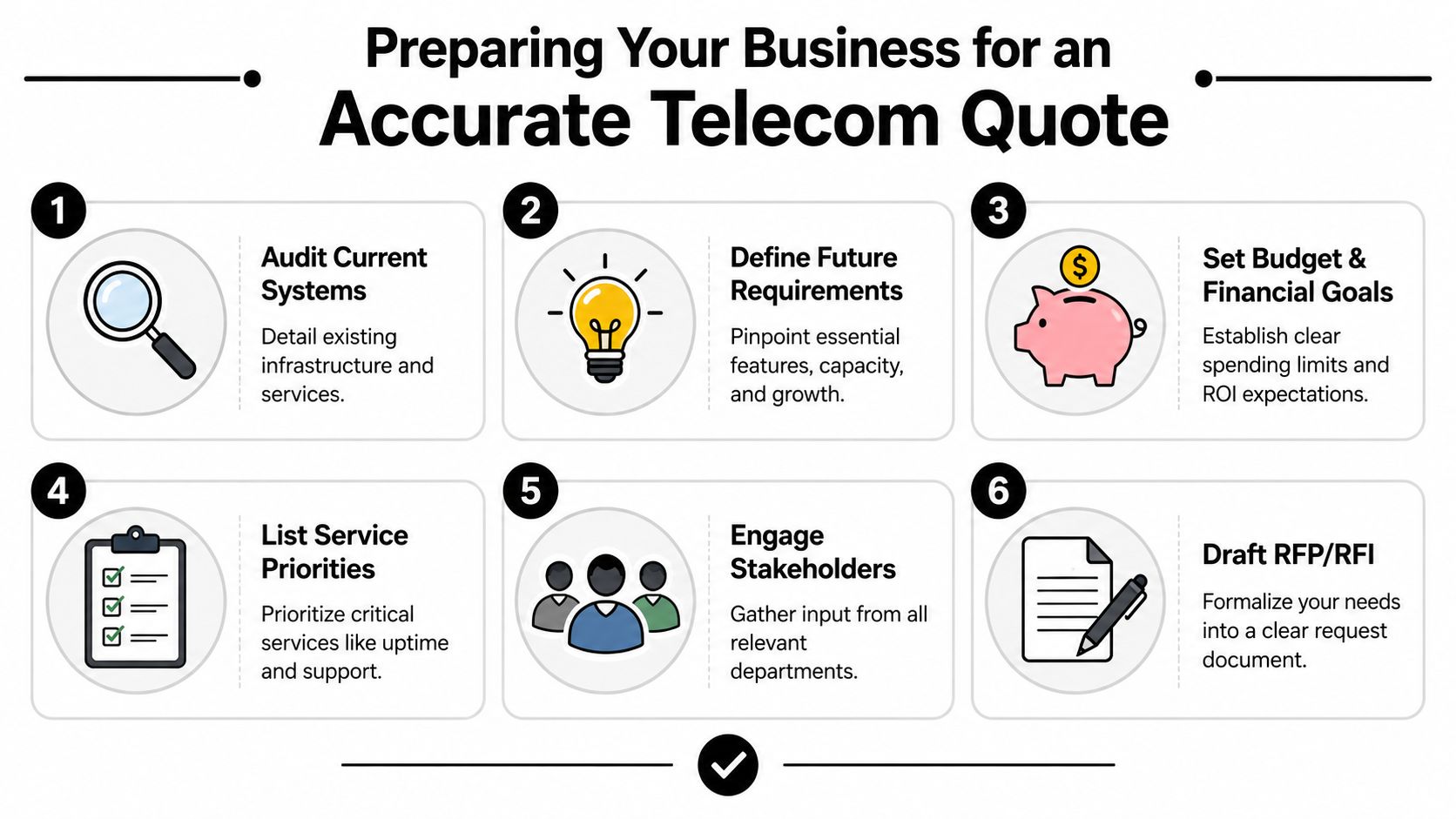
Build the internal packet first
Before requesting anything, gather the documents that define your current state and your risk tolerance.
- Current invoices: Pull recent telecom bills for each site so you can see existing services, billing structure, taxes, and recurring charges.
- Contracts and renewal dates: You need term commitments, notice windows, and any clauses that affect migration timing.
- Network and site details: Include circuit IDs, site addresses, demarc notes, rack space concerns, and any building access restrictions.
- Application requirements: Note what the connection supports, such as VoIP, cloud ERP, camera traffic, guest Wi-Fi, file transfer, or SD-WAN.
- Business constraints: Include whether downtime is acceptable, whether failover is required, and whether a site must stay live during cutover.
A provider can only quote accurately against what you define. "We need faster internet" is not a buying requirement. It's a complaint.
Define what the new service must do
Good requirements are operational, not aspirational. State what the site has to support and where you can compromise.
A simple way to frame it is to write down the answer to these questions:
- Which locations are critical, and which are flexible?
- Is the service primary connectivity, backup connectivity, or both?
- What applications break first when latency, jitter, or packet loss shows up?
- Do you need a managed router, static addressing, voice support, or installation coordination with another vendor?
- How much growth do you expect at the site over the contract term?
Practical rule: If your finance team, operations lead, and network team would describe the project differently, the RFP isn't ready.
Get precise about location and eligibility
Address quality matters more than many buyers expect. Broadband policy distinguishes between unserved locations, often below 25/3 Mbps, and underserved locations, often below 100/20 Mbps, and that status can affect quote outcomes, buildout timing, and eligibility for expansion support, as outlined in Pew's memo on unserved and underserved definitions.
That matters even in markets with broad availability. A provider website may show a building as serviceable while the actual quote depends on construction, landlord approvals, conduit access, or whether the address qualifies for an existing footprint.
Use a quoting checklist that forces clarity
A short internal checklist saves rounds of rework later.
| Item | Why it matters |
|---|---|
| Exact service address | Prevents broad, non-binding availability responses |
| Required bandwidth | Filters out quotes built on the wrong product tier |
| Desired install window | Exposes realistic versus optimistic timelines |
| SLA expectations | Separates business-grade offers from commodity access |
| Managed equipment needs | Avoids surprise rental or support charges |
| Cutover plan | Reduces downtime risk during migration |
If you're buying for multiple sites, normalize everything up front. Same request format. Same assumptions. Same pricing template. That's the only way to compare quotes cleanly later.
How to Source Comprehensive Local Telecom Quotes
Once your requirements are tight, sourcing becomes much easier. You don't need more quote volume. You need the right mix of providers.
In a market like Ocala, the provider environment is stratified. An industry comparison lists an average download speed of 240.2 Mbps, while individual offers range from 300 Mbps to 8,000 Mbps in select areas, which is why buyers should source from multiple provider types rather than relying on one familiar brand, according to local internet provider comparisons for Ocala.
Use more than one buying channel
A broad search engine query will surface ads and consumer-facing pages first. That can be useful for discovery, but it's weak for procurement.
The better approach is to work several channels at once:
- Direct carrier outreach: Good for national providers you already use or want on your vendor roster.
- Regional and municipal fiber inquiries: These often uncover strong local options that don't dominate ad results.
- Telecom brokers or aggregators: Useful when you need fast market coverage across many locations.
- Existing vendor account teams: Sometimes the fastest path for amendments, renewals, and migration quotes, though you still need external comparison pressure.
Each channel has trade-offs. Brokers can speed up discovery, but the quality of the process depends on how well they normalize bids. Direct outreach gives you cleaner accountability, but it takes more time. Regional providers may offer a strong fit at a specific address, but only if you ask.
How to ask for quotes so vendors take you seriously
Providers respond differently when they see a real buyer versus a casual inquiry. A vague web form gets a vague answer. A structured request gets routed to sales engineering faster.
Send a concise request package that includes:
- Site addresses
- Required service type
- Bandwidth targets
- Contract preference
- Desired install timing
- Whether managed equipment is needed
- Whether backup connectivity is part of the request
Then ask for the response in a common format. Require recurring charges, non-recurring charges, install assumptions, SLA language, and serviceability confirmation by address.
Ask vendors to quote the same scope, not their favorite variation of your scope.
Don't ignore local provider types
Many buyers leave value on the table. They collect quotes from the obvious national names and stop. That's not enough in a stratified market.
A cable operator may win on speed-to-install. A fiber provider may win on stability and long-term fit. A municipal network may be relevant for a public-sector or downtown site. A fixed wireless option may be the right interim service when construction would delay a wired install.
The strongest sourcing process usually ends with a small finalist group, not a giant spreadsheet. If you force every provider into the same service definition, the differences become easier to judge and the negotiation gets sharper.
Scrutinize Quotes and Identify Red Flags
A telecom quote should be read like a contract draft, not like a flyer. If you only compare the monthly number in bold, you'll miss the parts that cause trouble after install.
This is also where disciplined buyers separate themselves from rushed ones. The quote isn't just for approval. It's the first artifact you'll use later when the invoice arrives and doesn't match what sales discussed.

Read every quote in the same order
I like to review quotes top to bottom in a fixed sequence:
- Serviceability by address
- Access type and bandwidth
- Recurring charges
- Non-recurring charges
- Term and renewal language
- SLA terms
- Install interval and dependencies
- Taxes, surcharges, and exclusions
That order keeps the operational issues in front of the pricing issues. It also reduces the chance that a low monthly rate distracts you from poor install conditions or vague support obligations.
What a clean quote packet should contain
Gartner-cited estimates say up to 85% of telecom invoices contain mistakes, with recoverable errors consuming roughly 12–20% of total telecom spend, which is why an auditable quote packet with all recurring and non-recurring charges specified up front is so important, according to Tellennium's analysis of telecom cost management failures.
A quote worth approving should include more than price. It should document:
- Site eligibility: Confirmation that the provider can serve the exact location and building.
- Service details: Speed, access medium, handoff, and any managed hardware assumptions.
- Commercial terms: Monthly charges, one-time charges, term length, and any conditional pricing.
- SLA language: Uptime commitments, repair windows, and how credits are handled.
- Install detail: Expected interval, customer dependencies, and whether construction is excluded.
- Post-award validation plan: Enough detail to compare the first invoice against the approved commercial terms.
If a provider can't quote cleanly, expect billing and support problems later.
Common red flags buyers miss
Some red flags are obvious. Others hide in plain sight.
| Red flag | Why it matters |
|---|---|
| Bundled pricing with little detail | Makes invoice validation difficult |
| Vague install language | Leaves room for unexpected construction or delay disputes |
| Missing SLA attachment | Suggests business support isn't actually defined |
| Auto-renewal language | Can lock you into poor pricing if dates are missed |
| Unclear taxes and surcharges | Distorts true landed cost |
| Different assumptions across vendors | Breaks quote comparability |
A special watch item is anything added close to renewal or migration. That's where misapplied rates, promo confusion, and duplicate billing tend to show up. If a carrier bundles access, transport, and fees differently from another carrier, normalize before comparing. Otherwise, the "cheaper" quote may only look cheaper because important costs were moved into a different line item or excluded from the headline figure.
Plan for Your Old Equipment Decommissioning
Cutover night ends, the new service is live, and everyone wants to close the project. Then the old firewall is still in the rack, two PRI handoff devices are sitting on a shelf, and a branch closet has a box of handsets, APs, and backup media with no owner and no disposition plan. That is how a clean telecom upgrade turns into a security, storage, and audit problem.
A telecom purchase is not finished until the displaced equipment is removed, tracked, sanitized if needed, and sent down the right end-of-life path. Procurement should treat that work as part of the project scope, not as leftover cleanup for facilities or local IT.

Treat retirement as part of procurement
Teams that run a disciplined sourcing process should apply the same discipline after cutover. CloudAge describes the quote-to-cash lifecycle as a control problem, and the same point applies at retirement. If no one defines ownership, removal steps, data handling, and documentation before install day, old gear tends to linger and risk stays with the customer long after the new service is accepted, as described in best practices for mitigating telecom quote-to-cash lifecycle chaos.
The decommissioning plan should cover five basics:
- Asset identification: Which devices are being replaced, where they sit, and whether they are owned, leased, or provider-managed.
- Data handling: Which assets may store logs, credentials, call records, configurations, or other sensitive information.
- Chain of custody: Who removes equipment, where it is staged, who transports it, and how handoff is recorded.
- Disposition path: What gets reused, donated, remarketed, recycled, or destroyed.
- Documentation: Asset lists, sanitization or destruction records, and internal approval that the site is cleared.
What usually goes wrong
The failure pattern is predictable. The carrier finishes its work. The local team unplugs the old hardware. Then nobody owns the next step.
That creates several avoidable problems at once. Network and voice gear often retains configuration history. Firewalls, SBCs, call recording components, and even some UPS or management devices may hold data that matters to security or compliance. Less sensitive equipment still creates trouble if it sits in storage for months and no one can say whether it should be returned, reused, recycled, or written off.
Old telecom gear is only low risk after it is inventoried, sanitized where needed, and dispositioned with records.
Build an ITAD lane into the rollout
The practical fix is simple. Put decommissioning tasks on the same calendar as installation, testing, and cutover. Assign an owner before the first truck roll.
For larger refreshes, I prefer a site-by-site retirement checklist tied to the implementation plan. It should state what leaves the rack, what the provider takes back, what your team retains, and what goes to an IT asset disposition or recycling partner. That avoids the common mess where field teams finish the migration but retired assets pile up in MDFs, branch closets, and storerooms.
Reworx Recycling is one example of the kind of partner procurement teams use for electronics recycling, IT equipment disposal, pickups, decommissioning support, and secure hard drive shredding. The value is operational, not theoretical. You can align removal with cutover, maintain chain-of-custody records, and keep displaced hardware from turning into a storage and compliance issue.
This matters beyond routers and switches. A telecom upgrade often exposes adjacent cleanup work such as server retirement, product destruction, facility cleanouts, medical equipment disposal, laboratory equipment disposal, or data center decommissioning. The strongest upgrade plans account for that full exit path early, while contracts are being finalized and site work is still easy to coordinate.
Partnering for a Sustainable and Strategic Upgrade
The smartest telecom purchase isn't just a better circuit. It's a cleaner lifecycle.
A strong buying process starts with real requirements, not vague complaints. It continues with structured sourcing, normalized quote comparisons, and careful review of recurring and non-recurring charges. Then it finishes the job by retiring displaced equipment in a way that protects data, supports sustainability goals, and keeps your sites from becoming storage rooms for obsolete hardware.
For business owners, IT managers, facilities leads, and sustainability teams, that's the practical version of value. Not just lower monthly cost. Better fit, fewer billing surprises, cleaner operations, and a documented end-of-life process for old assets.
This matters in any city, whether you're managing one office or a multi-site footprint. A telecom service quote near me should lead to a full operating decision. Which provider fits the address. Which contract terms hold up under review. Which equipment gets replaced. Which assets can be reused or donated. Which materials need secure data destruction and responsible recycling.
There's also a broader business benefit. A disciplined transition supports sustainable recycling, social enterprise recycling, and corporate donation programs instead of letting retired technology drift into ad hoc disposal. If your organization reports on environmental responsibility or community impact, that operational detail becomes part of the story you can defend.
A procurement team that's serious about telecom should be just as serious about what leaves the building when the new service goes live.
If your business is upgrading connectivity and needs a responsible plan for retired phones, networking hardware, servers, laptops, or other surplus electronics, consider working with Reworx Recycling. They can help you coordinate donation-based recycling, secure data destruction, office and facility cleanout support, and IT asset disposition so your telecom project ends as cleanly as it starts.