A Fort Smith office cleanout often starts with a familiar scene: retired laptops stacked beside monitors, servers waiting in a storage room, printers nobody wants, and hard drives still carrying business data. The facilities team wants the equipment gone, while IT wants proof that information was protected and sustainability staff need a defensible recycling record.
That's where electronics recycling in Fort Smith AR becomes an operational issue, not just a disposal task. The city offers a useful residential pathway, but businesses, schools, healthcare offices, manufacturers, logistics companies, and public agencies need a separate plan for pickup, data destruction, compliance, and documented disposition.
Why Fort Smith Businesses Need a Different Recycling Playbook
A company truck rolling to Fort Smith's free e-waste drop-off sounds efficient. It is the wrong move for business equipment. All Sebastian County residents can use the city's e-waste drop-off at no additional cost, but the Solid Waste Services Department doesn't accept e-waste from businesses. Business computers go through a separate fee-based channel at the Fort Chaffee location, according to the Fort Smith waste management FAQ.
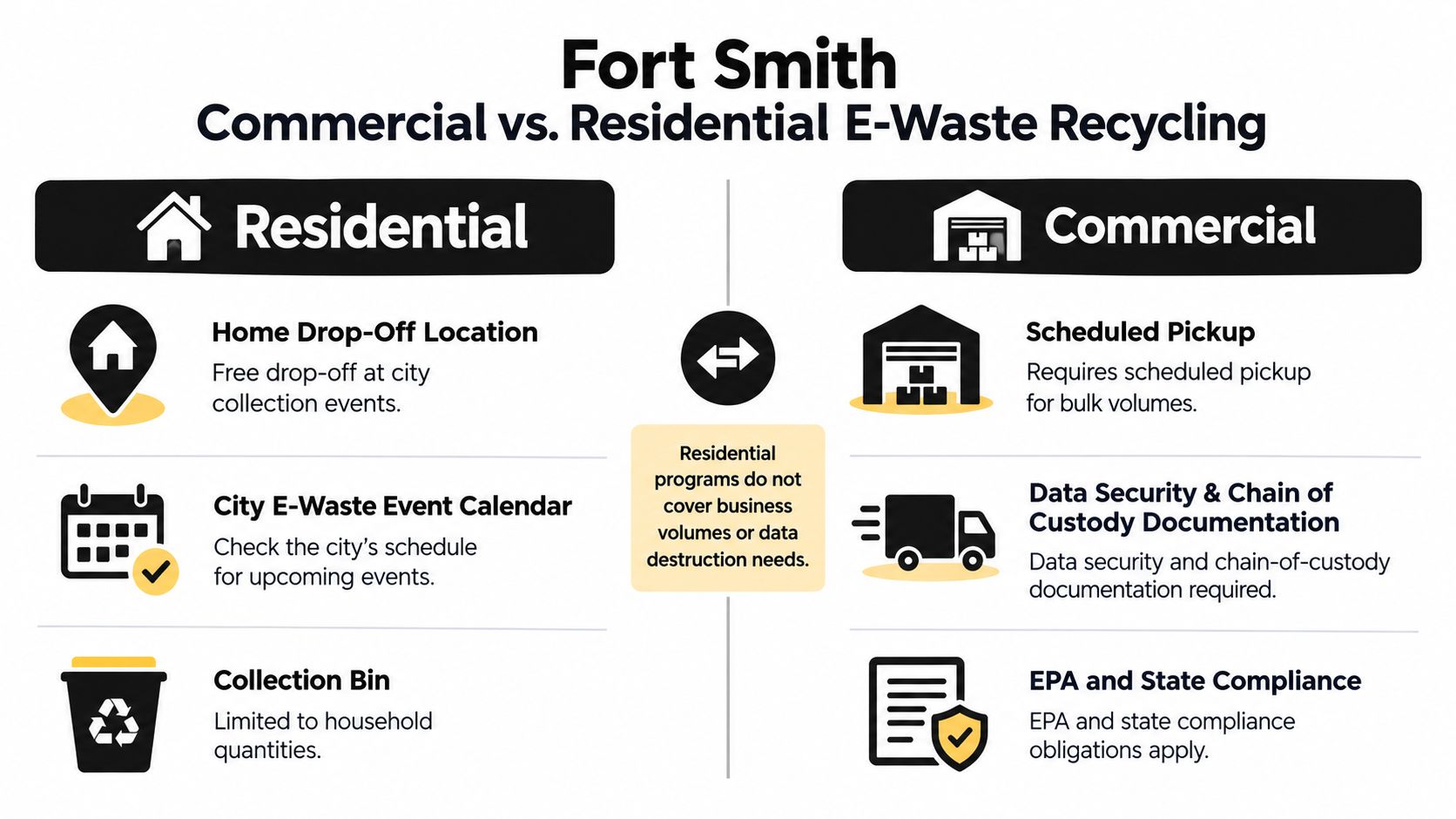
That residential-versus-commercial split shapes every office cleanout, facility shutdown, and technology refresh. Household electronics can move through the municipal program, but a corporate load needs scheduled pickup, a clear acceptance decision, and records that tie each device to its final outcome.
Fort Smith manufacturers, healthcare groups, schools, and logistics operators retire technology all the time. A plant swaps out rugged workstations, a clinic removes old laptops and imaging peripherals, a school rotates classroom devices, and a warehouse decommissions scanners, printers, networking equipment, and servers. Those assets do not become household waste because they are sitting in a commercial building.
Operational rule: A free residential drop-off is not a commercial recycling service, and acceptance of a device is not proof of secure data destruction.
The Sebastian County Regional Solid Waste Management District does not change that reality. A private IT asset disposition partner is the practical choice when the project involves serialized equipment, sensitive storage media, multiple departments, or pickup from a controlled facility.
Classify the generator correctly from the start. Residents use the household pathway. Businesses and institutions should arrange commercial processing, confirm what the provider accepts, and require documentation for reuse, remarketing, secure data destruction, product destruction, and material recovery.
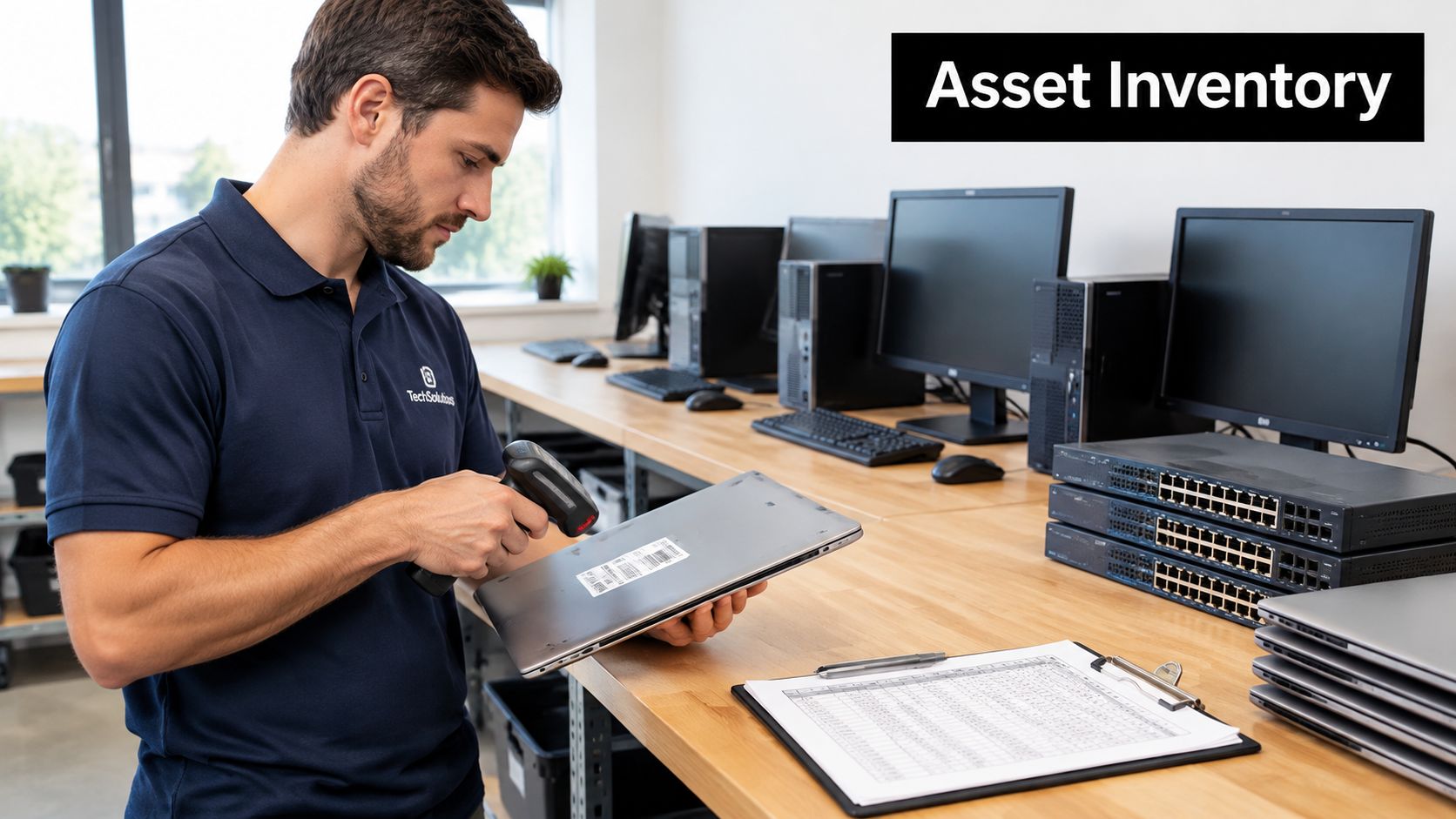
Building the Asset Inventory Before Anything Leaves the Building
The inventory is the control point for every successful ITAD project. Don't start with boxes. Start with a list that tells IT, facilities, procurement, and the recycler what each asset is, who owns it, what risk it carries, and what should happen next.
A Fort Smith office can build a workable inventory with these fields:
- Asset identifier: Record the serial number, service tag, barcode, or other unique identifier.
- Device class: Identify laptops, towers, servers, monitors, printers, phones, tablets, UPS units, networking equipment, copiers, or laboratory instruments.
- Owner and location: Note the department, user, room, building, and cost center where applicable.
- Data sensitivity: Mark the device as public, internal, confidential, regulated, or highly confidential.
- Physical condition: Record whether it's reusable, damaged, incomplete, obsolete, swollen, leaking, or otherwise unsafe.
- Disposition route: Assign reuse, donation, remarketing, verified sanitization, physical destruction, or recycling.
- Evidence required: Specify whether the project needs a sanitization record, certificate of destruction, transfer record, or recycling documentation.
Separate equipment by risk and handling
Capture asset tags before devices move. Photograph labels when a serial number is difficult to read, and keep the image associated with the inventory record. Quarantine laptops, servers, copiers, phones, and hard drives that contain storage media until the approved sanitization method has been completed and verified.
Fort Smith's accepted list includes towers, laptops, monitors, hard drives, servers, printers, phones, tablets, UPS units, and televisions. Tube televisions are accepted only up to 27 inches, and household computer recycling is limited to two computers per resident per year, as described in the local acceptance guidance. Those household limits reinforce why a business shouldn't treat a corporate load as a resident drop-off.
Flag lithium batteries, mercury-containing lamps, CRT glass, toner, and swollen batteries before packaging. Keep reusable equipment away from damaged equipment, and keep data-bearing assets away from material recovery loads. A clear inventory also helps procurement decide whether buyback or donation is more appropriate than recycling.
For a deeper pre-recycling control process, use this IT inventory audit guidance as a reference for the questions your team should answer before equipment leaves the building.
Arkansas and Federal Rules That Shape Your Compliance Stance
Arkansas gives organizations a mixed compliance picture. State law gave Arkansas authority to ban electronic waste from municipal solid-waste landfills beginning in January 2010, but the Arkansas Division of Environmental Quality says that ban hasn't been implemented statewide. Businesses and government offices can also face hazardous-waste requirements that do not apply to households, according to Arkansas DEQ's electronics guidance.
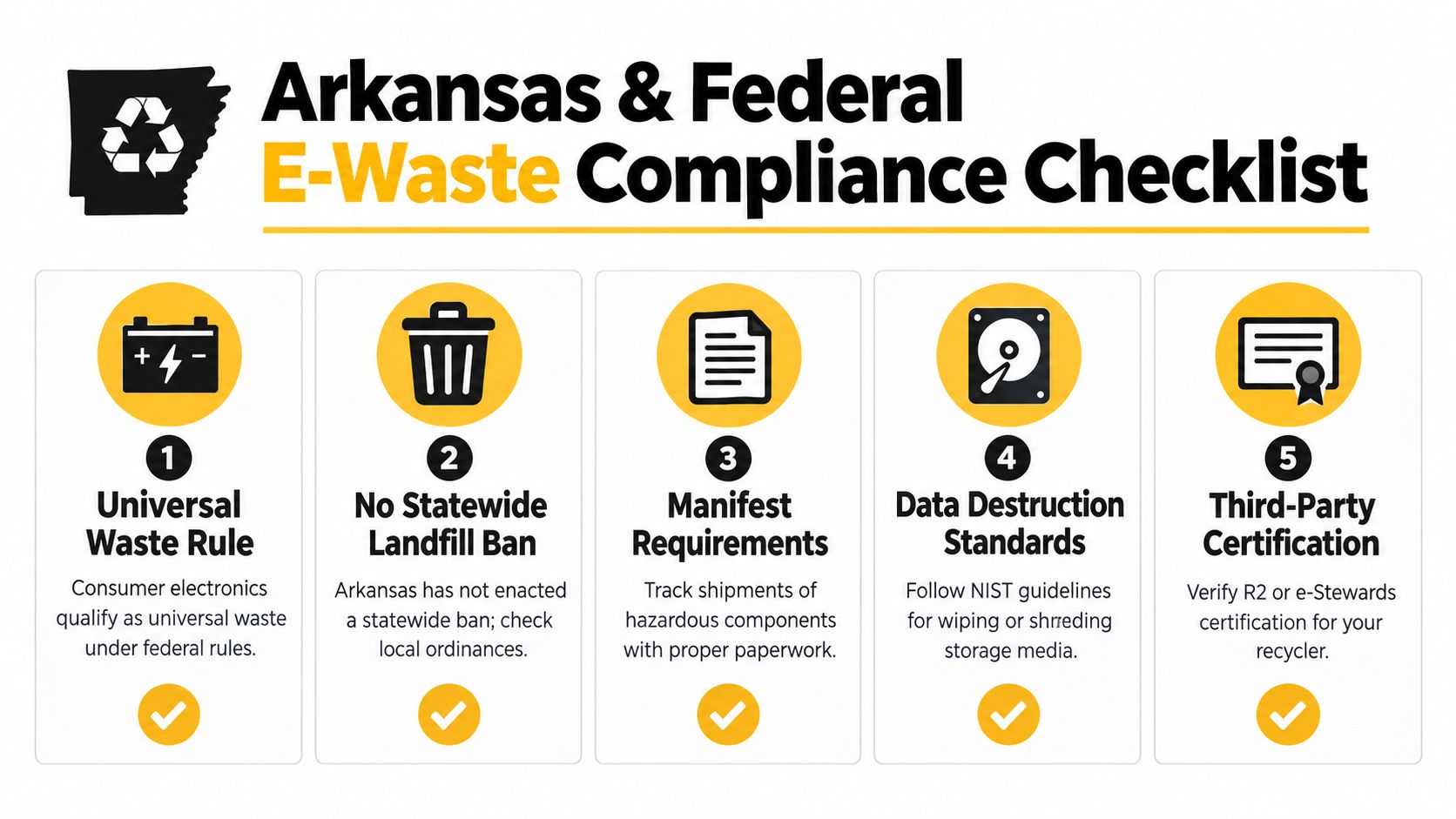
So don't treat the missing statewide landfill ban as permission to throw business electronics into ordinary trash. Generator status, device composition, data sensitivity, and volume decide the correct handling path. For a state-specific overview, see this guide to Arkansas electronics recycling.
Household electronics aren't the same as commercial equipment
Consumer electronics usually move through a universal-waste path, while businesses and government offices may trigger hazardous-waste duties. That distinction matters for laboratory equipment disposal, medical equipment disposal, facility cleanouts, and equipment that contains batteries, lamps, toner, or other regulated components.
Your compliance file should show:
- What you owned: Keep the asset inventory and ownership record.
- What you shipped: Retain the pickup manifest and acceptance confirmation.
- Who handled it: Document the transport and receiving parties.
- What happened next: Record reuse, remarketing, sanitization, destruction, or recycling.
- What evidence exists: Store certificates, weight records, destruction records, and reconciliation results.
Federal electronics guidance recommends recyclers certified through an accredited, independent third-party auditor. That standard covers environmental controls, feasible reuse and recycling, downstream management, human-health protection, and destruction of data stored on used electronics.
A certification logo alone is not enough. Ask which certification applies, whether downstream handlers are controlled, how failed devices are treated, and whether the provider can return records tied to individual serial numbers.
Matching Data Destruction Methods to Real Risk
Deleting files isn't data destruction. Removing a hard drive from a computer isn't data destruction either. A defensible program matches the treatment to the media, the data, the device condition, and the consequences of recovery.
NIST distinguishes clearing, purging, and destroying as different sanitization outcomes. NIST defines destruction as making data recovery infeasible with state-of-the-art laboratory techniques while preventing reuse of the media. For hard drives holding regulated or highly confidential data, NIST recommends physical destruction such as shredding, pulverizing, or disintegration, performed by trained and authorized personnel under appropriate safety controls, as explained in the NIST media sanitization publication.
Use the device and sensitivity together
| Device Class | Data Sensitivity | Recommended Method |
|---|---|---|
| Laptops and desktops | Internal business data | Verified clear or purge, followed by a recorded disposition |
| Servers and storage arrays | Confidential or regulated data | NIST-aligned purge where technically valid, or physical destruction when risk requires it |
| Copiers and multifunction printers | Confidential documents and cached data | Include internal storage in the sanitization review before reuse or recycling |
| Phones and tablets | Business, personal, or regulated data | Verified device reset and sanitization, with failed units isolated |
| Failed or encrypted drives | Highly confidential data or uncertain recovery status | Physical destruction when sanitization cannot be verified |
| Monitors and non-storage peripherals | No stored data | Functional triage, reuse, donation, or material recycling |
Reuse is appropriate only when the asset can be sanitized and its condition supports another user. Verified erasure can work for eligible media when the process produces a reliable record. Physical destruction is the right answer when a drive is damaged, inaccessible, regulated, highly confidential, or otherwise impossible to sanitize with confidence.
Copiers deserve special attention because teams often remember laptops and forget internal storage. Medical equipment and laboratory instruments may also contain local storage, removable media, or configuration data. Treat every storage-bearing component as a data-bearing asset until IT confirms otherwise.
Review what data destruction involves before approving a vendor's process. Your record should identify the asset, treatment, operator, date, result, and final disposition.
Choosing a Certified Recycling Partner in Fort Smith
A Fort Smith business needs a commercial ITAD partner, not a drop-off site. The city's free residential option does not cover business equipment, so choose a provider that controls both the material's environmental route and the data-security process.

Use a vendor scorecard before booking a pickup. Require specific answers and supporting records.
What to verify before awarding the work
- Independent certification: Confirm certification from an accredited, independent third-party auditor. Certification should address environmental controls, downstream management, reuse, recycling, and data destruction.
- Chain of custody: Require records showing who received the equipment, when custody changed, and where the assets went.
- Serial-level evidence: Confirm that serialized devices can be reconciled to reuse, remarketing, sanitization, destruction, or recycling outcomes.
- Data destruction detail: Ask whether the process uses software erasure, purge, shredding, pulverizing, or another method. Require a defined procedure for failed media.
- Downstream accountability: Identify downstream vendors and the final processing route.
- Commercial logistics: Confirm pickup coverage, staging requirements, packaging, acceptance rules, and the provider's capacity for bulk business equipment.
As the federal guidance cited earlier makes clear, certification must cover environmental and information-security controls. Weigh both in the scorecard. A certificate listing only total weight does not replace asset-level destruction evidence for sensitive storage media.
Reworx Recycling is one commercial option for Fort Smith organizations seeking donation-based recycling, business pickups, secure hard-drive shredding, data destruction, equipment decommissioning, and IT asset management. Its environmental certifications information gives procurement teams a useful basis for questions to ask every prospective provider.
Scheduling Pickups, Drop-Offs, and Documented Custody
The safest logistics plan separates movement from disposal. Create a controlled staging area inside the facility, restrict access, label every data-bearing device, and keep batteries and damaged equipment away from general loads.
For fragile displays, package them upright with cushioning. Isolate swollen or damaged batteries, identify CRT glass, and separate toner, lamps, and other components that require special handling. Before transport, obtain written confirmation that the commercial provider accepts the equipment and understands the load composition.
Build the manifest around evidence
Your pickup manifest should include:
- Asset identity: Serial number, barcode, device type, and owner.
- Condition: Reusable, damaged, incomplete, or end-of-life.
- Security status: Data-bearing, sanitized, awaiting treatment, or approved for destruction.
- Disposition: Reuse, donation, remarketing, destruction, or recycling.
- Custody details: Operator, transfer date, receiving party, and destination.
- Verification: Sanitization result, destruction record, weight ticket, or other supporting evidence.
NIST-aligned handling requires a record of the operator, method, date, disposition, and verification for each relevant asset. Don't let a driver's signature become the only evidence that equipment moved. The receiving record must connect the shipment to the inventory.
A useful internal benchmark is 100% manifest reconciliation. Every serialized asset should appear as reused, remarketed, sanitized, destroyed, or recycled, with zero unexplained units. Reconcile the final weight and asset count against the pickup manifest, then investigate every mismatch before closing the project.
Keep the chain-of-custody documentation with the inventory, purchase or transfer records, sanitization evidence, certificates, and sustainability reporting file. This creates an audit trail that procurement and facilities teams can defend.
Cost, Buyback, and Community Impact Considerations
The lowest quoted hauling price can become the most expensive option when it ignores data risk, labor, rejected material, or missing records. Evaluate the entire retirement project: inventory labor, packing, transportation, sanitization, destruction, downstream handling, documentation, and any recovery value.
Usable laptops, desktops, networking equipment, and peripherals may support buyback, remarketing, or donation rather than immediate material recycling. The right route depends on condition, marketability, data status, and your organization's policy. Ask for an itemized evaluation instead of assuming every device has either full value or no value.
Donation-based recycling adds a community dimension to the financial analysis. Reusable technology can support digital inclusion, technology access, and workforce development when the receiving pathway is properly managed. A social enterprise recycling model can also give sustainability teams a clearer story to document, provided the organization retains evidence of what was donated, reused, recycled, or destroyed.
The broader waste problem affects local decisions
The scale of electronic waste makes disciplined local handling necessary. A 2022 country profile based on the Global E-waste Monitor estimated that the United States generated 7.188 million metric tonnes of electronic waste in 2022, equal to 21.3 kilograms per person, while 4.054 million metric tonnes were formally collected and recycled. Globally, 62 billion kilograms of e-waste were generated in 2022, and only 22.3% was documented as formally collected and recycled in an environmentally sound manner, according to the Global E-waste Monitor country profile.
Fort Smith organizations can improve their position by treating retirement as a controlled business process. Inventory first, protect data, separate materials, choose an accountable partner, and retain proof of disposition. Reworx Recycling's mission combines environmental responsibility with community impact, giving businesses a way to pursue sustainable recycling, corporate donation programs, and secure ITAD without treating social value as an afterthought.
Businesses in Fort Smith can use Reworx Recycling for electronics recycling, commercial pickups, secure data destruction, equipment decommissioning, donation-based recycling, and documented IT asset disposition. Visit Reworx Recycling to start planning a pickup, donate usable equipment, or build a responsible recycling program for your next office or facility cleanout.