For Arkansas businesses, managing outdated IT equipment is more than a cleanup task—it's a critical component of smart, secure operations. Proper IT equipment disposal protects your company from data breaches, ensures regulatory compliance, and reinforces your corporate reputation. For business owners, IT managers, and corporate sustainability leaders in Arkansas, this guide provides a clear strategy for handling your IT Asset Disposition (ITAD) needs.
Why Smart Electronics Recycling Is a Business Imperative in Arkansas
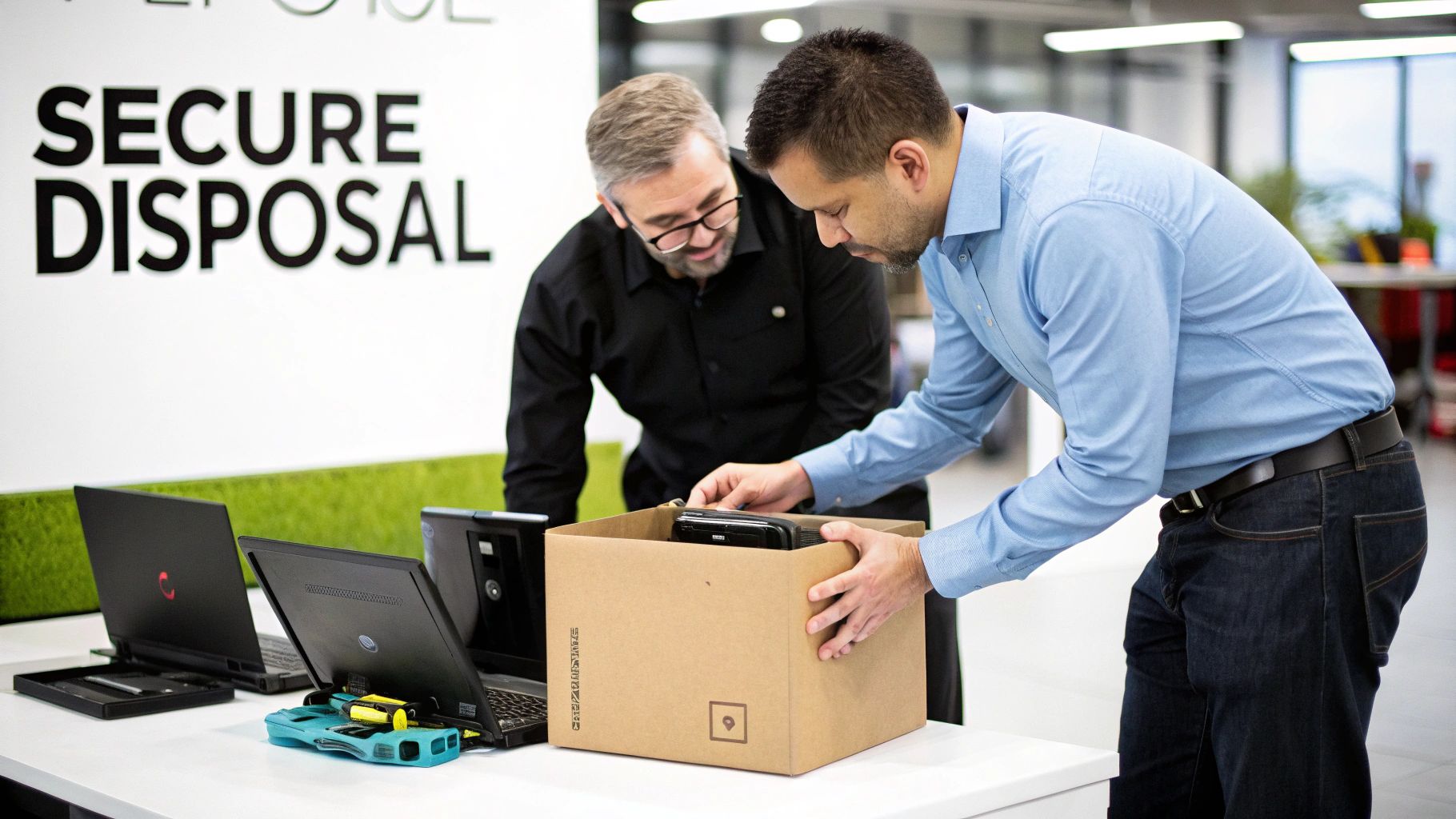
Dealing with old technology is a significant challenge for any Arkansas organization. Without a statewide ban on e-waste in landfills, the risks of improper disposal—from data breach fines to environmental liability—are heightened. However, a strategic approach to IT Asset Disposition transforms this challenge into a distinct business advantage, particularly for businesses in the state's growing logistics, healthcare, and manufacturing sectors.
A proactive plan for office cleanouts and IT equipment disposal safeguards your company’s brand, guarantees complete data security, and can even unlock residual value in retired assets. This is where partnering with a professional social enterprise like Reworx Recycling makes all the difference.
The Risks of Neglecting Professional ITAD
Failing to implement a formal plan for electronics recycling exposes your business to avoidable risks. Obsolete laptops, servers, and medical equipment stored in a back room are latent liabilities, still holding sensitive corporate and client data. Simply wiping a hard drive is often insufficient to prevent a determined party from recovering that information.
Furthermore, despite the lack of a specific landfill ban, federal environmental regulations still hold businesses accountable for pollution. If materials containing lead, mercury, or cadmium are traced back to your company after improper disposal, you could face significant fines and remediation costs.
These are not just theoretical concerns; they are real-world risks that demand a certified, secure process. The core benefits of e-waste recycling extend far beyond simple disposal—it's about comprehensive risk management for your entire organization.
Turning Liability into a Community Asset
When you partner with a social enterprise like Reworx Recycling, a potential liability is transformed into a tangible opportunity. Instead of viewing old computers and laboratory equipment as waste, our donation-based recycling model directs viable technology to community programs, helping to bridge the digital divide in Arkansas.
By choosing a social enterprise for your ITAD needs, your business converts a standard operational cost into a measurable social and environmental investment. This approach enhances your brand narrative and demonstrates a genuine commitment to corporate responsibility.
Your routine IT refresh cycle becomes a powerful story of positive community impact. Ultimately, engaging in smart electronics recycling is a critical step when you transform your small business to go green, demonstrating a serious commitment to sustainability. Partnering with Reworx Recycling offers a solution that protects your business, the environment, and supports the local Arkansas community.
Navigating Arkansas E-Waste Regulations and Business Responsibilities
When it comes to IT equipment disposal in Arkansas, the absence of a statewide landfill ban on electronics can create a false sense of security. Many assume this means regulations are lax.
That assumption is dangerously misleading. The lack of a specific landfill prohibition actually places a greater burden on businesses to manage their e-waste responsibly. The primary legal risks are not tied to environmental dumping laws, but to stringent state and federal regulations governing data privacy. Overlooking this can lead to substantial fines and severe reputational damage.
Your legal duty to protect the sensitive information on every server, laptop, and point-of-sale system does not end when the device is unplugged.
The Shift in State Funding and What It Means for You
The landscape for electronics recycling in Arkansas has evolved significantly. A major change occurred when the state eliminated its dedicated recycling fund under SB369, fundamentally altering how e-waste programs are supported.
Previously, the Computer and Electronic Solid Waste Management Act utilized those funds for collection initiatives. Now, funding is distributed through the competitive E-Waste Competitive Grants Program, which allocates nearly $250,000 annually for collection events and recycling projects.
For businesses, this means state-sponsored disposal options are limited, reinforcing the importance of a proactive partnership with a certified ITAD provider like Reworx Recycling.
Data Destruction: The Non-Negotiable Compliance Mandate
While you are unlikely to be fined for discarding an old monitor, the consequences of a data breach originating from that same device can be catastrophic. This is where the true compliance pressure lies.
Before disposing of any IT equipment, you must understand your key responsibilities. This table outlines what Arkansas businesses need to prioritize for secure computer recycling and ITAD.
| Business Responsibilities for E-Waste in Arkansas |
| :— | :— | :— |
| Compliance Area | Arkansas Specifics | Recommended Business Action |
| Data Security | While no landfill ban exists, state and federal data privacy laws (like HIPAA, FACTA) are strictly enforced. The primary legal risk is a data breach, not improper disposal. | Implement a mandatory secure data destruction policy. All storage media must be sanitized using methods aligned with NIST 800-88 standards or physically destroyed before leaving your facility. |
| Vendor Liability | Businesses are legally responsible for the actions of their downstream recycling vendors. Hiring an uncertified recycler exposes you to significant risk if they mishandle data or materials. | Conduct thorough due diligence. Partner exclusively with certified recyclers (like R2 or e-Stewards) who provide a secure chain of custody and assume liability for the assets. |
| Proof of Compliance | In the event of an audit or legal dispute, the burden of proof is on your business to demonstrate that data was properly destroyed and assets were handled responsibly. | Require and retain detailed documentation from your ITAD partner, including Certificates of Data Destruction and serialized asset tracking reports for every device. |
| Environmental Responsibility | Although not mandated by state law for electronics, federal laws like RCRA still govern the disposal of hazardous materials found in e-waste (e.g., lead, mercury). | Work with a certified partner like Reworx Recycling that guarantees sustainable recycling practices and prevents hazardous materials from entering landfills, regardless of state law. |
Ultimately, working with a certified and insured ITAD vendor is not just a best practice—it's your best defense.
The core takeaway for any Arkansas business is that regulatory compliance for e-waste is not about avoiding landfills—it's about avoiding data breaches. Your ITAD strategy must be built around a foundation of certified, auditable data destruction.
Failing to prioritize data exposes your organization to immense risk. To fully grasp what is at stake, review the environmental and legal impacts of improper commercial e-waste disposal, which extend far beyond green initiatives.
When navigating the Arkansas e-waste landscape, shift your thinking from "Where can I legally discard this?" to "How can I prove the data on this device was permanently destroyed?" Answering that question correctly is the key to protecting your business.
The Reality of E-Waste and Arkansas Recycling Rates
To fully appreciate why a strategic electronics recycling plan is vital for Arkansas businesses, it is essential to examine the data. The numbers reveal a significant disconnect between the state's management of general waste and its handling of the specialized, often hazardous materials in IT equipment. This is not merely an environmental issue; it is a missed opportunity for resource recovery and corporate leadership.
For IT managers and sustainability leaders, these statistics provide the hard evidence needed to build a compelling case for a professional IT Asset Disposition (ITAD) program. Understanding the scale of the challenge is the first step toward implementing the right solution.
The infographic below illustrates the flow of waste in Arkansas, highlighting the small fraction that electronic waste represents in the overall recycling effort.
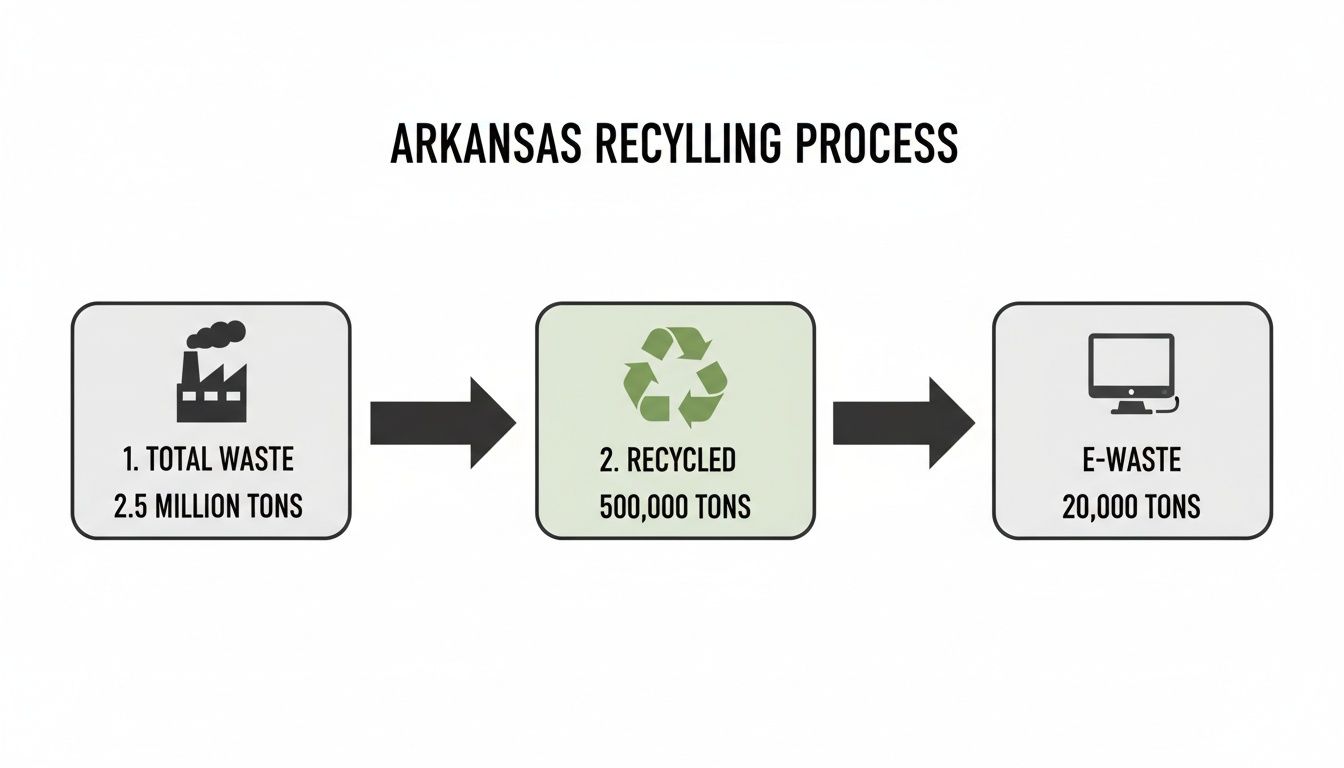
This visual contrasts the total volume of waste generated with the minimal fraction of e-waste that is properly recycled, indicating a significant gap in management practices.
The Stark Contrast in Recycling Figures
The data is clear: an inconsistency exists. While Arkansas has made progress in managing its general solid waste, its performance with electronics lags significantly. This is where both the risk and the opportunity for businesses lie.
In 2018, Arkansas recycled approximately 6,000 tons of electronic waste. While this sounds substantial, it represented only 12.5% of the total e-waste generated that year. This management gap persists today. This figure, drawn from state reports, means the vast majority of old monitors, laptops, printers, and TVs—all containing toxic materials like cadmium and mercury—likely ended up in landfills, creating serious environmental risks in the absence of a statewide ban.
Now, consider the broader context. By fiscal year 2015, Arkansas was recycling nearly 50% of its total solid waste—a commendable achievement showing that the potential exists. Yet, e-waste is being left behind. The state ranks a low 42nd in overall recycling rates, diverting just 25% of recyclables like containers and packaging, compared to a state like Maine, which achieves 75%. You can learn more about these e-waste legislation findings and their implications for business compliance.
This is not just a statistic; it's a call to action. It indicates that while basic recycling infrastructure exists, the specialized processes required for services like secure data destruction and responsible material recovery are vastly underutilized.
What This Means for Arkansas Businesses
The low e-waste recycling rate is not merely an environmental footnote—it has direct consequences for your business. Every server, computer, or piece of medical equipment that ends up in a landfill creates significant risk.
- Data Security Risks: Unrecycled devices are potential treasure troves of sensitive data. Without certified data destruction, your company’s trade secrets, employee records, and customer information are left vulnerable.
- Environmental Liability: While Arkansas lacks a landfill ban, federal regulations like the Resource Conservation and Recovery Act (RCRA) can still hold your business liable for the hazardous materials in your disposed equipment.
- Wasted Resources: Old IT assets contain valuable materials such as gold, silver, copper, and palladium. When this equipment is landfilled, these resources are lost, necessitating more energy-intensive mining to produce new devices.
- Reputational Damage: Consumers and investors are increasingly focused on corporate social responsibility. A link to improper e-waste disposal can tarnish your brand's reputation.
The low recycling rates in Arkansas are not a sign of failure but an opportunity for leadership. Businesses that adopt a formal ITAD program can distinguish themselves by taking measurable steps to close this recycling gap, protect their data, and contribute to a more circular economy.
A Path Forward with Reworx Recycling
This is precisely where partnering with a social enterprise like Reworx Recycling offers a clear path forward. Our model is designed to address the shortcomings revealed by these statistics. We provide businesses a streamlined, secure, and socially responsible method for handling their retired technology.
When you choose our donation-based recycling services, you are doing more than just keeping e-waste out of landfills. You are ensuring every device undergoes certified data destruction, that valuable materials are recovered responsibly, and that functional equipment gets a second chance in the community. This approach transforms a compliance task into a powerful statement about your company’s commitment to environmental stewardship and social impact.
Implementing a Strategic IT Asset Disposition Program
Recognizing the e-waste problem is one thing; actively solving it is another. For any Arkansas business, the solution is to create a strategic IT Asset Disposition (ITAD) program. This is not about occasional pickups; it's about a formal plan to manage retiring technology securely, responsibly, and efficiently—protecting your data, recovering value, and ensuring compliance at every step.
A robust ITAD program shifts your organization from reactive cleanups to proactive asset management, providing a clear, repeatable process for every facility cleanout or technology refresh.
Step 1: Create a Detailed Asset Inventory
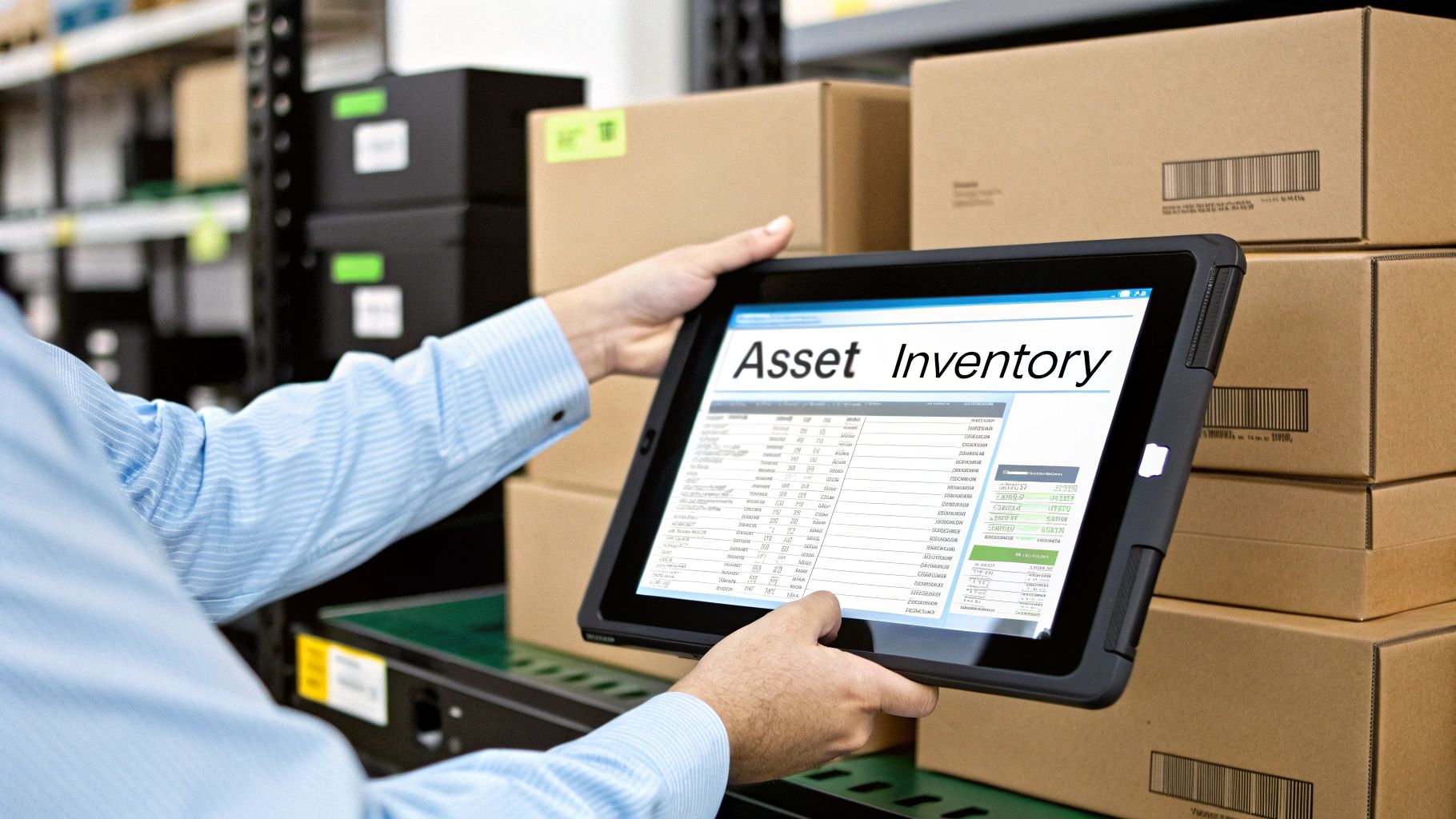
You cannot manage what you do not measure. The foundation of any effective ITAD program is a precise inventory of what you have. Before any device leaves your premises, create a detailed list cataloging every piece of equipment slated for disposal—from servers and laptops to specialized medical or laboratory equipment.
An accurate inventory is more than a checklist; it's a critical risk management tool. It allows you to track each item by serial number, asset tag, and device type. For any business managing IT asset disposition, adopting general inventory management best practices can significantly improve efficiency and reduce costs.
This first step is non-negotiable for establishing a clear, auditable chain of custody. Without it, you cannot prove that every device containing sensitive data was accounted for and properly sanitized.
Step 2: Assess for Reuse and Value Recovery
Not all of your old technology is "waste." Many devices, or their internal components, still retain significant value. The next step is to evaluate each item on your inventory list to determine if it can be refurbished, resold, or harvested for valuable parts.
This is where a professional partner excels. An expert can quickly identify assets with remarketing potential, turning depreciated equipment into a revenue stream. This process typically includes:
- Functionality Testing: Determining if devices are operational or can be economically repaired.
- Cosmetic Grading: Assessing the physical condition to help establish resale value.
- Component Analysis: Identifying valuable internal parts like RAM, CPUs, and solid-state drives for harvesting.
By prioritizing reuse, you not only achieve the best financial return but also adopt a more sustainable, circular approach to your technology lifecycle.
Step 3: Ensure Compliant and Secure Data Destruction
This is, without question, the most critical stage of the ITAD process. Every device that stores data—from server hard drives and employee laptops to the office copier—must undergo certified, irreversible data destruction. Simply hitting "delete" or reformatting a drive is insufficient and leaves your business vulnerable to massive legal and financial risks from a data breach.
Secure data destruction must adhere to established industry standards, such as those in NIST 800-88. This is typically achieved in one of two ways:
- Data Wiping/Sanitization: Using certified software to overwrite data multiple times, rendering it unrecoverable.
- Physical Destruction: Shredding or degaussing hard drives and other storage media to physically destroy them beyond any possibility of repair.
Upon completion, your ITAD partner must provide a Certificate of Data Destruction. This document serves as your official proof of compliance, verifying that all sensitive information was handled correctly according to legal and industry requirements. To build a more robust plan, review our guide on how to implement an IT asset disposition strategy for your organization.
Comparing DIY vs. Professional ITAD Services
When managing ITAD, the choice between a DIY approach and hiring a professional service involves weighing perceived cost against actual risk. A DIY method may seem cheaper initially, but the hidden liabilities in data security and compliance can be astronomical.
| ITAD Task | DIY Approach (High Risk) | Professional Service (Low Risk) |
|---|---|---|
| Asset Tracking | Manual spreadsheets; high risk of errors and lost assets. | Barcode scanning and audited chain-of-custody from start to finish. |
| Data Destruction | Relies on basic formatting; no certification or proof of erasure. | Certified to NIST 800-88 standards with a Certificate of Destruction. |
| Value Recovery | Difficult to assess market value; may miss revenue opportunities. | Expert market analysis and established resale channels to maximize returns. |
| Environmental Compliance | Risk of improper disposal and non-compliance with local/federal laws. | Guaranteed R2 or e-Stewards certified recycling and full compliance. |
| Logistics | Employee time spent packing, loading, and transporting equipment. | Secure, insured transportation and professional on-site services. |
Ultimately, a professional ITAD service like Reworx Recycling transforms a high-risk, labor-intensive task into a secure, streamlined, and often revenue-positive process.
Step 4: Manage Logistics and Final Disposition
The final step involves the physical removal, secure transportation, and final disposition of all assets. A professional ITAD provider like Reworx Recycling manages all these logistics, from on-site packing and palletizing to insured transport and final recycling at a certified facility.
At this stage, the benefits of working with an expert become evident. In-house management often leads to overlooked details, creating significant gaps in data security and compliance.
A formal ITAD program isn't an expense; it's an investment in risk mitigation. The cost of a single data breach far exceeds the investment in a secure, certified disposal process.
Choosing a professional ensures every step is documented, secure, and environmentally sound. With Reworx Recycling’s donation-based model, there is an added layer of value—functional equipment can be directed to community programs, reinforcing your company’s commitment to social responsibility.
Understanding Local Recycling Options Across Arkansas
When Arkansas businesses need to dispose of old electronics, they often consider local city or county options. Dedicated municipal and non-profit centers exist across the state, from Northwest Arkansas to the Little Rock metro. These facilities are vital for residential recycling and public education.
However, business leaders and IT managers quickly find that these local options are not designed to meet the unique, high-stakes needs of a commercial operation. They are a piece of the puzzle, but not the complete solution for corporate Arkansas electronics recycling.
The Limitations of Municipal Programs for Businesses
Local recycling centers and community drop-off events are excellent public services, but their operational constraints make them unsuitable for most businesses. Managing an office cleanout or a company-wide IT refresh through these channels presents significant challenges.
You will likely encounter limitations such as:
- Strict Volume Caps: Most centers are equipped to handle residential quantities, not a pallet of decommissioned servers or dozens of workstations. A truckload of equipment will likely be turned away.
- Lack of Certified Data Destruction: This is a critical issue. Local drop-off sites cannot provide a legally defensible Certificate of Data Destruction. Without this documentation, your business remains liable for compliance with data privacy laws like HIPAA or FACTA.
- No Chain of Custody: These programs do not offer the detailed, serialized asset tracking that corporate accountability and internal audits require. There is no auditable paper trail.
- Limited Accepted Items: Many local programs will not accept specialized or hazardous equipment common in business environments, such as laboratory equipment, large-scale medical devices, or specific industrial electronics.
Bridging the Gap with a Professional Partner
This is where the need for a comprehensive, statewide partner becomes clear. The limitations of local programs highlight why a professional ITAD provider is a necessity for any Arkansas business serious about security and compliance. A partner like Reworx Recycling is structured to complement local efforts by delivering the specialized services that businesses require.
While local drop-off sites are excellent for residents, they are not equipped for the scale, security, or liability requirements of commercial IT equipment disposal. Businesses need a partner who can provide an auditable, secure, and compliant process from start to finish.
The recycling landscape in Arkansas presents a mixed picture. While the state has made progress in diverting solid waste, e-waste recycling rates remain low. The latest data from 2018 shows Arkansas’s e-waste recycling rate was just 12.5%. This places the state at 42nd in the nation, with each person discarding approximately 230 pounds of recyclables annually.
This voluntary system, supported by grants and excellent local centers like Recycle Saline in Benton, underscores the need for more robust solutions—especially for businesses generating large volumes of e-waste. To assess options in your area, find local e-waste recycling options near you and compare them to your business requirements.
By working with a social enterprise like Reworx Recycling, your Arkansas business can close this service gap. We handle bulk pickups, provide certified data destruction for all storage devices, manage complex logistics, and ensure every component is processed to the highest environmental standards. This allows you to support local community programs for residential waste while knowing your corporate assets are managed with the security and accountability your organization demands.
Partnering With Reworx for a Social Enterprise Advantage
Choosing the right partner for your company's electronics recycling is about more than just ensuring compliance and data security. While those elements are non-negotiable, the decision also presents a unique opportunity to align your operational choices with your company’s core values. This is where the social enterprise model of Reworx Recycling offers a powerful, meaningful advantage for Arkansas businesses.
When you partner with us, you are not just responsibly disposing of old IT equipment; you are actively investing in the community. Our donation-based approach is designed to create a positive ripple effect that begins at your facility and extends far beyond.

Beyond Recycling: The Power of a Second Life
The core of our model is transforming retired corporate assets into genuine community opportunities. While many devices must be demanufactured for raw materials, a significant portion of the equipment from corporate donation programs and facility cleanouts has remaining functional life.
We are dedicated to identifying, refurbishing, and distributing these devices to individuals and organizations where they can make a difference. Your old laptops, desktops, and tablets become transformative tools for:
- Bridging the Digital Divide: We provide affordable, reliable technology to underserved students, families, and nonprofits, offering them access to educational and economic opportunities.
- Supporting Workforce Development: Our programs provide hands-on training in tech refurbishment and repair, creating valuable job skills and pathways to employment within the community.
- Empowering Local Initiatives: Donated equipment supports community centers, libraries, and local programs, enabling them to maximize their budgets and expand their impact.
A Partnership That Tells a Story
For corporate sustainability leaders and business owners, this creates a compelling narrative. Your routine IT refresh is no longer just a line item on a spreadsheet; it becomes a tangible story of corporate social responsibility that resonates with employees, customers, and stakeholders. You can explore the benefits of partnering for impact with Reworx to see how such a collaboration can amplify your company's community commitment.
By choosing a donation-based recycling partner, your business transforms an operational necessity into a strategic act of community investment. This decision benefits your bottom line, protects the environment, and strengthens the fabric of your local community.
Making a smart choice for your ITAD program means considering the complete picture. With Reworx Recycling, you receive the certified data destruction and environmental compliance you require, plus the profound social impact your company values. This is not just responsible disposal; it’s recycling with purpose.
Ready to make your next office cleanout a force for good? Contact Reworx Recycling today to schedule a consultation or arrange a pickup. Let's build a solution together that benefits your business, the environment, and your Arkansas neighbors.
Clearing Up Your Questions on Business Electronics Recycling
When it comes to IT asset disposition, Arkansas business leaders often have many questions. This is perfectly normal. Obtaining clear, straightforward answers is the first step toward building an electronics recycling program that is secure, responsible, and fully compliant. Here, we address some of the most common questions we hear from organizations across the state.
What’s the Single Most Important Rule My Business Needs to Follow?
This often surprises business leaders. While Arkansas does not have a statewide landfill ban on e-waste, the most critical regulations you must follow pertain to data privacy. Federal and state laws like HIPAA for healthcare and FACTA for financial information are stringent when it comes to protecting sensitive data.
This means your top priority is not keeping a computer out of a landfill—it's ensuring the certified, permanent destruction of all data on that computer. A single data breach from an improperly discarded device can lead to legal and financial penalties far more severe than any environmental fine in the state.
Can Our Business Just Use the Local City Drop-off Sites?
While it may be tempting, the answer is almost always no. Local municipal or county drop-off events and sites are designed and funded for residents, not businesses. They typically have strict volume limits that a standard office cleanout would easily exceed.
More importantly, these sites do not provide the official documentation your business needs for liability protection. You will not receive a Certificate of Data Destruction or a chain-of-custody report. Using a residential service for your company's assets leaves your organization exposed, with no proof that sensitive data was handled securely.
The core distinction is liability. Residential programs are for disposal, while professional ITAD services are for documented risk mitigation. For a business, choosing the latter is non-negotiable.
Does It Cost Money to Recycle Our Office IT Gear?
The cost can vary depending on the type, age, and volume of your equipment. Some certified recyclers charge fees for services like secure data destruction and transportation, particularly for older equipment with little resale value.
However, the right partnership can often reduce or eliminate these costs. Social enterprise partners like Reworx Recycling may offer free pickups for qualifying bulk donations of equipment that can be reused. Furthermore, if your retired assets are relatively new or contain valuable components, they may qualify for a value recovery or buyback program, which can generate a return that offsets the cost of the entire process.
Ready to put a secure, compliant, and socially responsible ITAD strategy in place for your Arkansas business? Partner with Reworx Recycling and turn your retired assets into a force for good. Schedule a pickup or consultation today to see how our donation-based model can protect your data while supporting the community.