
A 95% landfill diversion rate means little without a verified account of what happened to every device. The United States generated 62 million tonnes of e-waste in 2022, but only about 22% was formally collected and recycled, leaving most of the stream outside verified recovery.
Landfill diversion is a chain-of-custody problem, not a scoreboard. A vendor can report a high percentage while including incineration, energy recovery, downcycling, or material routed through opaque downstream processors. If a third party can't show whether each laptop was reused, donated, recycled, or destroyed, the percentage is marketing, not audit-ready evidence.
For an IT or facilities manager with six months to build a credible program, the priorities are clear: define diversion precisely, separate reuse from recycling, document secure data destruction, verify downstream handling, and report residuals accurately. The program should serve operational needs, regulatory requirements, community impact, and environmental performance at the same time.
Why Most Landfill Diversion Claims Deserve a Second Look
A headline diversion figure creates false confidence. Diversion from landfill doesn't automatically mean circularity, and it doesn't prove that an asset retained meaningful value. A device may avoid a landfill but still be burned for energy recovery, shredded into low-value mixed material, or exported into a processing chain that the buyer can't inspect.
That distinction matters because major enterprises use broad definitions. Amazon reported an 85% landfill diversion rate in 2024, but its definition includes recycling and incineration with energy recovery, as documented in coverage of Amazon's AWS hardware reuse measurement. The number may be accurate within that methodology, but it doesn't tell a procurement team how much equipment was repaired, resold, donated, materially recycled, or disposed of after processing.
Practical rule: Treat the diversion percentage as the first question, not the final answer.
Ask what the percentage includes
A credible contract should define the denominator, accepted material streams, excluded items, treatment pathways, and residual handling. It should also state whether energy recovery counts as diversion and whether the reported percentage is calculated by weight, unit count, or another basis.
UL-style claims can create similar ambiguity. A July 2026 trade report stated that Amazon had UL Solutions verify a 99% diversion rate across 89 supplier sites, while also noting that no public product-category breakdown showed how much electronics material was repaired, resold, recycled, or landfilled. The same gap appears in reports of Samsung's 100% landfill diversion certification across production facilities and LG's 97.4% rate at global production sites, figures that don't answer where a specific retired device went.
Those examples aren't proof that the claims are false. They prove that scope and pathway disclosure matter. Before signing, request asset-level or shipment-level records, processor identities, certificates of recycling, data destruction evidence, and a breakdown of reuse, donation, recycling, energy recovery, and residual disposal.
For a plain-language primer before you brief staff or students, you can browse an environmental science quiz for 7th grade. For an IT-specific review of common misunderstandings, compare the guidance in Reworx's explanation of e-waste recycling misconceptions.
What Landfill Diversion Really Means for Electronics and IT
Landfill diversion is the redirection of material away from landfill disposal through prevention, reuse, donation, repair, refurbishment, recycling, composting, or another defined treatment pathway. For electronics, that definition needs more precision because an asset carries both physical material and information risk.
A retired laptop might be reused internally, donated, resold, harvested for parts, or sent to a material recovery facility. Before any of those outcomes, the organization must control the data on the storage device. A recycling certificate without documented sanitization doesn't resolve the security obligation, and a data destruction certificate without downstream material records doesn't prove environmental performance.
Read the benchmarks carefully
The European Environment Agency reports that the share of total waste sent to landfill across the European Union fell from 23% in 2010 to 17% in 2022, even as total waste generated continued to rise. That long-term movement shows that policy, collection systems, and treatment infrastructure can reduce landfill dependence at scale. Review the European landfill diversion indicator for the underlying benchmark.
The EPA's U.S. materials-management data show a more mixed trajectory. In 2015, more than 91 million tons of municipal solid waste were recycled and composted, equal to a 34.7% rate, while more than 137 million tons, or 52.5%, were landfilled. In 2018, about 94 million tons were recycled or composted, representing a 32.1% rate, while more than 146 million tons, or 50.0%, were landfilled, according to the EPA municipal solid waste factsheet.
| Region | Reporting year | Landfill share of waste | Recycling or composting share |
|---|---|---|---|
| European Union | 2010 | 23% | Not stated in the cited benchmark |
| European Union | 2022 | 17% | Not stated in the cited benchmark |
| United States | 2015 | 52.5% | 34.7% |
| United States | 2018 | 50.0% | 32.1% |
The EPA also reports that the combined U.S. recycling-and-composting rate rose from less than 10% in 1980 to 35.0% in 2017. These figures are broad waste benchmarks, not direct ITAD targets. They help managers challenge inflated comparisons while recognizing that electronics require stronger controls than ordinary municipal waste.
Selling or donating usable equipment can be part of the solution, but it must be separated from final recycling. Resources explaining how Simply Tech Today sells used electronics can help teams understand secondary markets. For a fuller view of asset disposition, see Reworx's guide to IT asset disposition.
The Diversion Hierarchy Built for Real ITAD Decisions
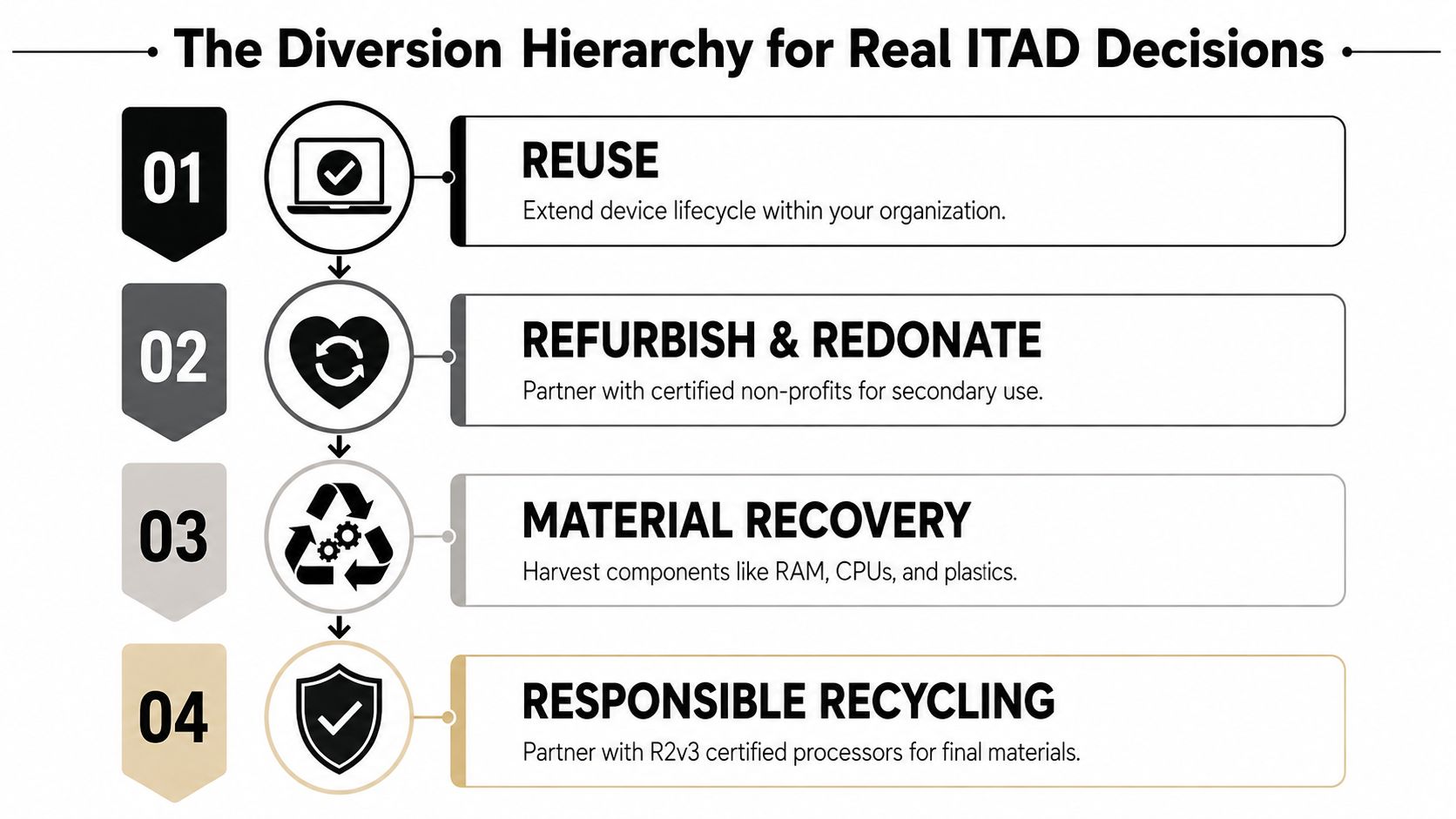
A useful hierarchy begins with the highest-value outcome and moves downward only when the previous option fails. For IT assets, the sequence is reduce, reuse, repair, refurbish, donate, recover components, and recycle responsibly. Secure data destruction runs across the entire decision tree. It isn't a disposal tier, it's the control that makes every downstream outcome acceptable.
Start with the asset's remaining function
Reduce means purchasing fewer replacement devices and extending useful life through repair, standardized configurations, and disciplined refresh planning. If a department can keep a laptop in service through a battery or storage replacement, no disposal pathway is needed.
Reuse comes next. Reassign equipment internally, place it in a lower-demand role, or retain compatible components for service stock. This option normally preserves more utility than breaking a complete device into commodities.
Repair and refurbish require triage. A processor should test boot status, battery health, display condition, storage, ports, and operating-system readiness. Devices that pass should be prepared for a second user, not automatically shredded because a refresh project made them surplus.
Choose donation before commodity recovery
Donation works when the device is functional, secure, supportable, and appropriate for the recipient. A social enterprise recycling partner can combine secure data destruction with refurbishment and community distribution, but the organization should still document recipient controls, equipment condition, and ownership transfer.
If reuse or donation fails, move to material recovery. Harvest RAM, CPUs, circuit boards, plastics, and other components where the processor has a defined market and can document downstream handling. Mixed shredding should be a fallback, not the default.
The right ITAD vendor earns its fee by making the highest-value pathway practical, verifiable, and secure.
Responsible recycling is the final planned tier. Choose processors with relevant certifications, require downstream transparency, and define how residuals are handled. Reworx's discussion of circular-economy business models provides useful context for connecting asset disposition with broader resource recovery.
KPIs That Tell You Whether Diversion Is Happening
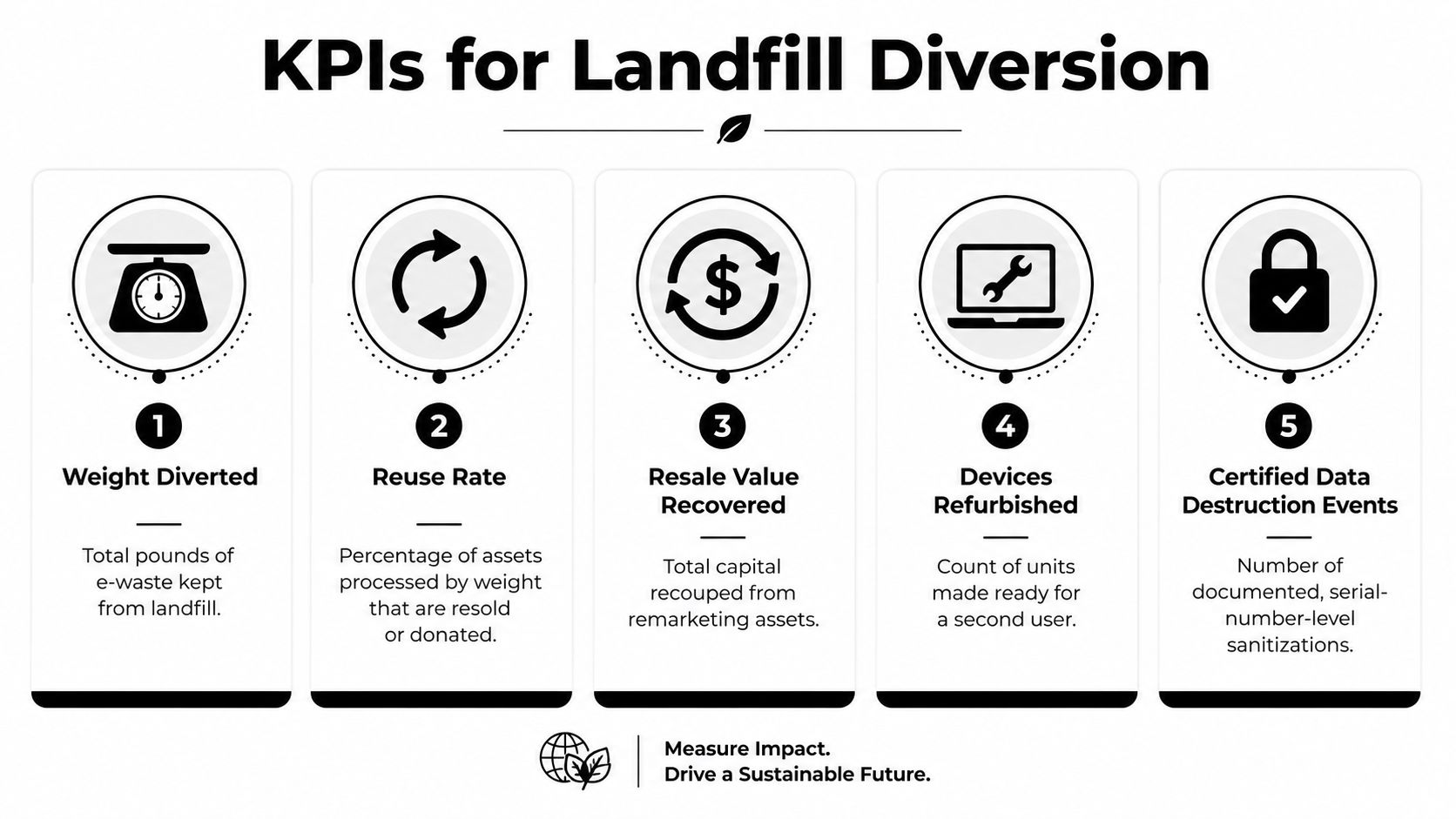
A credible dashboard separates material kept out of landfill from value retained in the economy. Weight diverted belongs on the report, but it cannot stand alone. A truckload of shredded electronics can produce a strong diversion figure while delivering less circular value than a smaller load of repaired and donated laptops.
Put these measures on the monthly dashboard
- Weight diverted: Record the total weight of electronics kept from landfill, then identify the treatment pathway responsible for that result.
- Reuse rate: Track the share of processed assets resold or donated. Record both weight and unit count when available.
- Resale value recovered: Report remarketing proceeds alongside disposition costs and ownership-transfer documentation.
- Devices refurbished: Count units prepared for a second user. Separate completed refurbishments from devices merely received.
- Certified data destruction events: Record serial-number-level sanitizations, shredding events, and other approved destruction activities.
Add evidence, not vanity metrics
Include rejected loads, contamination findings, missing serial numbers, unresolved chain-of-custody gaps, downstream processor reviews, and residual disposal. These measures expose operational weaknesses that a single diversion percentage hides.
For electronics, record whether storage media was sanitized before reuse, resale, or donation. Match asset IDs with pickup manifests, processing records, destruction certificates, and final disposition reports. A vendor that cannot connect those records leaves the organization unable to defend its result in an audit.
Separate reuse, donation, parts recovery, material recycling, energy recovery, and residual disposal in every report. Reuse percentage is the clearest circularity signal because it shows that the device or its function survived. Recycling still matters, but it must not be presented as equivalent to direct reuse.
Reworx outlines an outcome-based approach to impact measurement for recycling programs. Use that structure as a starting point, then set fields that match your procurement, ESG, and security requirements. Auditors care about traceable disposition, documented controls, and records that reconcile to the reported number.
Designing a Landfill Diversion Program in Seven Practical Stages
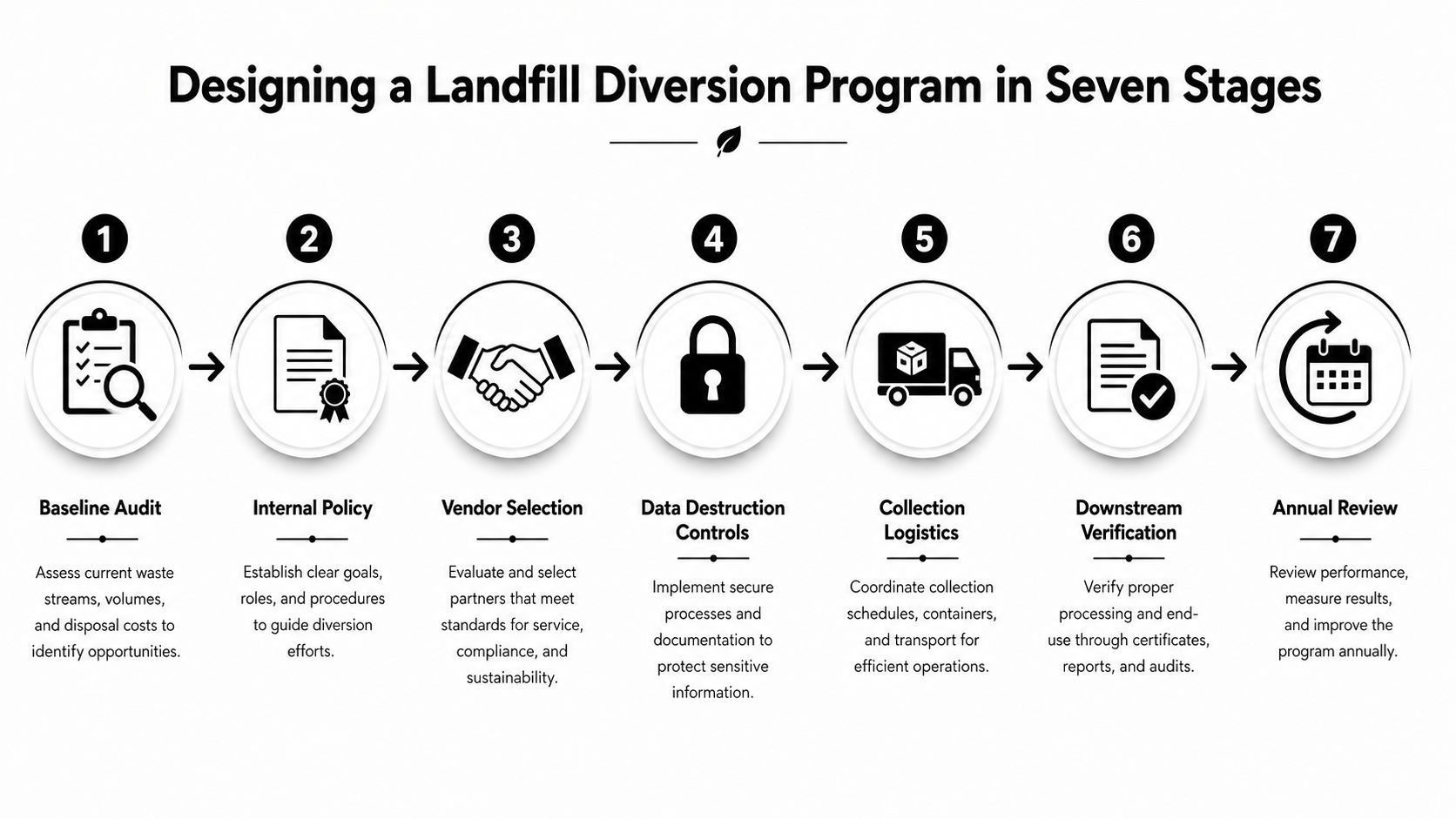
A six-month launch is realistic if the program owner treats each stage as a decision with an owner, a record, and a deadline. Don't begin with a marketing target. Begin with the material and the evidence.
1. Establish a baseline audit
Inventory devices, peripherals, batteries, networking gear, printers, laboratory equipment, and medical equipment. Record location, owner, condition, storage media, estimated volume, and current disposal route. Include office cleanout and facility cleanout material, because unmanaged surplus often bypasses the ITAD process.
2. Write the internal policy
Define acceptable outcomes in order. State who can authorize reuse, donation, resale, product destruction, recycling, and landfill disposal. Make secure data destruction mandatory for any asset containing storage media, with exceptions approved by a named security or compliance owner.
3. Select vendors against evidence
Request licenses, certifications, insurance, downstream processor information, sample reports, data destruction procedures, pickup controls, and residual policies. Ask whether the vendor supports laptop disposal, computer recycling, data center decommissioning, and mixed business pickups under the same documentation standard.
4. Lock down data destruction
Require serial-number capture at collection. Specify logical sanitization, physical destruction, or another approved method based on asset condition and reuse plans. Reconcile every storage device against the manifest before closing a shipment.
5. Design collection logistics
Choose secure staging areas, container types, pickup frequency, loading procedures, and site contacts. A regional office may use scheduled pickups, while a multi-site organization may need consolidated transportation and a central receiving point.
Reworx Recycling can fit into this implementation layer through business pickups, secure hard drive shredding, electronics recycling, equipment decommissioning, and ITAD support. Evaluate it alongside other vendors using the same evidence-based criteria.
6. Verify downstream handling
Obtain certificates of recycling, destruction records, weight tickets, processor identities, and disposition summaries. Audit the pathway for materials that leave the primary vendor, and require notification before a downstream processor changes.
7. Report annually and correct the program
Publish the baseline, diversion methodology, treatment breakdown, reuse and donation outcomes, data destruction completion, residuals, and unresolved exceptions. Set the next year's actions from the audit findings, not from an arbitrary headline target.
How SMBs, Hospitals, and School Districts Apply the Same Framework Differently
The framework stays consistent, but the risk profile changes. A small office needs a manageable process that employees will follow. A hospital needs tighter controls around regulated equipment and sensitive information. A school district needs logistics, public accountability, and a credible donation pathway.
The SMB office
A 75-employee office retiring 40 laptops a year should avoid building an enterprise bureaucracy. The baseline can identify each laptop by serial number, user department, condition, storage type, and planned outcome. The IT manager can route serviceable devices to internal reuse or donation, send failed units to material recovery, and retain certificates for every destruction event.
The monthly report should emphasize units received, units refurbished, reuse or donation outcomes, secure data destruction completion, and unresolved exceptions. A modest program becomes credible when the records reconcile, not when the dashboard contains elaborate sustainability language.
The hospital
A hospital's stream may include laptops, workstations, monitors, servers, diagnostic devices, laboratory equipment, and medical equipment. The disposition policy should distinguish ordinary IT equipment from assets that require specialized handling, maintenance records, or regulatory review.
Data handling must account for clinical information and embedded storage. Chain-of-custody records should show who collected each asset, where it was staged, what sanitization or destruction method was used, and which downstream processor received the material. The report should separate medical equipment disposal from computer recycling and show exceptions explicitly.
The school district
A district can combine scheduled site pickups with a controlled e-waste drive. Staff should remove personal data, but the processor must still verify and document sanitization before reuse, donation, or resale. Devices suitable for students or community programs should be evaluated for repairability, supportability, accessibility, and recipient needs.
The district's report can add community outcomes, such as equipment donated, recipient organizations, refurbishment status, and workforce-development participation. That makes the program more meaningful than a landfill percentage while preserving the same core controls used by an SMB or hospital.
Reporting, Regulation, and the Audit Trail Behind the Number
Auditors don't accept a percentage without a method. Procurement teams want to know which assets were included, which were excluded, who handled them, how data was destroyed, what the processor did, and where residual material ended up.
State rules can change the disposal decision before a vendor is selected. Illinois provides a concrete example. Its Consumer Electronics Recycling Act bans disposal of most computers, monitors, printers, and related IT assets in landfills, and requires businesses and agencies to use registered e-waste collectors and recyclers. The Illinois electronics disposal compliance guidance explains the practical implications for organizations operating there.
Build the evidence file
Use R2v3 and e-Stewards certification references as part of vendor due diligence, but don't treat a logo as a substitute for transaction-level documentation. Certification can support confidence in a management system, while the shipment record proves what happened to your assets.
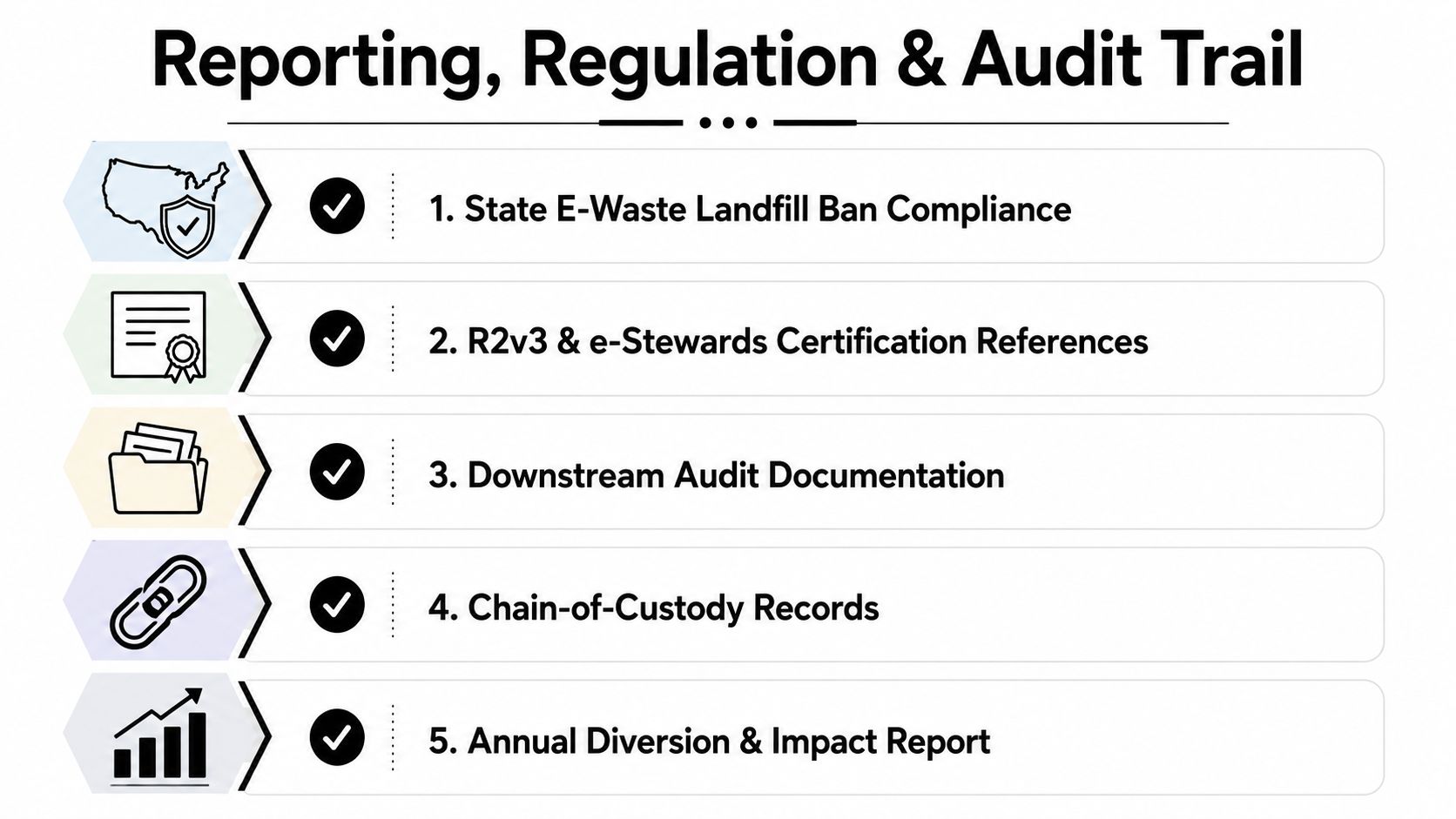
Require these documents on demand:
- Pickup manifest: Site, date, material category, quantities, and responsible personnel.
- Asset reconciliation: Serial numbers or other identifiers matched to received and processed equipment.
- Data destruction certificate: Method, date, scope, and asset-level references.
- Disposition report: Reuse, donation, resale, parts recovery, recycling, energy recovery, and residual pathways.
- Downstream evidence: Processor names, certifications, transfer records, and audit findings.
- Annual impact report: Methodology, weights, outcomes, exceptions, and corrective actions.
Reworx's chain-of-custody documentation guidance is relevant to organizations that need a practical record structure. The same principle applies to medical equipment disposal, laboratory equipment disposal, product destruction, and secure data destruction. If a claim can't be tied to a document, don't publish it as a verified outcome.
The global context makes this discipline urgent. The Global E-waste Monitor reports that the world generated 62 million tonnes of e-waste in 2022, with only about 22% formally collected and recycled according to the UN and ITU e-waste summary. About 14 billion kilograms were disposed of as residual waste in 2022, with the majority landfilled globally, as documented in the Global E-waste Monitor 2024 report.
Turning Diversion From a Headline Into a Real Program
A landfill-diversion percentage is credible only when an organization can trace each asset from collection to its final documented outcome. Put the percentage in the report, then show the decisions behind it: reuse, donation, resale, parts recovery, recycling, residual disposal, secure data destruction, and downstream verification.
For an ITAD program, source segregation starts at pickup. Keep working laptops, servers, and peripherals separate from damaged equipment and mixed scrap. Record asset identifiers, condition, data-destruction status, disposition route, and final processor. A documented reuse rate gives an ESG reviewer something stronger than a headline: evidence that equipment stayed in service instead of entering a recycling or disposal stream.
The operating model should also produce measurable ITAD outcomes. Track recovered value, reuse and donation volumes, recycling weights, residuals, exceptions, and unresolved chain-of-custody records. If a vendor reports diversion without showing how assets moved through those pathways, treat the claim as incomplete.
For stakeholder communications, disciplined reporting matters as much as logistics. Guidance in outbound campaign strategy articles reinforces a useful rule for diversion reporting: define the audience, state the evidence, and disclose any qualification that changes the claim. Procurement teams and ESG auditors will test the denominator, the disposition categories, and the documents supporting each result.
Reworx Recycling can support the chain-of-custody work through donation-based electronics recycling, secure hard drive shredding, scheduled business pickups, equipment decommissioning, and ITAD guidance. Its social enterprise recycling model connects asset retirement with technology donations, digital inclusion, workforce development, and community impact.
If your organization has retired laptops, servers, medical or laboratory equipment, or a pending office cleanout, visit Reworx Recycling to arrange a business pickup, donate usable equipment, or discuss a documented ITAD and landfill diversion program. Bring the asset list and reporting requirements first. Then require a disposition pathway an auditor can verify from collection through final outcome.