The most common advice on vendor liability insurance is wrong. A certificate of insurance can be useful, but it is not risk transfer. If your ITAD or e-waste vendor can hand over a clean COI while their endorsements, exclusions, and contract language still leave you exposed, you've only collected paperwork, not protection.
That distinction matters because vendor insurance is usually built on commercial general liability, and the market for that underlying liability is large and established. The broader U.S. commercial liability market reached $87 billion in premium volume in 2014, and the global COB/TPL Vendor Liability Insurance market was valued at $9.2 billion in 2024 and is projected to reach $18.7 billion by 2033, implying a CAGR of 8.1% from 2025 to 2033, with North America accounting for about 38% of the global market in 2024 (Insurance Information Institute factbook). That scale tells you something simple. Buyers are not dealing with a niche paperwork issue. They're dealing with a real market built around third-party injury, property damage, and contract-driven risk transfer.
Why a Certificate of Insurance Is Not Enough
A COI proves a policy existed on a date. It does not prove the policy matches your contract, your operations, or your loss scenario. That's the mistake too many procurement teams make. They file the PDF, mark the vendor as approved, and assume risk moved off their balance sheet.
A better framing is this. A COI is a receipt, not a guarantee. For anyone buying ITAD, electronics recycling, or disposal services, the key question is whether the vendor's policy language responds when something goes wrong. That is why a plain-English guide to a certificate of liability insurance is helpful, but it still only gets you to the starting line.
What the certificate doesn't tell you
Standard vendor onboarding often stops at the certificate and misses the endorsement stack underneath. That matters because many vendor arrangements need more than basic third-party bodily injury or property damage protection. They need a policy that lines up with the contract's risk allocation.
Practical rule: If the only thing you reviewed was the certificate, you reviewed evidence of insurance, not evidence of risk transfer.
For IT asset disposition and e-waste vendors, the gap is even wider. The act of collecting, wiping, transporting, dismantling, and reselling equipment creates exposures that a bare COI won't reveal, especially when a buyer's contract adds additional insured language or demands a higher limit than the vendor originally carried.
That is why the vendor should be able to produce more than a PDF. Your team should expect policy details, endorsement wording, and a contract review that confirms the insurance program follows the deal. If the vendor can't show that alignment, the coverage is decorative.
One more point matters here. Insurance certificates are only part of the record. Your own documentation matters too, especially when chain-of-custody and asset handling become part of a dispute. Keep that trail tight with chain of custody documentation, because claims and audits rarely fail on the first missing policy. They fail on the first missing proof.
Four Coverages Every ITAD Vendor Must Carry
ITAD work is not just “general business risk” with a recycling label on it. It combines property handling, data exposure, transportation, and on-site labor. That means CGL alone is not enough.
Start with commercial general liability
Commercial general liability, or CGL, is the base layer. It's the policy that typically handles bodily injury and property damage claims arising from the vendor's operations. In many venues, trade shows, and contractor agreements, the common baseline is $1 million per occurrence / $2 million aggregate (Hotaling Insurance). That baseline is common, but common doesn't mean sufficient.
For an ITAD vendor, CGL responds to the obvious stuff. A cart damages a client's lobby wall. A worker trips in a data center. A box of retired equipment falls and injures someone. It does not reliably solve the problems that keep procurement teams up at night.
Add pollution and environmental liability
Electronics recycling carries environmental exposure. If a facility mishandles batteries, circuit boards, or other regulated material, the claim isn't just a cleanup issue. It can become a contractual, regulatory, and reputational problem at once. Standard CGL forms are not built to absorb many pollution-related losses cleanly.
That is why pollution and environmental liability belongs in the vendor review. If the vendor's operations touch collection, sorting, dismantling, or downstream processing, you want a policy that addresses contamination claims, cleanup costs, and third-party damage tied to environmental release. Without it, the risk can sit exactly where no buyer wants it, back on the contract holder.
Require cyber and data breach liability
ITAD vendors handle devices that often contain sensitive files, credentials, or regulated records. A wiped drive that isn't wiped is not a hypothetical. It is a data incident waiting to happen. Standard CGL usually doesn't handle that exposure the way buyers assume it does.
Cyber and data breach liability belongs on the checklist whenever the vendor touches storage media, tablets, laptops, phones, or servers. This coverage helps address breach response, notification, and related third-party claims. In a disposal workflow, that's not a luxury. It's the difference between a contained incident and a contract dispute with real fallout.
Don't skip professional liability
Many ITAD engagements include planning, staging, decommissioning, inventory control, and project management. When a vendor misses a decommissioning window, mishandles an asset map, or gives bad guidance on disposal sequencing, the claim can look more like a service failure than a premises accident. That's where professional liability, or errors and omissions, matters.
The cleanest procurement stance is simple. Ask for CGL, pollution liability, cyber coverage, and professional liability, then verify how they interact. Vendor selection criteria should force those questions early, not after a loss.
Policy Limits and Endorsements That Transfer Risk
Coverage type matters, but limits and endorsements decide whether the policy protects you. Buyers who stop at “the vendor has insurance” usually miss the terms that control who gets defended, who gets paid, and whether the claim lands on the vendor or your own team.
Use the right limits for the work
The most common floor for vendor work is still $1 million per occurrence / $2 million aggregate for CGL (COI Software). Some procurement templates go higher. One common contract pattern requires $3 million per occurrence for CGL, $2 million for products and completed operations, and $1 million for auto liability, with some agreements also requiring crime coverage equal to 50% of contract value or $100,000, whichever is greater (Moraine Park procurement guidance).
That matters because ITAD scopes are not all equal. A small office pickup and a multi-site decommissioning project do not carry the same exposure. The more the vendor touches property, inventory, or transport, the less useful a bare minimum becomes. For higher-risk vendor programs, review the insurer's wording against your own best practices for risk management and do not assume a standard limit solves a nonstandard loss.
Treat endorsements as the real prize
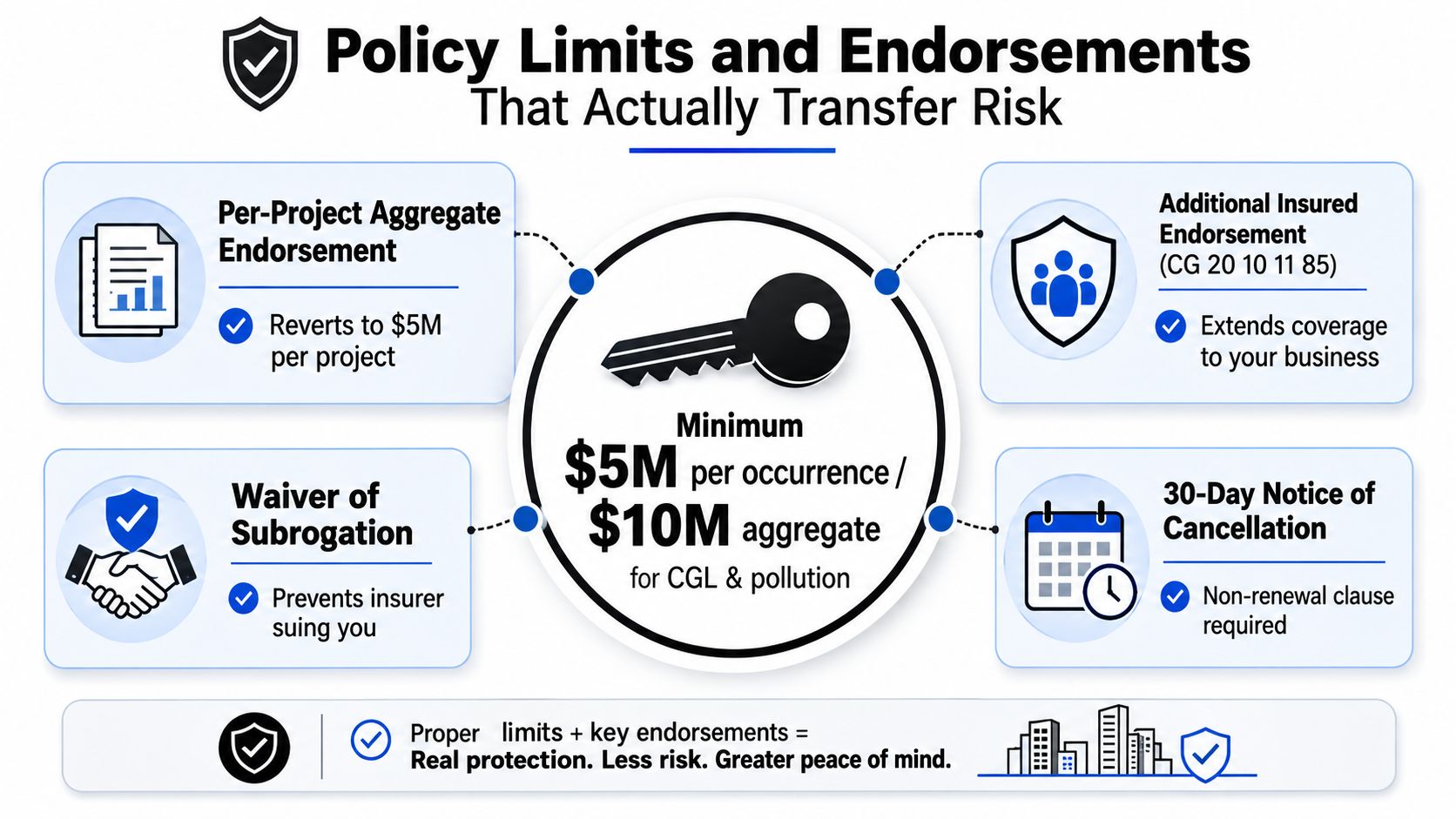
The endorsement list is where weak vendor programs get exposed. You want additional insured status, so your organization gets defense and indemnity for claims arising from the vendor's operations. You also want waiver of subrogation, so the insurer does not turn around and sue you after paying a claim. And you want primary and non-contributory wording, so the vendor's policy responds first.
Decision rule: If the endorsement does not name your company the way the contract does, the insurance has not matched the risk.
Some contracts also require 30-day notice of cancellation, with tighter notice for non-payment. That gives you time to react before a policy lapses mid-engagement. Higher-risk work may justify an umbrella or excess layer, especially when the contract exposure is above the base CGL tower.
Match the policy to the loss mode
The policy should line up with the way the loss would occur. Completed-operations language matters when work is finished but the client discovers the problem later. Crime coverage matters when the contract includes assets, inventory, or sensitive material that can disappear. Auto liability matters when vehicles are part of collection, pickup, or transport.
A smart contract review asks one question repeatedly. What loss is this vendor most likely to create, and which policy pays for it? If the answer is vague, the coverage is too.
The Gap Between a COI Checklist and Real Risk Transfer
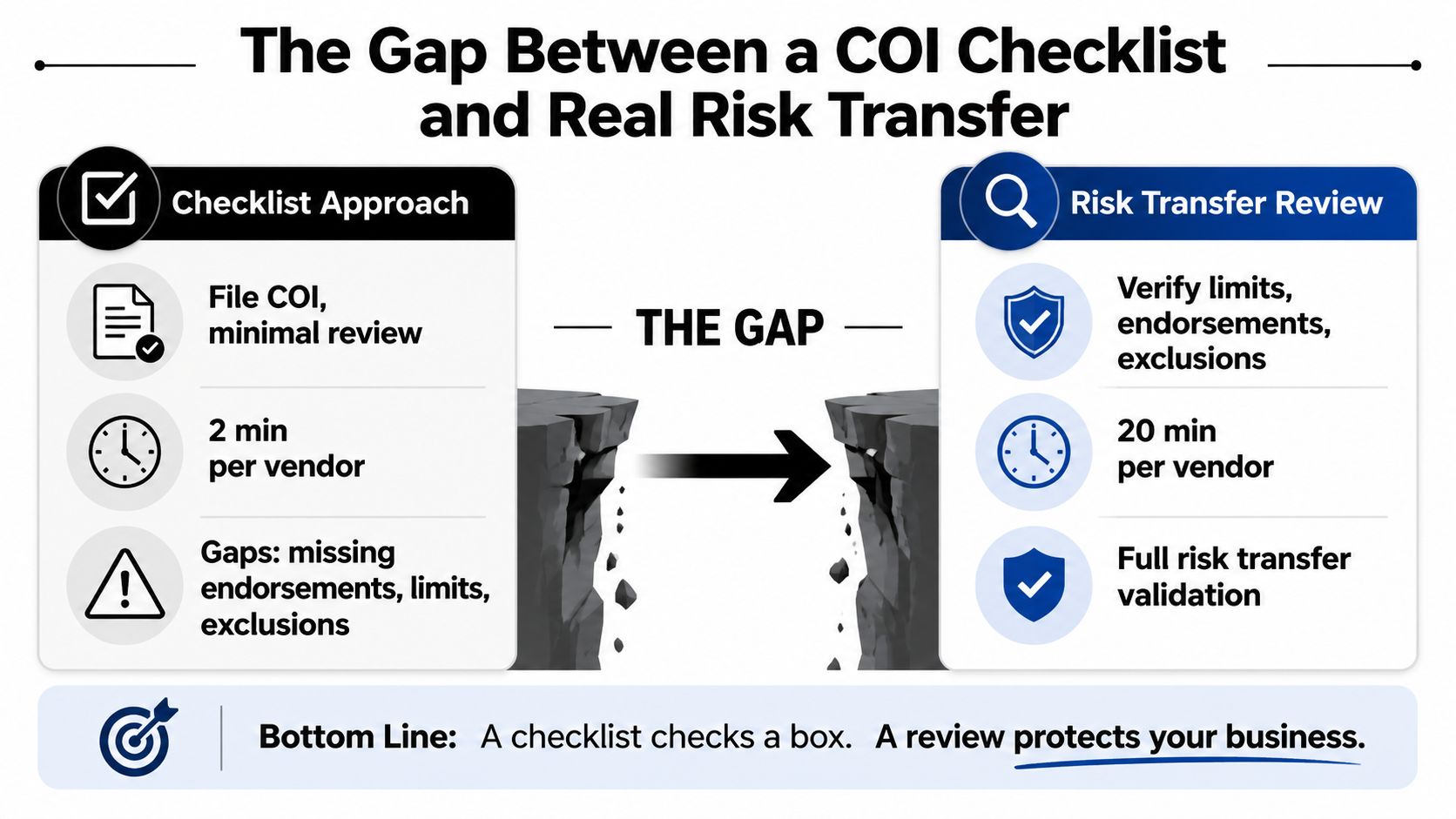
A checklist is fast. A real review is slower. That is exactly why the quick method keeps failing.
What the quick method catches
The quick method catches only the obvious things. A COI says the vendor had a policy in force on the date shown. It may show a limit. It may show a carrier name. That's useful, but it's thin.
A basic review often misses the core problem. The policy may exclude the exact activity your contract contemplates. The additional insured endorsement may be missing. The limits may be below what your agreement requires. The certificate may look clean while the underlying form is anything but.
What the deeper review catches
A deeper review asks for policy pages, endorsements, and contract alignment. It checks whether the vendor is carrying the right form of protection, not just any form of protection. That matters because the standard ISO vendor endorsement language is narrow and often tied to bodily injury or property damage arising out of the vendor's own products sold in the regular course of business, which leaves many mixed-scope service vendors outside the easy answer.
The earlier section on endorsements covers the mechanics, but the contract side is a blind spot. Liability caps appear in over 75% of negotiated agreements, and carve-outs for indemnification, confidentiality, death or personal injury, fraud, or willful misconduct appear in 40%+ of agreements (Legal Evolution data). That means the contract often limits recovery before insurance even gets a chance to respond.
Why the certificate alone fails in practice
A COI can't tell you whether the buyer has been added as an additional insured correctly. It can't tell you whether exclusions wipe out the claim. It can't tell you whether the vendor's upstream subcontractor created a problem that fell outside the tower. That's why vendor insurance programs increasingly rely on direct insurer-issued evidence and annual review instead of vendor-supplied PDFs.
Use best practices for risk management as a model for how disciplined this process should be. The point isn't bureaucracy. It's avoiding a false sense of safety.
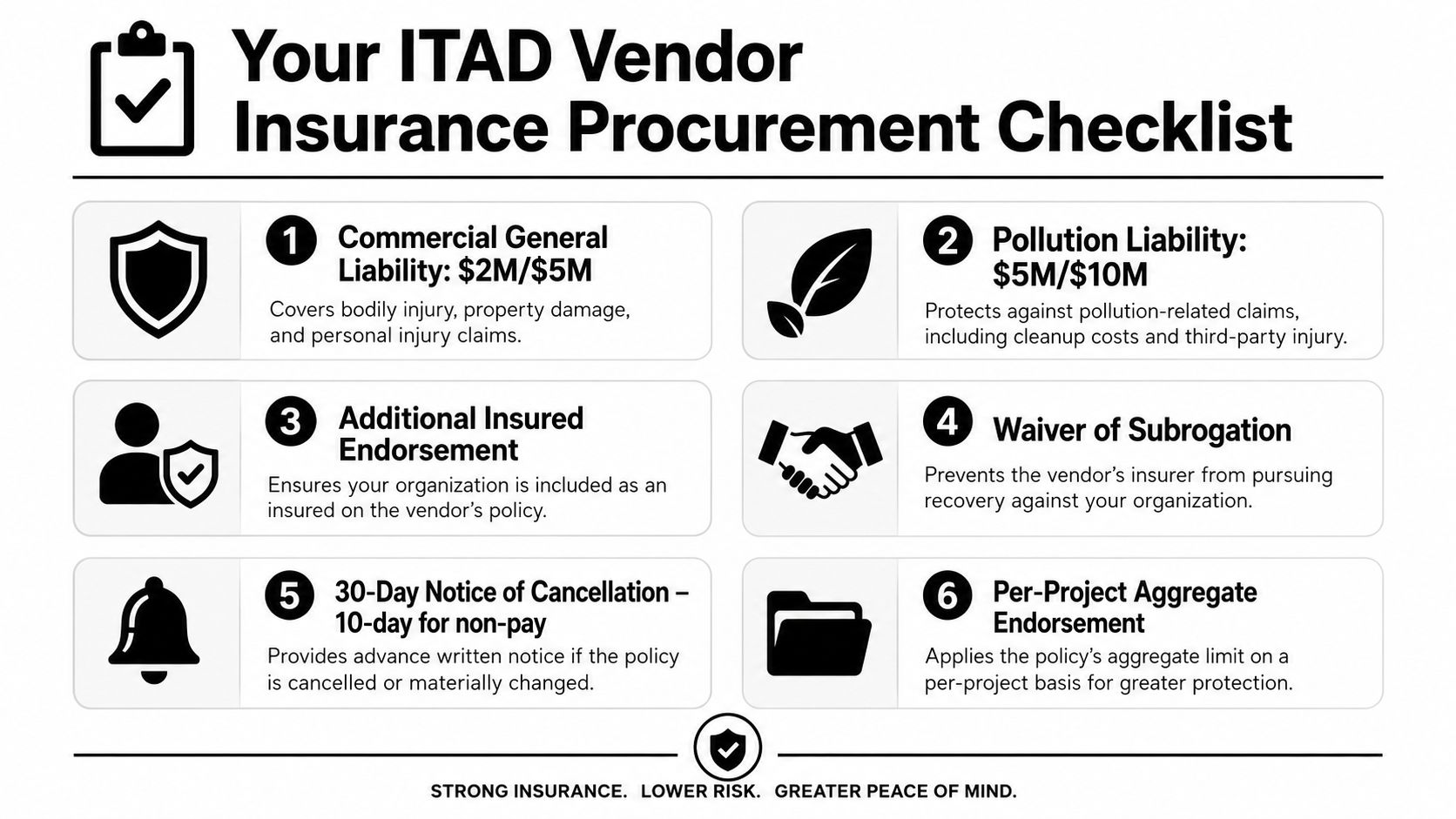
Your ITAD Vendor Insurance Procurement Checklist
Procurement teams need a repeatable process, not a one-off judgment call. The goal is to make vendor insurance review part of the deal, not a side task that gets rushed after the service order is signed.
Use a hard gate before award
Start with minimum requirements in the RFP or vendor onboarding form. Ask for current insurance certificates, full policy limits, and the actual endorsement pages. If the vendor won't provide those, that is a signal, not a nuisance.
- Commercial General Liability: Require the limit structure your contract demands, and don't accept a vague “industry standard” answer.
- Pollution Liability: Ask for coverage that matches the recycling, handling, or transport exposure.
- Cyber and Breach Coverage: Verify that data-bearing devices and media handling are included.
- Professional Liability: Confirm the policy addresses service failures, planning errors, and project mistakes.
- Additional Insured Language: Make sure your company is listed the way the contract requires.
- Cancellation Notice: Require written notice so a lapse doesn't surprise you mid-project.
Put the clause in the contract
The contract should say what the certificate can't. Require the vendor to maintain coverage during the entire term, provide updated evidence on request, and notify you of changes that affect the coverage you relied on. If the work includes transport or fleet activity, add auto liability. If the work includes media or device destruction, require proof of secure handling and a coverage form that reflects that risk.
The language should also preserve your indemnity rights. A policy is not a substitute for a strong indemnity clause. If the vendor pushes back, don't let them hide behind the phrase “we carry insurance.” Insurance without aligned language is just a comfort statement.
Know what's negotiable
Some points are flexible. Others aren't. A lower-risk shipment might tolerate a narrower stack than a full-site decommissioning, but if the work touches sensitive data, regulated material, or client infrastructure, the insurance stack needs to be firm. That is where a procurement checklist becomes valuable.
For a practical template you can adapt, keep this compliance checklist template in your vendor file. It helps standardize review, which is where companies either gain control or lose it.
Verifying and Monitoring Vendor Insurance Over Time
Insurance review is not a one-time event. Vendors renew late, policies change, and coverage slips below contract minimums between kickoff and closeout. If you only check once, you're gambling on timing.
The right move is a simple calendar. Tie every vendor's insurance review to contract renewal, annual renewal, and any scope change. If the vendor adds a warehouse, a transport subcontractor, or a new data handling step, the old certificate is no longer enough. Ask for updated evidence before the work changes, not after.
A good COI process catches expiration dates. A good risk process catches scope creep.
Centralize the documents. Don't leave them scattered across email threads, shared drives, and procurement notes. A single record should show the original certificate, the endorsement pages, any exceptions approved by legal, and the date of the last review. That way, when an auditor or claims adjuster asks what happened, your team can answer fast.
The biggest red flag is simple. If a vendor resists renewal proof, won't provide endorsements, or starts falling below agreed limits, pause the engagement. Mid-contract drift is how avoidable losses become disputes. Continuous monitoring is the only way to keep risk transfer real instead of theoretical.
Partner with Reworx Recycling for Insured and Responsible ITAD
The insurance lesson here is simple. Choose vendors that treat risk transfer as part of the job, not an afterthought. That standard matters most when the work includes device handling, data destruction, decommissioning, and responsible downstream processing.
Reworx Recycling, based in Smyrna, Georgia, brings that discipline to IT asset disposition with secure hard drive shredding, data destruction, equipment decommissioning, recycling consultations, and donation-based electronics recycling. That combination matters because it aligns compliance, environmental responsibility, and community impact in one workflow.
If your team is planning an office cleanout, data center decommissioning, or year-end equipment retirement, don't settle for a vendor that only looks insured on paper. Choose a partner that helps you reduce risk, protect data, and keep usable hardware in circulation where it can still do good.
If you're ready to retire old equipment the right way, Reworx Recycling can help with pickup scheduling, secure data destruction, and responsible electronics recycling that supports both compliance and community goals. Visit Reworx Recycling to plan your next donation-based recycling project or start a conversation about ITAD for your business.