Mercury-containing equipment refers to older devices like thermostats, relays, and gauges that hold elemental mercury. These are typically legacy items still found in older facilities, manufacturing plants, and laboratories, posing a unique challenge for modern IT equipment disposal and facility cleanouts. For businesses in Georgia, particularly those in industrial hubs like Atlanta or Savannah, managing these materials responsibly is a critical component of corporate sustainability and regulatory compliance.
Identifying Mercury-Containing Equipment in Your Facility
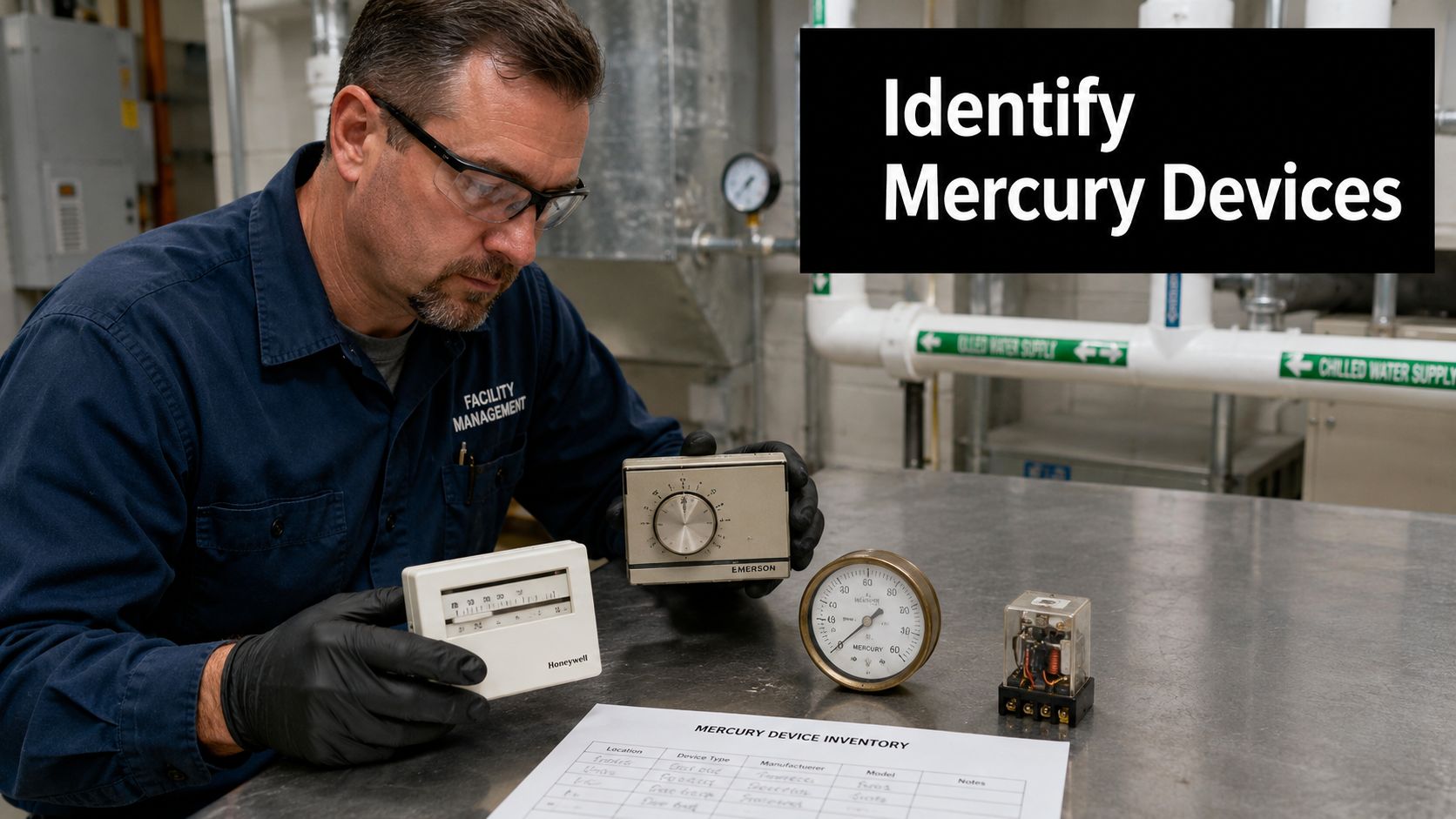
Legacy mercury devices tend to linger in data centers, hospitals, schools, and mechanical rooms because they were installed years ago and often get overlooked during upgrades. They remain in service until a renovation, facility cleanout, or data center decommissioning project brings them to light.
You'll commonly find these items in:
- Thermostats and control switches inside mechanical closets or AHU control panels.
- Electrical relays and tilt switches within older UPS panels or motor controls.
- Manometers, barometers, and certain gauges in laboratory equipment disposal scenarios.
Key Takeaway Most businesses discover these devices during renovations, office cleanouts, or IT hardware refreshes when old panels get opened and equipment is inventoried for disposal.
When you're looking for telltale signs, watch for metal cylindrical capsules, small glass vials inside switches, or labels that explicitly warn about mercury content. Don't assume a modern-looking device is mercury-free; visual inspection and label verification are crucial.
Common Types of Mercury-Containing Equipment
Before starting a facility audit, it helps to know what to look for. Here's a quick reference for device types commonly found in commercial and industrial settings.
| Device Category | Typical Location | Mercury-Containing Equipment Status |
|---|---|---|
| Thermostats and mercury bimetal sensors | Mechanical rooms, rooftop units | Regulated as mercury-containing equipment |
| Electrical relays and tilt switches | Control panels, switchgear rooms | Regulated when integral to device function |
| Manometers and pressure gauges | Labs, HVAC service points | Often mercury-filled; treat as regulated |
| Barometers and lab instruments | Science classrooms, research labs | Regulated; high spill risk in enclosed spaces |
| Older medical devices (select) | Clinical rooms, blood pressure units | May contain mercury; check labels and SDS |
| Lamps and batteries | Lighting closets, storage | Excluded from this category; manage under separate universal waste rules |
This table provides a starting point, but always err on the side of caution. When in doubt, treat a device as regulated until you can confirm otherwise.
Practical Example: During an office cleanout, assume a drawer full of mixed hardware contains regulated items until each device is positively identified. Establish a staging area with clear labels and keep suspect items separate from standard e-waste like computers and laptops to avoid cross-contamination.
Here's a straightforward approach for facilities managers:
- Walk through your mechanical and lab spaces with a focus on older equipment.
- Flag any devices matching the categories in the table above.
- Photograph and catalog each item, noting its exact location for your IT asset disposition (ITAD) records.
Read also: Learn more about laboratory equipment recycling and drop-off options in our guide on lab equipment recycling in New Orleans.
Why Legacy Mercury Equipment Is Still a Compliance Priority
Think of legacy mercury stocks like an old debt on a balance sheet—the original purchase happened decades ago, but the obligation to manage and retire it remains.
Buildings upgraded in the 1980s and 1990s often still contain thermostats, relays, and gauges holding elemental mercury. Facility cleanouts and data center decommissioning projects regularly surface these regulated devices. While substitution efforts have slashed new purchases, recovery programs haven't accounted for every installed unit. This gap creates a long-tail compliance burden that often appears unexpectedly.
Why This Matters for Your Business
- Older mechanical rooms and control panels are common hiding spots for mercury-containing equipment.
- Labs, hospitals, and manufacturing sites often hold specialized instruments with sealed mercury components.
- Office cleanouts and renovations frequently uncover these legacy items, and once found, universal waste rules and disposal obligations kick in immediately.
Key Insight: Even a small handful of thermostats or relays can generate regulatory paperwork, manifest requirements, and significant liability if mishandled.
How the Compliance Risk Plays Out
A broken mercury switch during a retrofit can force an occupational exposure response. A missed item during an electronics recycling drive can contaminate an entire load. Regulators don't view leftover mercury as historical trivia—they treat it as active hazardous waste with real consequences.
Practical Steps for Immediate Action
- Walk through mechanical, lab, and utility spaces to locate likely devices.
- Photograph and tag anything suspect, then log it into your IT asset disposition or facility inventory.
- Separate intact units from damaged ones and stage them in a sealed containment area until transport.
- Use UN-rated containers or original packaging whenever possible.
- Keep chain-of-custody records so every handoff and downstream recycling step is documented.
How a Responsible Partner Helps
Working with a recycler who understands mercury regulations transforms a complex challenge into a manageable workflow. Reworx Recycling is a donation-based recycling social enterprise providing scheduled business pickups and compliant handling. Our services cover everything from secure data destruction to comprehensive IT asset disposition. Read also: Learn more about the environmental impact of electronic waste in our article on environmental impacts and best practices.
Documenting removal and choosing licensed processors reduces fines, cleanup costs, and reputational risk. The bottom line? Treat legacy mercury as an operational risk to be audited, recorded, and resolved through a trusted recycling partner.
Health Risks and Operational Consequences of Mishandling
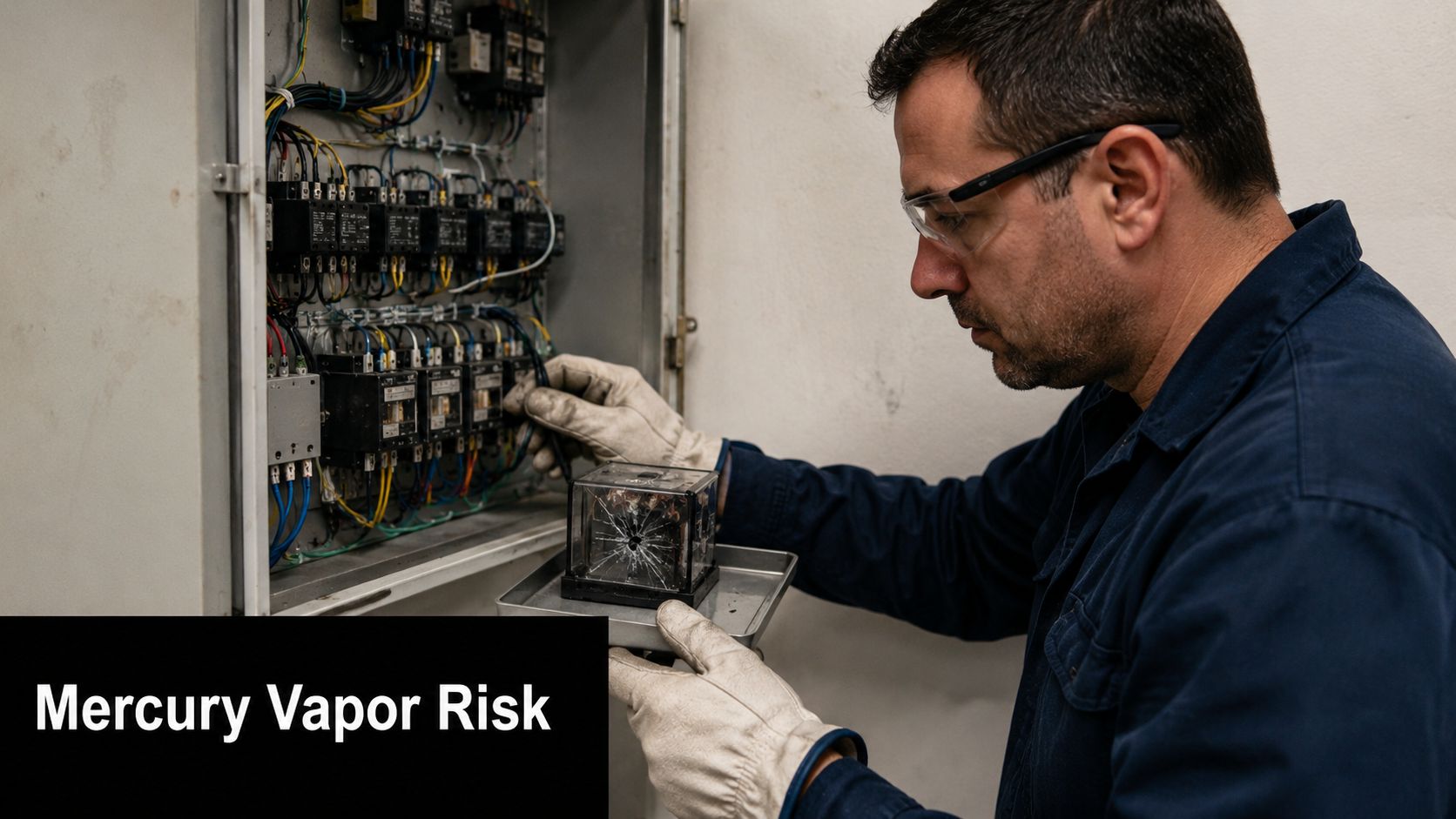
Key takeaway: Mercury vapor can travel through HVAC systems and silently contaminate occupied spaces long after a small device breaks.
A cracked relay discovered during an IT rack teardown is more than a maintenance headache. Mercury beads can vaporize at room temperature, creating an invisible exposure risk that can lead to headaches, cognitive issues, and long-term neurological damage. This immediate health risk forces work stoppages, medical evaluations, and possible OSHA reporting.
Flooding in a mechanical room that reaches old thermostats creates another pathway. Mercury can enter floor drains, spreading contamination into building plumbing or soil, which triggers environmental reporting and costly remediation.
Practical Operational Impacts
Cleanup Costs and Downtime
- Small spills can lead to professional cleanup bills in the thousands of dollars and cause significant productivity losses.
- Extended closures of labs or server rooms can disrupt projects and contractual SLAs.
Legal and Compliance Exposure
- Universal waste and hazardous waste rules, including those from the EPA, require documented handling, manifests, and sometimes notification to regulators.
- Failure to follow these rules may lead to fines and corrective orders.
Reputational and ESG Consequences
- An avoidable contamination incident damages stakeholder trust and creates gaps in ESG reporting.
- Investors and customers expect documented, sustainable recycling practices for IT equipment disposal and corporate donation programs.
Immediate Actions To Reduce Risk
- Isolate the area and restrict access to nonessential staff.
- Ventilate without using building vacuums; open windows if safe.
- Contact trained hazmat responders for any spill beyond a small, contained bead.
How This Translates To Procurement and Vendor Decisions
- Choose recyclers who provide chain-of-custody, manifests, and certificates of recycling.
- Verify downstream processors properly reclaim mercury.
- Integrate mercury checks into your IT asset disposition and office cleanout workflows.
Practical example: A data center decommission discovered five mercury relays during rack removal; prompt segregation and a licensed pickup avoided HVAC contamination and preserved project timelines.
Read also: Learn more about worker protection and safety protocols in our guide on Worker Protection Standards and Mercury Handling.
Reworx Recycling helps businesses inventory suspect items, stage them safely, and manage compliant pickup so organizations can protect employees, reduce cleanup liability, and maintain credible ESG records. Contact us to schedule an assessment, arrange a pickup, or include mercury handling in your next facility cleanout.
Navigating Federal and State Universal Waste Rules
If you've dealt with old thermostats, outdated relays, or industrial gauges, you've likely wondered about the applicable regulations. The answer starts at the federal level, where mercury-containing equipment is categorized under 40 CFR Part 273. This classification comes with specific handling and transport expectations separate from lamps or batteries. Whenever these devices leave your site, you need documented tracking.
State programs, however, can add another layer of complexity. Some states impose tighter accumulation limits or extra labeling requirements. Before scheduling transport, you must confirm both federal rules and any specific state-level demands.
Key Regulatory Concepts
Compliance is about documentation, not guesswork—manifests, container labels, and receipts form the paper trail regulators expect.
- Keep a manifest or shipment record for every transfer of mercury-containing equipment.
- Stage and transport items in approved, sealed containers with secondary containment.
- Ensure your downstream processors accept mercury-containing equipment and provide a recovery certificate.
Treat mercury devices like regulated financial assets, not loose recyclables. Just as you wouldn't transfer company funds without a record, shipping mercury devices without chain-of-custody documentation is a significant gamble.
Practical Implications for Multi-Site Operations
Managing this across multiple facilities can be streamlined with repeatable workflows. Centralize your regulatory checks through a single role or vendor point-of-contact to ensure consistency.
- Build a simple pickup checklist covering state acceptance rules and container specifications.
- Photograph every packed container and attach digital manifests to the corresponding shipment.
- Confirm your recycler issues final recycling or recovery certificates, not just a pickup receipt.
When the regulatory picture gets murky, legal guidance is valuable. See Miles Hansford Law Firm compliance help for relevant guidance.
Where Mercury Use Has Declined
National reporting shows a significant long-term drop in mercury use. The table below highlights where reductions have been steepest.
| Indicator | Earlier Value | Recent Value | Change |
|---|---|---|---|
| Mercury in measuring devices (thermometers, barometers) | ~450 metric tons/year | ~85 metric tons/year | –81% |
| Mercury in switches and relays | ~350 metric tons/year | ~60 metric tons/year | –83% |
| Mercury in dental amalgam | ~320 metric tons/year | ~90 metric tons/year | –72% |
| Mercury in lighting (fluorescent lamps) | ~200 metric tons/year | ~70 metric tons/year | –65% |
| Current share held by measuring devices | — | ~28% of remaining use | — |
| Current share held by switches/relays | — | ~20% of remaining use | — |
The trend is clear: mercury use has dropped sharply. But measuring devices and switches still account for a sizable portion of what remains, which is why proper end-of-life management for this equipment is so critical.
How Reworx Recycling Supports Compliance
As a licensed recycler and social enterprise, Reworx Recycling removes the burden of in-house hazardous waste expertise. We provide documented handling, verified downstream processors, and chain-of-custody management integrated with our donation-based recycling and IT equipment disposal workflows. We handle manifest preparation and certify final processing, shielding your organization from fines and liability.
Quick Takeaway Partnering with a knowledgeable recycler turns regulatory complexity into a predictable checklist that protects people, property, and corporate reputations.
Read also: Learn more about universal waste handling in our guide on Universal Waste Management and Reworx services.
Safe Handling and Storage Best Practices for Businesses
Think of a mercury-safe staging area as a controlled "waiting room" where suspect devices sit in sealed containers until a licensed recycler arrives. This approach prevents mercury from contaminating your general e-waste stream and dramatically reduces spill risk during office cleanouts or data center decommissioning.
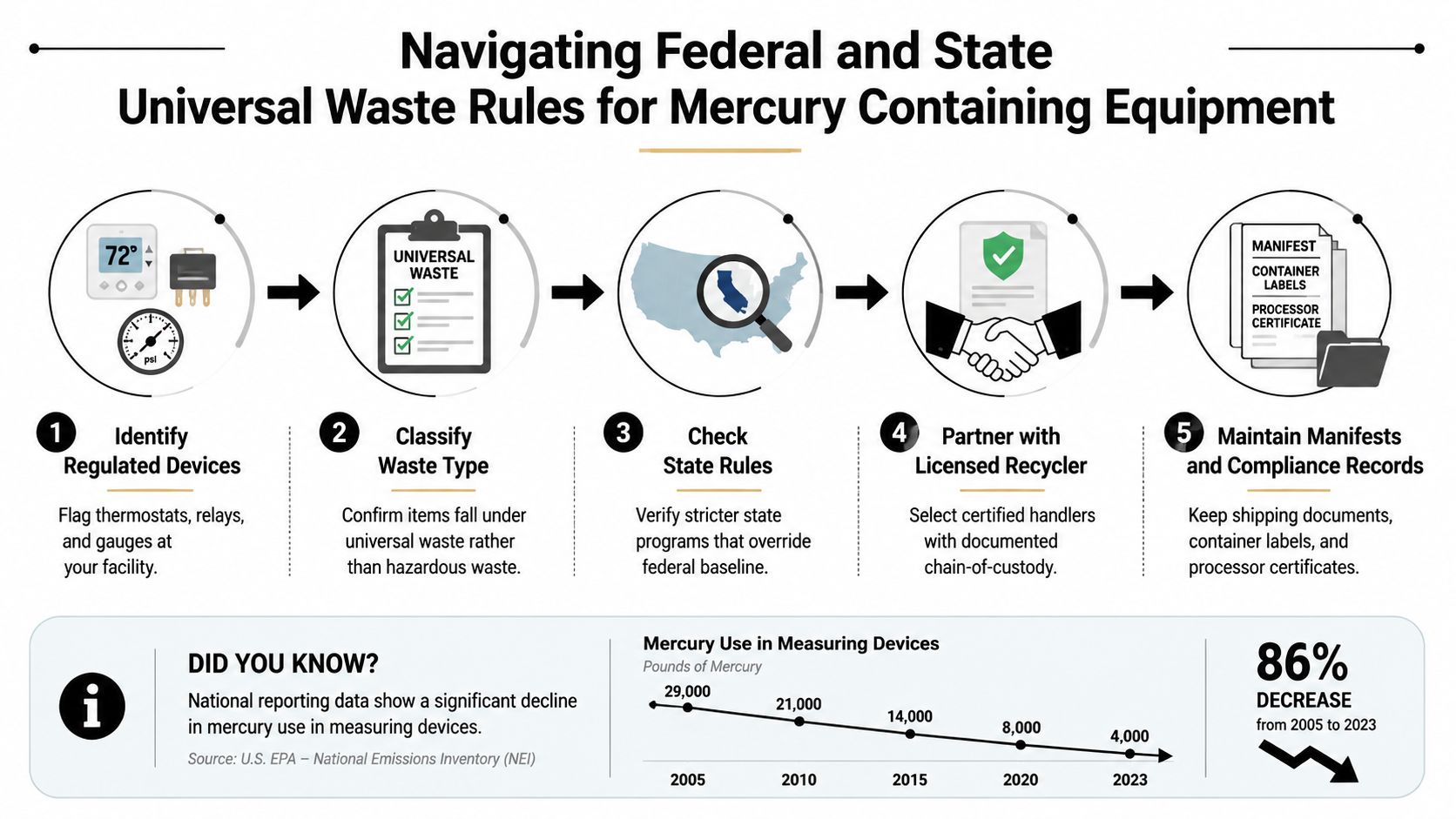
The infographic above outlines the five-step process your facility should follow when managing mercury-containing equipment, in line with federal and state universal waste rules.
Begin with a facility walk-through to identify potential mercury sources—thermostats, relays, gauges, and older medical monitors. Photograph, tag, and log each item's location, condition, and serial number in your IT asset disposition records.
Initial Segregation and Packaging
Immediately separate intact units from damaged ones. Intact devices can be placed in original packaging or padded boxes with absorbent liners. Damaged items require secondary containment in UN-rated containers, stored on impervious surfaces away from drains.
- Label containers clearly with the device type, collection date, and handler's name.
- Keep containers sealed and store them in a ventilated area with restricted access.
- Create a simple manifest for each container that integrates with your standard pickup workflow.
Stepwise Workflow for Safe Staging
- Walk through your facility with maintenance and IT staff to flag any suspect devices.
- Move flagged items to a designated staging area, separate from general e-waste like old computers.
- Pack intact and damaged units separately using appropriate UN-rated or original packaging.
- Attach manifests and digital photos to every container.
- Schedule pickup with a licensed recycler.
Think of staging like triage: isolate first, document second, and transfer items only with a certified handler.
Reworx Recycling integrates directly into this workflow by offering scheduled business pickups. For larger loads, we provide reverse-logistics guidance to ensure your shipment complies with all regulations before it leaves your dock.
For businesses facing complex hazmat situations, professional handling may be necessary—consider consulting experts like hazmat remediation by Restore Heroes.
Vendor Handoff and Recordkeeping
Before handoff, ensure your recycler provides full chain-of-custody documentation, manifests, and final processing certificates. File copies to support ESG reporting and prepare for regulatory audits.
Cost and recovery notes
Legacy mercury devices rarely have resale value. However, proactive staging saves you from cleanup bills, fines, and operational downtime. The key is to treat mercury handling as a planned part of office cleanouts and data center decommissioning, not a last-minute crisis.
Partnering with Reworx Recycling lets you fold mercury-safe staging into your broader electronics recycling programs. It protects your people, property, and your company's reputation.
Choosing a Responsible Recycling Partner for Mercury Devices
Selecting a recycler for mercury-containing equipment is a critical decision affecting your compliance, safety, and corporate reputation. Treat it as a formal vendor due diligence process, not a simple commodity pickup.
Use a checklist focused on accountability and transparency.
- Verify documented downstream vendors to ensure traceable mercury recovery.
- Require a written chain-of-custody for every shipment that aligns with your IT asset disposition records.
- Ask for transparent reporting, including weight summaries, recovery certificates, and final processing locations.
Look for partners who bundle ITAD services, so mercury handling fits naturally alongside secure data destruction and office cleanout workflows. This consolidation means fewer vendor handoffs and a cleaner audit trail.
Key Insight: A responsible recycler treats mercury devices like regulated assets, not loose recyclables. Manifests and certificates are non-negotiable proof.
Practical Vendor Selection Criteria
1. Licensing and Certification
- Confirm state universal waste acceptance and transporter credentials.
- Check for R2 or e-Stewards certification and evidence of hazardous materials training.
2. Handling Procedures
- Look for written packaging and labeling protocols, including UN-rated containers for damaged units.
- Ensure they separate intact from broken devices and use secondary containment during transport.
3. Downstream Verification
- Require contactable downstream processor references and proof of actual mercury reclamation.
- Ask for end-processing details to confirm mercury is recovered, not landfilled.
4. Reporting and Recordkeeping
- Insist on digital manifests, photographed pack-outs, and final recovery certificates for ESG reporting.
- Confirm turnaround times for paperwork to meet audit deadlines.
Cost Reality and Value
Legacy mercury equipment rarely generates resale revenue. Budget for disposal costs rather than expecting a profit. A well-run program prevents expensive cleanup events, regulatory fines, and reputational damage that far exceed compliant disposal costs.
- Budget for packaging, transport, and certified processing fees.
- Weigh these costs against avoided cleanup expenses, lost uptime, and potential penalties.
How Reworx Recycling Helps
Reworx Recycling is a donation-based electronics recycling social enterprise combining environmental stewardship with community impact. As part of our mission, we support technology donations and workforce development. We provide staged pickups, documented chain-of-custody, and integration with secure data destruction and ITAD services to simplify your compliance.
- Scheduled business pickups are available for staged loads across the region.
- Reworx issues manifests and final processing certificates to support your ESG and audit needs.
Learn more about selection practices in our vendor guidance at Vendor Selection Criteria for Responsible Recyclers.
Partnering with a responsible recycler turns regulatory complexity into a predictable process.
Frequently Asked Questions About Mercury Equipment Disposal
What is considered mercury-containing equipment in my facility?
This includes legacy devices with elemental mercury integral to their function—think thermostats, electrical relays, tilt switches, manometers, and certain lab gauges. It's a distinct category from fluorescent lamps and batteries, which follow separate hazardous waste streams. This distinction is vital during office cleanouts and data center decommissioning.
How does mercury equipment differ from general e-waste or lamps?
Universal waste rules treat mercury-containing equipment as a unique category, separate from general e-waste like old computers and from lamps or batteries. These devices require specific staging, containers, and documentation to prevent cross-contamination and minimize spill risk.
Do small quantities need special handling?
Yes. A single broken thermostat can release enough mercury vapor to trigger cleanup requirements and potential fines. Even minimal volumes must be treated as regulated waste: segregate them, label them clearly, and document everything before scheduling transport.
What immediate steps should my business take today?
- Inspect mechanical rooms, labs, and older control panels for suspect devices.
- Photograph, tag, and log any found items into your IT asset disposition records.
- Separate intact from damaged units and move them to a designated, secure staging area.
What are the best practices for handling, storage, and transport?
- Use sealed, labeled containers and UN-rated packaging for damaged items.
- Keep staging areas away from drains and HVAC intakes.
- Maintain manifests, photos, and chain-of-custody records for every shipment.
- Never vacuum or sweep a spill. Ventilate the area and call trained responders.
How do I choose a recycler, and what does Reworx Recycling offer?
Look for a vendor that provides written chain-of-custody, verified downstream processors, and clear recovery certificates. As a social enterprise, Reworx Recycling offers donation-based recycling, scheduled business pickups, and integration with comprehensive ITAD workflows, including secure data destruction. We provide all necessary documentation to ensure your compliance.
What records and costs should I expect?
Expect to receive manifests, pack-out photos, and final processing certificates for your ESG reporting. Legacy mercury items rarely generate revenue, so budget for disposal costs and weigh them against the significant potential costs of mishandling.
Where can I get help and what are the next steps?
Request a site assessment from a qualified partner to integrate mercury management into your sustainability efforts. By treating mercury handling as ongoing maintenance, you can reduce risk while supporting community-focused outcomes.
Key Insight: Proper staging, thorough documentation, and a trusted partner turn regulatory complexity into a manageable program that protects your people, assets, and reputation.
Partner with a social enterprise that makes responsible recycling simple. To schedule a pickup, donate old equipment, or learn more about our corporate donation programs, connect with Reworx Recycling today. Our mission is to help businesses like yours meet their environmental goals while creating positive community impact. Visit our blog for more insights: https://www.reworxrecycling.org/category/recycling-blog