A lot of companies are in the same position right now. They're refreshing laptops, retiring servers, clearing storage rooms, or planning an office cleanout. The vendor checklist gets attention. The pickup gets scheduled. The certificate language gets reviewed. Then a boxed-up tablet with saved credentials sits in an unsecured closet, or an employee drops an old drive into general recycling because they thought it was already cleared.
That's how avoidable ITAD failures happen.
A certified recycler matters. A secure process matters. But neither can fix internal handling mistakes that happen before assets ever reach the truck. The biggest gap in most corporate recycling programs isn't vendor selection. It's training and education inside the business.
I've seen organizations put serious effort into choosing a partner, then leave day-to-day decisions to employees who were never taught what counts as an asset, what requires secure data destruction, where devices should be staged, or who has authority to release equipment. One wrong assumption can break chain of custody, create compliance exposure, and undermine an otherwise sound electronics recycling program.
That's why staff training is the human firewall for IT asset disposition. When employees know what to do, risk drops early, not after the fact. When they don't, even a strong downstream recycler is forced into cleanup mode.
Introduction Your Recycling Partner Is Only Half the Solution
A common mistake in corporate recycling is treating vendor selection as the finish line. It isn't. It's the midpoint.
A business can do the visible parts right. Procurement reviews service options. Legal signs the agreement. IT confirms secure handling. Facilities schedules pickup. Then one employee bypasses the process. They leave phones in a desk drawer, move network gear to a loading dock without documentation, or hand off a laptop that was never logged. The recycler can only secure what the company effectively controls and transfers correctly.
That's why internal discipline matters as much as external capability. If your team doesn't understand basic IT asset disposition rules, your program has blind spots from day one. The practical work happens long before any pallet leaves the building.
Vendor quality doesn't replace internal control
Choosing the right partner still matters. A company should absolutely verify credentials, process transparency, and downstream handling. A useful starting point is this guidance on how to evaluate an e-waste recycling partner. But that review only addresses one side of the equation.
Your side includes the people who touch devices first. End users, help desk staff, desktop support, facilities teams, office managers, and site leads all influence whether equipment enters the correct disposition path or disappears into an informal one.
Practical rule: If an employee can physically touch a retired device, that employee needs clear ITAD instructions.
The first failure usually happens upstream
Most internal breakdowns aren't malicious. They're operational. Staff members guess. Someone assumes data wiping happened earlier. Someone else thinks an old access point isn't covered because it isn't a laptop. A department stores retired devices wherever there's space.
Those are training failures, not vendor failures.
A strong recycling program treats employees as part of the control environment. It gives them simple rules, repeatable steps, escalation paths, and role-specific accountability. That foundation is what turns electronics recycling, donation-based recycling, secure data destruction, and broader IT asset disposition (ITAD) into an actual process instead of a pickup event.
Why ITAD Training Is a Non-Negotiable Business Priority
ITAD training isn't an HR add-on. It's risk management.
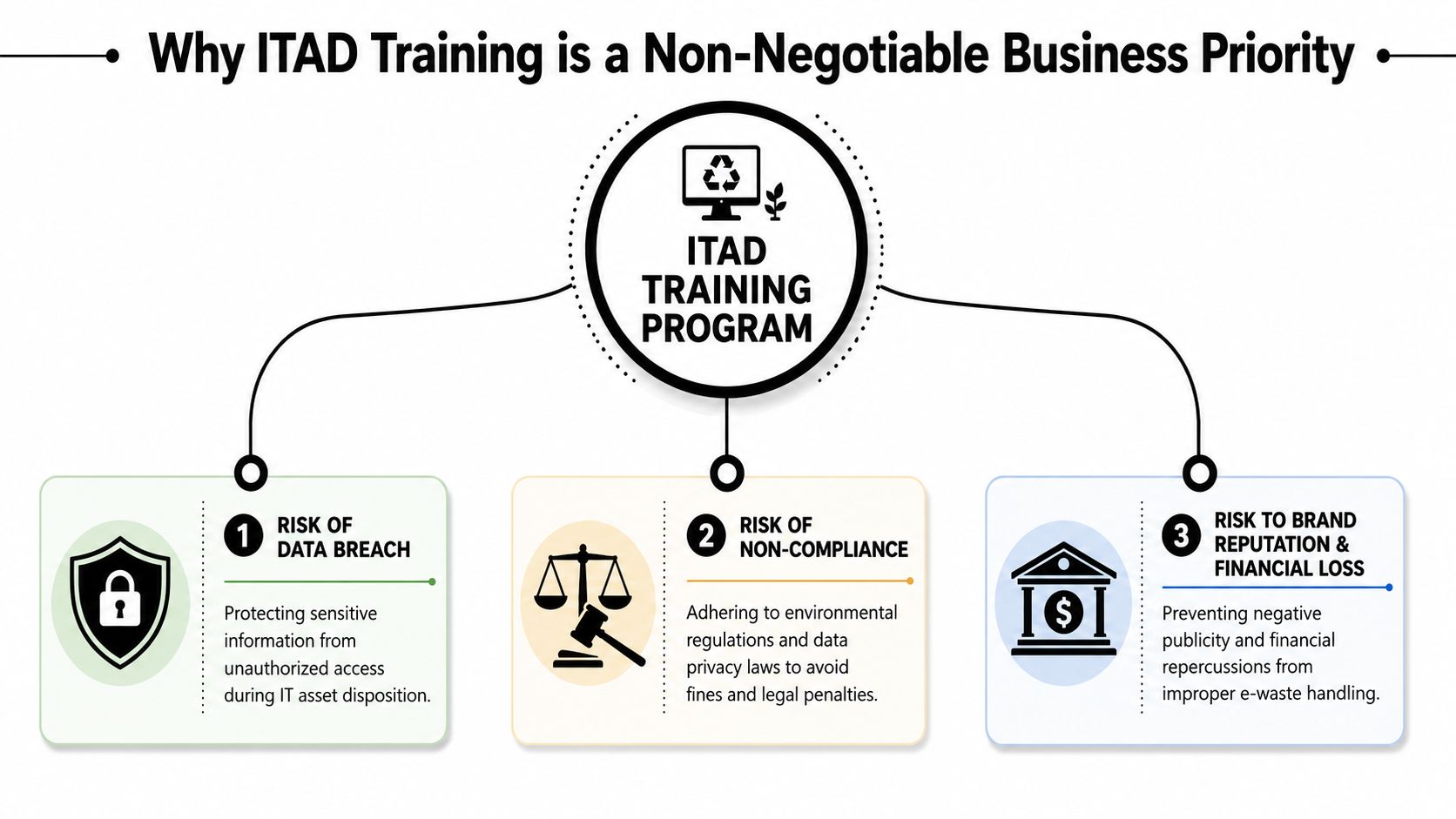
When organizations underinvest in staff education, they usually create three problems at once. Sensitive data moves without control. devices get handled in ways that don't match policy. Sustainability claims get weakened because no one internally knows what should be reused, refurbished, recycled, or held for review.
Data security starts before pickup
The phrase IT asset disposition gets reduced too often to a disposal event. In practice, it's a controlled workflow for identifying, collecting, securing, transporting, processing, and documenting end-of-life technology. If employees only understand the last step, the organization is exposed during every earlier step.
A related operational concept is reverse logistics. In e-waste management, reverse logistics specifically covers collecting end-of-life electronics, transporting them to recycling facilities, and reintegrating valuable materials back into the manufacturing supply chain, as explained in Reworx Recycling's overview of reverse logistics in a green supply chain. That process only works when internal teams know how to prepare assets for controlled movement.
Training has to answer practical questions:
- What counts as an IT asset: Laptops are obvious. Docking stations, printers, phones, access points, external drives, and embedded storage often get missed.
- What requires secure data destruction: Employees shouldn't guess whether a device contains data.
- Where assets wait for release: Hallways, open shelves, and personal vehicles aren't controls.
- Who signs off on transfer: If ownership is fuzzy, chain of custody is weak.
Compliance and reputation live in operations
Most companies don't get in trouble because their written policy looked bad. They get in trouble because daily behavior didn't match the policy.
That's why training should be treated like any other operational control. A useful parallel exists outside recycling. Companies that hire for practical capability often rely on frameworks like this skills-based hiring guide because role success depends on demonstrated ability, not just job titles. ITAD works the same way. Secure asset handling depends on what employees can do under routine conditions.
A policy doesn't protect a device in a hallway. A trained employee does.
Brand risk is tied to that reality. Customers, employees, regulators, and community stakeholders don't separate your intent from your execution. If your process fails, they see your company, not your vendor workflow.
Training is cheaper than cleanup
The strongest argument for internal education is simple. Prevention happens upstream, when assets are first retired.
A practical training program reduces the number of judgment calls employees make on their own. It standardizes handoff, storage, tagging, and escalation. It also supports secure data handling. Companies that are reviewing those controls should examine guidance like data security best practices in IT asset disposition, then make sure the policy is translated into staff behavior.
If your team doesn't know the process, your recycling partner is inheriting your internal disorder. That's inefficient. It also creates avoidable risk across electronics recycling, computer recycling, product destruction, laptop disposal, and data center decommissioning projects.
The Core Curriculum for E-Waste and ITAD Competence
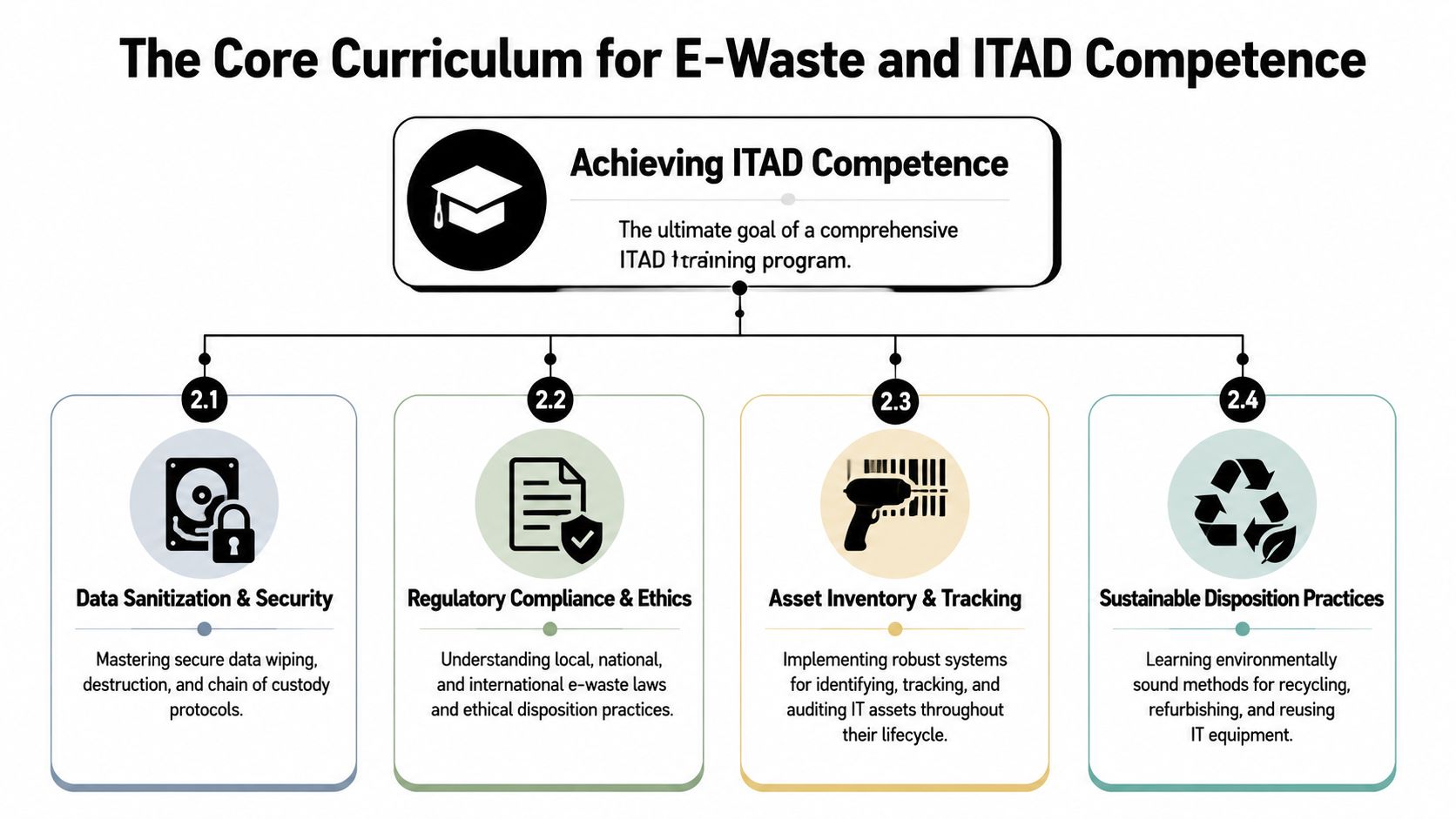
A workable ITAD program doesn't need bloated training libraries. It needs a tight curriculum that teaches employees how to act correctly when equipment leaves service.
The most effective programs I've seen are modular. They give every employee a baseline, then add deeper instruction for the people who manage data-bearing assets, storage areas, pickups, audits, and documentation. The point isn't academic coverage. The point is fewer errors at the moment of handoff.
Module one covers data handling before disposition
The first lesson is straightforward. Employees must know that retired equipment may still contain sensitive information, even when the device looks dead, old, or low value.
That means the curriculum should define approved actions before release, including secure data wiping where appropriate, clear escalation for devices that can't be processed internally, and hard boundaries around informal disposal. Staff should never be deciding on the fly whether a hard drive, phone, copier drive, or USB device is safe to toss.
A short baseline module should answer these questions:
- What never goes in trash or general recycling: Any covered device with potential storage or regulated components.
- When to stop and escalate: If the employee can't confirm status, ownership, or data condition.
- What documentation matters: Asset tags, user assignment, department ownership, and transfer records.
Module two establishes chain of custody
Many programs often remain too vague. “Send old equipment to IT” isn't a process. It's a hope.
Chain of custody training should define where retired devices go, who receives them, how they're labeled, how they're stored, and what evidence accompanies movement. That matters in an office cleanout, a facility cleanout, routine laptop disposal, or a larger IT equipment disposal event.
Operational check: If two departments describe your retirement process differently, you don't have a controlled process yet.
Module three covers environmental handling and recycler standards
Staff should also understand the environmental side of disposition. The point isn't to turn everyone into a compliance specialist. The point is to prevent careless handling that creates downstream problems.
One useful standard for employees and managers alike is the importance of a Zero Landfill Policy. When selecting a recycling partner, businesses should verify that reliable providers commit to repurposing, refurbishing, or recycling end-of-life electronics instead of sending them to landfill, as outlined in this ITAD compliance checklist template. Internal teams need enough awareness to support that standard through proper segregation and release practices.
A practical environmental module should include:
- Battery awareness: Batteries often require separate handling and shouldn't be left mixed in bulk device bins.
- Device separation: Mixed loads slow processing and increase sorting errors.
- Donation pathways: Equipment suitable for reuse should be identified early, not after rough handling reduces its value.
Module four teaches decision discipline
The final module is judgment. Employees need simple decision trees, not legal lectures.
Teach them how to identify whether an item belongs in secure data destruction, reuse review, donation-based recycling, product destruction, or standard electronics recycling. If your teams are handling specialized categories like medical equipment disposal or laboratory equipment disposal, those categories need explicit handling instructions too.
The best curriculum gives people confidence without giving them too much discretion. That balance is what keeps programs efficient.
Designing Role-Based Training for Maximum Impact
Blanket training wastes time. It also misses the people who carry the most risk.
An end user retiring a single laptop doesn't need the same depth as an IT asset manager coordinating data center decommissioning. Facilities staff moving boxed equipment for pickup need clear operational rules, but they don't need a detailed workshop on every sanitization method. Good training and education respects those differences.
Start with the three-step preparation rule
Before assigning training by role, anchor everyone to one shared operational standard. Effective end-of-life management for electronics requires three preparation steps before recycling: data wiping to remove personal data, material separation to extract batteries, and certified recycler selection for environmentally friendly processing, according to Reworx Recycling's electronics recycling best practices.
That shared rule creates consistency. After that, role-based depth can vary.
Match instruction to real responsibilities
Here's the simplest way to structure it.
| Role | Primary Focus | Key Training Topics | Example Action |
|---|---|---|---|
| General end-users | Recognition and handoff | What qualifies as covered equipment, where to return devices, what never goes in trash or bins, when to escalate | Turns in a retired laptop and charger through the approved internal channel instead of leaving it at a workstation |
| IT staff | Data control and asset processing | Data wiping procedures, chain of custody, asset inventory updates, release authorization, secure data destruction triggers | Verifies asset status, updates records, and routes failed drives for destruction |
| Facilities and operations | Secure staging and movement | Locked storage, pallet prep, pickup coordination, loading controls, battery separation, movement logs | Moves boxed equipment from a secure room to dock staging only after release confirmation |
| Procurement and finance | Governance and value recovery | Vendor review, disposition categories, buyback decisions, documentation expectations, audit support | Confirms approved disposition path before surplus hardware is sold, donated, or recycled |
| Site managers and department leads | Local enforcement | Staff reminders, office cleanout planning, exception handling, accountability for off-cycle retirements | Runs a pre-move check so no devices are left in file rooms or unsecured closets |
That table does two things. It narrows training to what each role will encounter, and it avoids overloading employees with information they won't use.
Different roles fail in different ways
End-users usually create risk through convenience. They leave equipment behind, move it informally, or assume someone else owns the next step.
IT staff usually create risk through process shortcuts. A skipped log entry, a mixed staging area, or undocumented transfer can weaken the whole chain of custody.
Facilities teams usually create risk through visibility gaps. They may move what's presented to them without knowing which boxes contain data-bearing devices, loose batteries, or equipment that hasn't been cleared.
Procurement and finance usually create risk when disposition is treated as a value-only decision. Recovery matters, but not at the cost of documentation, certified handling, or secure release.
The right training doesn't make every employee an ITAD expert. It makes each employee reliable in their part of the process.
Delivery matters as much as content
Role-based design also changes how training should be delivered. General users do better with short modules and visual examples. IT and facilities teams need scenario drills. Managers need quick decision guides for exceptions.
A good comparison comes from safety programs. Fleet operations don't train every employee as if they all drive the same route under the same risk conditions. That's why resources like this fleet driver safety guide emphasize role-specific instruction tied to actual duties. ITAD programs should follow the same logic.
For a typical business, role-based rollout often looks like this:
- Baseline awareness for all staff: Short onboarding and annual refreshers.
- Deep procedural training for IT: Asset intake, wipes, documentation, and release controls.
- Handling and logistics training for facilities: Storage, movement, pickup readiness, and escalation.
- Approval training for managers and finance: Exceptions, surplus approvals, and audit readiness.
That structure is more efficient than one-size-fits-all training, and it holds up better during office moves, refresh cycles, and high-volume disposal events.
A Practical Roadmap for Implementing Your Program
Most companies don't need a complicated launch. They need a disciplined one.
The easiest way to stall an ITAD training effort is to overbuild it before testing it. Start with actual points of failure. Then build from there.
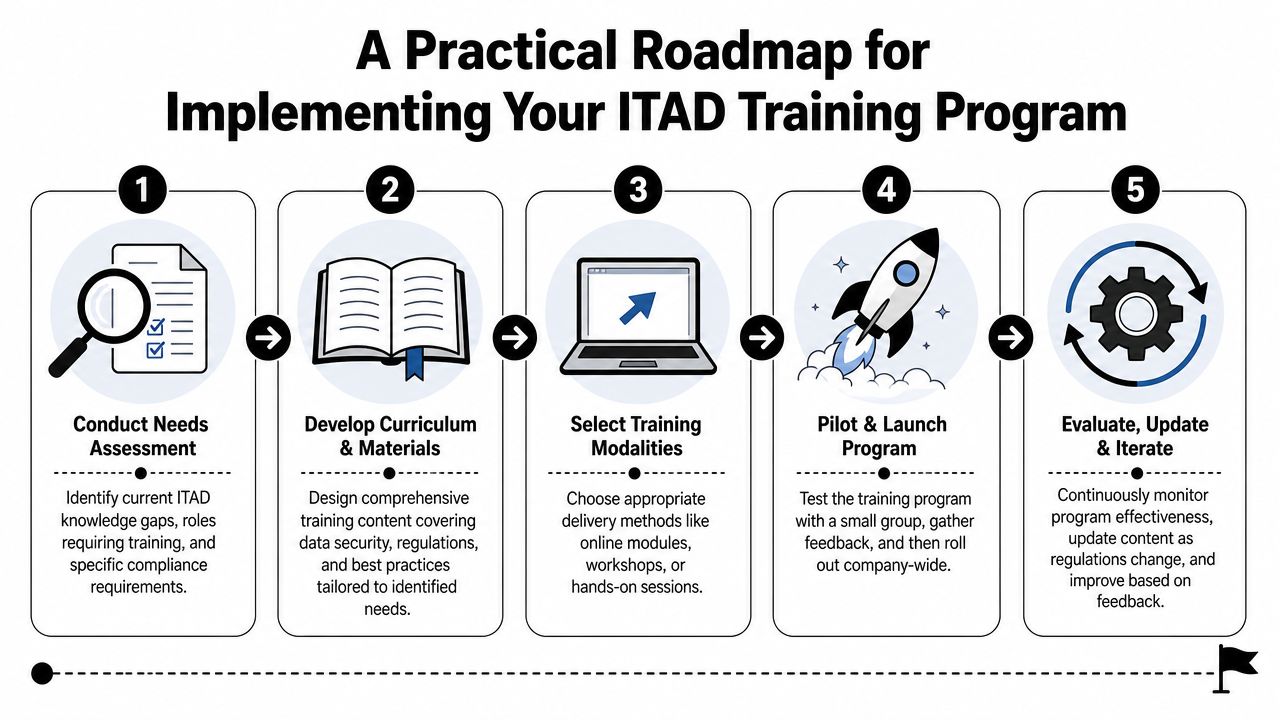
Step one identifies where the process already breaks
Walk the asset retirement path from user desk to final pickup. Don't start with the policy binder. Start with what people do.
Interview IT, facilities, office managers, department admins, and anyone who handles storage or surplus. Ask where retired equipment sits, who approves release, how pickups are requested, and what happens when a device appears outside the normal cycle.
Look for operational weak points such as:
- Unsecured staging areas
- No defined owner for old peripherals
- Inconsistent labeling
- Missing approval steps
- Informal donation or resale behavior
Step two builds content around decisions, not theory
Once gaps are visible, develop training around the decisions employees must make. Keep modules short. Use photos of actual equipment categories. Build scenario-based examples for office cleanouts, laptop refreshes, product destruction requests, and facility shutdowns.
This is the section where a service partner can help with process translation. One option is Reworx Recycling, which provides electronics recycling, secure data destruction, pickups, and practical guidance around IT equipment disposal workflows. The value isn't branding. It's operational specificity when internal teams need clearer retirement paths.
Field note: If your training can't tell an employee exactly what to do with a found hard drive, an old phone, and a box of mixed cables, it isn't ready.
Step three chooses delivery methods people will actually complete
Use more than one format. New-hire onboarding covers baseline rules. Short e-learning modules handle recurring awareness. Team meetings work for local reminders before office moves or refresh events. Managers should have one-page job aids.
If you're planning larger process changes, it helps to map timing in advance with tools like an ITAD implementation timeline. Training should be scheduled before pickup windows, not after the bins arrive.
Steps four and five keep the program alive
Pilot the material with one department or site first. Watch where people still hesitate. Those hesitation points usually reveal missing instructions.
Then formalize the review loop:
- Collect questions from users and managers
- Track repeat mistakes in asset handling
- Update modules after policy or vendor changes
- Refresh high-risk groups before major equipment transitions
The businesses that do this well don't treat training as a one-time compliance event. They treat it as part of operating a reliable ITAD program.
Conclusion Build a Human Firewall for Your IT Assets
The hard truth is that most ITAD risk begins inside the company. It begins when employees don't know what counts as a covered asset, where retired devices should go, when data destruction is required, or who controls final release.
That's why training deserves more attention than it gets. A recycling partner can process equipment responsibly. A certified downstream provider can document disposition. A secure pickup can protect transport. But none of that prevents the internal mistake that happens first.
A trained workforce does.
When staff understand the rules, your organization gets more than compliance support. You get cleaner chain of custody, fewer judgment errors, better staging discipline, stronger sustainability outcomes, and less friction during laptop disposal, office cleanout, computer recycling, and broader IT asset disposition work.
The strongest programs treat employees like part of the control system. They teach end-users how to hand off assets correctly. They teach IT teams how to document and secure them. They teach facilities how to move and stage them without creating new exposure. They teach managers how to enforce the process during real-world disruptions.
That's the human firewall. It isn't software. It's operational behavior repeated consistently.
If your business is upgrading hardware, planning a facility cleanout, reviewing medical equipment disposal, or tightening secure data destruction procedures, internal education should move to the top of the list. External partners matter. Internal readiness decides whether the program holds together.
For organizations refining that risk posture, it also helps to ground the program in clear governance and documented controls such as these best practices for ITAD risk management. The companies that take this seriously usually discover the same thing. Better training doesn't slow disposal down. It makes the whole process faster, cleaner, and easier to trust.
If your organization needs a more reliable path for electronics recycling, donation-based recycling, secure data destruction, or broader IT asset disposition, explore Reworx Recycling. You can use their resources to plan a pickup, donate old equipment, or build a tighter recycling process that protects data, supports sustainable recycling, and strengthens community impact through technology reuse and responsible end-of-life handling.