Atlanta businesses don't have a normal hiring problem. They're operating inside a larger labor shock. The United States is projected to face a software engineer shortage of over 1.2 million by 2026, and that shortfall could contribute to $5.5 trillion in economic losses tied to delays and weaker competitiveness, according to Tecla's summary of IDC-backed tech talent shortage estimates. If you're trying to hire in Atlanta, that national pressure shows up fast in harder searches, longer approvals, and more failed offers.
But the Atlanta tech talent shortage and solutions conversation usually gets one thing wrong. Leaders talk as if the city merely lacks talent. That's too lazy, and it leads to bad decisions. Atlanta's challenge is more specific than that. Companies are misreading the market, writing the wrong roles, signaling weak employer value, and ignoring one of the few recruiting advantages that still cuts through noise: a visible mission that connects technology strategy with community impact and environmental responsibility.
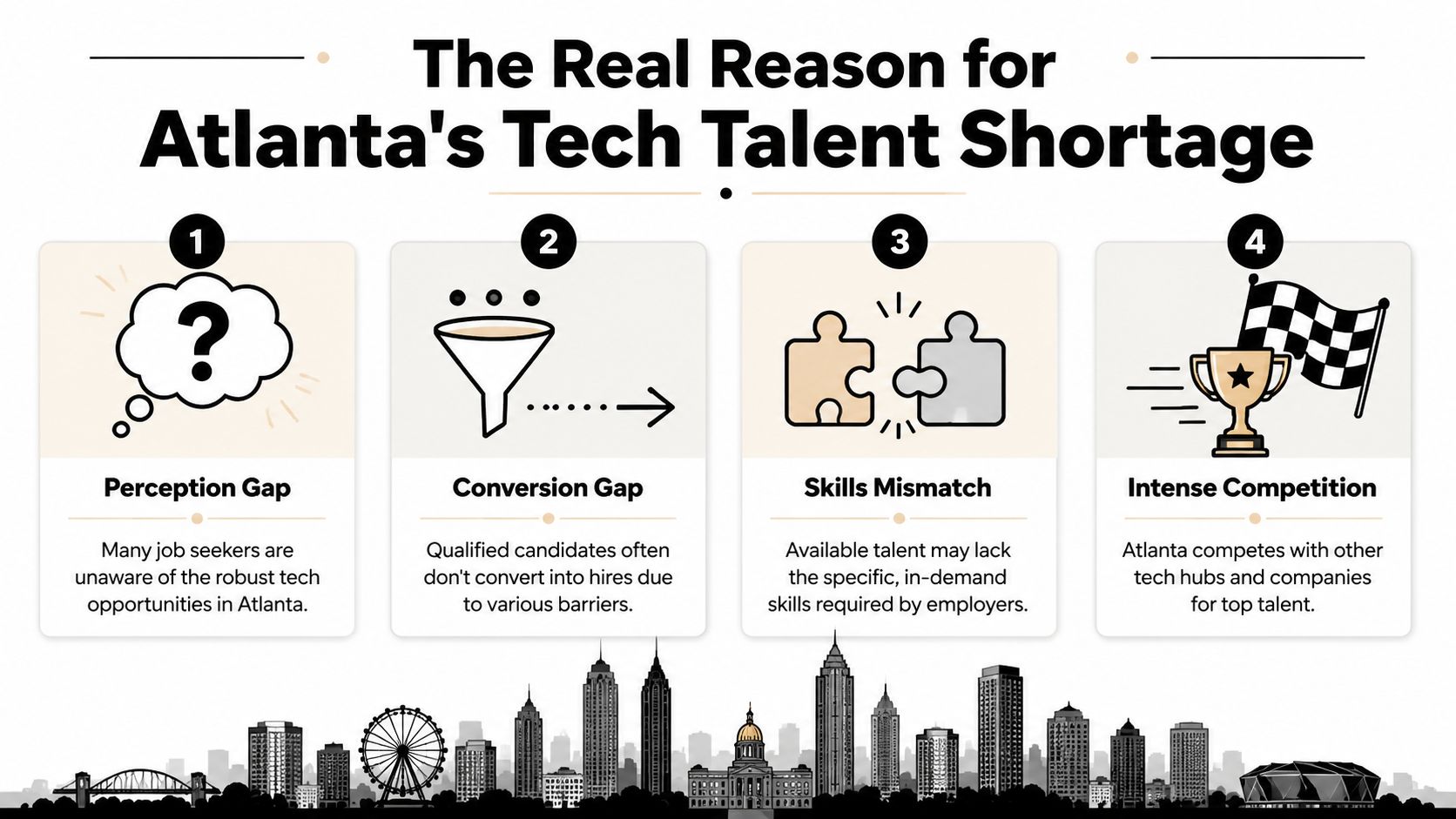
The Real Reason for Atlanta's Tech Talent Shortage
Atlanta has real tech depth. It also has real hiring friction. Those are not contradictory.
Georgia Tech's framing is the right place to start. Atlanta struggles with external recognition, which hurts its ability to attract talent and investment. That creates a perception-and-conversion gap, not just a raw labor shortage. At the same time, Metro Atlanta already has 52% more minority technology workers and 27% more female technology workers than comparably sized metros, which tells you the region's talent base is broader and more diverse than many employers assume, according to Select Georgia's Atlanta tech talent overview.
That matters because many employers are solving for the wrong problem. They keep asking, “How do we find more people?” when the better question is, “Why aren't qualified people converting into interviews, offers, and accepted roles?”
Atlanta has a branding problem as much as a hiring problem
Candidates compare Atlanta against louder markets. Austin gets the startup halo. Seattle gets the cloud halo. The Bay Area still gets the prestige halo. Atlanta often gets treated as a secondary option even when the actual role, cost structure, and career runway are better.
That gap changes behavior. Candidates hesitate on relocation. Recruiters get slower responses. Out-of-state talent assumes the most ambitious work is happening somewhere else. None of that means Atlanta lacks opportunity. It means employers have to sell the city and the role with far more precision than they think.
Atlanta doesn't win by acting like a cheaper version of another tech hub. It wins by being explicit about access, industry breadth, and career upside.
A lot of businesses also ignore adjacent labor signals. If you want perspective on how skills demand shifts across markets, even outside the U.S., this rundown of top UK careers in demand is useful because it reinforces a broader point: employers across regions are dealing with changing skill composition, not just empty seats.
The shortage feels worse because employers create unnecessary friction
The strongest Atlanta employers don't just post jobs. They remove obstacles.
Weak employer signaling creates fake scarcity. So does an interview process that drags. So does a job description that asks for a unicorn who can lead cloud migration, secure infrastructure, manage vendors, run analytics, and mentor junior staff for one mid-level salary band. That isn't market reality. That's poor role design.
If you want to understand how Atlanta businesses should think more strategically about local business change, this analysis of Atlanta tech mergers and acquisitions to watch is relevant because M&A activity changes role requirements fast. Teams inherit systems, tools, and security debt, then wonder why standard hiring templates stop working.
The real bottleneck is conversion to the right skills
The hardest positions now sit around cybersecurity, cloud, data engineering, and AI-adjacent work. Employers still act like traditional degrees and title matching are enough to identify talent. They aren't.
Here's the blunt version:
- Perception gap: Candidates don't always see Atlanta as their first-choice tech market.
- Conversion gap: Interested candidates drop out because the process is slow, vague, or badly sold.
- Skills mismatch: Employers screen for pedigree when they should screen for capability.
- Competitive pressure: The best people can choose among multiple cities, models, and mission profiles.
That's why Atlanta tech talent shortage and solutions should be framed as a go-to-market issue for employers. Yes, supply is tight. But hiring teams and executives are making it tighter.
Win the Hiring Game With Modern Recruiting Tactics
Most Atlanta companies don't need more recruiting activity. They need better recruiting design.
Metro Atlanta had more than 261,000 IT workers, representing over 9% of the region's workforce, yet the market still showed 541 cybersecurity openings on Indeed and 958 on Glassdoor in the cited snapshot. Atlanta's median IT salary was $91,209, while cybersecurity averaged about $120,000, according to AltexSoft's analysis of Atlanta tech jobs. That tells you exactly what kind of market this is: broad talent base, persistent vacancy depth in specialized roles, and concentrated pay pressure where the work is hardest to fill.

Rewrite the job before you reopen the search
If your requisition says “cybersecurity engineer” but the actual job is cloud IAM, audit response, vendor risk, and endpoint policy, you're not hiring. You're confusing people.
Start with a simple split:
| Role element | Keep | Remove |
|---|---|---|
| Core technical work | Tasks done weekly | Nice-to-have tools |
| Critical capabilities | Skills tied to outcomes | Prestige credentials |
| Business context | Why the role exists | Generic culture filler |
Generic requisitions fail in a supply-constrained market because specialists know when a company hasn't defined the job. Adjacent-skill candidates also self-select out when they don't see themselves in the title.
Hire for adjacent skills, not title history
The fastest way to widen your funnel is to stop using title-only matching.
A strong network administrator may be trainable into security operations. A backend software engineer may be able to shift into platform engineering. A systems analyst may fit cloud operations if the environment is structured correctly. Atlanta employers who insist on exact background matches shrink their own talent pool.
Practical rule: Screen for what the person can do in the next six months, not only what their last title says.
Use interviews that test judgment, troubleshooting, documentation discipline, and communication with nontechnical stakeholders. Those traits transfer. Product names on a resume often don't.
Pay premiums where scarcity is real
Don't inflate every salary band. That's expensive and unnecessary. Pay up where the market is constrained.
If security architecture, cloud security, or high-risk modernization roles are the bottleneck, isolate those jobs and fund them differently. If desktop support or general systems administration is the issue, the answer might be speed, flexibility, and cleaner process rather than a bidding war.
Operations leaders should work closely with IT managers. A practical reference point is this breakdown of IT manager responsibilities, because the scope of modern IT leadership now overlaps with staffing design, vendor coordination, risk management, and workflow prioritization.
Reduce demand before you expand headcount
Some work shouldn't require a full-time hire. That's not defeat. That's discipline.
Use a mix of approaches:
- Automation for repetitive tasks: Ticket routing, asset tracking, routine compliance checks, and standard user provisioning can often be optimized.
- Contract specialists for bursts: Bring in outside help for migration, decommissioning, incident response preparation, or one-time architecture reviews.
- Internal skill elevation: Move capable staff out of low-value manual work so they can take on more complex responsibilities.
Retention matters here too. A team that feels overloaded will leak talent into a market that's already tight. For leaders tightening internal practices, LeaveWizard's guide on building a thriving workforce offers practical retention ideas that complement recruiting changes.
Fix the hiring timeline
If your process takes too long, your competitor gets the candidate. It's that simple.
Cut unnecessary interview rounds. Give managers authority to make offers faster. Tell candidates what success looks like in the role. Explain the systems they'll touch, the project backlog they'll inherit, and the leadership support behind the hire.
Atlanta rewards employers that act decisively. Slow companies call it a shortage. Fast companies call it a market.
Build a Sustainable Talent Pipeline Through Local Partnerships
The best Atlanta employers don't treat talent as something they buy on demand. They build supply with partners.
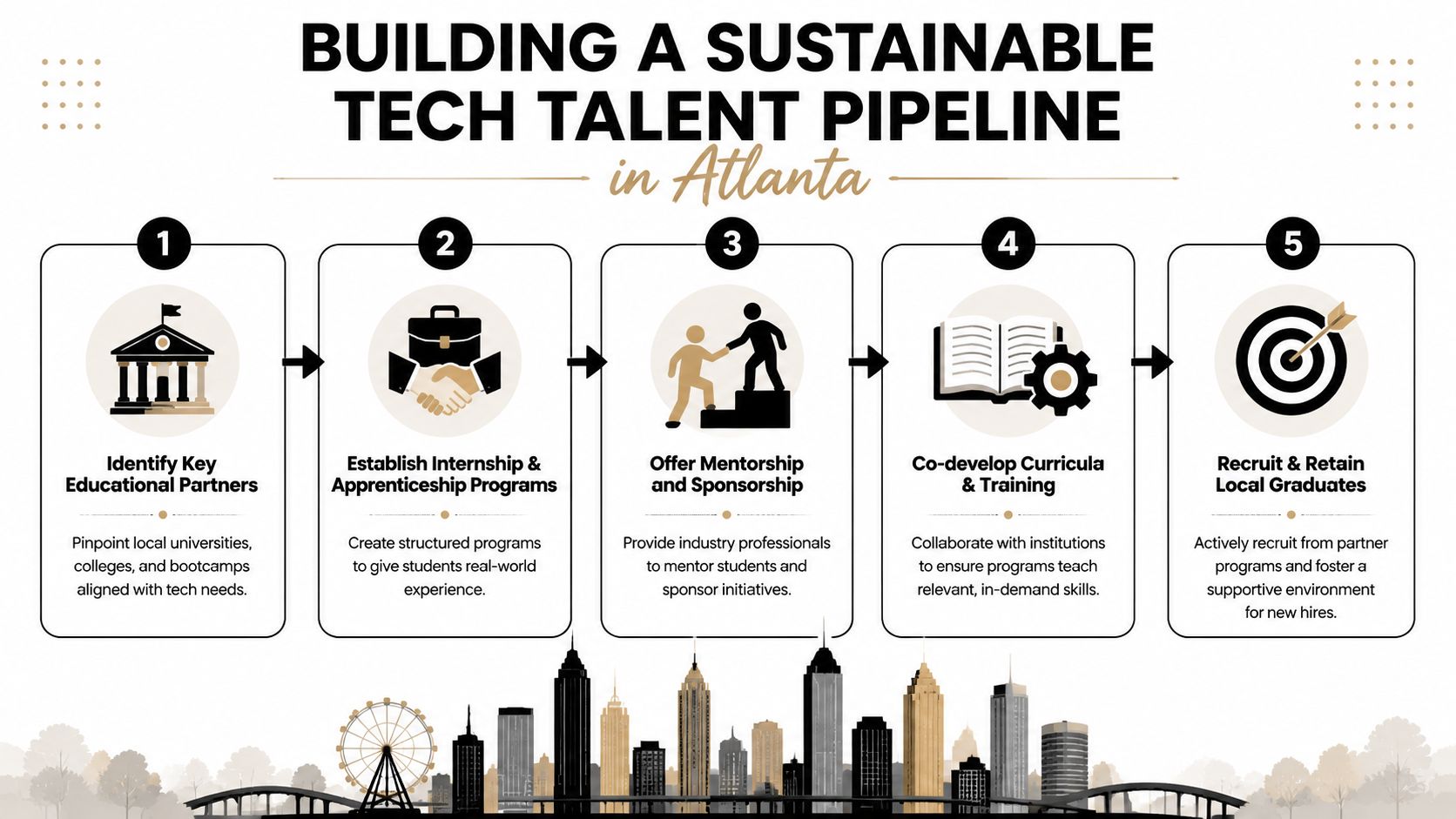
That approach lines up with the OECD's guidance. A skills-first pipeline is one of the most effective responses to tech talent shortages, and the sequence is practical: define role-critical skills, map them to modular learning or micro-credentials, widen the pool to nontraditional backgrounds, and coordinate across employers, educators, and public institutions. OECD also emphasizes that this works best as a multi-stakeholder model rather than a single-company effort, as outlined in the OECD publication on bridging talent shortages in tech.
Local partnerships beat endless poaching
Poaching works until everyone is doing it. Then salaries rise, tenure drops, and nobody fixes the root problem.
Atlanta has the ingredients for a stronger model. The missing piece is employer discipline. Companies need to stop waiting for schools and training providers to guess what “job-ready” means. Define the actual skills. Share the tool stack. Explain the environments. Then help shape the training path.
That can take several forms:
- Internships with real work: Don't park students in observation mode. Give them scoped projects tied to infrastructure, data quality, automation, or documentation.
- Apprenticeships for career switchers: Atlanta has adjacent-skill talent in operations, support, logistics, and analyst roles that can move into technical tracks.
- Micro-credential alignment: Shorter learning modules work when they map to a real hiring path, not generic resume padding.
Small companies can do this too
A lot of SMBs assume partnerships are only for large enterprises with campus teams and giant HR budgets. That's wrong.
You don't need a branded academy. You need one honest relationship with a local program and one manager willing to mentor. A mid-sized company can offer rotational exposure, part-time internships, or a defined apprenticeship seat. A school or training provider can then shape candidates around that opening.
Here's a practical framework:
- List the five skills your hardest role requires.
- Separate what must be known on day one from what can be learned in the first quarter.
- Find one local training partner that can teach the learnable portion.
- Create a trial path into paid work.
Hire fewer “perfect resumes.” Build more capable people around real business needs.
Use equipment access as part of workforce development
Training breaks down when learners don't have access to usable technology. That's one reason local employer involvement matters. Hardware access, lab access, and donation programs can strengthen the regional pipeline in ways that most companies overlook.
For organizations that want to support digital access while clearing retired devices responsibly, programs that donate an old computer can connect asset retirement with community benefit. For Atlanta employers, that's not separate from talent strategy. It supports digital inclusion, training readiness, and stronger community relationships.
Treat pipeline building as risk management
This is not philanthropy disguised as HR. It's operating discipline.
If your business depends on cloud modernization, cybersecurity readiness, data governance, or AI-enabled workflows, then you need a repeatable way to bring people into those roles. The companies that build local pipelines will be less dependent on last-minute recruiting drama. They'll also onboard faster because they helped shape the talent upstream.
Atlanta doesn't need more generic promises about workforce development. It needs employers that participate.
Your Untapped Advantage Attracting Talent with Sustainability
In Atlanta's hiring market, salary still matters. It just isn't enough.
As demand keeps shifting toward cybersecurity, cloud, and AI-adjacent work, the mismatch between jobs and skills gets worse. In that environment, companies can't rely on traditional hiring alone. They need a reason for candidates to care. One overlooked differentiator is a credible commitment to social and environmental responsibility, a point reinforced in the Atlanta-focused discussion of changing tech demand and employer differentiation.
That doesn't mean slapping a sustainability sentence on the careers page. Candidates can smell that from a mile away. It means showing how your company makes decisions. Equipment lifecycle is one of the cleanest places to prove it.
Your IT disposal process says more about your company than you think
Tech workers pay attention to operations. They notice whether leadership treats old devices as junk, compliance risk, or community asset. They notice whether e-waste gets handled responsibly. They notice whether secure data destruction is standard or improvised.
A company that runs thoughtful IT asset disposition is telling employees something important: we take stewardship seriously. That includes environmental risk, data protection, donation pathways, and the way technology exits the business.
This becomes visible in several moments:
- Job descriptions: Mention your commitment to sustainable operations and responsible device retirement.
- Candidate conversations: Explain how the company handles secure data destruction, electronics recycling, and donation-based reuse.
- Onboarding: Show new hires the operating standards behind IT asset disposition, office cleanout practices, and facility cleanout workflows.
Sustainability works best when it's operational, not ornamental
A lot of executives still treat sustainability as a reporting issue. That's too narrow. In a tight labor market, it's an employer-brand issue and a retention issue.
The strongest version of this strategy connects multiple functions:
| Business goal | Sustainability signal | Talent impact |
|---|---|---|
| Reduce risk | Secure data destruction and disciplined ITAD | Builds trust with technical hires |
| Support community | Donation-based recycling and reuse programs | Appeals to purpose-driven employees |
| Improve operations | Standardized laptop disposal and product destruction procedures | Shows maturity and execution |
| Advance ESG goals | Sustainable recycling integrated into procurement and retirement cycles | Strengthens employer narrative |
The significance of a partner relationship is evident. Companies that work with specialists on corporate sustainability with e-waste solutions can turn a back-office process into a real story for recruiting, retention, and stakeholder communication.
Candidates don't separate mission from management quality. They assume companies with disciplined values also run cleaner operations.
Why this matters more in Atlanta
Atlanta employers often compete without the instant name recognition that helps larger coastal firms. That means your differentiators have to be sharper and more credible.
A strong sustainability posture gives you talking points that go beyond compensation. It helps with corporate donation programs, digital inclusion efforts, and internal pride. It also connects well with sectors that are prominent in the Atlanta area, including healthcare, logistics, education, and corporate services, where equipment turnover and compliance expectations are real.
If your business already handles electronics recycling, computer recycling, medical equipment disposal, laboratory equipment disposal, laptop disposal, office cleanout, data center decommissioning, or product destruction, you already have raw material for a better employer story. Most firms overlook packaging it.
Put the mission where candidates can see it
Don't bury this in a sustainability PDF.
Use it in recruiting packets. Add it to manager talking points. Include it in internship outreach. Mention it during employee town halls when teams discuss upgrades, office moves, and hardware refreshes. If your company operates a serious social enterprise recycling or donation-based recycling initiative, make that visible.
Atlanta tech talent shortage and solutions won't be solved by culture slogans. But companies that combine modern hiring with operational values will beat companies that offer the same role with a bigger shrug.
Your Action Plan A Checklist for Closing the Talent Gap
The national pressure is not easing on its own. The United States is projected to face a software engineer shortage of over 1.2 million by 2026, and the broader economic fallout could reach $5.5 trillion from delays and lost competitiveness, according to Tecla's tech talent shortage overview. Waiting for the market to normalize is not a strategy.
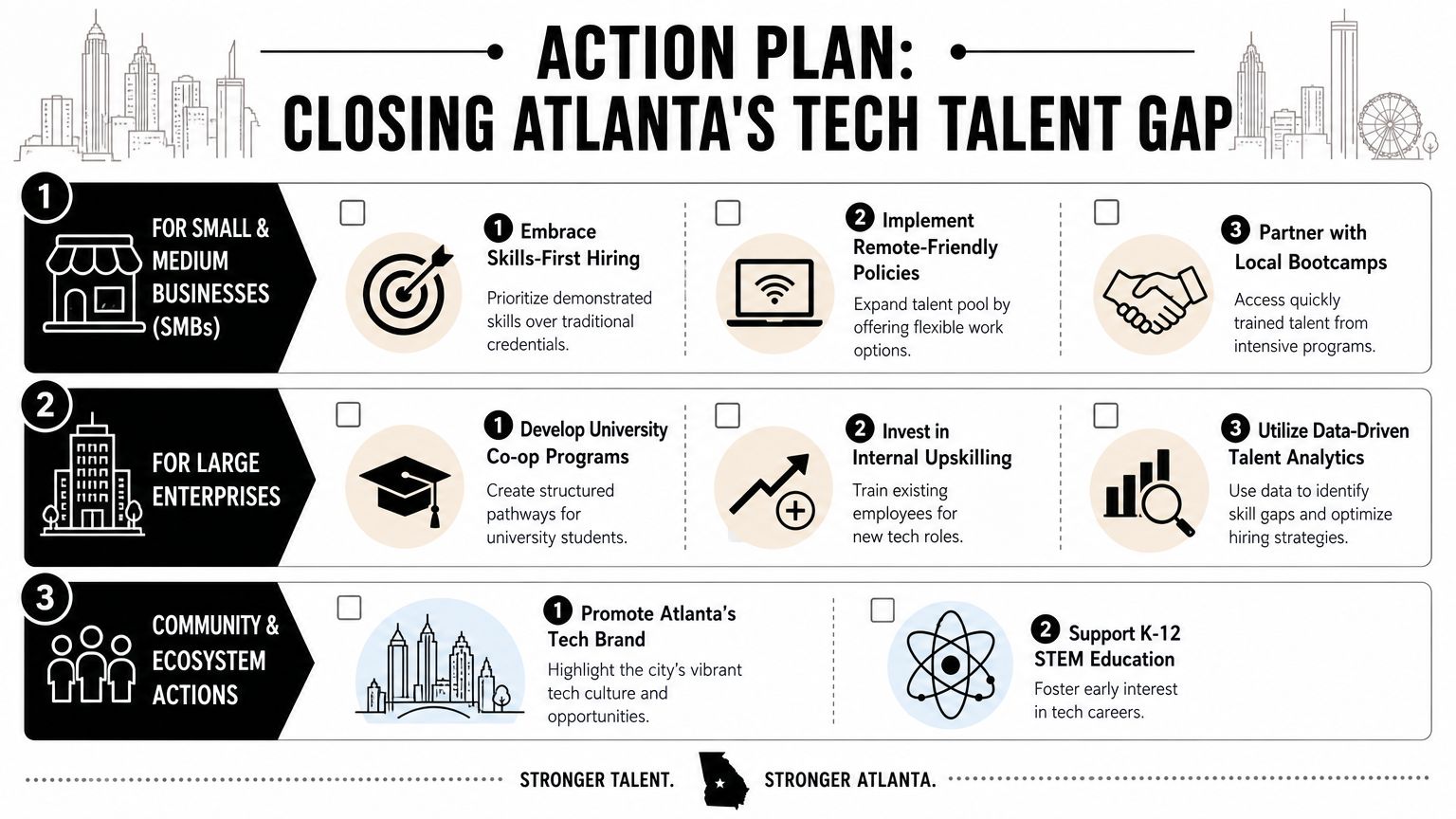
For small and mid-sized businesses
SMBs need speed and focus, not a giant transformation deck.
- Rewrite one critical job this month: Pick the hardest-to-fill role and strip out weak requirements. Remove degree filters if they aren't necessary. Define the business outcomes the person must deliver.
- Open the funnel to adjacent talent: Interview candidates from nearby disciplines who can grow into the role. Stop filtering only by title history.
- Use flexible staffing for urgent gaps: Bring in contract help for short-term modernization, cleanup, or transition projects so full-time staff can focus on core work.
- Package your employer story better: Explain why the company matters, what the team owns, and how the role grows.
Track a few simple indicators. Watch time-to-fill on critical roles, offer acceptance patterns, and retention in the first year. You don't need a complex dashboard. You need evidence that the process is improving.
For enterprises
Large organizations usually have the opposite problem. They have resources, but too much friction.
A better enterprise checklist looks like this:
| Priority | Immediate move | Why it matters |
|---|---|---|
| Role design | Split overloaded requisitions into realistic scopes | Improves candidate fit |
| Compensation strategy | Concentrate premium pay on scarce specialty roles | Avoids blanket overspending |
| Internal mobility | Move strong employees into structured upskilling paths | Preserves institutional knowledge |
| External partnerships | Build repeatable pipelines with educators and training providers | Reduces dependence on reactive hiring |
| Operational credibility | Tie sustainability and responsible IT practices into employer branding | Differentiates in a crowded market |
Enterprises should also audit decision latency. If approvals, interview scheduling, and offer generation drag on, the company is self-sabotaging.
For schools, public agencies, and ecosystem partners
Atlanta's labor challenge isn't only an employer issue. It's an ecosystem execution issue.
Public and nonprofit partners can help by aligning shorter-form training to real employer demand, supporting broader access to devices and technical learning, and coordinating with business leaders on what “job-ready” means in cybersecurity, cloud, and data-heavy environments.
A few practical moves stand out:
- Support skills validation: Employers trust clearer proof of capability.
- Back nontraditional pathways: Career changers and adjacent-skill workers can move faster than many degree pipelines.
- Connect digital access with workforce goals: Equipment access still shapes who can participate fully in technical training.
- Promote Atlanta more aggressively: The city needs stronger signaling around opportunity and career upside.
The companies that close their talent gaps first won't be the ones with the biggest recruiting budget. They'll be the ones with the clearest operating model.
For every organization with aging IT equipment
Talent strategy and sustainability converge in a useful, concrete way.
If you're replacing laptops, clearing storage rooms, closing offices, consolidating facilities, or retiring infrastructure, don't treat end-of-life technology as a cleanup detail. Build a standard process for secure data destruction, IT equipment disposal, donation evaluation, and sustainable recycling. That supports compliance, reduces waste, and gives you a stronger internal and external story.
For IT and operations teams building that discipline, these IT asset management best practices are a practical place to start. Stronger asset handling won't solve hiring by itself. But it strengthens culture, reduces operational drag, and supports the kind of employer brand that candidates remember.
A practical 30-day checklist
If you want a realistic starting point, do these five things:
- Audit your three hardest roles for inflated requirements and vague scope.
- Shorten the hiring process by removing at least one unnecessary step.
- Identify one local training partner for internships, apprenticeships, or skills-first hiring.
- Document your sustainability practices around retired equipment, data handling, and donation potential.
- Give managers a recruiting script that explains mission, growth path, and operating standards clearly.
Atlanta doesn't need more talk about a shortage. It needs better employer behavior.
If your business is upgrading hardware, clearing outdated devices, or building a more credible sustainability program, Reworx Recycling can help you turn end-of-life equipment into a business advantage. Donate old equipment, schedule a pickup, or explore a partnership that supports responsible electronics recycling, secure IT equipment disposal, and community impact through technology donation and digital inclusion.