Your telecom upgrade is underway, but the old hardware hasn't left the building. It's sitting in a network closet, a server room, or a back office shelf. Routers, switches, PBX components, VoIP phones, firewalls, patch gear, maybe a few legacy appliances nobody wants to touch until the new system is stable.
That pile doesn't look dangerous. But for an Atlanta business, it can create three immediate problems at once. You may have residual data risk, electronics recycling compliance risk, and lost recovery value if usable equipment gets treated like scrap. That's why the right question isn't just who can pick it up. The right question is who can document what happened to it, from release through destruction, reuse, or final recycling.
In the Atlanta market, that usually leads to one phrase: R2 certified telecom recycling Atlanta. For business managers, IT leaders, and sustainability teams, R2 matters because it turns a vague disposal task into a controlled IT asset disposition process with records, chain-of-custody, and audited operating standards.
The Hidden Risks in Your Old Telecom Equipment
An Atlanta IT manager finishes a network refresh and tells facilities to hold the retired gear for pickup. A month later, the stack has grown. There are old switches from a floor move, VoIP phones from a department consolidation, firewall appliances from a security upgrade, and a few servers that were part of a telecom environment years ago. Nobody is fully sure which assets still hold configurations, credentials, or logs.
That's where businesses get stuck. The hardware looks obsolete, but the risk isn't obsolete at all.
Why telecom gear causes confusion
Telecom equipment sits in a gray area for many organizations. People know to wipe laptops. They often know to shred hard drives. But routers, switches, PBXs, and voice systems don't always get the same attention, even though they may retain operational information that matters.
Common points of confusion include:
- Stored configuration risk: A router or firewall may retain settings, credentials, and network details.
- Mixed asset handling: Some telecom gear can be reused, some should be harvested for parts, and some belongs in electronics recycling.
- Unclear ownership: IT, facilities, procurement, and operations may each control part of the retirement process.
- Documentation gaps: If a vendor hauls everything away with a generic receipt, audit support may be weak.
Old telecom equipment is rarely just metal and plastic. It often contains business logic about how your network was built and how your users connected to it.
What can go wrong
When organizations use a general junk-hauling mindset for telecom hardware, they create avoidable exposure. Data can remain on devices. Materials can move downstream without clear tracking. Reusable assets can be destroyed unnecessarily. And if an auditor, customer, or internal compliance team asks for proof later, the paperwork may be too vague to help.
That's why businesses use certified recycling and ITAD partners for these projects. The goal isn't only removal. The goal is control.
Decoding R2 Certification for Business Leaders
A business manager approves a telecom cleanout, assumes the recycler will handle it properly, and later learns the vendor cannot clearly show how equipment was tracked, sanitized, or sent downstream. That gap is what R2 is designed to close.

R2 should be understood as an operating standard, not just a marketing badge. It sets rules for how an electronics recycler manages intake, records, data-bearing devices, environmental controls, and downstream vendors. For a buyer, the practical question is simple: can this company show its work, not just describe good intentions?
That distinction is important because electronics recycling often looks straightforward from the outside. A truck arrives. Equipment leaves. A receipt gets issued. But the actual compliance work happens in the chain of custody, the written procedures, the testing and sorting decisions, and the records that can hold up under customer review or an audit.
If your organization already works with certified vendors in quality, safety, or environmental management, the logic will feel familiar. Independent certification means the recycler is expected to follow a documented system and submit to outside verification. That gives procurement, IT, compliance, and operations teams a shared baseline for vendor oversight.
What business leaders should take from that
R2 helps translate a vague service category into something measurable. Instead of asking whether a recycler seems responsible, you can ask whether its process is defined, audited, and consistently applied.
| Business concern | How R2 changes the discussion |
|---|---|
| Audit readiness | You can request documented handling records rather than rely on a pickup receipt |
| Vendor oversight | Third-party certification gives your team an external reference point for evaluation |
| Risk management | Data security, material handling, and downstream accountability are built into the operating system |
| Sustainability credibility | Recycling and reuse claims are easier to defend when they rest on documented controls |
There is also a broader point that business leaders in Atlanta should not miss. R2 addresses technical discipline, but the choice of partner can also shape community outcomes. A social enterprise such as Reworx Recycling can pair certified process control with job creation and workforce support, which means a single telecom recycling decision can serve compliance goals and local social responsibility commitments at the same time.
That combination is useful for companies under pressure to do two things at once. They need to reduce legal and operational risk. They also need to show that end-of-life decisions reflect company values in a concrete, verifiable way.
Why this matters in Atlanta
Atlanta businesses operate in a market with large enterprise footprints, regulated sectors, and frequent equipment refresh cycles. In that environment, informal electronics disposal is hard to justify. A qualified recycler should be able to explain how assets are received, categorized, processed, documented, and transferred downstream in plain language.
Practical rule: If a vendor cannot explain its documentation workflow clearly, your team should treat that as a warning sign.
For telecom equipment, that level of discipline is especially useful. These assets may contain configuration data, network intelligence, reusable value, hazardous components, or all four. R2 gives business leaders a framework for judging whether a recycler is equipped to handle that complexity with control rather than improvisation.
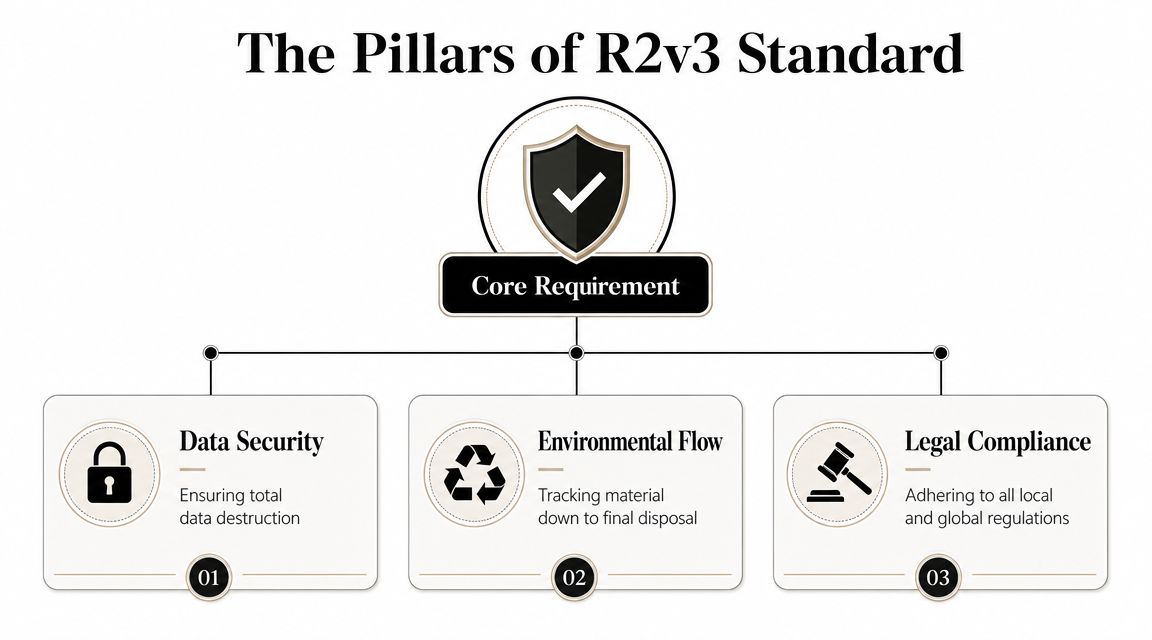
The Core Requirements of the R2v3 Standard
R2v3 matters because it turns “responsible recycling” from a promise into an auditable operating system. For a business manager, that distinction is practical. You are not just hiring a truck to remove old telecom gear. You are choosing a process that has to stand up to internal review, customer scrutiny, and, in some cases, regulatory attention.
The four controls that matter most
A helpful summary from GCI's explanation of R2 certification points to four controls that business buyers should understand:
- Legal and regulatory compliance
- An environmental management system
- Worker health and safety
- Documented downstream management
These are not paperwork categories. They function like checkpoints in a custody chain. If one checkpoint is weak, the whole process becomes harder to trust.
What each control means in practice
Legal compliance
A qualified recycler should be able to show how its work aligns with applicable laws, permits, and handling requirements. That reduces the chance that retired equipment is processed in a way that creates liability after it leaves your site.
This becomes more important with telecom projects because the asset mix is rarely simple. A single decommission can include backup batteries, boards, power supplies, transceivers, and mixed cabling, each with different handling rules.
Environmental management system
An environmental management system means the facility follows written procedures for receiving, sorting, storing, processing, and documenting material. That discipline matters because repeatable work produces repeatable records.
For companies with ESG or sustainability reporting goals, this is one of the clearest signs that a recycler is operating with control. A public claim about responsible recycling has limited value by itself. Documented procedures, audits, and corrective actions carry more weight.
Worker health and safety
Procurement teams sometimes treat safety as the recycler's internal issue. In practice, it affects your project too. Telecom removals can involve heavy racks, awkward cabling, damaged equipment, and battery handling. Poor safety controls increase the chance of incidents during pickup and breakdown, which can disrupt timelines and create avoidable exposure.
Downstream management
Downstream management is one of the most important pieces of the standard. It means the recycler can account for what happens after initial processing, including where commodity fractions, reusable components, or specialized materials are sent next.
That point often confuses buyers, so it helps to use a supply-chain comparison. Your first recycler is not always the final destination for every material stream. What matters is whether those next handoffs are qualified, documented, and traceable.
A practical downstream question is simple: after your equipment leaves the first facility, can the recycler still show where it went and how it was handled?
Why R2v3 fits telecom assets so well
Telecom equipment creates a more complicated end-of-life profile than many office electronics. One load may contain reusable modules, scrap metal, circuit boards, copper-rich wiring, plastics, and batteries. That mix requires process discipline, not case-by-case improvisation.
R2v3 is well suited to that complexity because it asks recyclers to manage materials, records, and downstream vendors in a controlled way. For Atlanta companies trying to align compliance with social responsibility, that structure also makes it easier to evaluate a partner such as Reworx Recycling. You can look at two outcomes at once. First, whether the technical process is documented and auditable. Second, whether the organization's social enterprise model creates local community benefit through workforce development and job access.
That combination is useful because CSR claims are stronger when they rest on verified operational controls rather than goodwill alone.
A short buyer checklist
When a vendor says it processes telecom equipment under R2v3, ask for evidence of:
- Pickup records showing what left your site
- Chain-of-custody documentation across each handoff
- Processing records showing how equipment was handled
- Downstream visibility for materials sent beyond the primary facility
Clear answers show process maturity. Vague answers usually mean your due diligence should continue.
Why R2 Certification is Critical for Telecom Hardware
A branch office closes. The switches come out of the rack, the firewall goes into a box, and someone labels the pallet "old network gear." On the surface, it looks like routine surplus equipment. In practice, that hardware can still hold pieces of your operating blueprint, including configurations, credentials, logs, and call system details.
Telecom gear is not “low data” equipment
Business managers often put laptops and servers at the top of the data-risk list. That instinct makes sense, but telecom equipment creates a different kind of exposure. A retired switch can reveal how the network was segmented. A firewall can contain rules, VPN settings, and administrator information. A VoIP platform can preserve call-related data and system settings that describe how the business communicates.
A casual disposal process is dangerous because it treats these devices like scrap before verifying what they contain and how they should be handled.
R2 certification matters here because it requires a recycler to follow documented controls for data-bearing equipment, material handling, and downstream accountability. For telecom assets, that structure works like a chain of signed handoffs in a legal file. Each step needs to be defined, recorded, and verifiable. That gives an Atlanta business something much more useful than a verbal assurance. It gives audit-ready evidence.
What that means for an Atlanta business
For a company retiring telecom hardware, "we reset the device" is only one small step in a much larger control process. While a factory reset can be part of a workflow, it does not provide the same level of assurance as documented sanitization or destruction. The core question is whether the recycler can show what method was used, who performed it, and how that outcome was recorded.
Here's the practical difference:
| Basic disposal mindset | Controlled telecom disposition mindset |
|---|---|
| Device is removed from site | Device is inventoried and tracked |
| Equipment is cleared informally | Sanitization or destruction is documented |
| Pickup receipt ends the process | Records support audit and customer review |
| Everything is treated as scrap | Reuse, parts recovery, and recycling are evaluated under controlled procedures |
That distinction affects more than security.
A documented R2 process helps procurement, legal, compliance, and IT speak the same language about retired assets. If a customer asks how network hardware was dispositioned, your team has records. If internal audit asks whether data-bearing devices were sanitized under a defined process, your team has records. If sustainability reporting asks whether assets were reused where appropriate instead of destroyed by default, your team has records.
That is where the technical side of R2 connects to corporate social responsibility in a way many companies miss. A qualified partner can protect data, manage environmental obligations, and still direct recoverable equipment and materials into outcomes that create local benefit. In Atlanta, a social enterprise model such as Reworx Recycling adds another layer of value. The same disciplined process that reduces compliance risk can also support workforce development and job access in the community.
If a recycler cannot explain whether your retired switch will be sanitized for reuse, dismantled for parts, or processed as commodity scrap, your company does not have a controlled telecom disposition process.
For telecom hardware, R2 certification sets a stronger operating floor. It supports chain-of-custody, documented data handling, and responsible downstream management. For Atlanta businesses that also care about social impact, it creates a practical way to meet compliance goals and CSR goals through the same recycling decision.
Finding Your Certified Recycling Partner in Atlanta
Choosing a recycler in Atlanta is less about finding any company with a truck and more about finding a partner whose controls match the risk profile of your telecom equipment. The city has a developed electronics recycling and ITAD market, so businesses are not limited to a single option. That gives procurement teams room to compare providers on the factors that matter. Certification status, telecom experience, documentation, and local operating capability.
Atlanta's local market also matters for practical reasons. Telecom retirement projects rarely come from one neat pile in one room. Assets are often spread across branch offices, MDFs, IDFs, storage areas, server rooms, and office floors. A nearby certified recycler can coordinate pickups, building access, and staged removals with less friction, which helps keep a routine refresh from turning into a facilities problem.
One useful signal is whether a provider can talk clearly about telecom hardware as its own category. A switch, firewall, PBX, or VoIP handset should not be treated like generic office e-waste. The right partner should be able to explain what happens to each asset class, what records you receive, and how they separate reuse candidates from equipment that should be dismantled or recycled as commodities. SERI's public directory lists active certified facilities in the Atlanta area, which gives businesses a starting point for verifying who currently holds certification.
Why local matters beyond convenience
Local support becomes especially important when the project touches several departments at once. IT may be tracking the retired network gear, facilities may control dock access, and compliance may need proof of disposition. A recycler that regularly works in metro Atlanta can usually handle those logistics more predictably.
That is particularly helpful for projects such as:
- Office cleanouts tied to network refreshes or relocations
- Facility cleanout coordination that requires scheduling with property management
- Data center decommissioning with phased removals instead of one-time pickup
- Secure data destruction workflows for mixed loads of telecom and traditional IT assets
Certification is the starting point, not the finish line
An R2 certificate tells you a provider has been audited against a serious standard. It does not tell you everything you need to know about how that company will handle your specific project.
A good comparison process usually covers four questions.
Do they understand telecom equipment?
Ask whether they regularly process switches, routers, firewalls, PBXs, handsets, and network modules. A company focused mainly on desktops and laptops may still be certified, but that does not automatically mean it has strong telecom-specific procedures.What documentation will you receive?
You want more than a pickup receipt. Ask about manifests, chain-of-custody records, serialization where appropriate, and certificates tied to the final disposition of the assets.How do they decide between reuse and recycling?
This is similar to triage in a hospital. The point is to send each item to the right path based on condition, data sensitivity, and market value. A capable recycler should be able to explain that decision process in plain language.Does their operating model support your CSR goals?
Some businesses want compliant recycling and a measurable local benefit from the same vendor relationship. That is a legitimate buying criterion, especially for companies with ESG or community impact reporting.
The Role of a Social Enterprise Model
For Atlanta companies trying to meet both compliance goals and community commitments, Reworx Recycling is one option to evaluate. The company operates as a social enterprise and donation-based recycling provider in the metro area, offering electronics recycling, IT equipment disposition, secure data destruction, office cleanout support, and pickup coordination.
That model adds a practical layer of value. The technical discipline required for certified recycling addresses risk, documentation, and environmental handling. A social enterprise structure can direct the economic benefits of that work toward local workforce development and community support. For a business manager, that means one vendor decision can serve two purposes at once. It can reduce exposure around retired telecom assets and contribute to a stronger local impact story.
The best partner for your company is the one that can show controlled processes, explain telecom handling in detail, and align with the kind of business your organization wants to be.
The Step-by-Step Recycling Process with Reworx
Most business uncertainty comes from not knowing what happens after the first email or pickup request. A good telecom recycling process should feel controlled from the start, not mysterious until paperwork arrives later.

Step 1 lets the project get scoped correctly
The first step is usually a conversation about what you have. That sounds basic, but it's where many projects go wrong. Telecom disposal jobs often begin with an incomplete list. Someone counts the switches but forgets the branch phones. Someone else remembers a storage shelf with old firewall appliances. Facilities may identify rack gear that IT no longer tracks.
A useful scope usually includes:
- Asset categories: Routers, switches, firewalls, handsets, servers, storage, cables, UPS units, telecom modules
- Project context: Office cleanout, network refresh, facility cleanout, relocation, or data center decommissioning
- Sensitivity flags: Which assets may retain credentials, logs, or customer-related information
- Site conditions: Loading access, elevator use, business-hour restrictions, and whether equipment is still installed
Step 2 is pickup and chain-of-custody control
Once the project is defined, the next question is how assets leave the site. Many non-experts assume the hard part is over at this stage. It isn't.
The handoff itself matters. Equipment should be packed, staged, or removed in a way that supports accountability. If the lot includes sensitive network equipment, you want a clear record of what was released and when. For distributed offices, site-level records matter even more.
Good chain-of-custody starts before the truck moves. It begins when your team identifies which assets are leaving and who approved the release.
Step 3 separates data-bearing assets from ordinary recycling loads
Not every telecom item should be treated the same way. Some devices require secure data destruction or sanitization. Some can move into reuse review. Some should go straight into sustainable recycling because they're obsolete, damaged, or incomplete.
That sorting decision affects three business outcomes:
| Decision path | Why it matters |
|---|---|
| Secure destruction | Protects sensitive data and supports compliance documentation |
| Reuse or redeployment review | Preserves useful equipment and may support donation or remarketing |
| Parts harvesting | Captures component value when full-device reuse isn't practical |
| Recycling | Handles non-usable material responsibly when recovery options are exhausted |
Step 4 produces documentation your business can actually use
This is the point many managers care about most. At the end of the process, you need more than “job completed.” You need records that fit internal controls.
For telecom ITAD, useful project documentation often includes:
- Asset manifests tied to the collected load
- Certificates of destruction or sanitization for applicable devices
- Disposition summaries showing what was reused, donated, harvested, or recycled
- Support for internal sustainability records when equipment entered a donation-based recycling pathway
That's especially relevant for organizations balancing electronics recycling, product destruction, laptop disposal, computer recycling, and broader IT asset disposition (ITAD) under one procurement or facilities workflow.
Step 5 closes the loop with business and community goals
A social enterprise model changes the final stage of the discussion. Instead of ending with “the assets are gone,” the business can also ask whether some portion of equipment was suitable for community reuse or donation-oriented recovery.
That won't apply to every telecom project. Some assets are too old, too specialized, or too sensitive. But when applicable, the model can connect secure retirement with a stronger social responsibility story. That's where donation-based recycling and corporate donation programs become more than branding language. They become part of how a company retires technology responsibly.
For Atlanta organizations, the practical takeaway is that a well-run process should combine secure logistics, documented handling, data control, and environmentally sound downstream decisions. If any of those pieces are missing, the process is incomplete.
How Your Business Can Verify an R2 Certified Recycler
A facilities manager in Atlanta gets two recycling proposals for retired telecom gear. Both vendors say they are R2 certified. Both promise secure handling. On paper, they look similar. The difference shows up when you ask for proof, scope, and process.
That verification step matters because R2 certification is not a generic badge. It is tied to a specific facility, a defined scope, and audited operating controls. If your switches, handsets, PBX equipment, or network appliances are sent to a site that is not covered, your company may be relying on a claim that does not apply to the work you hired out.
Start by verifying the facility, not just the company
A parent brand can market certification while only certain locations hold it. Treat R2 like a business license for a particular site, not a blanket promise across every warehouse or partner.
Use a simple check process:
Ask for the current R2 certificate
Review the legal entity name, facility address, and expiration date.Confirm the scope of certification
Check whether the listed scope covers the services your project needs, such as testing, reuse, materials recovery, or data sanitization-related activities.Verify where your equipment will go
If pickup happens in Atlanta but processing happens elsewhere, ask which facility receives the load and whether that exact site is covered.Match the paperwork to the operation
The address on the certificate should line up with the site that performs the work, not just a sales office or corporate headquarters.
This is similar to checking whether a contractor is insured for the job site you own, not just insured somewhere. The detail seems small until something goes wrong.
Ask questions that expose how the recycler works
Certification should lead to clear answers. If the provider struggles to explain its process in plain language, that is a warning sign.
Focus on questions like these:
- How do you identify telecom equipment that may store credentials, call records, or configuration data?
- What determines whether an item is reused, harvested for parts, or sent to commodity recycling?
- Who are your downstream vendors, and how are they qualified and monitored?
- Can you show sample audit-ready documentation from a similar business project?
- How do you separate equipment with community reuse potential from equipment that should never leave controlled disposition channels?
That last point often gets missed. A strong partner should be able to explain both sides of the decision. Some devices belong in tightly controlled destruction or materials recovery. Others may be suitable for responsible reuse through a social enterprise model, which can turn surplus value into local community benefit without weakening compliance controls.
Look for evidence of discipline, not polished sales language
A mature recycler can explain its process the way a good accountant explains internal controls. The answer is specific, repeatable, and supported by records.
| Verification step | What to look for | Why it matters |
|---|---|---|
| Certificate review | Current certificate with the correct facility details | Confirms the site handling your assets is covered |
| Scope check | Services listed that fit your telecom project | Reduces the risk of assuming coverage that is too narrow |
| Facility confirmation | Clear statement of where processing occurs | Prevents handoffs to unclear or uncertified locations |
| Process questions | Direct answers on sorting, reuse, and downstream control | Shows whether the recycler can manage compliance and recovery decisions |
| Social enterprise fit | A defined method for donation or community reuse pathways | Helps align CSR goals with documented, controlled disposition |
For Atlanta businesses, compliance and corporate responsibility can work together instead of competing. A recycler such as Reworx Recycling should be able to show how audited controls support the technical side of R2 while a social enterprise model supports broader community outcomes. If those two pieces are disconnected, your company may end up with a good sustainability story but weak controls, or strong controls with no broader community value.
Watch for three common red flags
One red flag is vague language about “certified partners” without naming the processing site.
Another is a certificate that looks valid but does not match the location or services involved in your project.
A third is a one-size-fits-all answer for every device. Telecom hardware does not all belong in the same stream. Good recyclers classify it carefully because the business risks are different.
Verification takes a few extra calls and document checks. That small effort can help your business avoid compliance gaps, reduce downstream risk, and choose a partner that supports both secure recycling and measurable community benefit.
FAQs on R2 Certified Recycling in Atlanta
Is R2 the same as ordinary electronics recycling
No. Ordinary electronics recycling can mean almost anything, from collection to basic material processing. R2 refers to a certified operating standard with documented controls, third-party auditing, and defined requirements around data handling, environmental practices, and downstream management.
Does every telecom device need secure data destruction
Not every device needs the same treatment, but telecom gear should never be assumed “safe” just because it isn't a laptop. Routers, switches, PBXs, VoIP systems, and related appliances may retain credentials, configurations, or logs. Your recycler should be able to explain which assets require sanitization, destruction, or other controlled handling.
Is local Atlanta pickup more important than certification
Certification comes first. Local service matters too, especially for reverse logistics, site coordination, and multi-location pickups. The strongest choice is usually a certified recycler that can also handle local logistics efficiently.
What's the benefit of a donation-based recycling model
For suitable equipment, a donation-based model can support both end-of-life management and community benefit. That can help businesses align IT equipment disposal, social enterprise recycling, and CSR goals without treating them as separate projects.
Can R2 certified telecom recycling support office and facility projects too
Yes. Many organizations retire telecom assets during broader office cleanout, facility cleanout, product destruction, or data center decommissioning work. The important part is keeping the telecom portion under the same documented controls rather than letting it disappear into general surplus removal.
If your Atlanta organization is planning electronics recycling, secure data destruction, computer recycling, laptop disposal, medical equipment disposal, laboratory equipment disposal, or a broader IT asset disposition project, review the resources from Reworx Recycling to evaluate pickup options, donation-based recycling pathways, and community-focused end-of-life programs. A practical next step is to schedule a pickup, request guidance on telecom and office equipment retirement, or explore a corporate donation program that supports both compliance and local impact.