Your team is replacing laptops, clearing a storage room, or shutting down an old server closet. Pallets of monitors appear. A few hard drives still hold sensitive data. Finance wants value recovery. Legal wants chain of custody. Facilities wants the space back.
That's where many organizations first ask a bigger question. What is environmental stewardship, really, when you're the one responsible for the equipment pile?
In business, stewardship isn't a slogan for the sustainability page. It's the discipline of making better operational decisions with materials, energy, risk, and end-of-life assets. For IT managers and facilities leaders, that often starts with one practical area: electronics recycling, secure data destruction, and IT asset disposition. The companies that handle those transitions well usually reduce waste, lower exposure, and produce cleaner records for procurement, compliance, and ESG discussions.
Beyond Buzzwords The Modern Business Imperative
An IT manager finishing a technology refresh rarely struggles with the definition of waste. They can see it. Old laptops under desks. Retired switches in a closet. Printers no one wants to touch because nobody knows where they should go next.
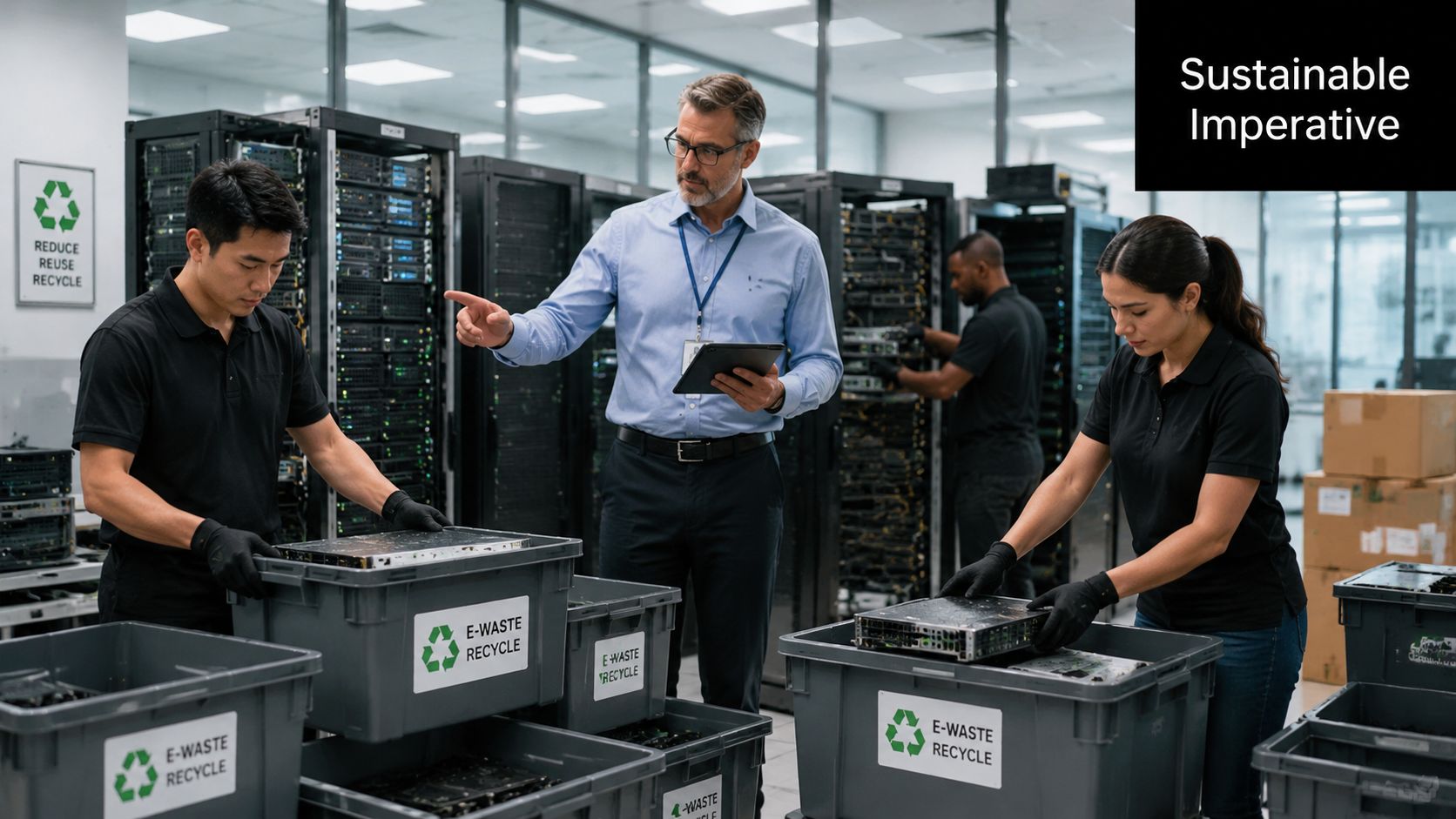
The confusion usually starts after that. Is stewardship just recycling? Is it compliance? Is it a CSR talking point? In practice, it's closer to an operating model. It asks a simple question: when your business buys, uses, stores, retires, and disposes of equipment, are you reducing harm and recovering value, or are you pushing problems downstream?
That's why environmental stewardship matters now more than it did when disposal was treated as a back-office task. A laptop retirement project can affect data security, storage costs, procurement planning, public credibility, and landfill exposure at the same time. Even a routine office cleanout can expose whether the company has a real process or a pile-and-hope method.
Where business leaders usually get stuck
Some teams think stewardship begins once equipment becomes waste. It starts earlier. The decision to extend device life, reuse assets internally, separate equipment by condition, and document final disposition all shape environmental outcomes.
Others assume stewardship is soft and hard to connect to operations. It isn't. A practical corporate lens often aligns stewardship with risk control, process discipline, and resource efficiency. That's why many organizations connect it with broader corporate responsibility work such as electronics recycling in corporate social responsibility.
Stewardship becomes real the moment a manager has to choose between the fastest exit and the most responsible process.
A useful definition has to work in the warehouse, in the server room, and in the budget meeting. If it can't guide a decision about retired devices, it's too vague to be useful.
Defining Environmental Stewardship for Your Organization
The strongest foundation is ethical, not technical. A ScienceDirect reference on the 1995 Dixon et al. definition describes environmental stewardship as an “ethical obligation to care for the environment” and to exhibit the behaviors required to provide that care. That language matters because it moved stewardship away from passive oversight and toward active responsibility.
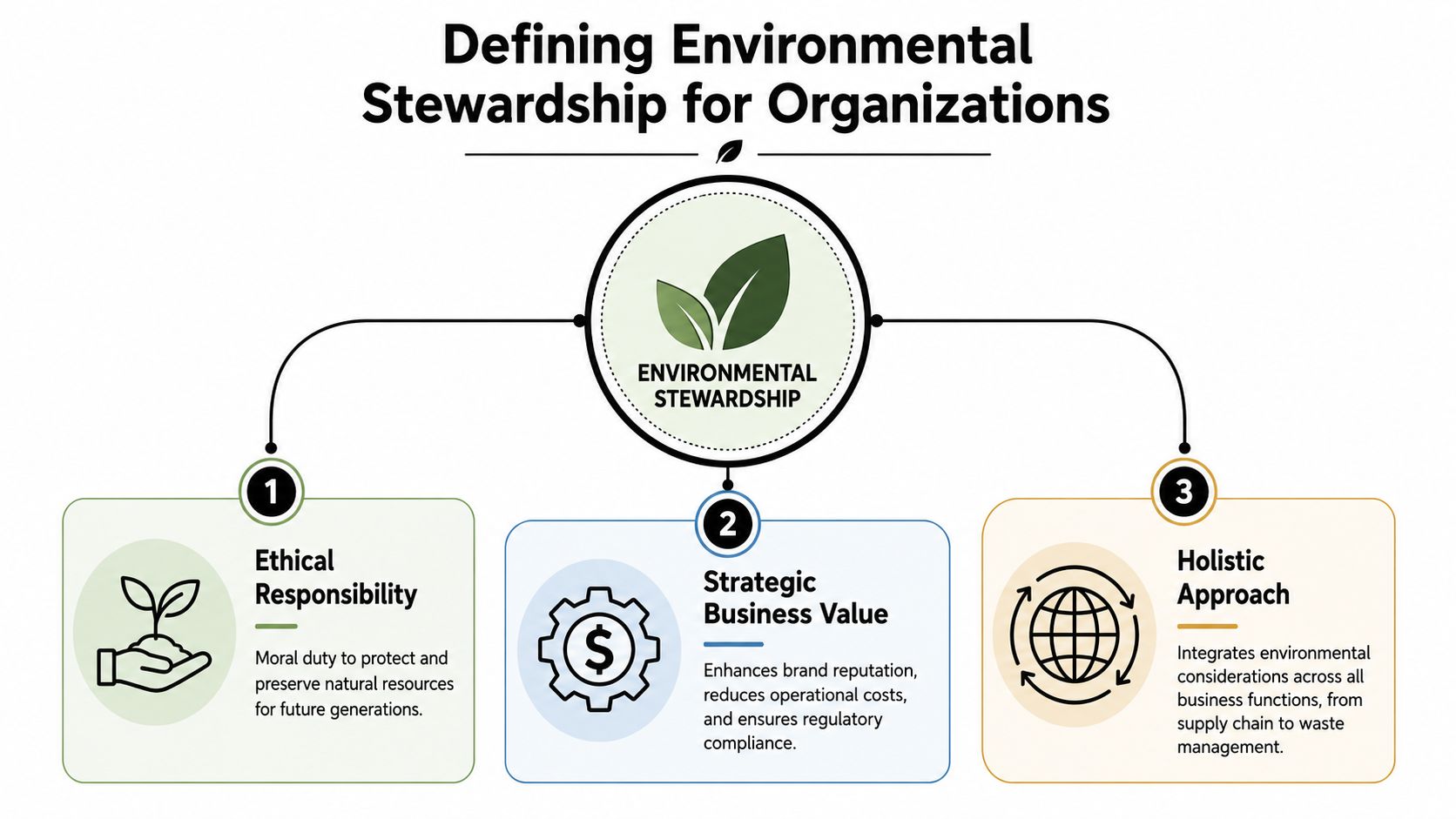
For a business, that ethical obligation turns into something concrete. Your organization accepts responsibility for the environmental effects of what it buys, how it operates, and how it retires assets. That includes electricity, materials, packaging, water, and waste. It also includes the overlooked stage where old electronics can either be reused, recovered, or mishandled.
What stewardship means in business terms
A practical definition for leaders is this: environmental stewardship is the disciplined management of your environmental footprint through decisions that prevent pollution, conserve resources, and improve outcomes over time.
That's broader than compliance. Compliance asks whether you met a requirement. Stewardship asks whether the process itself is responsible.
A procurement team sees it in vendor selection. An operations leader sees it in waste segregation. An IT manager sees it in whether devices are redeployed, remarketed, donated, or recycled through a documented chain.
Three tests for a usable definition
If you're trying to decide whether your organization has a stewardship mindset, these tests help.
Ownership test
Your team doesn't treat environmental impact as somebody else's issue after pickup day. It owns the result through final disposition.Prevention test
You don't just manage waste after it appears. You reduce it by extending useful life, purchasing thoughtfully, and avoiding unnecessary replacement.Evidence test
You can show what happened. Not with broad intentions, but with logs, certificates, internal records, and measurable outcomes.
Practical rule: If your process ends with “the vendor took it,” you have disposal. If your process ends with documented outcomes, you have stewardship.
Often, organizations become confused. They assume stewardship means doing more activities. Often it means doing fewer things poorly and more things intentionally. One disciplined process can matter more than a shelf full of green slogans.
The Triple Bottom Line The Business Case for Stewardship
Business leaders usually support stewardship once they see it as an operating advantage. The upside tends to show up in three places: cost discipline, risk reduction, and reputation.
The waste stream is a good place to start because it exposes how much value companies still leave unmanaged. The U.S. EPA reports that in 2018, the average American generated 4.9 pounds of municipal solid waste per day, while only 1.6 pounds were recycled or composted in its national materials, waste, and recycling overview. For businesses, that gap is less a talking point than a signal. There is still a large difference between what gets consumed and what gets responsibly recovered.
Cost reduction through better resource handling
Every organization pays for waste somewhere. Sometimes it's hauling and storage. Sometimes it's labor spent sorting old devices long after they should've left the building. Sometimes it's the lost residual value of equipment that sat too long to be reused or resold.
A stewardship approach changes the question from “How do we get rid of this?” to “What should happen to each asset category?” That simple shift can improve internal reuse, organize office cleanout planning, and support more disciplined IT asset disposition.
Teams exploring broader policy alignment often find that implementing a CSR framework helps connect waste, procurement, and community impact under one business process rather than scattered initiatives.
Risk mitigation that legal and IT both understand
Improper disposal creates two problems at once. The first is environmental liability. The second is information exposure when storage media aren't handled correctly.
That's why stewardship works well across departments. Facilities gets a documented removal path. IT gets secure data destruction requirements. Procurement gets clearer vendor standards. Leadership gets fewer unpleasant surprises.
A useful reference point is the operational logic behind the benefits of e-waste recycling. Done well, it isn't only about diversion. It supports chain of custody, material recovery, and a cleaner audit trail.
Reputation that has proof behind it
Customers, employees, and public-sector buyers don't respond strongly to vague environmental language anymore. They respond to evidence that the company handles real operational issues responsibly.
A sustainability claim is stronger when it begins with an equipment list, a documented process, and a clear final outcome.
That matters for bids, annual reports, recruiting, and community relations. Stewardship gives your brand something more credible than aspiration. It gives you a record.
From Principles to Performance How to Measure Stewardship
At a certain point, many articles stop being useful. They say stewardship means responsibility, then leave readers with no way to prove whether responsibility is happening. For managers, that gap is the whole problem.
The U.S. EPA frames stewardship around pollution prevention at the source, efficient use of energy and natural resources, and continuous improvement measured through indicators and environmental management systems in its stewardship guidance. That language gives you a practical standard. If you can't measure the process, you can't improve it.
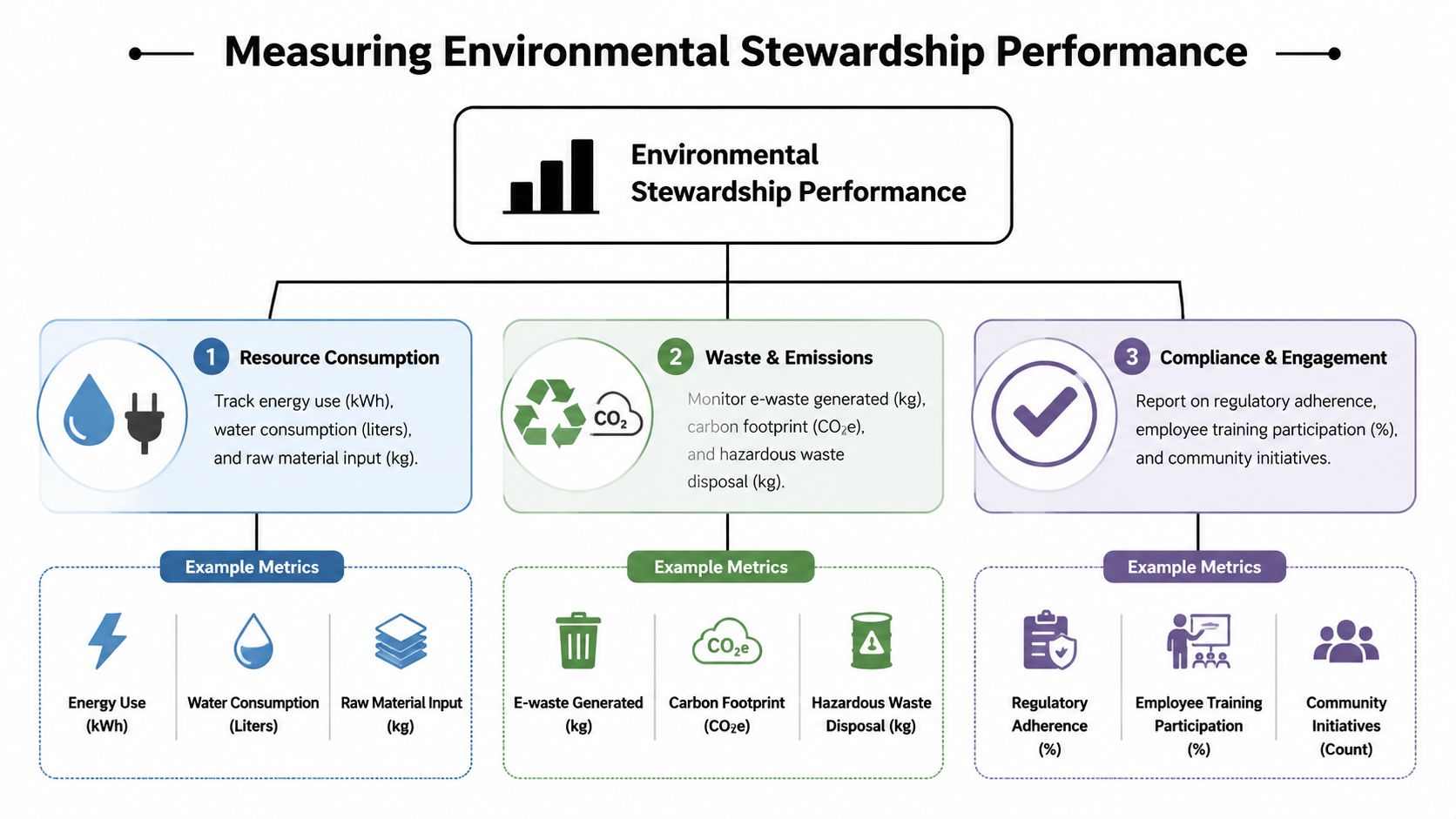
Start with a baseline, not a slogan
Before setting targets, record the current state. For IT and facilities teams, that often means building a simple baseline around what comes in, what stays in service, and what leaves the organization.
A workable baseline might include:
Asset flow
What types of devices are entering retirement, how often refreshes happen, and where equipment tends to accumulate.Disposition channels
Which assets are reused internally, which are remarketed, which are donated, and which are recycled.Control records
Whether you have serial-level tracking, pickup documentation, and data destruction verification.
You don't need a complex dashboard on day one. You need consistency.
Match each principle to a metric
Here's a simple way to translate stewardship into operational measurement.
| Stewardship principle | What to measure | Why it matters |
|---|---|---|
| Waste reduction | Waste diversion and landfill avoidance records | Shows whether material is being recovered instead of discarded |
| Resource conservation | Recycled content used or recovered material outputs | Connects operations to circularity |
| Data responsibility | Verified secure data destruction completion | Protects the organization while supporting compliant retirement |
| Asset life extension | Reuse, redeployment, or resale tracking | Reduces premature disposal |
| Process control | Chain-of-custody documentation and exception logs | Reveals whether the system is reliable |
This is also where carbon conversations become more grounded. Instead of making broad claims, organizations can use operational records to support internal models such as a carbon offset calculation approach tied to asset reuse and recovery workflows.
Useful KPIs for IT and facilities teams
Not every business needs the same metrics. A school district, hospital network, and manufacturer will have different priorities. But these categories usually work well:
Device outcome metrics
Reuse and redeployment rate
Tracks how many devices remain in productive use instead of moving straight to recycling.Donation and community transfer records
Useful when equipment still has functional value and the organization wants a documented social impact path.
Risk and verification metrics
Secure data destruction verification rate
Measures whether every applicable storage device receives documented treatment.Exception handling time
Shows how quickly your team resolves unknown assets, missing serial numbers, or mixed loads.
Operational efficiency metrics
Time from retirement decision to final disposition
Helps reduce storage sprawl and loss of residual value.Backlog visibility
A simple aging report for retired equipment can reveal process bottlenecks before they become storage or audit problems.
Track fewer metrics well rather than many metrics badly. Stewardship improves when managers can act on the numbers they see.
The point isn't to produce a prettier spreadsheet. The point is to create accountability that changes behavior.
Stewardship in Action Your ITAD and E-Waste Playbook
When old technology leaves service, stewardship gets tested in actual situations. Policies sound clear until the loading dock fills with mixed equipment, unidentified drives, and departments that all want something different.
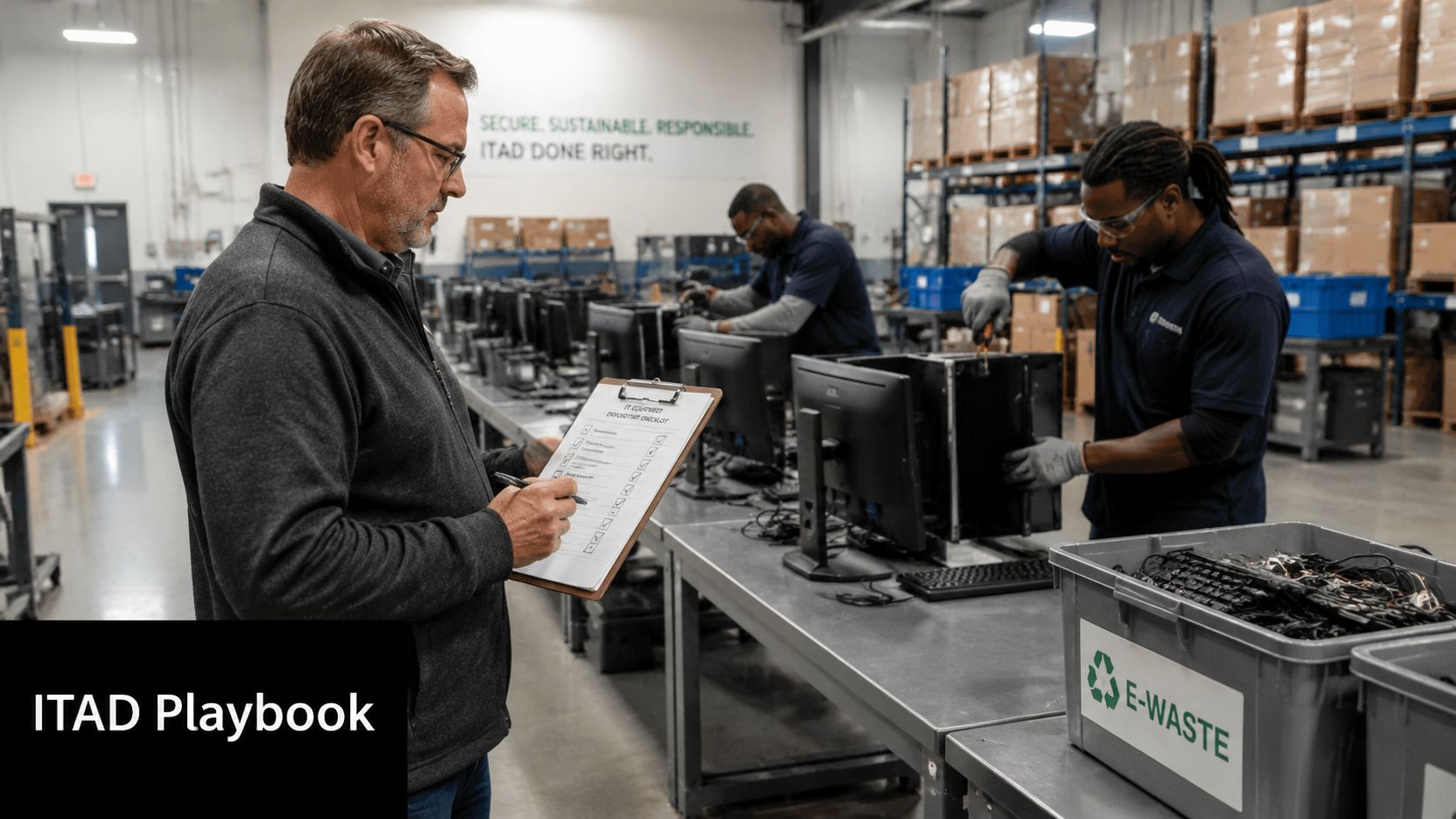
A workable ITAD process doesn't begin with a truck. It begins with segmentation. Some equipment can be reused. Some can be remarketed. Some belongs in secure destruction. Some needs commodity recycling because it has no remaining practical use. Mixing those categories creates waste, lowers recovery potential, and increases control risk.
A five-part operating routine
1. Build the inventory before pickup
List what's leaving service. Include asset type, condition, location, and whether it contains storage media. For a facility cleanout or office cleanout, this prevents one common failure: treating everything as identical scrap.
2. Separate value recovery from waste handling
A monitor isn't a hard drive. A working laptop isn't the same as broken peripheral cables. Once categories are clear, your team can route devices toward reuse, resale, donation-based recycling, or materials recovery.
3. Require secure data destruction controls
Any device with storage should trigger a documented decision. Wipe, shred, or isolate for special handling. Don't rely on assumptions from end users or unlabeled pallets.
The environmental side of stewardship falls apart fast if the data-security side is weak. A process that protects materials but loses control of data isn't responsible.
4. Choose partners that can document outcomes
A structured vendor review is a critical step. Ask what reports they provide, how they handle chain of custody, and whether they can distinguish reuse, donation, resale, and recycling outcomes. For organizations formalizing this work, a guide on how to implement an IT asset disposition strategy can help align IT, facilities, and leadership expectations.
One option in that process is Reworx Recycling, which provides electronics recycling, IT equipment disposal, pickup support, and secure hard drive shredding within a donation-based recycling and social enterprise model.
What circularity looks like in practice
Not every company can redesign its entire material system, but stewardship improves when you aim for recovery instead of disposal. A useful benchmark appears in Carpenter Technology's environmental stewardship reporting, which notes that 63% of its production feedstock is recycled scrap, 77% of waste was recycled, and 100% of slag from melt operations was recycled. The exact figures belong to that company and industry, but the operating lesson travels well. Track material recovery. Improve the percentage of useful output. Reduce what ends up as discard.
Common mistakes during electronics retirement
Last-minute cleanouts
Rushed decommissions often collapse reuse opportunities and weaken documentation.Mixed loads
Combining medical equipment disposal, standard office electronics, and storage devices in one stream makes downstream handling harder.No internal owner
When nobody owns the handoff between IT and facilities, assets sit longer and accountability gets blurry.
Stewardship during data center decommissioning, product destruction, laptop disposal, and computer recycling isn't glamorous. It is, however, highly visible to auditors, customers, and your own operations team when something goes wrong.
Real-World Impact A Tale of Two Companies
Company A treats retired electronics as a disposal nuisance. A storage room fills up after an upgrade. Facilities asks for a fast haul-away. The company chooses the lowest-friction vendor and ships mixed equipment with limited inventory control.
Weeks later, leadership wants proof of what happened to the assets. There's no clean chain of custody, no useful record of secure data destruction, and no clear answer on which devices were reused, recycled, or discarded. The environmental risk and the information risk now sit together in one messy story.
The company that planned ahead
Company B handles the same refresh differently. IT creates an asset list. Facilities stages equipment by category. Finance identifies hardware with possible residual value. Legal confirms data-handling requirements before any pickup happens.
The outcome looks different because the process was different. Devices suitable for continued use move into reuse or donation channels. Storage media receive documented destruction steps. Recycling is treated as the final option for equipment with no practical next life, not the default for everything.
Good stewardship often looks ordinary from the outside. Inside the organization, it feels like fewer surprises, cleaner records, and better decisions.
Why the contrast matters
Neither company needed a dramatic sustainability campaign. The difference was operational discipline.
That's the practical answer to what environmental stewardship means for business. It means the organization can show that it handled retired assets responsibly, protected data, reduced waste, and created a record strong enough to stand up in a procurement review, internal audit, or stakeholder conversation.
Take the Next Step with Reworx Recycling
Environmental stewardship becomes manageable when you stop treating it as a philosophy problem and start treating it as a workflow problem. The fastest place to make that shift is often electronics and IT asset retirement, because the waste, risk, and reporting needs are already sitting in front of you.
For business leaders, the path is straightforward. Set ownership. Define acceptable disposition paths. Require documentation. Measure outcomes. Improve the process with each refresh, decommission, and cleanout cycle.
If your organization is refining electronics recycling, secure data destruction, office cleanout planning, or broader IT asset disposition, a documented service model matters. A practical reference point is Reworx's IT asset disposition services, especially for teams that need an operational process rather than a general sustainability promise.
The bigger point is simple. Stewardship isn't abstract when it touches laptops, servers, storage devices, lab equipment, or surplus office technology. It's a set of decisions your team makes every day about waste, value, security, and accountability.
If you're ready to turn old equipment into a measurable stewardship program, explore the resources from Reworx Recycling, then donate retired devices, schedule a pickup, or start a conversation about a more responsible electronics recycling and ITAD process.