When an office refresh starts, the obvious task is clearing space. The actual challenge lies in controlling risk. Old desk phones, routers, access points, switches, firewalls, laptops, and retired servers often sit in a closet long after they've left production, and that “temporary” storage becomes a blind spot for security, compliance, and sustainability.
That's usually what people mean when they search for environmentally friendly telecom disposal near me. They're not just asking where to drop off scrap electronics. They're trying to find a local path that protects data, documents the handoff, and keeps usable equipment in circulation instead of treating every device as waste.
The Hidden Risks in Your Office Equipment Graveyard
A back room full of retired telecom gear rarely looks urgent. It looks messy, inconvenient, and easy to postpone. But the longer equipment sits untouched, the harder it becomes to identify what's there, who owned it, whether it still contains data, and which items still have reuse value.
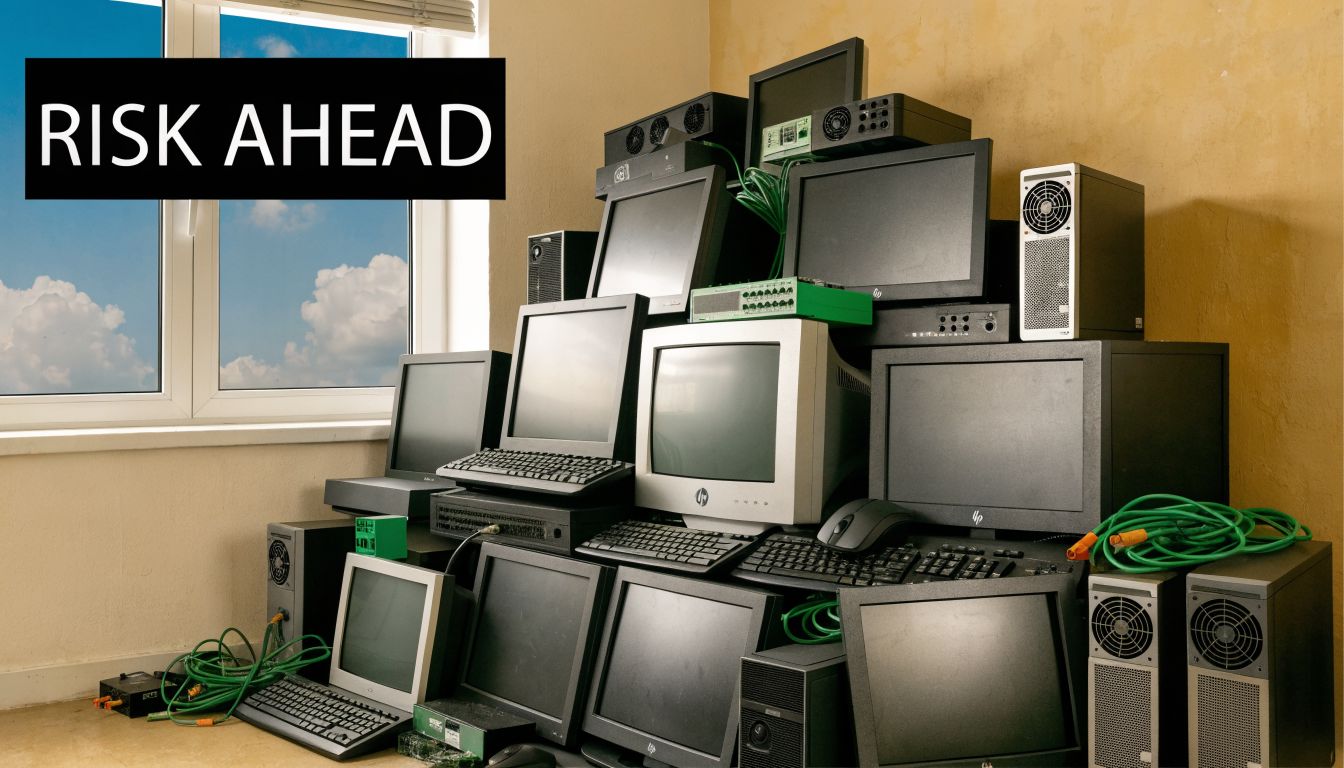
For an IT manager, that pile can include devices that store network settings, account information, call records, saved credentials, or configuration backups. For a facilities lead, it can become an operational problem that blocks moves, adds clutter to secure areas, and creates confusion during audits or lease transitions. For a sustainability leader, it's a missed chance to recover value through reuse, donation, and proper material recycling.
The scale of the problem isn't small. The world generated 62 million tonnes of e-waste in 2022, including about 5 million tonnes from small IT and telecommunication equipment, and only 22.3% was formally collected and recycled according to the UN Global E-waste Monitor 2024. That same report projects global e-waste could reach 82 million tonnes by 2030 if current trends continue.
Why stored equipment becomes a business problem
A storage-room backlog creates several issues at once:
- Data exposure risk because retired telecom hardware may still hold sensitive settings or access information.
- Asset visibility loss when equipment leaves active inventory but never enters a documented disposition process.
- Environmental leakage if mixed loads eventually go to informal handlers or general waste channels.
- Value loss because equipment that could have been reused or refurbished often becomes obsolete while sitting idle.
Practical rule: If your team can't say where a retired device is, what data was removed, and where it went next, disposal hasn't happened yet.
That's why disposal should be treated as IT asset disposition, not junk removal. A good local partner helps convert a cluttered liability into a controlled process with pickup, sorting, documentation, and downstream accountability. Businesses that want a clearer view of those risks can review the environmental and legal impacts of improper commercial e-waste disposal.
Why a Simple Search Is Not Enough for Your Business
A local search result can help a household find a drop-off site. It usually won't tell a business what happens after a pallet of retired phones, switches, or servers leaves the building. That gap matters because corporate telecom disposal has requirements that consumer recycling pages rarely address.
Maine's Department of Environmental Protection is a good example of the broader issue. It explains where households, schools, small businesses, and nonprofits can recycle electronics through approved sites, and notes that some locations may charge fees. But those public pages don't walk a business through secure decommissioning, asset tracking, or certified data destruction workflows for enterprise telecom hardware, as shown on Maine DEP's e-waste guidance.
Consumer recycling and business ITAD are not the same
A consumer program is usually built around convenience. A business ITAD project is built around control.
Here's the difference in practice:
| Need | Consumer drop-off | Business ITAD workflow |
|---|---|---|
| Handoff | Basic acceptance of devices | Scheduled pickup or managed intake |
| Asset records | Limited or none | Itemized tracking and disposition records |
| Data handling | Often unclear to the customer | Defined sanitization or destruction process |
| Audit support | Minimal | Documentation for internal and external review |
| Reuse strategy | Sometimes unspecified | Reuse-first decision process when appropriate |
An IT manager can't rely on “they recycle electronics” as a sufficient answer. Telecom gear often sits inside larger business systems. A firewall appliance, managed switch, VoIP handset fleet, or decommissioned branch office rack may carry more operational sensitivity than a casual recycler expects.
What environmentally friendly should mean
For a business, environmentally friendly has to include more than diversion from landfill. It should also mean:
- Business-safe handling with documented intake and transfer
- Security discipline for devices that may contain sensitive information
- Compliance-ready records your team can retain
- Reuse before recycling when equipment still has practical life
If a vendor only talks about “keeping electronics out of landfill” and can't explain how they track assets or document data destruction, they're describing a recycling service, not a business disposition program.
This is also where a donation-based model can fit well. Some organizations want buyback. Others care more about community impact, digital inclusion, or keeping useful equipment in service longer. A social-enterprise recycler such as Reworx Recycling can support that objective when the equipment and project scope align, but the same due diligence still applies. You still need to verify handling, reporting, and security controls.
Your Vendor Vetting Checklist for Compliance and Certification
Marketing language is easy to write. Vendor qualification is harder. If you're evaluating companies for environmentally friendly telecom disposal near me, skip the broad promises and test the operation behind them.

A credible partner should be able to explain certifications, processing controls, and downstream management in plain language. If they hide behind buzzwords, that's useful information by itself.
Start with certification, then verify the scope
Two names often come up in this space: R2 and e-Stewards. Both are used to signal that a recycler follows formal standards for responsible electronics handling. In practical terms, you're looking for evidence that the company operates with defined controls around environmental management, worker safety, and data-bearing devices.
Don't stop at “yes, we're certified.” Ask:
- Which facility is certified and for what services
- Whether the certification is current
- Whether telecom equipment is included in the actual processing scope
- How downstream vendors are managed for materials they don't process in-house
A useful reference point is this overview of e-waste certification standards, which can help teams understand what those labels should mean operationally.
Red flags that show up early
You can often spot weak vendors in the first conversation.
- No documentation examples. If they can't provide sample intake records, destruction certificates, or reporting formats, they may not run a disciplined process.
- Vague downstream answers. “We have partners” isn't enough. You need to know how those partners are reviewed and what proof of final handling exists.
- All recycling, no reuse discussion. A serious ITAD partner knows some equipment should be evaluated for refurbishment or redeployment before material recovery.
- Cash-only or informal pickup arrangements. That's usually a sign the process is optimized for speed, not accountability.
Screening note: The fastest way to expose a weak vendor is to ask what paperwork you'll receive before pickup, at transfer, and after final disposition.
Check legal fit, not just green claims
Certification matters, but it doesn't replace legal responsibility. Your organization still needs a disposal path that fits your internal policies, sector rules, and any state-specific e-waste requirements that apply to your operations.
Use this short checklist during review:
Confirm facility identity
Make sure the legal business name on contracts matches the operating facility handling the assets.Review service boundaries
Some companies collect but don't process. Others process but subcontract logistics. Neither model is automatically wrong, but it must be transparent.Ask about restricted items
Batteries, damaged hardware, and mixed telecom closets can trigger special handling needs.Match the vendor to the project type
A one-time office cleanout, a data center decommissioning effort, and recurring branch refreshes do not require the same logistics.
What good answers sound like
A qualified vendor usually sounds specific. They can describe who labels equipment, how assets are serialized, when data-bearing devices are separated, how materials move downstream, and when you receive final reporting. They don't need a polished sales script. They need a controlled operating model.
Securing Your Data and Proving It with a Chain of Custody
A branch closes on Friday. By Monday, the routers, switches, desk phones, and firewall appliances are stacked near the loading dock waiting for pickup. If nobody records serial numbers, seals the shipment, and documents each custody transfer, your company has no defensible proof of what left the site or how the data-bearing equipment was handled.
Telecom gear creates risk that many internal teams underestimate. Laptops get attention because everyone knows they store files. Network and voice equipment often gets treated like low-risk scrap, even though it may retain credentials, network diagrams, call logs, configuration files, customer settings, and cached admin data. For ITAD planning, that distinction matters.
The first decision is practical. Which assets can be sanitized and reused, and which ones should go straight to physical destruction? Reuse usually produces better environmental results and can recover some value, but only if the media can be sanitized to your policy standard and the device is still suitable for redeployment. Destruction costs more in lost resale value, yet it reduces uncertainty for damaged media, unsupported devices, and equipment tied to sensitive environments.
| Asset condition | Typical handling goal | Documentation need |
|---|---|---|
| Reusable hardware with manageable risk | Sanitization for reuse or remarketing | Item-level record and certificate |
| Damaged, obsolete, or high-sensitivity media | Physical destruction | Serialized destruction confirmation |
A capable vendor explains that decision by asset class, not by sales package. If every item gets the same answer, your organization is probably being fit into the vendor's process instead of the process being fit to your risk profile.
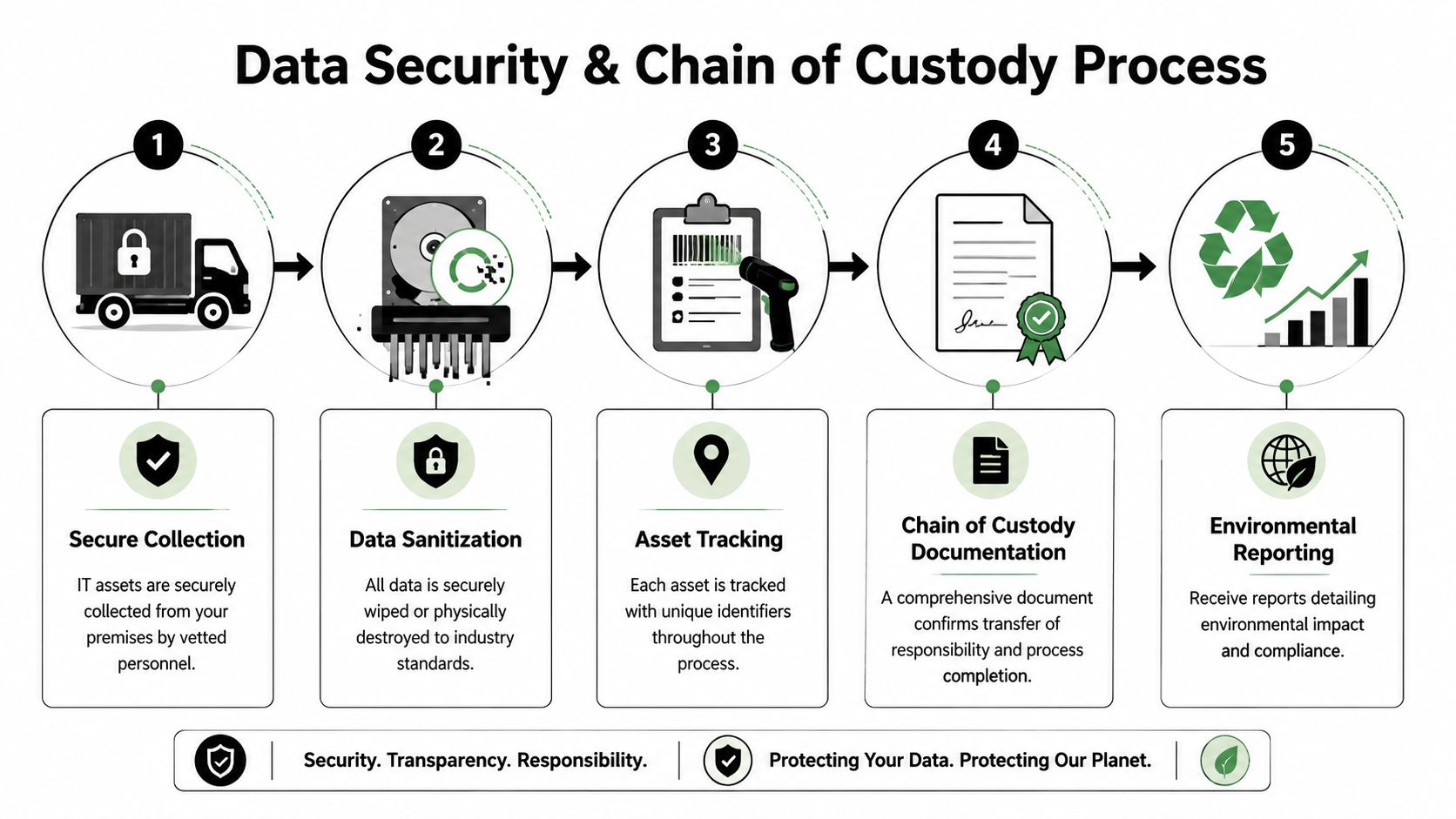
A chain of custody is the audit trail for possession and control. It should show who released the asset, who accepted it, how it was identified, where it moved, what happened to it, and what proof was issued at the end.
That record needs to stand up after an internal audit, a customer security review, or a regulator's questions months later.
At minimum, your documentation should answer these points:
- What equipment was collected
- When it left the site
- Who took possession
- How each asset was identified or serialized
- Whether it was sanitized, remarketed, recycled, or destroyed
- What final certificate or report closed the record
For teams building their review process, a certificate of destruction template helps clarify what final documentation should include before you sign a service agreement.
Collection control starts inside your facility, not at the recycler's dock. Equipment waiting for disposition should be separated from general surplus, protected from informal removal, and matched to an asset list before pickup. I have seen well-run security programs break down in this exact gap. The IT team approved the project, facilities cleared the room, and untracked devices still left through side channels because nobody owned the handoff.
That is why proof matters as much as intent. If your team cannot reconstruct the asset journey after pickup, you do not have a controlled disposal process. You have a gap in evidence.
Key Questions to Ask Every Potential Disposal Partner
Most vendor calls fail because the client asks broad questions and gets polished broad answers. Ask narrow questions instead. You're trying to learn whether the company can run your project with control, not whether they have a convincing sustainability page.
Questions that reveal process quality
Use questions like these in your first screening call or RFP:
- Can you provide a sample chain-of-custody report and a sample certificate of data destruction?
- How do you track each asset from pickup through final disposition?
- What happens to reusable telecom equipment before you decide to recycle it?
- Which parts of the process are handled in-house, and which are subcontracted?
- How do you verify final destination for downstream materials?
These questions force the vendor to talk about process mechanics. That's where weak programs usually break down.
Pickup, drop-off, donation, and buyback
Logistics and value recovery models should fit your project, not the other way around.
| Option | Works well for | Limitation to watch |
|---|---|---|
| Pickup service | Office cleanouts, multi-site projects, bulky telecom loads | Requires clear scope and site coordination |
| Drop-off | Small volumes, one-off retirements | Often provides less control for corporate chain-of-custody needs |
| Buyback model | Higher-value reusable assets | Can encourage focus on resale over broader program goals |
| Donation-based recycling | CSR-oriented programs and community benefit goals | Needs the same security and documentation rigor as any other path |
Ask a vendor what they optimize for. Speed, resale, donation, recycling, and compliance reporting are not always balanced equally.
Ask for performance metrics, not slogans
A strong benchmark exists in the telecom sector. One major provider reported a 99.9% reuse and recycling rate for its operational waste by integrating collection, sorting, reuse, and verified downstream recycling, according to a telecommunications resource efficiency case study. That doesn't mean every vendor will match that result. It does mean serious programs measure reuse rate, recycling rate, landfill diversion, and final destination.
So ask directly:
- What reuse rate do you report?
- What recycling rate do you report?
- What landfill diversion reporting do you provide?
- Can you show proof of final destination for residuals?
If the answer is “we recycle responsibly” but there are no metrics or reports behind it, keep looking.
Building a Sustainable Corporate ITAD Program
A sustainable ITAD program usually starts with a familiar scene. Retired phones are stacked in a storage room, a few switches are sitting under a desk, and nobody is fully sure which items are cleared for reuse, donation, resale, or recycling. That backlog creates cost, security exposure, and reporting problems. It also makes every cleanout feel like a fire drill.
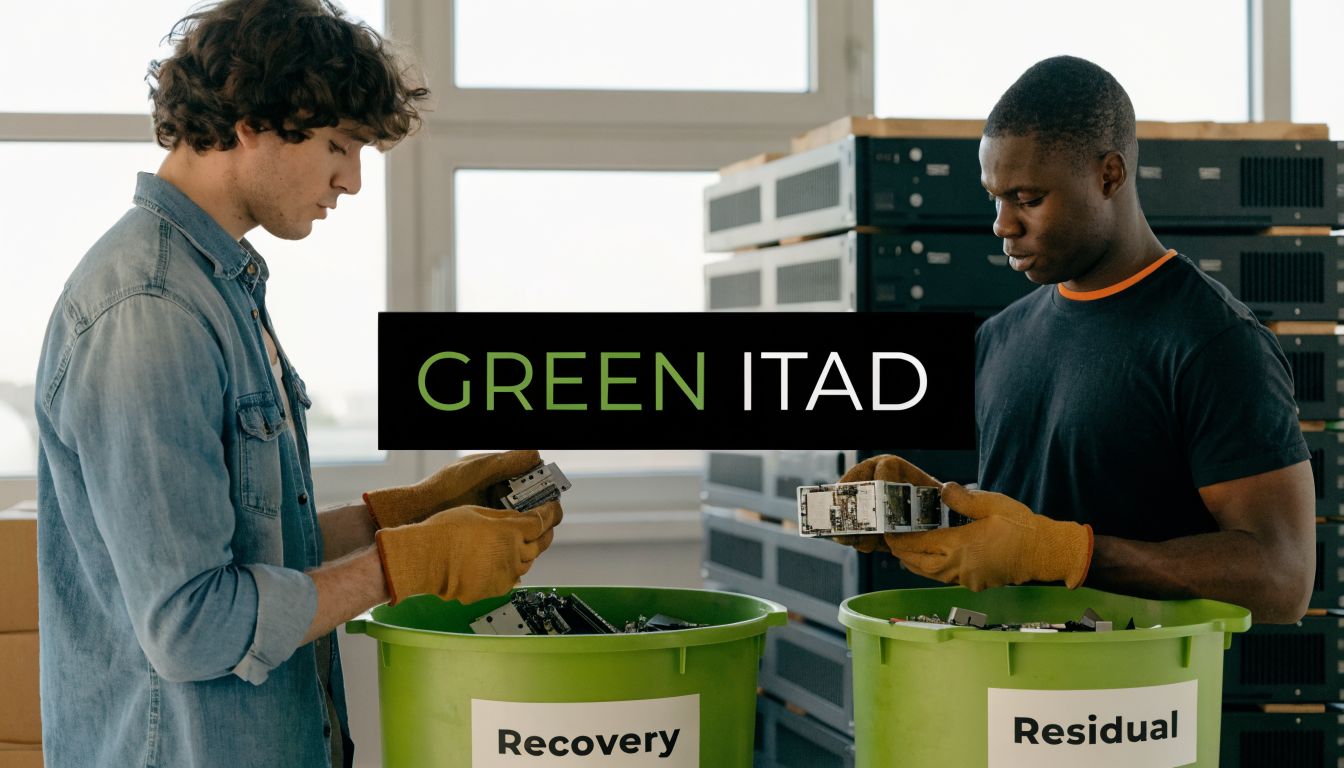
The better approach is operational, not episodic. Treat disposition as part of the asset lifecycle from the day equipment is deployed. That means tagging assets accurately, assigning ownership for end-of-life decisions, and setting a regular collection cadence before storage areas turn into unmanaged holding zones.
Collection discipline matters. As noted earlier, formal recovery rates for smaller IT and telecom devices remain lower than many companies expect. In practice, the businesses with the cleanest audits and strongest sustainability results are the ones that separate assets early, document internal handoffs, and avoid mixing reusable equipment with scrap.
The operating model that works
Build the program around policy, scheduling, and clear asset paths.
Written disposition policy
Define who can approve retirement, who releases equipment, which assets require extra review, and how long records must be kept for audit and compliance purposes.Scheduled collection cycles
Set recurring office cleanout or telecom refresh intervals by site, rather than waiting for a relocation, lease event, or storage crisis to force action.Separated handling streams
Sort reusable devices, data-bearing assets, damaged units, peripherals, and commodity scrap at the point of collection. That reduces processing mistakes and improves recovery value.CSR and donation criteria
If your company supports digital inclusion or community reinvestment, write those goals into the program. Donation should be a defined path with approval rules, testing standards, and documentation, not an informal side option.
This is also where trade-offs become real. A tighter sorting process takes more coordination from facilities, IT, and security. Regular pickups may cost more than waiting for a larger one-time load. But those costs are often lower than the labor, storage sprawl, and avoidable exceptions that build up in an unmanaged program.
Social impact deserves a deliberate place in the plan. A recycler can remove material. A partner with reuse and donation capabilities can also help your team extend device life, support community access to technology, and give ESG reporting more substance. That only works if social impact goals are handled with the same discipline as security and compliance.
Organizations that want a practical model for recurring pickups, reuse planning, and policy design can use this resource on building a sustainable future with e-waste management services to shape a program that holds up operationally, not just on paper.
Partner with Reworx for Responsible Telecom Disposal
Responsible telecom disposal isn't about finding the nearest truck. It's about finding a process that protects data, preserves auditability, supports compliance, and keeps useful equipment out of the waste stream whenever possible.
That means checking certifications carefully, asking for documentation samples, understanding how chain of custody is maintained, and requiring clear reporting on reuse, recycling, and final handling. If a provider can't explain those basics clearly, they haven't earned your trust.
Businesses evaluating service options can review how Reworx Recycling's services support eco-friendly outcomes while comparing pickup support, secure data destruction, office cleanout help, and donation-based electronics recycling models against their own ITAD requirements. The right partner should make your program easier to manage, not harder to defend.
If your team is planning an office cleanout, telecom refresh, laptop disposal project, data center decommissioning effort, or broader IT asset disposition program, contact Reworx Recycling to discuss equipment donation options, schedule a pickup, or build a more secure and sustainable electronics recycling process.