
Your phone system migration is finished. The new cloud voice platform is live, the network closet is cleaner than it was last week, and now the leftovers are stacked in a back room. Old VoIP handsets, access points, routers, switches, patch panels, and a few mystery boxes of power supplies are still your problem.
That's the moment most Atlanta IT managers search for e-waste telecom recycling near me and get a flood of vague results. Some pages talk about drop-offs. Some mention electronics recycling in broad terms. Very few explain how to retire business telecom gear in a way that protects data, preserves reusable value, and gives you the paperwork your legal, finance, and sustainability teams may ask for later.
A practical telecom recycling process isn't just about moving equipment out of the office. It's about control. You need to know what left the building, what data was removed or destroyed, what was eligible for reuse, and what entered a compliant recycling stream. If you work with a donation-based social enterprise, you also have a chance to turn a routine cleanout into something that supports digital inclusion and local community benefit.
Your Guide to Telecom E-Waste Recycling in Atlanta
Atlanta businesses retire telecom hardware constantly. Office consolidations, UCaaS rollouts, Wi-Fi upgrades, branch closures, and server room refreshes all create the same backlog. The gear may be obsolete for your environment, but it still carries environmental, security, and operational consequences until you process it correctly.
The scale of the waste stream is already too large to treat casually. The world generated 62 million tonnes of e-waste in 2022, and only 22.3% was formally collected and recycled, according to the Global E-waste Monitor 2024. For Atlanta organizations, that makes end-of-life planning part of normal IT governance, not an afterthought.
What a simple local search usually misses
A generic recycler listing doesn't tell you much about business readiness. It may not tell you whether the provider handles mixed telecom lots, whether they can separate reusable units from scrap, or whether they issue chain-of-custody documentation.
That gap matters most when you're dealing with equipment like:
- VoIP phones and conference phones that may retain settings or user associations
- Managed switches and routers that can hold configurations, credentials, or logs
- Wireless access points and firewalls that often need controlled decommissioning
- Closet cleanout leftovers such as UPS units, cabling, and telecom peripherals
A storeroom full of old phones isn't a space problem first. It's a process problem.
What a stronger Atlanta process looks like
The right search question isn't just “who recycles telecom equipment near me.” It's “who can document the full disposition path for this equipment.”
That means looking for a provider that can support inventory, secure handling, reuse evaluation, material recovery, and final reporting. In metro Atlanta, that's why many businesses start with a local ITAD-oriented option such as Reworx Recycling's Atlanta service area, then compare based on process discipline rather than convenience alone.
For an IT manager, that shift changes everything. Instead of treating end-of-life hardware as clutter, you treat it like any other controlled asset class with risk, residual value, and reporting requirements.
Finding and Vetting Responsible Telecom Recyclers
Most vendors can remove equipment. Fewer can explain what happens after pickup in plain language. That's the difference between a hauler and a telecom recycling partner.
Questions to ask before you approve anyone
Start with operating fit. A provider may sound polished but still be set up mainly for household electronics or very large enterprise truckloads. Atlanta SMBs and multi-site regional offices often need something in between.
Use a short screening list:
- Commercial intake. Ask whether they routinely handle business-generated telecom and IT equipment, not just public drop-offs.
- Asset tracking. Ask how they record serial numbers, asset tags, pallet contents, and exceptions during pickup and intake.
- Data-bearing device handling. Require a device-specific answer for phones, routers, switches, firewalls, and other managed hardware.
- Downstream visibility. Ask where non-reusable equipment goes and whether they can explain the downstream recycling path.
- Final documentation. Confirm what records you'll receive after processing is complete.
A useful benchmark is whether the provider can walk you through the same decision path you'd use internally. If they speak only in broad recycling terms, they may not have a mature ITAD workflow.
What certification language should mean in practice
Many buyers look for labels first. That's reasonable, but labels alone don't solve your problem. What matters is what the process does.
If a recycler references standards such as R2v3, e-Stewards, or NAID AAA, ask what those standards change in day-to-day handling. A credible answer should connect certification language to operational controls such as intake discipline, secure data destruction, environmental safeguards, and audit-ready records.
Practical rule: If a vendor can't explain chain of custody and downstream handling without jargon, don't assume they can document it well after pickup.
For Atlanta teams comparing options, it helps to review a structured vendor checklist like this guide on selecting a reliable e-waste recycling partner.
Why the social enterprise model changes the decision
Not every retired asset belongs in a scrap stream. Some equipment can still support reuse after proper testing and data handling. A social enterprise recycler adds another possible outcome. Functional equipment may support donation channels, digital inclusion work, or workforce development rather than going straight to destruction.
That's a different model from a recycler whose only objective is commodity recovery. For many Atlanta organizations, especially schools, public agencies, healthcare offices, and growing businesses, that difference aligns better with sustainability and corporate donation goals.
Reworx Recycling stands out as one local option. It operates as a donation-based social enterprise in the Smyrna area and supports electronics recycling, secure data handling, and business pickup workflows for organizations retiring mixed IT and telecom assets.
Preparing Telecom Gear for Secure Disposal
The disposal risk usually starts before the truck arrives. Teams lose control when they mix live gear with retired gear, skip inventory, or assume a factory reset is enough.
Most pages on telecom recycling barely address the security issue. Devices like SIP phones, routers, and access points can retain configs or logs, and the average data breach cost reached $4.88 million in IBM's 2024 reporting, as cited in this telecom-focused ITAD discussion. That's why certified data destruction for data-bearing telecom assets is a business requirement, not a nice-to-have.
Start with inventory before decommissioning
Don't begin by unplugging everything and tossing it into bins. Begin with a device list that operations can use. At minimum, record manufacturer, model, serial number, asset tag, location, and whether the device is known or suspected to store data.
Then separate assets into three groups:
Clearly reusable equipment
Newer phones, switches, or accessories that are complete and in serviceable condition.Data-bearing gear needing controlled handling
Firewalls, managed switches, routers, voicemail systems, servers, or any device with storage.Residual electronics and scrap
Damaged hardware, power supplies, broken peripherals, obsolete accessories, and non-repairable units.
That one sorting pass reduces confusion later. It also helps your recycler decide what can be tested for reuse and what should move directly toward destruction or material recovery.
Factory reset is not a disposal policy
A factory reset may restore defaults for the next user. It doesn't create an audit trail for your business.
That's the mistake I see most often in telecom retirements. Staff assume that because a desk phone boots to a setup screen, it's safe. They assume that because an AP was removed from the controller, it no longer carries useful information. That's too loose for business disposal.
Use a method that matches the device and the risk profile. If the device contains removable drives or known storage media, your ITAD partner may sanitize or physically destroy those components. If the hardware is damaged, obsolete, or too difficult to validate for reuse, physical destruction is often the cleaner path.
Telecom Equipment Decommissioning Checklist
| Equipment Type | Data-Bearing? | Recommended Action Before Pickup |
|---|---|---|
| VoIP phones and conference phones | Often yes | Remove from service, document model and quantity, keep handsets with bases, flag for sanitization review |
| Managed switches | Yes | Export or archive needed configs internally, label by rack or site, mark as data-bearing |
| Routers and firewalls | Yes | Decommission from network, retain any needed records, isolate for certified handling |
| Wireless access points | Sometimes | Remove from controller inventory, group by model, treat managed units as potentially data-bearing |
| PBX or voicemail equipment | Yes | Coordinate with telecom admin, confirm service cutover, route to secure destruction or validated sanitization |
| UPS units and power accessories | Usually no, but may require special handling | Separate batteries and damaged units, keep with related hardware if part of a closet cleanout |
| Patch panels, cabling, mounts | No | Bundle by type, remove non-electronic debris, send as material recovery if no reuse path exists |
What to do internally before pickup day
A controlled handoff is easier when your internal prep is clean:
- Assign one owner. One person should reconcile inventory, approve exceptions, and sign handoff records.
- Create a secure staging area. Keep retired telecom gear away from active stock and employee traffic.
- Leave labels in place. Asset tags and rack labels help with reconciliation unless your policy requires separate handling.
- Don't mix categories. Reuse candidates, data-bearing devices, and obvious scrap shouldn't travel in the same unlabeled gaylord or pallet.
- Document odd items. Proprietary modules, expansion cards, and mixed accessories usually create confusion later if nobody identifies them upfront.
If your team needs a practical staging guide, this checklist for preparing your company's electronics for recycling is a useful internal handoff document.
Verifying Compliance with Certifications and Chain of Custody
Most compliance failures don't happen because a company meant to cut corners. They happen because nobody defined what proof should come back after pickup.
That's why chain of custody matters so much in telecom disposition. Small devices are easy to lose, easy to misclassify, and easy to move without enough documentation. According to the ITU summary on global e-waste and recycling, small telecom devices such as phones and routers represented about 4.6 million tonnes of global e-waste in 2022, and only about 22% was documented as collected and recycled. In practice, the organizations that manage these assets well use a best-practice ITAD workflow that includes inventory, data sanitization, testing for reuse, and material recovery.
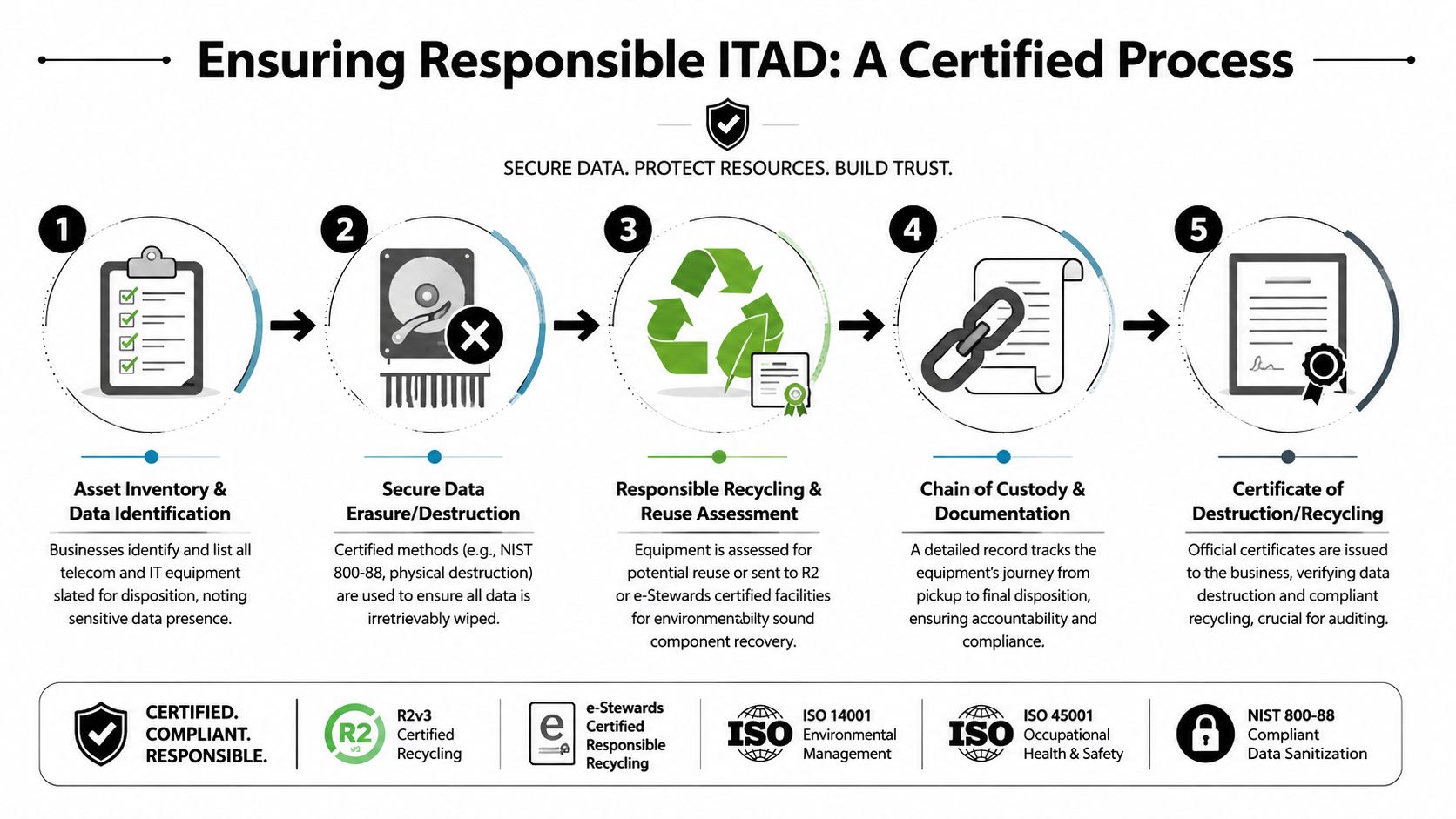
What chain of custody should include
A serious chain-of-custody process isn't just a driver signature. It should establish who had the equipment, when it changed hands, and how final disposition was recorded.
Look for these elements:
- Pickup acknowledgment that identifies the load, the date, and the releasing party
- Asset or lot reconciliation tied to serials, tags, or clearly described categories
- Processing records that separate sanitization, destruction, reuse evaluation, and recycling
- Final certificates or reports that support audit, insurance, policy, or sustainability review
What certification should help you verify
Certification matters most when it changes what your team can ask for and receive. In a telecom context, that usually means stronger controls over data-bearing assets, better downstream accountability, and clearer environmental handling.
A vendor should be able to answer simple questions without deflecting:
- What happens to reusable phones versus broken phones?
- How do you identify data-bearing network hardware?
- What proof do you issue after destruction or recycling?
- Can you explain where residual material goes?
If your legal or compliance team asks what happened after pickup, “the recycler handled it” is not a defensible answer.
For buyers who need a plain-English overview of standards and what they typically cover, this resource on e-waste certification standards is worth keeping in your vendor review file.
Arranging Business Pickups and Office Cleanouts in Atlanta
Self-transport works for a single household monitor. It's rarely the right approach for a business telecom cleanout. Once you're dealing with rolling carts of phones, stacked switches, batteries, peripherals, and network closet leftovers, logistics become part of the risk.
In the United States, one source reports that about 9.4 million tons of e-waste are thrown away every year and only 12.5% is recycled, while local access points can improve responsible handling. That same discussion points to Sioux Falls as an example of free electronics drop-off infrastructure for residents, and it also notes that for businesses, a dedicated pickup model is often the more secure and scalable channel for retiring end-of-life assets, as described in this discussion of electronics recycling access and pickup workflows.
What to do before the truck arrives
Business pickups go smoothly when the site is prepared like a small move, not a casual cleanup.
A short prep list helps:
- Consolidate by category. Keep phones together, network gear together, and loose accessories in labeled containers.
- Clear the route. Confirm elevator access, dock access, parking instructions, and any badging requirements.
- Stage heavier items low. UPS units, rack gear, and battery-containing equipment shouldn't be buried under lighter electronics.
- Designate a contact person. One onsite lead should handle questions and final signoff.
Why pickup beats ad hoc disposal for B2B loads
Drop-off thinking creates hidden costs. Staff spend time loading personal vehicles, there's no consistent intake record, and equipment often leaves your control in pieces rather than as a managed lot.
A scheduled business pickup is better suited to:
- Office cleanouts after relocations or floor reconfigurations
- Facility cleanouts involving multiple closets, storage rooms, or branch offices
- Data center decommissioning support where telecom and IT hardware are mixed
- Corporate donation programs that need sorting, testing, and documentation rather than bulk scrap removal
The biggest operational win is consistency. When your team knows how pickups work, future retirements stop turning into one-off fire drills.
Calculating Value Recovery Through Buybacks and Donations
Old telecom gear isn't always worthless. The mistake is assuming the only choice is “recycle everything” or “try to sell everything.” Mature IT asset disposition programs use a third approach. They sort equipment by the outcome it supports.

One of the biggest missed opportunities in local recycling content is the remarketing step. Much of the value in the 62 million metric tons of e-waste generated in 2022 was lost because only 22.3% was formally recycled, and a stronger ITAD process can recover value by assessing telecom assets for reuse before recycling, as noted in this discussion of remarketing and e-waste recovery.
When buyback makes sense
Buyback is most realistic when equipment is newer, functional, complete, and still relevant in the secondary market. In telecom environments, that may include current-generation handsets, supported switches, certain network modules, and usable accessories.
The value question isn't just age. It also depends on:
- Condition. Broken screens, missing power supplies, or damaged ports reduce reuse potential.
- Completeness. A lot with matched handsets, bases, cords, and mounts is easier to remarket.
- Supportability. Assets still compatible with current environments are easier to place.
When donation creates the better return
Some assets won't produce a meaningful buyback, but they can still create social value if they're safe, functional, and appropriate for reuse after processing. That's where a donation-based recycling model changes the outcome.
The best disposition result isn't always the one that produces the largest check. Sometimes it's the one that clears risk, supports reuse, and helps your organization show a measurable community commitment.
For Atlanta businesses with CSR or ESG goals, donation can fit more naturally than liquidation. It also gives sustainability leaders a stronger story than “we removed obsolete equipment.”
If your organization wants a mixed strategy, this guide to telecom asset recovery services near me is a practical reference for deciding what belongs in buyback, donation, or recycling.
Partner with Reworx for Responsible ITAD in Atlanta
If you're searching for e-waste telecom recycling near me in Atlanta, your primary objective isn't just finding someone to haul equipment away. It's finding a process your team can trust.
That process should do a few things well. It should identify what you have, separate data-bearing assets from ordinary electronics, control handoff through documented chain of custody, and route each item toward reuse, donation, or compliant recycling based on condition and risk. It should also fit the way Atlanta businesses operate, whether you're handling a single office cleanout, a recurring refresh cycle, or a broader IT equipment disposal program.
A donation-based social enterprise model adds one more advantage. It gives your organization a way to manage electronics recycling and secure data destruction while supporting broader community outcomes. For many companies, that aligns better with sustainability reporting, corporate donation programs, and local impact goals than a basic scrap-only vendor relationship.
If your team is planning a telecom refresh, office relocation, facility cleanout, laptop disposal effort, or broader ITAD review, the right next step is to gather your inventory, define your data-handling requirements, and confirm the documentation you expect back at the end. Once those three points are clear, the disposal project gets much easier to manage.
If your business is ready to retire phones, switches, routers, laptops, servers, or mixed office electronics, Reworx Recycling offers a practical path for donation-based recycling, secure data destruction, office cleanouts, and IT asset disposition support. Contact the team to schedule a pickup, discuss a facility cleanout, or explore a corporate donation program that keeps usable technology in circulation while protecting your organization's data and compliance needs.