
Beyond the blue bin, waste reduction has become an operating decision. If you're managing an office refresh, a facility cleanout, a server room upgrade, or a multi-site IT rollout, the old model of “put recyclables here and trash there” doesn't solve the actual problem. It doesn't address aging laptops in storage closets, surplus monitors after a hybrid-work transition, retired medical carts, batteries sitting in desk drawers, or hard drives no one wants to touch because of data risk.
For modern organizations, landfill reduction now touches cost control, brand reputation, procurement policy, and compliance. It also affects how much usable value you recover before material becomes waste. The University of Michigan's Center for Sustainable Systems identifies source reduction as the most effective waste reduction method, and landfill disposal still accounted for about 146.1 million tons of U.S. municipal solid waste in 2018, according to a summary citing the Center's work in this waste and landfill data guide. That's why the strongest programs start before disposal ever enters the conversation.
Most advice on ways to reduce landfill waste stays at the household level. Recycle more. Buy less. Compost. Those are useful, but business leaders and IT managers need a system. They need policies for asset recovery, secure data destruction, redeployment, donation-based recycling, and end-of-life routing that works at scale. If you're also thinking about broader sustainability habits, these tips for eco-conscious living are a good companion read.
1. Implement Comprehensive Electronics Recycling Programs
If your organization doesn't have a formal electronics recycling program, devices will drift into the wrong stream. Some end up forgotten in storage. Some get tossed during office cleanouts. Some stay on shelves because no one knows who owns the decision.
A structured electronics recycling process fixes that. Set up central collection points, assign department-level contacts, define accepted items, and schedule recurring pickups. For business leaders, the benefit isn't just environmental. It reduces clutter, lowers ad hoc disposal decisions, and gives IT and facilities teams a repeatable path for retired assets.
A strong partner matters here. Reworx Recycling supports business-focused electronics recycling for organizations, which is especially useful when you need a donation-based recycling option instead of a one-off haul-away approach.
What good execution looks like
Use a short operating standard so teams know what belongs in the program:
- Collect the full device ecosystem: Include laptops, desktops, monitors, docking stations, cables, phones, printers, and small peripherals.
- Assign ownership: Put IT in charge of data-bearing devices and facilities in charge of pickup coordination and staging.
- Separate damaged equipment: Broken screens, swollen batteries, and physically damaged hardware should be flagged before transport.
- Document transfers: Keep a chain of custody for anything that once stored company data.
Electronics recycling works best when it's boring. If every pickup depends on a special request, equipment will pile up.
This is also where many “ways to reduce landfill waste” programs either become operational or stay theoretical. Businesses generate a steady stream of laptops, accessories, and networking gear that curbside systems were never designed to handle. A formal program keeps that stream out of landfills and moves it into reuse, parts recovery, or proper recycling.
2. Establish IT Asset Management and Equipment Buyback Programs
The cheapest device to dispose of is often the one you don't dispose of yet. The second-best option is the one you sell or recover value from before it becomes scrap.
IT asset management should connect procurement, deployment, maintenance, refresh timing, and end-of-life decisions. When that chain breaks, organizations replace equipment too early, lose track of what's in service, and miss resale or buyback windows. That's where landfill risk and value leakage happen at the same time.
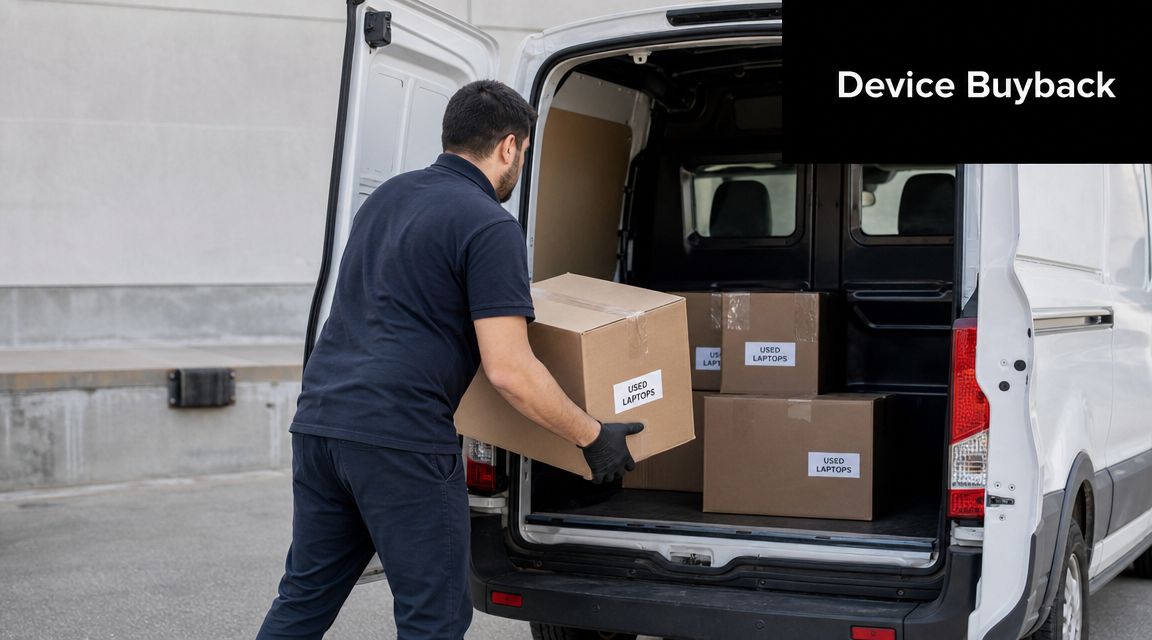
Reworx has published practical guidance on IT asset management best practices that aligns well with this approach. For organizations handling regular refresh cycles, that kind of structure helps decide what should be redeployed, resold, donated, or recycled.
Build the decision tree before the refresh
Don't wait until pallets are sitting in a hallway. Define the routing logic first.
- Buyback candidates: Working business-class devices with marketable specs and manageable cosmetic wear.
- Redeployment candidates: Devices that still perform well for lower-demand roles, training rooms, kiosks, or temporary staff.
- Donation candidates: Functional equipment that no longer fits internal standards but still has practical use.
- Recycling candidates: Nonfunctional, obsolete, incomplete, or uneconomical assets.
The trade-off is simple. Buyback takes more evaluation effort, but it can offset refresh costs. Scrap-everything is faster, but it destroys residual value and usually increases downstream landfill pressure unless the recycler has a strong recovery process.
3. Develop Extended Producer Responsibility Partnerships
Not every waste stream should be managed entirely on your side of the fence. Some of the most effective landfill-reduction decisions happen during purchasing, when you choose vendors that will also take responsibility at end of life.
Extended producer responsibility, often shortened to EPR, pushes recovery upstream. In practice, that means asking manufacturers and authorized return partners what happens to equipment after your organization is done with it. Some vendors operate take-back programs for their own products. Others offer trade-in credits, return logistics, or materials recovery pathways tied to product design.
Questions worth asking suppliers
Procurement teams should stop treating disposal as a separate phase. Put these questions into sourcing reviews:
- Take-back terms: Will the manufacturer accept equipment back at the end of its useful life?
- Packaging recovery: Can pallets, foam, crates, and transport packaging be returned or reused?
- Repair support: Are parts, batteries, and service documentation available long enough to extend product life?
- Mixed-fleet reality: If your environment includes several brands, can your disposal partner cover the gaps that OEM programs won't?
This is one of the more overlooked ways to reduce landfill waste because it doesn't look like waste management at first. It looks like procurement discipline. But that's the point. Disposal costs and diversion performance are shaped by the products you buy, the support terms you negotiate, and the recovery channels you line up before rollout.
Manufacturer programs can work well for standardized fleets. They usually work less well for mixed inventories, legacy devices, and fast-moving cleanouts. That's when organizations need a second lane through a recycling or ITAD partner who can handle everything the OEM program won't.
4. Create Internal Device Refurbishment and Redeployment Programs
A surprising amount of hardware gets retired because it no longer fits a premium use case, not because it's unusable. That distinction matters.
A design workstation may be too slow for creative software but perfectly fine for reception, inventory, training, or conference room scheduling. A laptop with short battery life may still work well on a desk with a power adapter. Internal refurbishment and redeployment turn those mismatches into landfill avoidance.
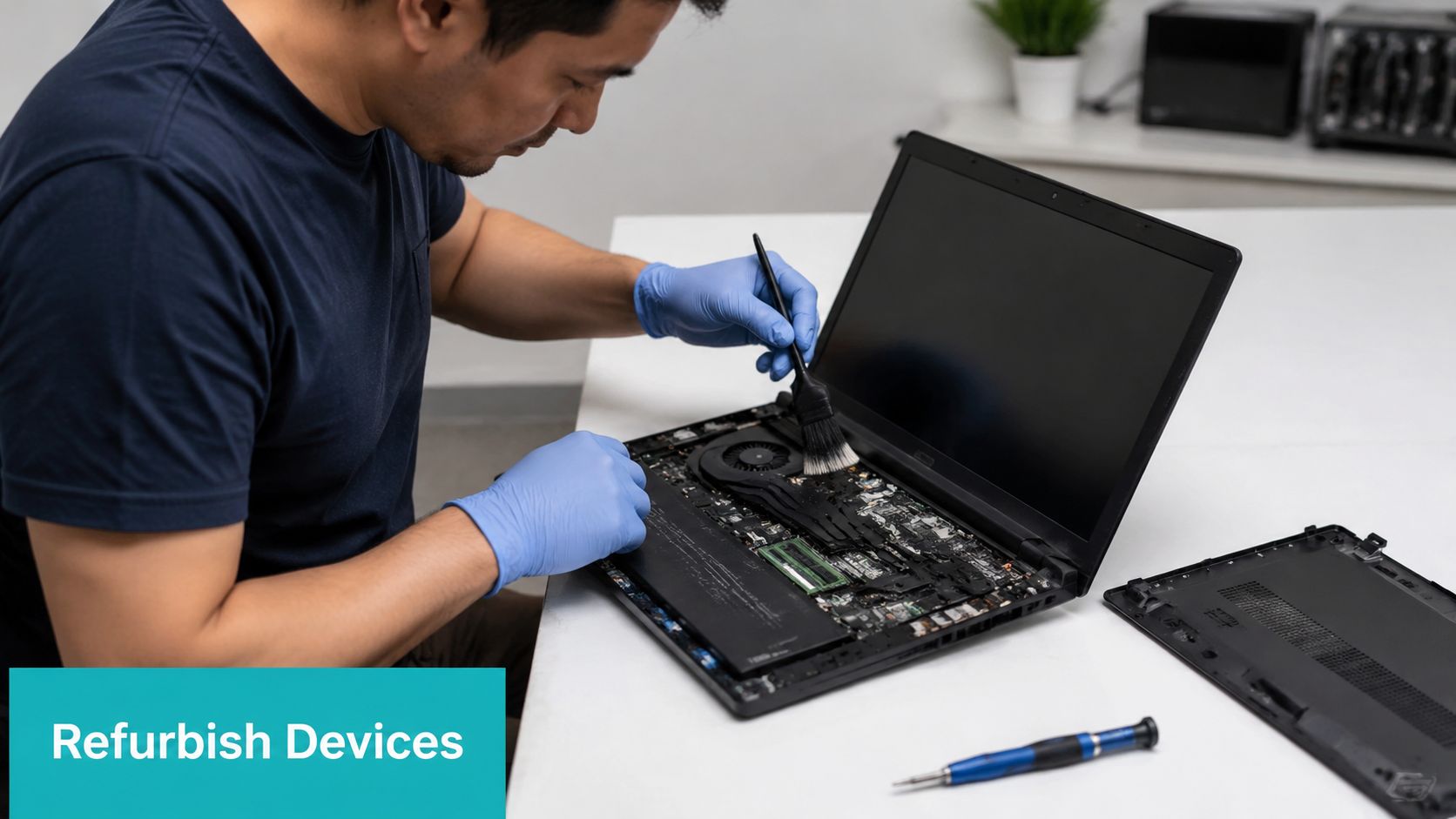
The U.S. EPA notes that donating or upgrading computers can extend product life, and its guidance emphasizes reuse and organized collection in schools and districts through this EPA page on reducing waste. That same logic applies inside businesses before outside donation ever starts.
Where redeployment usually works best
Not every device deserves refurbishment. The good candidates are the ones that need modest effort and still meet a defined business need.
- Back-office roles: Basic admin, scheduling, and browser-based work often need less horsepower than engineering or media teams.
- Shared environments: Training rooms, loaner pools, kiosks, and warehouse stations are good fits for older but stable devices.
- Temporary projects: Contractors, seasonal staff, and pilots often don't require new hardware.
- Community donation pipelines: When devices no longer fit internal use, structured donation can extend their life again.
Field observation: Organizations save the most equipment when IT sets minimum performance standards by role instead of forcing one hardware standard for everyone.
The trade-off is management overhead. Refurbishment takes testing, cleaning, reimaging, and tracking. But if you skip it entirely, you'll retire devices that still have practical life left in them.
5. Implement Secure Data Destruction and Compliance Management
Many businesses don't send old equipment to landfill. They let it sit in locked rooms because they're worried about data exposure. That's not a sustainability program. It's deferred risk.
A serious end-of-life process needs secure data destruction built into the workflow from the start. Once that step is standardized, equipment can move confidently into reuse, donation-based recycling, resale, or material recovery. Without it, even good sustainability goals stall.
Reworx offers guidance on data security in IT asset disposition, and that issue belongs at the center of any electronics recycling program for business. If you're handling employee records, customer data, financial files, health information, or confidential project material, chain of custody matters as much as diversion.
Non-negotiables for retired devices
A workable policy doesn't need to be complicated, but it does need clear triggers and evidence.
- Classify by data risk: Laptops, desktops, servers, phones, copiers, and network gear can all store sensitive information.
- Choose the destruction method: Depending on the asset, that may mean wiping, shredding, or another documented process.
- Require documentation: Certificates and serialized records help with audits and internal accountability.
- Control storage time: The longer retired devices sit onsite, the more likely they are to disappear, get mixed into trash, or create backlog.
This is one of the easiest places to see what works versus what doesn't. What works is a standard retirement workflow tied to ITAD. What doesn't is telling staff to “bring old equipment to IT when you have time.”
6. Establish Quarterly E-Waste Drives and Collection Events
Most organizations already have hidden e-waste. It's in desk drawers, under reception counters, in cable bins, in old server closets, and in branch offices nobody audits closely. Quarterly collection events bring that material back into the system before it leaks into trash or indefinite storage.
The biggest advantage of recurring drives is predictability. Employees know there will be another opportunity soon, so they stop treating disposal as an exception. Facilities teams can plan space. IT can prepare secure handling for data-bearing devices. Sustainability leaders get a rhythm they can communicate.
If you're organizing one for a business campus, school, agency, or office network, Reworx has a useful resource on planning a successful e-waste drive.
Keep the event simple
The best collection events are tightly scoped and clearly communicated.
- Set dates in advance: Put pickup windows on the calendar for the full year.
- List accepted items clearly: Avoid confusion over appliances, toner, furniture, and general trash.
- Separate employee drop-off from company assets: Consumer items may need a different intake process than business equipment.
- Stage securely: Anything with storage media should go into a controlled area, not an open lobby pile.
A quarterly model also supports broader ways to reduce landfill waste because it creates visibility. Once you start seeing the volume of cables, peripherals, batteries, and aging laptops coming out of the business, weak spots in procurement and asset management become obvious.
7. Design Sustainable Procurement and Device Lifecycle Planning
The USDA's national strategy for reducing food loss and waste supports preventing waste first and recycling unavoidable organics through composting and anaerobic digestion, while also backing a national 50% recycling rate by 2030 and recommending better handling, routing, storage, inventory management, plus tools such as AI, blockchain, and remote sensing in supply chains, as outlined in this USDA national strategy document. Even though that guidance focuses on organics, the operating principle applies directly to electronics and facility waste. Better planning upstream reduces disposal pressure downstream.
Procurement teams often create landfill waste without meaning to. They buy devices that are hard to repair, refresh fleets on calendar habit instead of performance need, and ignore the practical cost of collecting and processing what they purchase. Sustainable procurement corrects that by making repairability, support life, and end-of-life handling part of the buying decision.
What to change in the purchasing process
A good procurement standard asks more than “what's the unit price?”
- Prioritize longevity: Favor devices with strong service support, replaceable parts, and realistic business lifespans.
- Match specs to roles: Overbuying creates early surplus when premium hardware isn't needed.
- Plan the exit path: Include take-back terms, packaging recovery, and end-of-life support in vendor conversations.
- Review refresh triggers: Replace based on performance, security, and support realities, not habit alone.
Buy less, buy better, keep it longer. That's still the strongest landfill strategy for most business equipment.
Source reduction becomes practical. It isn't abstract sustainability language. It's fewer unnecessary purchases, fewer premature retirements, and fewer assets entering the waste stream in the first place.
8. Develop Employee Education and Sustainability Awareness Programs
Waste systems become ineffective when employees don't understand them. The policy may be sound, but if managers keep old laptops in cabinets “just in case,” or if staff throw docking stations and cables into mixed trash during an office move, landfill reduction stalls.
Education works best when it stays operational. Employees don't need a lecture on circular economy theory before they retire a monitor. They need clear rules, visible collection points, and short training that explains what goes where, who approves disposal, and how data-bearing items must be handled.
Focus training on moments of decision
Most mistakes happen during moves, upgrades, and cleanouts. Train for those moments.
- New equipment rollouts: Tell staff what happens to replaced devices and where they go.
- Office cleanouts: Give facilities and department admins a simple separation guide.
- Remote worker returns: Explain how laptops, chargers, and accessories should be packed and routed back.
- Department refreshes: Make managers responsible for inventory confirmation before disposal starts.
A sustainability message gets stronger when employees can see the social outcome as well. Donation-based recycling, digital inclusion efforts, and community reuse programs give people a reason to participate beyond compliance. That's especially true when your partner is a social enterprise recycling organization like Reworx Recycling, where responsible IT equipment disposal can also support community benefit.
9. Implement Battery Recycling and Hazardous Materials Management
Batteries are one of the easiest waste streams to mishandle. They're small, common, and often attached to equipment people don't think of as hazardous. But from a business operations perspective, batteries need their own lane.
That means separate containers, separate training, and separate shipping procedures when required. Don't tell employees to toss loose batteries into a generic electronics bin and hope your downstream vendor sorts it out. That approach creates safety risk and contaminates the collection stream.
Treat batteries as a standalone program
Battery recycling succeeds when it's visible and specific.
- Use battery-only containers: Label them clearly and place them where devices are serviced or retired.
- Train staff to remove batteries when appropriate: IT and facilities teams should know when a battery stays with the device and when it needs separate handling.
- Flag damaged units immediately: Swollen, leaking, or compromised batteries need special attention.
- Document transport rules: Shipping and storage standards matter, especially for larger volumes.
The same principle applies to lamps, certain medical electronics, and other components with hazardous elements. General recycling language isn't enough. These materials need defined handling rules or they slip into the wrong stream during busy cleanouts.
10. Create Partnerships with Nonprofits and Community Donation Programs
A device that still works should stay in service. For many organizations, donation is the missing policy between internal redeployment and certified recycling.
This option works best for equipment that has cleared your retirement process and still has practical use left in it. Laptops, monitors, keyboards, and other standard hardware can support schools, job training programs, nonprofits, and community groups that need reliable technology at a lower cost. That extends asset life, reduces landfill volume, and turns disposition into a community investment instead of a pure disposal expense.
Reworx outlines that model through its laptop donation program, which gives IT teams a defined path for placing usable devices with organizations that can put them back to work.
Donation needs operating standards
Donation programs fail when they become a cleanup channel for obsolete equipment. They work when procurement, IT, legal, and sustainability teams set clear acceptance criteria and assign ownership.
Use a simple policy framework:
- Set a minimum usability standard: Donate equipment that is functional, supportable, and appropriate for the recipient's environment.
- Document chain of custody: Record asset tags, transfer dates, recipient details, and the condition of each item.
- Include the full kit: Power adapters, docks, cables, and basic peripherals often determine whether donated equipment is usable on day one.
- Match assets to recipient capacity: A small nonprofit may benefit from ten tested laptops, but not from a mixed pallet of aging hardware with missing parts.
- Route the rest to recycling: Equipment that fails testing or lacks practical reuse value should go into your approved recycling stream.
There are trade-offs. Donation rarely delivers the same financial return as resale, and it takes staff time to sort, test, package, and coordinate transfers. It can also create reputational risk if recipients receive hardware that is unreliable or expensive to support. But for devices with limited resale value and real remaining life, donation often produces a better overall outcome than shredding usable equipment.
For business leaders, the strategic value is straightforward. A formal donation partnership gives your organization another outlet for retired assets, improves diversion rates, and supports ESG goals with visible local impact. It also makes your broader e-waste program stronger because each asset goes to the right channel: redeploy, resell, donate, or recycle. That is how waste reduction programs mature from one-off cleanouts into a system.
10-Point E-Waste Reduction Comparison
| Strategy | Implementation Complexity (🔄) | Resource Requirements (⚡) | Expected Outcomes (📊) | Ideal Use Cases (💡) | Key Advantages (⭐) |
|---|---|---|---|---|---|
| Implement Comprehensive Electronics Recycling Programs | 🔄🔄 High, infrastructure, logistics, certification | ⚡⚡ High, collection sites, processing partners, operations | 📊 Diverts 15–30% waste; recovers valuable materials; ensures compliance | 💡 Enterprises, governments, SMBs needing compliant e‑waste handling | ⭐ Large diversion; material recovery; data/security compliance |
| Establish IT Asset Management and Equipment Buyback Programs | 🔄🔄 Medium, systems, market coordination | ⚡⚡ Medium, inventory systems, refurbishment logistics | 📊 Recovers 15–40% of value; extends life 3–5 years; reduces disposal costs | 💡 Mid-to-large orgs upgrading fleets seeking revenue recovery | ⭐ Monetizes surplus; predictable recovery; lifecycle extension |
| Develop Extended Producer Responsibility (EPR) Partnerships | 🔄 Medium, negotiation and integration with manufacturers | ⚡ Low–Medium, contractual work; relies on manufacturer resources | 📊 Lowers org recycling costs 20–40%; improves material recovery | 💡 Large-scale upgrades; brand-specific equipment purchasers | ⭐ Shifts cost to manufacturers; optimizes recovery rates |
| Create Internal Device Refurbishment and Redeployment Programs | 🔄 Medium, internal processes, QA, training | ⚡ Medium, staff time, testing tools, storage | 📊 Extends lifecycles 2–4 years; reduces e‑waste 25–40% | 💡 Organizations with multiple departments/locations | ⭐ Cost savings; reduced waste; CSR benefits |
| Implement Secure Data Destruction and Compliance Management | 🔄🔄 Medium, certified processes and chain-of-custody | ⚡ Medium, certified services, documentation, equipment | 📊 Prevents breaches; meets HIPAA/GDPR/SOC2; enables resale/recycling | 💡 Healthcare, finance, government, any org with sensitive data | ⭐ Risk reduction; regulatory compliance; auditability |
| Establish Quarterly E‑Waste Drives and Collection Events | 🔄 Low, scheduled events requiring coordination | ⚡ Low–Medium, promotion, temporary storage, logistics | 📊 Increases participation 30–50%; prevents device hoarding; steady collections | 💡 SMBs and enterprises wanting employee engagement and routine pickup | ⭐ Boosts awareness; regular collection rhythm |
| Design Sustainable Procurement and Device Lifecycle Planning | 🔄 Medium, policy changes and supplier negotiation | ⚡ Medium, procurement training; potentially higher upfront cost | 📊 Reduces e‑waste 40–50%; lowers total cost of ownership long term | 💡 Enterprises with procurement leverage aiming prevention | ⭐ Prevents waste upstream; long‑term cost & carbon reductions |
| Develop Employee Education and Sustainability Awareness Programs | 🔄 Low–Medium, program design and ongoing engagement | ⚡ Low, training materials, communications, ambassadors | 📊 Improves participation 25–60%; better device handling and categorization | 💡 All organizations seeking behavior change and program uptake | ⭐ Increases participation; improves handling and security |
| Implement Battery Recycling and Hazardous Materials Management | 🔄🔄 High, hazardous handling and regulatory compliance | ⚡⚡ High, specialized recyclers, transport, segregation systems | 📊 Prevents contamination and fires; recovers lithium/cobalt; supports EV supply chains | 💡 Organizations with many batteries (EV, labs, large device fleets) | ⭐ Protects environment; recovers valuable battery materials |
| Create Partnerships with Nonprofits and Community Donation Programs | 🔄 Low–Medium, vetting partners and coordinating logistics | ⚡ Low–Medium, refurbishment, shipping, tax documentation | 📊 Extends lifecycles 2–4 years; supports digital equity; provides tax benefits | 💡 Organizations seeking CSR impact and donation channels | ⭐ Social impact; tax deductions; diverts functional devices from landfill |
Turn Waste Reduction Into Your Competitive Advantage
A landfill invoice, a surprise data-security issue, and a rushed equipment refresh often show up in the same quarter. That is usually a sign of a weak operating system, not a one-time cleanup problem. Organizations that reduce landfill waste consistently set policy upstream. They control what gets purchased, how long equipment stays in service, how assets are tracked, how data is destroyed, and which end-of-life paths are approved.
That is why waste reduction belongs in management reviews, procurement standards, IT workflows, and facilities planning. The highest-impact gains usually come from system design, especially in e-waste, where a poor process creates disposal costs, compliance exposure, and lost asset value at the same time.
Organics still matter for companies with cafeterias, hospitality operations, campuses, or food production. As noted earlier, food and other organic materials can represent a large share of the waste stream, so landfill reduction plans for those organizations should include prevention, source separation, and composting or anaerobic digestion where local infrastructure supports it. The trade-off is operational. Organics programs need staff training, contamination controls, and hauler coordination to perform well.
For residual waste that cannot be prevented or reused, landfill methane management still matters. Project Drawdown explains in its landfill management analysis that capture systems, gas destruction, and biocovers can reduce emissions from material that still reaches landfill. That matters, but it should not be mistaken for a substitute for prevention. In practice, upstream controls are more predictable than relying on downstream mitigation after waste has already been mixed and hauled away.
The same principle applies to disposal alternatives. Reuse, recycling, composting, waste-to-energy, and landfill each fit different materials, contamination levels, and local economics. Independent guidance in this discussion of landfill alternatives and tradeoffs makes the point clearly. Reduction and reuse preserve the most value. Composting and anaerobic digestion fit organics where collection programs are disciplined. Waste-to-energy can reduce landfill volume for residuals, but it does not recover the value of equipment that could have been repaired, redeployed, resold, or donated.
For business leaders and IT managers, the practical takeaway is simple. Build waste decisions into normal operations.
Set refresh policies that require reuse screening before replacement. Require chain-of-custody and data-destruction documentation before any device leaves the organization. Track batteries, peripherals, and accessories with the same discipline used for laptops and servers. Review waste and asset-disposition data quarterly, not once a year, so missed pickups, storage buildup, and avoidable purchases show up early.
Done well, waste reduction improves more than sustainability metrics. It lowers hauling and storage costs, reduces avoidable purchasing, protects sensitive data, supports compliance, and strengthens ESG reporting with records that stand up to audit. That is the competitive advantage. Less material sent to landfill, fewer operational surprises, and more value recovered from assets you already paid for.
Reworx Recycling is one practical option for organizations that need help with electronics recycling, secure data destruction, office cleanouts, computer recycling, and donation-based recycling. For teams building a more disciplined IT asset disposition process, a partner that supports reuse, pickup coordination, and responsible downstream handling can reduce administrative burden and make the program easier to maintain.
If you're ready to reduce landfill waste through smarter electronics recycling, secure IT equipment disposal, and donation-based recycling, Reworx Recycling can help you plan the next step. Contact the team to schedule a pickup, discuss a facility cleanout, or build a repeatable ITAD process that protects data, supports community reuse, and keeps more equipment out of landfills.