
Your Atlanta team may already be feeling the pressure. Branch offices need faster application response. Cameras, sensors, and connected equipment keep producing more data. Cloud platforms still matter, but sending everything to a distant environment can create delays, higher network strain, and more operational complexity than many teams expected.
That's why edge computing has become a boardroom topic instead of a lab concept. For Atlanta businesses with warehouses, clinics, retail sites, campuses, or multi-building operations, the conversation isn't just about innovation. It's about where data should be processed, which systems need local resilience, and what new hardware footprint that decision creates.
The Next Wave of Innovation Hitting Atlanta
An Atlanta IT manager usually sees the problem before leadership names it. A warehouse system starts lagging during busy windows. A healthcare workflow depends on fast local access to images or device data. A branch location loses productivity when connectivity degrades. At that point, edge computing stops sounding theoretical.
Edge computing means placing compute, storage, and sometimes AI inference closer to where data is created. That can be a server in a branch, a rugged appliance in a warehouse, a micro-data-center footprint at a facility, or a localized deployment connected to a broader hybrid environment. The purpose is simple. Keep latency-sensitive work local, push only the right data upstream, and make operations less dependent on a faraway core.
The market direction makes this hard to ignore. The global edge computing market is projected to grow from USD 168.40 billion in 2025 to USD 248.96 billion by 2030, at a CAGR of 8.1%, according to MarketsandMarkets research on the edge computing market. For a major commercial center like Atlanta, that signals a meaningful shift in how logistics, finance, and healthcare environments will run over the next several years.
What Atlanta leaders should pay attention to
Atlanta businesses tend to have the exact conditions that make edge useful:
- Distributed operations: Multiple locations create real demand for local processing and site resilience.
- High-value uptime: Delays in clinics, financial workflows, or logistics environments can disrupt service quickly.
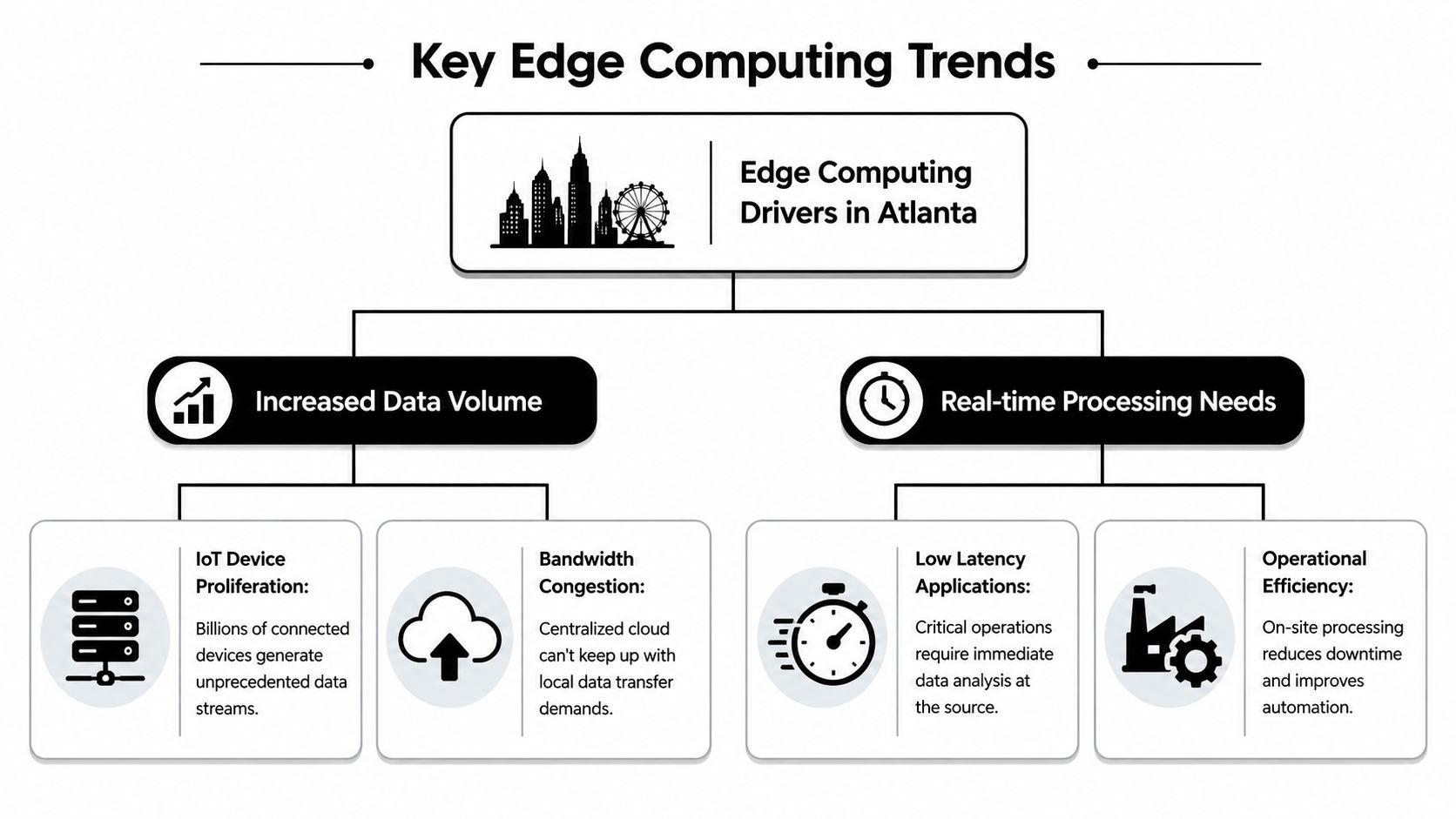
- Data-heavy facilities: Cameras, IoT devices, and machine-generated data often overwhelm a cloud-only design.
A practical starting point is to review where your environment already behaves like an edge candidate. If a site can't tolerate delay, if WAN interruptions cause real downtime, or if too much raw data is being transported without adding value, that workload deserves a second look.
Operational lens: Edge works best when teams treat it as infrastructure design, not as a gadget purchase.
Atlanta companies also need to think about storage architecture alongside compute placement. That becomes clearer when you look at Atlanta's growing demand for data storage solutions, because edge doesn't replace central systems. It changes what stays local, what gets filtered, and what belongs in long-term repositories.
Key Edge Computing Trends Shaping Local Business
The biggest shift isn't just that compute is moving closer to the source. It's that the edge is becoming smarter. Atlanta firms evaluating edge today shouldn't plan only for local caching, basic failover, or simple protocol translation. They should plan for AI-enabled edge infrastructure that can analyze, classify, and act on data locally.
According to Gartner, generative AI is projected to be part of 60% of all edge computing deployments by 2029, up from 5% in 2023, as cited in Digi's overview of edge computing trends. That matters because edge is no longer just a place to reduce traffic. It's increasingly where real-time AI inference happens.
AI at the edge is changing system design
For Atlanta operations, AI at the edge has very practical implications. A warehouse may need local video analytics. A clinic may need fast analysis at a device or workstation level. A campus may need automated anomaly detection without sending every stream back to a centralized platform.
That changes hardware and software planning in a few ways:
- Compute selection matters more: Basic branch servers may not be enough if local inference is part of the roadmap.
- Workload packaging becomes critical: Teams increasingly rely on containerized services to keep deployments consistent across sites.
- Data handling gets stricter: Local filtering decides what should be retained, what should be escalated, and what should never leave the site.
The mistake I see most often is under-scoping the edge node. Teams buy for current demand, then discover the business wants AI, computer vision, or more advanced automation the following refresh cycle.
Connectivity is the enabler, not the strategy
5G is part of the broader edge story because it expands where low-latency, high-responsiveness services become feasible. But 5G by itself isn't the trend. The trend is what businesses can do once mobile and distributed devices can interact with localized compute more reliably.
For Atlanta, that opens the door for more responsive field operations, mobile endpoint workflows, and distributed monitoring across large properties or multi-site footprints. Still, the strongest edge deployments don't start with “we have 5G.” They start with a specific operational requirement.
A useful way to assess readiness is to ask:
| Question | Why it matters |
|---|---|
| Does this workload need immediate response? | Latency-sensitive systems benefit most from local processing. |
| Is the site generating more raw data than the WAN should carry? | Edge can reduce unnecessary backhaul. |
| Would local decision-making improve uptime or safety? | Edge supports resilience when central connectivity is impaired. |
For teams also reviewing governance and security implications, IT risk management trends for Atlanta businesses is a useful companion topic, because the edge expands your operational perimeter whether you acknowledge it or not.
Edge becomes valuable when local action matters more than centralized visibility in that moment.
Edge in Action Across Atlanta Industries
Edge computing makes the most sense when you stop describing architecture and start describing work. In Atlanta, the strongest use cases usually appear in industries with distributed facilities, heavy operational data, or a low tolerance for delay.

Healthcare and clinical environments
A hospital or specialty clinic doesn't want every workflow to pause while a centralized system catches up. In a medical setting, local processing can support imaging workflows, bedside device integration, and rapid alerting tied to time-sensitive events. The value isn't abstract. Staff need systems that respond immediately and continue operating even when broader networks are under stress.
This is especially relevant in large metro healthcare ecosystems where facilities span multiple buildings and outpatient sites. Edge can help organizations place the right processing power close to diagnostic equipment, monitoring systems, and front-line operations.
Logistics, warehousing, and transportation support
Near freight corridors, industrial parks, and airport-adjacent operations, the edge case is often obvious. Conveyor systems, scanners, cameras, environmental sensors, and worker-facing applications all benefit when decisions happen locally.
A warehouse team may use edge infrastructure to analyze video streams on-site, route only exceptions to central systems, and keep automation moving during connectivity disruptions. A cloud-only pattern can still support long-term analytics, but daily operations improve when the facility doesn't have to wait on every round trip.
Campuses, public sector, and research settings
Schools, universities, and government facilities often manage broad physical footprints. They may have labs, surveillance systems, building controls, classroom technology, and public-service applications that all create local processing demand. Edge can support those environments by segmenting workloads and keeping essential functions near the endpoint.
Three patterns show up repeatedly:
- Smart facilities: Building systems work better when local controllers and compute can respond quickly.
- Security operations: Video and access systems generate more data than many organizations want to backhaul continuously.
- Research and specialized computing: Some workloads need local performance before data is archived or moved centrally.
Keep the cloud for aggregation, oversight, and long-term analytics. Keep the edge for decisions that can't wait.
Atlanta's mix of healthcare, logistics, higher education, media production, and public services gives edge computing broad relevance. The winning projects aren't the ones with the flashiest hardware. They're the ones tied to a real operational bottleneck and a clear site-level business case.
Planning Your Edge Deployment Strategy
Most edge projects don't fail because the concept is wrong. They fail because the operating model never catches up to the architecture. The primary challenge for businesses moving to edge is not the technology itself, but redesigning site infrastructure, power, cooling, and device refresh cycles to support it, as discussed in Davenport Group's guidance on edge computing business impacts. That's a major issue in metro Atlanta, where many organizations run branch offices, retail sites, clinics, and other distributed locations.
Picking the right deployment model
Most Atlanta businesses end up choosing among three approaches.
| Model | Works well when | Trade-off |
|---|---|---|
| Build on-site | You need direct control at the facility | More responsibility for power, cooling, support, and physical security |
| Use colocation | You want control over hardware without housing it in every site | You still need disciplined workload placement and transport planning |
| Consume edge as a service | You need speed and operational simplicity | Less customization and potentially tighter vendor dependency |
What doesn't work is treating every site the same. A flagship facility may justify substantial local infrastructure. Smaller sites may only need compact appliances or gateways. Some locations shouldn't host meaningful compute at all.
Security and networking decisions at the site level
Distributed infrastructure expands the number of systems that can drift from policy, miss updates, or sit physically exposed. That means edge security has to include endpoint hardening, local access control, encryption policy, and remote management discipline. If a team can't patch and monitor a site consistently, it shouldn't deploy critical workloads there.
Networking details also matter more than many buyers expect. Teams evaluating branch and facility hardware should understand when visibility and control justify managed switching and when simplicity is enough. For buyers comparing options, this primer on understanding managed vs unmanaged switches is useful because switch choice affects segmentation, monitoring, and supportability across edge sites.
A practical planning checklist should include:
- Power review: Confirm each facility can support the intended hardware reliably.
- Cooling reality check: Small rooms often run hotter than design documents suggest.
- Remote support model: Decide who owns updates, monitoring, and break-fix response.
- Refresh planning: Don't deploy devices without a retirement and replacement path.
For governance, IT asset management best practices belongs in the same conversation. Edge isn't just an infrastructure project. It's an asset tracking project with infrastructure consequences.
The Hidden Impact on Your Hardware Lifecycle
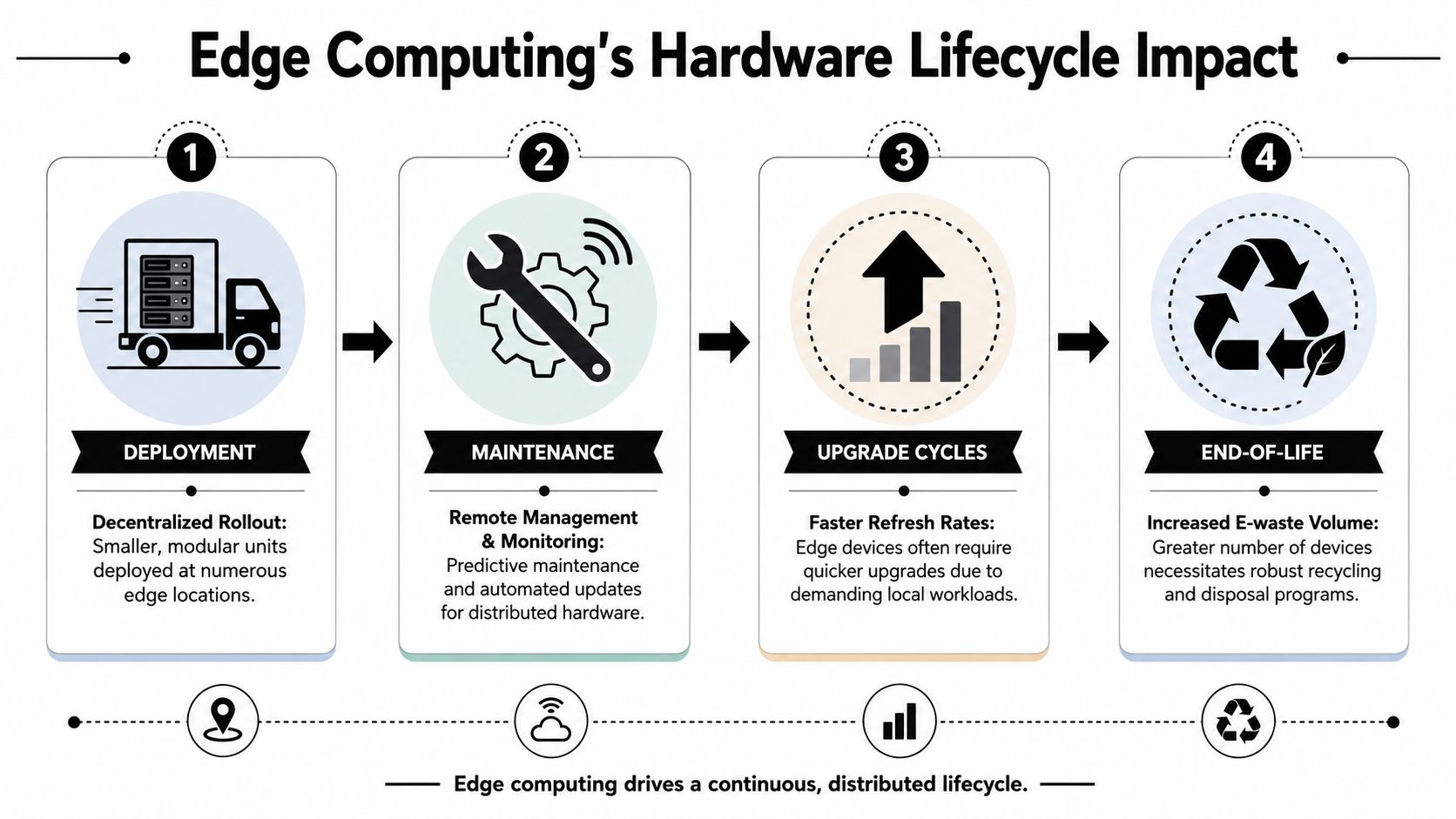
Every edge strategy creates a physical consequence. More localized compute means more boxes in more places, more storage devices outside the core, more accessories in closets and enclosures, and more equipment that eventually reaches end of life. That hardware reality gets ignored until the first large refresh cycle arrives.
Many teams still think about lifecycle management as a data center issue. Edge changes that. Instead of retiring a concentrated block of hardware from one server room, you may be collecting small batches from clinics, branch offices, retail stores, labs, and warehouses across the metro area. That's harder to inventory, harder to secure, and easier to mishandle.
Why refresh cycles get messier at the edge
Edge equipment often lives in conditions that are less forgiving than a centralized facility. It may sit in dustier spaces, warmer network rooms, or mixed-use closets where non-IT staff can access it. Even when the hardware is enterprise-grade, the environment may not be.
That creates a few predictable problems:
- Uneven aging: One site's appliance stays healthy while another site's identical unit degrades faster.
- Accessory sprawl: Mounting kits, UPS units, drives, cables, and small peripherals get lost in the lifecycle conversation.
- Poor chain of custody: Devices are removed locally and stored informally before central IT knows they're gone.
Field lesson: If you can't account for a retired edge device within the same process you used to deploy it, your lifecycle controls are incomplete.
ITAD becomes part of architecture, not cleanup
At this stage, IT asset disposition (ITAD) stops being an afterthought. A serious edge program needs a retirement process built into procurement, deployment, maintenance, and decommissioning. Otherwise, old hardware lingers in offices, closets, and storage cages long after it should've been sanitized and removed.
That's why teams should map the lifecycle before rollout. Decide how assets will be tagged, who authorizes removal, how storage media will be handled, and how retired devices move from field sites to final disposition. The more distributed your edge footprint becomes, the more important those answers get.
For teams formalizing that process, the lifecycle of IT equipment from acquisition to recycling with Reworx in Atlanta is relevant because it connects deployment planning with end-of-life execution. That connection matters more in edge environments than in traditional centralized estates.
Sustainable ITAD for Atlanta's Edge-Powered Future
Atlanta businesses that expand edge infrastructure will also expand their disposal burden. Some retired gear can be remarketed or reused internally. Some has to be dismantled and recycled. Some contains storage media or sensitive components that require secure handling from the moment the device leaves service. If the organization treats all of that as generic junk removal, risk piles up fast.
What responsible disposal actually requires
A sound ITAD program for edge environments should cover more than pickup. It should include documented chain of custody, secure data destruction, clear separation between reusable and non-reusable assets, and processes that fit distributed collections from multiple sites. It also helps when the recycling program supports broader sustainability goals rather than treating old hardware as waste only.
That's where a donation-based recycling model can fit well for Atlanta organizations trying to align IT modernization with environmental and community commitments. Reworx Recycling provides electronics recycling, secure data destruction, IT equipment disposal, and pickup services that support organizations retiring outdated business hardware, including the kinds of systems that can accumulate during edge refresh cycles. Companies evaluating local options can review Atlanta e-waste recycling services as part of a broader ITAD plan.
Why social impact belongs in the discussion
The edge conversation usually centers on latency, AI, and infrastructure design. It should also include what happens after devices leave production. Donation-based recycling and social enterprise recycling models give businesses a way to connect responsible disposal with community value, digital inclusion, and practical environmental stewardship.
For Atlanta firms, that can support several goals at once:
- Secure data handling: Sensitive devices need controlled retirement, not casual storage.
- Sustainable recycling: Equipment that can't be reused should be processed responsibly.
- Corporate donation programs: Usable technology can support community outcomes when routed appropriately.
- Operational cleanup: Office cleanout, facility cleanout, laptop disposal, computer recycling, and product destruction all become easier when one process covers them consistently.
The important point is simple. Edge computing increases the number of devices your organization owns outside the traditional core. A sustainable ITAD program keeps that growth from turning into a security problem, a compliance headache, or an unmanaged e-waste stream.
Your Next Steps for Smart Adoption and Responsible Disposal
Most Atlanta businesses don't need an edge-everywhere strategy. They need a disciplined one. Start with the workloads that suffer most from delay, interruption, or unnecessary backhaul. Then test whether local compute improves operations enough to justify the added infrastructure and lifecycle burden.
A practical readiness checklist
Use this short checklist before you expand:
- Identify the right workloads. Focus on locations where immediate processing changes service quality or uptime.
- Match the site to the design. Don't place serious hardware in facilities that can't support power, cooling, or physical security.
- Standardize operations. Remote monitoring, patching, and field support need a repeatable model before rollout.
- Plan retirement before deployment. Every edge node should have an ownership record, media-handling rule, and disposition path.
- Include sustainability leaders early. Electronics recycling, secure data destruction, medical equipment disposal, laboratory equipment disposal, and data center decommissioning all connect back to procurement decisions.
What smart teams do differently
The strongest programs treat infrastructure and disposal as one lifecycle. They don't separate innovation from responsibility. They know a new edge deployment today becomes tomorrow's decommissioning event, and they build for that from the start.
Smart adoption means choosing where edge belongs, where it doesn't, and how every device will leave service before it ever goes live.
If your team is evaluating edge computing trends in Atlanta businesses, keep the strategy grounded in operational realities. Budget for the facility changes. Secure the distributed footprint. Track the hardware. And don't wait until closets fill with retired appliances, drives, and endpoints before building your ITAD process.
Businesses planning edge upgrades, office cleanouts, laptop disposal, secure data destruction, or broader IT asset disposition can explore Reworx Recycling for practical guidance on responsible electronics recycling, pickup coordination, and donation-based recycling programs that support both environmental goals and community impact.