
A merger closes on Friday. By Monday, someone in Atlanta is sorting through duplicate laptop fleets, inherited mobile devices, badge access tied to departed staff, and racks of equipment that still hold regulated data. The headline is the transaction. The operational risk starts after signing.
That is the right frame for any discussion of Atlanta Tech Mergers and Acquisitions to Watch. Deal activity in technology remains active, and Atlanta continues to attract buyers because it combines enterprise density, fintech scale, and a steady pipeline of software and infrastructure companies. Financial coverage usually stops at valuation, market share, and investor logic. Operating teams do not have that luxury.
Post-close integration creates a second workstream that rarely gets enough attention. Teams have to reconcile endpoint inventories, retire overlapping hardware, preserve records, control chain of custody, and decide what can be redeployed, refurbished, or destroyed. Every one of those decisions affects security, compliance, cost, and ESG reporting. For companies absorbing another business, IT asset disposition services in Atlanta for corporate IT teams belong in the integration plan early, not after surplus equipment starts piling up in storage rooms.
That operational aftermath is where real execution separates disciplined acquirers from expensive ones. A buyer can pay the right multiple and still create avoidable exposure if redundant assets sit untracked, hard drives leave the building without documentation, or disposal vendors cannot support enterprise reporting. Atlanta's M&A story is not only about which companies get bought. It is also about which buyers are prepared to turn IT turnover, data destruction, and electronics recycling into a controlled part of the deal thesis.
1. The Target Enterprise IT Asset Management Platforms
A buyer closes an Atlanta tech deal and inherits thousands of laptops, monitors, network appliances, and mobile devices spread across offices, storage rooms, and remote employees. The headline may be about product fit or market share. The integration risk often starts with a simpler question. Who can account for every asset, prove what happened to the data, and show finance what can be reused, resold, or retired?
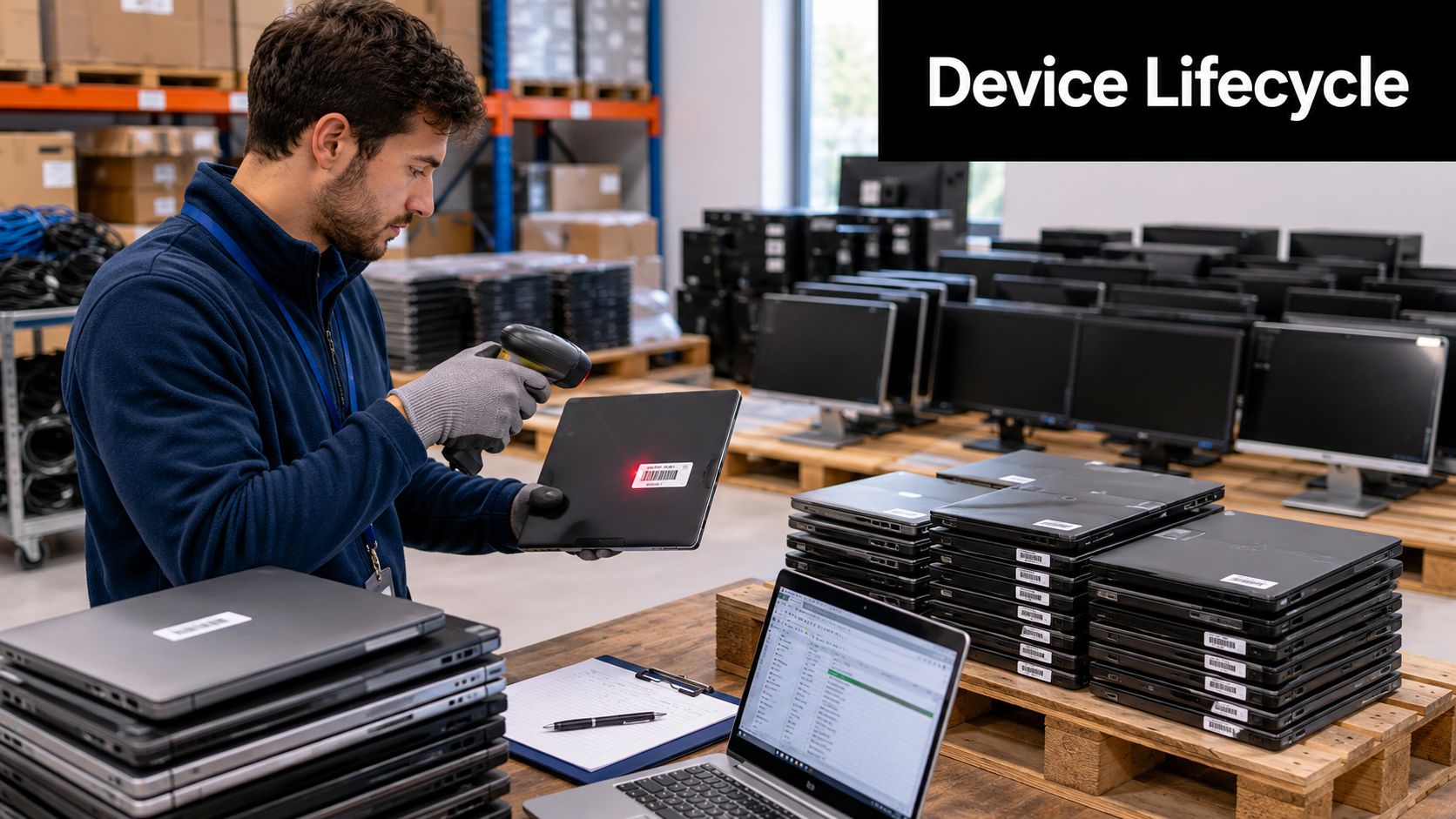
That is why enterprise IT asset management platforms deserve attention in Atlanta's M&A market. These businesses give acquirers a system for tracking devices from deployment through disposition, documenting chain of custody, recording sanitization outcomes, and turning reverse logistics into client-facing reporting instead of an internal scramble.
The appeal is operational, not just technical. Buyers get standardized workflows, cleaner audit trails, and a faster path to integrating overlapping hardware estates after a merger. For acquirers rolling up managed services, ITAD, or enterprise support capabilities, that control can matter as much as the codebase.
The broader deal environment supports that thesis. PwC notes in its 2025 Global M&A Industry Trends Outlook for technology, media and telecommunications that buyers continue to focus on assets tied to software, data, and infrastructure where post-close execution can determine whether value is realized. In practice, platform targets with disciplined asset data, reporting logic, and process consistency tend to be easier to scale than service businesses that still rely on spreadsheets and manual handoffs.
Practical rule: Review the platform architecture before consolidating accounts. If serial conventions, asset states, and reporting fields do not match, integration slows down, client communication gets messy, and exception handling multiplies.
Atlanta is a strong market for this target type because enterprise clients here usually need more than pickup capacity. They need a platform that can support office consolidations, refresh cycles, inherited assets from acquired business units, and documented downstream handling. That requirement gets sharper after a transaction, when legal, security, procurement, and sustainability teams all want different answers from the same asset record.
A common buyer profile is an MSP, lifecycle services provider, or recycler that wants to move upstream with larger accounts. Acquiring an IT asset management platform can shorten that path. Instead of building portal functionality and compliance workflows internally, the buyer gets established process logic, customer reporting habits, and teams that already know how enterprise clients review disposition events. Companies evaluating service support around secure retirement work often pair that platform need with local execution such as hard drive shredding services for retired enterprise devices.
The deals that work usually share a few traits:
- Keep the account operators in place: Enterprise customers often trust the people managing exceptions, audits, and reporting reviews as much as the software itself.
- Reconcile client promises early: If two organizations define turnaround times, pickup scopes, or disposition categories differently, cross-selling creates friction instead of growth.
- Stage system integration carefully: Portal migration, barcode schema, and asset status mapping should happen in phases, especially when active refresh projects are already underway.
- Test disposition reporting before rollout: Finance, compliance, and security teams will all read the same report differently. Weak field definitions create disputes after the merger, not before it.
For operators handling post-close cleanup, Atlanta IT asset disposition services for corporate IT teams fit into the integration plan as a control function. They help determine what equipment can be redeployed, what must be destroyed, and how the company documents the result for auditors, insurers, and ESG reporting. In an active M&A market, that discipline turns surplus hardware from a liability into a managed workstream.
2. The Target Specialized Data Destruction and Logistics Providers
If I were screening Atlanta-adjacent targets for defensive value, I'd put specialized data destruction and logistics providers near the top of the list. They solve a hard problem that gets more urgent after every merger, office consolidation, and hardware refresh.
These businesses combine secure pickup operations with witnessed destruction, mobile shredding capacity, documented chain of custody, and compliance-ready certificates. That makes them sticky with healthcare systems, financial institutions, school districts, and public-sector clients that can't treat retired devices like ordinary surplus.
What acquirers are really buying
The obvious asset is the destruction capability. The less obvious asset is trust. A regional provider with disciplined routing, trained technicians, and standardized documentation can become the anchor for a broader Southeast expansion strategy.
That post-close discipline matters more now than many deal teams admit. KPMG notes that execution scrutiny and integration feasibility are now decisive gatekeepers rather than afterthoughts in the broader TMT market, especially as buyers focus on assets tied to data infrastructure, tooling, and security, as outlined in its tech, media, and telecom M&A trends analysis.
Buyers don't lose sleep over the press release. They lose sleep over the inherited laptop with customer data that nobody logged before it left the branch office.
A realistic example is a regional compliance services firm acquiring a local destruction specialist with mobile capability. The acquirer can bundle on-site drive shredding into branch closures, office cleanouts, and equipment retirement projects, then use the acquired logistics footprint to support faster pickups across metro Atlanta and surrounding markets.
Integration usually goes wrong in familiar ways:
- Documentation drift: One team uses strict chain-of-custody forms, another uses lighter field records.
- Routing inefficiency: Mobile units sit idle because dispatch isn't merged with pickup scheduling.
- Sales overpromises: Commercial teams sell witnessed destruction without understanding site access, security constraints, or volume handling.
When the operation is disciplined, though, this target type gives the buyer a compliance-led service line that competitors can't easily fake. That's one reason secure destruction remains one of the most practical areas to watch.
For organizations retiring sensitive equipment after a merger, hard drive shredding services near Atlanta fit directly into the risk-management side of IT equipment disposal and secure data destruction.
3. The Target Regional Electronics Processing Centers
A regional electronics processing center changes the economics of an acquisition. Instead of relying heavily on downstream partners, the buyer controls more of the physical flow from collection through dismantling, material segregation, and outbound commodity or reuse channels.
That kind of target doesn't always look glamorous from the outside. Warehouses, sort lines, gaylords, test benches, pallets of monitors, and cages of mixed peripherals don't read like venture-backed software. But for operators, margin control and sustainability credibility become real in these settings.
Vertical integration has operational advantages
An Atlanta-area processor can help a buyer reduce dependency on third parties, tighten turnaround times, and produce cleaner reporting for clients that want to know where retired equipment went. That matters for sustainability managers who need more than a pickup receipt.
It also fits the broader market tone. Adweek, citing JP Morgan data, reported that across technology, media, and advertising, M&A volumes reached about US$4.3 trillion in 2025, up 39% from 2024. In adjacent adtech, martech, and digital content, activity was also up year over year in the same report, which suggests a market liquid enough to support both larger platform transactions and more practical infrastructure acquisitions.
For an acquirer, the value isn't just in recovered commodities. It's in process visibility. A processing center can support:
- Material recovery reporting: Useful for ESG and procurement teams that want documented downstream handling.
- Faster triage: Devices can move quickly into reuse, parts harvesting, or recycling streams.
- Less vendor sprawl: Fewer handoffs usually mean fewer chain-of-custody gaps.
What buyers often underestimate
Environmental diligence is the first hurdle. Older facilities may carry equipment replacement needs, permit questions, or historical handling practices that don't fit the buyer's standards.
Commodity exposure is the second. If the deal model assumes every outbound stream will hold favorable pricing, the buyer can get surprised quickly. Strong operators protect themselves with conservative assumptions, disciplined sorting, and clear downstream relationships.
Businesses looking for a local partner in this part of the lifecycle often start with Georgia electronics recycling services because they need an outlet that can handle both volume and reporting, especially during office cleanouts, facility cleanouts, and post-merger decommissioning work.
4. The Target B2B E-Waste Logistics SaaS Platforms
This is the category a lot of operators overlook until they have to coordinate pickups across multiple sites. Then they realize the actual bottleneck isn't always the truck. It's the workflow.
A B2B e-waste logistics SaaS platform can centralize scheduling, approvals, asset declarations, chain-of-custody records, and compliance reporting. For a buyer, that creates a digital front door to physical services. It also creates a recurring software relationship that can outlast a one-time office cleanout.
Software turns a local service into a network
The most valuable platforms don't just dispatch jobs. They reduce friction between the business retiring assets and the teams processing them. A university can coordinate end-of-semester laptop collection. A healthcare system can manage device retirement requests across departments. A distributed company can standardize how branches submit equipment for secure pickup.
PwC's U.S. technology deals outlook says AI capabilities and the infrastructure stack behind them are driving a new phase in tech M&A, with buyers focusing on high-conviction assets tied to data, compute, and security in this technology deals outlook. Even in e-waste and ITAD, that logic applies. If the platform captures high-quality operational data and supports defensible compliance workflows, it's more than scheduling software.
A practical acquisition thesis here is simple. A recycler or ITAD firm buys a SaaS business that already owns customer workflows, then layers in physical service capacity. That combination can be hard to displace because the customer doesn't want to retrain users, rebuild reporting, and reconfigure approvals just to switch vendors.
Field note: Technical debt matters more in this category than the demo suggests. If the platform's reporting engine is brittle, enterprise clients will discover it during the first audit.
Buyers should pressure-test a few areas before they move:
- Customer contract quality: Are renewals driven by true workflow dependence or by inertia?
- Data structure: Can the platform support varied asset classes, locations, and disposition outcomes?
- Service integration: Does the software cleanly connect with pickup, processing, and certificate generation?
If your team is trying to understand the movement side of the equation, reverse logistics in the supply chain is the core concept behind making these platforms work at scale.
5. The Target Certified Independent Recycler Networks
A buyer closes two or three recycler acquisitions across the Southeast and inherits a familiar post-deal problem. The branches share little beyond the word "recycling." Intake rules differ. Chain-of-custody documentation varies by site. Downstream vendor controls are inconsistent. In an M&A cycle where companies are consolidating operations fast, that gap can turn redundant IT assets into a security, compliance, and e-waste liability.
Certified independent recycler networks deserve attention because they solve for local trust and regional scale at the same time. The best platforms in this category keep customer-facing relationships close to the market while bringing discipline to audit trails, environmental handling, and asset disposition controls. That matters after a merger, when the combined company often has equipment spread across offices, warehouses, data rooms, and remote employee homes.
The attraction for acquirers is straightforward. Private equity and strategic buyers continue to favor add-on acquisitions and regional roll-ups in fragmented service industries, especially in the middle market, according to GF Data's middle-market M&A reporting. Certified recycler networks fit that playbook because they offer density, recurring commercial relationships, and a path to standardizing operations without erasing local market knowledge.
That last point is where deals often succeed or fail.
In this category, local identity still carries real weight. Municipal buyers, school systems, hospitals, and enterprise facilities teams usually rely on known operators with established pickup practices and a record of handling retired equipment correctly. Strip away that trust too quickly and customer retention gets harder. Leave every location untouched and the acquirer misses the operational upside it paid for.
A sound integration thesis usually focuses on a short list of controllable items:
- Keep local operators in place: Relationship continuity often matters more than immediate brand consolidation.
- Standardize compliance controls: Certificates, intake records, downstream tracking, and site safety need one operating standard across the network.
- Rationalize logistics carefully: Route density and processing capacity can improve margins, but only if service windows stay reliable.
- Review data-risk edge cases: Devices sent into recycling streams still surface with recoverable information, which is why some acquirers also assess adjacent capabilities such as professional data recovery during diligence.
The trade-off is speed versus control. Spreadsheet synergies look clean. Field integration rarely does. Different forklift setups, packaging methods, customer SLAs, and state-level requirements create friction fast. Experienced buyers centralize finance, reporting, vendor qualification, and policy first. Then they phase in operating changes market by market.
For companies dealing with merger aftermath, this category is more strategic than it first appears. A certified network can help absorb the surge of retired devices that follows consolidation, reduce exposure tied to inconsistent handling, and keep more material out of the wrong downstream channels. That is not just an environmental story. It is part of making the deal work operationally.
6. The Target Secure Data Wiping and Refurbishment Specialists
The most interesting targets in this space sit between disposal and resale. They know how to sanitize devices, grade them accurately, repair what makes economic sense, and move usable hardware back into service through resale, redeployment, or donation.
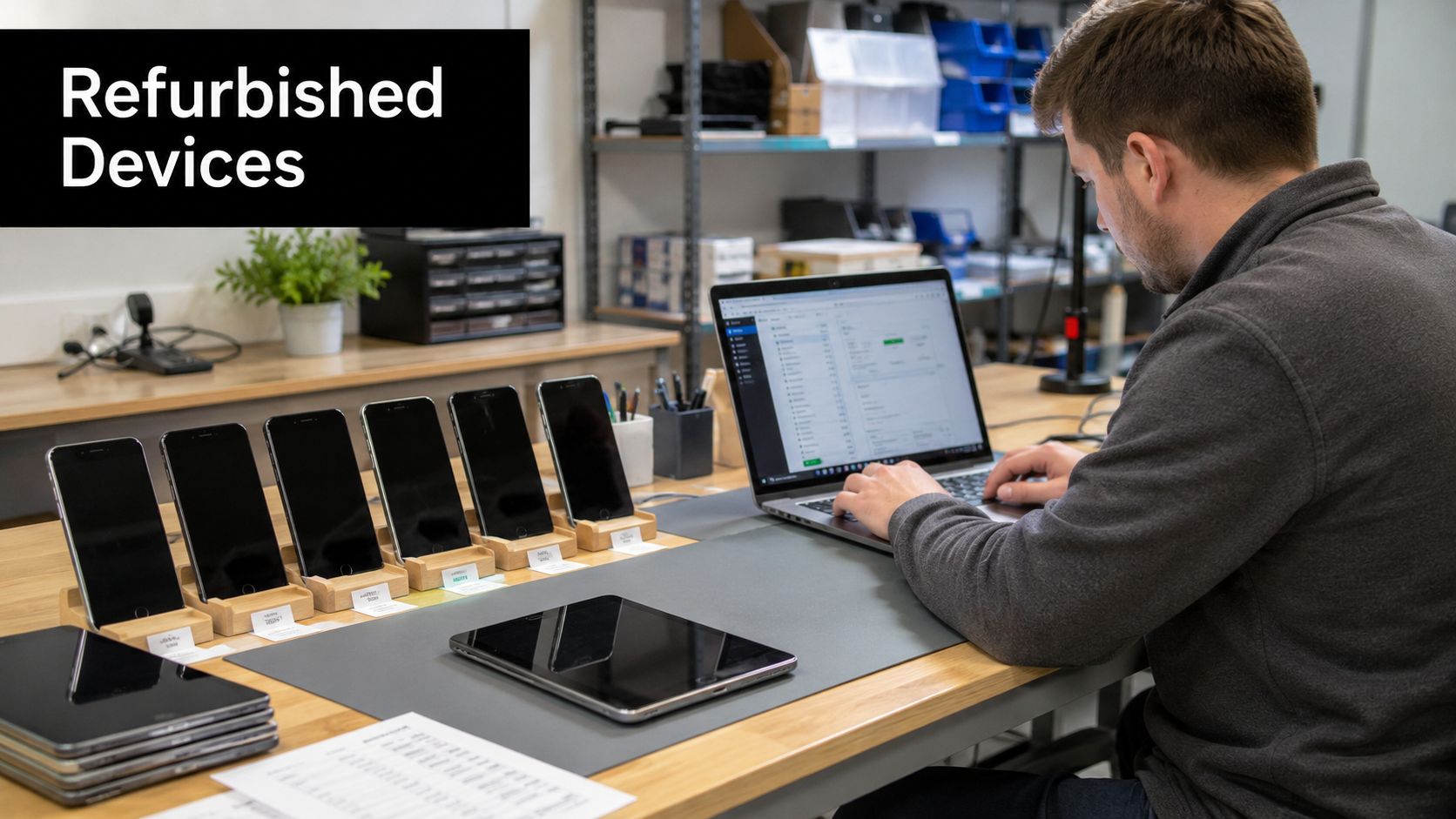
That capability becomes especially valuable after a merger. The combined company often discovers a mix of newer laptops, overbought accessories, retired desktops, and still-usable mobile devices that don't need to become scrap. A buyer that owns refurbishment can recover more value and support a stronger circular-economy story at the same time.
Value recovery is only real if process quality is real
This category attracts interest because it moves a company up the value chain. But it only works when the operation is disciplined. Weak grading, inconsistent wiping records, and sloppy inventory controls can destroy trust fast.
Travelers reports that tech M&A drove about 3,300 transactions worth more than $450 billion in 2024, and says private equity activity is a major driver of tech deals across the U.S. For operators in the aftermath of those transactions, that means more system standardization, more device replacement, and more pressure to decide what gets destroyed, redeployed, sold, or donated.
A refurbishment specialist can support several practical outcomes:
- Corporate buyback programs: Equipment that still has value can offset transition costs.
- Donation-based recycling: Usable devices can support community distribution rather than immediate shredding or scrap.
- Secondary market recovery: The buyer gets a more flexible disposition model than pure recycling alone.
Refurbishment isn't the opposite of security. Good refurbishment starts with security, then moves to testing, grading, and controlled remarketing.
The strongest operators also know when not to refurbish. Devices with poor specs, physical damage, battery issues, or uncertain chain of custody often belong in recycling streams instead. That judgment is part of the capability being acquired.
In some cases, companies also need adjacent support like professional data recovery before a final disposition decision, especially when a critical device surfaces late in a consolidation project.
7. The Target Sustainability and ESG Reporting Consulting Firms
The integration committee signs off on a merger. Within weeks, the practical questions start piling up. Which devices are being redeployed, which are headed for destruction, who can document the chain of custody, and how will leadership report the environmental outcome without creating legal or reputational exposure?
That is why sustainability and ESG reporting consulting firms can be attractive targets. They shift the acquirer from a company that removes retired equipment to one that helps set policy, document outcomes, and connect IT asset disposition to board-level reporting. In post-merger environments, that advisory layer has real value because the asset surge is predictable, but the reporting discipline often is not.
The appeal is not headline M&A volume. It is what follows the deal. Larger integrations usually bring site closures, endpoint standardization, data-bearing asset reviews, and pressure from procurement, legal, and sustainability teams to show what happened to retired equipment. A consulting capability helps establish rules before the backlog turns into a cleanup exercise.
That changes the buying conversation.
An advisory-led firm can get involved during integration planning, not just after pallets of equipment appear in a warehouse. The strongest targets help buyers define lifecycle policy, set evidence standards, and translate operational activity into reports that executives can use.
Typical consulting-led capabilities include:
- Lifecycle policy design: Rules for redeployment, donation, resale, destruction, and recycling based on risk, value, and reporting needs.
- Cross-functional reporting: Outputs that finance, procurement, legal, and sustainability teams can all review without reconciling conflicting data.
- Program design tied to operations: Consulting paired with secure disposition, downstream vendor controls, and audit-ready documentation.
There is a real trade-off, though. Advisory firms can improve margins and strengthen executive relationships, but weak technical grounding becomes obvious fast. If the consultancy cannot trace material streams, verify data destruction records, or account for downstream vendors, the reporting layer creates exposure instead of reducing it.
That is why this target category matters in Atlanta's tech M&A pipeline. The winner is not the firm with the best slide deck. It is the one that can connect sustainability claims to operational proof across reused, resold, destroyed, and recycled assets. For companies trying to tie merger integration to measurable environmental performance, ESG electronics recycling programs provide a useful model for structuring disposal, reuse, and reporting as one coordinated process.
Atlanta Tech M&A Targets: 7-Point Comparison
| Acquisition Target | Implementation Complexity 🔄 | Resource Requirements ⚡ | Expected Outcomes 📊 | Ideal Use Cases 💡 | Key Advantages ⭐ |
|---|---|---|---|---|---|
| Enterprise IT Asset Management Platforms | Very high, deep system integration, legacy modernization | Large capital outlay, skilled IT teams, account management | Enterprise contracts, recurring revenue, rapid national scale | Acquire to serve Fortune 500 clients and scale enterprise services | Proprietary software, established enterprise relationships, compliance certifications (High ⭐) |
| Specialized Data Destruction & Logistics Providers | Moderate, operational complexity with fleet & compliance | Mobile shredders, trained technicians, robust chain-of-custody systems | Defensible, compliance-driven revenue and regional consolidation | Add on-site destruction for healthcare, finance, and regional clients | Mobile secure destruction capability, differentiation on compliance (Strong ⭐) |
| Regional Electronics Processing Centers | High, capital-intensive, environmental and regulatory burden | Heavy equipment, facility CAPEX, specialized workforce | Increased margins via material recovery and vertical integration | Control downstream processing to capture commodity value | Direct commodity sales, higher margins, strong ESG reporting (High ⭐) |
| B2B E-Waste Logistics SaaS Platforms | Medium, tech modernization, integrations, security concerns | Engineering, cloud infra, customer success, API integrations | Scalable recurring SaaS revenue and direct digital customer relationships | Platform-driven expansion and integration with enterprise EAM systems | Recurring revenue, defensible data-driven moat, scalable growth (High ⭐) |
| Certified Independent Recycler Networks | Medium, many small integrations, standardization required | Multiple acquisitions, local management retention, certification upkeep | Rapid geographic expansion, network effects for enterprise contracts | Roll-up strategy to expand regionally while preserving local trust | Fast market entry, local brand equity, existing certifications (Moderate ⭐) |
| Secure Data Wiping & Refurbishment Specialists | Medium, inventory control, quality assurance challenges | Testing/diagnostics tools, refurb benches, working capital for inventory | High-margin resale, extended device lifecycles, stronger sustainability story | Build buyback/refurb programs for education, nonprofits, SMBs | Secondary market revenue, customer acquisition via buybacks, circular offering (Strong ⭐) |
| Sustainability & ESG Reporting Consulting Firms | Low–Medium, different operating model, longer sales cycles | Senior consultants, thought leadership, client-facing sales teams | High-margin advisory revenue and embedded strategic client relationships | Position as strategic advisor to C-suite on device lifecycle and ESG | C-suite access, high switching costs, informs product/service strategy (High ⭐) |
The M&A Aftermath Turning IT Chaos into Strategic Advantage
On day one after a deal closes, the integration plan usually centers on applications, headcount, contracts, and facilities. By week three, a different problem starts to surface. Duplicate laptops are stacked in storage, retired servers still sit in cages, and no one is fully sure which team owns the phones, networking gear, lab devices, or backup media left behind.
That operational spillover is one of the least discussed parts of Atlanta tech M&A. The market may reward software, data, security, and infrastructure plays, but the post-close work happens in the physical IT estate. As noted earlier, the volume of tech transactions remains high. Each integration decision creates a trail of hardware to inventory, secure, relocate, refurbish, remarket, recycle, or destroy.
The risk sits in the details. A decommissioned device can still hold regulated data, cached credentials, licensed software, customer files, or records subject to retention rules. A rushed cleanout can break chain of custody, erase asset visibility, and turn recoverable equipment into disposal cost. Leaders usually find the same trade-off here. Move fast and accept more risk, or build a disciplined process that protects data, captures residual value, and documents the outcome.
That is why IT asset disposition belongs in merger planning earlier than many teams expect. It is not a janitorial task at the end of integration. It is part of governance, security, and cost control. The companies that handle this well set policies before sites are consolidated, assign ownership across IT, security, facilities, and legal, and decide in advance which assets will be wiped, redeployed, remarketed, donated, or recycled.
Reworx Recycling fits into that operating model as a service provider for electronics recycling, secure data destruction, and donation-based recycling. For organizations working through office closures, laptop refreshes, product destruction, or data center decommissioning after an acquisition, that creates a more controlled path than treating every retired asset as scrap.
The business case is practical. A structured ITAD process supports chain of custody, device triage, documented destruction, responsible downstream handling, and reuse where it makes economic sense. It also helps companies avoid a common integration mistake. Mixing security-sensitive assets, recyclable material, and reusable devices into one bulk removal stream.
There is also a reputational and ESG angle that deserves more board-level attention. Post-merger cleanouts can generate large volumes of e-waste in a short period. Companies that route usable equipment into donation or refurbishment programs can reduce waste, support digital inclusion, and show a more credible operating approach than firms that only talk about sustainability at the policy level.
For CIOs, integration leaders, facilities teams, and sustainability managers, the measure of a successful deal is broader than the announcement and the synergy model. The inherited technology environment needs to be secure, documented, compliant, and physically cleared without losing control of data or recoverable value.
If your organization is dealing with surplus laptops, servers, monitors, networking gear, or other retired equipment after a merger or upgrade, Reworx Recycling can help you plan a secure, sustainable next step. Reach out to discuss donation-based recycling, schedule a pickup, or build a corporate program for responsible IT equipment disposal and community impact.