For inquiries about who buys telecom equipment in Houston, the scenario typically isn't limited to a single box of old desk phones. More often, it's a mix of retired VoIP handsets, PBX components, switches, routers, conference gear, cabling, and maybe a few racks of hardware left behind after a migration or office move. The hard part isn't finding someone willing to take it. The hard part is choosing a buyer that won't create a data security, compliance, or downstream disposal problem later.
Houston has plenty of outlets for telecom equipment, but they don't all solve the same problem. Some buyers want reusable gear with brand value. Others want weight, not functionality. Some can document chain of custody and data destruction. Others will load the pallet and leave. For a business manager, IT lead, or facilities team, those differences matter more than the first price quote.
A practical approach starts with one question: what outcome matters most for this batch of equipment? If the goal is cash recovery, the answer may be different than if the goal is secure retirement, sustainable recycling, or a clean audit trail for an office cleanout or data center decommissioning. In Houston, the right path usually depends on matching the asset type to the buyer type, then confirming that the process is defensible.
First Steps Identifying Your Telecom Assets and Their Potential Value
The fastest way to lose money on surplus telecom gear is to contact buyers before you know what you have. Vague descriptions like "phones, switches, and old network stuff" usually produce vague offers. Buyers price risk into incomplete inventories.
A useful inventory separates reusable equipment, parts-grade equipment, and scrap-only material. That distinction changes whether you're talking to a telecom reseller, an IT asset disposition provider, or a recycler handling electronics recycling and product destruction.
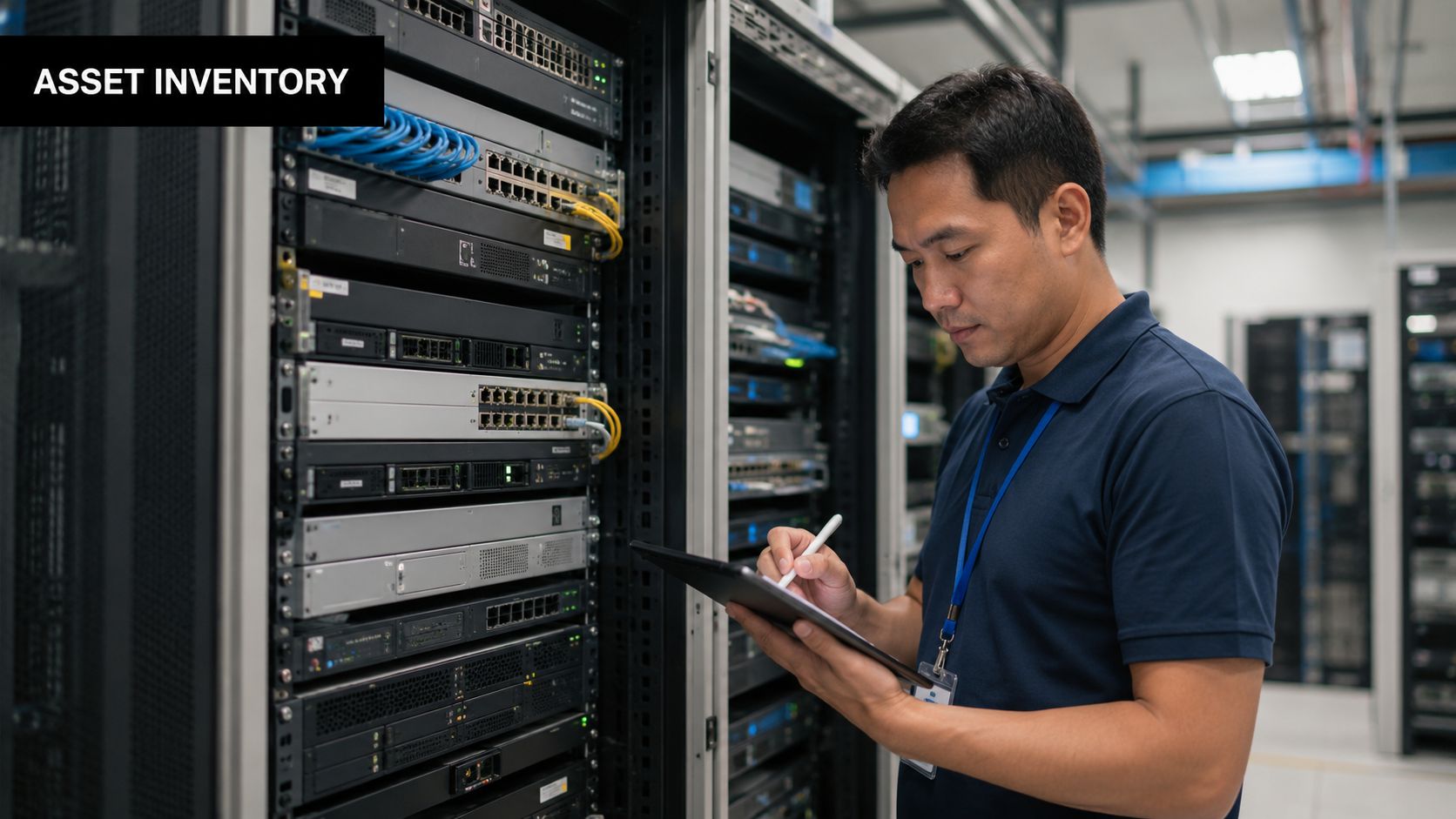
A disciplined inventory process is the same reason IT inventory audits matter before recycling. If your list is clean, you control the conversation. If it isn't, the buyer does.
Build the inventory by equipment family
Start by grouping assets into categories that buyers use:
- Voice systems: PBX shelves, cards, voicemail hardware, gateways, handsets, conference phones
- Network gear: switches, routers, firewalls, access points, controllers
- Infrastructure: racks, patch panels, UPS units, power supplies, optics, transceivers
- Peripheral lots: cables, adapters, injectors, mounting kits, spare parts
Then capture the details that affect resale.
| Item detail | Why it matters |
|---|---|
| Brand and model | Buyers sort demand by make and exact part number |
| Quantity | Bulk lots can justify pickup and project pricing |
| Working status | Tested gear is easier to place than unknown gear |
| Cosmetic condition | Missing faceplates, cracked plastics, and labels reduce value |
| Age or generation | Newer platforms often go to reuse markets, older ones go to parts or recycling |
| Completeness | Power supplies, licenses, cards, and accessories can change buyer interest |
Separate value recovery from disposal
Not every asset belongs in the same lot. A batch of Cisco switches, Avaya phones, or Juniper hardware may attract specialized buyers. Mixed broken handsets, damaged boards, and obsolete accessories often move better through computer recycling or broader electronics recycling channels.
Practical rule: Never mix your highest-value hardware into a scrap-weight lot unless you've already confirmed it has no resale path.
Businesses often make avoidable mistakes. They let a facilities cleanout team palletize everything together. Then a reseller declines the lot because it's too mixed, or a scrap buyer prices the entire batch by weight. Both outcomes leave money on the table.
Use condition labels that mean something
Don't overcomplicate grading. A short, honest condition label works:
- Pulled working: removed from service during upgrade, no known fault
- Untested: power status or functionality not verified
- For parts: incomplete, damaged, or failed units
- Scrap: no practical reuse value
If the inventory includes storage, voicemail, call recording, or management appliances, flag those separately. Their value isn't just in resale potential. They also carry handling risk because they may retain user, call, or configuration data.
That inventory becomes the foundation for every next step, including buyback, donation-based recycling, secure data destruction, and sustainable recycling planning.
Understanding the Houston Buyer Landscape
Houston isn't a one-lane market for retired telecom hardware. It's a layered reuse and recycling market with several buyer types operating side by side. That matters because "who buys telecom equipment in Houston" doesn't have one answer. It depends on whether your equipment still has secondary-market demand, whether the lot is mixed or sorted, and whether your organization needs documentation beyond a receipt.

Houston is a strong secondary market because it sits inside a large electronics-reuse ecosystem. In the Houston area, ScrapMonster lists 214 scrap yards that accept telecom equipment, and it reported a $0.18 per pound market price for telecom equipment on March 12, 2026, with stable pricing in that Houston data set, which points to an established commodity-and-reuse chain rather than a thin market for one-off assets (Houston telecom equipment pricing and accepting yards).
Four buyer categories and what each one does well
The Houston market usually breaks down into four groups.
Refurbishers and resellers want branded, reusable equipment. They care about model numbers, completeness, and condition. If you have clean lots of current or still-supported switches, routers, access points, or business phone systems, these buyers usually produce the best recovery.
Scrappers and commodity recyclers care about weight and material value. They're useful for obsolete handsets, damaged boards, cable-heavy lots, or mixed loads that no resale market wants. They're usually not the right first stop for reusable telecom inventory.
ITAD firms focus on secure retirement. They handle chain of custody, data-bearing assets, logistics, and downstream processing. Their value is strongest when the project includes secure data destruction, office cleanout work, or broader IT equipment disposal.
End-users and local businesses sometimes buy specific gear directly when they need replacement stock or compatible legacy hardware. This can improve price on the right item, but it tends to be slower and less predictable than working through an established channel.
A buyer that pays the most for one switch may be the wrong buyer for a pallet that also includes voicemail servers, call-recording hardware, and damaged phones.
The real trade-off isn't price alone
Many Houston sellers compare offers as if every quote covers the same service. It doesn't. A per-pound recycler, a lot buyer, and an ITAD provider are pricing different scopes.
A practical comparison looks like this:
| Buyer type | Best for | Main upside | Main limitation |
|---|---|---|---|
| Refurbisher | Tested branded gear | Better resale recovery | May reject mixed or damaged loads |
| Scrap buyer | Obsolete mixed material | Fast movement of low-value lots | Little upside on reusable assets |
| ITAD provider | Sensitive or mixed business assets | Documentation, secure handling, recycling coordination | Not always the highest immediate cash offer |
| End-user | Specific in-demand models | Can pay well for exact need | Slow and inconsistent |
If your telecom removal is tied to a relocation, timelines matter as much as pricing. Teams moving operations into Texas often need coordinated decommissioning and transport support before the recycling or resale phase begins. In those cases, a logistics resource like your Boston to Texas relocation partner can help frame the upstream move planning so disposal doesn't become a last-minute scramble.
For businesses that need secure handling as part of the transaction, secure IT asset disposition services in Houston for businesses are closer to their core need than a simple buyer directory. The buyer market only makes sense when you compare what each channel will document, sanitize, and take.
Securely Preparing Your Equipment for Sale or Disposal
Telecom equipment often leaves behind more than hardware. It can retain call logs, voicemail data, user directories, saved credentials, network settings, and customer information. That's why decommissioning can't be treated like a warehouse cleanup task.
The financial exposure is large enough to reset the conversation. IBM's 2024 Cost of a Data Breach Report found the global average cost of a data breach reached USD 4.88 million, a figure cited in this telecom equipment disposal context by Montclair Crew, and that's why a buyer's sanitization process matters more than a price-per-pound offer (data-breach cost reference in telecom disposal context).
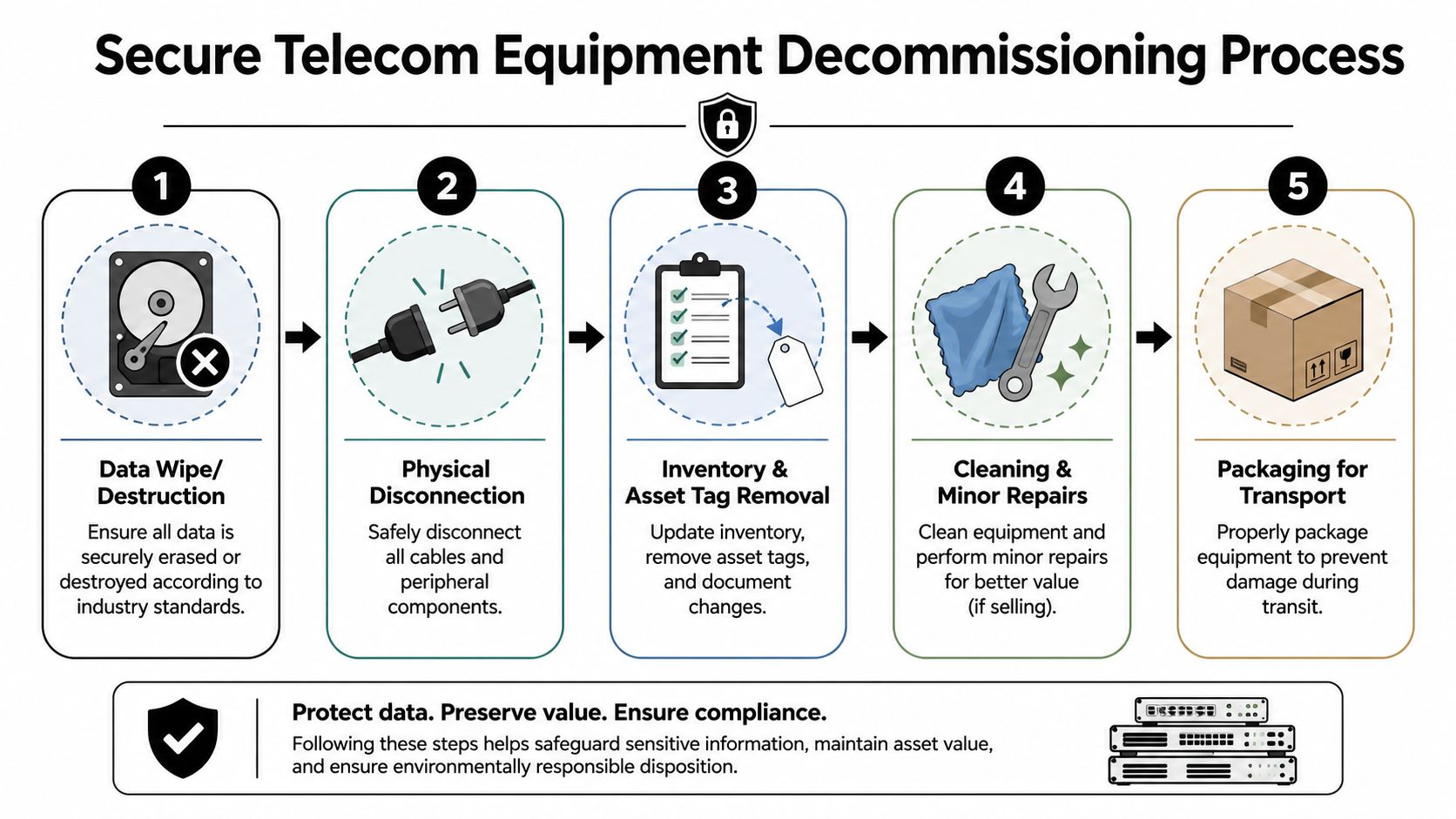
Decommission the equipment before it changes hands
A sound process has five parts.
Identify data-bearing devices first
Don't assume only servers store information. Voicemail systems, call managers, UC appliances, certain phones, and network management hardware may all hold residual data.Choose the right sanitization method
Some equipment can be wiped and redeployed. Some media should be physically destroyed. The right choice depends on the asset, the storage type, and your internal policy.Remove from production cleanly
Export needed configurations, revoke credentials, disconnect circuits, and confirm that failover and replacement systems are live before removal starts.Update records as assets leave service
Remove asset tags where appropriate, note serial numbers, and align the retirement list with finance and IT records.Prepare for transport
Box small items, palletize heavier gear, separate fragile equipment, and label lots so the chain of custody stays clear.
Wiping and shredding are not interchangeable
A common mistake is treating all data destruction methods as equal. They're not.
- Software wiping fits assets that still have reuse value and can be sanitized to your policy requirements.
- Physical destruction fits failed media, unsupported storage, or assets where destruction is the only acceptable control.
- Hybrid handling is often the appropriate approach in telecom projects, where reusable chassis are preserved but embedded or removable media is destroyed.
If a buyer can't explain how it handles data-bearing telecom assets, that buyer hasn't earned access to your equipment yet.
For organizations that need a documented path, secure data destruction services are one option alongside internal controls and audited downstream vendors. The important thing is that the method, the custody record, and the final disposition all line up.
Physical prep affects value and accountability
Operational discipline matters after sanitization too. Clean equipment photographs better, ships better, and gets fewer condition disputes. Small steps help:
- Keep matched components together: handsets with stands, systems with cards, switches with rails and power supplies
- Separate breakage: damaged plastics and loose scrap can lower confidence in an otherwise good lot
- Mark exceptions clearly: if a unit is incomplete or dead, say so on the lot sheet
- Control pickup access: designate a staging area and release equipment against a documented handoff
Office cleanout and facility cleanout projects frequently encounter problems. The team focuses on floor space and speed, but not on data controls or item-level visibility. When that happens, the business loses both defensibility and resale advantage.
How to Find and Vet Buyers in the Houston Area
Most bad telecom disposal outcomes don't start with fraud. They start with convenience. A buyer answers fast, offers pickup, and sounds confident. Then the hard questions go unasked. That's how reusable equipment gets undervalued, data-bearing gear leaves without a clear custody trail, and environmental responsibility turns into an assumption instead of a verified process.
Houston has buyers with very different specialties. GreenTek Solutions says it buys used networking equipment from brands including Cisco and Dell. Synergy Tel says it buys overstock telecom gear from brands such as Avaya and Nortel. RQ Communications states that it buys used phone systems and related equipment and highlights a green initiative. Those examples show why specialization matters. The best buyer for switches may not be the best buyer for legacy phone systems or mixed telecom/network lots (examples of Houston-area telecom and networking buyers).
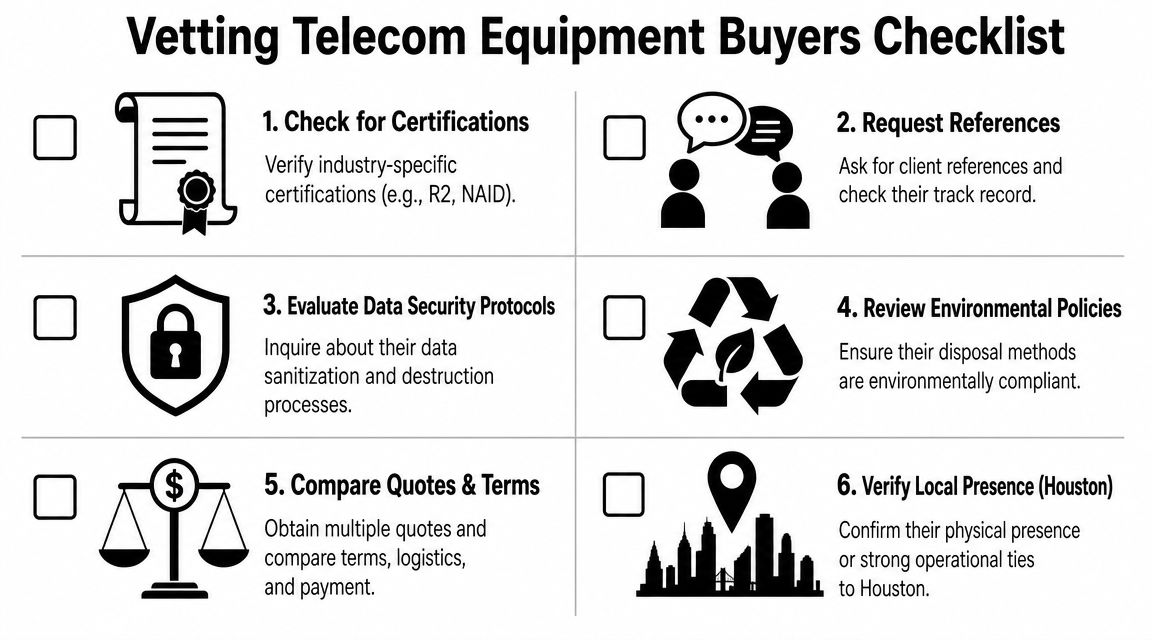
Questions that separate serious partners from opportunistic buyers
When you're evaluating who buys telecom equipment in Houston, ask direct questions and listen for direct answers.
- What exactly do you buy? Ask for examples by brand, model family, and condition type.
- How do you handle data-bearing telecom assets? A serious partner should describe sanitization or destruction procedures clearly.
- What documentation do you provide? You want pickup records, asset lists where appropriate, and final disposition support.
- Who handles downstream processing? If they recycle material, ask whether they do it directly or through downstream partners.
- Can you manage mixed loads? Many business projects include reusable hardware, scrap, cables, and accessories in one removal.
- How do pickups work in an occupied facility? Logistics discipline matters in healthcare, education, energy, and multi-tenant offices.
Red flags worth taking seriously
Some warning signs are easy to miss because they arrive wrapped in a decent quote.
Vague answers about data destruction usually mean the process is vague too.
Watch for these issues:
No distinction between resale and scrap
If every item is treated like bulk metal, the buyer probably isn't equipped for value recovery.No written scope of service
If pickup, testing, sanitization, and recycling aren't described in writing, disputes are likely.No clear local operating plan
A company doesn't need a storefront on your block, but it should be able to explain how Houston pickups, staging, and transport are handled.Overfocus on fast removal
Fast isn't bad. Uncontrolled is bad.
For businesses comparing broader providers, IT asset disposition companies give a useful frame for what a more formal retirement partner should cover. The point isn't to make every telecom sale complicated. It's to make sure a low-friction transaction doesn't create a high-friction problem later.
Negotiating the Deal and Managing Logistics
Once you've narrowed the buyer list, the next risk is accepting a quote you haven't fully decoded. Telecom offers can look comparable on the surface while hiding very different assumptions about testing, pickup, data liability, packaging, and rejected items.
The first thing to pin down is the pricing structure. Some buyers quote by item, especially for reusable switches, routers, or business phone systems. Others quote a lot price based on your inventory. Scrap-oriented channels usually quote by weight. None of those methods is wrong, but they aren't interchangeable.
Read the quote like an operations document
A good quote should answer more than "how much."
| Quote element | What to confirm |
|---|---|
| Asset scope | Which items are included, excluded, or subject to inspection |
| Pricing basis | Per item, lot value, or weight-based |
| Condition assumptions | Tested, pulled working, untested, or scrap |
| Pickup terms | Who packs, pallets, labels, and loads |
| Payment terms | Timing, adjustments, and dispute process |
| Liability | Responsibility for data, transit, and rejected assets |
If the lot includes equipment from an office cleanout or facility cleanout, ask how exceptions are handled. A common problem is partial acceptance. The buyer takes the valuable gear and leaves the low-value remainder unless the contract spells out full-load responsibility.
Put chain of custody in writing
This matters even when the equipment is low value. The handoff should document:
- Release date and pickup contact
- Asset list or shipment summary
- Transport method
- Destination or processing pathway
- Any data destruction obligations
- Final confirmation of receipt
If you're considering direct online sale channels for some reusable pieces, it also helps to understand local laws for Houston online sales before listing business-owned assets individually. That's especially relevant when internal teams want to auction smaller lots rather than move everything through one buyer.
Keep logistics boring
Boring logistics are good logistics. Schedule removal after systems are decommissioned, not during cutover confusion. Stage equipment in one controlled area. Tag lots so accounting, IT, and facilities all reference the same release.
If the project is large, assign one owner internally. That person doesn't need to touch every box. They need to approve the inventory, release the shipment, and keep the paperwork together. That single point of control reduces the chance that telecom hardware, general e-waste, and data-bearing devices get mixed into one undocumented pickup.
The Social Enterprise Advantage Choosing Donation-Based Recycling
A straight sale isn't always the best outcome. Some telecom equipment has limited resale appeal but still has reuse potential through donation-based recycling, parts harvesting, or responsible refurbishment. For businesses with sustainability targets or community commitments, that path often aligns better with the reason they're disposing of equipment in the first place.
A social enterprise recycling model changes the question from "What will this lot pay?" to "What value can this lot create?" That value can include responsible electronics recycling, secure handling, and support for digital inclusion through corporate donation programs. For some organizations, especially those managing laptop disposal, office refreshes, or mixed IT equipment disposal alongside telecom gear, that broader outcome matters.
One option in this category is Reworx Recycling, which provides electronics recycling, IT asset disposition, business pickups, decommissioning support, and secure handling services, while also operating as a donation-based social enterprise. Businesses looking at donation pathways can review its donate-a-laptop program as part of a larger sustainable recycling and community impact strategy.
Selling is transactional. Donation-based recycling can be strategic. It supports environmental stewardship, reduces landfill disposal, and gives sustainability managers a stronger story than a scrap settlement sheet alone.
If your Houston business is retiring phones, switches, routers, mixed network gear, or broader office technology, Reworx Recycling is worth considering for donation-based recycling, secure data destruction, pickup coordination, and responsible IT equipment disposal. Whether you're planning a telecom refresh, office cleanout, or larger ITAD project, the next step is simple: review your inventory, decide what must be sold versus donated, and schedule a conversation about the safest path for value recovery and community impact.