

Your internet term is ending. The office connection that worked for 20 people now has to support editors pushing large files, a warehouse that cannot lose order visibility, and leadership asking for one clear recommendation on the best telecom company in Los Angeles.
In LA, the right answer depends on the site, the workload, and the cost of failure. The city's businesses range from post-production studios and law firms to logistics operators, healthcare groups, ecommerce brands, and venture-backed software teams. A carrier that is a good fit for one Santa Monica suite can be the wrong choice for a Vernon warehouse, a Downtown high-rise, or a company trying to standardize service across several locations.
That is why smart telecom buying starts with operating requirements, not advertised speeds. Creative teams need stable upstream performance and low latency to cloud storage. Ecommerce and distribution teams need redundancy, fast outage response, and support that can handle a circuit issue before revenue is affected. Startups often care more about contract flexibility and fast installs than carrier pedigree alone. Companies reviewing office moves or hardware refreshes should also line up telecom planning with related projects such as IT asset disposal solutions for businesses in Los Angeles, because timing mistakes in one workstream often create delays in the other.
The practical effect is that choosing a provider in Los Angeles is a procurement exercise, not a speed test. Building access, fiber availability, wireless failover options, service-level commitments, support ownership, and contract terms usually decide the winner before headline bandwidth does.
The following shortlist focuses on providers that committed LA buyers should first assess. Our aim is not merely to rank brands, but to help align each carrier with the specific realities of Los Angeles operations. This enables buyers to make a final decision using a checklist that highlights the unique nature of this market for media, logistics, and tech businesses.
1. AT&T Business
An LA company opening a second site often starts with one practical question. Can one carrier cover headquarters, the new office, and a wireless backup plan without turning procurement into three separate projects? AT&T Business usually makes that first conversation easier because it can serve as a single-vendor option for primary connectivity, mobility, and failover.
That matters in Los Angeles, where requirements change sharply by industry. A media team in Hollywood may care more about steady upstream performance to cloud editors and storage platforms. A logistics operator near the ports or along the 710 corridor may put redundancy and outage response first. A startup in Santa Monica may care most about install timing, contract flexibility, and whether the provider can support a move six months later without forcing a full redesign.
AT&T is strongest when the buying goal is consistency across sites. Its business portfolio gives procurement teams several paths: business fiber for standard office use, dedicated internet for stricter performance and SLA expectations, and wireless options where wired service is delayed or limited. For companies that want one provider accountable for both the main circuit and backup, that structure reduces handoff problems during an outage.
Where AT&T fits best
AT&T tends to fit firms that want broad coverage, predictable service options, and a carrier that can support growth beyond one LA address. I would shortlist it for law firms, healthcare groups, professional services companies, and mid-market businesses planning office openings, relocations, or multi-site standardization. It also deserves a look from creative studios that need symmetrical fiber and low enough latency for cloud-heavy production workflows, but do not yet need a custom-engineered network from a specialist carrier.
The appeal is less about brand recognition and more about procurement control. One master service relationship can simplify billing, support escalation, and mobility coordination. That is useful if your telecom review is part of a larger infrastructure project, especially for teams also working through a broader Los Angeles telecom services planning process.
Trade-offs to watch
AT&T is not always the fastest path to install. If a site needs new construction, landlord approvals, riser access, or a custom fiber build, timeline risk increases quickly. Older buildings in Central LA and some industrial properties can turn a clean sales proposal into a slow implementation.
It can also become less attractive when your environment calls for unusual routing, highly customized engineering, or aggressive pricing at a single site. In those cases, a provider with a narrower footprint but more customized design support may quote the job more effectively.
Use these questions during evaluation:
- Confirm the actual access method: Ask whether the quote is for shared fiber, dedicated internet, fixed wireless, or a temporary connection during build-out.
- Test the backup design: If 5G failover is included, ask what happens to throughput, latency, and traffic policies during an outage.
- Check building readiness early: Verify MPOE access, riser capacity, conduit availability, and landlord approval steps before signing.
- Review support ownership: Ask who handles first response, carrier escalation, and site coordination when service affects multiple locations.
- Match the service to the site: A creative office editing large files may need different upstream performance than an admin office that mainly uses SaaS tools.
AT&T is usually a good fit when the business wants a scalable carrier strategy more than a highly customized one.
For companies replacing firewalls, switches, handsets, or edge gear during a telecom refresh, it also helps to coordinate circuit changes with hardware retirement. Reworx Recycling covers IT asset disposal solutions for businesses in Los Angeles for teams handling that part of the project in parallel.
You can evaluate current offerings directly through AT&T Business.
2. Spectrum Enterprise

Spectrum Enterprise belongs on any serious LA telecom shortlist because it has a dense metro presence and a practical mix of enterprise fiber services and broader commercial connectivity. If your company operates multiple locations across Los Angeles and wants one carrier that can cover headquarters, branches, and larger operational sites, Spectrum is often easier to deploy than more engineering-heavy providers.
Its appeal is simple. You can buy broadband where that's enough, move into Dedicated Fiber Internet where it isn't, and add Ethernet, cloud connectivity, or enterprise trunking without switching vendors.
Best use cases in Los Angeles
This carrier tends to make the most sense for distributed organizations. Think healthcare groups with several clinics, regional professional firms, retailers, schools, or logistics companies with a headquarters plus operational sites. In those environments, Spectrum's local field familiarity and lit-building footprint can matter more than a highly customized network design.
I'd also put Spectrum in front of any business that needs enterprise support but doesn't want to overbuy. Not every site needs dark fiber or custom wavelengths. Sometimes the right answer is a stable business-grade connection at branch offices and a stronger dedicated service at the core site.
If your network design includes both standard office locations and a few mission-critical sites, Spectrum is often one of the more practical carriers to model first.
Where buyers get tripped up
The mistake I see most often is assuming Spectrum Enterprise and consumer-style cable products should be judged the same way. They shouldn't. Enterprise services, especially dedicated fiber, need to be evaluated on SLA terms, install scope, and account management, not on broad consumer perceptions of cable internet.
That said, buyers do need to read carefully. Quote-based enterprise pricing can make apples-to-apples comparisons harder, and broadband promotions can obscure long-term contract reality if your team only looks at the first term.
A few negotiation points worth raising:
- Separate branch and HQ requirements: Don't force every location into the same circuit class if the business impact differs by site.
- Ask for install path details: Clarify whether your building is already serviceable or whether new work is required.
- Review support escalation: Enterprise support quality often depends on how your account team and implementation team are structured.
Companies replacing telecom hardware during consolidation should also think beyond bandwidth. Reworx Recycling publishes guidance on navigating telecom services in Los Angeles, which is useful when a connectivity project overlaps with equipment retirement, office cleanout work, or IT asset disposition planning.
You can review the carrier's enterprise portfolio at Spectrum Enterprise.
3. Frontier Business

Frontier Business is the carrier I'd watch closely if you're an LA small or mid-sized business that wants fast fiber performance without jumping straight to a high-touch enterprise contract. In the right building, Frontier can be a very attractive option for teams that care about symmetrical speed, clean uploads, and straightforward internet service rather than a large stack of managed network add-ons.
This matters more in Los Angeles than many buyers expect. Media teams, architecture firms, design shops, and software companies often discover that upload performance affects daily operations more than flashy download marketing.
Why Frontier works well for creative and growing teams
Frontier's strongest business case is for companies that need serious fiber but still buy like an SMB. If your office pushes large files to clients, cloud storage, or remote collaborators, symmetrical service is the headline benefit. That's why I like Frontier for post-production support offices, agencies, boutique studios, and startups moving from a coworking setup into their first dedicated space.
It's also a sensible bid to collect when budget discipline matters. Frontier has often been competitive for businesses that want multi-gig capability in serviceable areas without the complexity of custom-engineered enterprise procurement.
What doesn't work
Coverage is the issue. Frontier can be excellent at one address and irrelevant a few neighborhoods over. That's the first filter. The second is building condition. Older properties can introduce install friction if the site needs updated optical hardware, interior work, or access coordination.
Don't assume availability because a neighboring building has service. Los Angeles is full of block-by-block telecom inconsistencies.
- Run address checks early: Frontier is highly location dependent, so don't wait until contract review to confirm serviceability.
- Match the circuit to the workload: It's a good fit for cloud-heavy office work and large file movement, but not every site needs the top tier available.
- Inspect landlord constraints: In older buildings, internal wiring and access approvals can become the actual project timeline.
A good Frontier location can be a strong value. A bad one won't become good because the brochure looks compelling.
Frontier can also make sense in a broader transition project. Businesses replacing telecom appliances, legacy modems, retired desktops, or networking closets during a move can align that work with secure disposition and reuse planning. Reworx Recycling discusses telecom equipment buyers in Los Angeles, which is relevant when procurement and hardware retirement happen at the same time.
See current business service options at Frontier Business.
4. Verizon Business
Verizon Business earns its place on this list for one reason above all: speed of deployment. If you need connectivity quickly in Los Angeles, fixed wireless can solve problems that fiber can't solve on the same timeline. Temporary office, pop-up location, pilot site, sales branch, backup circuit, or short-notice move. Verizon is often one of the first providers I'd consider.
That doesn't make it the automatic answer for every office. It makes it highly useful in the right scenario.
Where Verizon shines
For smaller sites, Verizon 5G Business Internet can work as a primary connection when the address sits in a strong service area and the workload is mostly cloud applications, collaboration tools, web traffic, and standard business operations. For larger locations, the better role is usually failover. Pair it with wired primary service and you get a fast-to-activate secondary path that helps keep the office productive during an outage.
This is especially relevant in LA for businesses with frequent office changes, event-based operations, or branch networks that need quick turn-ups. Real estate teams, field operations, temporary production offices, and startup branches often value deployment speed more than idealized network symmetry.
What to verify before you sign
Wireless internet needs more real-world testing than fiber. Performance depends on local radio conditions, building materials, signal quality, and congestion patterns. If your team runs latency-sensitive workloads, don't buy on the basis of a coverage map alone.
I'd ask Verizon to prove fit at the exact service location. Run a pilot if the site matters.
- Test during business hours: The circuit has to perform when your team is online, not just during a quiet setup window.
- Profile the application mix: VoIP, video calls, browser-based apps, and large uploads all behave differently on fixed wireless.
- Define the role clearly: As primary access, it's a convenience play. As failover, it's often easier to justify.
A reputation-based tie-breaker won't help much here. In a telecom reputation survey covering more than 15,000 respondents across 21 countries, Verizon and AT&T tied for the top U.S. telecom reputation score at 65, with T-Mobile close behind at 64, according to Group Caliber's telecom reputation review. For LA buyers, that narrow spread is a good reminder to choose based on local coverage behavior, support, and workload fit rather than brand preference.
If your branch rollout also includes retiring old phones, routers, tablets, or backup appliances, Reworx Recycling offers information on sustainable telecom recycling in Los Angeles, which is useful when speed-to-deploy and sustainability planning need to happen together.
You can assess current business offerings at Verizon Business.
5. T-Mobile for Business
A Culver City production team opens a temporary edit space for six weeks. A startup in Santa Monica needs internet this week, not after a construction interval and carrier handoff. A logistics firm adds a small dispatch office near the port and wants a backup connection in place before peak season. Those are the situations where T-Mobile for Business deserves a serious look.
T-Mobile fits buyers who value speed to deploy, portability, and simpler monthly cost structure over tightly engineered performance. In Los Angeles, that can make sense for shared offices, project-based teams, pop-up locations, field operations, and smaller branches where the business case favors fast activation and low friction.
The trade-off is straightforward. Wireless business internet is easier to stand up than a wired circuit, but it is also less predictable. If the site supports latency-sensitive creative workflows, large media uploads, always-on VoIP, or revenue-critical transaction traffic, T-Mobile should go through the same evaluation discipline as any other provider. Test the actual address, during normal operating hours, with the applications your staff uses every day.
T-Mobile also deserves credit for being more than a consumer carrier with a business label. In LA, its network footprint and post-merger spectrum position make it relevant for companies building a wireless-first branch strategy or adding secondary connectivity to reduce outage risk, as noted earlier. That said, broad market presence is not the same as guaranteed site performance.
I usually position T-Mobile in one of three roles:
- Primary internet for light-duty sites: Good fit for small offices, temporary spaces, and teams that need to get online quickly.
- Secondary connection for resilience: Useful for e-commerce, customer support, and operations teams that need a backup path if wired service fails.
- Interim service during move-ins or carrier installs: Practical when a business cannot wait for construction, permits, or fiber turn-up.
Procurement is where buyers separate a good fit from an expensive shortcut. Ask T-Mobile to confirm expected performance at the exact location, not just the ZIP code. Check whether pricing depends on bundling mobile lines. Confirm hardware terms, support path, and how easy it is to move service if the office changes. For LA businesses with mixed device fleets, this is also a good time to plan decommissioning for retired handsets and network gear. Reworx Recycling outlines telecom support services in Los Angeles that can support secure disposal and refresh planning.
Use T-Mobile when flexibility is part of the requirement and consistency is not the top priority.
Review the current portfolio at T-Mobile for Business.
6. Zayo
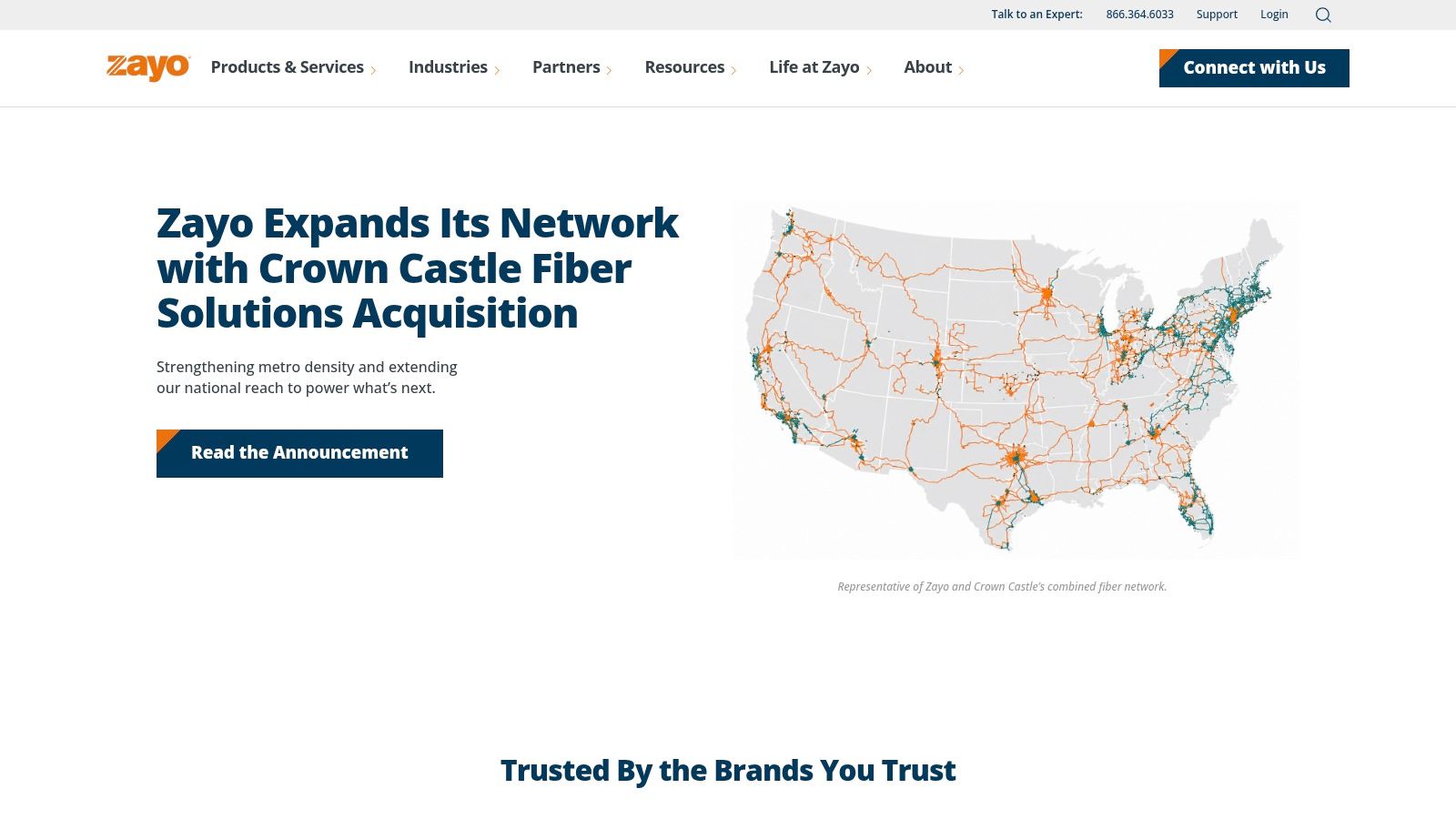
A Burbank production team pushing large video files to editors, a downtown firm linking offices to a data center, and an LA e-commerce operator building redundant paths for order traffic do not buy connectivity the same way. Zayo belongs in that conversation because it serves the part of the market where network design matters as much as monthly price.
For Los Angeles buyers, that usually means media companies, logistics operators, larger multi-site businesses, and technical teams that care about route diversity, carrier hotel access, wavelength services, dark fiber, or tightly controlled latency between sites. If your shortlist is based only on standard office internet, Zayo will often feel too specialized. If your requirements include engineered paths and higher-capacity transport, it becomes a serious option.
Where Zayo fits best
Zayo is strongest when the WAN is tied directly to revenue, production timelines, or platform uptime. The company offers dark fiber, Ethernet, DIA, and wavelength services for organizations that need more control over pathing, handoff options, and future scale. In LA, that can matter for studios moving large assets between facilities, businesses connecting into colocation environments, or operators that need cleaner east-west traffic patterns across the metro.
Its on-net reach and data center presence are part of the buying case, especially for enterprise teams that want to reduce construction risk or simplify interconnection planning. Buyers evaluating cloud connectivity, private transport, or metro diversity should examine the carrier footprint closely before they compare headline pricing.
The trade-offs buyers should expect
Zayo is usually a design-led purchase. Quotes can take longer, requirements gathering matters, and the best outcomes come from buyers who already know their technical objectives. That is a strength for companies with network architects, infrastructure leads, or consultants involved in procurement. It is less appealing for a small office that just needs internet installed fast.
I would also separate Zayo from general ISP comparisons. In many LA evaluations, the key question is not "Who has the cheapest port?" It is "Which provider can give us the right physical path, the right failover design, and the right handoff into our data center or cloud environment?" That is where Zayo tends to justify its place on the list.
Use these criteria during review:
- Latency-sensitive creative work: Ask for route details between production sites, post houses, and data center destinations. Low latency matters, but predictable pathing often matters more.
- Redundancy for transaction-heavy operations: Require documented diversity, not just dual circuits on paper. Separate entrances, laterals, and upstream paths should be part of the discussion.
- Growth and interconnection needs: Confirm how easily the design can expand to additional sites, higher-capacity transport, or direct data center connectivity without a full redesign.
For the right buyer, Zayo is one of the more technically capable options in Los Angeles. It is rarely the simplest one to buy.
Start with the carrier's enterprise network portfolio at Zayo.
7. Lumen (formerly CenturyLink)
A common LA buying scenario looks like this: a media team is pushing large files to cloud storage, a logistics operation needs stable connectivity across several sites, and the security team wants fewer vendors in the incident chain. Lumen tends to enter the shortlist in those cases because it can combine enterprise internet, backbone reach, and security services under one contract.
That makes Lumen more relevant for complex environments than for simple office connectivity. If the goal is low-friction internet for a small branch, there are easier options on this list. If the goal is tighter control over routing, cloud access, and security operations, Lumen deserves a serious review.
Why Lumen makes sense for application-sensitive environments
Lumen is a fit for companies that care about how traffic moves, not just the access speed on the quote. In Los Angeles, that often includes production studios moving time-sensitive assets, SaaS teams supporting customer-facing apps, and e-commerce businesses that cannot afford a weak failover design during peak sales periods.
Its Dedicated Internet Access, Internet On-Demand, and security portfolio give buyers more room to shape the service around actual usage patterns. That flexibility matters when traffic spikes are real, or when procurement is trying to reduce the number of providers involved in connectivity and threat mitigation.
Lumen also emphasizes interconnection depth as part of its enterprise network story. For IT teams, that is relevant because peering and route quality can affect consistency between LA offices, cloud platforms, and customer endpoints.
The practical trade-offs
Lumen is usually a stronger fit for buyers who can run a disciplined procurement process. On-net buildings are one conversation. Off-net locations can become a very different one once loop costs, construction, and service ownership are clarified.
I also advise clients to separate "good backbone" from "good operating model." A provider can have strong network reach and still create headaches if support boundaries are unclear between access, managed security, and third-party local loops.
Use these questions early in the evaluation:
- Is the site on-net or dependent on third-party access? This changes cost, install timing, and how cleanly issues get escalated.
- Do the security services replace another vendor or just add overlap? Consolidation only helps if it reduces operational complexity.
- Does burstable or on-demand capacity match real traffic patterns? Creative teams with project swings may benefit. A stable office workload may not.
- What does redundancy look like? Ask for path diversity details, especially for transaction-heavy operations and multi-site environments.
For larger LA organizations, Lumen can make sense as part of a broader sourcing strategy, especially when the buying team is balancing latency, security, and multi-site resilience instead of comparing headline bandwidth alone.
Explore current enterprise networking options at Lumen.
Top 7 LA Telecom Comparison
| Provider | Implementation Complexity 🔄 | Deployment Speed ⚡ | Expected Outcomes ⭐📊 | Ideal Use Cases 💡 | Key Advantages |
|---|---|---|---|---|---|
| AT&T Business | Medium, mix of shared GPON and custom DIA; location-dependent builds | Moderate, online ordering for SMB fiber; DIA can take longer | ⭐⭐⭐⭐ Reliable symmetric fiber + optional 5G backup; strong support | SMBs wanting fiber primary with unified billing and 5G failover | Broad LA coverage; published SMB pricing; unified billing/support; 5G backup |
| Spectrum Enterprise (Charter) | High, custom DIA, potential construction; enterprise provisioning | Moderate, many lit buildings speed turn‑ups but quotes required | ⭐⭐⭐⭐⭐ SLA-backed high-capacity DIA up to 100 Gbps; enterprise-grade | Multi-site enterprises and data centers needing SLA and local support | 100% uptime SLA options; extensive lit building inventory; strong metro footprint |
| Frontier Business | Medium, fiber in many areas but address-specific availability | Moderate, common promotions; install windows vary by ONT/construction | ⭐⭐⭐⭐ Symmetric multi‑gig performance at SMB price points | SMBs seeking multi‑gig symmetric links without enterprise complexity | Competitive multi‑gig rates; frequent promotions; no hard data caps |
| Verizon Business | Low–Medium, fixed wireless primary or failover; simple device installs | Fast, often self‑install and rapid turn‑up | ⭐⭐⭐ Reliable for fast deployment and redundancy; variable RF performance | Pop‑ups, branch sites, rapid failover, mobile‑bundle customers | Quick deployment/self‑install; mobile integration; promotional options |
| T‑Mobile for Business | Low, self‑install gateway, portable service | Fast, rapid activation and easy relocation | ⭐⭐⭐ Predictable flat pricing; good for primary small sites or failover | Small sites, portable deployments, SD‑WAN transport, predictable billing | Portability; flat‑rate plans; multi‑year price guarantees with voice bundles |
| Zayo | High, engineered dark fiber and custom routes; enterprise/wholesale focus | Slow, construction/engineering timelines often required | ⭐⭐⭐⭐⭐ High‑capacity, low‑latency custom routes and DC connectivity | Large enterprises and carriers needing dark fiber, route diversity, DC links | Dark fiber + high‑capacity wavelengths; strong metro/DC density; route engineering |
| Lumen (formerly CenturyLink) | High, DIA with on‑net/off‑net considerations; integrated services | Moderate, Internet On‑Demand speeds some turn‑ups; site dependent | ⭐⭐⭐⭐⭐ Tier‑1 backbone with strong peering, scalable DIA and security add‑ons | Enterprises needing robust peering, burstable bandwidth, and integrated security | 99.99% SLA options; Internet On‑Demand; deep peering and security integrations |
Making the Final Call: Your Telecom Procurement Checklist
The best telecom company in Los Angeles isn't a universal ranking. It's the provider that matches your exact mix of applications, locations, tolerance for downtime, support expectations, and contract discipline. That's why many disappointing telecom projects start with a brand preference and end with an expensive workaround.
For most businesses, the right process starts internally. Map every site. Separate business-critical locations from ordinary offices. Identify which teams need low latency, which teams need high upload performance, and which locations mainly need stable cloud access. A Hollywood post-production office, a South Bay logistics operation, and a Venice startup shouldn't be forced into the same connectivity template just because procurement wants one carrier everywhere.
Then tighten your evaluation criteria. Don't ask every provider for “best price on internet.” Ask for the right design. If a site needs strict uptime, request dedicated options and explicit failover behavior. If a site opens quickly or changes often, ask for fixed wireless deployment details. If your team uses large media files, ask how uploads perform under real workloads. If you depend on SaaS platforms and VoIP, ask about latency, packet loss handling, and support escalation.
A practical shortlist often looks like this:
- Choose AT&T when you want broad business coverage and a one-carrier model that can combine wired access with wireless backup.
- Choose Spectrum Enterprise when you have multiple LA locations and want a practical mix of enterprise fiber and mainstream commercial connectivity.
- Choose Frontier when your address qualifies and symmetrical fiber performance matters more than an expansive enterprise stack.
- Choose Verizon Business when deployment speed or backup connectivity is central to the project.
- Choose T-Mobile for Business when portability, flat-rate simplicity, and quick setup matter most.
- Choose Zayo when the project is really about engineered network paths, data center connectivity, or capacity planning.
- Choose Lumen when backbone performance, peering, and integrated security belong in the same conversation.
Procurement teams should also force vendors to answer operational questions early. Who owns implementation? What causes install delays in your building type? What happens during failover? How are outages escalated? Can you test the service before standardizing across locations? Telecom contracts often look similar at a glance, but the service experience can be very different once the circuit is live and your business depends on it.
Reputation alone won't settle the question. As noted earlier, the leading national carriers in this market are all credible options, and brand scores sit close enough that you shouldn't use them as a substitute for technical validation. In practice, the smarter move is to evaluate coverage at the exact address, test service under actual workloads, and compare support and contract terms with the same rigor you'd apply to a core software platform.
Los Angeles businesses should also think one step beyond activation. Telecom changes usually trigger hardware retirement. Old firewalls, phones, switches, access points, backup appliances, and user devices need secure handling, especially when an office move, data center decommissioning effort, or network refresh is involved. That's one reason some organizations bring in a specialized partner like Reworx Recycling to support electronics recycling, secure data destruction, and IT asset disposition alongside infrastructure changes.
If your broader communications stack includes live call coverage and front-desk continuity, it's also worth reviewing professional answering solutions in California as part of business continuity planning.
The best telecom company in Los Angeles is the one that fits your operations on a bad day, not just your budget on signing day. Buy for resilience, not just rate. That's the difference between a carrier quote and a sound infrastructure decision.
If your Los Angeles business is replacing phones, networking gear, servers, laptops, or other retired equipment during a carrier change, Reworx Recycling can help with donation-based recycling, IT equipment disposal, secure data destruction, pickup coordination, and responsible end-of-life planning. If you're managing an office cleanout, telecom refresh, or broader ITAD project, contact Reworx Recycling to donate old equipment, schedule a pickup, or explore a partnership.