Most Michigan IT directors don’t have an ITAD problem on the calendar. They have a storage room problem.
It starts with a rack of retired servers after a virtualization project. Then a stack of laptops from the last refresh. Then a bin of phones nobody wants to touch because no one’s fully sure what data is still on them, whether the lease paperwork is closed, or who signed off on disposal. By the time someone asks facilities to “clear that space,” the issue isn’t cleanup. It’s risk.
That’s why Michigan ITAD services matter. Done well, IT asset disposition protects data, creates a clean audit trail, supports environmental compliance, and recovers value from equipment that still has a second life. Done poorly, it leaves your organization exposed at the exact point when you think the risk is leaving the building.
The Hidden Risks in Your Michigan Office Storeroom
A typical Michigan office storeroom tells a familiar story. There’s a shelf of old desktops from a finance upgrade, a few network switches with handwritten tape labels, and a carton of laptops waiting for someone to “recycle them later.” In automotive, manufacturing, healthcare, education, and insurance, that pile grows fast because refresh cycles don’t wait for disposal workflows to catch up.
The mistake is treating retired equipment like dead equipment. It isn’t dead until your organization has documented custody, removed data, resolved ownership, and sent the asset into a controlled downstream process. Until then, every device is still a business record, a security object, and a liability.
What actually sits in that room
Most organizations underestimate how mixed these inventories are. It’s rarely just office PCs.
- User devices often include laptops, tablets, phones, and docking stations that may still hold cached credentials or local files.
- Infrastructure gear includes servers, storage arrays, firewalls, and backup appliances that can contain the most sensitive information in the building.
- Specialized equipment can show up in labs, clinics, production environments, and engineering teams, where disposal is harder because the equipment wasn’t bought through standard IT channels.
That’s where ordinary junk hauling fails. A hauler can move boxes. They can’t establish a defensible chain of custody or prove your data was handled properly.
Practical rule: If the asset ever touched customer data, employee records, IP, or regulated information, disposal belongs in a governed ITAD process, not a general cleanup project.
The risk usually appears after the move
What gets organizations in trouble isn’t the visible pile. It’s the invisible gap between retirement and proof.
If a drive goes missing after it leaves your site, your team still owns the incident. If devices sit for months without inventory reconciliation, your asset register becomes less reliable. If a business unit drops off equipment through an informal channel, IT may not even know which serial numbers left the building.
Michigan organizations also have to think like incident responders. A retired device with unencrypted personal information can turn into a breach notification event under the state’s Identity Theft Protection Act (Act 452 of 2004, MCL 445.72) when resident data is exposed. That means the safest time to handle end of life equipment is before it becomes an exception, not after.
A disciplined process also fixes an operational problem. Storerooms full of obsolete hardware waste space, slow audits, and create confusion during office moves and refresh cycles. Teams that address the backlog usually discover that the disposal project was really an asset control problem all along.
For many organizations, the easiest first step is reviewing a practical framework for dealing with office e-waste before the next office cleanout or hardware refresh turns a manageable backlog into an emergency.
Understanding IT Asset Disposition Beyond Simple Recycling
Most companies hear “recycling” and think of the last step. Michigan ITAD services start much earlier.
The better comparison is fleet management. When a company retires a vehicle, it doesn’t just tow it away and hope for the best. Someone verifies ownership, removes it from service, checks condition, documents transfer, and decides whether the vehicle should be reassigned, sold, or scrapped. End of life IT equipment deserves the same discipline.
ITAD is a lifecycle process
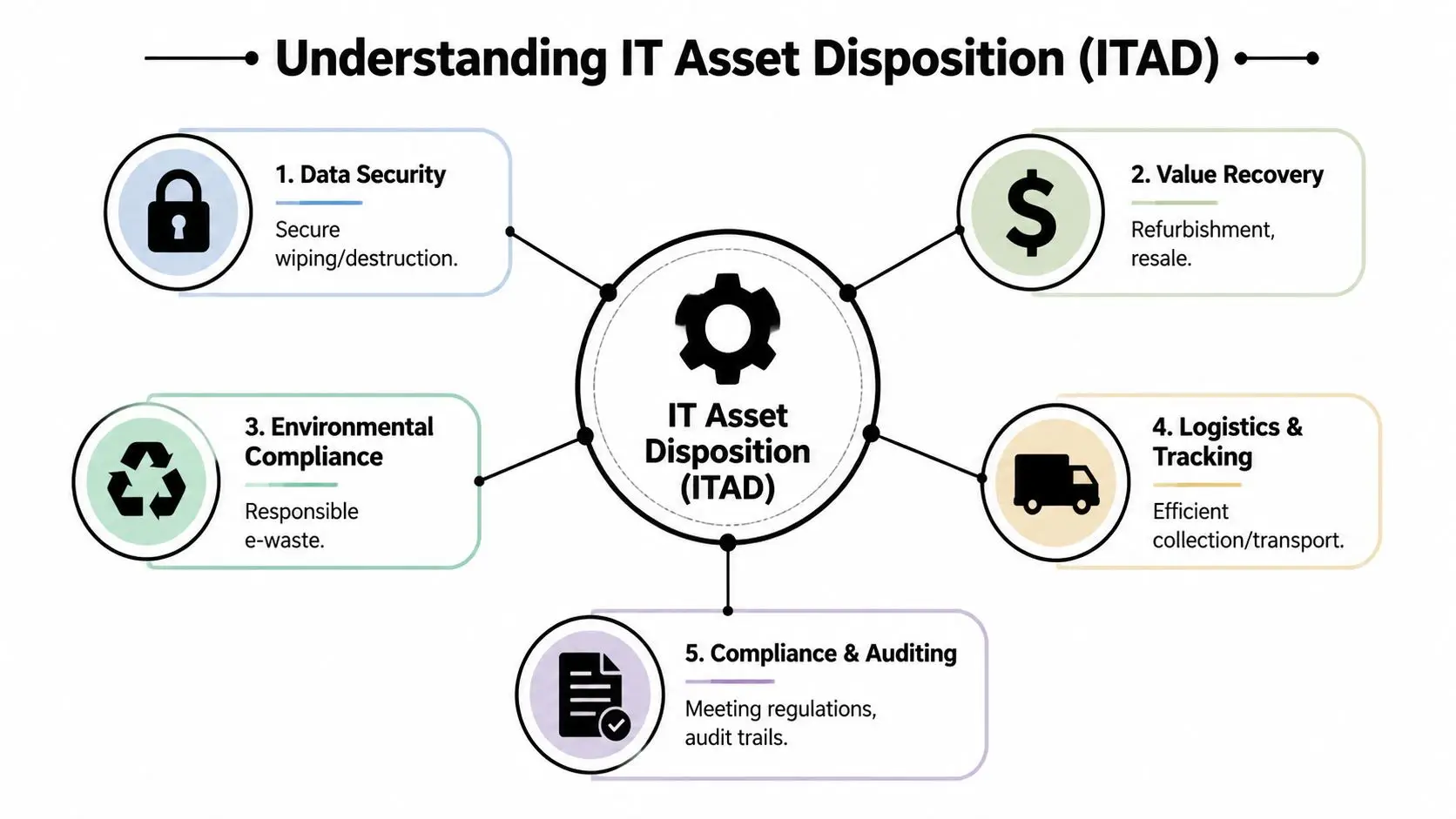
A proper ITAD program usually includes several connected decisions:
Retirement from service
The asset is formally removed from production use. Access is cut off, dependencies are checked, and the business owner signs off.Secure collection and movement
Equipment is packed, labeled, tracked, and moved under controlled custody. These strong logistics separate professional ITAD from ad hoc pickup.Data handling
Storage media is sanitized or destroyed based on risk, policy, and device type.Disposition path
Reusable equipment may be redeployed, refurbished, remarketed, donated, or harvested for components. Nonrecoverable equipment goes to responsible recycling.Documentation
The organization receives reporting that closes the loop. Think asset lists, destruction records, and transfer evidence.
Why simple recycling falls short
A general recycler may be perfectly acceptable for low-risk scrap. That’s not the same as enterprise ITAD.
Here’s the practical difference:
| Approach | What it handles well | Where it falls short |
|---|---|---|
| General recycling | Basic material removal | Limited data governance, weak auditability |
| Junk removal | Fast physical clearout | No real IT asset control process |
| ITAD provider | Security, reporting, value recovery, compliance support | Requires planning and internal coordination |
That distinction matters when you’re dealing with leased endpoints, data center equipment, or hardware tied to software licensing and internal controls. In those cases, value doesn’t come only from scrap. It can come from reuse, resale, software harvesting, redeployment, or avoiding a security failure.
Good ITAD providers don’t ask only, “How do we remove this?” They ask, “What’s the correct exit path for each asset class?”
If your team needs a cleaner baseline definition, this overview of what IT asset disposition means in practice is a useful reference point before you build policy or start vendor selection.
Navigating Michigan's Data Security and E-waste Landscape
A common Michigan cleanup starts the same way. Retired laptops are stacked in a storage room, a few old servers are still sitting in a branch office, and nobody wants to be the person who signs off on disposal without knowing exactly what data is still on them.
That hesitation is justified. In Michigan, disposal decisions sit close to breach response, environmental handling, and audit readiness. If a device leaves your control with readable personal information on it, the issue is no longer surplus equipment. It is a security event with legal consequences.
The Michigan rules that change disposal decisions
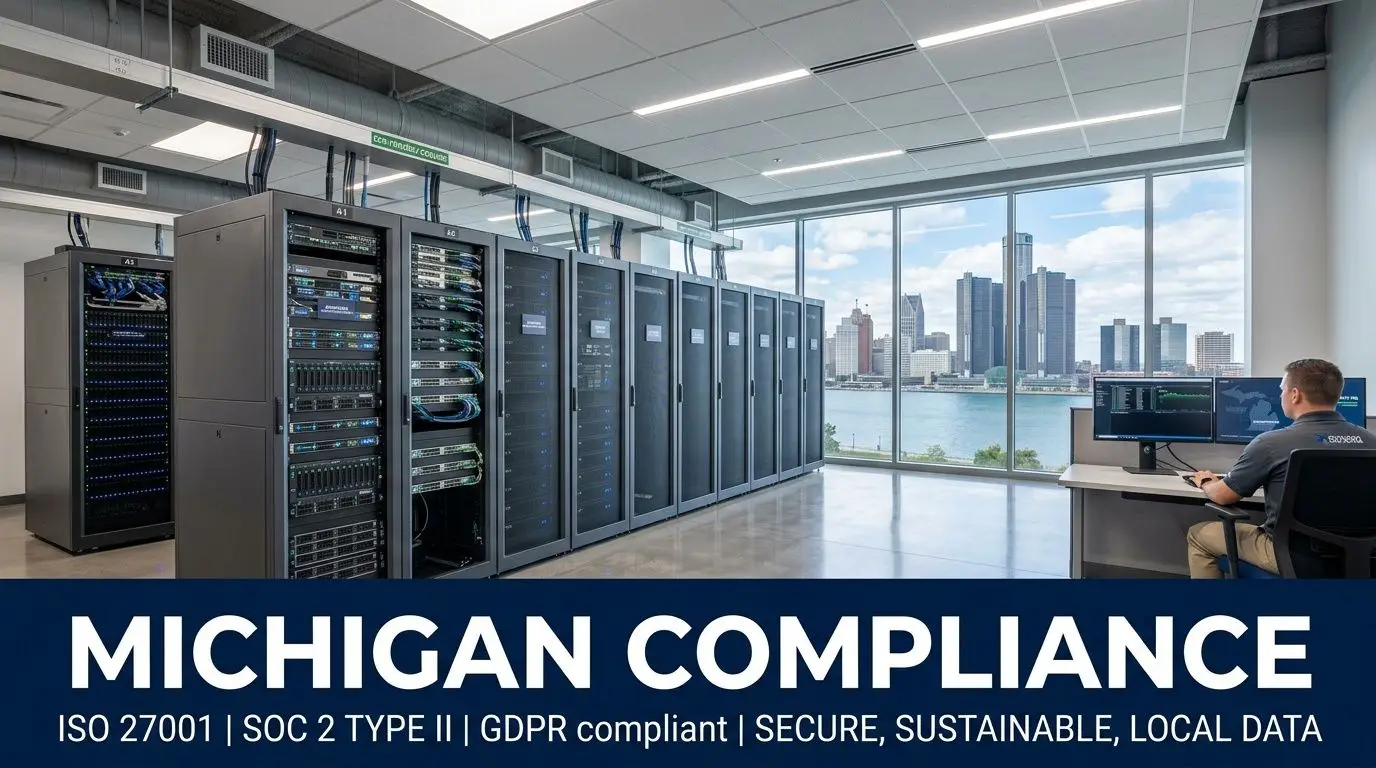
For many organizations, the key state law is Michigan’s Identity Theft Protection Act. If unencrypted personal information involving Michigan residents is acquired by an unauthorized party, breach notification duties can follow. From an ITAD standpoint, that means your team needs a defensible process before pickup, during transport, and at final data destruction.
Certain sectors carry extra pressure. Michigan insurers also need to account for Public Act 690 of 2018, the state’s Insurance Data Security Law, which sets expectations around cybersecurity programs and event reporting. Healthcare organizations face parallel scrutiny from HIPAA, and automotive firms often manage engineering files, supplier records, telematics data, and employee information across a wide hardware footprint. Different regulations apply, but the operating lesson is the same. Disposal work has to stand up to review after the fact.
E-waste risk is operational, not just environmental
Michigan companies also have to handle the physical side correctly. Screens, batteries, circuit boards, and other electronics cannot be treated like ordinary office trash. A vendor should be able to explain where material goes downstream, which equipment is remarketed, which is dismantled, and how hazardous components are handled.
That matters for two reasons. First, weak downstream controls create environmental and reputational exposure. Second, once equipment enters an opaque chain, your team loses the documentation needed to answer legal, compliance, or customer questions later.
What good control looks like on the ground
A defensible Michigan ITAD process usually includes:
- Serialized asset tracking from collection through final disposition
- Data destruction methods matched to the asset’s reuse or destruction path
- Clear chain-of-custody records with dates, quantities, and responsible parties
- Certificates and audit records your legal, security, and procurement teams can retrieve later
- Downstream vendor accountability for recycling, resale, and material handling
In practice, the trade-off is simple. The fastest pickup option is not always the safest one, and the cheapest outlet often produces the weakest paperwork. For low-risk peripherals, that may be acceptable. For laptops, servers, network gear, and devices tied to regulated data, it usually is not.
A Michigan-based provider should also understand the local operating environment. Multi-site manufacturers, health systems, school districts, and automotive suppliers do not dispose of equipment the same way. Plant equipment, remote user devices, and data center hardware each need different handling rules, collection workflows, and reporting.
If your team is comparing local disposal options, this guide to electronics recycling services in Michigan is a useful starting point for separating basic recycling from business-grade ITAD.
The Core Components of a Comprehensive ITAD Program
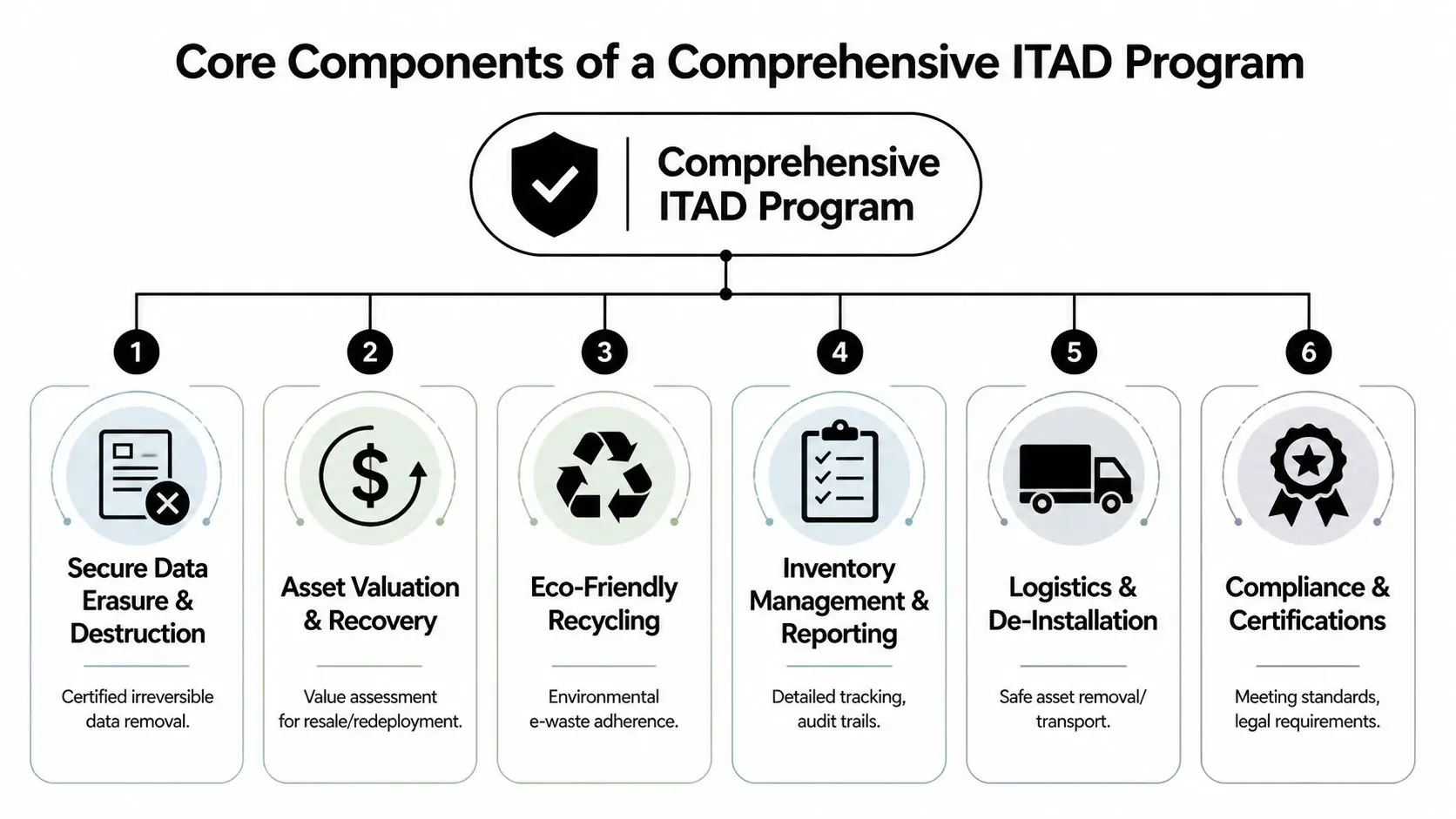
An ITAD program stands or falls on execution. In a Michigan organization, that usually means handling mixed fleets across offices, plants, clinics, and remote users while keeping legal, security, finance, and operations aligned.
For automotive suppliers, healthcare groups, and multi-site manufacturers, the risk is rarely limited to the device itself. The primary exposure sits in engineering files, protected health information, licensing records, authentication data, and the missing paperwork that leaves your team unable to prove what happened.
Start with decommissioning and inventory control
Good results start before pickup. Assets need to be identified, matched to the right owner or department, and verified against internal records before they leave service.
That sounds obvious. It is also where programs break down.
I see the same pattern often. A server changed roles three times but the CMDB still shows the original use case. A plant has network gear in a cabinet that corporate IT never added to the retirement list. A business unit kept old laptops in a locked room for years and assumed they were already handled. If those gaps are not resolved first, every later step gets harder to defend.
Serialized inventory, condition grading, and documented release approval give your team a clean starting point. They also protect value recovery. A recent laptop with known specs, working condition, and clear ownership is much easier to resell than a device pulled from a pallet with no supporting records.
Set data destruction rules by risk, not by habit
A defensible ITAD process uses different data destruction methods for different assets. NIST 800-88 Rev. 1 remains the standard reference point for sanitization decisions, but the method should match the media, the data sensitivity, and whether the asset is headed for reuse or destruction.
For example, overwriting or other approved sanitization methods may fit laptops and desktops that still have resale value. Failed drives, highly sensitive storage, and media from regulated environments often call for physical destruction instead. The right answer depends on what is stored on the device and what your organization needs to prove later.
The proof matters as much as the method. Your provider should be able to show serialized reporting, destruction records, and a clear chain of custody. If your team is vetting vendor credentials, this overview of electronics recycling and data security certifications is a useful reference point.
Field note: If your policy says “wipe everything” but your provider cannot confirm drive health, media type, and final disposition by serial number, the policy is weaker than it looks.
Build the remarketing and recycling paths separately
Value recovery and end-of-life processing should not run through the same decision tree.
Devices with remaining market value need testing, grading, and resale handling that protects both data security and return. Equipment that has reached end of life needs responsible dismantling, parts separation, and downstream accountability for materials handling. Blending those paths usually creates one of two problems. Your organization destroys assets that still had resale value, or it pushes obsolete equipment through a resale workflow that wastes time and produces little return.
This is also where a social enterprise model can change the equation for Michigan businesses. The financial return still matters, but community return matters too. When an ITAD partner combines secure processing with local workforce development, your disposition program does more than clear storage rooms and reduce risk. It supports job training and keeps more economic value in the region.
A well-run program covers decommissioning, data destruction, remarketing, recycling, and documentation as one controlled process. That is what turns ITAD from a disposal task into a risk, recovery, and community impact strategy.
Finding a Secure and Certified ITAD Partner in Michigan
A Michigan IT director usually sees the warning signs before leadership does. Laptops pile up in a locked room after a refresh. A plant closes a line and leaves industrial workstations waiting for disposition. Someone asks for certificates of destruction two months after pickup. At that point, vendor selection stops being a purchasing exercise and becomes a risk decision.
The right ITAD partner should be able to walk your team through chain of custody, sanitization standards, transport controls, resale handling, and downstream recycling without vague language. If security, legal, procurement, and internal audit ask the same question in different ways, the answers should still line up.
What the main certifications actually tell you
Certifications matter, but only if you match them to the service being bought.
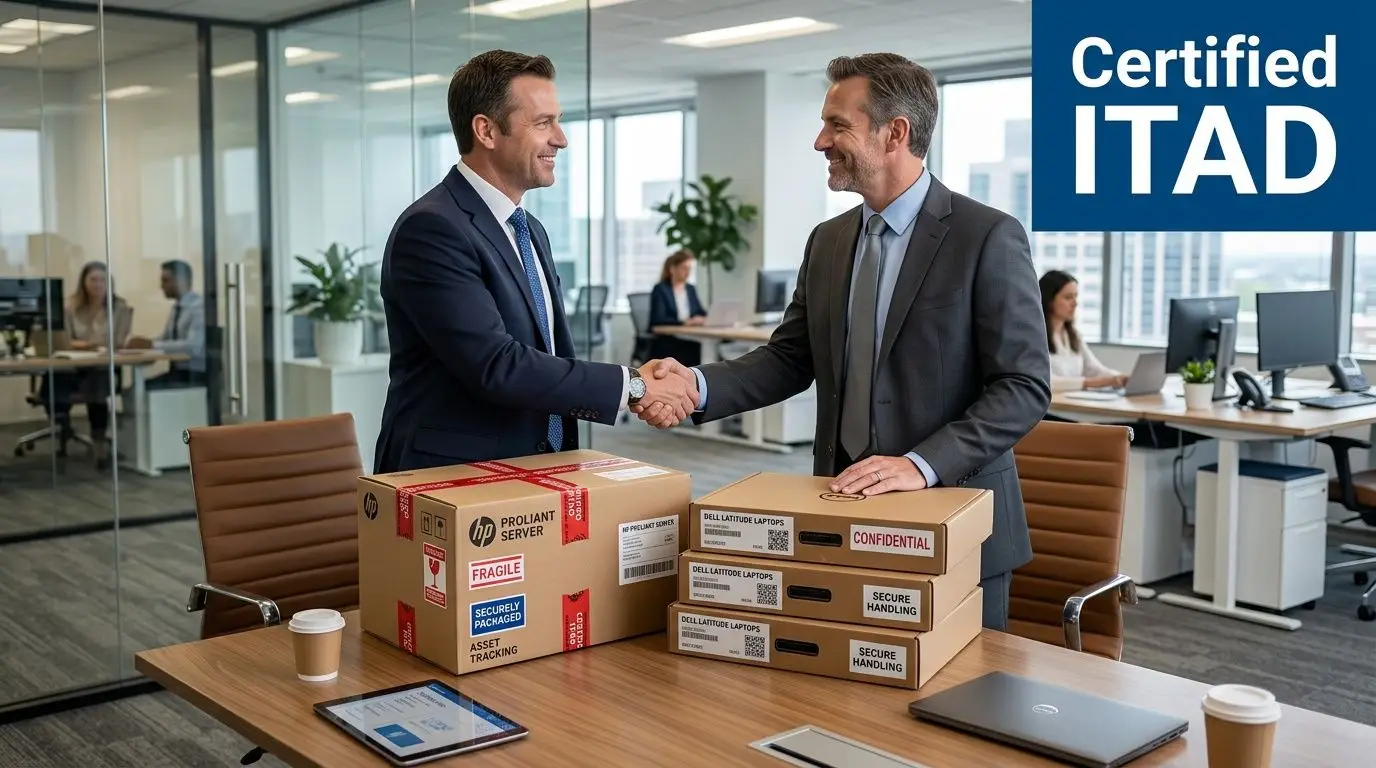
- R2 indicates controls around electronics reuse, recycling, and downstream management.
- e-Stewards signals tighter environmental restrictions and stricter downstream accountability.
- NAID AAA is often used to assess whether data destruction processes and custody controls are disciplined enough for sensitive media.
Those labels answer different questions. A provider can be credible on material recovery and still fall short on media handling, serialized reporting, or audit readiness. Michigan organizations in healthcare and automotive tend to feel that gap quickly because they deal with regulated data, design files, shop-floor systems, and long retention expectations.
Set the bar higher than “certified”
In Michigan, a serious review goes beyond checking for certification logos on a website. Ask which facility holds the certification, which services fall under it, how often the provider is audited, and what happens to assets that cannot be resold. Then verify whether the provider can document every step by serial number, including exceptions such as failed drives, missing tags, or damaged equipment.
This is also the point where operating model matters. A social enterprise can process assets securely and still produce local value through workforce development, job training, and reuse programs that keep more benefit in Michigan. For many IT leaders, that is not a soft benefit. It helps support ESG reporting, local procurement goals, and internal pressure to show community return alongside financial recovery.
Questions worth asking before you sign
A short diligence call often reveals more than a polished proposal.
- How is each asset tracked from pickup through final disposition?
- What proof do we receive for data destruction, transfer of custody, and resale or recycling outcomes?
- Which certifications apply to this exact scope, including onsite work, transport, and processing?
- How are downstream vendors approved, monitored, and documented?
- What happens to failed media, low-value devices, and equipment with no resale market?
- Can you support redeployment, donation, resale, and recycling as separate paths?
Strong providers answer with process detail, sample documentation, and defined exception handling. Weak providers answer with reassurance.
If your team wants a plain-language reference before contract review, this guide to electronics recycling certifications helps clarify what each label does and does not cover.
Your Step-by-Step Michigan ITAD Planning Checklist
Most ITAD projects go sideways before pickup day. The equipment isn’t fully inventoried, business units add surprise assets, someone forgets leased devices, and security asks for documentation after the truck has already left. A checklist solves that.
This one is built for a Michigan business that wants clean execution, not last-minute improvisation.
Before you contact vendors
Start internally. The goal is to know what you have, what risk it carries, and what outcome you want.
Build the asset list
Pull from your CMDB, endpoint platform, procurement records, and local department inventories. Then verify physically. The physical count often exposes gaps.Classify by sensitivity
Separate ordinary office devices from assets that handled regulated data, engineering IP, or executive information. Don’t let a low-value device get treated as low-risk by default.Identify business constraints
Note lease returns, storage media failures, software licensing concerns, and any assets that may be candidates for redeployment rather than disposition.
While selecting the ITAD path
Policy translates into action. Be specific about what success looks like.
| Decision area | What to confirm internally |
|---|---|
| Data handling | Wipe, shred, or mixed approach by asset class |
| Chain of custody | Who signs release, who witnesses removal, who stores records |
| Value recovery | Which assets can be remarketed or donated |
| Environmental handling | Any restrictions on downstream processing expectations |
A smooth ITAD project usually reflects work done before the first pallet is wrapped.
On pickup day and after
Execution matters, but so does closure.
- Confirm serialized counts at handoff so the receiving list matches what your team released.
- Keep stakeholder ownership clear across IT, security, legal, facilities, and procurement.
- Request final documentation promptly rather than waiting until audit season.
- Reconcile internal systems so retired assets don’t continue appearing as active in reports.
- Review exceptions such as missing drives, damaged equipment, and untagged assets while the project is still fresh.
Many teams also benefit from using a formal server decommissioning checklist when infrastructure assets are in scope, because server retirement usually involves more dependencies and more data risk than endpoint refreshes.
A good checklist doesn’t make the project bureaucratic. It makes the result defensible.
How Michigan Businesses Succeed with Socially Responsible ITAD
A Michigan IT director can run a clean retirement project and still miss part of the return. The gap usually shows up after the last pallet leaves. Finance sees limited recovery, sustainability gets a thin story, and leadership has little to point to beyond “equipment removed.”
The stronger outcome is more deliberate. Secure ITAD should protect regulated and proprietary data, document every handoff, recover value where the secondary market supports it, and direct appropriate equipment into a donation channel that produces a local benefit. In Michigan, that matters because many organizations want more than a recycling receipt. They want a defensible process that also supports the communities where they hire, operate, and sell.
A Detroit-area supplier retiring engineering and server assets
Consider a supplier serving the automotive sector. The server room includes aging compute, storage, and engineering workstations tied to design files, test results, and internal production records. The risk is not limited to the drives. The company also has to avoid confusion over custody, missing components, and assets that were retired physically but still appear active in internal records.
A socially responsible ITAD program works only if the control points stay intact. Asset triage comes first. Devices with resale value are separated from true end-of-life equipment. Media-bearing assets follow the destruction or sanitization path already approved by the business. Equipment that is still suitable for reuse can enter a donation-based stream, but only after the same inventory, serialization, and documentation standards are met.
That structure changes the internal conversation. The project is no longer a disposal event. It becomes a managed release of assets with security controls, financial accountability, and a documented community outcome.
An Ann Arbor lab deciding between resale, recycling, and donation
Research and healthcare-adjacent environments often have a mixed inventory. Some laptops and desktops fit standard resale channels. Some devices are specialized and worth little outside a narrow buyer pool. Some equipment contains storage media in places staff do not catch during a quick review.
That is where social enterprise ITAD can outperform a basic recycler. The goal is not to push every asset into one outlet. The goal is to sort carefully enough that each item follows the right path.
Used business laptops in good condition can produce resale returns, but recovery depends on age, model, specs, cosmetic condition, and current secondary market demand. Market conditions also shift over time. For example, tariff changes enacted after 2025 have been cited by service providers as one factor affecting resale pricing in Midwest markets, as discussed in the PR Newswire announcement on expanded ITAD services and value recovery. The practical takeaway is simple. Careful sorting and realistic disposition decisions usually outperform bulk recycling.
Why the social enterprise model matters in Michigan
For many Michigan organizations, community impact is not a marketing add-on. It is part of the procurement and ESG conversation, especially for employers with a visible local footprint. A social enterprise model gives those organizations another option for qualified equipment that still has useful life after refurbishment.
There is a trade-off. Full remarketing may produce higher short-term recovery on some assets. Donation-based reuse may reduce direct cash return on others. The right choice depends on your priorities, your asset mix, and the condition of the equipment.
Experienced teams usually do not force a single answer across the whole inventory. They use a hybrid model. Higher-value assets can be remarketed. Lower-value but usable equipment can support digital inclusion or workforce access programs. Scrap should stay in properly managed recycling channels. That approach protects business interests without treating community benefit as an afterthought.
The Michigan-specific advantage is practical. Companies in automotive, healthcare, education, and advanced manufacturing often need a partner that can satisfy security and compliance expectations while still producing a local story leadership can stand behind. Socially responsible ITAD does that best when donation decisions are built into asset triage at the start, not added later as a goodwill gesture.
Done well, the result is measurable in more than one way. The business reduces data risk, keeps cleaner records for audit and legal review, recovers value where the market supports it, and puts part of its retired fleet to work in the same state where the equipment was originally deployed.
Partner with Reworx for Your Michigan ITAD Needs
Michigan ITAD services shouldn’t be chosen on convenience alone. Your team needs a partner that can handle secure data destruction, disciplined logistics, office and facility cleanouts, and responsible downstream recycling without turning the project into an administrative burden.
That’s especially important when your retired equipment includes more than office laptops. Many Michigan organizations also need help with server retirement, product destruction, computer recycling, medical equipment disposal, laboratory equipment disposal, and broader data center decommissioning programs. A qualified ITAD partner should be able to support those different streams inside one controlled process.
Reworx Recycling is built for that kind of work. As a donation-based social enterprise recycling partner, Reworx helps businesses handle electronics recycling, IT equipment disposal, secure data destruction, laptop disposal, office cleanout, and facility cleanout needs with a process designed around security, sustainability, and practical execution. For organizations that want more than a basic recycler, that matters.
The community angle also deserves serious attention. Many companies want sustainable recycling, but they also want a stronger outcome from retired assets. Reworx’s donation-based recycling model supports corporate donation programs that can extend the useful life of qualified equipment and contribute to digital inclusion and workforce development. That gives sustainability leaders, IT managers, and business owners a cleaner way to connect operational disposal with community benefit.
If your Michigan team is planning a hardware refresh, lease return, warehouse cleanup, or decommissioning project, don’t let the backlog sit until it becomes a security or compliance issue. Build a documented ITAD process and work with a partner that understands both asset control and social impact.
Reworx Recycling helps Michigan businesses turn outdated technology into a secure, sustainable outcome. If you need support with electronics recycling, computer recycling, IT asset disposition, hard drive destruction, office cleanouts, or donation-based recycling, visit the Reworx Recycling blog to schedule a pickup, explore service options, or start a conversation about a community-focused ITAD program.