
Atlanta businesses are adopting AI at a pace that changes the question from “Should we experiment?” to “Can our infrastructure, people, and processes keep up?” One local assessment places AI adoption among surveyed Atlanta companies at 68%, compared with roughly 17% to 20% of U.S. businesses using AI in production operations as of May 2026 (local Atlanta AI adoption assessment). That gap points to a practical reality: many companies in the metro area are already moving AI into customer service, procurement, marketing, finance, healthcare, and operations.
Growth at this pace creates a less visible obligation. Every new AI workflow depends on software, endpoints, servers, networking equipment, and data-handling controls. When those assets are upgraded or retired, businesses need a secure and sustainable plan for IT asset disposition, not a stack of unwanted laptops in a storage room.
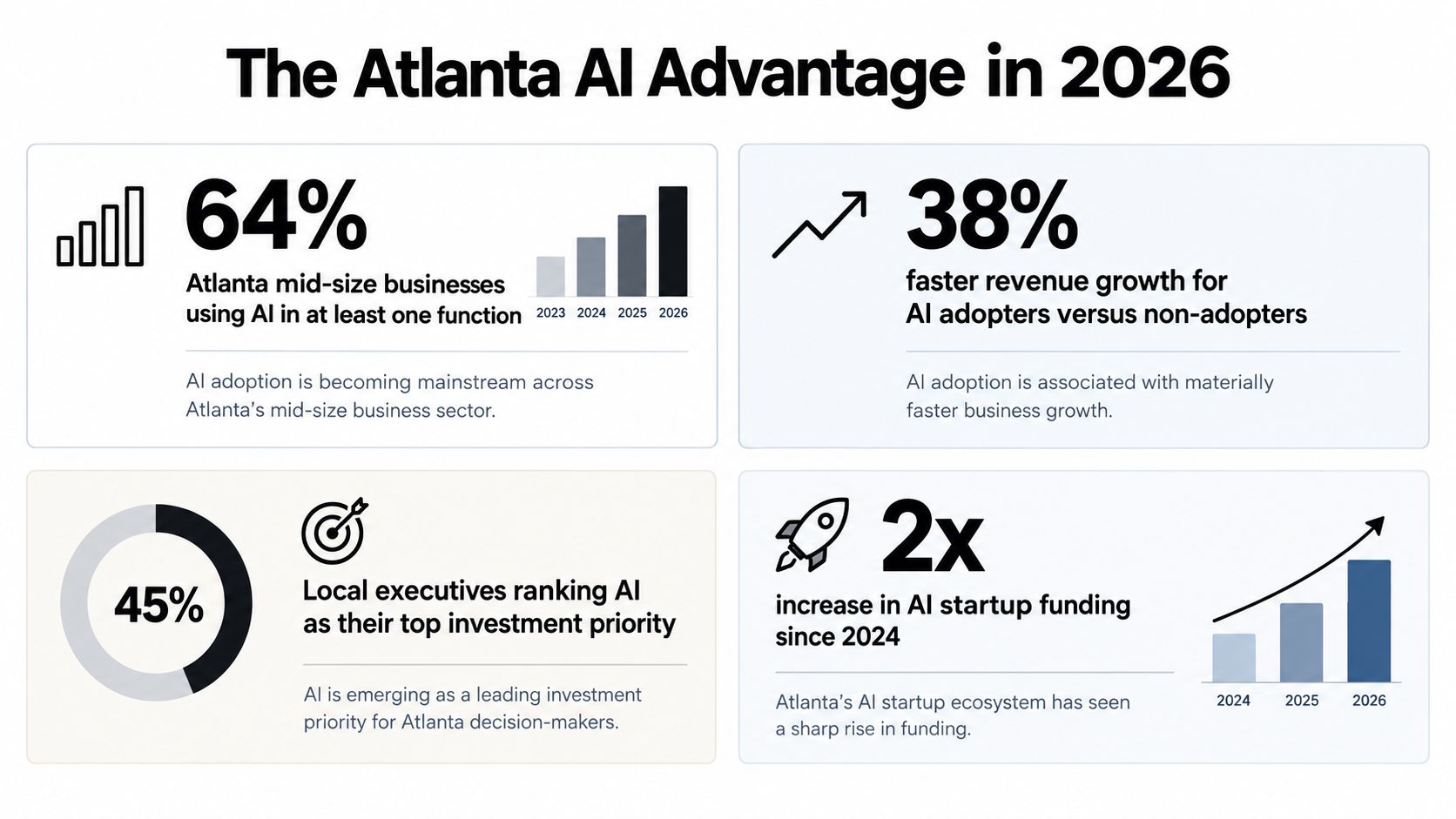
The Atlanta AI Advantage in 2026
Atlanta's AI advantage is becoming visible in the systems behind customer-facing tools. A local assessment describes adoption across surveyed Atlanta companies (Atlanta business AI adoption data), while Georgia small-business research points to similar momentum beyond large enterprises. The practical question is no longer whether companies can test AI. It is whether their operating model can support reliable use across departments.
Production AI depends on more than a strong application. A customer-service assistant needs stable identity management, current knowledge sources, network capacity, monitoring, and a clear owner. Forecasting and document workflows also depend on data quality and repeatable review procedures. If one employee is the only person who understands the workflow, the company has created a dependency rather than a scalable capability.
Georgia's small-business picture reinforces that point. Independent research found that 56% of small businesses in Georgia were already using AI, and 87% of those users reported a positive operational impact (Georgia small-business AI research). The same source reports 58% using AI, with 89% reporting a positive impact. These findings support a practical interpretation: smaller companies are adopting tools that reduce manual work and shorten decisions, not just collecting experimental software.
What local leaders should do with this signal
Start with workflows that have measurable delays, repeated handoffs, or inconsistent information. Document the systems involved, the data each process uses, the person accountable for outcomes, and the failure conditions that require human intervention.
AI growth also creates a back-office hardware cycle. New models and automation workloads can require upgraded laptops, servers, storage, networking equipment, and security controls. Those assets eventually leave service. A scaling plan should therefore include IT asset disposition, with data sanitization, chain-of-custody records, reuse decisions, and responsible recycling defined before equipment accumulates.
Atlanta's technology concentration and business diversity increase the value of a controlled rollout. Companies can begin with a limited use case, restrict access, measure operational results, and review both software and hardware requirements before expanding. Context on why Atlanta is becoming the South's tech hub helps explain why local firms face pressure to improve efficiency while competing for talent and customers. The strongest programs treat AI, infrastructure, security, and equipment retirement as one operating decision.
Front Office and Operational AI Applications
A regional service company might begin with an AI assistant that classifies incoming requests. The system can separate billing questions from technical issues, identify urgent language, and send each inquiry to the right queue. Staff still handle exceptions, but they no longer spend their first hour sorting routine messages.
That same pattern appears across Atlanta's diverse economy. A distributor can use AI to summarize account history before a sales call. A professional-services firm can use it to draft a proposal from approved service descriptions. A retailer can analyze customer interactions to identify recurring questions. A healthcare organization can use governed tools to support documentation and administrative coordination, while keeping clinical decisions with qualified professionals.
Where AI usually earns trust first
The strongest early applications have three characteristics. They involve repeatable work, use information the company already controls, and allow a person to review the result before it affects a customer or financial commitment.
- Customer service: Classify requests, draft responses, surface relevant knowledge-base articles, and route complex cases to specialists.
- Sales and marketing: Segment audiences, summarize account activity, suggest follow-up tasks, and adapt approved content to customer context.
- Back-office administration: Extract fields from documents, prepare invoice data, reconcile routine records, and flag missing information.
- Operations: Detect unusual patterns in equipment readings, prioritize maintenance work, and support inventory or scheduling decisions.
Atlanta's logistics, manufacturing, healthcare, financial, and professional-services businesses each face different data and compliance conditions. A predictive-maintenance model might be useful in a facility with reliable equipment data, but it won't solve a process where sensors are inconsistent or maintenance records are incomplete. Similarly, a generative AI tool may draft clear customer communications while still producing unsupported answers if the source material isn't controlled.

What separates useful automation from expensive experimentation
Start with the process, not the software license. Document the current workflow, including manual steps, approval points, sensitive data, and the consequence of an error. Then define what the system may do automatically and what requires human approval.
A chatbot that answers approved questions can be easier to govern than an open-ended tool connected to internal documents. A lead-prioritization system can support a sales team without replacing judgment. Predictive maintenance can identify a pattern for inspection, but a technician should determine whether equipment requires intervention.
The same discipline applies to the physical environment. More AI use can mean more workstations, monitors, network devices, storage systems, and specialized computing equipment moving through the business. Atlanta leaders evaluating IT automation trends in local companies should include the hardware lifecycle in the business case. Faster workflows create value only when the organization can secure, maintain, replace, and retire the technology behind them.
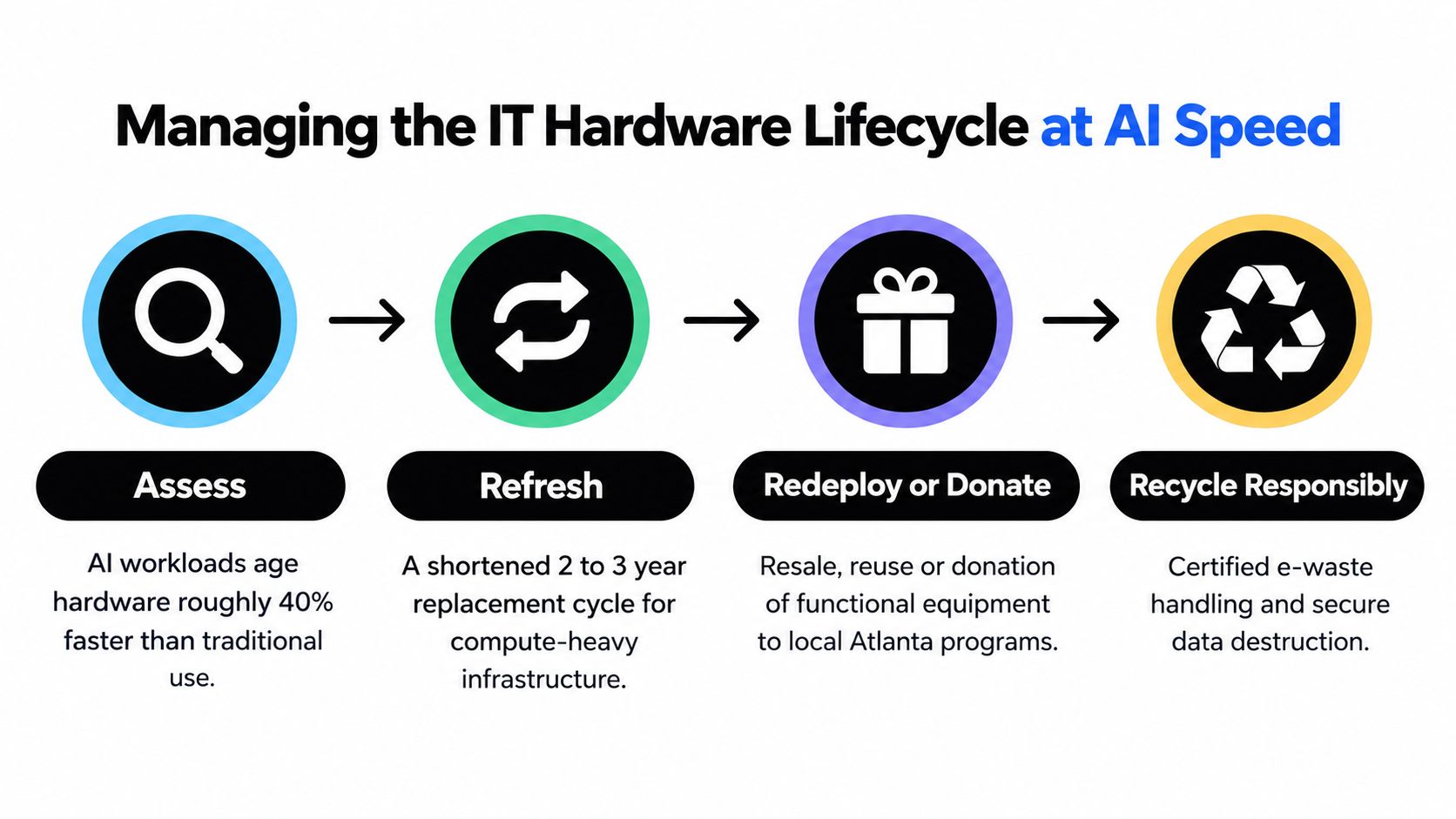
Managing the IT Hardware Lifecycle at AI Speed
AI scaling changes the rhythm of infrastructure management. Teams may add higher-capacity workstations, upgrade storage, deploy new networking equipment, or consolidate systems into a more specialized environment. The result is a growing stream of assets that still contain business data, configuration information, credentials, or customer records when they leave active service.
An old laptop isn't harmless because a user has stopped carrying it. A server isn't ready for recycling because it has been disconnected from the rack. Until the organization verifies data destruction, records the asset, and controls its movement, the device remains part of the company's security boundary.
Build an asset record before the refresh
A practical ITAD program begins with identification. Record the asset type, serial number, assigned department, location, condition, storage media, and disposition decision. Include servers, drives, desktops, laptops, networking equipment, monitors, and peripheral devices when they move through the same decommissioning project.
Next, separate assets by outcome:
- Redeploy: Keep functional equipment in service if it meets security and performance requirements.
- Donate: Direct usable devices toward an approved community or workforce program after data has been removed.
- Resell or recover value: Evaluate equipment that has a viable secondary market.
- Recycle: Send obsolete or damaged electronics through an accountable recycling process.
- Destroy: Use secure destruction for media or equipment that cannot be safely reused.
Data destruction must be a controlled decision
Software wiping may suit some assets when the organization can verify the method, device condition, and result. Physical destruction may be more appropriate for damaged drives, failed media, or equipment subject to stricter internal requirements. The choice should come from a documented policy rather than a last-minute decision by a facilities employee.
A complete chain of custody also matters. Identify who packed the equipment, who transported it, who received it, and what final disposition occurred. Keep certificates or other records that support the organization's internal controls and reporting requirements.
The disposal dock is part of the security architecture. If IT secures a device during use but loses control of it during removal, the lifecycle has a gap.
Businesses should also plan for the physical impact of refresh work. Server rooms, offices, labs, and storage areas often accumulate obsolete equipment because no one owns the removal process. A scheduled device lifecycle management program can connect procurement, IT, facilities, security, and sustainability teams before equipment becomes a storage problem.
Aligning Tech Upgrades with Sustainability Goals
AI growth can create tension between an IT manager who needs capable equipment and a sustainability leader who needs responsible resource management. The conflict is avoidable when both teams plan the lifecycle together. The relevant question isn't only whether a device is old. It's whether the business can extend its useful life, transfer it safely, recover materials, or direct it to a community use.
Donation-based recycling creates a bridge between those priorities. Functional laptops, monitors, and networking equipment may support digital inclusion or workforce development after secure data destruction and appropriate testing. Equipment that cannot be reused can enter a responsible electronics recycling stream instead of remaining in storage or being handled informally.
Turn an equipment refresh into a measurable program
A business can connect its AI deployment plan to sustainability reporting by documenting:
- Asset categories: What equipment was retired, reused, donated, resold, or recycled?
- Data controls: Which devices required secure data destruction, and how was completion recorded?
- Community outcomes: Which usable equipment supported schools, nonprofits, training programs, or workforce access?
- Operational improvements: How did a scheduled pickup, office cleanout, or facility cleanout reduce internal handling?
- Vendor accountability: Can the service provider explain its chain of custody and downstream process?
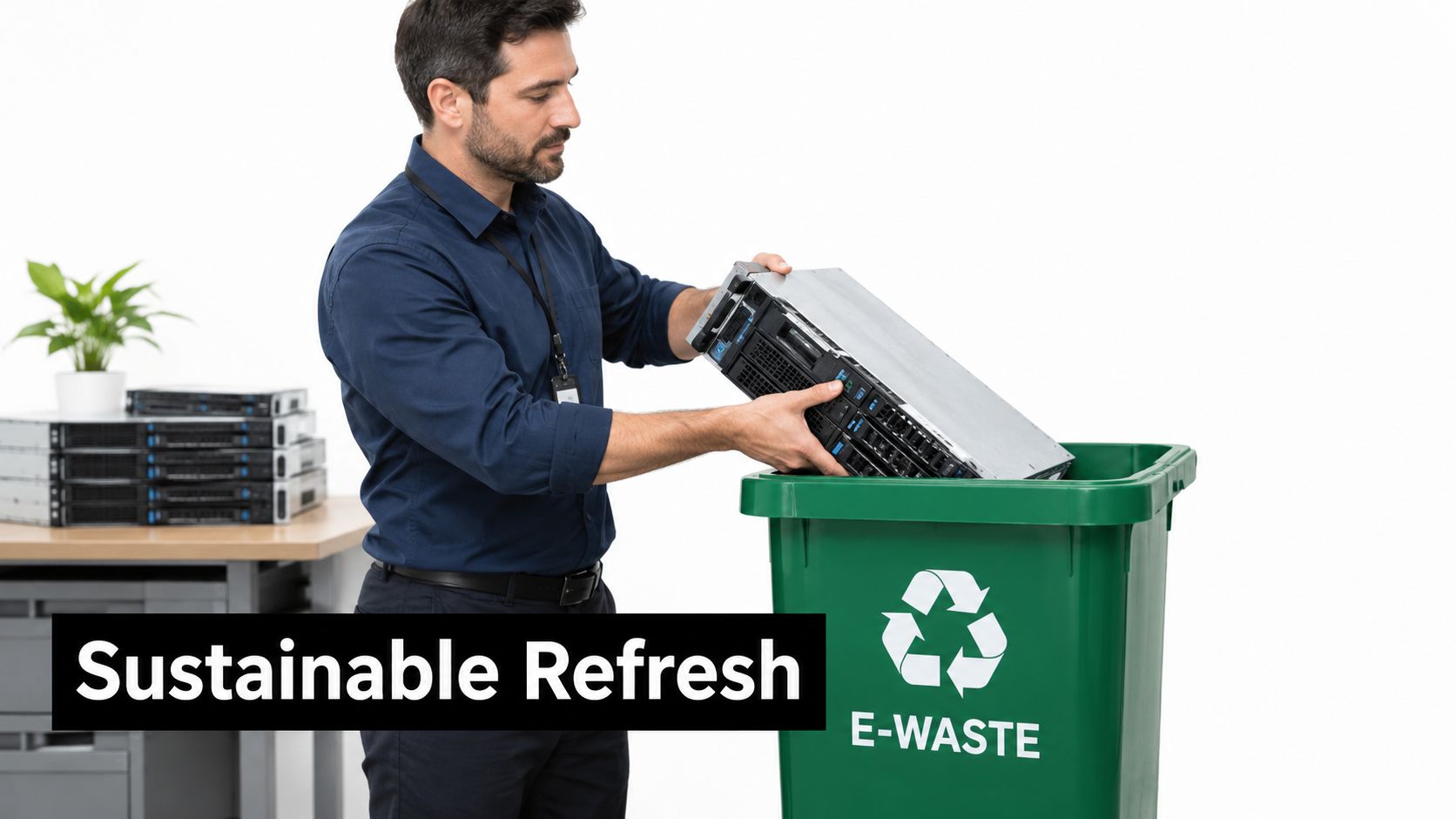
Reworx Recycling is a donation-based electronics recycling and IT asset disposition partner based in Smyrna, Georgia. Its services include business pickups, equipment decommissioning, IT asset management, recycling consultations, equipment buyback options, and secure hard drive shredding with data destruction. That model gives businesses a way to combine sustainable recycling, security controls, and community impact within one retirement process.
Sustainability needs operational evidence
A donation claim should be supported by a clear record of what happened to the equipment. If a device is unsuitable for reuse, responsible recycling remains the appropriate outcome. The EPA's electronics donation and recycling guidance provides useful background for organizations developing an electronics management policy.
The strongest corporate donation programs don't treat community benefit as a substitute for security. They apply secure data destruction first, evaluate equipment thoroughly, and document the final path. That approach protects the company while creating a credible connection between technology investment and local impact.
Overcoming the AI Talent and Governance Bottleneck
Better software won't remove the need for accountable people. An Atlanta-focused analysis reports that 68% of Atlanta-based companies struggle to find qualified AI professionals, even as work-related generative AI adoption is highest in financial services at 63% and professional services at 62% (Atlanta AI workforce analysis). That shortage leaves non-tech businesses asking a practical question: how can they deploy AI safely without building a large internal machine-learning team?
The answer isn't to hand every decision to a vendor. It's to separate the skills a business must own from the skills it can obtain through a managed service provider, implementation partner, or specialist consultant.
Governance can begin before advanced expertise arrives
A small or midsize company can establish useful controls without designing a complex research program. Begin by creating an approved-use policy that identifies which tools employees may use, what information they may enter, and which decisions require review. Prohibit confidential customer, employee, financial, or regulated information from unapproved public systems.
Then assign practical ownership:
- Business owner: Defines the workflow and acceptable outcome.
- IT or security lead: Reviews access, integrations, retention, and vendor controls.
- Process reviewer: Checks output quality and escalates errors.
- Executive sponsor: Decides whether the use case should expand, change, or stop.
A vendor should explain how it handles customer data, manages access, logs activity, supports deletion, and responds to incidents. Marketing claims aren't a substitute for contract language, technical review, and a test using representative but controlled data.
Leaders evaluating AI-supported recruiting and workforce processes may also benefit from insights from nexus IT group, particularly when deciding where automation can assist employees without removing human review from sensitive decisions.
Don't confuse access with readiness
A company can buy an AI subscription in an afternoon and still lack the policies, source data, and workflow ownership required for safe use. Conversely, a business without specialist staff can make progress by choosing a narrow use case, using a governed platform, and bringing in external expertise for architecture and security review.
The physical side deserves the same governance. When a platform rollout retires devices, the project owner should coordinate with ITAD and facilities rather than leaving removal to an informal cleanup. Atlanta businesses working through local tech talent shortages and solutions should treat governance and asset retirement as part of capability building, not administrative overhead.
A Phased Roadmap for AI and Infrastructure Integration
A mid-sized Atlanta business doesn't need to transform every department at once. It needs a sequence that exposes risk early, produces a useful operational result, and keeps hardware and data controls aligned with deployment.
Phase one, audit the starting point
List the workflows that consume the most staff time or create the most avoidable delay. For each one, record the systems involved, data owners, manual decisions, approval points, and known failure modes. At the same time, inventory the physical environment, including laptops, desktops, servers, storage, networking equipment, and devices held in storage.
The audit should answer practical questions:
- Which equipment supports the target workflow?
- Does it have sufficient performance and security support?
- Where does sensitive data reside?
- What equipment will be replaced if the pilot succeeds?
- Who owns decommissioning and data destruction?
Phase two, select one controlled pilot
Choose a process where the output can be reviewed. Examples include ticket classification, document extraction, customer-service drafting, internal search, or maintenance triage. Define the baseline process in qualitative terms, then select review criteria such as accuracy, escalation quality, employee acceptance, privacy, and support effort.
Evaluate vendors on integration, access controls, audit logging, data use, portability, service continuity, and exit terms. A low-cost tool that creates uncontrolled copies of sensitive information is not inexpensive. Neither is a system that requires extensive manual correction after deployment.
Phase three, prepare the transition
Before expanding the pilot, confirm that the network, endpoints, identity systems, and storage environment can support it. Create a refresh list for equipment that will be replaced, and decide whether each asset will be redeployed, donated, resold, recycled, or sent for product destruction.
Schedule the work rather than allowing retired equipment to accumulate. A coordinated office cleanout or facility cleanout should include packing requirements, access restrictions, chain-of-custody records, pickup timing, and a final disposition report. This prevents facilities teams from becoming an untracked holding area for sensitive technology.
Phase four, review and scale
Review the pilot with the people who perform the work, not only the project sponsor. Stop or redesign the use case if it produces unreliable output, creates unacceptable privacy exposure, or adds more review effort than it removes. If the results are sound, expand gradually and update the asset plan as new infrastructure enters service.
Securing Your Competitive Edge with Responsible ITAD
McKinsey's 2026 global survey found that 44% of respondents said AI was scaling across their enterprise, up from 38% a year earlier, while nearly nine in ten reported regular AI use in at least one business function (McKinsey State of AI survey). The benchmark reflects a broader shift from isolated pilots to operating models that touch more departments, systems, and devices.
That shift makes responsible ITAD a competitive safeguard. A business that manages only the software layer can create gaps in data security, procurement, facilities planning, sustainability reporting, and employee access. A business that connects deployment with lifecycle management can refresh equipment deliberately, protect information during transition, and recover value from assets that still have a useful role.
The operational standard Atlanta companies should adopt
Treat every major AI initiative as a lifecycle project:
- Before deployment: Define the workflow, data boundary, owner, and infrastructure requirements.
- During operation: Monitor access, output quality, vendor performance, and equipment condition.
- During refresh: Record assets, control movement, and complete verified data destruction.
- At retirement: Choose reuse, donation, resale, recycling, or destruction based on condition and risk.
- After completion: Retain disposition records and update procurement and sustainability reporting.
Improperly handled drives can expose sensitive information, while careless electronics disposal can waste recoverable materials and undermine environmental commitments. A structured responsible electronics recycling program for Atlanta businesses addresses both concerns by bringing security, logistics, and environmental responsibility into the same operating process.
AI can help Atlanta companies respond faster and scale service, but growth shouldn't leave a trail of unmanaged laptops, servers, and storage devices. The organizations that plan the back office as carefully as the front office will be better positioned to expand without adding avoidable risk.
Reworx Recycling can help Atlanta businesses coordinate secure data destruction, equipment decommissioning, business pickups, donation-based recycling, and responsible IT equipment disposal as AI infrastructure evolves. Visit Reworx Recycling to review practical guidance, then schedule a consultation or pickup for your next technology refresh.