

Depending on the dataset, a typical Columbus, Ohio home in 2026 can look like $248,686, about $304,000, or roughly $350,000, while rent sits around $1,400 to $1,600 per month. Those figures aren't necessarily contradictory. They measure different slices of a large, fast-changing metropolitan market.
That distinction matters to relocating households, employers planning office sites, and facilities teams managing moves. The Ohio Columbus Ohio Housing Market and Living Guide below treats the city as several overlapping markets, then connects housing choices with schools, commuting, taxes, and responsible electronics recycling during relocation.
Why Columbus Reads Like Three Different Markets
A single Columbus housing number can conceal more than it clarifies. Zillow reported an average home value of $248,686, a median sale price of $253,333, and homes moving to pending in around 9 days in 2026 (Zillow's Columbus home value data). Redfin reported a median sale price of $304,000 over the three months ending in July 2026. Its homes averaged 40 days on market, and sellers received about 2 offers per home (Redfin's Columbus housing market data).
Columbus REALTORS and Central Ohio MLS reporting showed a higher median, $350,000 in May 2026 and $352,000 in June 2026, with roughly 2.2 months of supply in the June report (Columbus REALTORS April market report). These figures describe different samples: algorithmic property values, reported sales, and MLS transactions. Geography, property mix, and timing also affect the comparison.
Three overlapping submarkets
Columbus operates as several overlapping markets rather than a single price curve:
- Stabilized owner-occupied areas contain established homes where buyers often pay for location, condition, and neighborhood identity.
- Renter-heavy inner neighborhoods include apartment concentrations and smaller units, making rents a practical affordability reference.
- Outer-ring growth corridors feature new construction, larger homes, and builder inventory, which can produce higher transaction medians than older city neighborhoods.
The broader supply pattern reinforces the divide. Redfin recorded 3,099 homes sold in July 2026, up from 2,834 a year earlier, while the Columbus metro all-transactions house price index rose from 339.78 in Q2 2025 to 351.14 in Q2 2026 (Federal Reserve house price index data). Columbus is normalizing, yet demand remains substantial and supply is still tight enough to produce sharply different experiences by price band.
| Source | Headline Value | What It Samples | 2026 Context |
|---|---|---|---|
| Zillow | $248,686 average value, $253,333 median sale price | Algorithmic property-value estimates and recorded sales | About 9 days to pending |
| Redfin | $304,000 median sale price | Closed sales in its reported market geography | 40 days on market, about 2 offers |
| Columbus REALTORS/MLS | $350,000 to $352,000 median sale price | MLS closed transactions across the relevant reporting area | About 2.2 months of supply |
The useful question is which submarket, property type, and transaction dataset match the decision. Businesses assessing relocation should apply the same test to office costs, employee housing budgets, and disposal logistics. Guidance on Chicago neighborhood selection shows why location-specific planning matters, even though Columbus has its own market structure.
Decoding the 2026 Housing Data Signals
The reported Columbus home values span $248,686 to $352,000, while rental estimates cluster around $1,400 to $1.6K per month. That spread is not a forecasting error. It reflects different samples, property mixes, and decisions. The analytical task is to identify which signal matches the household, building, or relocation budget under review.
Price gaps reveal submarket composition
The MLS median is most useful for a specific purchase because it describes completed transactions. It can rise when more move-in-ready or higher-priced properties close, then soften when lower-priced homes make up a larger share of sales. Buyers should therefore compare the median with nearby closed properties that share tenure, condition, and building type.
The July Redfin reading of $304,000, alongside 40 days on market and approximately 2 offers per home, points to active transactions with less uniform urgency than a headline median suggests (Redfin's July 2026 Columbus market data). Its broader meaning is market speed. A relocation team can use that signal to estimate how quickly an employee may need to make an offer, while still checking the relevant neighborhood and price band.
Zillow's average home value of $248,686, down 1.0% year over year, with a median sale-to-list ratio of 1.000 and 38.5% of sales closing above list price, measures a wider property universe (Zillow's Columbus housing values). That makes it useful for directional tracking, but less suitable for pricing one renovated house or a property with deferred maintenance. An algorithmic estimate cannot fully capture block-level differences, inspection findings, or recent improvements.
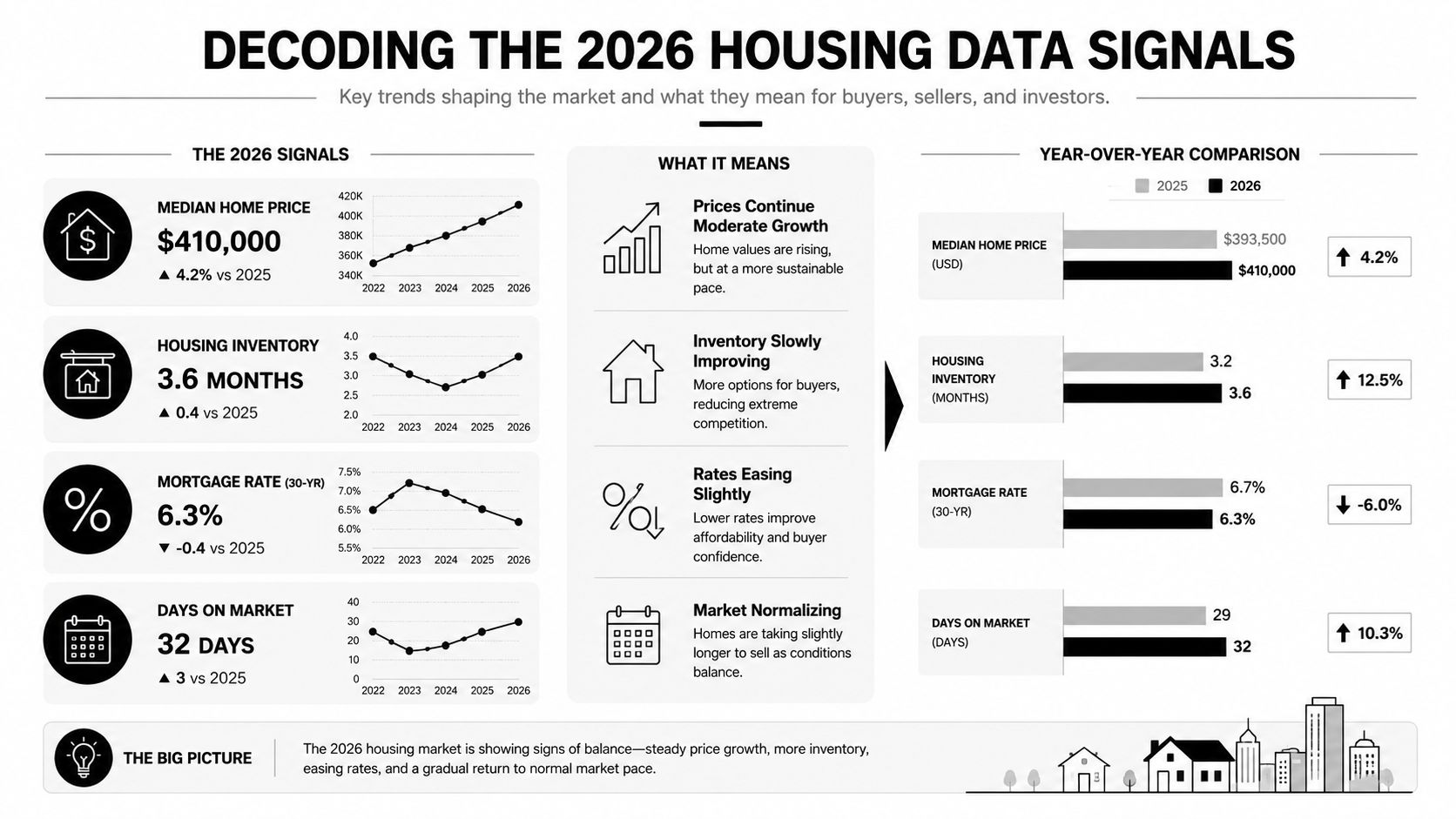
Rent data describes a different submarket again. One market report placed Columbus's median near $1.6K, while another analysis cited average rent near $1,400 and an annual income requirement of about $56,000 (Columbus housing market analysis). The difference likely reflects unit mix, listing selection, and the affordability rule applied. Renters should compare like-for-like units, including location, size, utilities, and lease terms, rather than substitute a sales median for a rent budget.
Practical rule: apply transaction medians to comparable sales, platform values to directional monitoring, market-speed measures to timing, and rents to household cash-flow planning. A forward-looking review should also test the assumptions against another housing market forecast, especially when a relocation decision depends on conditions beyond one reporting period.
Property condition can reverse the apparent bargain. Before starting your exterior renovation, separate improvement costs from the value supported by comparable homes. That calculation keeps a broad platform estimate from becoming an overconfident renovation budget.
Neighborhoods and Submarkets Across Central Ohio
German Village, Grandview Heights, and Bexley form the top tier of Columbus owner-occupied neighborhoods, but their appeal is not explained by price alone. Price tier, tenure pattern, and commute corridor distinguish these areas from renter-centered districts and newer suburban construction. Citywide averages therefore provide limited guidance once a household has identified its preferred housing type and daily travel pattern.
These established neighborhoods generally fall within a planning range of $380,000 to $520,000, with homes often selling in under 20 days. Demand comes from established households, professionals seeking shorter urban commutes, and buyers willing to pay for architectural character or proximity to employment centers. German Village offers access to downtown and nearby employment, Grandview Heights connects efficiently to central business and medical areas, and Bexley serves households that place greater weight on established residential streets and local institutions.
Downtown, University-area employment, medical institutions, and established business corridors support demand across this tier. Owners also tend to hold properties longer, which restricts turnover. A calmer regional market can therefore coexist with few suitable listings in a specific neighborhood.
The Short North, Italian Village, University District, and Olde Towne East reflect a different demand structure. These renter-heavy inner-belt areas commonly anchor rents near $1,400 to $1,600, while the price-to-rent relationship can favor landlords, especially for residents who prioritize walkability and flexibility over immediate ownership.
Students, young professionals, service-sector workers, and households seeking access to downtown, Ohio State, entertainment, and nearby jobs drive much of this demand. The relevant housing comparison includes more than purchase price or rent. Parking, maintenance, amenity premiums, and the cost of avoiding a long commute can materially change the household budget.
Dublin, New Albany, Hilliard, and Grove City form outer-ring growth corridors. Their planning range places medians around $340,000 to $420,000, with months of supply above 2.5. New construction and builder inventory may offer greater selection, although advertised prices may exclude upgrades, fees, or landscaping.
These suburbs attract families, corporate relocations, and employees commuting toward technology, logistics, manufacturing, and suburban office clusters. Space, school access, and newer systems may outweigh downtown proximity for some households, while longer travel distances and vehicle costs can reduce the apparent price advantage.
| Tier | Representative Neighborhoods | 2026 Median Price | Days on Market | Renter Share |
|---|---|---|---|---|
| Tier 1 | German Village, Grandview Heights, Bexley | $380,000–$520,000 | Under 20 days | Lower |
| Tier 2 | Short North, Italian Village, University District, Olde Towne East | Varies by property type | Varies by property type | Higher |
| Tier 3 | Dublin, New Albany, Hilliard, Grove City | $340,000–$420,000 | Varies by builder inventory | Mixed |
Match the household's budget and tenure plan to a tier first, then compare individual neighborhoods. Corporate relocation teams should map employee addresses against commute corridors and school needs instead of applying one Columbus median to every candidate.
Buying Versus Renting in the Current Cycle
Columbus's 2026 market doesn't fit a simple buyer's-market or seller's-market label. Inventory reached 5,551 homes in one MLS-based report, while another Central Ohio report recorded 6,193 single-family homes and condominiums, described as the highest July inventory in over a decade (Central Ohio housing inventory report). At the same time, months of supply remained around 2.2 in the June MLS report, below the range commonly associated with balanced conditions (Columbus REALTORS market data).
That combination gives buyers more selection than during the tightest phase of the market, but it doesn't eliminate competition for correctly priced, move-in-ready homes. Redfin's about 2 offers per home and Zillow's 38.5% share of sales above list price show why condition and pricing still matter (Redfin market data, Zillow market data).
A decision framework for households
Buying becomes more defensible when the household expects to stay long enough to absorb transaction costs, can fund repairs without destabilizing cash reserves, and finds a property whose total ownership cost compares reasonably with rent. Renting remains attractive when the move is uncertain, the household needs flexibility, or ownership expenses include substantial insurance, association, maintenance, and financing costs.
The requested $320,000 representative purchase comparison illustrates the issue, but the brief doesn't provide a verified mortgage rate, down payment, tax bill, insurance premium, or rent sample for that exact home. Those figures shouldn't be fabricated. A buyer should calculate principal, interest, taxes, insurance, maintenance, and association fees using a lender's actual quote, then compare that total with a comparable rental.
| Submarket | Buy Monthly PITI | Rent Monthly | Cash to Close / Move-In | Break-Even Horizon |
|---|---|---|---|---|
| Established owner-occupied | Must be quoted for the property | Must be quoted for a comparable unit | Down payment and closing costs vary | Depends on financing and tenure |
| Renter-heavy inner belt | Must be quoted for the property | Around $1,400–$1,600 in cited market reporting | Deposit and moving costs vary | Depends on rent growth and ownership costs |
| Outer-ring growth | Must be quoted for the property | Must be quoted for a comparable unit | Down payment, upgrades, and closing costs vary | Depends on builder pricing and tenure |
A useful test is to run three scenarios, conservative, expected, and stressful. Include rate changes, repairs, insurance, and resale costs. For renters, compare the cash difference with the value of flexibility and the ability to preserve a down-payment reserve.
The cheapest monthly payment isn't automatically the cheapest housing decision. The correct comparison is total cost over the years you expect to remain in the property.
For residents who rent, design choices can improve daily comfort without creating ownership obligations. Practical ideas for how to turn a rental into a home can help a household evaluate lifestyle value separately from the purchase decision.
Cost of Living Schools and Commuting
Columbus combines a substantial urban population with a regional housing market that extends well beyond city boundaries. The city population is 914,802, median gross rent is $1,295 per month, and median household income is $66,082, according to the cited Columbus demographic profile (Columbus population, rent, and income data). Those figures are useful anchors, but they shouldn't be mixed casually with metro-level income or suburban school data.
Schools change the housing equation
Columbus City Schools serves a different housing and commuting context from suburban districts such as Dublin, Worthington, Hilliard, and Upper Arlington. Families comparing locations should examine the assigned school, transportation arrangements, extracurricular access, and the daily trip required to reach work, not just a district label.
Suburban school access often carries a housing premium because buyers compete for a bundled package of home space, district assignment, parks, and perceived resale demand. An urban household may instead prioritize walkability, shorter access to downtown, and proximity to cultural or university destinations. Neither choice is universally cheaper once time, transportation, and housing costs are combined.
Commute corridors define practical affordability
The main corridors connect different housing products to different employment geographies:
- I-71 North: Delaware and Westerville connect to downtown and northern employment areas.
- I-70 East: Reynoldsburg and Pickerington serve households traveling toward eastern Franklin County and surrounding communities.
- SR-315 South: Dublin and Hilliard connect to northwest employment clusters and central Columbus.
- Grove City to downtown: This corridor offers outer-south housing options for workers accepting a longer urban trip.
The brief does not provide verified average drive times for these routes, so a relocation team should test actual addresses at the employee's likely departure times. A map distance that looks manageable can produce a different quality-of-life result when school drop-off, winter conditions, or shift work enters the calculation.
| Submarket | School Rating | Median HH Income | Avg Commute to Downtown | Cost-of-Living Index |
|---|---|---|---|---|
| Columbus urban core | Varies by assigned school | $66,082 citywide anchor | Address-dependent | Not specified in verified data |
| Dublin and Hilliard | Varies by assigned school | Not specified | Corridor-dependent | Not specified |
| Worthington and Upper Arlington | Varies by assigned school | Not specified | Corridor-dependent | Not specified |
| Grove City and eastern suburbs | Varies by assigned school | Not specified | Corridor-dependent | Not specified |
For employers, the practical implication is clear. A salary that works for a city renter may not support a suburban ownership plan once commute and school preferences are included. Housing stipends, hybrid work policies, and office-site selection should use neighborhood-level scenarios, not one regional average. Families looking beyond Columbus can also compare the framework used in this Connecticut family living guide.
Sustainability Resources and E-Waste Options
Housing turnover creates a second planning problem that price dashboards don't capture. Moves, renovations, office consolidations, and technology refreshes all produce discarded electronics, and those materials require a documented route rather than a general trash solution.
The Ohio EPA regulates solid and hazardous waste through Ohio law, including ORC 3734. Organizations should verify current requirements with the Ohio EPA's official recycling and waste resources, especially when equipment includes batteries, CRT displays, lamps, or other potentially regulated materials.
Build the disposal stream before moving day
Residents and small businesses can simplify a pickup by separating equipment into clear categories:
- Computing equipment: laptops, desktops, servers, and related components.
- Network hardware: switches, routers, access points, and cabling.
- Displays and peripherals: monitors, printers, keyboards, and accessories.
- Power and battery items: household batteries, uninterruptible power supplies, and battery-containing devices.
Don't place electronics in regular trash without confirming the applicable local requirements. For business assets, the risk also includes data exposure. Drives, removable media, and embedded storage should be identified before secure data destruction, and the organization should retain documentation suitable for internal controls or compliance review.
A business-ready chain of custody
Reworx Recycling is one option for organizations seeking electronics recycling, donation-based recycling, computer recycling, office cleanout, facility cleanout, and IT asset disposition (ITAD) support. Its published services include business pickups, equipment decommissioning, IT asset management, recycling consultations, secure hard-drive shredding with data destruction, equipment buyback options, and customer drop-off support (Reworx Recycling's recycling resources).
A facilities or IT team should request an asset list, confirm accepted materials, remove loose media, consolidate cables, and ask whether serialized reporting and a certificate of destruction are available for the specific project. Larger environments may also need data center decommissioning, laboratory equipment disposal, medical equipment disposal, product destruction, laptop disposal, or corporate donation programs.
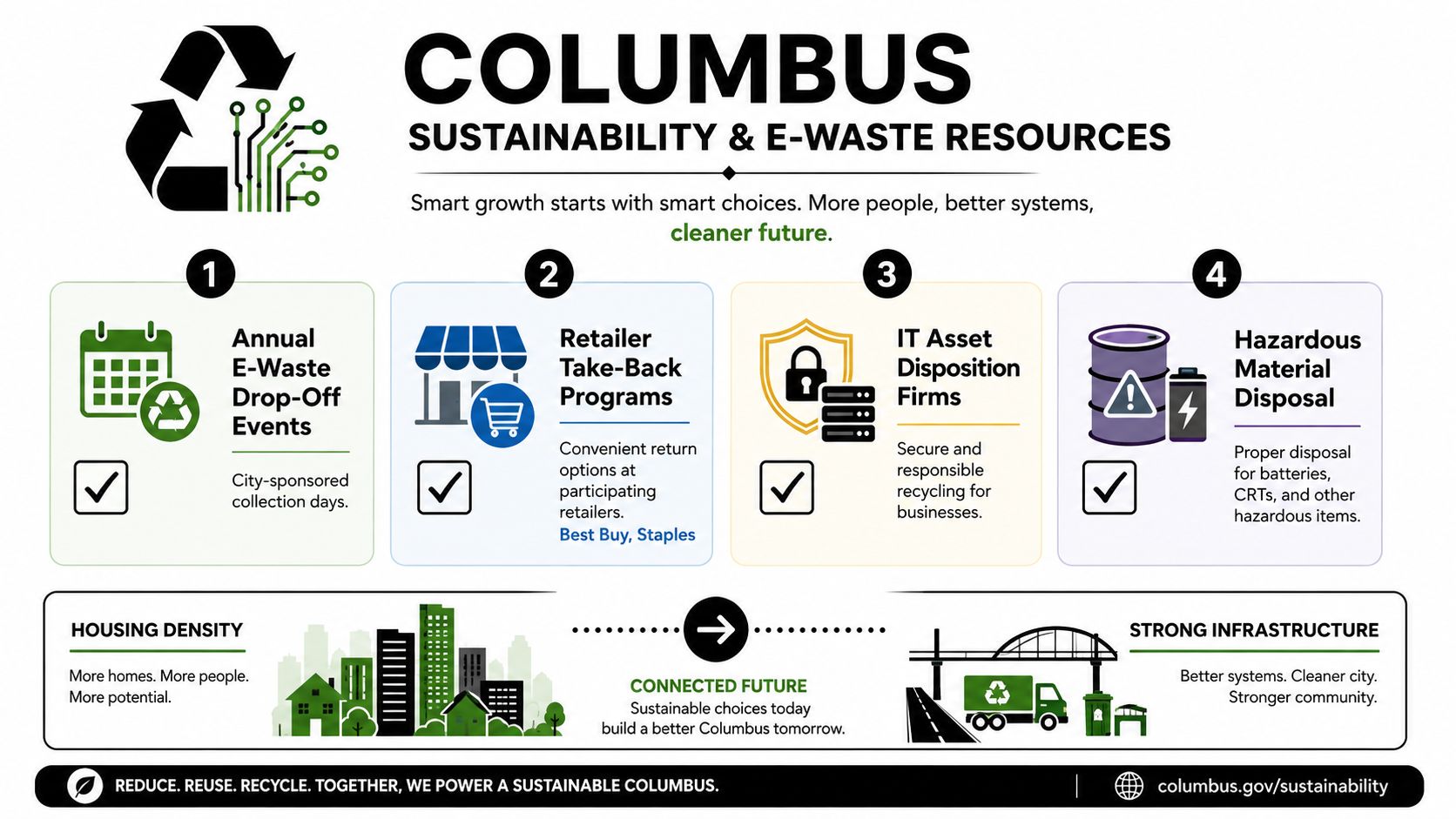
The housing insight is broader than recycling alone. A market with active moves and office changes needs reverse logistics that can keep electronics out of disposal channels, preserve resale or donation value, and document how sensitive data was handled. That connects sustainable recycling with operational risk management and community-focused technology reuse.
Moving Tips Taxes and a Practical Next Step
A Columbus move involves more than selecting a neighborhood. Property taxes vary by jurisdiction, municipal income-tax withholding can affect paychecks, and a move can create a large volume of unwanted electronics in a short period.
The planning brief identifies effective property-tax rates across Franklin County jurisdictions in the approximate 1.7% to 1.9% range, but the exact bill depends on the property, assessed value, jurisdiction, exemptions, and local levies. Buyers should request a current tax estimate for the address and ask how the homestead exemption applies to an owner-occupied residence. Employees should also confirm Columbus municipal income-tax withholding with payroll, particularly when work and residence locations differ.
A staged relocation checklist
Sixty days before moving
- Review lease obligations, purchase timing, and any lease-buyout terms.
- Request school records and confirm enrollment requirements.
- Update voter-registration plans and collect address documentation.
- Inventory computers, monitors, networking devices, and household electronics.
Thirty days before moving
- Schedule utility transfers and arrange USPS change-of-address service.
- Confirm municipal tax-registration responsibilities, including any applicable RITA process.
- Obtain mover insurance details and verify the mover's certificate of insurance, or COI.
- Separate equipment for donation, resale, recycling, or secure destruction.
During moving week
- Photograph high-value equipment and retain serial numbers.
- Keep storage media separate from general household goods.
- Confirm pickup instructions, loading access, and documentation requirements.
- Keep certificates, receipts, and asset reports with the relocation file.
A small business leaving an office should treat the transition as an office relocation and an ITAD project at the same time. A documented office relocation service can help the team coordinate equipment removal with the broader move, while households can plan furnishings separately using practical guidance on how to furnish a new home.
The best vendor is the one that explains scope clearly, identifies accepted materials, states how data will be handled, and provides records appropriate to the organization. That standard applies to movers, recyclers, contractors, and any partner handling equipment during a Columbus transition.
Reworx Recycling helps Columbus-area businesses and institutions manage electronics recycling, donation-based recycling, secure data destruction, equipment pickups, and IT asset disposition for retired technology. Visit Reworx Recycling to learn how to donate old equipment, schedule a business pickup, or establish a documented recycling partnership for an office, school, facility, or technology refresh.