

You open your annual appraisal notice expecting a routine update and find a market value that seems detached from what your home would command today. The number feels personal because it affects your escrow payment, your monthly budget, and the cost of staying in a house you already own.
Texas property taxes reward homeowners who understand the machinery behind that notice. The Texas Texas Property Tax Guide for Homeowners approach is simple: verify your homestead status, read the appraisal record, challenge an unsupported value, and track every deadline. The state's 2026 exemption changes help, but they don't eliminate the need to review your appraisal.
Why Your Texas Property Tax Bill Feels So High
A homeowner in a growing Texas suburb can receive an appraisal notice showing a sharp rise in market value even when the house hasn't changed. The roof, kitchen, and floor plan may be the same, but nearby sales can influence the appraisal district's opinion of what the property could sell for. That creates sticker shock before local taxing units even apply their rates.
Texas has no state property tax. The state doesn't collect property tax or set property tax rates. Instead, local taxing units establish rates and collect revenue for schools, streets, roads, police, fire protection, and other local services, as explained by the Texas Comptroller's overview of the Texas property tax system. Your bill reflects the combined decisions of the jurisdictions serving your address.
Why local funding changes the homeowner experience
The absence of a state property tax doesn't mean Texans avoid property taxes. It means the obligation is administered locally, through appraisal districts and overlapping taxing units. A school district, county, city, and special district may each appear on the same bill, and each can affect the final amount.
That structure has deep roots. The Texas Comptroller notes that property taxes have existed in Texas since the 1830s, and the issue helped spur the fight for Texas independence after the Mexican government removed a generous property tax exemption for settlers in 1830. The history explains why property taxes remain central to Texas public finance, even without a state income tax.
Practical rule: Treat your appraisal notice as a document to audit, not a bill you must accept without question.
Your home's market value and your taxable value aren't necessarily the same. Homestead protections and exemptions can reduce the amount exposed to local rates, while a protest can address an appraisal that doesn't reflect the property's condition or comparable values. Homeowners researching broader housing conditions can also review this Texas housing market forecast for 2026, but your county appraisal record remains the controlling starting point for your tax review.
How Texas Property Taxes Are Calculated and Assessed
Texas property taxation becomes manageable once you separate appraisal, tax-rate setting, and collection. Three different actors handle those jobs.
Think of the system like a restaurant. The appraisal district decides the menu price, the taxing units determine the percentage added to the check, and the tax collector delivers the bill and processes payment. Confusing those roles leads homeowners to send the wrong question to the wrong office.
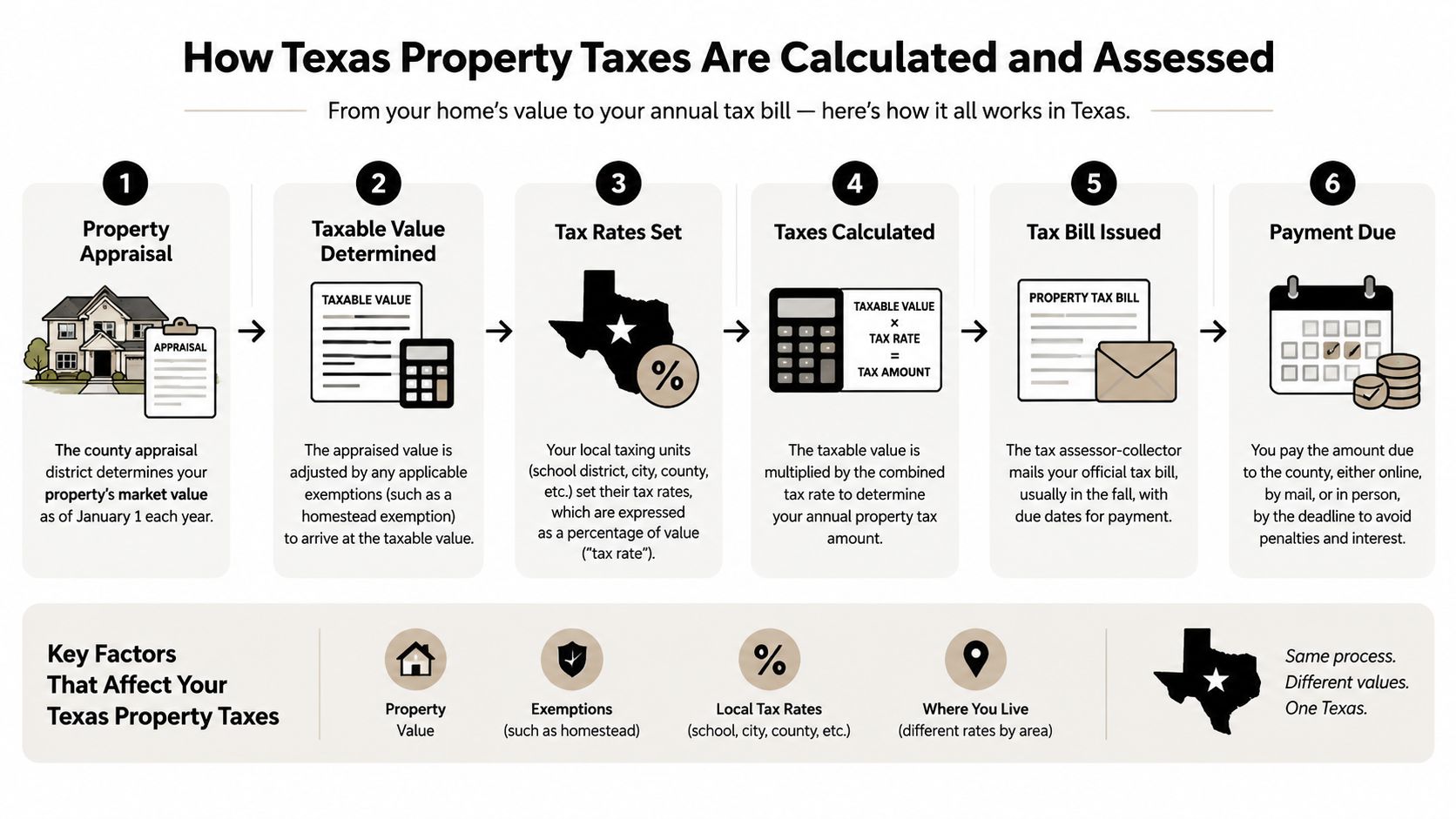
The three offices behind the bill
- County appraisal district: The chief appraiser and appraisal district determine the property's appraised value and decide whether the owner qualifies for exemptions.
- Local taxing units: School districts, counties, cities, and special districts adopt their own tax rates. Their combined rates apply to the taxable value.
- Tax collector: The collector sends the bill and receives payment. That office generally doesn't decide whether the appraisal or exemption determination was correct.
The basic calculation is straightforward:
Appraised value minus exemptions equals taxable value. Taxable value multiplied by the combined local rates equals the tax charged.
The distinction between appraised value and taxable value matters. Appraised value represents the district's valuation of the property. Taxable value is the figure left after eligible exemptions are deducted. A homeowner may disagree with the appraised value even after receiving an exemption, because the exemption doesn't correct an inflated valuation.
The homestead cap
Once a primary residence qualifies for a homestead exemption, annual increases in its taxable appraised value are capped at 10%, excluding the value of new improvements, according to the Texas Comptroller's property valuation guidance. If market value rises 25% in a year, the homestead's taxable value can rise by no more than 10% that year under the cap rules.
The cap slows assessment shock. It doesn't freeze the value, and it doesn't apply automatically to every residence. Confirm that your property has an approved homestead exemption and review the appraisal notice for new improvements that may be treated separately.
Changes to the property can also create questions. For example, homeowners considering upgrades may find a practical discussion of property tax and metal roofs useful when thinking through how improvements may affect valuation.
For a broader comparison of housing conditions outside Texas, see this Atlanta real estate market trends guide. It won't replace your local appraisal record, but it can help separate general market discussion from the specific data used for your property.
Homestead and Other Exemptions That Lower Your Bill
The largest immediate change for many homeowners took effect in 2026. The general school-district residence homestead exemption increased from $100,000 to $140,000, effective January 1, 2026, according to the Texas Comptroller's exemption guidance. That deduction reduces the school-taxable base before the school district's rate is applied.
Homeowners who are 65 or older or disabled received a separate increase. The additional school-tax exemption rose from $10,000 to $60,000, producing a combined $200,000 school-tax exemption for qualifying households. This is annual tax relief, not merely a one-time adjustment, although the exact dollar effect depends on the school district's rate and the property's eligibility.
A practical comparison
The table below isolates the change in the general school exemption. It doesn't estimate a complete tax bill, because Texas has no single statewide property tax rate and local taxing units apply their own rates.
| Home Appraised Value | Pre-2026 Exemption | 2026 Exemption | Annual Savings |
|---|---|---|---|
| $350,000 | $100,000 | $140,000 | Approximately $1,400 at a $1.00 school tax rate |
| $400,000 | $100,000 | $140,000 | Approximately $1,400 at a $1.00 school tax rate |
| $500,000 | $100,000 | $140,000 | Approximately $1,400 at a $1.00 school tax rate |
The savings comparison comes from the additional $40,000 removed from the school-taxable base. It assumes the school tax rate is $1.00, so don't treat it as your total property-tax savings. County, city, and special-district charges may remain unchanged, and local rates differ.
Filing is your responsibility
File the homestead application with the county appraisal district, not the tax collector. The chief appraiser determines eligibility, and the general filing deadline is before May 1. Most exemptions require an application, so first-time buyers should put this task on the closing and move-in checklist rather than assume the exemption transfers automatically.
A taxing unit may also adopt a local-option homestead exemption of up to 20% of appraised value. That option isn't universal, so check the taxing units listed on your bill and ask the appraisal district which local exemptions apply to your address.
Homeowners approaching the age-based exemption should review eligibility timing carefully. A plain-language resource on senior property tax discounts in Texas can help frame the questions, but the county appraisal district makes the actual determination.
How to Protest Your Appraisal and Win
The 2026 exemption increase doesn't make an appraisal protest obsolete. It lowers the taxable base, but it doesn't correct an appraised value that's too high, an unequal appraisal, a denied exemption, or a notice problem.
You can protest when the district's value exceeds what the property would reasonably sell for, when comparable properties receive lower appraisals, when the home's condition isn't reflected, when an exemption was denied, or when you didn't receive proper notice. The usual deadline is May 15 or 30 days after the notice is mailed, as described by the Texas Comptroller's property tax protest information.

Build the right record
A persuasive protest isn't a complaint about taxes in general. It's a focused argument about the property's value or treatment.
- Comparable sales: Use nearby homes with similar size, age, condition, and features. A general neighborhood price increase doesn't prove that your specific appraisal is correct.
- Condition evidence: Photograph foundation problems, outdated systems, flood damage, deferred maintenance, or other defects that affect saleability.
- Independent valuation: An appraisal prepared for a relevant purpose can support your position, particularly when it explains adjustments rather than just stating a conclusion.
- Unequal appraisal evidence: Compare your property with similar properties that the district values lower. The comparison should be truly similar, not merely nearby.
File, review, and escalate
Submit the protest online through the appraisal district when that option is available, or send the required form by mail. Keep confirmation of delivery. Then request the district's evidence packet in advance and compare its sales, property characteristics, and adjustments with your own documentation.
Attend the informal review prepared with a one-page summary. Put the requested value or correction at the top, list the strongest evidence underneath, and explain each adjustment briefly. If the informal process doesn't resolve the issue, present the same organized record at the formal Appraisal Review Board hearing.
A higher exemption may reduce the consequence of an appraisal error, but it doesn't erase the error. Protest when the evidence supports it, especially when the district's record contains incorrect characteristics or ignores substantial condition issues.
The Comptroller's 2026 guidance on temporary relief for improvements destroyed by fire also matters to affected homeowners. If a fire damaged or destroyed improvements, ask the appraisal district about reappraisal and temporary relief rather than waiting for the next ordinary cycle.
Reading Your Tax Bill and Understanding What You Owe
A Texas tax bill is easier to audit when you read it from the property record outward. Start with the appraised value, then check every exemption, identify the resulting taxable value, and review the taxing units and rates listed below it.
The bill should identify the school district, county, city, and any special districts that levy against the property. Add those rates to understand the combined local rate, but don't assume the nominal rate equals your personal tax burden. Your effective tax rate compares the total tax paid with the home's market value, while the nominal calculation applies rates to the taxable value after exemptions.

A simple audit method
Use a worksheet with these columns:
| Bill item | What to verify |
|---|---|
| Appraised value | Does it reflect the property's condition and market evidence? |
| Exemptions | Is the homestead exemption shown, and are other approved exemptions listed? |
| Taxable value | Does the calculation reflect the deductions? |
| Taxing units | Are the listed school, county, city, and special districts correct? |
| Rates and charges | Do the rates and individual amounts add up to the total? |
For a worked review, take a $400,000 home and separate the school, county, city, and municipal utility district charges rather than treating the bill as one statewide assessment. Apply the exemptions first, then examine how each local rate contributes to the total. This side-by-side approach often reveals whether the main issue is valuation, a missing exemption, or the combined local burden.
The tax bill typically arrives in October, is due by January 31 of the following year, and becomes delinquent on February 1. Those dates are summarized in the Comptroller's property tax reports and resources. Some counties offer installment arrangements, and a penalty waiver may be possible when a taxing unit made an error, but ask the collector promptly and document the mistake.
Homeowners comparing moving costs or regional affordability can also consult this Columbus, Ohio housing and living guide. For a Texas bill, however, your own exemption record and local taxing-unit breakdown matter more than a statewide average.
Critical Deadlines Penalties and County Resources
Put these dates on a calendar as soon as the appraisal notice arrives. Missing an administrative deadline can cost more than the time required to file a form or submit a protest.
| Action | Deadline or timing |
|---|---|
| Homestead exemption application | Before May 1 |
| Property tax protest | May 15 or 30 days after the notice is mailed |
| Tax payment | January 31 |
| Delinquency begins | February 1 |
For delinquent taxes, the penalty is 6% plus 1% interest per month for the first month, escalating to a 12% penalty plus continued interest if unpaid by July 1, according to the verified Texas property tax guidance supplied for this guide. Delinquency can lead to a tax lien and eventual foreclosure, so contact the collector about payment arrangements before the account becomes unmanageable.
Keep the right offices handy
- State guidance: Use the Texas Comptroller property tax division for statewide forms and explanations.
- Appraisal records: Check the websites for Harris County Appraisal District, Dallas Central Appraisal District, Tarrant Appraisal District, Bexar County Appraisal District, and Travis Central Appraisal District.
- Protest filing: Start with your county appraisal district's online portal or property tax protest page. Many counties offer online filing and virtual hearing options.
- Hearing support: The Appraisal Review Board is administered through the local appraisal district. Use that district's contact page for the current board procedures and hearing information.
A homeowner in Austin, Houston, Dallas-Fort Worth, San Antonio, or another Texas market should rely on the county's own notice for the controlling date. The Austin electronics disposal resource is unrelated to tax administration, so don't confuse service directories with appraisal or collection offices when organizing household records.
Common Questions Texas Homeowners Actually Ask
Does the 2026 exemption mean I should stop protesting?
No. The exemption reduces the taxable base. It doesn't correct overvaluation, unequal appraisal, a denied exemption, or a notice error. Protest when your evidence supports a correction.
What happens if I miss the May 1 exemption deadline?
You may still qualify for a late filing if you can show good cause, but you risk paying the full applicable taxes for that year. Contact the county appraisal district immediately and ask about its late-filing procedure.
Can I protest every year?
Yes. A successful protest in one year doesn't guarantee that the next appraisal is accurate. Review each new notice and use current evidence.
Do I need to reapply for homestead exemption annually?
Generally, no. The exemption stays on file unless you sell, change occupancy, or the appraisal district removes it for cause. Confirm the exemption appears on your record, especially after moving or changing ownership.
What if a storm or fire damaged my home?
Ask the appraisal district about reappraisal and temporary relief for destroyed improvements. The Comptroller's 2026 guidance addresses temporary relief for improvements destroyed by fire, so document the damage and file promptly.
For broader household planning, you can also review this Alabama homeowners insurance guide, but Texas exemption and protest decisions must be handled through your county appraisal district.
Reworx Recycling helps households and businesses retire unwanted electronics through responsible recycling, equipment pickups, secure data destruction, and donation-based programs that support digital inclusion and workforce development. Visit Reworx Recycling to arrange a pickup, donate old equipment, or build a responsible technology disposal plan.