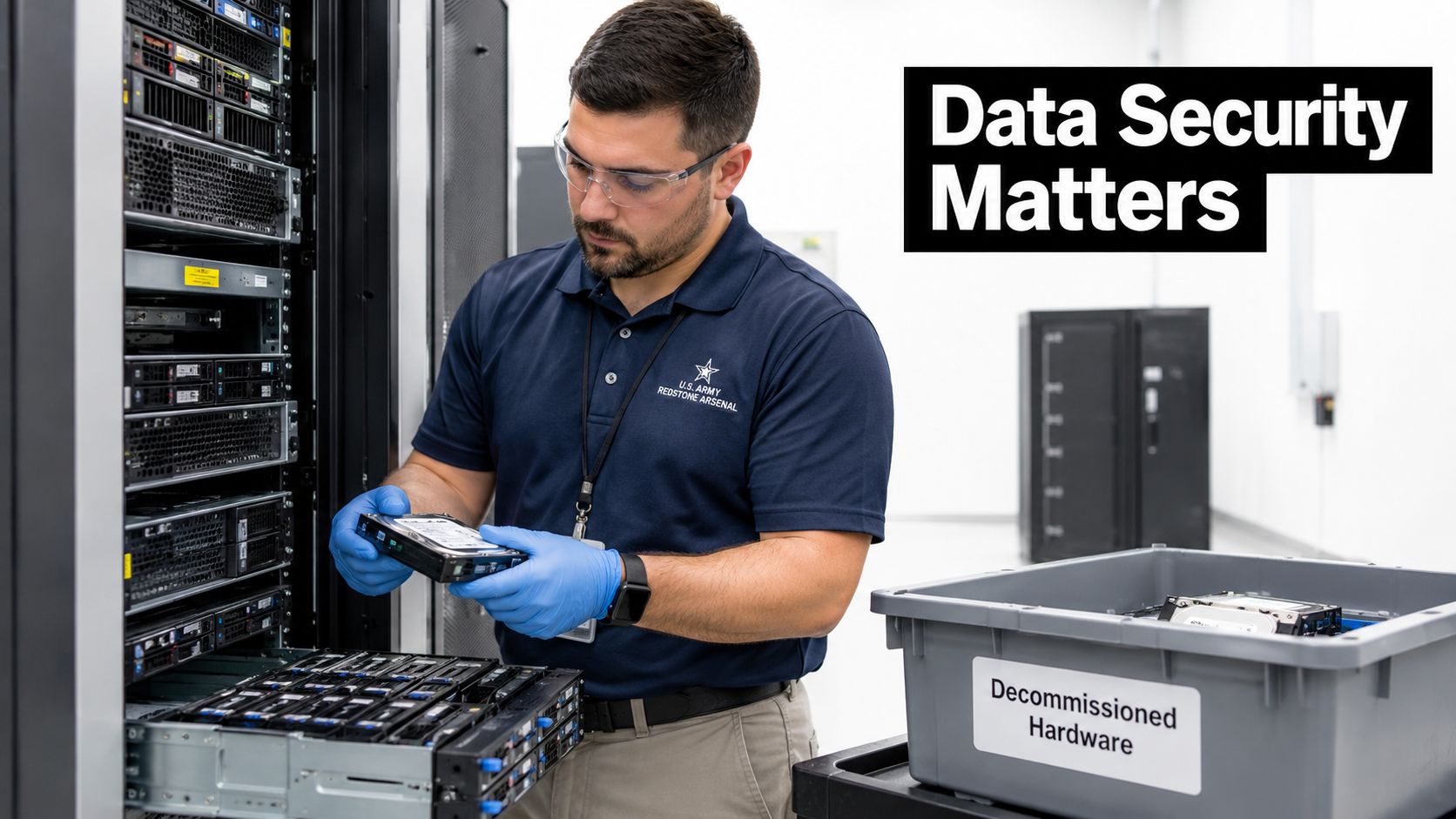
A server room is being cleared at Redstone Arsenal. A healthcare practice is retiring laptops after a technology refresh. A school is emptying a laboratory and finds a box of old drives with no reliable inventory. In each case, the equipment may be obsolete, but the data isn't automatically gone.
That is the point at which Hard Drive Shredding in Huntsville becomes a risk decision, not a recycling detail. The right process depends on the sanitization method, destruction location, documentation, compliance requirements, and vendor capability. A drive that can be securely purged for reuse shouldn't be destroyed unnecessarily, but a failed, highly sensitive, or uncontrolled drive may be a poor candidate for resale.
Huntsville's mix of defense, aerospace, healthcare, education, manufacturing, research, and public-sector operations makes that distinction practical. This guide helps operations and compliance managers choose the right tier, specify a defensible workflow, and connect secure data destruction with responsible electronics recycling.
Why Huntsville Organizations Need Hard Drive Shredding
A Huntsville office cleanout often starts with ordinary tasks. Facilities staff label surplus monitors, IT removes laptops from a domain, and a vendor loads servers for recycling. The risk appears in the middle of that workflow, when a hard drive leaves organizational control before anyone can prove what happened to the information stored on it.
That risk is especially relevant around NASA's Marshall Space Flight Center, Redstone Arsenal, and Cummings Research Park, which the City of Huntsville identifies as major technology, space, and defense institutions or hubs. Healthcare practices hold protected health information, schools manage student records, and manufacturers and service companies retain employee, customer, financial, and proprietary data.
Hard-drive shredding is the point at which a retired device can become physically unusable for storage. It shouldn't be treated as an automatic answer for every asset, though. A working drive with a verified purge path may retain reuse or resale value, while a damaged drive or one governed by stricter security rules may need destruction.
The five decisions a buyer must make
Before approving a pickup, determine:
- Method: Should the media be cleared, purged, or destroyed?
- Location: Does the sensitivity justify on-site destruction, or is controlled off-site processing acceptable?
- Documentation: Will the provider supply asset-level records and a certificate of destruction?
- Compliance fit: Does the process match the organization's governing policy and data category?
- Vendor selection: Can the provider handle mixed form factors, failed media, chain of custody, and downstream recycling?
A useful starting point is this overview of why data destruction matters. The practical conclusion is simple: don't let a recycler's general claim that equipment was “handled securely” substitute for a defined media-sanitization process.
What Hard Drive Shredding Actually Is
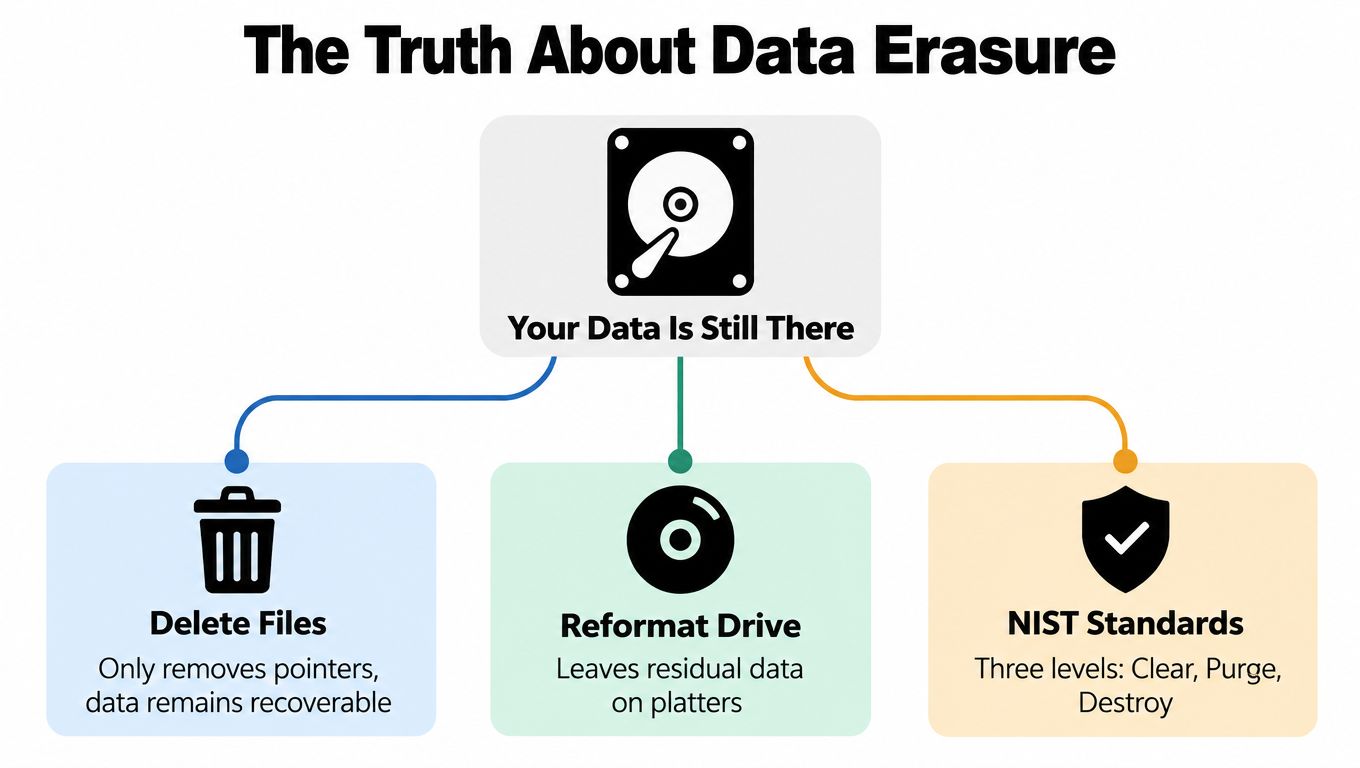
Deleting files usually removes references to information rather than destroying every underlying data area. Reformatting changes how a drive is organized, but it doesn't automatically make residual data unrecoverable. For a business handling sensitive information, the question isn't whether the drive looks empty. The question is whether recovery is infeasible under the applicable standard and risk policy.
The National Institute of Standards and Technology, or NIST, published its first Guidelines for Media Sanitization on September 1, 2006, defining sanitization as removing data so there's reasonable assurance it can't be easily retrieved and reconstructed. NIST's framework uses three broad approaches: Clear, Purge, and Destroy. Its guidance recognizes shredding as one method of physically destroying media. NIST's media-sanitization guidance supports choosing the method according to the information's confidentiality and the type of media involved.
Think of shredding as a paper shredder with a much harder job. It doesn't merely make a drive inconvenient to open. A properly specified process breaks or reduces the storage components so the media can't be reused and recovery isn't feasible with state-of-the-art laboratory techniques.
Three tiers, not one default
Clear may be appropriate when the organization retains control of the media and the data has lower sensitivity. Purge uses a validated technique intended to make recovery impractical while preserving the drive for possible reuse. Destroy makes the media unusable and is the strongest physical option.
NIST later issued Revision 1 in December 2014, retaining the Clear, Purge, and Destroy structure and listing disintegration, pulverization, melting, and incineration among destruction methods. NIST's later revision activity continues to emphasize an enterprise program built around risk, validation, and accountability rather than a blanket instruction to destroy every device. Read the practical distinction in this explanation of what data destruction means.
For Huntsville defense-related work, healthcare records, student information, or other high-sensitivity data, physical destruction may be the soundest choice. For reusable assets with a trustworthy sanitization path, destruction can be overkill because it removes future storage value and limits material recovery.
On-Site Versus Off-Site Shredding Workflows
On-site and off-site shredding can both be secure. The difference is where the destruction occurs, how the handoff is controlled, and what operational constraints your facility can absorb.
On-site mobile shredding brings equipment to the customer's property. Staff can watch the drives enter the machine, and the provider may issue destruction documentation after the event. This model suits organizations that need visible destruction, have strict internal controls, or want to minimize the period during which media travels.
Off-site plant shredding uses sealed containers, controlled transport, and processing at a secured facility. It often works better for larger inventories or facilities without enough room for a mobile unit. The trade-off is that the buyer must scrutinize seals, vehicle security, handoff records, and the plant's equipment specifications.
Decision table for Huntsville buyers
| Factor | On-Site Mobile Shredding | Off-Site Plant Shredding |
|---|---|---|
| Visibility | Staff can witness destruction at the facility | Destruction occurs at the provider's secured site |
| Site requirements | Requires safe vehicle access, staging space, and operating clearance | Requires a controlled loading area and secure storage before pickup |
| Chain of custody | Fewer transport steps after collection | Strong seals, signed handoffs, and locked transport are essential |
| Volume | Practical for planned, observable batches | Often better suited to larger or recurring inventories |
| Documentation timing | May support same-day destruction records | Certificates follow the documented plant process |
| Operational fit | Useful for sensitive sites and audit visibility | Useful for office cleanouts, data-center decommissioning, and consolidated ITAD |
A Huntsville facility should decide based on sensitivity, volume, and site constraints, not on the assumption that one model is always safer. Ask for the provider's collection procedure, equipment details, failure protocol, and certificate sample before scheduling on-site hard-drive destruction.
Procurement rule: On-site service improves visibility, but it doesn't excuse weak equipment specifications or incomplete asset records. Off-site service can be defensible, but only when custody controls are documented from pickup through destruction.
Chain of Custody and the Certificate of Destruction
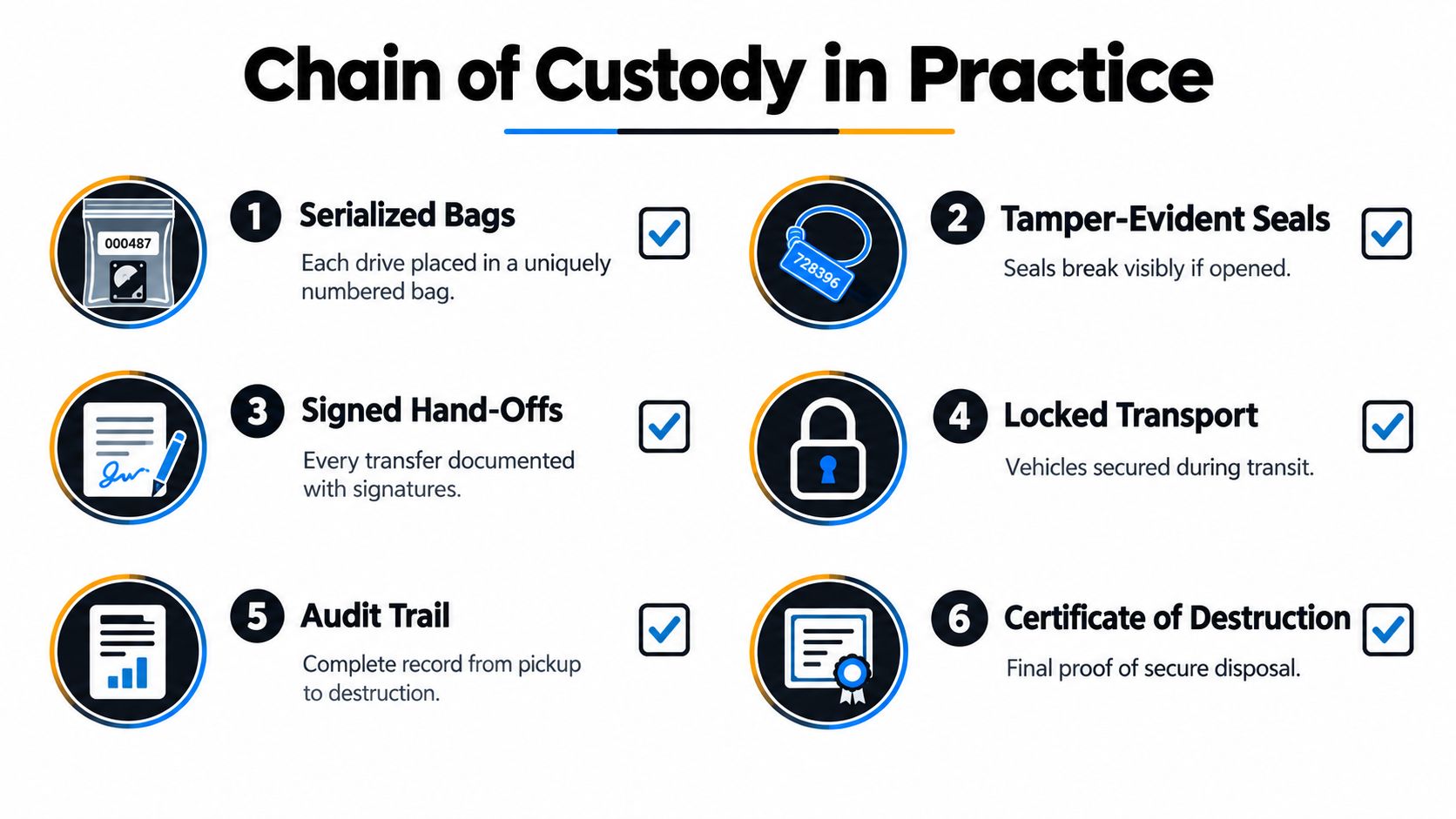
Chain of custody is the record of who controlled the media, when they controlled it, and what happened at each transfer. It starts before the drive reaches a truck. A sound process assigns an asset ID or serial number, places the drive in a serialized bag or bin, applies a tamper-evident seal, and records the authorized handoff.
Transport should use secured containers and a controlled vehicle. At the processing facility, the provider should reconcile the received inventory against the pickup record, document the destruction event, and retain the final evidence in a way the customer can retrieve during an audit.
What the record should show
A defensible certificate isn't a generic recycling receipt. It should identify:
- Media identity: Serial numbers, asset IDs, form factors, or another reconciliable inventory reference.
- Destruction method: Shredding, pulverizing, disintegration, or another approved method.
- Equipment and output: The machine used and the applicable particle-size, deformation, or equivalent specification.
- Event details: Destruction date, operator, location, and responsible personnel.
- Verification status: How the provider confirmed that the prescribed process was completed.
- Authorization: An accountable signature or equivalent approval.
Procurement teams use this document to close an asset disposition record. Compliance teams attach it to the applicable policy or control evidence. Auditors compare the certificate with the original inventory and investigate gaps, substitutions, missing serial numbers, or unexplained quantities.
Organizations with broader records obligations may also benefit from resources that help structure retention and disposition workflows, such as browsing Bidwell records management. That resource doesn't replace a destruction certificate, but it can help teams connect media retirement to a larger records-management process.
The certificate should be reconciled against the pickup inventory, not filed without review. If the list says one set of drives was collected and the certificate describes another, the organization has a documentation problem even if the vendor's machine performed properly. Reworx provides a certificate of destruction for hard drives as part of a documented secure-disposal workflow.
Compliance Considerations for Huntsville Organizations
Compliance rules don't ask a manager to destroy every drive in the same way. They require the organization to protect information through its lifecycle, including the point at which equipment is retired. The evidence must show that the selected method matched the data and that the organization controlled the media until the process was complete.
For a healthcare practice or business associate, HIPAA means the retirement process should protect protected health information through reasonable administrative, physical, and technical safeguards. The relevant evidence includes the data classification, approved destruction procedure, vendor responsibility, chain-of-custody records, and certificate details.
A financial institution and its service providers should connect hard-drive retirement to the GLBA Safeguards Rule. The file should show how the organization selected the provider, restricted access, monitored the service, and retained proof that customer information was disposed of securely.
Map each obligation to evidence
The FACTA Disposal Rule makes consumer-report information a disposal concern. A company handling credit applications, identity records, or related financial data should preserve the procedure used to protect that information when equipment leaves service.
Alabama's breach-notification law, Ala. Code § 8-38-1 et seq., defines breach-related obligations. Secure retirement doesn't eliminate every security risk, but it reduces the chance that discarded media becomes the source of an avoidable exposure. If an incident occurs, a documented process gives investigators a clearer record of what was retired, by whom, and under which method.
| Obligation | Evidence to retain |
|---|---|
| HIPAA | Media inventory, approved sanitization method, business-associate controls, custody records, certificate |
| GLBA | Vendor due diligence, safeguards, access controls, destruction record, responsible approvals |
| FACTA | Disposal procedure, consumer-information classification, destruction evidence |
| Alabama breach exposure | Asset reconciliation, custody history, incident-ready records, certificate and policy linkage |
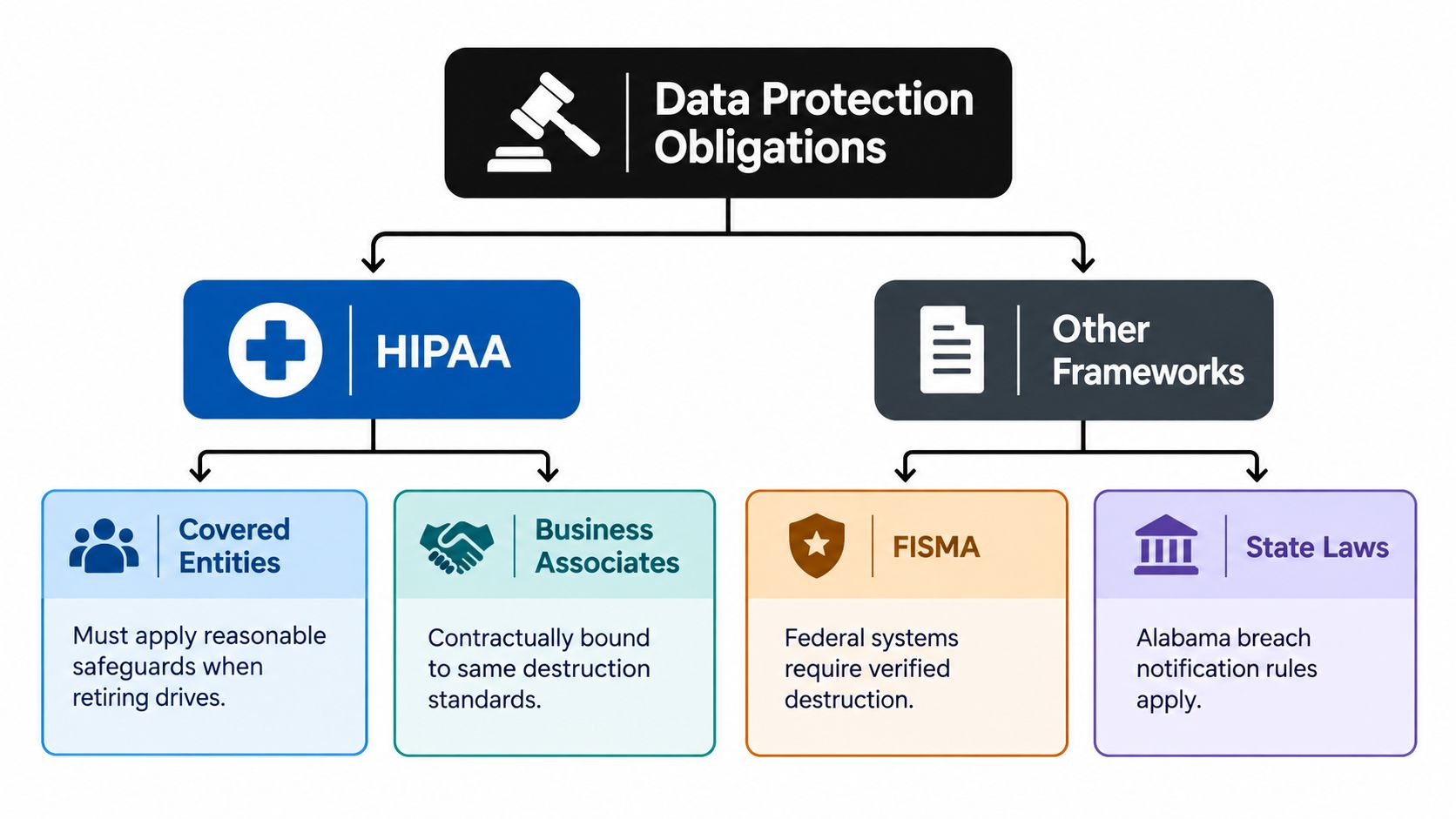
Federal contractors and agencies may have additional requirements under their governing security policies, including FISMA-related controls. Security procedures also depend on physical access around the pickup and staging area. For facilities teams reviewing that broader environment, this practical guide to how security patrols work offers useful context for separating site-security controls from media-destruction controls.
Huntsville buyers should put the requirement in the purchase order. Specify the data category, approved method, custody evidence, certificate fields, and escalation path for missing or unreadable media. Reworx's Alabama electronics recycling service can be evaluated as part of a broader disposition plan that separates secure destruction from downstream material recovery.
How to Choose a Hard Drive Shredding Vendor in Huntsville
A vendor's website may say “secure shredding,” but that phrase doesn't tell you whether the equipment handles your inventory or whether the resulting evidence will survive an audit. Ask technical and operational questions before the first pickup.
Start with media compatibility. The provider should identify whether its equipment supports 3.5-inch desktop and data-center drives and 2.5-inch laptop and portable drives. HDDs must be separated from SSDs and other flash media because increasing data density and material hardness can make a conventional shredding approach unsuitable for higher-security flash storage.
Specify measurable destruction controls
Particle size matters, but the required specification depends on the media and security context. NSA/CSS guidance for classified storage-media disintegration calls for particles nominally 2 millimeters on an edge, while NIST's legacy guidance specifies 5-millimeter edge dimensions and 25-square-millimeter surface area for certain shredded or disintegrated media. Those figures aren't interchangeable. Require the provider to state which specification applies to your media and policy.
NSA/CSS equipment requirements also provide useful performance benchmarks. An evaluated hard-disk destruction device must deform platter assemblies within 30 seconds or less and operate continuously for one hour while destroying at least 100 drives from different manufacturers. These are procurement benchmarks, not a reason to assume every organization needs the same machine. Ask about throughput, jams, unreadable serial numbers, damaged drives, and failed processing.
Also request evidence of:
- Staff controls: Training, authorization, background-screening practices, and safety procedures.
- Commercial protection: Insurance coverage and responsibility for loss or exposure during custody.
- Relevant experience: Recurring work with defense, healthcare, education, government, manufacturing, or data-center customers.
- Mixed-media handling: A separate workflow for SSDs, removable media, backup devices, and hybrid drives.
- End-to-end disposition: Recycling, donation, buyback, and destruction kept distinct in the asset report.
A useful vendor interview should be as concrete as other physical-security procurement. Teams that want a structured question set can review what to ask a guard provider, then apply the same discipline to media destruction.
Reworx Recycling is one option Huntsville organizations can assess against these criteria. Its service scope includes secure data destruction, donation-based electronics recycling, IT asset disposition, equipment buyback, business pickups, and drop-off options. That combination lets a buyer route reusable equipment toward donation or recovery while reserving failed or high-risk media for physical destruction.
Pricing Factors and What to Budget
A credible quote for hard-drive shredding in Huntsville starts with inventory, not a generic per-drive promise. The provider needs to know the number of drives, form-factor mix, whether SSDs are included, the pickup location, and whether equipment also needs recycling, donation, buyback, or broader ITAD support.
The main cost drivers are:
- Drive volume and mix: Small batches and mixed media can require more handling than uniform pallets.
- Service location: On-site mobile work includes site access, staging, and equipment logistics. Off-site processing adds controlled transport and plant handling.
- Documentation: Asset-level reconciliation, certificates, photographs, and special reporting can change the scope.
- Scheduling: Recurring service, urgent collection, weekend work, and data-center shutdown windows affect planning.
- Additional disposition: Computer recycling, laptop disposal, office cleanout, facility cleanout, or downstream material recovery may be quoted alongside destruction.
Treat any published range as planning guidance rather than a guaranteed price. Reworx scopes the inventory and service requirements before commitment, which is the right approach for a business that needs evidence rather than a quick disposal transaction.
Budgeting principle: The cheapest quote is not the lowest-cost option if it omits chain of custody, suitable equipment, mixed-media handling, or a certificate that an auditor can reconcile.
For a sustainability leader, the financial comparison should include recovered value and avoided handling. Functional equipment may support donation-based recycling or buyback, while unusable drives require destruction before their materials enter a recycling stream. A single disposition plan can therefore protect data, preserve appropriate asset value, and support sustainable recycling without treating every device as identical.
Practical FAQs and How to Get Started with Reworx
Do SSDs follow the same process as HDDs?
No. SSDs use flash storage and should be separated from magnetic hard drives before processing. Ask the vendor to name the approved method for each media type rather than accepting one machine for the entire inventory.
What should we do with encrypted or failed drives?
Encryption can reduce risk, but it doesn't automatically settle the disposition decision. If key control is uncertain, the drive is damaged, or policy requires physical destruction, isolate it and document it for destruction. A functional drive with reliable key management may be evaluated for a validated purge instead.
How often should certificates be reconciled?
Reconcile every certificate against the pickup inventory when the record arrives. Resolve missing asset IDs, quantity differences, unreadable serial numbers, and substitutions before closing the work order.
How does donation-based recycling fit?
Separate reusable computers, monitors, and peripherals from media that requires destruction. Reworx's donation-based model supports technology donations, digital inclusion, and workforce development, while secure data destruction handles the devices that shouldn't be reused.
Huntsville businesses, schools, agencies, and research organizations can request a pickup, arrange a drop-off, or seek a consultation for a mixed inventory. Reworx also supports nationwide ITAD, computer recycling, office and facility cleanouts, data-center decommissioning, and sustainable electronics recycling.
Reworx Recycling helps Huntsville organizations combine secure hard-drive shredding with electronics recycling, equipment donation, buyback, and documented ITAD. Visit Reworx Recycling to discuss a pickup, drop off old equipment, or plan a data-destruction and reuse program that protects information while supporting community impact.