What would you do with a filing cabinet full of sensitive client records after an office move? You wouldn't just leave it unlocked on the curb. Yet, that's the kind of risk businesses in Georgia take when they dispose of old computers, servers, and other IT equipment without a secure data destruction plan.
On-site hard drive destruction is the definitive solution. It brings the entire data elimination process right to your office or facility, offering a transparent, verifiable method to destroy sensitive information without the security risks of off-site transport. For businesses in Georgia's thriving tech, healthcare, and financial sectors, this service is an essential component of modern risk management.
Why Your Data Security Plan Needs On Site Hard Drive Destruction
Hitting "delete" or even reformatting a hard drive isn't enough to protect your business from a data breach. Think of it like wiping a chalkboard—you can still see the faint outlines of what was written before. Specialized software can easily recover that "deleted" data, exposing everything from client lists and financial records to employee files and trade secrets.
A single data breach can lead to crippling regulatory fines, legal liabilities, and a complete loss of customer trust.
On-site hard drive destruction mitigates this risk by bringing industrial-grade equipment directly to your Georgia location. You can witness the entire process, from a technician scanning your drives' serial numbers to the moment they are physically shredded into tiny, useless pieces. It’s the only way to guarantee a truly unbroken and auditable chain of custody for your retired IT assets.
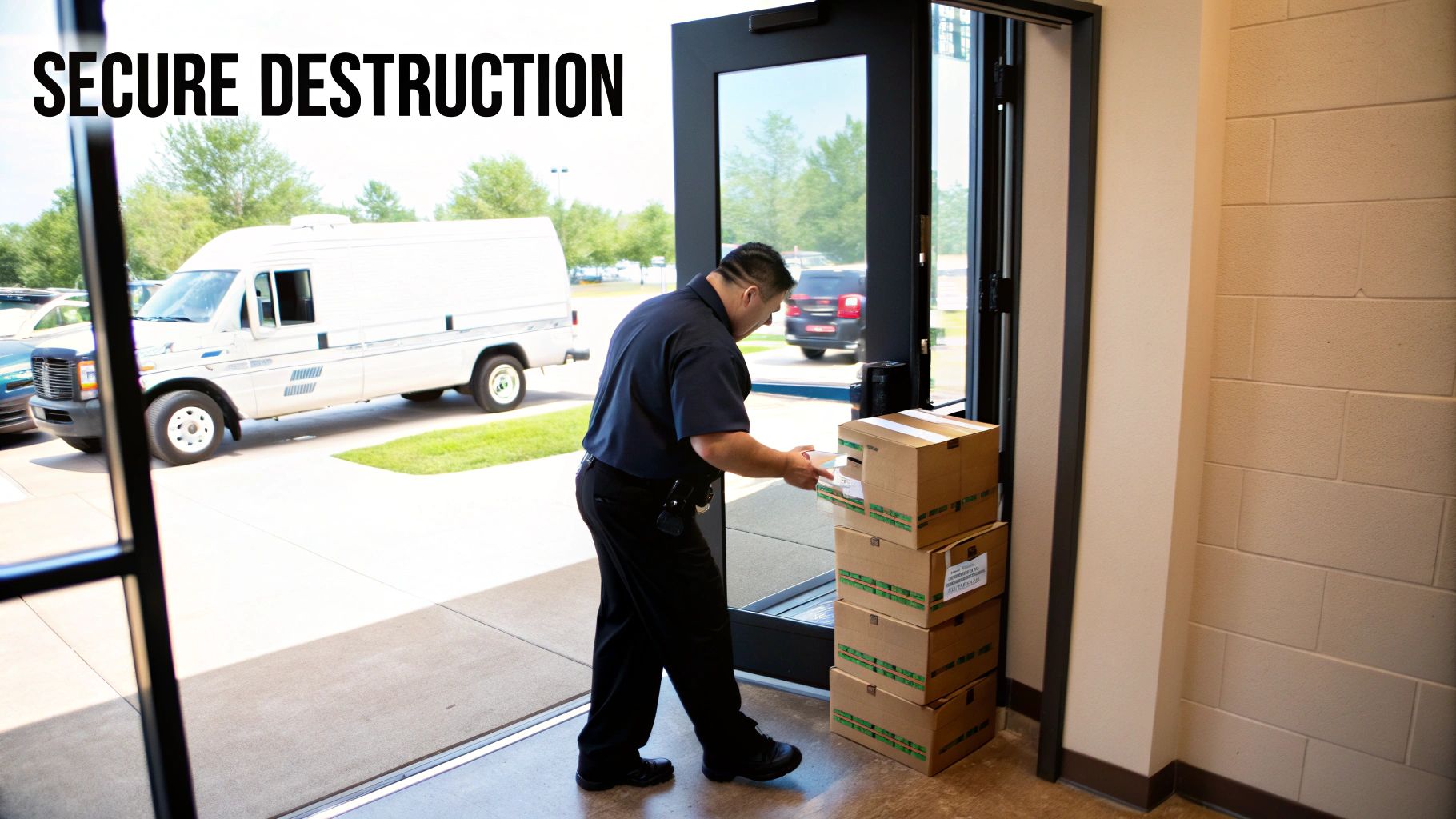
The Growing Demand for Verifiable Destruction
We're not the only ones who see the value here. The global market for hard drive destruction services is booming, climbing from USD 1.5 billion in 2023 to a projected USD 3.6 billion by 2032. This growth is fueled by increasing concerns over data breaches and stringent regulations like HIPAA and GDPR that demand absolute proof of data disposal.
This trend signals a major shift in how organizations handle their old IT equipment. It's no longer about just getting rid of old hardware; it's about actively managing risk. This approach works hand-in-hand with good data center physical security, which protects data while it's still live. On-site destruction provides the final, secure step once that data is retired.
Key Takeaway: On-site destruction isn't just a service; it's an insurance policy against data breaches. By bringing the shredder to your door, it eliminates any doubt about where your sensitive data ends up, offering unparalleled peace of mind.
Partnering for Security and Sustainability in Georgia
Choosing the right partner for this critical task is everything. Reworx Recycling, a Georgia-based social enterprise, combines best-in-class, on-site hard drive destruction with a responsible, sustainable IT asset disposition (ITAD) plan. We understand that your data security is non-negotiable.
Our process not only guarantees your data is permanently destroyed but also ensures the leftover electronic scrap is ethically recycled, keeping harmful materials out of Georgia's landfills.
Because Reworx is a donation-based social enterprise, your commitment to data security also creates a powerful community impact. You protect your business, contribute to a circular economy, and support our mission of digital inclusion and workforce development right here in Georgia.
- Verified Security: Witness every single drive get destroyed at your facility.
- Compliance Assurance: Receive a Certificate of Destruction to satisfy any audit trail.
- Environmental Responsibility: Rest easy knowing all shredded materials are responsibly recycled.
- Community Support: Your partnership helps us provide technology and training to underserved communities in Georgia.
Ready to protect your information and make a local impact? Schedule a pickup with Reworx Recycling today.
Understanding the Methods of Secure Data Elimination
When it's time to retire old hard drives, simply hitting "delete" or reformatting the disk is dangerously insufficient. That’s like erasing a pencil sketch—faint traces of the original image almost always remain, and a determined data thief can often recover them. True data elimination is about making that data completely and permanently unrecoverable.
Think of it this way: professional data destruction is like turning that piece of paper into confetti. There’s no piecing it back together. The original message is gone for good. Let's walk through the three main techniques the pros use to make sure your data stays gone.

Hard Drive Shredding: The Gold Standard
Picture an industrial paper shredder, but built to chew through solid steel, aluminum, and complex circuit boards. That's exactly what a hard drive shredder does. It uses powerful, interlocking steel blades to grab, tear, and grind hard drives and other media into a pile of small, mangled fragments.
This method is the top choice for a simple reason: it physically annihilates the platters or flash memory chips where the data actually lives. Once a drive is turned into a pile of metal and plastic bits, no technology on earth can reassemble it to get the information back.
- Universally Effective: Shredding works on everything. From old-school spinning Hard Disk Drives (HDDs) to modern Solid-State Drives (SSDs), backup tapes, and even cell phones.
- Visually Verifiable: You get tangible, visible proof of destruction. You can literally see the shredded pieces, which offers a level of peace of mind you can't get from software.
- Compliance Friendly: This method meets or exceeds the toughest data sanitization standards out there, including HIPAA, GDPR, and NIST 800-88.
For any Georgia business that needs the absolute highest level of assurance, on site hard drive destruction via shredding is the definitive choice. You can see how this process guarantees security by exploring Reworx Recycling's approach to secure hard drive shredding.
Degaussing: The Magnetic Wipe
Degaussing is another method, though it’s becoming less common these days. It works by exposing a magnetic hard drive to an incredibly powerful magnetic field. This field completely scrambles the magnetic alignment on the drive's platters, effectively erasing the data stored there and making it unreadable.
But there’s a huge catch with degaussing in today's world of tech.
Degaussing is completely ineffective on Solid-State Drives (SSDs). SSDs don't store data magnetically; they use flash memory, which is totally immune to magnetic fields. As SSDs have become the standard, the usefulness of degaussing has dropped off a cliff.
Crushing: The Brute Force Approach
Crushing is exactly what it sounds like. A machine uses immense hydraulic force to drive a metal cone or plate straight through the hard drive, bending, breaking, and puncturing it. The goal is to shatter the internal platters and damage the core components beyond repair.
While crushing definitely causes catastrophic damage, it might not destroy every last piece of the data platters as thoroughly as shredding does. A small, intact fragment could theoretically still hold data. That’s why shredding is almost always the preferred choice—it guarantees a more uniform and complete destruction, leaving zero doubt.
The demand for surefire data security has fueled major investment in these technologies. In fact, the market for hard disk destruction equipment hit USD 2.69 billion in 2024 and is expected to climb to USD 4.23 billion by 2032. This growth is being driven by businesses, schools, and government agencies that need compliant, on-site solutions to handle their sensitive data. You can find more insights on the growth of the hard disk destruction equipment market.
Staying on the Right Side of Data Destruction and Compliance
Let's be honest, data security standards aren't just "good practice" anymore—they're a legal and operational necessity. Get it wrong, and you're looking at staggering fines, drawn-out legal battles, and a permanent black eye on your reputation. For any business handling sensitive information, making sense of these rules is non-negotiable, but the legal jargon can feel like trying to read another language.
The trick is to turn those complex regulations into simple, real-world actions. Whether you’re a clinic in Georgia governed by HIPAA or a software company with EU customers under GDPR, the core idea is identical: you have to be able to prove that sensitive data was completely and irreversibly destroyed. This is exactly where professional on site hard drive destruction shifts from being a good idea to an essential part of your compliance game plan.
Understanding Key Data Protection Laws
A few major regulations call the shots on how businesses must handle data disposal. They might cover different industries or parts of the world, but they all sing the same tune when it comes to destroying personally identifiable information (PII) or protected health information (PHI). It has to be secure and you have to be able to verify it.
- HIPAA (Health Insurance Portability and Accountability Act): This is the big one for healthcare. It mandates that any organization touching PHI must have ironclad safeguards. When it's time to retire old computers or servers, HIPAA is crystal clear: the data must be made "unreadable, indecipherable, and otherwise cannot be reconstructed." Physical destruction, like shredding, is explicitly named as a compliant method.
- GDPR (General Data Protection Regulation): If you handle data for anyone in the EU, GDPR applies to you. It champions the "right to be forgotten," which means you need a rock-solid process for permanently wiping customer data when they ask or when it's no longer needed. Just dragging a file to the trash bin won't cut it—the data has to be gone for good.
- NIST SP 800-88 (National Institute of Standards and Technology): While this is a guideline, not a law, it's the gold standard for data sanitization in the U.S. government and is widely adopted by private industry. It lays out methods for clearing, purging, and destroying data, with physical destruction sitting at the top as the most secure option. Many government and corporate contracts will specifically require you to follow NIST standards.
Getting a handle on the legal side of data disposal means building a solid framework for compliance risk management. This isn't just about ticking boxes; it's about proactively spotting and neutralizing risks before they become problems.
Key Data Security Regulations and Their Destruction Requirements
To help simplify things, here’s a quick breakdown of what some of the major regulations demand when it comes to destroying sensitive data.
| Regulation | Applicable Sector | Key Data Destruction Mandate |
|---|---|---|
| HIPAA | Healthcare, Insurance & Business Associates | Data must be rendered "unreadable, indecipherable, and otherwise cannot be reconstructed." Physical destruction is a preferred method. |
| GDPR | Any entity processing EU resident data | Upholds the "right to erasure," requiring data to be permanently and completely deleted upon request or when no longer necessary. |
| NIST SP 800-88 | U.S. Federal Agencies, Contractors, Security-conscious private firms | Recommends physical destruction as the ultimate form of sanitization for media containing highly sensitive information. |
| FACTA | Financial Institutions, Creditors | Requires the proper disposal of consumer report information to prevent unauthorized access. Methods include shredding or destroying electronic media. |
As you can see, the theme is consistent: data can't just be deleted, it needs to be verifiably destroyed to meet modern legal standards.
The Certificate of Destruction: Your Proof of Compliance
So, how do you actually prove to an auditor that you followed all these rules? The answer is the Certificate of Destruction. Think of this as your official, legally-defensible record showing that your hard drives and other media were properly destroyed.
A Certificate of Destruction is more than just a receipt. It's an essential legal document that confirms your due diligence, detailing what was destroyed, when, where, and by what method. In the event of an audit or legal inquiry, this certificate is your first line of defense.
A legitimate certificate from a reputable vendor should always include:
- A unique serial number for tracking.
- The date and location of the destruction service.
- A detailed list of the media destroyed, often including serial numbers.
- The name of the company and technician who performed the service.
- A statement confirming the transfer of custody and secure destruction of the materials.
Reworx Recycling: Your Partner in Compliant Destruction
Wading through these requirements can feel like a heavy lift, but you don't have to go it alone. At Reworx Recycling, we provide NAID AAA Certified on site hard drive destruction that guarantees you're compliant with even the strictest regulations. Our whole process is built on transparency, giving you total peace of mind.
We don't just destroy your hard drives—we give you the meticulous documentation needed to satisfy any auditor and protect your business. When you partner with us for your data destruction needs, you get a detailed Certificate of Destruction that stands as proof of your commitment to data security. And because we're a donation-based social enterprise, your responsible IT disposal also helps bridge the digital divide in our community.
The On-Site Destruction Process From Start to Finish
Booking an on-site hard drive destruction service might sound complicated, but a good partner makes the whole thing feel surprisingly simple and transparent. When you know what to expect, you can confidently manage your company’s IT asset disposal without any guesswork. The entire process is built from the ground up for maximum security, complete verification, and as little disruption to your day as possible.
From that first phone call to the final certificate in your hand, every step is designed to create a rock-solid chain of custody. It’s all about ensuring your sensitive data is handled securely from the moment it leaves your server room until it’s turned into tiny, unreadable fragments.
Phase 1: Initial Consultation and Scheduling
It all starts with a simple conversation. You’ll talk with a destruction specialist to go over the key details of your project:
- Inventory Scope: A rough idea of how many drives you have and what kind they are (e.g., standard hard drives, SSDs, backup tapes, full servers).
- Location Logistics: Practical details like where the shredding truck can park and any special access or security protocols at your building.
- Compliance Needs: Highlighting any specific rules you need to follow, like HIPAA for healthcare data or NIST standards for government work.
With that information, the provider will give you a clear, detailed quote and find a time that works for your schedule. For businesses looking for a more holistic approach, this is also a great time to explore a complete IT asset disposition (ITAD) plan that rolls secure destruction into a broader strategy.
Phase 2: Preparation and Asset Tagging
Before the truck pulls up, your team just needs to get the devices ready. This usually means gathering all the old hard drives and other media in one secure, designated spot. It’s also a smart move to create an inventory list with the serial number of every device you plan to destroy.
When our certified technicians arrive, the first thing they'll do is check your devices against that list. Each hard drive is scanned, creating a digital paper trail that ties every single serial number to this specific destruction event. This careful tracking is what makes the chain of custody so secure.
Phase 3: The On-Site Destruction Event
This is the main event. We move the secured hard drives to our mobile shredding vehicle parked right outside your facility. You and your team are not just allowed to watch—we encourage it.
One by one, each drive is fed into an industrial-grade shredder that physically grinds the device into tiny, confetti-like pieces of metal. It’s fast, incredibly effective, and gives you immediate visual proof that your data is gone for good.
Crucial Insight: Being able to witness the destruction is the single biggest advantage of on-site service. It completely removes any doubt and gives you absolute certainty that your data never left your property intact—a game-changer for risk management and compliance.
The infographic below shows just how neatly this hands-on process fits into the major compliance frameworks.

As you can see, having a verified, on-site destruction process provides the tangible proof you need to satisfy strict HIPAA, GDPR, and NIST standards.
Phase 4: Final Documentation and Recycling
After the last drive is shredded, there’s one final, crucial step. You'll receive a Certificate of Destruction. This is a legally binding document that serves as your official proof of compliance for any audit. It details everything about the service: the date, the location, a full list of the serialized assets that were destroyed, and a statement confirming the transfer of custody.
With the data gone and the paperwork in hand, the shredded material is securely transported to a certified recycling facility. At Reworx Recycling, we make sure these fragments enter a responsible downstream process. Valuable commodities are recovered, and hazardous e-waste is kept out of landfills. This final step turns a security requirement into an act of environmental stewardship, perfectly aligning with our social enterprise mission to build a more sustainable community.
Beyond Security: Sustainable ITAD and Community Impact
Secure data destruction is non-negotiable, but it shouldn't be the end of the story for your retired IT gear. Once the risk of a data breach is completely neutralized through on site hard drive destruction, a new opportunity emerges—the chance to make a real environmental and social difference. This is where security protocols and corporate sustainability goals don't just coexist; they merge.
After your hard drives are physically shredded on-site, those fragments aren't just waste. They become the first step in a responsible, circular economy. We securely transport the shredded material to a certified facility where it enters a sophisticated recycling stream.
This process is absolutely critical. It prevents hazardous e-waste, which is full of nasty stuff like lead and mercury, from poisoning our landfills and water supplies. By making sure this material is handled correctly, your business takes a direct stand for a healthier environment. This commitment to sustainable recycling aligns perfectly with initiatives like Georgia's statewide recycling programs, demonstrating corporate leadership in environmental stewardship.
Aligning Security with ESG Goals
These days, companies are measured by more than just their balance sheets. A strong commitment to Environmental, Social, and Governance (ESG) principles is a must. A responsible ITAD program is one of the most powerful and tangible ways to show you’re serious about it.
When you ensure your destroyed assets are properly recycled, you're taking a proactive step to:
- Shrink your environmental footprint: You stop pollution in its tracks and conserve natural resources by allowing valuable commodities like aluminum, steel, and precious metals to be recovered and put back to use.
- Boost your brand reputation: Everyone, from investors to customers, wants to do business with companies that practice genuine environmental stewardship.
- Hit your sustainability targets: A documented, responsible recycling process gives you clear, reportable data for your annual corporate social responsibility (CSR) reports.
Choosing a partner who manages the entire lifecycle—from secure destruction to sustainable recycling—transforms a routine operational task into a meaningful contribution to your company's ESG platform.
The Reworx Recycling Difference: The Triple Bottom Line
This is where working with Reworx Recycling becomes a powerful choice. We're not just another data destruction vendor; we are a social enterprise built to create a positive ripple effect. When you choose us for your on-site hard drive destruction, your decision supports a mission that goes far beyond just security.
Your partnership helps us deliver on a triple bottom line:
- Security: We provide NAID AAA Certified on-site destruction, giving you the highest level of data protection and compliance peace of mind you can get.
- Sustainability: We guarantee that 100% of the shredded material is responsibly recycled, keeping e-waste out of landfills for good and supporting a circular economy.
- Social Good: As a donation-based organization, the value generated from your recycled assets directly funds our community programs. This means providing refurbished technology to underserved families, supporting digital inclusion initiatives, and creating local workforce development opportunities.
By working with Reworx Recycling, your IT asset disposition project becomes a true force for good. You aren't just protecting your business and the planet—you're actively helping to bridge the digital divide right here in your community. It’s an integrated approach that ensures your secure ITAD project delivers value on every level: for your business, for the environment, and for society.
Common Questions About On Site Hard Drive Destruction
Deciding to bring in a professional for on-site hard drive destruction is a huge step toward protecting your company. As you think about it, it's completely natural for questions to pop up about the process, what it costs, and what you get in the end. Getting clear, straightforward answers is how you move forward with confidence.
We've pulled together the most common questions our clients ask, giving you the direct information you need to make the right call for your organization's data security.
Is Shredding or Degaussing Better for My Hard Drives?
Shredding is always the answer. It physically obliterates the drive, turning it into tiny fragments and making data recovery impossible. This works on every type of media, including modern Solid State Drives (SSDs). Think of it as turning a book into confetti—the story is gone for good.
Degaussing, on the other hand, uses a powerful magnetic field that only works on older, magnetic-based Hard Disk Drives (HDDs). It’s completely useless on SSDs, which don't store data magnetically. For guaranteed security across every single one of your devices, physical shredding is the superior and more reliable choice, every time.
What Does On-Site Hard Drive Destruction Typically Cost?
The price usually depends on how many drives you have, where you're located, and if you need extra services like asset tracking. While it's an investment, it’s tiny compared to the fallout from a data breach, which can run into millions in fines, legal fees, and damage to your reputation that you can't undo.
Look at it as an insurance policy for your most valuable asset: your data. To get a price that fits your exact needs, the best way forward is to ask for a custom quote. A partner like Reworx Recycling can give you a transparent proposal with no hidden fees.
The real question isn't "What does destruction cost?" but "What could a data breach cost me?" Investing in professional on-site destruction is a proactive shield protecting your business from catastrophic financial and reputational loss.
What Happens to the Shredded Materials After You Leave?
This is a critical part of a truly responsible process. Once the destruction is done on-site, we securely transport the shredded fragments to our certified recycling facility. There, the materials are carefully sorted and processed to reclaim valuable resources like aluminum, steel, and precious metals.
This ensures nothing ends up in a landfill and actively supports a circular economy. This commitment to environmental responsibility is a core part of our mission at Reworx Recycling. Your secure data destruction also becomes a positive act for the planet.
For a deeper dive into related topics, you can explore more answers on our comprehensive frequently asked questions page.
Do I Receive Proof That My Data Was Destroyed?
Absolutely. Once the on-site service is complete, you will receive a formal Certificate of Destruction. This document is much more than a receipt; it's your official, auditable record proving your data was securely and permanently destroyed in compliance with standards like HIPAA or GDPR.
It lists the items destroyed, the method used, the date of service, and confirms the secure chain of custody. This certificate gives you the legal proof and peace of mind you need for your records.
Ready to secure your data and make a positive community impact? Partner with Reworx Recycling for NAID AAA Certified on site hard drive destruction and responsible electronics recycling. Donate your old equipment and join our mission to build a more sustainable and equitable Georgia. Explore our services further on the Reworx Recycling Blog.