Atlanta's cybersecurity exposure is already substantial, and the risk is rising faster than many business technology refresh cycles. The FBI's 2024 Internet Crime Report recorded 859,532 Internet Crime Complaint Center complaints and $16.6 billion in reported losses nationally. Georgia ranked 11th among states, with $420 million in reported potential losses, a 40% year-over-year increase. For Atlanta organizations, that makes phishing, account compromise, business email fraud, and data exposure operational concerns, not abstract IT problems.
At the same time, Atlanta businesses are modernizing identities, cloud environments, applications, backups, and monitoring systems. Retired laptops, servers, storage devices, network equipment, and backup media can still contain credentials, logs, source code, patient information, and business records if teams treat disposal as a logistical task rather than a security control.
This roundup examines eight Atlanta cybersecurity trends, what they mean for financial, healthcare, government, technology, industrial, and defense-related organizations, which signals leaders should monitor, and how to implement practical safeguards. It also connects modernization to regulatory planning, secure IT asset disposition, documented data destruction, environmental responsibility, and Reworx Recycling, a Smyrna-based, donation-based electronics recycling and ITAD partner. Every technology transition needs a documented retirement workflow, not an improvised disposal decision after the new system is already live.
1. Zero Trust Architecture Adoption in Atlanta's Enterprise Networks
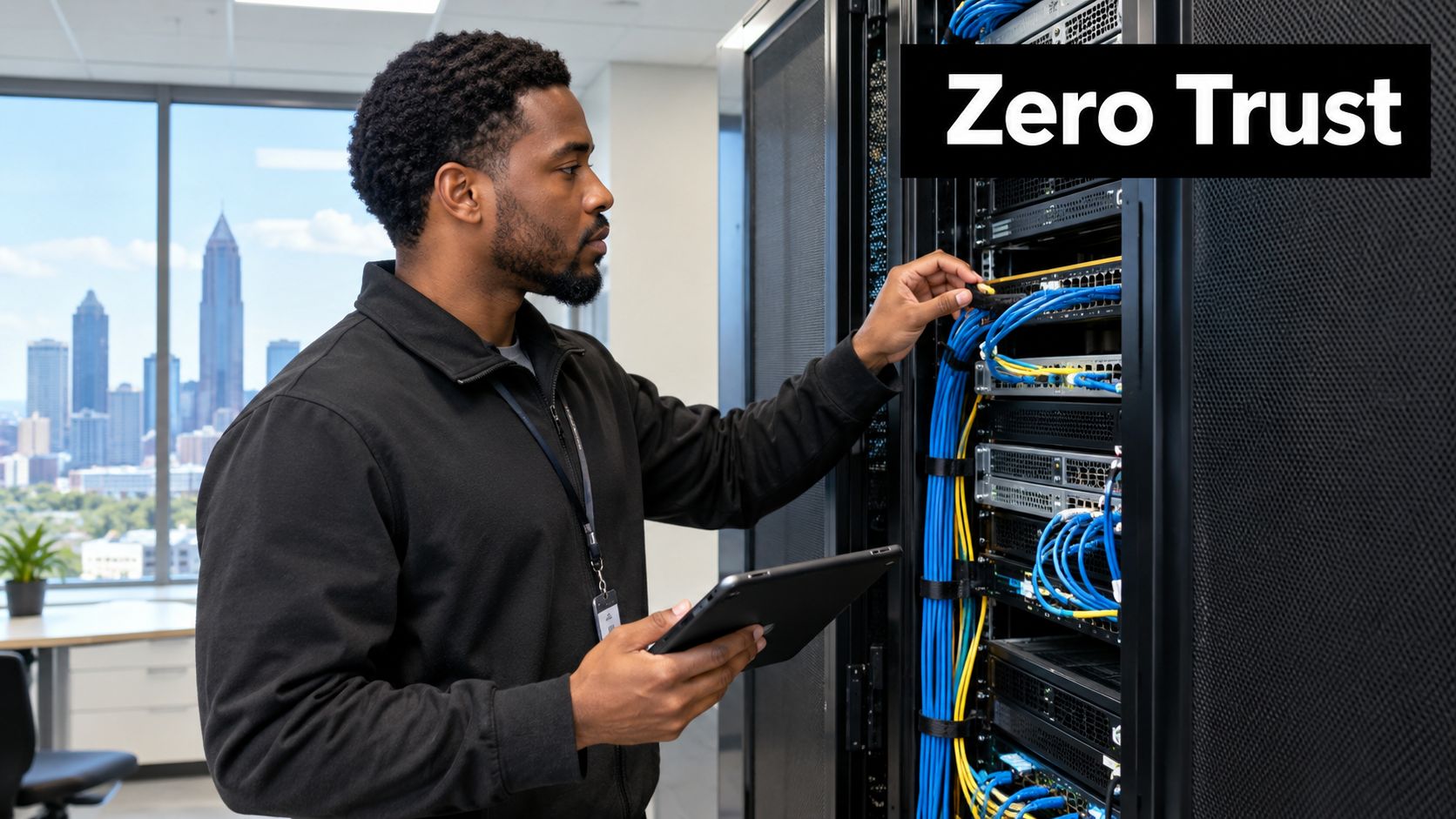
Zero Trust changes the basic question from “Is this device inside the network?” to “Should this user, device, application, or session receive this specific access right now?” That distinction matters in Atlanta, where financial institutions, hospitals, public agencies, manufacturers, and technology companies often connect cloud services, remote workers, contractors, legacy systems, and third-party platforms.
A practical Zero Trust program verifies identity continuously, checks device health, limits privileges, and segments sensitive resources. Microsoft Entra ID, Microsoft 365, Okta, and Cloudflare can support parts of that model, but purchasing a platform won't create a sound architecture by itself. A business must first know which applications exist, who uses them, which devices connect to them, and what happens when an employee, contractor, or vendor leaves.
Start with high-risk access
A sensible pilot might cover administrators, finance teams, clinical systems, payment workflows, or remote access tools. Require multifactor authentication, review privileged accounts, and use endpoint detection and response to assess whether a device meets policy before it connects. Map legacy systems before applying segmentation, because an older application may depend on broad network access that nobody documented.
Practical rule: Secure access policies must account for equipment retirement. Disable accounts, revoke tokens, remove certificates, and confirm that wiped or shredded devices no longer appear in management consoles.
Security leaders can use this secure access strategy guide as supplementary reading, while executives should connect architecture decisions to a documented cybersecurity program for business leaders. The strongest result comes from phased migration, staff training, regular privilege reviews, and a clear exception process for systems that can't yet support modern authentication.
2. AI-Powered Threat Detection and Behavioral Analytics
Traditional security tools look for known signatures. Behavioral analytics asks whether a login, file transfer, privilege change, or application action fits the organization's normal pattern. That difference can help an Atlanta healthcare provider spot an unusual access sequence, a financial company identify abnormal payment-system activity, or a government contractor investigate a sudden data movement event.
Platforms such as Microsoft Sentinel, Splunk, CrowdStrike Falcon, Darktrace, and Okta offer different approaches to analytics and automated detection. The trade-off is straightforward. AI can help security teams process more signals, but poor asset inventories, incomplete logs, inconsistent identity data, and excessive alerting can produce noise instead of useful decisions.
Build a reliable baseline before automating response
Start with high-risk users, systems, and data repositories. Confirm that authentication events, endpoint activity, cloud logs, email events, and administrative actions are collected. Then define who reviews alerts, which actions require human approval, and when a suspected compromise triggers account suspension, legal review, or incident response.
A suspicious login shouldn't automatically destroy access to a critical clinical or industrial system without a continuity plan. Conversely, a business that sends every alert to an already overloaded IT generalist may gain little protection from an expensive detection platform.
AI should prioritize investigation. It shouldn't replace judgment for containment, evidence preservation, or business continuity decisions.
Security teams should also include retired equipment in their visibility model. Before a server or laptop leaves the organization, remove it from monitoring, revoke credentials stored on it, preserve required logs, and document the approved disposition. Reworx Recycling's discussion of AI tools for Atlanta business owners can support broader technology planning, but the security outcome still depends on disciplined human governance.
3. Supply Chain Security and Software Bill of Materials Compliance
Atlanta's defense, logistics, industrial, healthcare, and government-facing organizations depend on vendors they don't directly control. A software update, cloud service, managed device, open-source library, or hardware component can introduce risk far beyond the company's physical perimeter.
A Software Bill of Materials, or SBOM, gives teams a structured view of the components inside an application. SPDX and CycloneDX are established formats that can help development and procurement teams compare information consistently. An SBOM doesn't make software safe, and it won't replace vendor reviews. It does improve the organization's ability to identify affected components, ask precise questions, and respond when a dependency has a newly disclosed weakness.
Make vendor evidence usable
Start with critical applications rather than demanding perfect coverage immediately. Ask vendors for component inventories, vulnerability-notification procedures, access-control details, breach obligations, and evidence that they retire equipment and accounts securely. Store the responses where procurement, security, legal, and operations teams can use them.
A vendor relationship isn't complete when the contract is signed. It also needs an offboarding record, access revocation, asset return process, and evidence of data destruction.
Development teams can automate SBOM generation in build pipelines, while procurement teams can establish review criteria for software, hardware, and managed services. Supply-chain transparency guidance also belongs in physical asset planning. If a vendor, contractor, or internal team replaces switches, servers, endpoint fleets, or laboratory equipment, the organization should know where each asset went, what data it contained, and how the disposition was verified.
4. Cloud-Native Security and Container Protection
Atlanta companies are using cloud platforms, containers, serverless services, and distributed applications to support fintech, SaaS, healthcare, logistics, and digital commerce. These environments change quickly. A workload may be created, scaled, modified, and removed without passing through the same review process used for a traditional server.
Cloud-native security therefore starts in development and continues through runtime. Teams should scan container images, use minimal base images, protect registries, manage secrets outside images, restrict container-to-container communication, and monitor unusual workload behavior. Kubernetes network policies and cloud-native controls from AWS, Microsoft Azure, and Google Cloud can help, but each organization remains responsible for configuring its portion of the shared-responsibility model.
Treat configuration as an operating control
A practical workflow connects code repositories, build pipelines, registries, deployment tools, cloud identity, and runtime monitoring. It also defines who can approve exceptions and how quickly teams must address a vulnerable image or exposed secret. Developers need security feedback early, while operations teams need a reliable inventory of production workloads and ownership.
The cloud can reduce physical infrastructure, but it doesn't eliminate retirement work. Companies still decommission servers, storage appliances, network equipment, backup systems, and employee devices. They must also close cloud accounts, remove credentials, preserve required records, and verify that temporary storage or local caches don't retain sensitive information.
For Atlanta leaders assessing distributed infrastructure, edge computing trends in Atlanta businesses provide useful context. The right equipment retirement decision may involve data center decommissioning, secure transport, IT equipment disposal, and sustainable recycling rather than moving hardware into a storage room.
5. Ransomware Resilience and Backup Strategy Modernization
Ransomware planning has moved beyond the assumption that prevention alone is enough. Atlanta businesses face risk from compromised accounts, exposed remote services, phishing, vendor access, and unpatched systems. Local guidance increasingly emphasizes payment workflows, third-party access, and operational continuity, which means a recovery plan must protect more than file servers.
A sound program identifies critical services, defines acceptable downtime, isolates backups, encrypts recovery data, and tests restoration. An immutable or offline copy can help prevent attackers from altering every available recovery option. The design should also cover identity systems, cloud applications, network configurations, specialized clinical or industrial systems, and the records needed to rebuild operations.
Test the recovery story
A backup that has never been restored is an assumption, not a proven control. Run scenario-based exercises with IT, finance, legal, communications, facilities, and business owners. Confirm who can authorize isolation, who contacts vendors, how customers are informed, and where clean replacement equipment comes from.
Recovery planning should include the physical exit path. If damaged or compromised devices remain in a loading area, they can preserve data and obstruct the restart process.
After a ransomware event, teams may need secure hard drive shredding, controlled product destruction, replacement hardware, and documented chain-of-custody handling. Reworx Recycling's data breach prevention resources can complement an incident plan, but no recycling provider substitutes for tested backups, access controls, or incident-response leadership.
6. Identity and Access Management Modernization and Passwordless Authentication
Identity has become the control plane for modern Atlanta businesses. Employees, contractors, suppliers, applications, service accounts, and devices all need access, yet each account can create exposure when nobody owns it or reviews its permissions.
Passwordless authentication can use hardware security keys, biometrics, certificates, or approved device-based prompts. Microsoft Entra ID, Okta, Duo, and Yubico support different parts of this transition. The benefit is not just convenience. Stronger authentication can reduce reliance on reusable passwords and make phishing-based account takeover harder, provided recovery processes do not reintroduce weak methods.
Sequence the migration carefully
Begin with administrators and other high-impact accounts. Then address executives, finance staff, remote access users, and teams handling patient, payment, government, or intellectual property data. Maintain a controlled fallback during the transition, but don't allow “temporary” password exceptions to become permanent.
An IAM modernization project should include:
- Joiner and leaver controls: Create, change, and disable accounts through an owned process.
- Privilege reviews: Confirm that access matches current duties, not past projects.
- Service-account governance: Record owners, credentials, rotation requirements, and dependencies.
- Legacy integration: Identify systems that can't support modern authentication and isolate them with compensating controls.
When a user receives a replacement laptop, the old device must leave the identity system as deliberately as the user leaves the payroll system. Remove certificates, tokens, cached credentials, and management enrollment before secure data destruction and responsible laptop disposal.
7. Insider Threat Detection and Data Loss Prevention Enhancement
Insider risk doesn't always involve a malicious employee. A compromised account, misdirected email, careless cloud share, unauthorized USB transfer, or contractor mistake can expose sensitive information. Atlanta organizations handling financial records, healthcare data, government information, trade secrets, and payment transactions need controls that understand context rather than blocking every file movement.
Data loss prevention tools such as Microsoft Purview, Forcepoint, Proofpoint, and Code42 can monitor content, destinations, user roles, and activity patterns. The operational trade-off is employee trust and productivity. A policy that blocks legitimate clinical, engineering, or financial work without explanation will encourage workarounds, while a policy that only logs activity may fail to stop a preventable disclosure.
Use monitoring before automatic blocking
Classify data by sensitivity, identify approved destinations, and begin in audit mode. Review false positives with business owners, then enforce narrow policies around payment data, patient records, credentials, source code, and regulated personal information. Be transparent about monitoring practices and align them with employment, privacy, and contractual requirements.
Retirement workflows need the same discipline. A “retired” USB drive, backup tape, laptop, or multifunction printer may still contain data even if the device no longer powers on. Record the asset owner, serial number, disposition method, transfer date, and destruction result. Georgia's framework covers entities that maintain computerized personal information, including information brokers and state or local government agencies, and focuses on unencrypted personal information such as driver's-license and credit-card data, making encryption status an important compliance mechanic under Georgia privacy guidance.
8. API Security and Microservices Protection Framework
APIs connect Atlanta's payment platforms, healthcare applications, logistics systems, customer portals, mobile apps, and internal services. They can expose sensitive data without looking like a traditional network entry point, particularly when teams create endpoints quickly and retire them informally.
API security requires an inventory of endpoints, owners, data flows, authentication methods, and dependencies. OAuth 2.0, mutual TLS, API gateways, schema validation, rate limits, secrets management, and anomaly monitoring can each address a different failure mode. Kong, AWS API Gateway, Apigee, and Tyk are examples of platforms teams may evaluate, but an API gateway can't protect an endpoint nobody knows exists.
Make retirement part of API governance
Set an approval process for new endpoints and a deprecation process for old ones. Require documentation, test authorization boundaries, scan for common API weaknesses, rotate keys, and monitor unusual request patterns. When a service is replaced, remove its tokens, certificates, DNS records, deployment artifacts, test data, and connected vendor permissions.
The same principle applies to physical infrastructure. A developer laptop, network appliance, server, or storage device may contain API keys, logs, local repositories, or configuration files. Secure IT asset disposition should therefore sit beside application decommissioning, not after it. For a payments-heavy market, teams should also document how encryption, access reviews, vendor controls, and data destruction support PCI obligations and contractual commitments.
8-Point Comparison: Atlanta Cybersecurity Trends
| Item | 🔄 Implementation Complexity | ⚡ Resource & Cost | ⭐ Expected Outcomes | 📊 Ideal Use Cases | 💡 Key Advantages / Quick Tips |
|---|---|---|---|---|---|
| Zero Trust Architecture Adoption in Atlanta's Enterprise Networks | High, phased network overhaul, policy design, and integration | High, identity platforms, EDR, micro-segmentation, training | ⭐⭐⭐⭐, stronger access control, reduced lateral movement, better compliance | Distributed workforces, finance, healthcare, cloud/hybrid migrations | Key: least-privilege + continuous auth. Tip: pilot high-risk assets; enforce MFA and map assets. |
| AI-Powered Threat Detection and Behavioral Analytics | Medium–High, data readiness, model tuning, SIEM integration | High, AI platforms, storage, skilled analysts, long baseline data | ⭐⭐⭐⭐, faster MTTD/MTTR, detection of zero-days and insider anomalies | Large enterprises, SOC modernization, regulated sectors (finance/health) | Key: scalable, predictive detection. Tip: build baselines, start pilot, combine human review. |
| Supply Chain Security and SBOM Compliance | Medium, process-heavy inventorying and vendor coordination | Medium, SBOM tooling, vendor assessments, ongoing maintenance | ⭐⭐⭐, improved software visibility and regulatory compliance | Government contractors, defense, critical infrastructure, dev-heavy orgs | Key: traceable components and faster remediation. Tip: start with critical apps; automate SBOM in CI/CD. |
| Cloud-Native Security and Container Protection | High, new lifecycle security controls, orchestration policies | Medium–High, scanning tools, runtime protection, skilled staff | ⭐⭐⭐⭐, secure, auditable deployments and reduced attack surface | Cloud-native SaaS, fintech, startups adopting Kubernetes/containers | Key: image scanning + runtime monitoring. Tip: scan at build, manage secrets, use minimal base images. |
| Ransomware Resilience and Backup Strategy Modernization | Medium, backup architecture, immutability, and recovery planning | High, immutable/air-gapped storage, testing, backup appliances | ⭐⭐⭐⭐, rapid recovery, continuity, reduced ransom impact | Healthcare, municipal services, critical infrastructure | Key: immutable & isolated backups. Tip: implement 3-2-1-1, test restores quarterly, isolate backup networks. |
| IAM Modernization and Passwordless Authentication | Medium, IAM platform rollout and legacy integration | Medium–High, hardware keys, identity platforms, migration support | ⭐⭐⭐, fewer credential-based breaches, better UX, lower reset costs | Enterprises, remote workforces, finance, high-risk user groups | Key: phishing resistance and SSO. Tip: start with privileged accounts, plan recovery procedures. |
| Insider Threat Detection and DLP Enhancement | High, sensitive policy tuning, privacy/legal alignment | High, DLP/UEBA platforms, monitoring, analyst resources | ⭐⭐⭐, reduced data exfiltration, audit trails for investigations | Organizations handling PHI, PCI, IP (finance, healthcare, R&D) | Key: context-aware DLP + UEBA. Tip: run in monitor mode first; classify data and tune rules. |
| API Security and Microservices Protection Framework | Medium–High, gateway deployment, auth schemes, team coordination | Medium, API gateways, secrets management, monitoring tools | ⭐⭐⭐, reduced API abuse/exploits and clearer usage visibility | Fintech, SaaS, e‑commerce, microservices-heavy dev teams | Key: centralized policy, rate limiting, auth (OAuth/mTLS). Tip: inventory APIs, enforce schema validation and rate limits. |
Turn Atlanta's Security Upgrades Into a Safer Retirement Plan
The eight trends point to one practical conclusion. Security modernization isn't complete when a company deploys a new identity platform, migrates an application, activates AI monitoring, or moves workloads to the cloud. It's complete when the organization can account for the people, devices, applications, data, vendors, and retired assets connected to that change.
Start with an inventory. Record users, privileged accounts, endpoints, servers, cloud services, APIs, software dependencies, backup media, network equipment, and third-party connections. Include equipment in storage rooms and devices waiting for a facility cleanout. If a record has no owner, no location, or no disposition status, it deserves attention before the next migration.
Next, prioritize access and recovery controls. Protect administrative identities, payment workflows, clinical systems, sensitive repositories, API credentials, and backup infrastructure. Test restoration rather than assuming it works. Review vendor access and contractual obligations, then document the regulatory requirements that apply to personal information, healthcare records, payment data, government information, and customer notifications.
Georgia's breach-notification framework requires businesses maintaining unencrypted personal information to notify affected individuals in the most expedient time possible and without unreasonable delay, unless law enforcement determines that notice could compromise an investigation under Georgia breach-notification guidance. A third-party processor maintaining covered computerized data for an information broker or data collector must notify the owner within 24 hours of discovering a breach, according to the same guidance. When an incident affects more than 10,000 Georgia residents, the responsible entity must also notify major consumer reporting agencies under Georgia notification requirements. These obligations make asset inventories, encryption records, escalation paths, and chain-of-custody documentation practical response tools, not paperwork for its own sake.
Build retirement into every project plan. Define who disables accounts, removes devices from management systems, preserves required evidence, transports equipment, verifies data destruction, and approves the final disposition. Old laptops, servers, storage devices, backup media, network equipment, and office technology can remain a security risk after replacement. Sending them to an unverified outlet or leaving them in an open storeroom creates uncertainty about credentials, logs, source code, patient information, and business data.
Reworx Recycling supports business pickups, equipment decommissioning, secure hard drive shredding, data destruction, IT equipment disposal, electronics recycling, and community-focused donation programs. Its services can help organizations document asset movement and retire equipment responsibly, while its donation-based social enterprise model connects usable technology with community impact. Businesses may also need computer recycling, medical equipment disposal, laboratory equipment disposal, office cleanout support, or corporate donation programs, depending on the project.
A responsible retirement plan protects more than information. It keeps recoverable materials in productive use, reduces unnecessary e-waste, and supports environmental responsibility. It can also create a clearer audit trail for security, facilities, procurement, sustainability, and leadership teams. Businesses evaluating insurance requirements should also review cyber policy guidance alongside their actual controls, exclusions, recovery assumptions, and vendor obligations.
Atlanta organizations should now choose one technology transition, inventory every connected asset, test its access and recovery controls, and attach a documented disposition plan before replacement equipment arrives. Donate usable devices, schedule a secure pickup for retired hardware, or partner with Reworx Recycling to connect data destruction, responsible recycling, and community benefit in one accountable process.
Reworx Recycling provides business pickups, equipment decommissioning, secure hard drive shredding, data destruction, IT asset disposition, and donation-based electronics recycling for Atlanta-area organizations. Visit Reworx Recycling to plan a secure technology retirement project, schedule responsible equipment handling, and support community access to usable technology.