A Montgomery IT manager has a lease-return deadline, two pallets of retired laptops, desktop towers waiting beside the loading dock, and servers removed during a room refresh. The hardware still contains business data, but the next tenant won't wait for an informal disposal plan. The practical question is not just how to recycle electronics. It's whether the load belongs in a municipal collection channel or with a private IT asset disposition partner that can document every handoff.
That decision depends on three operational details: volume, data sensitivity, and accountability. Montgomery has established electronics collection pathways, while local private providers advertise specialized handling for computers, servers, networking equipment, hard drives, and data center decommissioning. The right route protects information, keeps useful equipment in circulation, and supports sustainable recycling instead of treating every device as undifferentiated scrap.
Why Montgomery Businesses Are Rethinking Electronics Recycling Right Now
A Montgomery office refresh can produce a small stack of retired laptops, a mixed pallet of desktops, and servers removed during a room upgrade. Those items should not automatically follow the same disposal route. The practical choice is whether the material fits a municipal drop-off or needs a private ITAD workflow with controlled transport, data handling, and signed handoffs.
Montgomery's recycling guidance identifies electronics among accepted materials, including desktops, laptops, CPUs, towers, printers, copiers, fax machines, scanners, keyboards, mice, servers, phones, cell phones, PDAs, cameras, camcorders, televisions, radios, and other electronics. The guidance has been publicly maintained since at least 2006 and shows a 2026 update, giving businesses a longstanding local reference point. Montgomery electronics recycling guidance can help staff sort ordinary device categories before scheduling a drop-off.
Operational rule: Decide whether each device contains recoverable data, reusable equipment, or only recyclable material before it leaves the office.
For a modest, pre-sorted load, a municipal route may be practical if staff can confirm acceptance and transport the equipment safely. A private partner becomes easier to justify when a Montgomery team would need repeated trips, the load includes servers or networking equipment, or the asset owner requires a chain-of-custody record rather than a simple delivery.
One useful local checkpoint is the receiving schedule advertised by a Montgomery electronics facility, Monday through Friday, 8:00 AM to 4:00 PM. That detail matters when a refresh is tied to a lease-return deadline or a loading-dock booking. Local electronics recycling and ITAD service details describe handling for computers, laptops, phones, tablets, networking equipment, servers, circuit boards, and telecommunications equipment. For the environmental rationale behind diversion, see this analysis of the environmental impact of electronic waste.
The triage questions are direct: How much material is moving? How sensitive is the data? Who will sign for destruction or recycling? If the answers require documented custody, secure data destruction, or coordinated pickup, private ITAD can pay for itself through fewer internal handling steps and clearer accountability.
What the City of Montgomery Actually Accepts for Drop-Off
Montgomery's published electronics list is broad enough to help businesses identify common device categories. It explicitly names desktops, laptops, CPUs and towers, printers, copiers, fax machines, scanners, keyboards, mice, servers, phones, cell phones, pagers, PDAs, medical electronics, VCRs, DVD players, cameras, camcorders, televisions, TV dish boxes, and radios. The detailed Montgomery electronics list is a useful pre-sorting reference.
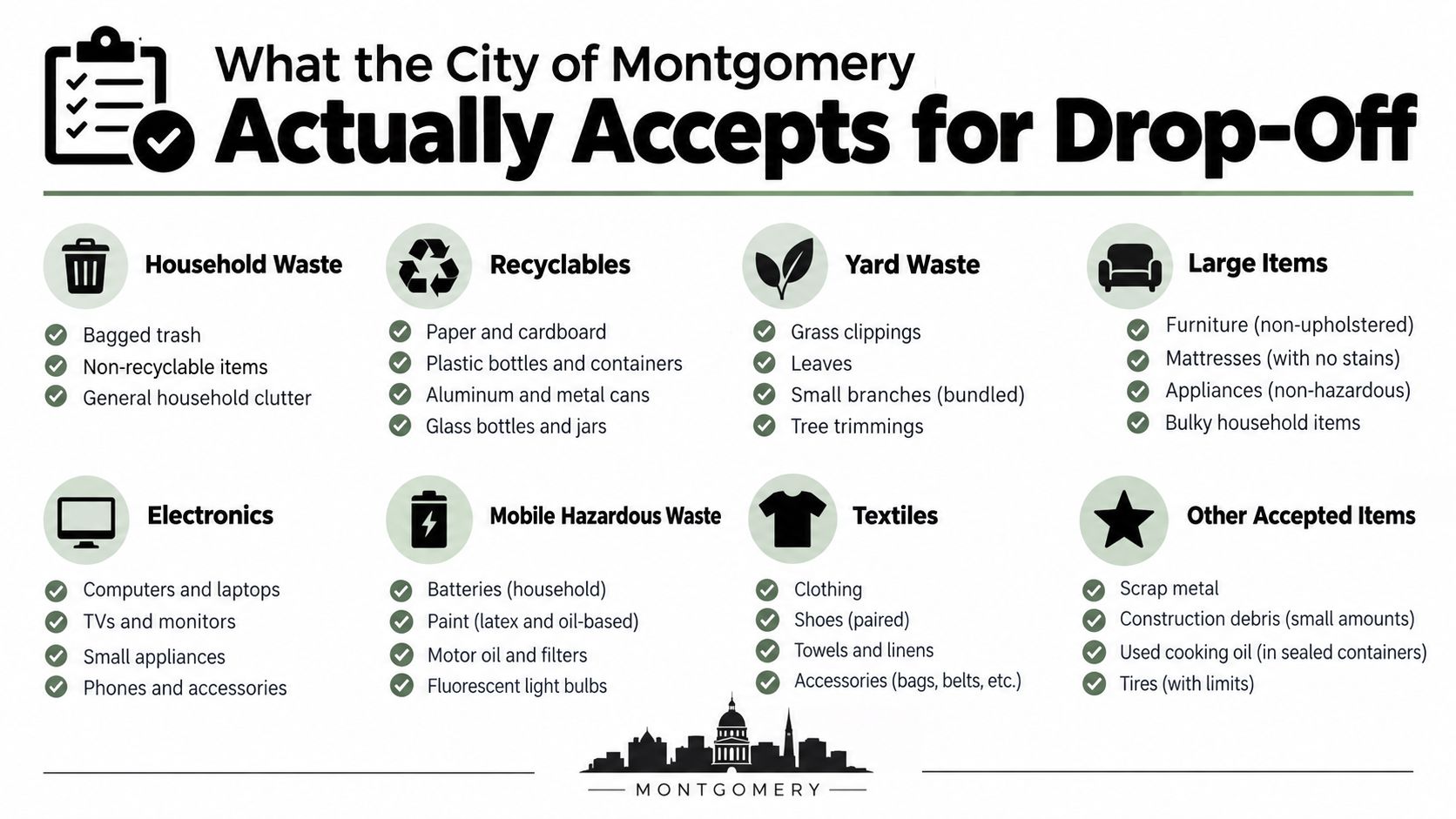
Build the load from the published list
Before a drop-off, separate devices into clear groups:
- Computing equipment: Desktops, laptops, CPUs, towers, and servers.
- Office hardware: Printers, copiers, fax machines, scanners, keyboards, and mice.
- Communications devices: Phones, cell phones, pagers, PDAs, and related equipment.
- Audio and visual equipment: TVs, TV dish boxes, radios, VCRs, DVD players, cameras, and camcorders.
- Specialized electronics: Medical electronics and other items named in the local guidance.
The list establishes what the city identifies as accepted electronics. It doesn't, by itself, establish a universal business volume allowance, a complete exclusion list, or a guaranteed acceptance decision for every commercial load. Do not assume that a city drop-off can absorb a palletized refresh just because individual devices appear on the list.
Confirm the practical details first
Check the current city schedule, location instructions, and any limits before loading a vehicle. For a business, call ahead when the load is larger than a normal resident drop-off or includes servers, medical electronics, displays, or mixed commercial equipment. Fixed collection points also have operating constraints, and an unattended delivery can create a second handling problem if the site can't receive it.
For a larger Montgomery office cleanout, use the municipal guidance to sort material, then ask a private provider about pickup, data destruction, reuse, and downstream documentation. Montgomery electronics recycling service information can help a business evaluate that alternative without confusing a public drop-off list with a full corporate ITAD program.
Municipal Drop-Off vs Private ITAD in the Local Market
Municipal drop-off and private ITAD solve different problems. A public collection point provides access to an established electronics stream. A private partner manages the operational burden that starts when a company needs inventory control, secure transport, data handling, or certificates.
| Factor | City of Montgomery Drop-Off | Private ITAD, such as Reworx |
|---|---|---|
| Cost | Public programs may provide a low-cost route for eligible household or small-load material. Confirm current business terms before delivery. | A quote may include logistics, processing, data destruction, and documentation. Reuse or buyback can affect the final balance. |
| Data security | A drop-off list doesn't establish a device-level sanitization record or certificate of destruction. | The business can request a defined media process, custody records, and destruction documentation. |
| Pickup availability | Material must reach a fixed collection location during its operating schedule. | A provider can arrange a pickup from the organization's facility when the load and service area qualify. |
| Documentation | The public guidance identifies accepted categories, but it doesn't establish a corporate asset register or per-device certificate. | The scope can specify serial capture, sealed containers, chain-of-custody records, and a certificate of recycling or destruction. |
| Best fit | Modest, low-complexity loads that fit the published program. | Enterprise refreshes, mixed IT assets, sensitive data, distributed offices, and deadline-driven cleanouts. |
Montgomery's local service infrastructure includes a listed electronics recycling location at 871b Plantation Way Bay 13, Montgomery, AL 36117, while another local facility advertises dedicated e-scrap handling and qualifying pickups. The Montgomery location listing also treats electronic recycling, hard drive destruction, and data center decommissioning as distinct services. That distinction matters. A recycling load, a drive-destruction job, and a server-room retirement shouldn't share an undefined scope of work.
If the business needs to prove what happened to a specific drive, a general drop-off receipt isn't the same control as a serialized ITAD record.
For a low-volume load with no retained data and no reporting requirement, municipal drop-off may be sufficient after confirmation. For a larger or sensitive load, compare private proposals by the evidence they produce, not only by the pickup price. Alabama ITAD service information is one local reference for evaluating that scope.
Preparing Devices the Right Way Before They Leave Your Office
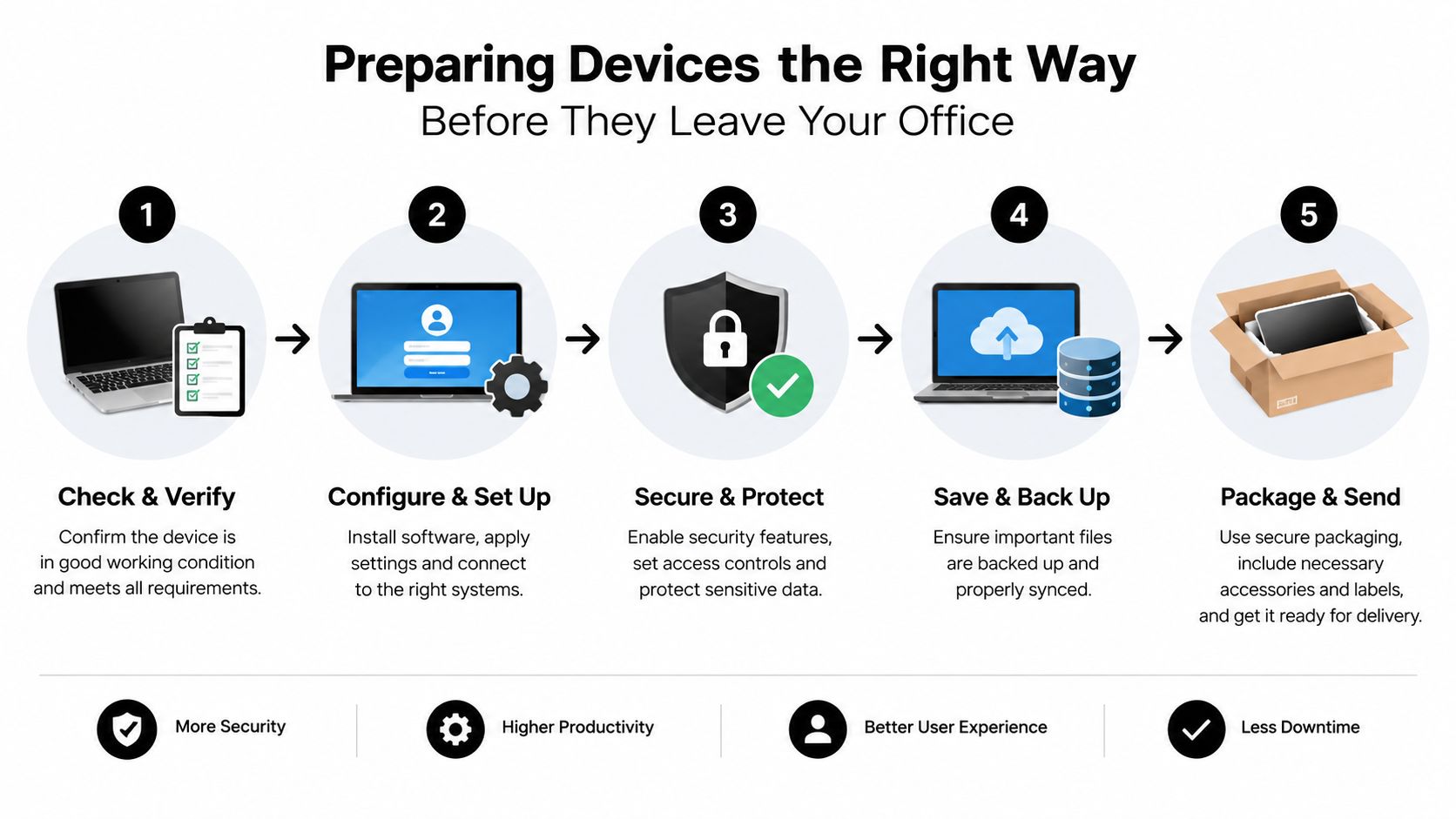
Data protection starts before the recycler arrives. The receiving team should be able to match every device to an internal record, identify its storage media, and explain what happened after collection.
Start with inventory, not wiping
Pull serial numbers into a CSV or asset management system. Reconcile the list against purchase records, assigned-user records, lease schedules, and the equipment physically present. Apply or confirm barcode or RFID tags, then flag missing, duplicate, or mismatched identifiers before staging.
Separate laptops, desktops, servers, phones, removable media, and failed equipment. A working laptop with a missing asset tag needs a different review from a dead server with several drives. Treat detachable USB devices and SIM cards as assets or data-bearing media, not as packing debris.
Choose the media process deliberately
Your security team should approve the sanitization method for each storage type. A written procedure can use the terminology of NIST 800-88, including Clear or Purge decisions for solid-state storage, while failed or inaccessible drives may require physical destruction. Spinning disks may receive an approved overwrite process where that method is technically suitable, but a business shouldn't use one generic wipe instruction for every media type.
Encryption can support a risk-based workflow before a wipe, but it doesn't remove the need for an accountable disposition record. Mobile devices should be removed from management platforms, reset through the approved enterprise process, and checked for detachable storage.
Stage the handoff
Use tamper-evident containers for isolated hard drives and removable media. Log the serial number, container identifier, seal condition, and person responsible at each transfer. Create a restricted pickup zone inside the facility so the vendor collects only verified assets, not equipment that still belongs to another department.
This electronics preparation guidance can support a documented pre-pickup checklist. The goal is simple: no unidentified device, loose drive, or unlogged handoff should enter the truck.
Cost, Buyback, and the Real Economics of Local E-Scrap
A free drop-off can still produce a poor business outcome if employees spend hours sorting, transporting, and reconciling equipment without recovering value or obtaining the records the auditor needs. Private ITAD pricing should be read as a total-disposition calculation, not as a comparison between a zero-dollar drop-off and a single pickup charge.
Working corporate-grade laptops, enterprise SSDs, network switches, and late-model smartphones may be candidates for buyback after inspection, testing, data handling, and market review. Consumer tablets, miscellaneous peripherals, broken monitors, CRTs, office LCDs, and older DDR3 systems may have limited recovery value or require processing without a meaningful credit. The actual result depends on condition, completeness, storage media, and the buyer's current channel.
Read the quote line by line
A Montgomery ITAD quote may separate logistics, per-device processing, secure data destruction, and certificates from any resale credit. Ask whether the credit applies per device, per lot, or only after testing. Confirm how nonworking material is priced and whether failed drives, display-heavy loads, and mixed pallets are handled separately.
| Device category | Typical buyback value | Processing fee | Net outcome |
|---|---|---|---|
| Corporate laptops | May qualify after testing and data review | Depends on scope and condition | Potential credit, subject to inspection |
| Enterprise SSDs | May retain recovery value when identifiable and functional | Secure media handling may apply | Credit or destruction cost, depending on condition |
| Network switches | Potential resale or parts recovery | Logistics and testing may apply | Often evaluated separately from scrap |
| Smartphones | Depends on model, condition, and account status | Data and account removal may apply | Possible recovery after verification |
| Peripherals | Usually limited resale potential | Sorting and handling may still apply | Often processing-focused |
| Broken displays and CRTs | May require specialized downstream handling | Transport and processing can dominate | Commonly a cost item |
| Older DDR3 systems | Market demand may be weak | Processing remains necessary | Often low-return or recovery-only |
No verified local price sheet supports exact dollar amounts or a universal buyback threshold, so insist on a written asset-level or lot-level assessment rather than relying on national averages. Businesses with sellable surplus can also review a specialist marketplace option such as joining as a seller, while keeping secure data destruction and environmental disposition under a clearly defined workflow.
Two Montgomery Sectors, Two Different Refresh Stories
A school district and a healthcare organization can send similar-looking laptops to the same downstream market while requiring very different controls. The device category is only the starting point. Ownership, data, timing, and reuse eligibility shape the disposition plan.
A school technology refresh
A district retiring student Chromebooks and staff laptops should begin with device accountability. The technology team needs a school-by-school inventory, confirmation that devices are removed from management systems, and a documented decision about whether each unit can be redeployed, donated, or recycled.
Student information raises the bar for custody and sanitization. A district may require an ITAD partner with appropriate certifications, controlled collection, witnessed or verified destruction for failed media, and a serialized destruction record filed with the disposition documentation. A scheduled pickup outside instructional hours can reduce disruption, but the important control is that the approved assets remain separated and countable until transfer.
Reusable equipment can support a donation-based recycling program when the district's policy permits it and the devices pass inspection. Units with damaged storage or uncertain history should not be routed to a donor only because they power on.
A regional clinic retirement
A clinic retiring MRI workstations, cardiology carts, or pharmacy-related equipment needs a broader review. Hard drives may require degaussing or shredding when they can't be sanitized through an approved process, while equipment associated with medications or controlled materials may need separate labeling and clearance before transport.
The cutover schedule adds pressure. The clinic must preserve access to replacement systems while removing retired equipment from clinical areas, inventory records, and data environments. Buyback may matter for ordinary business hardware, but specialized medical equipment often carries a compliance and logistics priority rather than a straightforward resale value.
A device can be reusable and still be unsuitable for donation until its data, ownership, software, and regulatory status have been cleared.
For both sectors, chain of custody should follow the risk. The district may emphasize serialized records by school and student-data controls. The clinic may require tighter media handling and equipment-specific release checks. Neither should treat a mixed pallet as a complete disposition record.
Running an E-Waste Drive or Office Cleanout in Montgomery
An e-waste drive works when someone manages it like a project. Start by confirming whether the venue falls inside Montgomery city limits or in unincorporated Montgomery County. The responsible collection channel, item list, and site requirements may differ, so the organizer should confirm local instructions before advertising the event.
Plan the intake
Choose a partner that can provide pallets, gaylords, secure containers, and on-site labor when the event needs them. Reworx Recycling's published service description includes business pickups, equipment decommissioning, secure hard drive shredding, and recycling support for organizations. Don't promise residents or employees that every television, battery, appliance, or damaged device will be accepted until the partner confirms the list.
Publish the accepted categories in plain language. Separate business assets from public donations, and give employees a clear place to ask about laptops, phones, printers, cables, batteries, and displays. A moving or facilities team planning a broader cleanout may also find TLC Moving & Storage's zero-waste moving approach useful when electronics are part of a larger relocation.
Control pickup day
Use a chain-of-custody form with fields for serial number, outgoing count, weight, photographs, container identifier, and seal condition. Data-bearing devices should go into locked or tamper-evident containers before the truck departs. Keep reusable equipment, recyclable material, and rejected items in separate zones.
After processing, request a certificate of recycling that identifies the applicable weight and device classes, along with destruction documentation when media was destroyed. These e-waste drive planning tips can help facilities teams turn a one-day collection into a repeatable office cleanout process.
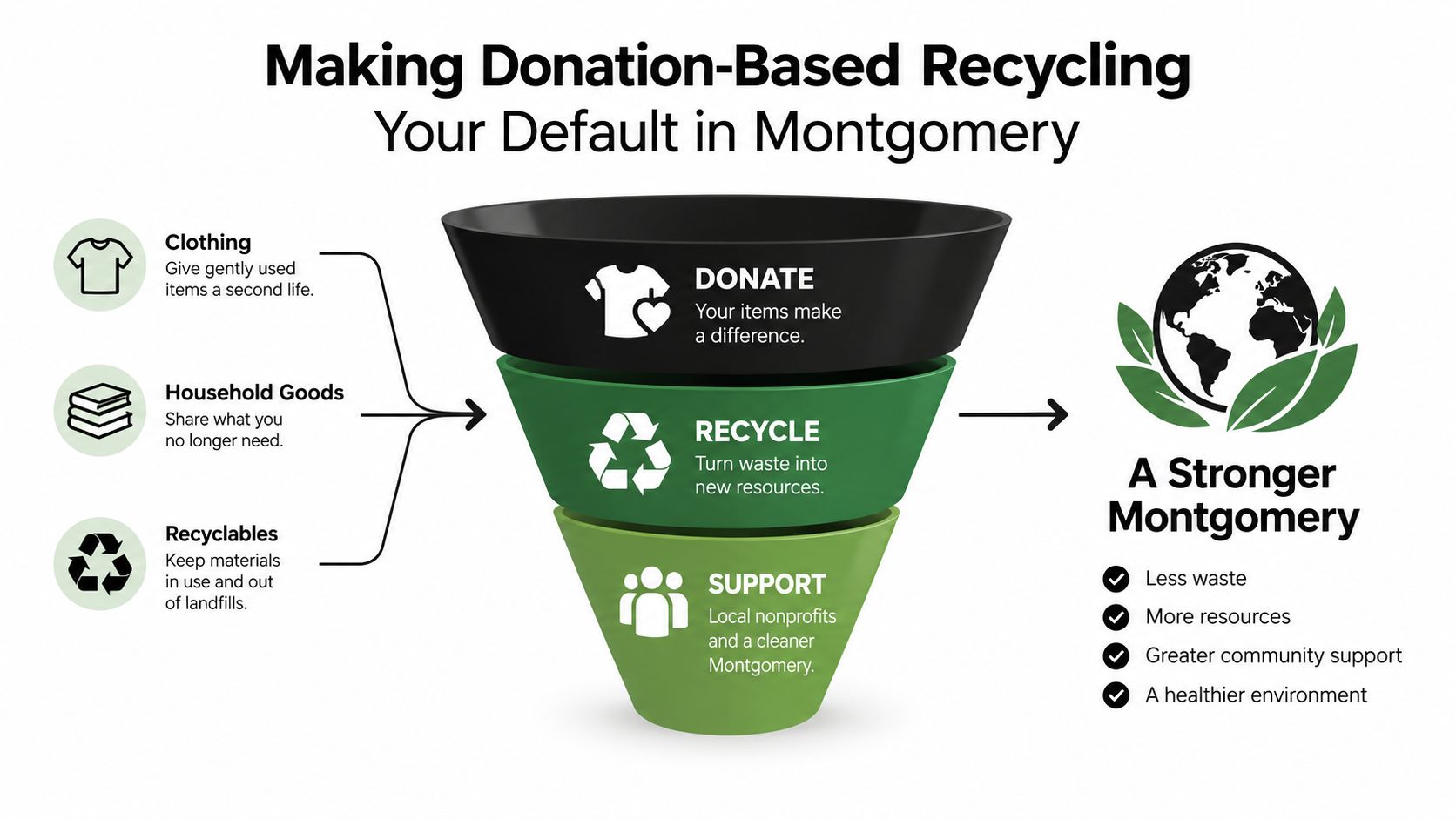
Making Donation-Based Recycling Your Default in Montgomery
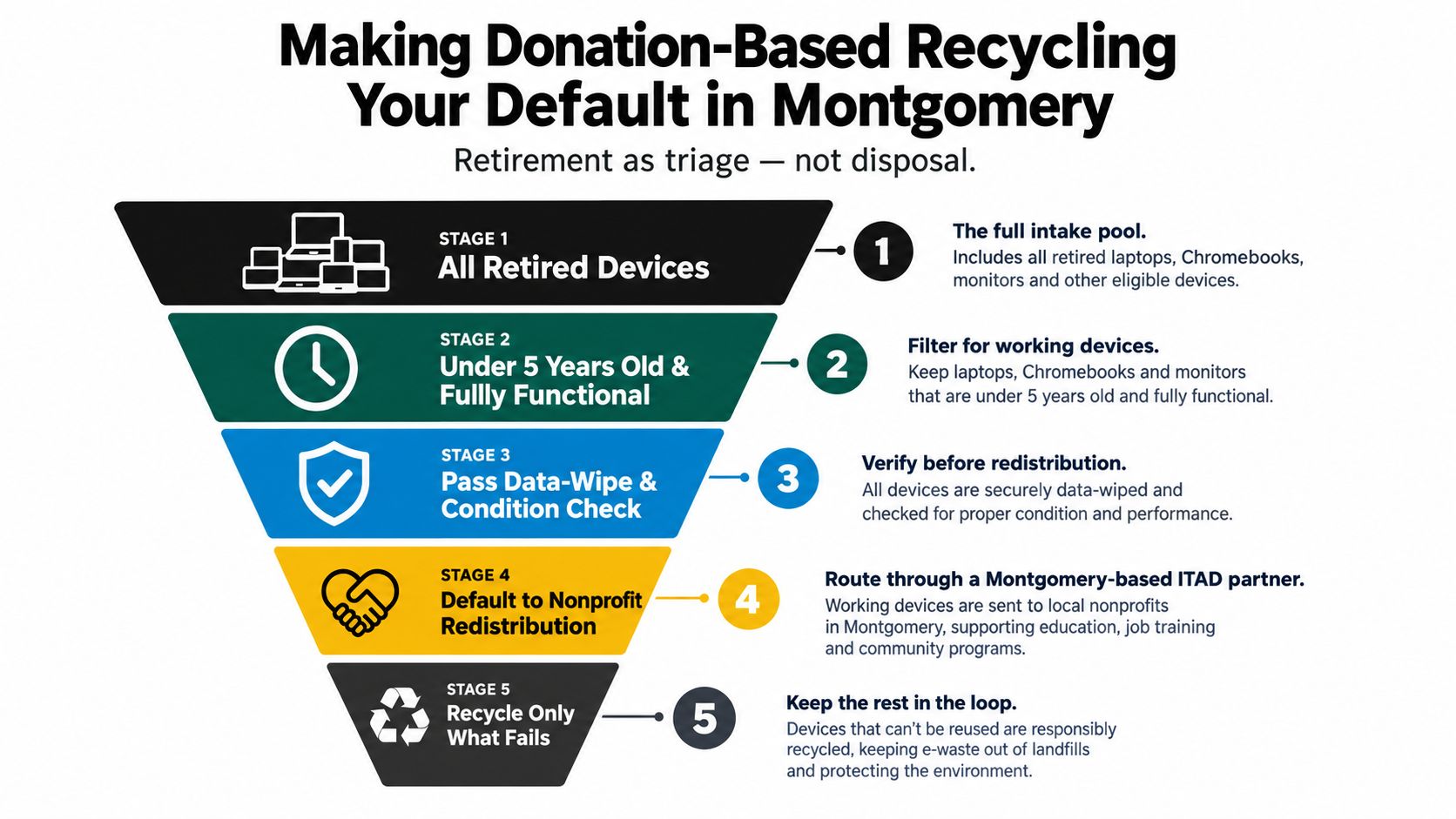
Retirement shouldn't automatically mean disposal. Grade each device when it enters the disposition workflow, then choose redeploy, donate, or recover. That triage protects data and directs working equipment toward a second use before the organization sends anything to material recovery.
Working laptops, Chromebooks, and monitors that remain functional may be suitable for nonprofit redistribution after inspection, account removal, sanitization, and condition checks. A Montgomery-based ITAD partner can help route eligible equipment through a local or regional donation workflow, while the business retains documentation for its compliance and sustainability files.
Make the decision tree part of the refresh policy
A practical policy asks four questions at receiving:
- Can the organization identify it? If not, quarantine it until ownership and data status are resolved.
- Can the storage be sanitized or destroyed? Match the method to the media and risk.
- Can the device support another user? Test the hardware, remove accounts, and record condition.
- If reuse fails, what can be recovered? Send components and materials through the appropriate recycling stream.
Montgomery's electronics-recycling system illustrates why this sorting matters. Accepted devices may be disassembled for parts reuse, refurbished for second-life use, or processed for metals and plastics, while equipment intended for reuse requires data erasure and destruction of remaining memory devices. Montgomery County's electronics handling guidance also describes expanded categories such as audio and video tapes, printer cartridges, and handheld electric tools.
At the regional level, Montgomery County is reported as one of about 8 of 23 Maryland county or city jurisdictions offering year-round, free-at-drop-off acceptance of all municipal electronics, including televisions and monitors, and county electronics and battery recycling exceeded 3,700 tons from 2022 to 2024. Maryland testimony on electronics recycling connects that public infrastructure to the actual cost of display-heavy material and downstream processing.
A donation-first policy gives every refresh a community outcome as well as an environmental one. It can support digital inclusion and workforce development, while responsible recovery handles equipment that can't safely or economically be reused.
Reworx Recycling helps Montgomery businesses coordinate electronics recycling, business pickups, IT equipment disposal, equipment decommissioning, and secure hard drive destruction with donation and recovery pathways considered during triage. Review the Reworx Recycling resource center and schedule a conversation about your next office cleanout, school refresh, clinic retirement, or data center decommissioning project.