Georgia's data-center economy generated $25.7 billion in GDP in 2023, supported 30,070 direct jobs and 176,790 total jobs, and produced $1.8 billion in taxes, according to reporting based on Data Center Coalition figures (Georgia Trend's data-center analysis). That figure reframes how AI is transforming Georgia's economy. The story isn't limited to software companies or machine-learning engineers. It includes power plants, substations, cooling systems, construction crews, cybersecurity teams, equipment logistics, and the responsible retirement of technology assets.
Georgia's opportunity is substantial, but it isn't evenly distributed. Atlanta captures most of the state's AI-related job postings, while rural communities face greater exposure to task automation and fewer pathways into high-value technology work. For business owners, IT managers, sustainability leaders, and public agencies, the practical question isn't whether AI will affect Georgia. It's how to capture productivity and investment while managing grid pressure, workforce disruption, geographic inequality, and the growing stream of retired hardware.
Why Georgia Is a National AI Bellwether
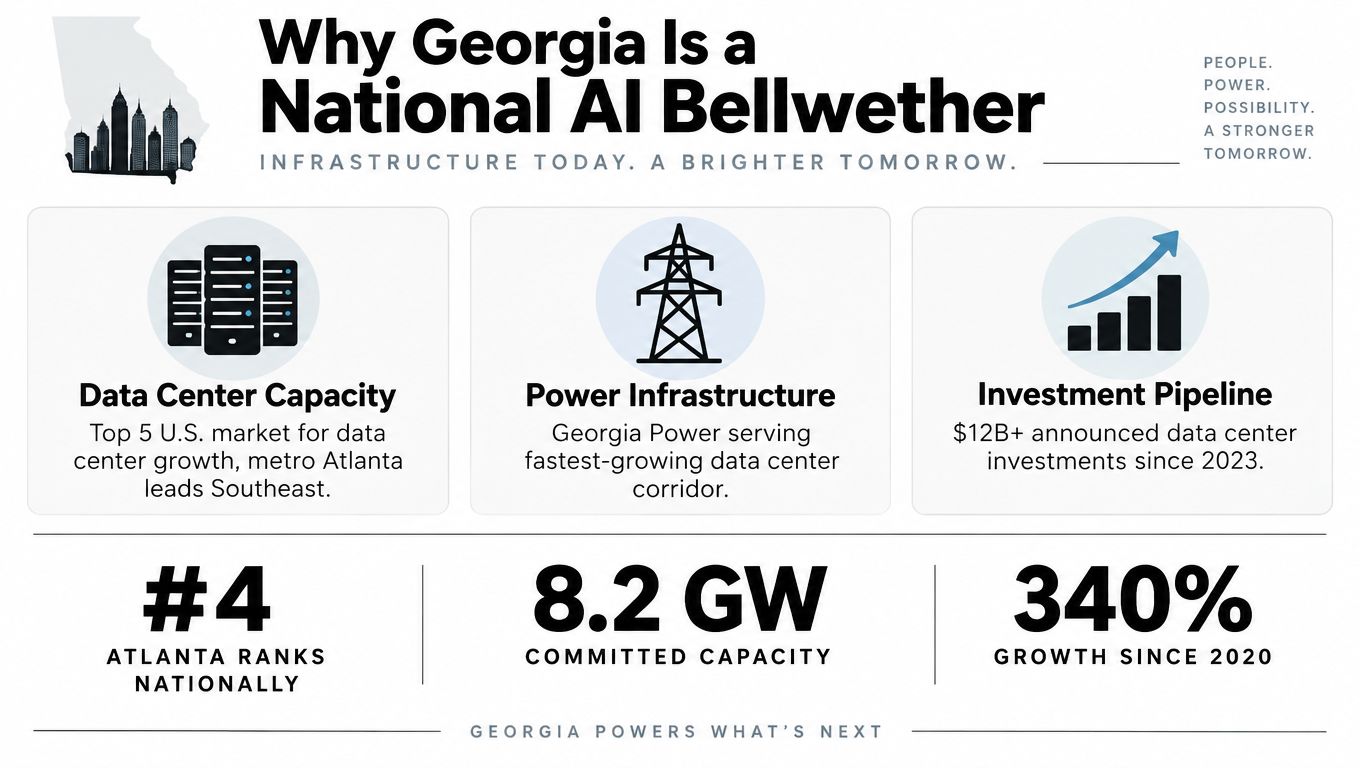
Georgia's AI position rests on a contradiction. The state has a large technology base and a rapidly expanding physical infrastructure, yet enterprise AI adoption remains at an early stage. One industry summary describes Georgia as home to more than 14,000 technology companies, over 280,000 technology professionals, and more than $50 billion in annual economic impact, with a projection of 100,000 additional technology jobs by 2033 (industry summary of Georgia's technology and AI ecosystem). UNESCO's 2026 profile, cited in the same verified overview, puts enterprise AI adoption at 2.2% of firms in 2024, with roughly 30 active AI startups.
That combination makes Georgia a useful bellwether. The state already has software, logistics, telecommunications, cybersecurity, higher education, and corporate headquarters. It also has land, power infrastructure, and major transportation links that allow AI companies to build the facilities required for training and inference. The result is an economy where AI's software layer and physical layer are developing together, but not at the same speed.
The physical layer is particularly important. Data centers require large, continuous electricity loads, specialized cooling, high-capacity network connections, and equipment replacement programs. Those requirements create demand beyond the technology sector itself. Electrical contractors, facility managers, construction companies, environmental service providers, equipment transporters, and IT asset disposition specialists all become part of the AI supply chain.
Operating principle: Georgia's AI economy should be evaluated as an infrastructure ecosystem, not only as a collection of software firms.
For operators, that changes the sequence of questions. Start with the available data and business process. Then assess compute, energy, security, and workforce requirements. Finally, plan for equipment refreshes, secure data destruction, and material recovery. Businesses exploring Atlanta's technology expansion can also review why Atlanta is becoming the South's tech hub as they evaluate local vendors, facilities, and workforce needs.
The Tech Foundation Powering Georgia's AI Push
Georgia enters the AI economy with a substantial technology base, but adoption remains selective. The state's technology companies employ more than 280,000 tech professionals and generate more than $50 billion in annual economic impact. The same overview reports more than 14,000 technology companies, roughly 30 active AI startups, and 1.1 AI publications per million inhabitants in 2024 (Georgia technology ecosystem data). Enterprise AI adoption reached only 2.2% of firms in 2024, indicating that Georgia's capacity to develop technology is ahead of its capacity to deploy it broadly.
That gap changes the market opportunity for B2B suppliers. Atlanta concentrates developers, data scientists, startups, and research activity, while manufacturers, hospitals, logistics operators, financial firms, schools, and local governments must still identify workable use cases. Their constraints are practical: inconsistent data, unclear ownership, cybersecurity exposure, limited implementation staff, and systems that do not fit existing workflows.
Two different AI workforces
Georgia's AI economy depends on two connected labor markets. The software workforce builds models, manages data pipelines, and develops applications. The applied workforce incorporates those tools into daily operations. Warehouse supervisors may use demand forecasts, maintenance teams may review machine alerts, and IT departments may automate ticket triage or endpoint management.
Applied AI does not require every employee to become a machine-learning engineer. It does require people who understand process design, data quality, cybersecurity, change management, and human review. For employers, that makes implementation capability a workforce issue as much as a software purchasing decision.
A Georgia State University policy brief summarized in the same overview indicates that STEM employment growth is expected to be strongest in Metro Atlanta. Customer service, sales, and office-support roles face greater displacement risk, particularly in rural areas. The result is a geographic mismatch between the workers most prepared to build AI systems and the organizations that need help applying them.
| Metric | Georgia | U.S. Average |
|---|---|---|
| Enterprise AI adoption | 2.2% of firms in 2024 | A comparable average is not provided |
| Technology companies | More than 14,000 | A comparable figure is not provided |
| Technology professionals | Over 280,000 | A comparable figure is not provided |
| Active AI startups | Roughly 30 | A comparable figure is not provided |
| AI publications | 1.1 per million inhabitants in 2024 | A comparable average is not provided |
For operators, implementation skills create more value than software access alone. Companies need data governance, workflow integration, secure device and server management, and plans for retiring laptops, networking equipment, and specialized hardware. Those requirements extend the AI supply chain into asset disposition, e-waste processing, and material recovery. Businesses assessing Atlanta's technology expansion can also review the region's growing demand for data storage solutions when connecting AI plans with facility, equipment, and vendor decisions.
Georgia holds a sizable base from which AI can scale, while adoption remains selective. Companies that build implementation skills inside operations stand to gain the most.
Data Centers, Power Grids, and the Infrastructure Economy
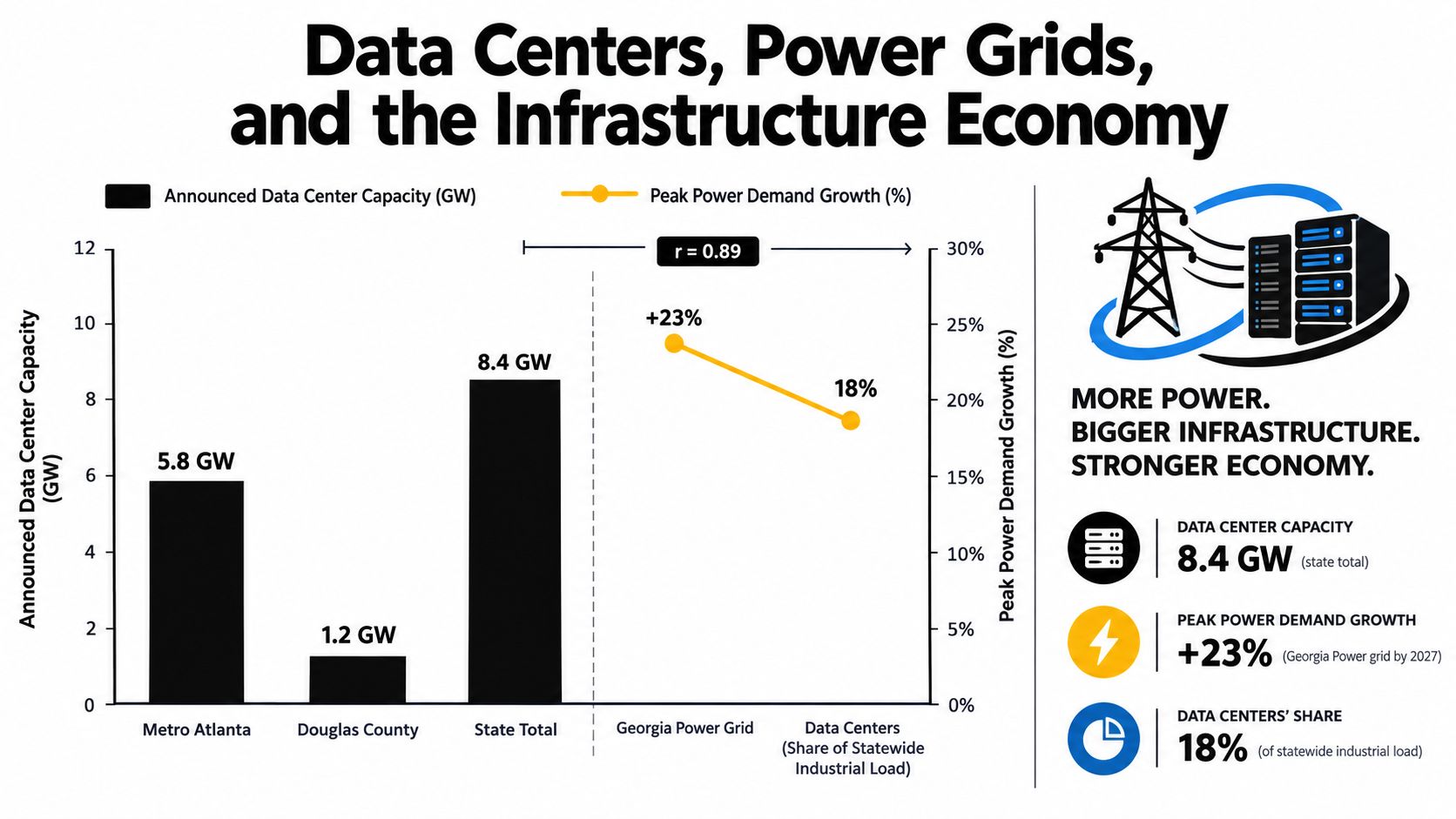
Georgia's data-center expansion has turned AI infrastructure into an industrial policy issue. Software demand now drives requirements for generation, transmission, substations, cooling water, backup systems, and long-term grid planning. Georgia Power and state regulators are preparing major additions to generation capacity, with data centers expected to account for most of the projected increase, according to reporting on Georgia's AI infrastructure challenge.
Those requirements reshape project economics. A facility's cost extends well beyond servers and buildings to transmission, substations, cooling water, backup systems, grid planning, and exposure to future power prices or reliability conditions. High-density computing makes cooling a central design constraint. Continuous workloads also make energy procurement, workload scheduling, and power-source evaluation part of daily operations.
Who captures the multiplier
Data centers already function as a major economic sector in Georgia. In 2023, the industry supported 30,070 direct jobs and 176,790 total jobs, generated $14.1 billion in labor income, and contributed $1.8 billion in taxes, according to Georgia Trend's report on data-center economic impact. Those totals show the industry's reach beyond facility payrolls. Industry observers cited in the report describe a multiplier in which each data-center job supports additional employment elsewhere in the economy.
The multiplier will vary by location. Local governments need agreements that account for infrastructure costs, workforce preparation, water use, equipment traffic, and tax arrangements. Businesses need power-aware procurement, including workload scheduling and supplier reviews that account for energy exposure. Public agencies need transparent tests for whether employment and tax gains justify the grid, land, and public-service requirements.
The central economic risk is facility growth without surrounding capabilities. Georgia can host large computing sites, while long-term value depends on local contractors, technicians, cybersecurity providers, recycling firms, schools, and training programs that retain more activity in the state. Equipment retirement also belongs in the initial plan. Responsible data-center decommissioning, hardware recovery, and reducing the environmental impact of data centers can limit e-waste and clarify costs across the hardware lifecycle. The strongest regional outcomes will therefore depend on who supplies, maintains, powers, and eventually dismantles these facilities.
Sector-by-Sector Impacts Across the State
AI adoption in Georgia won't follow one statewide pattern. Each industry has a different combination of data, regulation, labor, physical assets, and tolerance for operational risk. The most useful distinction is between systems that assist workers and systems that make decisions without meaningful review.
Logistics and manufacturing
Georgia's logistics economy can use AI to improve routing, inventory planning, facility scheduling, and equipment maintenance. In manufacturing, the strongest opportunities are likely to come from machine-vision inspection, predictive maintenance, production planning, and quality control. These applications support plant workers by identifying anomalies earlier, but they still require technicians who can validate alerts and repair the underlying equipment.
Healthcare and finance
Healthcare organizations face a higher governance burden. Clinical documentation, imaging support, patient-flow analysis, and administrative automation can reduce repetitive work, but hospitals need audit trails, access controls, human review, and clear responsibility for errors. Financial companies face a similar challenge in fraud detection, customer service, transaction monitoring, and back-office processing. A faster model is useful only when the organization can explain its controls to regulators, customers, and internal risk teams.
Government and education
Public agencies can use AI for document search, service routing, procurement analysis, and constituent communications. The benefits are constrained by data quality and public accountability. Government buyers should require explainability, records retention, accessibility, and clear rules for human escalation.
Schools and universities have a dual role. They must prepare students to use AI responsibly while also managing the technology lifecycle of laptops, tablets, laboratory devices, and network equipment. A device donation program can connect technology retirement with digital inclusion, but organizations still need secure data destruction and documented chain of custody before equipment moves to another user.
| Sector | Leading Georgia adopter(s) | Primary AI capability |
|---|---|---|
| Logistics | Ports, carriers, warehouses, and distribution operators | Forecasting, routing, scheduling, and equipment monitoring |
| Manufacturing | Automotive, electronics, and industrial plants | Machine vision, predictive maintenance, and quality control |
| Healthcare | Hospitals, clinics, and medical schools | Documentation support, imaging assistance, and patient-flow analysis |
| Finance | Banks, payment companies, and fintech operators | Fraud detection, transaction monitoring, and service automation |
| Government | State, county, and municipal agencies | Document processing, procurement analysis, and service routing |
| Education | Universities, school districts, and workforce programs | Learning support, administration, and AI literacy |
These applications also create downstream needs for computer recycling, laboratory equipment disposal, medical equipment disposal, and secure data destruction. Companies tracking Georgia's business expansion can review Atlanta's fastest-growing industries in 2026 while mapping technology upgrades to facilities, staffing, and asset-disposition plans.
The Hidden Labor Story Behind AI Adoption
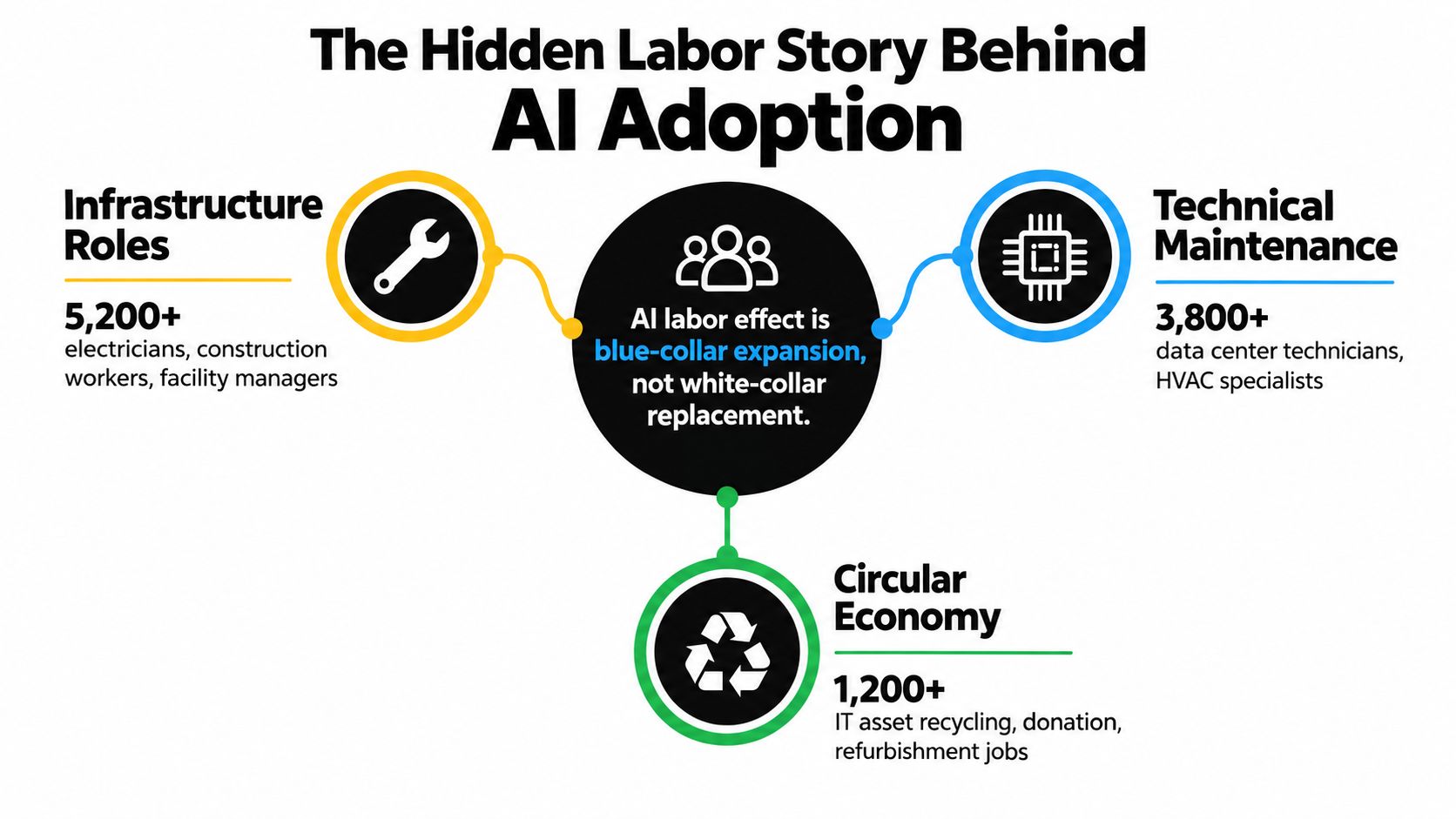
The most visible AI debate focuses on office workers, but Georgia's infrastructure buildout creates a different labor story. Data centers require electricians, power-system specialists, network technicians, cooling experts, construction workers, facility managers, and cybersecurity staff. The state's information and communication employment rose from 49.8 thousand in Q2 2025 to 53.0 thousand in Q2 2026, while professional, scientific, and technical activities increased from 25.5 thousand to 27.0 thousand over the same period (analysis of AI-related job creation in Georgia).
Task exposure is not the same as job loss
A 2025 policy paper using ILO exposure scores and the 2023 Georgian Labor Force Survey found that 26% of Georgian workers are in occupations where some tasks could potentially be performed fully or partially by generative AI. More than one-third of exposed workers fall into medium- to high-exposure roles, a group estimated at 100,584 individuals (2025 policy paper on generative AI and Georgia's labor market).
The operational implication is task redesign. Document handling, customer triage, routine analysis, and administrative processing may become faster, while demand rises for supervision, prompt design, model governance, workflow integration, and exception handling. Employers should measure which tasks change, how many decisions still require human judgment, and whether training keeps pace with the new workflow.
IT asset disposition is part of this labor system. AI facilities and corporate technology teams generate retired servers, GPUs, laptops, networking equipment, and storage devices. Certified electronics recycling, product destruction, refurbishment, resale, and ITAD services create work while reducing the risk that sensitive data or valuable materials leave the organization without control. Managers assessing technical hiring can also consult guidance on assessing AI engineering judgment, because technical competence now includes knowing when a model should not replace a person.
The state's workforce response must therefore include both advanced software skills and practical infrastructure skills. Georgia businesses reviewing the talent pipeline can draw on Atlanta's tech talent shortage and potential solutions while building reskilling plans around actual tasks, not broad job titles.
Geographic Inequality and the Rural Gap
Georgia's AI gains are concentrated geographically. The Atlanta metro area accounted for more than four-fifths of the state's AI job postings, while Georgia's share of AI-skills postings reached 2.93% in December 2025, close to the 3.0% national average and the highest share in the Southeast, according to the Atlanta Federal Reserve's analysis of AI demand.
That concentration creates a distribution problem. Atlanta can attract AI firms, investors, technical workers, and data-center suppliers in the same geography. Smaller cities and rural counties may receive construction activity or utility investment without gaining equivalent access to high-wage technology careers. They may also face greater exposure if customer service, sales, clerical, and office-support tasks are automated without a local reskilling pathway.
The rural question is participation
A rural AI strategy shouldn't attempt to recreate Atlanta's startup ecosystem in every county. It should connect local strengths to specific AI-enabled services and infrastructure needs. Manufacturers can use vision systems and maintenance analytics. Agricultural businesses can adopt tools that support production planning and resource management. Community colleges can align training with electrical, cooling, network, cybersecurity, and equipment-repair roles.
Public agencies should also treat broadband, postsecondary attainment, and local procurement as economic infrastructure. A county that can't support reliable connectivity or train technicians will struggle to retain AI-related value, even if companies elsewhere in the state grow quickly.
Policy test: A project creates broader inclusion when local residents can access its training, supplier contracts, technical jobs, and equipment-reuse benefits, not only when a facility is located nearby.
The most durable approach combines regional training partnerships, mobile technical programs, small-business support, and equipment donation channels for schools and community organizations. That helps rural communities participate in the circular economy around AI, even when model development and hyperscale computing remain concentrated in metropolitan areas.
What Businesses and Agencies Should Do Next
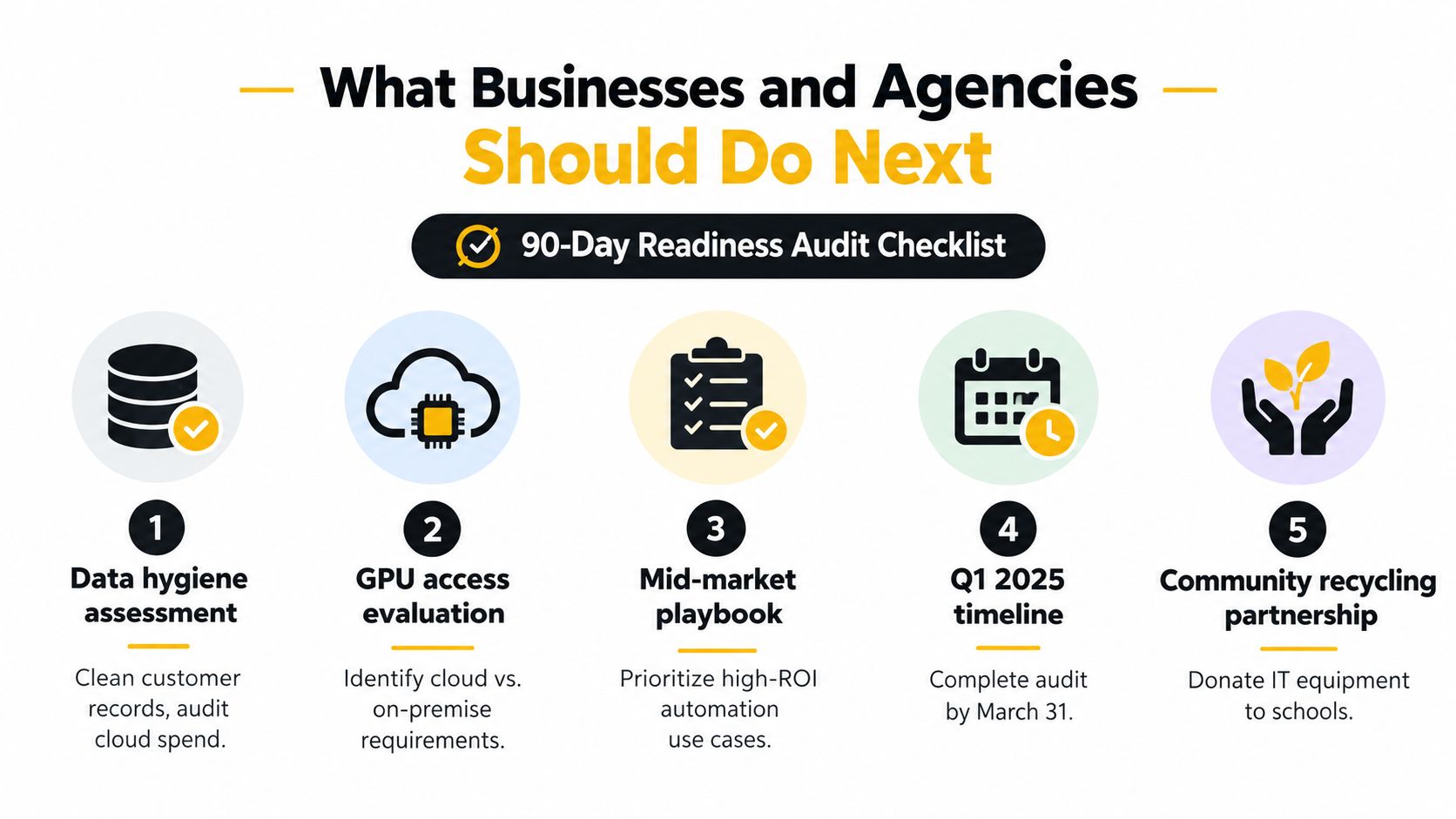
Georgia organizations shouldn't begin with a large AI purchase. They should begin with an operating audit that identifies where data, infrastructure, labor, and risk intersect. A practical 90-day readiness audit can establish whether the organization has a credible path from experimentation to production.
Days one through thirty, establish the baseline
Start with data hygiene. Identify duplicate customer records, incomplete asset inventories, inconsistent naming, undocumented spreadsheets, and sensitive information stored outside approved systems. Audit cloud spending and document which workloads require predictable latency, specialized hardware, or local control.
Next, map the technology estate. Include laptops, servers, networking devices, storage media, GPUs, printers, laboratory equipment, and medical devices. An accurate inventory supports procurement, cybersecurity, insurance, sustainability reporting, and eventual IT equipment disposal.
Days thirty-one through sixty, choose one operational pilot
A manufacturer might begin with predictive maintenance on one production line. A logistics team might test demand forecasting or exception routing. A healthcare system could limit an initial pilot to documentation support with explicit review requirements. A financial firm might test fraud-alert prioritization rather than automated account decisions.
Each pilot should define:
- Decision boundary: Specify what the system may recommend and what requires human approval.
- Data owner: Assign responsibility for accuracy, access, retention, and correction.
- Failure path: Document what happens when the model is unavailable, uncertain, or wrong.
- Workforce effect: Measure training needs, changed tasks, review time, and new control responsibilities.
- Exit criteria: Decide when to stop, redesign, or expand the pilot.
Public agencies should add procurement requirements for explainable models, accessibility, records retention, security controls, and clear data residency expectations. Financial and healthcare organizations need stronger audit trails and liability assignments because a model's recommendation can affect customers, patients, and regulated decisions.
Days sixty-one through ninety, scale responsibly
Before expanding, compare productivity with total cost. Include integration work, oversight, energy consumption, cloud fees, cybersecurity, employee training, and equipment retirement. A dashboard should track:
- Operational performance: Cycle time, error rates, exception volume, and human review load.
- Workforce readiness: Retraining hours, new technical roles, and unresolved skills gaps.
- Infrastructure exposure: Power requirements, cooling constraints, network dependencies, and service continuity.
- Environmental outcomes: E-waste tonnage, reuse rates, recycling documentation, and recovered equipment value.
- Governance quality: Incidents, access reviews, model changes, and unresolved audit findings.
Technology retirement deserves its own workstream. Organizations should require documented chain of custody, secure data destruction, equipment testing, refurbishment decisions, and downstream recycling records. A donation-based recycling partner can help route usable laptops and devices to schools or community programs, while certified processors handle equipment that can't be reused. This approach connects corporate donation programs, digital inclusion, sustainable recycling, and compliance instead of treating old hardware as ordinary waste.
For companies planning an office cleanout, facility cleanout, data center decommissioning, laptop disposal, or server refresh, the responsible path is to plan asset disposition before the new equipment arrives. That gives IT and sustainability teams time to separate reusable assets, restrict access to data-bearing devices, document destruction, and recover value through resale or refurbishment.
Board-level question: Can your organization show where AI created value, who carried the risk, what workers learned, and what happened to the equipment it replaced?
Funding and partnership options should be evaluated against the specific use case. Georgia businesses and agencies can investigate programs connected to manufacturing innovation, state economic development, and federal clean-energy incentives, but they should verify current eligibility and deadlines before budgeting. The same discipline applies to vendors. Select providers that can document security, environmental handling, labor practices, and measurable outcomes.
Reworx Recycling helps Georgia businesses manage electronics recycling, secure data destruction, equipment decommissioning, donation-based recycling, and IT asset disposition as technology estates change. Visit Reworx Recycling to plan a business pickup, donate usable equipment, or build a responsible retirement process for laptops, servers, and other IT assets.