Atlanta's AI adoption is already broad enough to affect business planning. About 66.5% of households in the Atlanta Metropolitan Statistical Area use AI tools, yet only 18.8% trust information from AI systems and 13.1% feel in control of how their data are used, according to a regional survey summarized by Georgia Tech's AI research program. That gap captures Atlanta's central AI challenge: the region is adopting the technology faster than institutions are building confidence, governance, and responsible hardware lifecycles around it.
For operators, the future of artificial intelligence in Atlanta won't be decided only by model performance or startup funding. It will also depend on whether companies can connect compute expansion with workforce readiness, secure data handling, infrastructure planning, regulatory compliance, and responsible IT asset disposition. The AI boom is creating a technology transition, but it's also creating a physical stream of servers, storage devices, networking equipment, and retired electronics that businesses must manage carefully.
Why Atlanta's AI Moment Is Real but Uneven
Atlanta's 66.5% household AI usage rate establishes a substantial adoption base. The same survey shows that only 44.9% of respondents said AI tools make them more productive, while 18.8% trusted information from AI systems and 13.1% felt in control of how their data were used. The result is a market where use is advancing faster than confidence. The infographic on Atlanta's uneven AI adoption and institutional trust captures that gap.
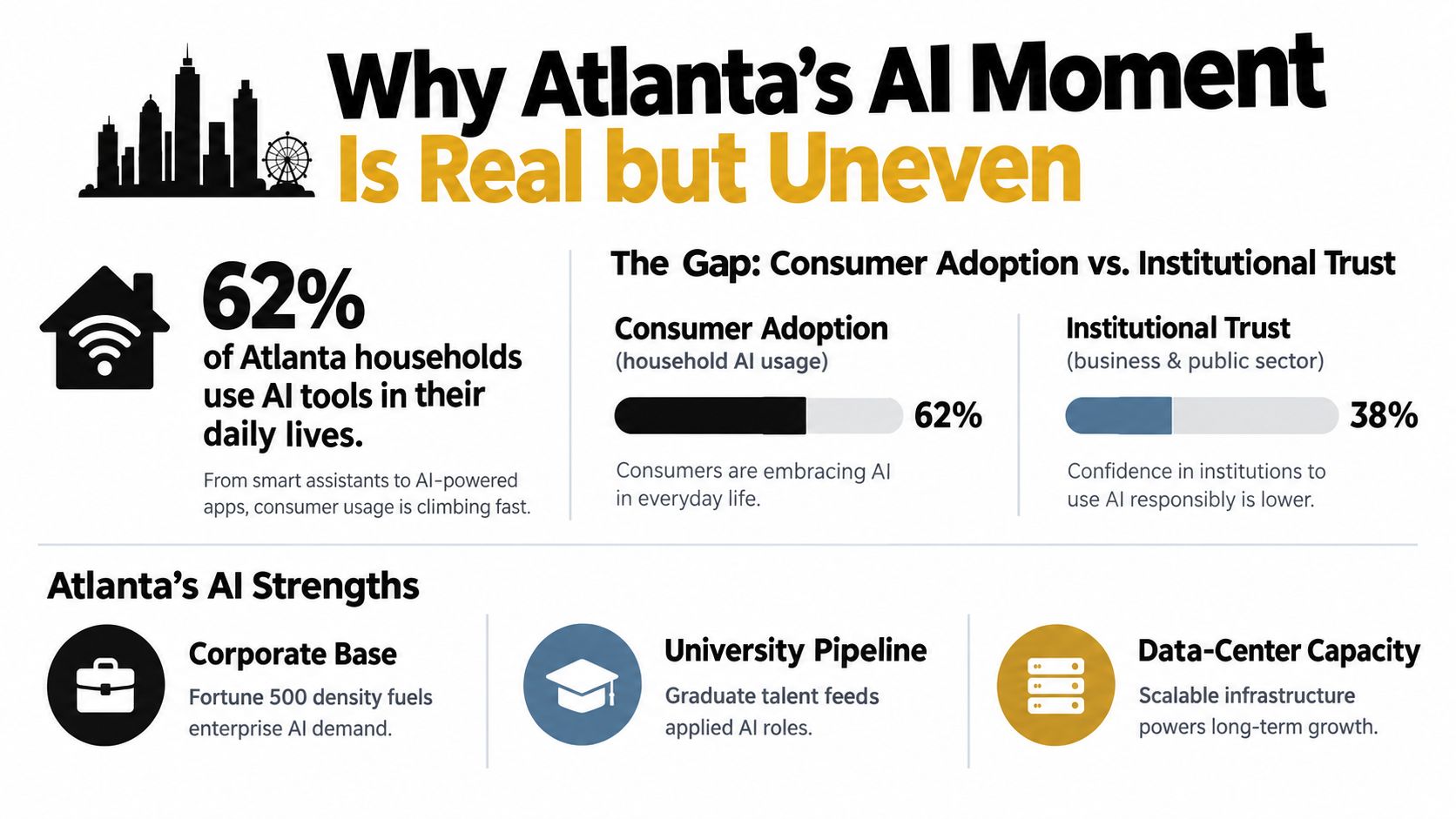
Three signals point in different directions
Atlanta has strong commercial reasons to pursue AI. Its corporate base can support demand for automation, analytics, customer-service systems, fraud controls, and operational forecasting. Georgia Tech contributes research capacity and interdisciplinary talent, while the region's expanding data-center footprint gives companies more options for cloud adjacency and high-performance computing.
Adoption remains concentrated in practical experimentation. The survey found that 27.2% of households reported someone using AI for a work project, 24.1% used it for creative tasks, and only 7.8% reported agentic AI use. Those results describe a market that is testing AI broadly, while autonomous systems remain at an earlier stage of deployment.
Practical rule: Atlanta businesses should measure AI readiness through documented workflows, accountable owners, data controls, and hardware retirement plans, not through the number of announced pilots.
Institutional conditions vary widely. Private companies can introduce productivity tools quickly, while public agencies and regulated operators must address approvals, records, and review procedures before deploying generative systems. Compute investment may therefore advance faster than enterprise integration, leaving training, trust, and governance behind.
That imbalance has direct IT lifecycle consequences. More compute means more servers, storage devices, networking equipment, cooling capacity, and eventually retired hardware. Operators that connect AI procurement with secure data destruction, documented asset disposition, and e-waste accountability will be better positioned to scale responsibly. The analysis of Atlanta's technology hub development supports a broader conclusion: Atlanta's advantage will depend on making adoption dependable, auditable, and environmentally responsible.
How Georgia Tech Is Anchoring Atlanta's AI Future
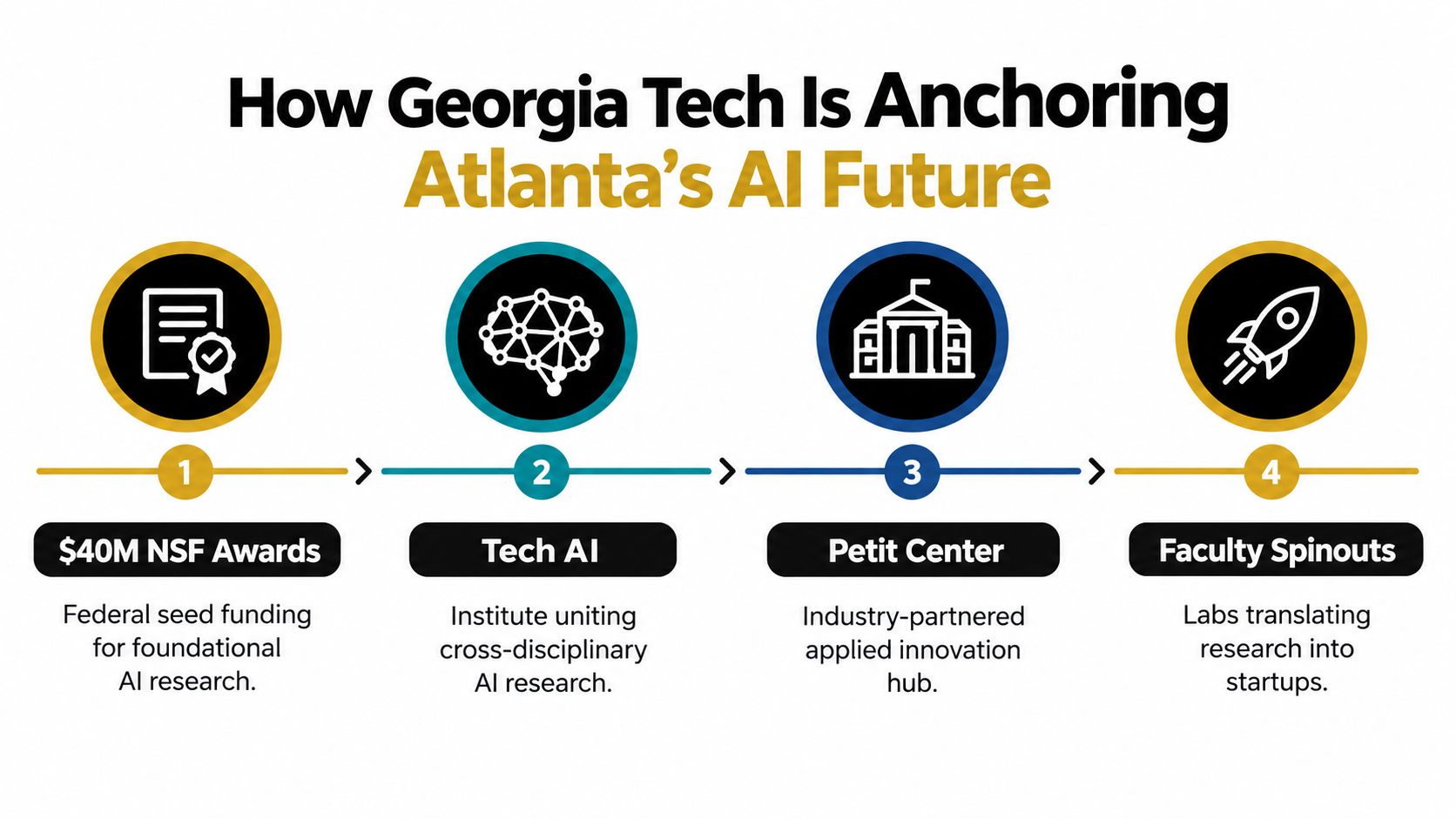
Georgia Tech gives Atlanta a durable route from research to deployment. Its work connects federally funded institutes and university labs with healthcare, enterprise systems, startups, and public services, creating an institutional pipeline rather than a collection of isolated pilots.
In 2021, Georgia Tech received two National Science Foundation Artificial Intelligence Research Institute awards totaling $40 million. By 2025, the university had launched Tech AI to move research toward practical use, drawing on its three NSF-funded AI Institutes and wider interdisciplinary network. In 2026, it announced the Parker H. Petit Center for AI-Driven Health Innovation, which focuses on using AI to predict, treat, and prevent disease. The Georgia Tech's artificial intelligence and machine learning overview places these efforts within the university's broader research and education activity.
Funding becomes capacity when institutions connect it
The grant total matters less than the capacity it creates. Federal research support can fund laboratories, technical expertise, partnerships, and intellectual property. Commercialization structures then give researchers a path into applied work. The Petit Center extends that path into healthcare, where AI systems must address reliability, privacy, and clinical accountability before they can support patient care.
That makes Georgia Tech a conversion point for Atlanta's AI market. Research can flow into hospitals, logistics operators, financial technology companies, public agencies, and software firms. Those organizations need staff who can test model outputs, connect systems to existing workflows, and set clear boundaries for human review.
The pipeline also creates physical requirements. Applied research depends on compute, storage, networking, laboratory equipment, and protected data environments. As these systems expand, operators face hardware refreshes, server and storage retirement, secure data destruction, and electronics recycling. AI research therefore creates IT lifecycle demand alongside technical capability. Procurement decisions made today can determine whether retired equipment is documented, reused where appropriate, or processed through accountable disposition channels.
Georgia Tech also gives Atlanta a stronger policy voice. Its interdisciplinary structure brings engineering, medicine, economics, and ethics into the same conversation. That combination supports better decisions about procurement, data governance, workforce design, and environmental responsibility.
The connection between Atlanta's digital economy and IT demand is structural. Each applied capability introduces requirements for maintenance, oversight, asset tracking, and eventual retirement. Atlanta's advantage will depend on carrying research through deployment while managing the equipment and data consequences that deployment creates.
The Atlanta AI Labor Market and the Embedded Skills Shift
Atlanta's AI labor market is spreading through established occupations. The Federal Reserve Bank of Atlanta labor-market analysis reports that the metro accounts for more than four-fifths of Georgia's AI-related job postings, while most AI postings across the Southeast require one to four AI skills. The pattern points to demand for applied capability across departments, alongside continued demand for specialist teams.
That shift changes how employers define a qualified hire. Companies need people who can apply AI safely within finance, operations, engineering, scientific work, customer service, and management. Prompt design, output evaluation, workflow automation, data classification, and model stewardship matter because they connect software to decisions, controls, and daily processes.
AI Skill Demand Across Atlanta Occupational Clusters
| Occupational Cluster | AI Skill Demand | Top Embedded Tasks |
|---|---|---|
| Operations and management | Applied AI capability within existing roles | Workflow support, decision preparation, process monitoring |
| Finance and fintech operations | AI skills combined with control functions | Document review, anomaly assessment, customer-risk workflows |
| Engineering and technology | Technical integration and evaluation | System integration, testing, performance review |
| Scientific and healthcare administration | Domain expertise paired with responsible AI use | Research support, records processing, administrative assistance |
| Public services | Governance-aware operational use | Request routing, information support, human escalation |
These examples show where embedded capability can become useful. They do not establish adoption across every Atlanta employer. The available labor evidence supports a narrower conclusion: AI demand is reaching multiple occupations, so workforce preparation must include cross-functional readiness and role-specific judgment.
The staffing effect also reaches the IT lifecycle. As more employees use AI-enabled applications, organizations must provision approved devices, manage access, retain relevant records, and replace hardware on a predictable schedule. Retired laptops, storage devices, and local systems can contain prompts, source files, credentials, or regulated information. Secure destruction, asset tracking, reuse decisions, and documented electronics recycling therefore become operating requirements attached to workforce expansion.
Hiring managers need a broader definition of competence
Hiring teams should test whether candidates can explain an AI system's limits, document how they use it, and identify outputs requiring review. Mid-career employees often know the underlying business process best, which can make targeted upskilling more practical than replacing them with outside specialists. Governance becomes a shared operating skill across legal, IT, and business teams.
People pursuing these roles can use structured guidance, including the best AI tools for job hunting, to compare requirements and identify transferable skills. Employers should separate tool familiarity from sound judgment. A candidate who can produce an output quickly still needs to understand data handling, verification, escalation, and accountability.
The Atlanta technology talent shortage and possible solutions reinforces the case for AI literacy across departments. That workforce model requires secure access, clear policies, training records, and defined equipment retirement procedures. Broader participation increases the need for consistent guardrails and accountable IT disposition.
Data Centers Power and the Compute Buildout Reshaping the Region
Atlanta's AI infrastructure story has moved beyond software. Independent reporting described more than 2,000 megawatts of data-center capacity under construction across the metro in 2025, while Georgia surpassed Northern Virginia in net data-center leasing in 2024, becoming the most active U.S. market for space brought online. (Reporting on Georgia's data-center infrastructure)
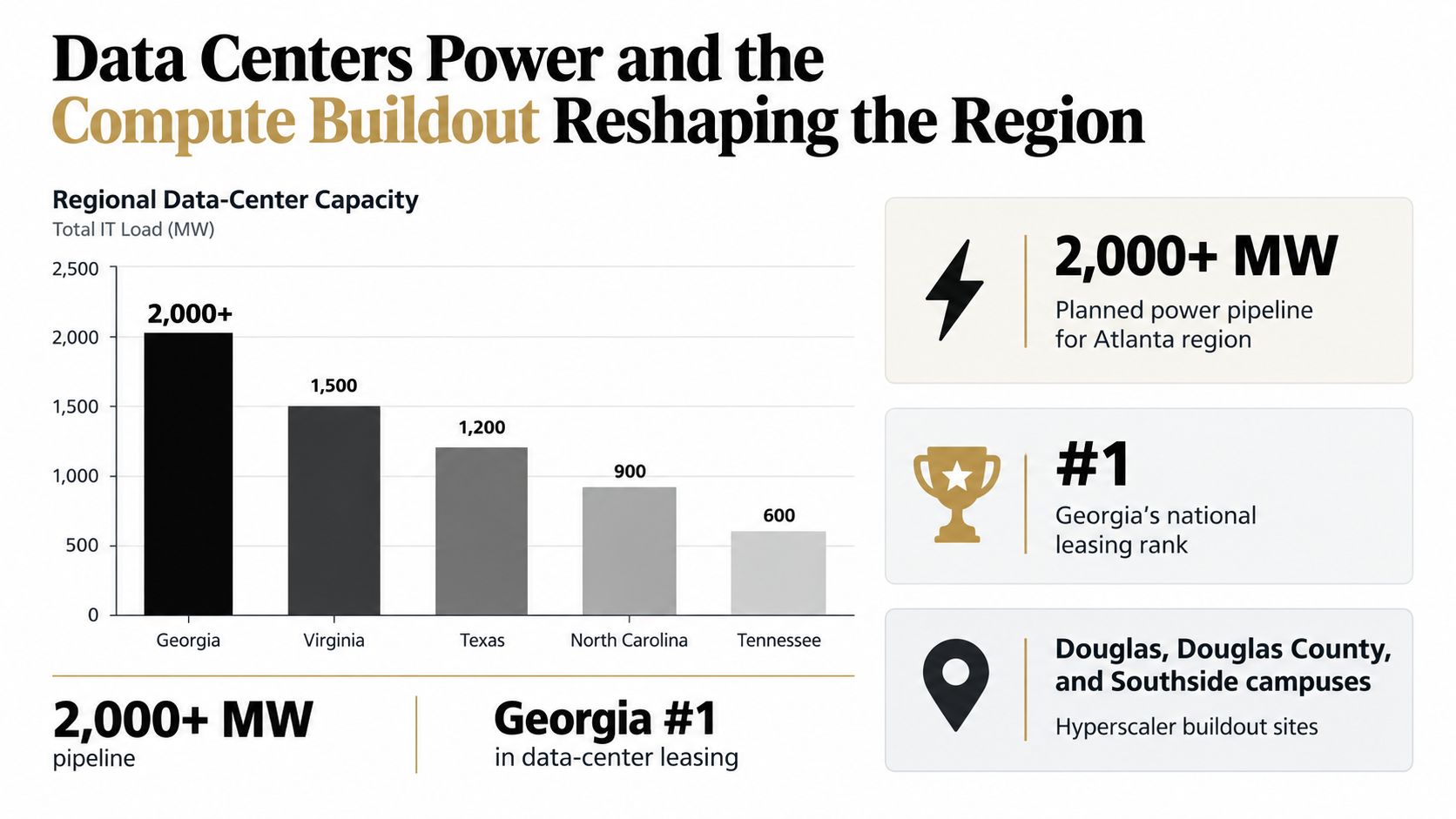
For IT and facilities leaders, that scale changes planning assumptions. More regional compute can improve access to cloud services, colocation, and low-latency infrastructure. It also intensifies competition for electrical capacity, cooling resources, network connectivity, and qualified operations staff.
Translate the buildout into operating decisions
Start with workload classification. Training and high-volume inference can place different demands on compute, storage, networking, and cooling. Before selecting a facility, teams should identify which workloads require low latency, which can run in the cloud, and which involve regulated or sensitive data.
Review power and cooling dependencies. AI systems depend on dense compute and reliable heat removal. A facilities plan should document available power, expansion limits, cooling design, maintenance windows, and backup arrangements. It should also identify whether a proposed deployment depends on infrastructure that the local utility or facility cannot yet support.
Separate cloud adjacency from physical ownership. Atlanta's expanding data-center ecosystem may give businesses more choices without requiring every organization to build its own campus. A hybrid approach can combine cloud capacity with local or edge processing where latency, resilience, or data handling makes that appropriate.
Add sustainability reporting to the capacity review. The region already has facilities experimenting with lower-water cooling. Edged describes its Atlanta campus as an 80-plus-acre sustainable site, and says one Atlanta facility's waterless cooling system is expected to save nearly 664 million gallons of water per year compared with conventional data centers. (Edged Atlanta facility information)
Planning question: Can your AI roadmap explain not only where workloads will run, but also how power, cooling, equipment replacement, and end-of-life handling will be managed?
The growing demand for Atlanta data-storage solutions reflects the next planning layer. Storage expansion creates more devices that eventually require secure decommissioning. Facilities leaders should include asset inventories, media handling, vendor accountability, and recycling documentation in the same planning cycle as capacity and power.
High-Impact Industry Use Cases Across Atlanta
Atlanta's strongest AI opportunities are likely to emerge where the region already has dense operational knowledge. Healthcare, logistics, financial technology, and public services each present different data conditions, risk levels, and tolerance for automation. A useful analysis therefore asks not only what AI can do, but also where a copilot is safer than an autonomous system and where cloud processing is less suitable than local inference.
| Industry | Leading Use Cases | Deployment Pattern | Maturity |
|---|---|---|---|
| Healthcare | Administrative support, clinical documentation assistance, imaging workflow support | Human-reviewed copilot, with strict access controls | Developing |
| Logistics | Routing support, demand forecasting, asset monitoring, visual inspection | Cloud analytics combined with edge systems where latency matters | Developing |
| Fintech | Fraud detection, customer verification support, transaction monitoring | Automated screening with escalation for consequential decisions | Established in selected workflows |
| Public sector | Service-request classification, permitting support, maintenance prioritization | Assisted decision-making with records and human review | Early to developing |
Healthcare illustrates why deployment discipline matters. AI may help staff summarize information or prioritize work, but medical and coverage-related decisions require accountable human processes. The operational pattern is therefore augmentation, not unrestricted automation. Organizations need clear escalation paths and evidence that staff can challenge an output.
Logistics offers a different balance. Routing, facility monitoring, and visual inspection can benefit from systems that process large volumes of operational data. Edge processing may be useful where a decision must be made close to equipment or a moving asset, while cloud systems can support broader forecasting and analysis. The dividing line is operational latency, data sensitivity, and the cost of a wrong decision.
Fintech operators face a control-heavy environment. Fraud and verification systems can automate pattern detection, but organizations must distinguish a risk signal from a final customer decision. Model evaluation, documentation, and review are more important than presenting an automated result as objective.
Public agencies have an additional obligation to make systems understandable to residents. Request classification or maintenance prioritization may be suitable for assistance, but agencies should preserve records, explain escalation routes, and avoid allowing an opaque output to become an unreviewable decision.
The market's maturity will vary by workflow. A narrow internal copilot with human review may deliver practical value sooner than an autonomous agent connected to sensitive records. That distinction gives Atlanta operators a clearer investment filter: prioritize measurable workflow improvement, defined accountability, and reversible deployment over demonstrations that merely appear intelligent.
Workforce Gaps and Who Actually Captures the AI Dividend
AI expansion doesn't automatically produce broad-based economic gains. The Atlanta labor market data shows strong demand across AI-related roles, but the same pattern can leave smaller firms, public agencies, schools, and non-specialist workers without the people needed to implement systems responsibly.
The bottleneck is often deployment capacity. Organizations need technical specialists, but they also need employees who can define requirements, manage data, test outputs, document controls, train colleagues, and redesign processes. Without those roles, a company can purchase an AI product and still fail to turn it into a dependable business capability.
UNESCO notes that Georgia has allocated USD 18.4 million for AI research and competence-building from 2026 to 2029. RenderATL 2026 is drawing more than 8,000 attendees and more than 150 speakers, signals of ecosystem momentum rather than proof that every employer can access the skills it needs. (UNESCO information on Georgia's AI investment)
The inclusion question is practical, not symbolic
Women, non-degree holders, and career changers over 40 can be excluded if employers define AI work too narrowly around advanced credentials. Many valuable responsibilities involve domain judgment, process knowledge, communication, and risk awareness. Companies that reserve AI pathways only for elite technical roles may deepen the implementation gap.
A stronger employer response includes paid upskilling, apprenticeships, supervised project work, and internal mobility. Training should connect directly to a real workflow, such as records review, service operations, inventory planning, or compliance documentation. Employees need time to practice, feedback from experienced reviewers, and a clear route from learning to responsibility.
Georgia Tech, Kennesaw State University, and Georgia State University are part of the region's broader education ecosystem, but institutional supply alone won't solve the problem. Employers must translate academic learning into workplace pathways, especially for small and mid-sized organizations that can't support large internal research teams.
The AI dividend will therefore depend on who controls the implementation layer. Companies that build practical talent pipelines can improve adoption quality and expand participation. Companies that buy tools without investing in people may create a market where advanced systems coexist with weak oversight, uneven access, and avoidable operational risk.
Governance Compliance and the Rules Quietly Shaping Atlanta AI
Atlanta's most important AI story may be operational compliance rather than model performance. Georgia's Technology Authority requires prior approval for regular generative AI use by state organizations, documentation of AI tools, and periodic review of AI systems. Those requirements show that responsible deployment begins before an employee connects a model to sensitive information. (Georgia Technology Authority AI policies and programs)
Georgia also advanced laws in 2026 requiring chatbot disclosure and restricting AI-only medical coverage decisions. For Atlanta businesses, government contractors, schools, and healthcare operators, the message is direct: organizations need to know where AI appears in a workflow, what information it handles, and when a human must intervene.
Build an operational record before deployment
A defensible governance program should begin with an inventory. Record each system, its business owner, data classification, purpose, vendor, access method, review process, and retirement plan. The inventory should include embedded AI features inside ordinary enterprise software, not only standalone chatbots.
The next step is workflow testing. Teams should identify failure modes, establish escalation routes, and document the language used when people interact with automated systems. For public-facing tools, disclosure should be prepared before launch. For internal tools, employees should know what information they can enter and what outputs require validation.
Governance principle: If an organization can't explain who owns an AI system and how its outputs are reviewed, it isn't ready to scale that system.
Security testing should also reflect the system's actual behavior. For organizations evaluating adversarial testing, robotics red teaming services provide a useful reference point for thinking about how automated systems can be challenged before deployment. The same mindset applies to AI-enabled software, agents, and connected operational systems.
Finally, connect governance to procurement and retirement. Contracts should address data use, audit rights, incident handling, system changes, and end-of-life deletion. When a vendor relationship ends, the organization needs evidence that accounts, integrations, stored prompts, and associated media have been handled appropriately.
This approach turns compliance from a reactive legal exercise into an operating discipline. It also reduces the chance that Atlanta organizations will discover an undocumented AI system only after a customer, employee, regulator, or procurement reviewer asks about it.
Responsible ITAD and the Hidden E-Waste Side of the AI Boom
AI infrastructure creates a physical afterlife. As companies add servers, accelerators, storage, switches, and endpoint devices, they also create future requirements for equipment decommissioning, secure data destruction, and electronics recycling. A complete AI strategy must account for those assets before they leave a rack, lab, office, or data center.
The risk is not limited to the resale value of hardware. Storage media may contain customer information, credentials, proprietary model files, prompts, logs, or operational records. Equipment that appears obsolete can still hold sensitive data. Responsible retirement therefore requires an asset inventory, documented custody, verified sanitization or destruction, and downstream accountability.
Match the disposal process to the hardware
| Hardware Category | Typical Refresh Cycle | Data Destruction Standard | Compliance Note |
|---|---|---|---|
| Servers and storage arrays | Depends on workload, performance needs, and procurement policy | Verified media sanitization or physical destruction when appropriate | Preserve chain-of-custody records |
| GPUs and AI accelerators | Depends on utilization, capacity planning, and system redesign | Assess attached or integrated storage before transfer | Document ownership and disposition |
| Network switches and appliances | Depends on platform support and security requirements | Clear configuration data and inspect attached media | Control access during decommissioning |
| Laptops and workstations | Depends on endpoint policy and replacement planning | Securely erase or destroy drives before reuse or recycling | Protect employee and customer information |
| Batteries, CRTs, and other regulated components | Depends on equipment type and condition | Follow applicable hazardous-material handling procedures | Federal requirements may apply |
The EPA's Resource Conservation and Recovery Act can classify components in older electronics, especially CRT monitors and many batteries, as hazardous waste. Federal law prohibits hazardous-waste disposal in landfills, so businesses need a compliant downstream process rather than an informal disposal arrangement. (Federal and Georgia electronics recycling compliance guidance)
Georgia doesn't have a statewide e-waste law requiring electronics recycling, but that doesn't remove the need for responsible handling. Federal rules, local programs, contractual obligations, data-protection expectations, and sustainability commitments still shape the risk profile. (Georgia e-waste law overview)
The FTC's Disposal Rule requires businesses to take reasonable measures to protect consumer information stored on devices before disposal. Secure data destruction is therefore a compliance control, not merely an environmental preference. (FTC Disposal Rule guidance for electronics retirement)
Operators should write ITAD requirements into AI and data-center procurement contracts, including inventory reconciliation, pickup procedures, data destruction certificates, downstream processor review, and reporting on recovered or recycled materials. The responsible electronics recycling guidance for Atlanta businesses provides a useful framework for connecting security, sustainability, and operational planning.
Atlanta's AI future will be more credible when its compute growth includes a documented hardware afterlife. That means treating computer recycling, data center decommissioning, laptop disposal, office cleanout, facility cleanout, product destruction, and secure data destruction as connected parts of the technology lifecycle, not as separate tasks handled after the strategy is complete.
Reworx Recycling helps Atlanta-area businesses manage electronics recycling, donation-based recycling, IT equipment disposal, secure data destruction, equipment decommissioning, and responsible ITAD while supporting community technology access. Visit Reworx Recycling to learn how to donate old equipment, schedule a business pickup, or build a compliant retirement plan for AI and office hardware.