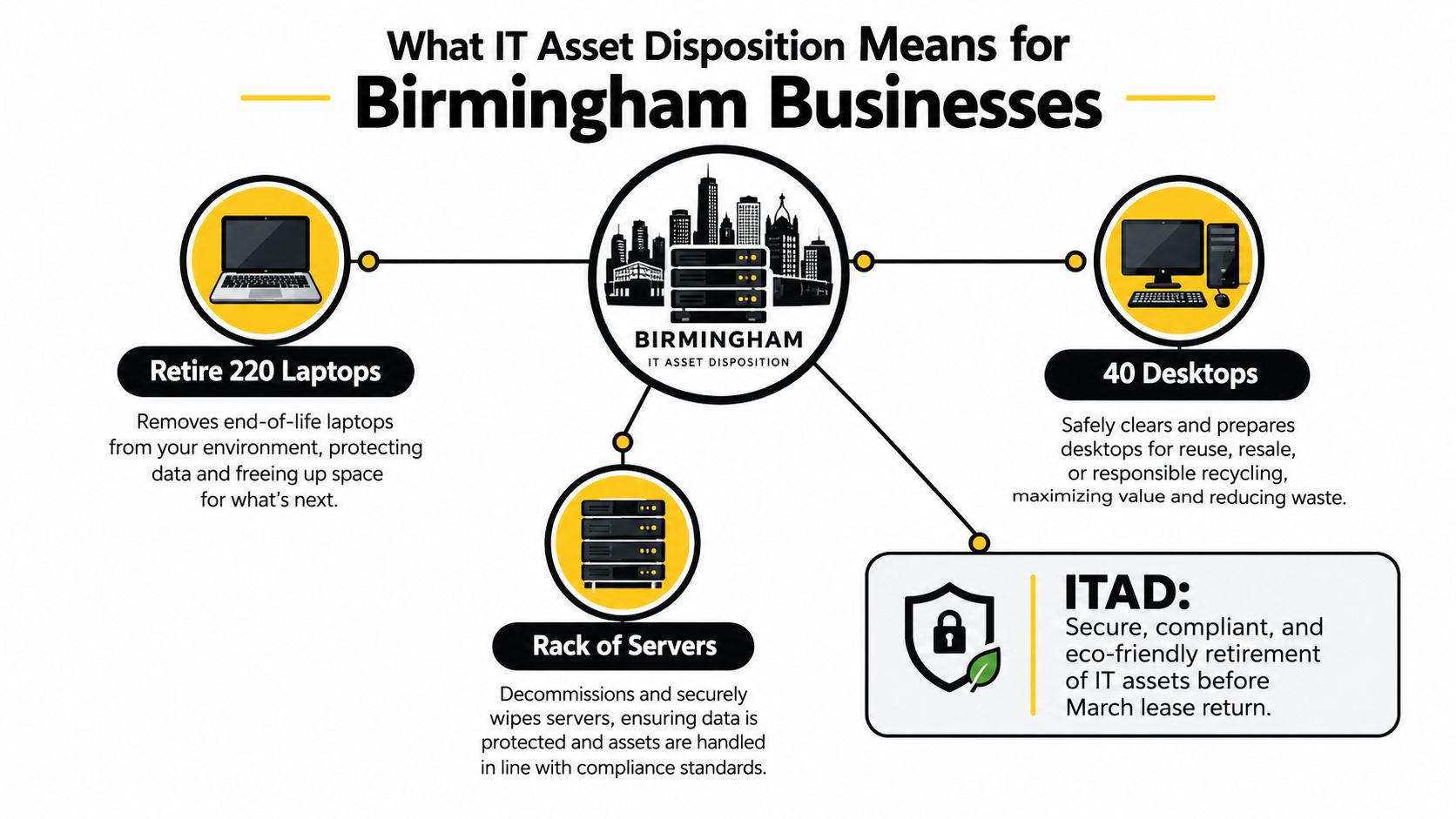
A Birmingham IT manager gets an unwelcome deadline: retire 220 laptops, 40 desktops, and a rack of decommissioned servers before a March lease return. The equipment is spread across offices, the servers still contain storage media, and nobody wants to discover after collection that one serial number or hard drive is missing.
That situation is why IT Asset Disposition in Birmingham needs more structure than a standard office cleanout. A sound process protects data, recovers useful equipment, documents every handoff, and sends non-reusable materials through responsible electronics recycling. The key decision isn't where the equipment goes. It's whether each asset should be reused, wiped, shredded, or recycled.
What IT Asset Disposition Means for Birmingham Businesses
IT asset disposition, or ITAD, is the controlled retirement of technology after an organization no longer needs it. The process covers collection, inventory, data sanitization, resale or donation, recycling, and the records that prove each stage happened correctly.
For the Birmingham manager facing the March deadline, that means treating the laptops, desktops, and servers as separate asset classes rather than one pallet of old computers. A working laptop with a reusable solid-state drive may follow a different route from a failed server drive containing regulated information. A monitor may need responsible recycling, while a functioning desktop could be refurbished for a second user.
What a defensible engagement delivers
A Birmingham organization should expect more than a collection receipt. A defensible ITAD engagement should produce:
- On-site inventory capture: Each item receives a serialized record that identifies its make, model, condition, and storage media.
- Verified data treatment: Every relevant drive has a documented wipe, cryptographic erase, or physical destruction event.
- Downstream accountability: The provider records whether the asset was reused, remarketed, donated, dismantled, or sent to a recycler.
- Audit-ready reporting: The final file connects the original inventory to certificates of sanitization, destruction, and recycling.
Providers serving Birmingham commonly describe a secure chain of custody that includes collection, data destruction, recycling, and ethical end-of-life disposal. Their Birmingham-facing materials also emphasize WEEE-related compliance and documentation for institutional clients such as the NHS, schools, local government, and SMEs, as reflected by Birmingham ITAD service information.
That documentation supports internal audit, GDPR-aligned data handling, and sector-specific review. The technical benefit is straightforward: asset-level tracking reduces uncertainty when devices leave an office, laboratory, data room, or clinical environment.
Practical rule: If a provider can't show how one serial number moved from pickup to final disposition, the engagement isn't fully defensible.
The decision tree is simple in principle. Reuse equipment that remains functional and can be securely sanitized. Wipe suitable media when verification and residual value justify reuse. Shred sensitive, failed, or unknown media when software alone can't provide enough assurance. Recycle the remaining hardware through a documented downstream channel.
For a Birmingham business comparing options, Alabama ITAD services from Reworx Recycling illustrates the broader service model, including secure logistics, data destruction, asset evaluation, and responsible recycling.
How a Defensible Chain of Custody Works
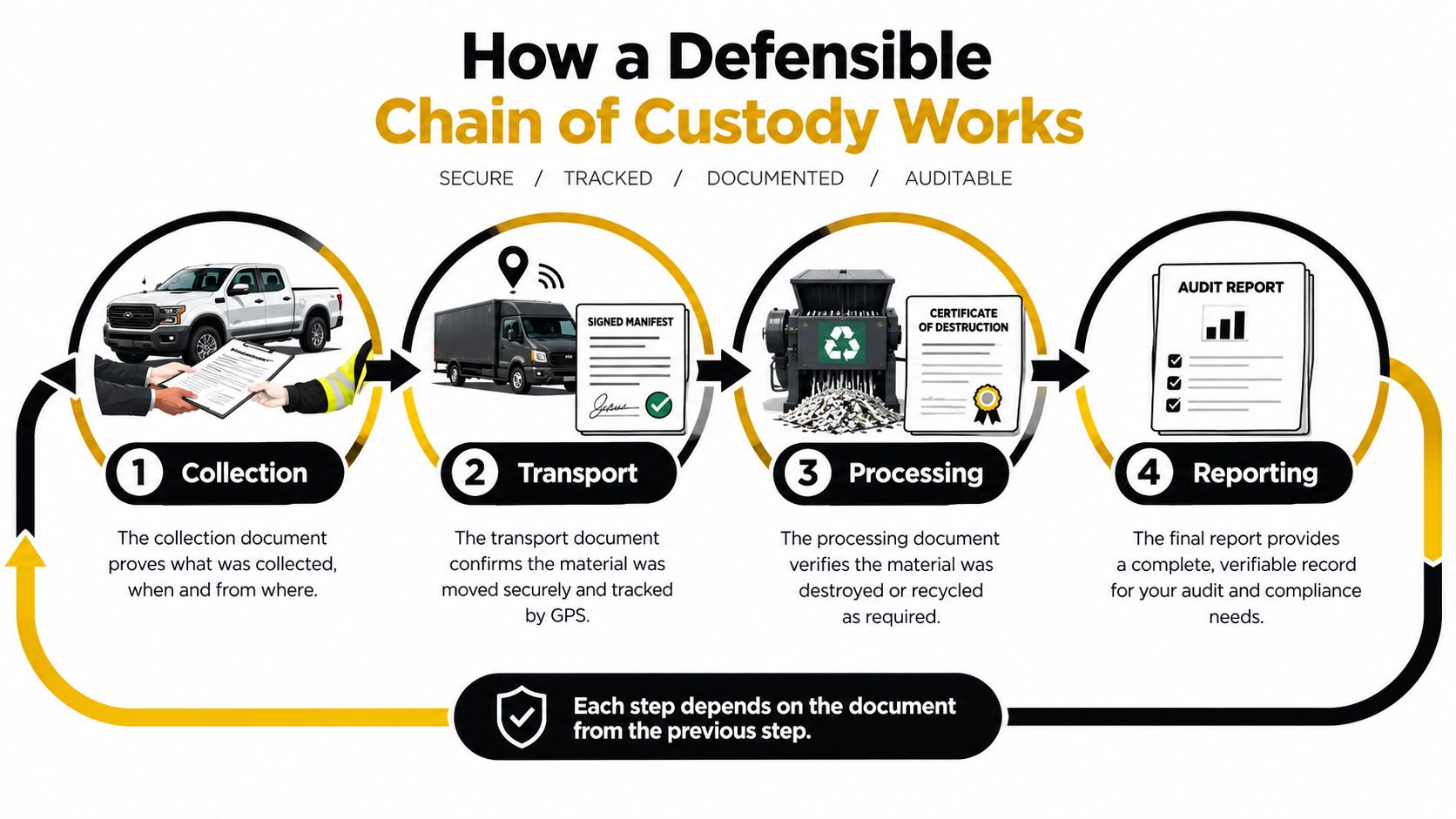
A chain of custody is not a single form. It's a connected record in which each stage creates the evidence needed for the next stage. If the collection manifest is incomplete, the processing certificate can't fully prove what was received. If the final disposition report omits the serial number, the earlier records can't close the loop.
Start with identification and tagging
The first handoff happens at the Birmingham site. The provider should capture the asset tag or serial number, manufacturer, model, condition, location, and media type. A server with several drives needs enough detail to distinguish the chassis from each storage device.
That inventory becomes the baseline for reconciliation. It should identify missing, damaged, or duplicate records before equipment leaves the building. Data classification also belongs here, because a laptop holding public training material may need a different treatment from a workstation used for patient, employee, or financial information.
Secure transport preserves the record
Collection should produce a signed pickup manifest. The manifest should match the serialized inventory and describe how the equipment was secured for transport. Depending on the project, controls may include tamper-evident seals, locked containers, or GPS-tracked logistics.
Facilities teams often focus on loading time and forget access controls. Confirm dock access, elevator restrictions, loading permits, and the names of people authorized to release equipment. A secure vehicle can't compensate for an unverified handoff at the building.
Processing creates asset-level evidence
At the processing facility, each storage device should be matched against the manifest before sanitization or destruction. A wipe certificate should identify the device and the method used. A destruction record should identify the destroyed media and, where applicable, record the resulting weight or particle size.
The documentation must reflect what happened. A generic certificate stating that “a batch” was destroyed is weaker than a record that connects each drive to a serial number or unique internal identifier.
Downstream disposition closes the loop
The final stage records where the asset went. A reusable device may move to refurbishment, donation, or resale. A non-reusable unit may be dismantled, with plastics, metals, and other materials sent to downstream processors. Each route should produce a reuse, resale, or recycling record naming the receiving party where appropriate.
Auditors need to trace a single serial number from pickup manifest to final disposition certificate. One missing handoff breaks the chain, even if the other records are complete. Birmingham buyers can use chain-of-custody documentation guidance to define the records required before approving a provider.
Choosing Between Secure Wiping and Physical Destruction
The right sanitization method depends on three variables: media type, data sensitivity, and residual value. A working hard drive containing internal information may be suitable for a verified wipe if the organization intends to resell the device. A failed SSD containing regulated data may require physical destruction because the provider can't reliably verify every memory cell.
NIST 800-88 frames sanitization around the risk of data remanence. In practical terms, its levels are commonly understood as Clear, Purge, and Destroy. Clear uses logical techniques to remove data in a way suitable for a lower-risk reuse scenario. Purge applies a stronger process intended to make recovery impractical under more demanding conditions. Destroy makes the media unusable through physical destruction.
The following comparison uses those levels as a decision aid, not as a substitute for a media-specific procedure.
| Method | NIST 800-88 Level | Best Media Types | Best Sensitivity Class | Residual Value Fit | Birmingham Use Case |
|---|---|---|---|---|---|
| Software overwrite | Clear or Purge, depending on the validated method | Spinning HDDs with reliable access | Internal or appropriately classified confidential data | Preserves the device when verification succeeds | Office laptops or desktops being prepared for reuse |
| Cryptographic erase | Purge | Modern SSDs, NVMe drives, and correctly provisioned self-encrypting drives | Internal or confidential data where encryption controls are verified | Strong fit for reuse because the device remains intact | Recent laptops and storage arrays with documented encryption management |
| Physical shredding | Destroy | Failed drives, damaged media, mixed storage, and media of unknown provenance | Regulated, highly sensitive, or unclassifiable data | Sacrifices resale value for higher destruction assurance | Healthcare, public-sector, or uncertain media from a data room |
Why SSDs change the decision
Traditional overwrite logic doesn't automatically transfer to SSDs. Solid-state storage uses flash memory management and may move data between physical cells, so a basic software pass may not address every location in the same way as it would on a spinning hard disk. Cryptographic erase can be appropriate when the drive's encryption was correctly configured and the sanitization event can be verified.
Physical destruction becomes the safer route when a drive has failed, encryption status is unknown, or the organization can't prove that the selected method covered the media correctly. Birmingham data destruction guidance describes NIST 800-88-aligned sanitization and physical hard drive shredding as complementary options rather than interchangeable services.
Decision rule: For a regulated or unknown device in Birmingham, shred it and document the particle size instead of relying on software alone.
The same logic applies to hybrid servers and mixed-fleet retirements. Triage the lot. Send high-value, verifiable devices through reuse or remarketing, and route failed, damaged, or highly sensitive storage devices to documented destruction. A secure data destruction explanation can help non-specialists understand why deletion, formatting, wiping, and destruction aren't equivalent outcomes.
Where Birmingham Assets Go After Collection
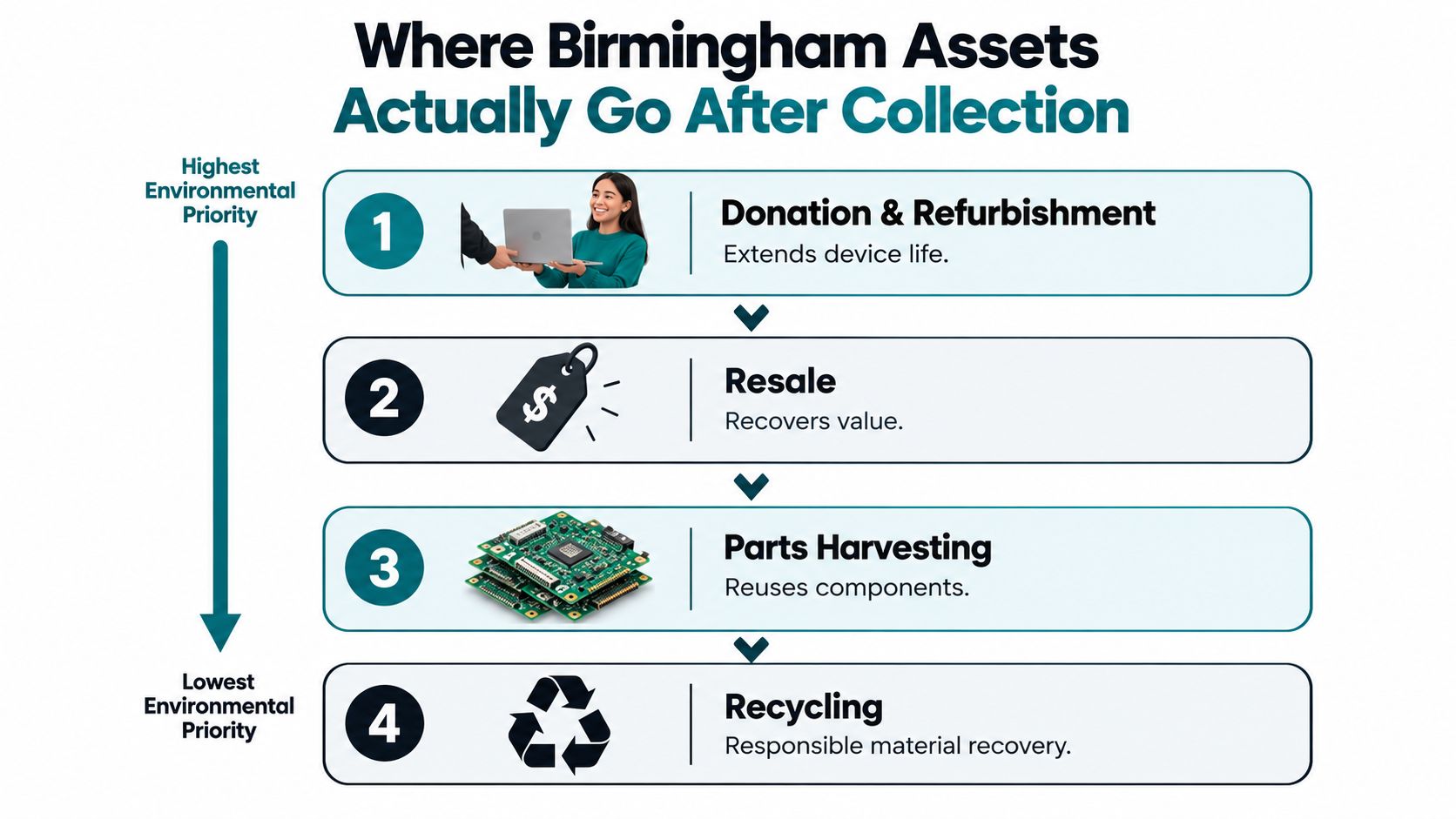
Collection marks the midpoint of an asset's journey. After equipment leaves a Birmingham site, the provider should place it on a documented route rather than send the entire batch to one destination. Use a simple decision tree: first identify the media type, then assess the sensitivity class, and finally consider physical condition and residual value. A device with usable life may go to reuse or resale. Equipment with recoverable components may go to parts harvesting. Items with no practical second use should enter controlled material recycling.
The route should fit the asset, much like sorting luggage by what it contains and where it can safely travel. A working laptop may be refurbished and donated to a local charity, school, or community program after its data requirements are satisfied. A working server from a data center decommissioning project may be remarketed to a buyer seeking compatible infrastructure. A failed desktop may yield usable memory, processors, power supplies, or other components before its plastics and metals enter material recovery.
Reuse often beats default recycling
Recycling has a clear role, but routing every device directly to a recycler can discard useful service life. Refurbishment and donation can preserve value already embodied in the equipment while improving access to technology. That route requires documented data clearance and a recipient that the provider can identify and account for.
Global e-waste reached 62 million tonnes in 2022 and is projected to reach 82 million tonnes by 2030, while only 22.3% was formally documented as collected and recycled, according to the Global E-waste Monitor data summarized by SK tes. Those figures support examining reuse before material recovery. Birmingham organizations can review a worked example of downstream handling in what happens to recycled electronics before approving a provider's disposition report.
The appropriate channel depends on the asset and the organization's purpose:
- Donation and refurbishment: Functional equipment that can be securely cleared and matched with a credible recipient.
- Resale: Equipment whose brand, specification, condition, and market demand support remarketing.
- Parts harvesting: Devices that are not viable as complete units but contain serviceable components.
- Material recovery: Equipment that cannot be reused or safely remarketed.
The selected route affects the final report, downstream chain of custody, and any residual value or rebate calculation. Birmingham buyers should compare data sensitivity, physical condition, brand residual value, and ESG objectives before approving a channel. A sustainability leader may prioritize verified reuse, while an information security team may require destruction for a failed drive even when the surrounding server retains resale value.
Ask the provider to name the outcome precisely. Reports should distinguish donation, refurbishment, resale, parts recovery, and controlled recycling, giving procurement and sustainability teams a clear account of where each asset went.
Planning Checklist for a Birmingham ITAD Project
A bulk retirement becomes manageable when the team separates planning from execution. Start early enough to align the project with lease returns, facilities access, data protection review, and internal audit windows.
Phase one covers scope and risk
Build the initial project file before inviting providers to quote. It should contain:
- Inventory capture: Export available records from endpoint management, procurement, and facilities systems.
- Asset tagging: Reconcile asset tags and serial numbers, including devices stored in cupboards or server rooms.
- Data classification: Mark equipment that held public, internal, confidential, or regulated information.
- Retirement date: Set a target that works with the March lease return and leaves time for discrepancy resolution.
Include servers, networking equipment, monitors, printers, mobile devices, batteries, and accessories. A narrow “computer list” can leave hazardous or data-bearing equipment outside the chain of custody.
Phase two prepares the vendor and site
Shortlist providers that can explain their sanitization methods, downstream controls, insurance, reporting, and on-site capability. Request sample certificates and ask whether the provider can separate reusable assets from destruction-only media during the same collection.
Prepare a secure staging area with restricted access. Coordinate with facilities for dock access, loading schedules, lift capacity, parking controls, and any building security requirements. Notify the data protection officer before a mobile collection if the project involves personal or regulated information.
A Birmingham ITAD compliance checklist template can help teams turn those requirements into sign-off points rather than informal reminders.
Phase three controls the handoff
On collection day, reconcile the physical equipment against the manifest before loading. Photograph unusual conditions where policy permits, record damaged or missing assets, and obtain signatures from both the releasing site and collection team.
Confirm how the provider handles a failed drive discovered during processing. The procedure should specify who authorizes a change from wiping to shredding and how that decision appears in the final report. Also confirm insurance coverage for equipment while it's in transit and at the processing site.
Phase four closes the project
Don't close the project when the truck leaves. Compare the pickup manifest with the processing report, verify sanitization and destruction certificates, and check that reuse, resale, donation, and recycling outcomes are separately identified.
Archive the final records according to the organization's retention policy. Include the inventory, signed manifests, certificates, exception log, downstream records, residual value statement, and any approval for deviations. The project is complete when the evidence is complete, not when the storage room is empty.
Vetting Vendors and Reading ITAD Proposals
A polished proposal can still leave important questions unanswered. Birmingham buyers should score providers against evidence they can verify, rather than against broad promises about “secure disposal.”
Certifications can help, but buyers need to understand what they cover. R2v3 addresses responsible recycling practices, including environmental, health, safety, and data-related controls. e-Stewards is associated with strict responsible electronics recycling and downstream management requirements. ADISA focuses on secure data sanitization processes, while ISO 27001 concerns an organization's information security management system. None of these labels replaces a project-specific chain of custody or asset-level reporting.
| Criterion | What to Verify | Red Flag |
|---|---|---|
| Certification scope | Ask for current certificates, scope statements, and the facility covered | A logo appears without a certificate or relevant scope |
| On-site capability | Confirm whether staff can inventory, tag, and secure assets at the Birmingham location | The provider expects the client to prepare an unverified pallet |
| Sanitization methods | Require media-specific procedures for HDDs, SSDs, NVMe, and failed drives | One wiping method is offered for every device |
| Reporting depth | Request sample serialized reports and certificates before approval | The proposal promises only a batch receipt |
| Insurance | Check coverage for collection, transit, storage, and processing | Insurance limits or exclusions remain unclear |
| Downstream accountability | Ask who receives resold, donated, or recycled equipment | Downstream partners aren't disclosed |
| Audit rights | Confirm how the client can review records and investigate exceptions | The contract offers no meaningful audit access |
Read the verbs in the proposal
“Secure,” “compliant,” and “environmentally responsible” are descriptions, not proof. Look for commitments that can be tested: serial-level reporting, signed manifests, witnessed destruction, documented particle size where relevant, named downstream recipients, and certificate delivery dates.
Be cautious with one-size-fits-all pricing. A mixed lot containing reusable laptops, failed SSDs, servers, batteries, and monitors needs triage. A single price may conceal separate handling assumptions or leave the buyer unclear about which services are included.
Ask for operational references
Reference checks should focus on incidents, not just successful collections. Ask how the provider handled a failed drive, a missed pickup, a discrepancy in the manifest, and a suspected data incident. Ask who received the certificates, how long records remain available, and whether the client could inspect the relevant evidence.
You can also ask the provider to walk through one sample asset from pickup to final disposition. If the explanation jumps from collection to a generic recycling certificate, the proposal likely lacks the traceability a regulated Birmingham organization needs.
Making ITAD Work for Compliance and Community Impact
A practical Birmingham ITAD policy should make four decisions explicit. First, classify each media type by sensitivity. Second, match the sanitization level to that classification and the condition of the device. Third, require a chain of custody that connects serial numbers to final outcomes. Fourth, prefer reuse when the equipment has functional life and the organization can prove secure treatment.
That policy turns disposal from a last-minute facilities task into a controlled operating process. IT, procurement, information security, facilities, and sustainability leaders can agree in advance on who approves wiping, who authorizes destruction, who reviews exceptions, and who signs off the final report.
Compliance and community outcomes can align
Donation pathways in the West Midlands can give suitable laptops and desktops a second life through charities, schools, and digital inclusion programs. They can also support workforce development by creating opportunities to test, refurbish, repair, and prepare equipment for new users. Those outcomes are different from commodity recycling, where the primary result is material recovery.
The distinction matters because a default shred-and-recycle route may be appropriate for regulated or failed media, but it can eliminate the community benefit of a device that could have been safely reused. A reuse-first approach doesn't mean ignoring security. It means applying the right sanitization method, recording the decision, and using a recipient channel that can be verified.
Organizations exploring community partnerships can also review the grant landscape for Birmingham nonprofits to understand the kinds of funding context that may surround digital inclusion and nonprofit capacity. That resource doesn't replace due diligence on a recipient, but it can help sustainability teams identify relevant local conversations.
Measure evidence, not goodwill
A strong program reports both compliance and impact. Compliance measures include the percentage of assets reconciled to the manifest, the number of storage devices with method-specific certificates, unresolved exceptions, and the completeness of downstream records. Environmental and social measures can include the number of devices reused, the categories of recipients, the volume sent to material recovery, and the equipment that required destruction.
Use those results to run a pilot retirement before a major data center decommissioning, office cleanout, medical equipment disposal project, or laboratory equipment disposal program. Review the pilot with IT security and sustainability teams, then update the policy before scaling it across Birmingham sites.
For organizations that want a donation-based route alongside secure logistics and hard drive shredding, Reworx Recycling provides electronics recycling and IT asset disposition services for business equipment, with a social enterprise focus on environmental responsibility, technology donations, digital inclusion, and workforce development.
Reworx Recycling can help Birmingham organizations arrange business pickups, secure data destruction, equipment decommissioning, and responsible recycling for retired technology. Review the Reworx Recycling resources, then contact the team to plan a documented pilot, donate usable equipment, or schedule a collection.