Atlanta employers are looking for specialized technical capability, operational judgment, security awareness, and communication, not isolated tool knowledge. In January 2026, Atlanta tech postings rose 17% month over month, while 58% of roles mentioned AI skills, showing how quickly employers are broadening their expectations.
A résumé can list AWS, Python, SQL, Kubernetes, or Security+, but hiring teams want evidence that you can use those tools safely in a business environment. That matters across Atlanta's enterprise, healthcare, finance, retail, logistics, aviation, and technology sectors, where a technical decision can affect customers, compliance, operating costs, and business continuity. Recent Atlanta job-market coverage also points to a broader demand for business understanding, judgment, communication, and problem-solving.
The strongest Atlanta tech candidates combine eight areas: cloud infrastructure and DevOps, cybersecurity, full-stack development, data science, systems administration, solution architecture, project management, and database engineering. Employers still value practical tools such as Excel, Microsoft Office, HTML, Workday, Agile, Python, SQL, AWS, Azure, Java, and machine learning, as reflected in broader technology hiring data. Salary figures published for individual roles should be treated as directional signals, not guarantees.
Reworx Recycling adds an important technology-lifecycle perspective. Its electronics recycling, IT equipment disposal, secure data destruction, and technology donation work shows why cloud migrations, infrastructure upgrades, and office cleanouts require more than technical deployment skills. Someone must also retire equipment responsibly, protect data, document chain of custody, and connect surplus technology with community impact.
1. Cloud Infrastructure and DevOps Engineering
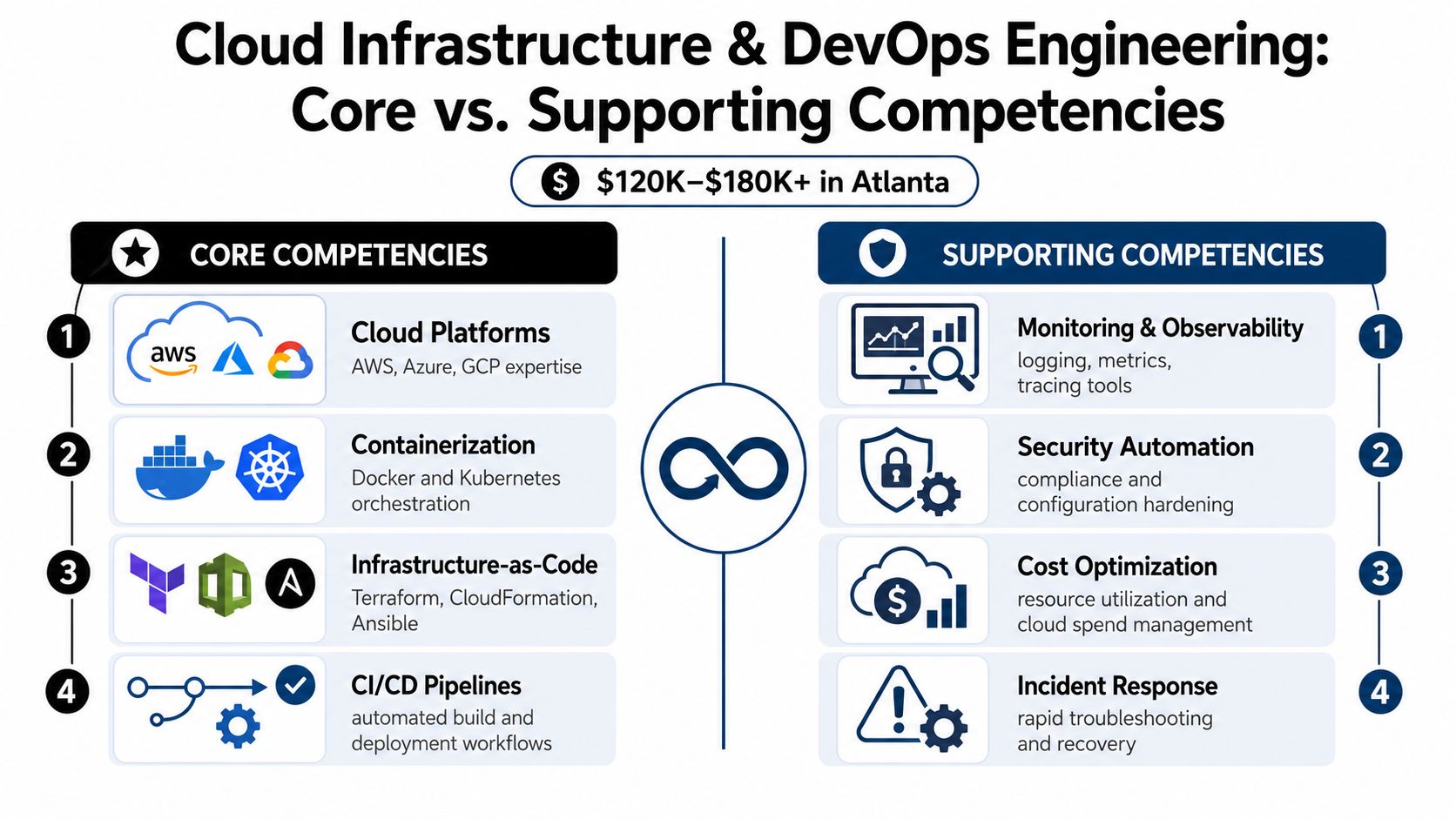
Cloud and DevOps hiring in Atlanta favors candidates who can connect software delivery with reliable operations. Employers commonly look for experience with AWS, Microsoft Azure, Google Cloud, Docker, Kubernetes, Git, CI/CD, infrastructure as code, and automation. Atlanta job guidance also highlights cloud platforms, Kubernetes, Docker, CI/CD, analytics, machine learning, and cybersecurity as recurring requirements.
The strongest proof isn't a list of certifications. Build a small application, deploy it through a repeatable pipeline, define infrastructure with code, add monitoring, and document what happens when a deployment fails. A hiring manager should be able to see your repository, architecture diagram, deployment steps, security decisions, and rollback process.
What employers should test
A practical work sample can ask candidates to deploy a containerized service, explain scaling choices, troubleshoot a failed build, and identify secrets that shouldn't be stored in source control. It should also test whether the candidate can explain trade-offs. Managed services may improve speed, while portability, vendor dependence, and cost governance still require judgment.
Certifications such as AWS Solutions Architect or Certified Kubernetes Administrator can strengthen an early-career application, but they won't replace hands-on work. Learn PowerShell, Bash, or Python for operational automation, and understand security and compliance concepts relevant to the employer's environment, including SOC 2, HIPAA, or PCI DSS.
Practical rule: A cloud migration isn't complete when workloads move. It also needs an inventory, a retirement plan for replaced servers and devices, secure data handling, and documented ownership.
Candidates can prepare for DevOps troubleshooting questions and connect cloud architecture to the full technology lifecycle. Understanding how server virtualization affects infrastructure helps explain why consolidation, decommissioning, and responsible IT asset disposition belong in the same operational conversation.
2. Cybersecurity and Data Protection Expertise
Cybersecurity is a practical operating discipline, not just a specialist function. Atlanta employers in healthcare, finance, retail, education, aviation, and technology need people who can reduce exposure, respond to incidents, protect sensitive information, and preserve business continuity.
Relevant capabilities include identity and access management, multifactor authentication, firewalls, VPNs, endpoint security, vulnerability management, security information and event management, secure coding, cloud security, and incident response. Candidates should also understand how requirements change across regulated environments. A technically elegant control that users bypass or operators can't maintain won't protect an organization for long.
How to demonstrate security judgment
Create a portfolio exercise around a fictional business environment. Map assets and users, define access rules, identify likely attack paths, configure logging, and write an incident response sequence. Then explain what you would do with a retired laptop, server, or storage device that may contain sensitive information. That final step distinguishes security awareness from tool familiarity.
Hiring teams can use a work sample that asks candidates to review a simple access policy, investigate a simulated alert, or prioritize vulnerabilities. The evaluation should reward clear reasoning, appropriate escalation, and careful documentation, not only the number of security products a candidate recognizes.

Certifications such as CompTIA Security+, CISSP, CISM, and CEH can signal structured study, but their value depends on role and experience. Learn the OWASP Top 10, practice with a SIEM platform, and become comfortable discussing encryption, access control, evidence preservation, and hardware sanitization.
Data security and compliance planning should include the end of an asset's useful life. Secure wiping, hard drive shredding, documented handling, and responsible recycling support the same risk-management objective as endpoint controls and identity policies. Employers should ask candidates how those activities fit into a defensible ITAD process.
3. Full-Stack Software Development and Modern Programming Languages
Atlanta software teams want developers who can deliver working systems, not just isolated code exercises. Common requirements include Python, Java, JavaScript or TypeScript, C#, Go, React, Angular, Vue.js, Node.js, Spring Boot, Django, relational databases, and cloud deployment.
You don't need to master every language listed in a job description. A stronger approach is to develop depth in one primary stack while learning enough adjacent technology to understand application boundaries, APIs, testing, deployment, observability, and database performance.
Build evidence across the application
A portfolio project should include a user-facing interface, backend services, authentication, data storage, tests, deployment instructions, and a short explanation of design decisions. For example, build an internal equipment donation portal that tracks devices, intake status, data-destruction confirmation, pickup scheduling, and final disposition. That project demonstrates software skill while reflecting a real operational workflow.

The project should show what changed because of your work. You might document reduced manual steps, fewer duplicate records, faster search, or clearer handoffs, but only claim outcomes you measured. Employers can evaluate the same capability by asking candidates to extend an existing feature, diagnose a failing API, or explain how they would retire a legacy service without losing required data.
“Show the decisions, not just the screenshots.”
Cloud deployment knowledge matters because application development doesn't stop at the merge. Candidates should explain environment configuration, secrets management, logging, rollback, dependency updates, and the consequences of decommissioning old servers or unsupported software. Contributing to an open-source project can add credibility, especially when the contribution history makes your collaboration and review habits visible.
4. Data Science and Business Analytics
Data professionals in Atlanta need to turn messy information into decisions that a business can act on. The technical foundation includes Python, SQL, statistics, data visualization, machine learning, data modeling, and cloud analytics platforms, but the differentiator is often communication.
A useful project begins with a business question rather than a preferred algorithm. Analyze equipment replacement patterns, identify factors associated with delayed pickups, or create a dashboard showing inventory aging and disposition status. Explain data quality limits, assumptions, possible bias, and what decision the analysis supports.
Make the business connection visible
Candidates should show the full path from source data to recommendation. Include data cleaning, query logic, model or analysis selection, visual design, validation, and a concise executive summary. A hiring manager shouldn't need a statistics background to understand what the result means or what action should follow.
Employers can test this skill with a realistic dataset and an ambiguous question. Ask candidates to identify missing information, choose an appropriate metric, explain uncertainty, and present a recommendation to a nontechnical audience. That approach reveals judgment more effectively than asking for definitions of regression or clustering.
Certifications such as Google Data Analytics or AWS Data Analytics may reinforce a learning path, but a clear portfolio carries more practical weight. Candidates should practice Tableau or Power BI, improve SQL query performance, and learn how analysts collaborate with operations, finance, sustainability, and compliance teams.
Business intelligence and data services also illustrate the lifecycle issue. Data must remain useful, protected, governed, and eventually retired appropriately. A strong analyst understands that replacing a reporting platform or decommissioning a database can create data-retention, access, and secure-destruction questions.
5. Systems Administration and Infrastructure Management
Systems administration remains foundational even as organizations adopt more cloud services. Atlanta employers continue to need people who can operate Windows and Linux environments, TCP/IP networks, DNS, DHCP, routing, switching, virtualization, backups, monitoring, endpoint controls, and disaster-recovery processes.
The role has changed rather than disappeared. Administrators increasingly manage hybrid environments, coordinate with cloud teams, automate repetitive work, and support legacy systems that cannot be replaced immediately. A candidate who can explain both a modern cloud service and an aging on-premises dependency is often more useful than someone who knows only one environment.
Prove operational reliability
Build a lab that includes user accounts, permissions, network configuration, patching, backups, monitoring, and a recovery exercise. Document the baseline, the failure scenario, the alert, the remediation, and the verification step. Employers should evaluate whether candidates protect availability without ignoring security or change control.
CompTIA A+, Network+, and Security+ can help early-career candidates establish fundamentals. Atlanta employers also value customer service, clear communication, collaboration across hybrid teams, and adaptability, according to local guidance on IT positions. Those skills matter when an administrator has to explain an outage to a finance team, coordinate maintenance with facilities, or guide a user through a secure workaround.
Operational insight: Hardware retirement belongs in the runbook. Record ownership, dependencies, data-bearing components, sanitization requirements, pickup logistics, and final disposition before equipment leaves the facility.
An IT manager may need to coordinate servers, laptops, networking gear, and peripherals during a refresh. IT manager responsibilities include the kind of lifecycle awareness that connects daily administration with responsible IT asset disposition, secure data destruction, and sustainable recycling.
6. Solution Architecture and Enterprise Systems Design
Solution architects translate business requirements into systems that people can operate, secure, scale, and eventually replace. The role demands technical breadth across cloud platforms, integration patterns, APIs, data architecture, identity, observability, resilience, and hybrid environments, plus the ability to explain trade-offs to executives and delivery teams.
A strong architecture decision includes more than a product choice. It addresses total cost of ownership, service dependencies, recovery objectives, regulatory obligations, skills availability, vendor risk, and the path from implementation to retirement.
Demonstrate architecture before claiming the title
Create a design for a business scenario such as modernizing an internal service while preserving critical integrations. Include a context diagram, sequence flow, data classification, failure modes, security controls, migration stages, and an end-of-life plan for the replaced components. Explain why you rejected plausible alternatives.
Employers can assess architecture candidates through a structured design discussion. Ask them to clarify requirements, identify constraints, draw a system, respond to a failure, and revise the design when a business condition changes. The best answer isn't always the most elaborate one. It is the one that fits the organization's priorities and can be delivered by the available teams.
Certifications such as TOGAF or AWS Solutions Architect Professional can support career progression, but architecture credibility comes from decisions made in real or carefully documented projects. Candidates should develop financial analysis skills, learn how regulated industries manage information, and practice presenting to technical and nontechnical stakeholders.
Lifecycle planning should appear in the architecture from the start. Data-center consolidation, cloud migration, and application replacement can leave behind servers, storage devices, network equipment, and medical or laboratory technology. A responsible design identifies who will inventory those assets, protect data, arrange equipment decommissioning, and determine whether reuse, donation, product destruction, or recycling is appropriate.
7. Project and Program Management
Technology programs succeed when someone converts a complex objective into accountable work. Atlanta employers look for project and program managers who can coordinate budgets, schedules, dependencies, vendors, risks, technical teams, business owners, and executive stakeholders.
PMP, Scrum, Agile, SAFe, Jira, Azure DevOps, budgeting, vendor management, and risk planning can all matter, depending on the environment. The trade-off is important. A team that applies Agile ceremonies without clear outcomes creates meeting overhead, while a team that ignores planning can miss dependencies that surface late and cost more to resolve.
Show how you manage uncertainty
A useful portfolio artifact might include a charter, roadmap, RAID log, stakeholder map, delivery metrics, change decision, and retrospective. Choose a technology transition such as an office cleanout, cloud migration, data-center decommissioning, or endpoint refresh. Explain how you sequenced work, protected business operations, escalated risks, and verified completion.
Employers can use a scenario that introduces a late vendor delay, a security concern, or an incomplete asset inventory. Candidates should explain what they would communicate, what they would replan, and which decision requires executive approval. Clear written status reporting often reveals more than a polished interview response.
PMP certification through PMI may reinforce traditional project discipline. A Certified ScrumMaster credential can support Agile roles, while SAFe training may be relevant in scaled enterprise delivery. None of these credentials replaces evidence that you can control scope, resolve conflict, manage change, and keep stakeholders informed.
A technology retirement program tests all of those skills. The manager must align IT, security, facilities, finance, sustainability, and an external ITAD partner. Reworx Recycling's donation-based recycling and equipment decommissioning model provides a practical context for tracking assets, arranging pickups, protecting data, and directing usable technology toward community benefit.
8. Database Administration and Data Engineering
Atlanta's data-intensive organizations need both dependable database administrators and engineers who can build modern data platforms. The core capabilities include SQL, relational database design, NoSQL systems, query optimization, backups, recovery, encryption, access control, high availability, data pipelines, warehouses, lakehouses, and cloud database services.
Database administration focuses heavily on availability, performance, security, retention, and recovery. Data engineering adds pipeline design, orchestration, transformation, streaming, and platform development. The roles overlap, but employers should distinguish whether they need someone to stabilize a production database, build an analytics platform, or do both.
Turn technical work into proof
A candidate can demonstrate capability by designing a schema, writing optimized queries, creating an Airflow pipeline, loading data into a warehouse, and documenting failure recovery. A strong submission includes execution plans, indexing decisions, data-quality checks, access controls, and a clear explanation of what happens when a source system changes.
Employers can evaluate this work with a practical exercise that introduces slow queries, duplicate records, a failed pipeline, or an access request. Ask the candidate to protect availability while avoiding unsafe shortcuts. Communication matters because database decisions affect application developers, analysts, security teams, and business users.
Cloud credentials such as AWS database certifications or Google Cloud Professional Data Engineer may reinforce relevant experience. Candidates should also learn AWS RDS and DMS, Azure SQL, Google Cloud database services, Apache Spark, Airflow, and Kafka when those tools match their target roles.
Data platforms have an end of life too. Before a database server or storage array is retired, teams must identify dependencies, preserve required records, revoke access, sanitize data-bearing equipment, and document the disposition. Atlanta's growing demand for data storage solutions makes that lifecycle planning especially relevant to database, infrastructure, and facilities professionals.
Atlanta Tech Jobs: 8-Point Skills Comparison
| Skill / Role | Implementation Complexity 🔄 | Resource Requirements ⚡ | Expected Outcomes 📊 | Ideal Use Cases 💡 | Key Advantages ⭐ |
|---|---|---|---|---|---|
| Cloud Infrastructure and DevOps Engineering | High 🔄🔄🔄, orchestration, IaC, CI/CD integration | Moderate–High ⚡, cloud accounts, container platforms, automation tooling | Faster deployments, scalable infra, cost optimization | Microservices, frequent releases, cloud migrations | ⭐⭐⭐⭐, Automation, reduced lead time, operational consistency |
| Cybersecurity and Data Protection Expertise | High 🔄🔄🔄, security architecture and compliance complexity | High ⚡, SIEM, forensics tools, specialized staff | Reduced breach risk, regulatory compliance, incident readiness | Regulated industries, sensitive-data environments, incident response | ⭐⭐⭐⭐⭐, Risk mitigation, legal compliance, trust preservation |
| Full-Stack Software Development and Modern Programming Languages | Medium 🔄🔄, broad stacking across front/back/database | Moderate ⚡, dev tooling, test/staging environments | End-to-end feature delivery, rapid prototyping | Startups, product teams, MVP development | ⭐⭐⭐, Versatility, faster feature cycles, independent delivery |
| Data Science and Business Analytics | High 🔄🔄🔄, data quality, modeling, validation challenges | High ⚡, data pipelines, compute, analytics platforms | Actionable insights, revenue optimization, operational efficiency | Pricing, forecasting, customer analytics, strategic decisions | ⭐⭐⭐⭐, Strategic insights, predictive impact, measurable ROI |
| Systems Administration and Infrastructure Management | Medium 🔄🔄, routine ops, hybrid/on-prem responsibilities | Moderate ⚡, servers, storage, monitoring and backup tools | Stable operations, high availability, capacity management | Data centers, legacy systems, regulated infra | ⭐⭐⭐, Reliability, hands-on expertise, uptime assurance |
| Solution Architecture and Enterprise Systems Design | Very High 🔄🔄🔄🔄, cross-system design and stakeholder alignment | High ⚡, senior architects, modeling tools, integration budgets | Scalable integrated systems, optimized TCO, risk reduction | Enterprise transformation, multi-system integration, strategic planning | ⭐⭐⭐⭐⭐, Strategic alignment, scalability, long-term cost control |
| Project and Program Management (PMP, SAFe, Agile) | Medium 🔄🔄, coordination, governance, methodology adoption | Moderate ⚡, PM tools, certified practitioners, stakeholder time | On-time delivery, risk mitigation, stakeholder alignment | Large migrations, portfolio delivery, cross-functional programs | ⭐⭐⭐, Predictability, governance, coordinated execution |
| Database Administration and Data Engineering | High 🔄🔄🔄, tuning, backups, pipeline reliability | High ⚡, storage, compute, specialized DBAs/data engineers | Reliable data availability, performant analytics, secure recovery | Data warehouses, mission-critical transactional systems, ETL | ⭐⭐⭐⭐, Data integrity, performance optimization, scalable pipelines |
Turn Skills Into Hiring Evidence
The Atlanta tech hiring market increasingly rewards combinations rather than isolated credentials. Georgia employers led the Southeast in the share of job postings requiring AI skills, and the Atlanta metro accounted for more than four-fifths of Georgia's AI-related postings as of December 2025, according to Tech Square ATL's hiring analysis. That doesn't mean every candidate needs to become a machine-learning engineer. It means candidates should understand how AI affects their role, use it responsibly, validate its output, and connect it to business judgment.
Employers are also looking beyond technical expertise. A WABE report on Atlanta hiring describes employer demand for adaptability, communication, problem-solving, and learning agility. A technically strong candidate who can't explain risk, collaborate across teams, or learn an unfamiliar system may struggle in a hybrid enterprise environment.
A candidate action plan
Start by choosing one target role, not a broad category such as “tech.” Cloud engineer, security analyst, data engineer, systems administrator, and technical program manager each require different evidence. Use the relevant section above to select one project that resembles the work you want to perform.
Your project should include a visible result, not just a tutorial completion badge. Document the starting problem, your approach, tools, constraints, security decisions, testing, and outcome. If you claim that your work reduced manual effort, improved response time, lowered errors, or clarified an operational decision, show how you measured it. A technical skills guide from StoryCV can help you translate that evidence into résumé language without turning the résumé into a keyword list.
Pair technical proof with communication proof. Add a short architecture explanation, incident report, executive summary, recorded walkthrough, or stakeholder update. Practice explaining a technical decision to someone who cares about patient privacy, customer trust, revenue, safety, sustainability, or operating continuity rather than the underlying implementation.
Choose certifications that reinforce your hands-on direction. CompTIA A+, Network+, and Security+ can support foundational infrastructure and security paths. AWS, Azure, Google Cloud, Kubernetes, PMP, Scrum, data, and architecture credentials can be useful when they match the role. They shouldn't substitute for a working project, a credible work sample, or evidence that you can operate responsibly.
An employer action plan
Employers should define each skill in terms of business outcomes. “Kubernetes experience” is incomplete. A better requirement describes the ability to deploy and operate containerized services, troubleshoot failures, protect secrets, document dependencies, and plan retirement when a platform changes.
Use structured work samples and consistent evaluation criteria. Test the candidate's technical reasoning, communication, security awareness, learning approach, and lifecycle judgment. For infrastructure roles, ask about hybrid environments and end-of-life assets. For data roles, include access controls and retention. For program roles, include vendor coordination, asset inventories, and change management.
Responsible technology retirement should be part of Atlanta's operating model, not an afterthought. Businesses may need electronics recycling, donation-based recycling, IT equipment disposal, computer recycling, laptop disposal, data-center decommissioning, medical equipment disposal, laboratory equipment disposal, product destruction, secure data destruction, office cleanout, facility cleanout, and broader IT asset disposition. An appropriate partner should help the organization protect information, document handling, recover value where possible, and direct usable equipment toward community needs.
Reworx Recycling is a donation-based social enterprise in Smyrna, Georgia, supporting electronics recycling, business pickups, equipment decommissioning, secure hard-drive shredding, data destruction, equipment donations, and ITAD planning. Its model connects sustainable recycling with digital inclusion and workforce development, giving Atlanta businesses a practical way to align technology transitions with environmental responsibility and community impact.
Before your next upgrade, create an asset inventory and identify the data-bearing devices that will leave service. Then assign ownership for secure data destruction, pickup, reuse, donation, or recycling. Businesses can also consult the EPA's e-waste resources when developing a responsible electronics recycling program.
If your Atlanta organization is replacing laptops, servers, networking equipment, medical devices, or laboratory technology, Reworx Recycling can help with secure data destruction, business pickups, equipment decommissioning, donation-based recycling, and ITAD planning. Review your next office cleanout or infrastructure upgrade, then contact Reworx to donate old equipment, schedule a pickup, or build a responsible technology retirement process.