Atlanta added 23,500 jobs in its latest reported healthcare and education services period, with healthcare and social assistance accounting for 94% of those gains. Beyond Surplus reports that service-providing employment also rose by about 0.1% per month during the first half of 2026, compared with 0.04% nationally. Atlanta's growth is creating more than jobs and investment. It's also creating technology refreshes, office cleanouts, facility transitions, medical equipment disposal needs, and data-security obligations.
This ranking uses the supplied 2026 growth-rate evidence where sector-specific figures are available, then applies local relevance and operational impact to sectors without a comparable published rate. The list covers cloud and data center services, cybersecurity, financial technology, biotechnology, healthcare, advanced manufacturing, professional services, higher education, government, hospitality, and the professional-services category's continuing importance in Atlanta's economy.
Growth creates an equipment lifecycle. Every new office, upgraded platform, expanded laboratory, and modernized facility eventually produces assets that must be secured, reused, recovered, or recycled.
The practical question for IT managers, sustainability directors, business owners, and e-waste providers is straightforward: how can Atlanta organizations handle expansion without losing control of data, compliance, or environmental outcomes? Reworx Recycling, a Smyrna-based donation-focused electronics recycling and IT asset disposition resource, helps businesses plan pickups, equipment decommissioning, secure hard drive shredding, and community-oriented technology reuse.
Atlanta's 2026 growth ranking and the equipment lifecycle
Atlanta's 2026 growth ranking starts with the sectors showing the clearest expansion evidence. The PNC Atlanta regional analysis found that education and health services grew faster than the national pace through mid-2026, while professional and business services recovered from late-2025 losses. Industrial leasing activity, examined in the advanced manufacturing section, provides a second signal of expansion.
These measures do not assign an identical growth rate to every industry in the ranking. They establish an evidence-led order, then local operating conditions determine placement for sectors without comparable published figures. The ranking therefore connects growth ranges with Atlanta's technology refresh cycles, facility expansion, data-security requirements, and specialized equipment needs.
What the ranking means for operators
Expansion creates equipment obligations alongside new revenue and employment. More staff typically requires laptops, monitors, networking equipment, printers, and access-control devices. A new logistics site may add scanners, warehouse terminals, industrial controls, and communications systems. Healthcare growth can produce clinical workstations, imaging systems, diagnostic devices, and equipment containing protected information.
The highest risk often appears during transition. Retired devices may remain in storage, chain-of-custody records may be incomplete, and reusable technology may enter a low-value disposal stream. Data-bearing assets require documented destruction, while usable equipment should be assessed for redeployment or donation-based recycling.
Business, IT, facilities, and sustainability leaders should forecast retirement volumes before a refresh begins. A practical plan separates reusable equipment from damaged assets, schedules secure data destruction, and selects a recycling partner able to manage logistics, responsible electronics recycling, and community outcomes. Reworx Recycling supports Atlanta-area organizations with equipment pickups, decommissioning, secure hard drive shredding, and donation-focused technology reuse tied to its community mission.
1. Cloud computing and data center services
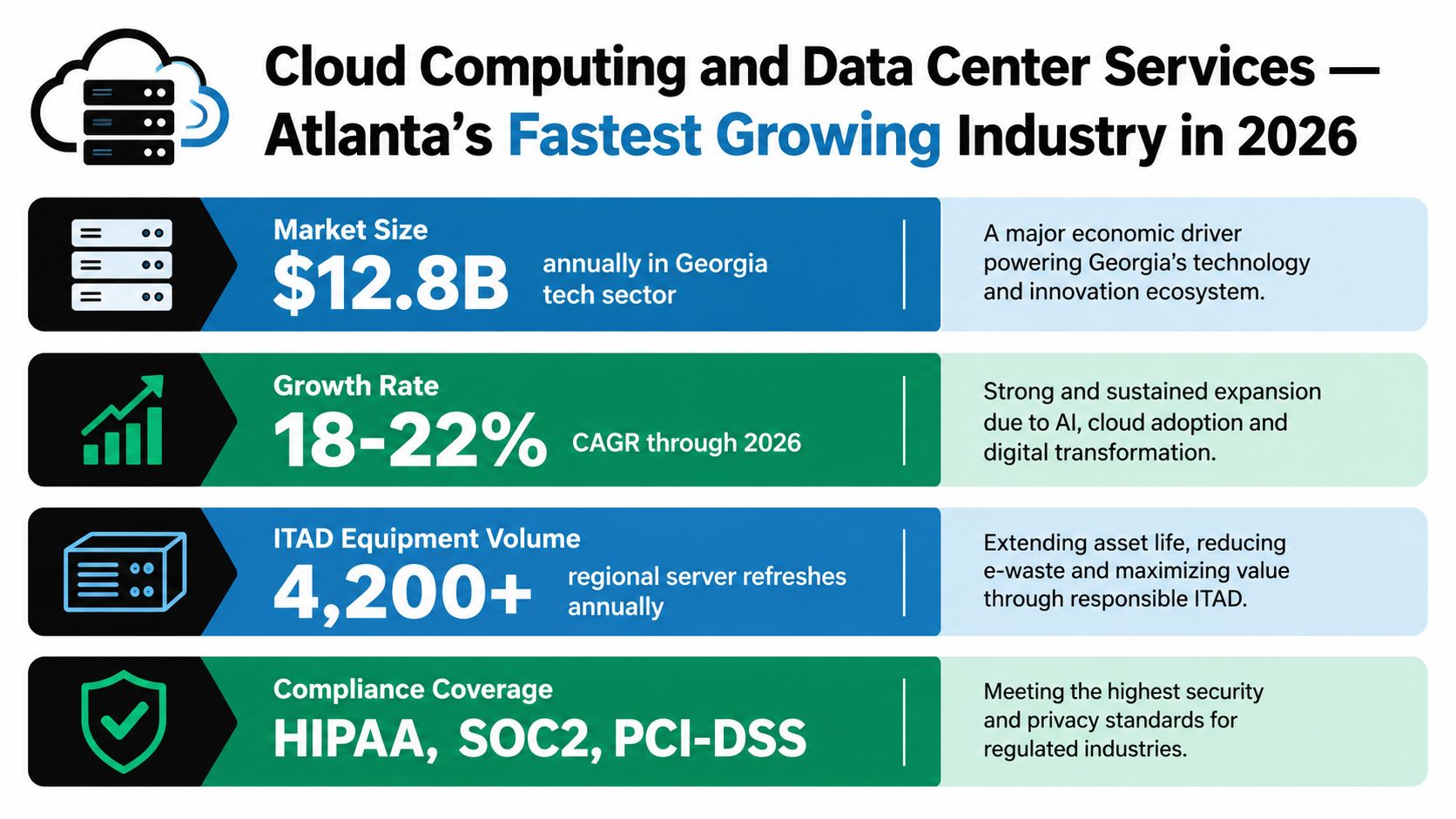
Atlanta's cloud and data center economy ranks first because infrastructure expansion creates unusually concentrated equipment lifecycle pressure. Datacenters.com identifies Atlanta as a fast-growing U.S. data center development market, citing enterprise demand, regional connectivity, available land outside the urban core, and expanding infrastructure investment as important development characteristics.
Cloud operators, colocation facilities, and enterprise IT departments retire servers, storage arrays, switches, racks, power equipment, and monitoring systems as they consolidate or modernize infrastructure. The equipment may contain customer information, credentials, configuration files, or operational data. A simple warehouse transfer isn't enough. Each asset needs an inventory record, a disposition decision, and a documented security treatment.
Decommissioning belongs in the migration plan
Organizations planning a hybrid-cloud migration should bring an ITAD provider into the project before the first server is powered down. The provider can help align pickup windows with maintenance schedules, identify equipment suitable for recovery, and define secure data destruction requirements for devices that cannot be redeployed.
For Atlanta data center operators, the practical sequence is:
- Build the asset register: Record serial numbers, ownership, location, condition, and data-bearing status before removal.
- Separate disposition paths: Direct reusable equipment toward recovery or donation, while routing non-reusable electronics into sustainable recycling.
- Protect uptime: Schedule collection during approved maintenance windows and coordinate loading access with facility security.
- Document closure: Retain certificates, inventory reconciliation, and chain-of-custody records for every shipment.
Businesses can review Atlanta data center decommissioning support when planning server retirement, storage removal, or a broader facility transition. The trade-off is clear. In-house handling may appear simpler, but a specialized partner can reduce the risk of unmanaged assets and incomplete records.
2. Cybersecurity and information technology services
Cybersecurity and IT services rank second because security infrastructure has a short operational tolerance for obsolescence. Managed security service providers, technology consultants, government contractors, and enterprise teams continually replace firewalls, intrusion detection appliances, endpoint devices, network switches, and backup hardware.
The retirement risk is higher than it looks. Security devices can contain logs, network maps, credentials, policies, or traces of customer environments. A recycler that only weighs equipment and issues a generic receipt doesn't provide enough assurance for a business handling regulated or contract-sensitive information.
Treat security hardware as evidence
A managed security provider replacing equipment across multiple customer environments should separate assets by client, location, and data sensitivity. That creates a defensible chain of custody and prevents one customer's devices from being mixed with another's shipment. Government contractors and regulated enterprises may also need procedures aligned with frameworks such as NIST, CMMC, or FedRAMP, depending on their obligations.
A practical disposition file should include:
- Device identity: Capture make, model, serial number, and assigned customer.
- Security status: Mark whether the device stores data, configuration information, or removable media.
- Destruction method: Define whether wiping, degaussing, physical destruction, or hard drive shredding is appropriate.
- Completion evidence: Request certificates of destruction and an audit trail tied to the original inventory.
Atlanta businesses can also consult cybersecurity guidance for executives when aligning information security and asset retirement. The key trade-off is speed versus control. A rapid pickup without documentation may clear space quickly, but it can leave security teams unable to prove what happened to sensitive equipment.
3. Financial services technology and fintech innovation
Atlanta's financial technology cluster ranks third because banking modernization produces a persistent stream of data-bearing hardware. Investment firms, banks, payment companies, credit unions, and fintech businesses replace trading workstations, transaction infrastructure, customer terminals, ATMs, networking equipment, and backend systems as platforms change.
The most important local implication is concentration. Atlanta's financial-services technology operations often connect customer information, payment records, identity data, and internal controls across offices and processing environments. A technology refresh therefore becomes both an IT project and a records-management event.
Link disposition to migration controls
A bank retiring branch terminals should establish a pickup manifest before equipment leaves the site. A fintech company moving from legacy servers to a modern platform should map every storage device to a migration workstream, then confirm that the disposition record matches the final decommissioning list.
Useful controls include:
- Migration coordination: Set pickup dates with application owners, security teams, and facilities staff.
- Data classification: Identify devices that held financial, customer, employee, or authentication information.
- Regulatory evidence: Preserve destruction records and chain-of-custody documentation for internal review.
- Value recovery: Evaluate whether functioning workstations, monitors, or networking equipment can be remarketed or donated.
Atlanta banking leaders can read about how local banks are modernizing IT systems while building an equipment retirement plan. The strongest approach doesn't treat secure data destruction and asset recovery as competing goals. It first protects information, then determines whether the hardware can support reuse, recovery, or responsible electronics recycling.
4. Biotechnology and life sciences research
Biotechnology and life sciences rank fourth because Atlanta's research and pharmaceutical operations use specialized equipment with both technical and environmental constraints. Laboratories may retire analytical instruments, spectrometers, chromatography systems, diagnostic devices, computers, and connected monitoring equipment as research programs evolve or facilities consolidate.
Laboratory equipment disposal requires more planning than a standard office cleanout. An instrument may contain stored research data, chemical residues, compressed components, or materials that require review before transport. The organization must also distinguish equipment that can be reused from assets that need controlled dismantling or recycling.
Build a lab-specific disposition file
A laboratory manager should involve environmental health and safety personnel, research leadership, IT, and facilities before moving equipment. The disposition file should record the instrument's condition, decontamination status, data-storage components, ownership, and intended destination.
For research organizations, the most useful preparation steps are:
- Inspect before removal: Confirm that instruments are safe to handle and identify any hazardous materials.
- Protect research data: Review computers, drives, instrument controllers, and removable media for sensitive findings.
- Coordinate schedules: Align equipment removal with study closeout, lab renovation, or facility consolidation.
- Preserve traceability: Keep records showing who approved the disposition and how the asset was handled.
The Reworx Recycling overview of recycled medical equipment illustrates why specialized equipment can be treated as a resource rather than immediate waste. The trade-off is between faster clearance and safer preparation. Rushing a lab cleanout may create handling, data, or compliance problems that cost more than the original logistics.
5. Healthcare technology and medical device manufacturing
Healthcare technology and medical device manufacturing rank fifth among Atlanta's supplied 2026 growth sectors. As noted in the introduction, healthcare and social assistance drove the majority of recent employment gains, while education and health services continued to expand faster than the national pace through mid-2026. That momentum creates a distinct equipment-lifecycle challenge for hospitals, clinics, imaging centers, laboratories, telemedicine operators, and device manufacturers.
A 500-bed expansion can place several hundred clinical workstations and a dozen imaging systems into the retirement queue within one fiscal year. Technology migrations also affect patient-monitoring systems, diagnostic devices, prototype units, and connected equipment. Each asset may require a different path, from redeployment or donation to secure data destruction and responsible electronics recycling.
Protect patients, data, and usable equipment
Healthcare IT and facilities teams should include device retirement in clinical change management. A workstation may store protected health information, an imaging system may contain drives, and a prototype may hold proprietary research or manufacturing data. Medical equipment can also present contamination, regulatory, battery, or maintenance concerns.
A practical disposition plan should:
- Coordinate with clinical operations: Schedule removals around patient care, service coverage, and replacement availability.
- Apply secure data destruction: Identify every data-bearing component and document the treatment completed.
- Classify device status: Separate reusable, regulated, damaged, contaminated, and donation-eligible equipment.
- Track recovery and recycling: Record assets that are reused, donated, recovered for parts, or processed through electronics recycling.
Healthcare organizations can review asset recovery for Atlanta healthcare operations when designing an ITAD workflow. Teams planning connected clinical tools can also consult practical clinic AI strategies. Reworx Recycling's community mission adds a donation-based option where suitable equipment can benefit local organizations.
The trade-off is continuity versus speed. Phased retirement takes coordination, but it reduces service disruption, protects patient data, and preserves more usable equipment.
6. Advanced manufacturing and industrial IoT
Advanced manufacturing ranks sixth as Atlanta expands connected production while retaining its role as a logistics and distribution hub. Industrial leasing activity, covered in this section, provides a second growth signal. Cushman & Wakefield recorded 10.2 million square feet of new industrial leasing activity in Atlanta in Q2 2026, a 26.3% quarter-over-quarter increase. The report also recorded 2.2 million square feet of completed industrial space, below the 6.0 million square feet average quarterly deliveries between 2021 and 2025.
Modern facilities connect sensors, robotics, control systems, inspection tools, network hardware, and monitoring platforms. A single SCADA replacement on a production line can retire 40 to 60 networked controllers and industrial PCs in one project. Replacing legacy CNC controls, testing equipment, or production-floor computers therefore creates an ITAD requirement alongside facility cleanout. Secure data destruction should cover storage in controllers, workstations, and monitoring devices. Responsible electronics recycling can recover materials, while suitable equipment may support donation-based recycling and Reworx Recycling's community mission.
Plan around production, not just storage
Manufacturers should map access and equipment dependencies before scheduling removal. A robotic arm or industrial controller may require production-line isolation, lift access, specialized handling, and safety-personnel coordination. The recycling partner also needs an accurate inventory of batteries, fluids, and other handling concerns.
A modernization plan should include:
- Site access review: Confirm doors, loading areas, floor restrictions, and equipment routes.
- Production coordination: Schedule removals during planned downtime or line changes.
- Safety controls: Define who may disconnect, move, package, and load industrial assets.
- Disposition segmentation: Separate electronics, reusable controls, scrap metal, and equipment requiring special review.
Manufacturers considering automation expansion can review automated quoting for fabrication shops. A low-cost general haul may remove material, while a specialized cleanout partner can reduce production disruption and improve the final disposition record.
7. Professional services and management consulting
Professional and business services rank seventh in this operational list and remain one of Atlanta's largest employment categories, as noted in the regional analysis cited earlier. The sector's recovery from late-2025 job losses reinforces its importance to the metro economy.
Consulting firms, accounting practices, law offices, engineering companies, and design consultancies manage extensive fleets of laptops, monitors, printers, mobile devices, and network equipment. Office relocations and hybrid-work changes can reveal stored equipment, abandoned peripherals, aging servers, and client-information risks. Technology refreshes also create recurring requirements for secure data destruction and responsible electronics recycling.
Make office cleanout part of the move
Facilities teams should arrange an office cleanout consultation before movers arrive. IT can identify devices requiring secure data destruction, while sustainability leaders set donation, recovery, and recycling reporting requirements. Coordinating one pickup gives the firm better control than allowing departments to dispose of equipment independently.
Effective controls include:
- Confidentiality protection: Match data destruction procedures to client-information obligations.
- Move coordination: Align loading with lease dates, mover schedules, building rules, and elevator access.
- Inventory reconciliation: Compare the final pickup list with the original asset register.
- Disposition tracking: Document donation, material recovery, and recycling outcomes for internal and corporate reporting.
Reusable laptops and monitors may support a corporate donation program. Donation-based recycling can extend technology access through community reuse while reducing unnecessary disposal. Reworx Recycling's community mission gives firms a practical route to connect equipment disposition with local benefit.
The trade-off is preparation time. Sorting, testing, and documenting equipment require planning, but these steps can reduce storage, protect client data, and clarify the end-of-lease outcome. A defined process also helps business, IT, and sustainability leaders agree on disposition before removal begins.
8. EdTech and higher education digital transformation
EdTech and higher education rank eighth in Atlanta's growth outlook. Their expansion also creates a recurring equipment-lifecycle challenge. Universities, colleges, and education companies refresh student labs, faculty workstations, classroom systems, residence-hall connectivity, collaboration tools, and learning-platform infrastructure.
As noted earlier, education and health services expanded faster than the national pace through mid-2026, making device retirement a recurring planning issue. A mid-sized Atlanta university refreshing two student labs can retire 300 to 500 laptops during one summer intersession, alongside monitors, docking stations, network equipment, and storage media.
Pair data security with digital inclusion
Schools must protect student and faculty information before equipment leaves campus. Functional devices may also support community programs, workforce development, or digital inclusion initiatives. A donation-based recycling partner can separate reusable equipment from obsolete electronics while keeping secure data destruction under documented control.
Campus teams should:
- Use the academic calendar: Schedule collection during summer, intersession, renovation, or approved move periods.
- Segment equipment: Separate working devices, repairable assets, obsolete electronics, and data-bearing storage.
- Document erasure: Maintain records for laptops, desktops, tablets, servers, and removable media.
- Measure community impact: Track donations and reuse outcomes alongside recycling volumes.
The right partner should provide flexible scheduling and clear disposition records, rather than treating every device as commodity scrap. Schools may need to balance resale value against community benefit. Reworx Recycling's community mission supports donation-based recycling alongside responsible electronics recycling, while secure data destruction remains the operating requirement. A defined process helps administrators plan refresh cycles, protect records, and report outcomes.
9. Government and public sector technology modernization
Government and public-sector technology modernization ranks ninth because Atlanta-area agencies manage sensitive information across municipal, county, state, federal, utility, and public-service environments. Cloud migrations, cybersecurity upgrades, smart-city systems, citizen-facing platforms, and operational technology projects all create retirement requirements for computers, network equipment, servers, controls, and storage devices.
Public-sector ITAD requires more than a pickup appointment. Agencies may need procurement alignment, documented chain of custody, approved destruction methods, audit trails, and procedures compatible with frameworks such as NIST, FISMA, or CJIS. Utility and operational-technology teams may also need to treat control systems differently from ordinary office equipment.
Establish compliance before procurement
An agency should define disposition requirements in the project statement of work rather than trying to add them after equipment has been removed. That lets procurement teams evaluate vendors on security procedures, reporting, insurance, transportation, and experience with public-sector environments.
Government leaders should verify:
- Vendor qualifications: Confirm that the provider can meet the agency's security and documentation requirements.
- Asset traceability: Require serialized inventories and custody records from pickup through final disposition.
- Destruction evidence: Obtain certificates that identify the relevant devices and treatment.
- Operational separation: Keep office IT, controlled equipment, and utility systems on appropriate handling paths.
Public agencies also have a community role. Functional devices may support schools, nonprofit programs, or workforce initiatives when policy permits. The trade-off is administrative effort versus defensibility. Strong documentation takes time, but it gives agency leaders evidence that equipment, data, and public resources were handled responsibly.
10. Hospitality technology and guest experience innovation
Hospitality ranks tenth among Atlanta's growth sectors, yet its equipment lifecycle is unusually distributed. Hotels, restaurants, convention facilities, attractions, and entertainment venues refresh payment terminals, point-of-sale systems, property-management servers, guest Wi-Fi equipment, digital signage, ticketing devices, room controls, and back-office computers across many sites.
A 200-room hotel replacing its property-management system can retire dozens of terminals, room controllers, and administrative devices during one renovation window. That concentration creates a short removal schedule, while the variety of equipment increases the risk of incomplete inventories or unsecured data.
Design a property-by-property rollout
Hospitality organizations rarely close every location at once. A repeatable process must work during renovations, ownership changes, seasonal slowdowns, and system migrations. Crews should follow property access rules, limit disruption, and protect payment and guest information.
Operators should:
- Schedule off peak: Coordinate pickups with property managers during lower-demand service windows.
- Standardize manifests: Use consistent asset categories, serial records, and completion documents across locations.
- Protect payment data: Apply secure data destruction to terminals, drives, servers, and devices that stored guest information.
- Track completion: Reconcile each property's equipment with the rollout plan before closing the project.
Responsible electronics recycling can separate reusable equipment from devices requiring destruction. Donation-based recycling may also direct functional hardware toward community programs, aligning hospitality upgrades with Reworx Recycling's community mission. The trade-off is discretion versus throughput. A rapid removal can interrupt guest service, while a phased, property-aware program protects operations and produces more reliable records.
Hospitality leaders can consult this 2026 guide to smart hospitality when planning technology upgrades. The practical priority is a documented handoff from renovation planning through final disposition.
Turn Atlanta growth into a smarter equipment lifecycle
Atlanta's growth sectors don't create one uniform recycling problem. Data centers produce concentrated server and storage retirements. Cybersecurity firms handle sensitive infrastructure. Banks and fintech companies manage regulated financial data. Laboratories and healthcare organizations add specialized equipment, while manufacturers and logistics operators introduce access, safety, and scheduling constraints. Schools and public agencies combine security requirements with community responsibilities.
IT managers should start by mapping expected refreshes, migrations, relocations, and facility cleanouts. Build an asset register before equipment leaves its assigned location, classify every data-bearing device, and identify specialized equipment that may need decontamination, safety review, or controlled handling. Include secure data destruction, chain of custody, certificates, and final reporting in the project plan.
Sustainability directors should measure more than landfill avoidance. Track equipment donated, reused, remarketed, recycled, and processed through product destruction. A donation-based recycling program can connect responsible electronics recycling with digital inclusion and workforce development, while asset recovery can help organizations reclaim value from usable hardware.
E-waste and ITAD providers should prepare for different operating environments. A data center needs decommissioning discipline. A hospital needs clinical coordination and medical equipment expertise. A manufacturer needs facility access planning. A government agency needs procurement and audit alignment. A professional-services firm needs confidentiality and a precise office cleanout schedule.
Reworx Recycling offers businesses a relevant Atlanta-area option for electronics recycling, equipment decommissioning, business pickups, IT asset disposition, secure hard drive shredding, data destruction, and community-focused technology reuse. Based in Smyrna, Georgia, the donation-focused social enterprise helps organizations retire outdated devices while supporting environmental responsibility and community impact. Businesses can also explore Reworx Recycling's recycling and ITAD education when planning office recycling programs, e-waste drives, reverse logistics, or year-end technology transitions.
The practical sequence is clear. Forecast the equipment, protect the data, classify the assets, coordinate the pickup, and document the outcome. Atlanta's fastest-growing industries in 2026 will continue creating technology turnover. Organizations that connect growth planning with responsible disposition can reduce risk, improve sustainability reporting, and turn surplus equipment into a community resource.
Atlanta 2026: Top 11 Fast-Growing Industries Comparison
| Sector | 🔄 Implementation complexity | ⚡ Resource requirements | ⭐ Expected outcomes | 📊 Ideal use cases | 💡 Key advantages / tips |
|---|---|---|---|---|---|
| Cloud Computing and Data Center Services | Very high, multi-rack shutdowns, sequencing, multi-vendor coordination | Large crews, heavy transport, certified ITAD tooling, extensive documentation | ⭐⭐⭐, Secure, compliant destruction; high asset recovery potential | Mass server refreshes, colocation consolidation, cloud migrations | Pre-establish ITAD partners; schedule during maintenance windows |
| Cybersecurity and IT Services | High, sensitive configs, chain-of-custody and clearance needs | Security‑cleared staff, strict documentation, secure transit and storage | ⭐⭐⭐, Certified destruction; minimal residual security risk | Firewall/IDS upgrades, MSSP rollouts, sensitive hardware refreshes | Use cleared ITAD providers; require certificates of destruction |
| Financial Services Technology & FinTech | High, stringent audit/regulatory requirements and legacy complexity | Compliance experts, tight chain-of-custody, secure logistics | ⭐⭐⭐, Regulatory-ready disposition and strong audit trails | Trading system upgrades, ATM/terminal decommissions, core migrations | Require financial‑grade certifications and documented processes |
| Biotechnology & Life Sciences Research | High, specialized instruments, hazardous materials, research data concerns | Scientific-equipment handlers, hazardous-material protocols, certifications | ⭐⭐, Safe, compliant disposal; limited refurbishment options | Lab modernizations, instrument replacements, facility consolidations | Coordinate with lab safety teams; assess hazardous-component handling |
| Healthcare Technology & Medical Devices | High, HIPAA + FDA compliance; biohazard and device rules | Medical-device expertise, HIPAA-compliant destruction, biohazard controls | ⭐⭐, Compliant disposal and patient-data protection | EHR migrations, imaging equipment upgrades, hospital cleanouts | Engage ITADs with healthcare certifications; plan around clinical schedules |
| Advanced Manufacturing & IIoT | High, heavy machinery, OT/IT integration, safety protocols | Rigging, industrial transport, OT specialists, hazardous-material checks | ⭐⭐, Large-volume removals; limited resale for specialized machinery | Factory modernization, IIoT deployments, SCADA retirements | Plan facility access and safety procedures early; coordinate with production |
| Professional Services & Management Consulting | Moderate, distributed fleets and confidentiality needs | Coordinated pickups, secure wipes, flexible scheduling across offices | ⭐⭐, High refurbishment potential; secure sanitization | Office consolidations, relocations, hybrid-work device refreshes | Schedule early; maintain confidentiality agreements and audit records |
| EdTech & Higher Education Digital Transformation | Moderate, campus logistics and academic calendar constraints | Large-scale collection, donation/refurb programs, secure erasure | ⭐⭐, Strong donation/refurb outcomes; community impact | Lab refreshes, dorm upgrades, campus-wide device rollouts | Align pickups with term schedules; enable donation pathways |
| Government & Public Sector Modernization | Very high, NIST/FISMA/CJIS compliance, procurement and clearance rules | Cleared personnel, stringent audit trails, procurement-compliant processes | ⭐⭐⭐, Fully auditable, legally compliant disposition | Municipal cloud migrations, agency system retirements, SCADA upgrades | Obtain clearances and compliance certs upfront; document everything |
| Hospitality Technology & Guest Experience Innovation | Moderate, multi-property logistics and guest-disruption sensitivity | Flexible scheduling, discreet pickups, secure payment-data destruction | ⭐⭐, Responsive removals; typically moderate asset value | Property renovations, POS replacements, multi-hotel rollouts | Schedule off-peak pickups; coordinate with property management for discretion |
Reworx Recycling helps Atlanta-area businesses manage electronics recycling, IT equipment disposal, business pickups, equipment decommissioning, secure hard drive shredding, and donation-based reuse. If your organization is planning a technology refresh, office cleanout, facility transition, or data center project, visit Reworx Recycling to learn how to donate old equipment, schedule a pickup, or build a community-focused ITAD program.