The world generated 62 billion kg of e-waste in 2022, and only 22.3% was formally collected and recycled in an environmentally sound manner, according to the Global E-waste Monitor 2024. That should end the old conversation about “getting rid of old electronics.” Business electronics don't belong in a disposal mindset. They belong in an operating model.
If you manage laptops, desktops, servers, phones, monitors, networking gear, lab devices, or medical equipment, your retirement process now touches three departments at once. IT wants secure data destruction. Sustainability wants reporting that stands up in reviews. Finance wants value recovery where it's still available. Good IT asset disposition solves all three. Bad ITAD creates audit gaps, lost assets, and unnecessary scrap.
Why Business Electronics Recycling Is Now a Strategic Lever
Only 22.3% of global e-waste was formally collected and recycled in 2022. For businesses, that is less a recycling statistic than a control problem.
Corporate device retirement sits at the intersection of data security, sustainability reporting, and value recovery. Treat it like a disposal chore and you will miss all three. Treat it like an operating process and one workflow can satisfy IT, ESG, and finance at the same time.
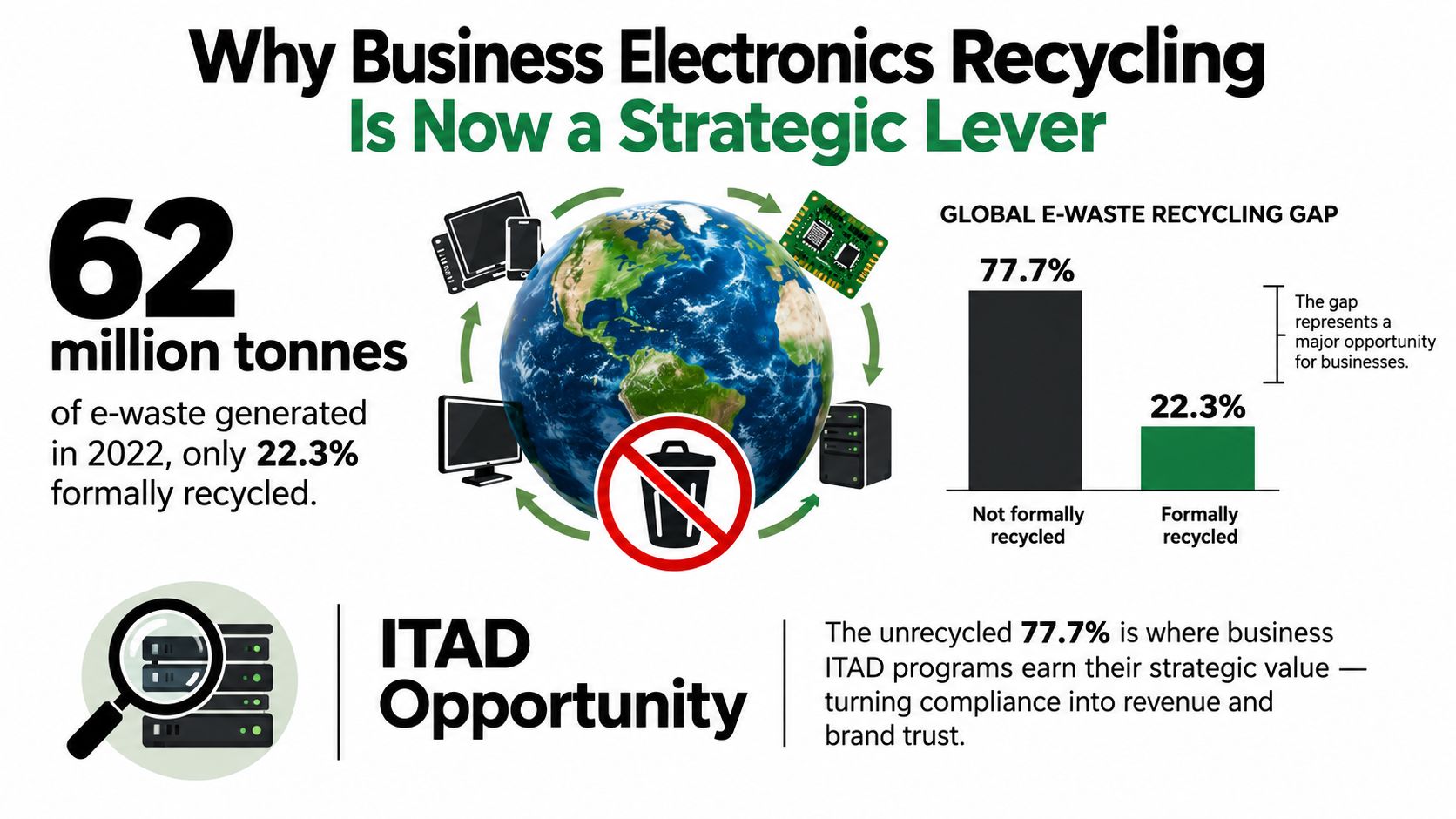
The gap that matters
Business assets retire in batches, on refresh schedules, and through known handoff points. That gives companies a capture advantage households do not have. If you set the process up correctly, you know when devices leave service, who touched them, where they went, whether data was destroyed, and whether any resale value was preserved.
That is the strategic point. The biggest wins in ITAD come from timing and control.
The companies that underperform usually make the same mistake. They postpone pickup after decommission. Devices sit in closets, branch offices, cages, and storerooms for weeks or months. By then, chain-of-custody is weaker, resale windows have narrowed, reporting gets patchy, and reusable equipment is far more likely to end up as scrap.
Practical rule: Your best ITAD decision happens the day an asset leaves production, not months later when someone asks for a cleanout.
The six decisions that define the program
A business program works when six decisions are made up front and enforced the same way across locations.
- Policy scope. Cover the full asset estate, not just laptops and desktops. Include servers, phones, monitors, networking gear, peripherals, lab devices, and any specialized electronics your teams deploy.
- Vendor model. Pick one accountable ITAD partner if you want fewer custody gaps and cleaner reporting. Split vendors only when you have a real operational reason and the staff to manage the handoffs.
- Data destruction tier. Set sanitization rules by media type, risk level, and reuse potential. Do not destroy recoverable value without a reason.
- Pickup logistics. Match the collection model to your footprint. A headquarters refresh, branch cleanout, and recurring field pickup should not run on the same assumptions.
- Reporting cadence. Require serial-level tracking, certificates, and downstream disposition records on a schedule your audit, IT, and ESG teams can use.
- Routing logic. Decide in advance what gets redeployed, resold, donated, harvested for parts, or sent to material recycling.
Separate these decisions and the program breaks in predictable ways. Security gets handled in one lane, sustainability reporting in another, and value recovery as an afterthought. Good ITAD ties all three together under one chain of custody.
If you want a clearer picture of why formal retirement programs outperform ad hoc cleanouts, the benefits of e-waste recycling for organizations are strongest when collection, data destruction, reporting, and downstream routing are designed as one business process.
What Effective IT Asset Disposition Actually Looks Like
Effective ITAD starts at the moment an asset leaves service, not when a pallet reaches a recycler. Companies lose control in that gap. Devices sit in closets, branch offices stack gear without intake records, and finance, security, and sustainability teams end up working from different versions of the same retirement event.
That is the wrong operating model.
A good program runs one decision flow with three outputs. Security gets documented sanitization. ESG gets defensible diversion and downstream reporting. Finance gets the highest realistic recovery before scrap enters the picture. If any one of those is handled separately, the program gets slower, harder to audit, and more expensive than it needs to be.
The routing logic is simple. Start with condition, media type, and marketability, then assign the asset to its highest acceptable use.
| Asset profile | Best-fit route | What the business gets |
|---|---|---|
| Current, functional laptops, desktops, mobile devices, and enterprise hardware | Redeployment or resale | Maximum value recovery and delayed replacement spend |
| Usable but lower-demand equipment | Donation through a documented channel | Diversion credit, community benefit, and clean reporting |
| Incomplete or partially functional assets | Parts harvesting or refurbishment | Partial recovery without forcing low-value scrap |
| Failed, obsolete, or physically damaged equipment | Certified material recycling | Commodity recovery and compliant downstream handling |
The mistake I see most often is forced destruction too early. If you shred resale-grade devices by default, you are not reducing risk. You are wasting margin and cutting against your own sustainability claims. Data risk should be handled through the right sanitization method and chain of custody, not by destroying every asset with residual value.
That also changes how pickup events should work on the ground. The handoff needs to be operationally tight, boring, and repeatable. Staff should know where retired equipment goes, how it gets tagged, who scans it, and when records come back. If that sounds too basic, good. Programs usually fail on basic process discipline, not on strategy.
Here is the test. Could you pick any retired device from the last quarter and answer four questions quickly?
- Who released it from use?
- Where did custody transfer?
- How was data sanitized or destroyed?
- What final route did it take?
If you cannot answer those four questions, you do not have a mature ITAD program. You have a hauling arrangement.
That is why the operating model matters as much as the recycler. Multi-site businesses in particular need intake, consolidation, transportation, sanitization, resale, and recycling to function as one controlled process. The benefits of a reverse logistics partner show up in fewer custody breaks, cleaner asset visibility, and less administrative drag across sites.
A proper IT asset disposition process for businesses is not a disposal chore. It is the point where data security, sustainability reporting, and value recovery either converge under one chain of custody or split into three separate problems. The companies that get this right design for that convergence from day one.
Building the Recycling Policy and Compliance Spine
If your electronics recycling program lives in email threads and vendor promises, it's weak. A defensible business program needs a policy spine that survives turnover, audits, and site-level inconsistency.
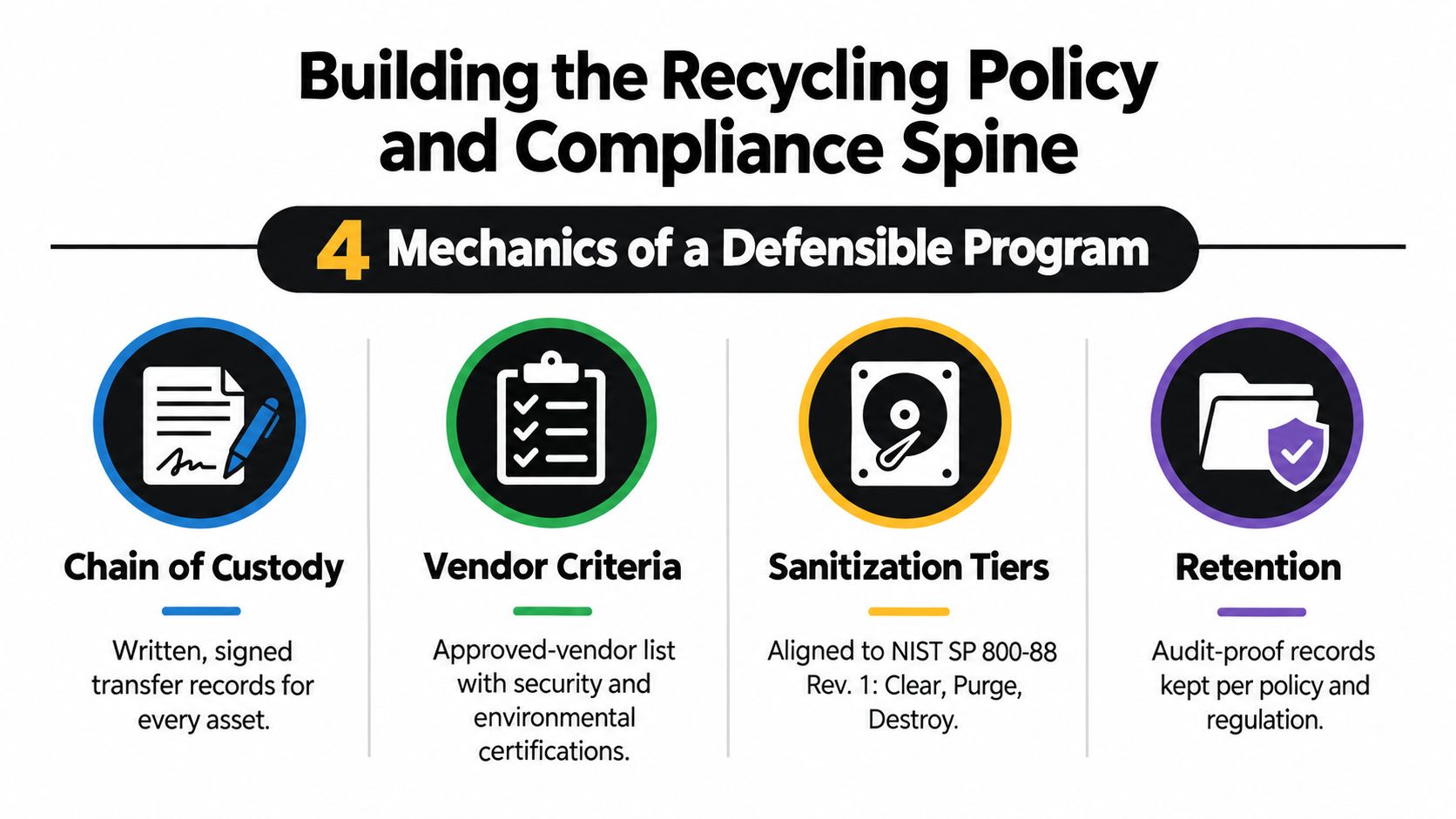
Four mechanics every policy needs
Start with four essentials.
- Chain of custody. Every transfer needs written evidence. That includes internal release, carrier handoff, processor receipt, and final disposition documentation.
- Approved-vendor criteria. Don't approve vendors just because they can haul. Approve them because they can document.
- Sanitization tier selection. Your policy should define when to use Clear, Purge, or Destroy.
- Retention rules. Records must remain available long after the pickup truck leaves.
California gives businesses a useful concrete model. Under the state's Universal Waste Rule, companies can use an authorized collection site, a certified e-waste hauler or recycler, or a manufacturer take-back program. Businesses also can't accumulate e-waste on-site for more than one year and should keep records showing where devices went, as summarized in this California e-waste compliance guide.
Use NIST language, not improvised language
Your policy shouldn't invent its own data destruction vocabulary. NIST Special Publication 800-88 defines Clear, Purge, and Destroy, and that gives IT, compliance, and vendors a common operating language. The same source notes that for most business-critical data, physical destruction is the only method that provides complete certainty, and vendors should provide documentation that can be retained for at least three years, as described in this NIST-focused compliance overview.
Policy failure usually starts with undefined exceptions. Someone says, “These are just old monitors,” or “Those laptops are probably fine.” That's how undocumented assets leave the building.
What approved-vendor criteria should actually say
Write plain requirements, not vague aspirations.
- Require recognized environmental and security controls. Ask for R2v3 or e-Stewards certification, audited downstream accountability, and insurance.
- Demand serial-level documentation. Batch certificates aren't enough for devices that held business data.
- Separate reuse, refurbishment, and commodity recycling in reports. If a vendor can't distinguish those paths, your reporting will stay shallow.
- Set retention expectations in the contract. If documents disappear after a short window, your audit trail disappears with them.
A practical starting point is a documented internal checklist. This compliance checklist template is the kind of operational artifact teams should have before they schedule the first pickup.
Choosing a Pickup and Logistics Model That Fits
A weak logistics model breaks all three outcomes at once. Security slips when assets sit too long at the site. Sustainability reporting gets messy when returns arrive without consistent intake. Value recovery drops when good equipment is stacked badly, shipped late, or never collected from remote locations.
Start with one question. Where do assets get stuck in your business?
For some companies, the problem is volume. Gear comes out of service every month across multiple offices, so a scheduled route keeps the flow controlled and keeps aging inventory off the floor. For others, the issue is timing. A refresh, relocation, or shutdown creates a large one-time pile, and a bulk pickup clears it fast if the site stages assets correctly. Then there is the distributed fleet problem. Remote staff, field teams, and small branches rarely produce enough material to justify a pallet, but they still hold laptops, phones, and accessories that contain data and belong in your reporting.
That last category is where programs usually fail.
A monitor at a branch office is easy to ignore. A laptop in a home office is not. If you do not have a defined return path for low-volume assets, your chain of custody weakens, your ESG totals stay incomplete, and reusable devices miss the resale window.
Use this model selection test instead of defaulting to whatever the vendor sells most:
| Operating reality | Best-fit model | What it solves | What usually goes wrong |
|---|---|---|---|
| Predictable retirements across several business sites | Scheduled route | Keeps pickup cadence steady and reporting cleaner by month or quarter | Sites book pickups before assets are staged or approved |
| Office closures, refresh events, warehouse cleanouts, data center work | On-demand bulk pickup | Consolidates a large volume quickly and reduces handling touches | Internal teams mix scrap, reusable gear, and undocumented items |
| Remote employees, field technicians, low-volume branches | Mail-back or prepaid containers | Captures assets that never return through HQ | Packaging, labels, and serial capture vary from one sender to the next |
Procurement should stop treating transportation as a commodity line item. The right logistics setup is part of the ITAD control system.
Ask blunt operational questions. How long can the vendor hold a pickup slot? What happens if the site is only half ready? Who records serials before the truck leaves? How are exceptions handled when a box arrives with no asset list or the wrong contents? Weak answers here turn into missing devices, disputed certificates, and shallow sustainability reporting later.
Standardized return instructions matter more than companies expect, especially for distributed programs. DPP Grid's product return guides are useful because they show the practical side of getting returns back through consistent intake paths instead of improvised office-by-office methods.
One more rule. Match the logistics model to stakeholder goals, not just freight efficiency. Security wants documented custody. Sustainability wants defensible totals and downstream visibility. Finance wants usable equipment protected well enough to preserve resale value. A good ITAD program satisfies all three in the same pickup design.
If you need recurring site service, branch collection, remote asset returns, or decommission support, evaluate reverse logistics services for business electronics pickups and returns as part of the operating model, not as an afterthought after policy is written.
Data Destruction as the Center of the Program
Most companies still treat data destruction as the last line item. That's backwards. It's the center of the entire program because every routing decision depends on whether media can be sanitized to the right standard without destroying recovery value.
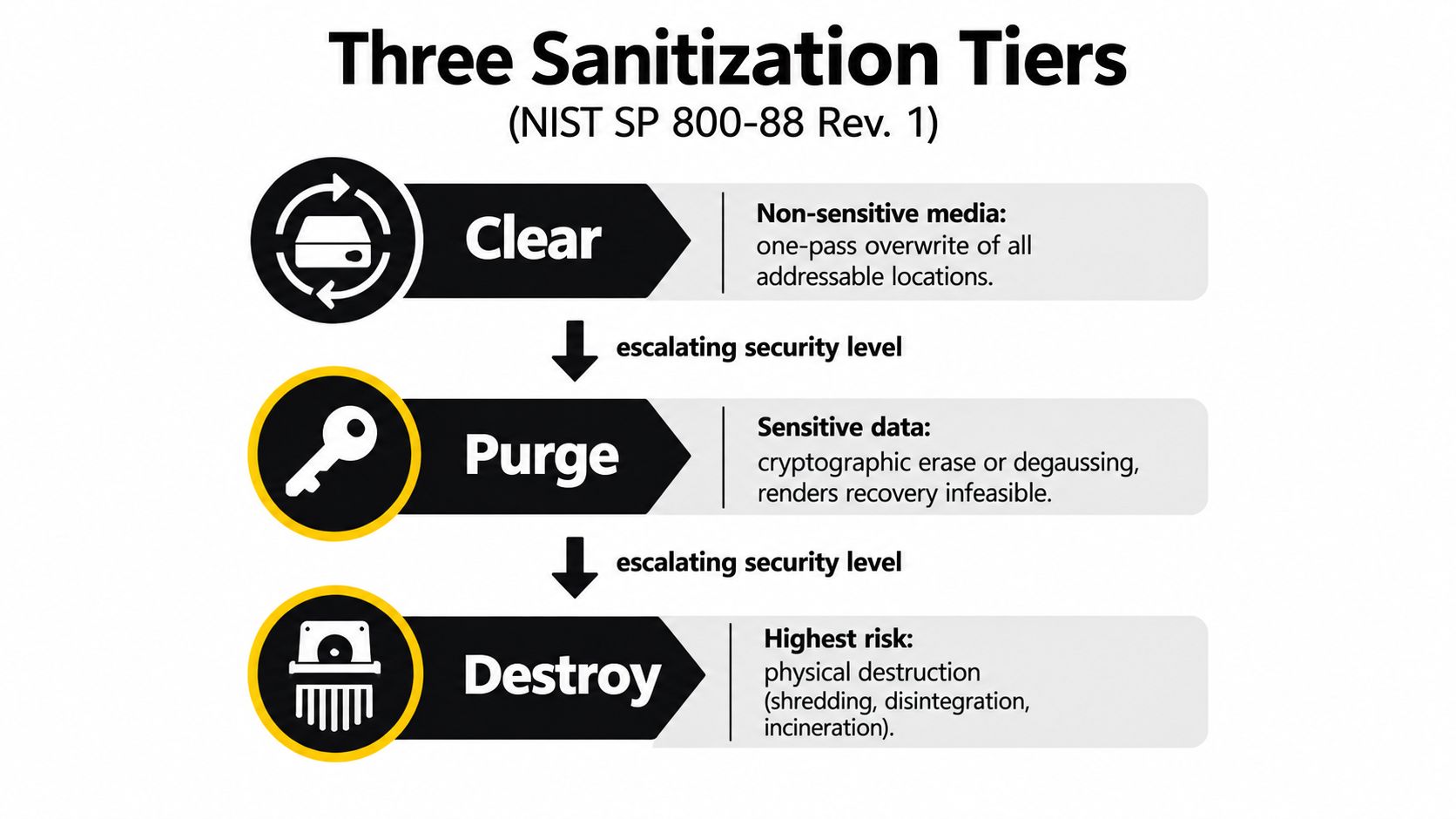
Match the sanitization tier to the asset
NIST SP 800-88 gives you three operating levels: Clear, Purge, and Destroy. In practice, each belongs to different business scenarios.
- Clear fits lower-risk reuse situations where software overwrite is sufficient and the media is fully addressable.
- Purge is usually the sweet spot for modern business endpoints with strong encryption and viable cryptographic erase options.
- Destroy is the answer for failed media, questionable drives, unsupported SSD workflows, and high-risk data sets where certainty matters more than resale.
For many laptops with encrypted drives, Purge preserves reuse potential. That matters because the same benchmark report that tracks ITAD buying priorities found that 34% of respondents in recent 2025 benchmarking said sustainability was an important factor in IT asset disposition, up from 19% in 2023, while resale values rebounded for laptops by 37.3% and desktops by 14.8%, according to the Cascade 2025 ITAD benchmarking report release. Security still leads, but sustainability and value recovery now sit inside the same decision.
Build one evidence trail
Good programs don't just sanitize media. They prove it.
The evidence trail should include:
- Serial capture at intake so each asset enters the process as a unique record.
- Tamper-evident containment for loose drives and removed media.
- Method attribution that states whether the item was Cleared, Purged, or Destroyed.
- Per-asset certificates tying serial number, date, technician, and final destination together.
That workflow matters across endpoints, servers, mobile devices, and specialized systems. It also matters when retired equipment came from hybrid environments where keys, cached credentials, or tenant artifacts may still create exposure.
The fastest way to ruin a sustainability story is to create a weak destruction record. No ESG win survives a data-handling failure.
If you're building the operating sequence from intake through hard drive shredding and certificates, review a documented data destruction process before you set internal policy.
Sustainability Reporting and Value Recovery Together
Analysts covering the ITAD market estimate that 240 million Windows 10 PCs will be retired during 2025 as companies replace aging fleets, according to this ITAD market report summary. If your program treats that volume like a disposal task, you lose twice. You miss recoverable value, and you end up with weak sustainability reporting that finance and ESG teams cannot use.
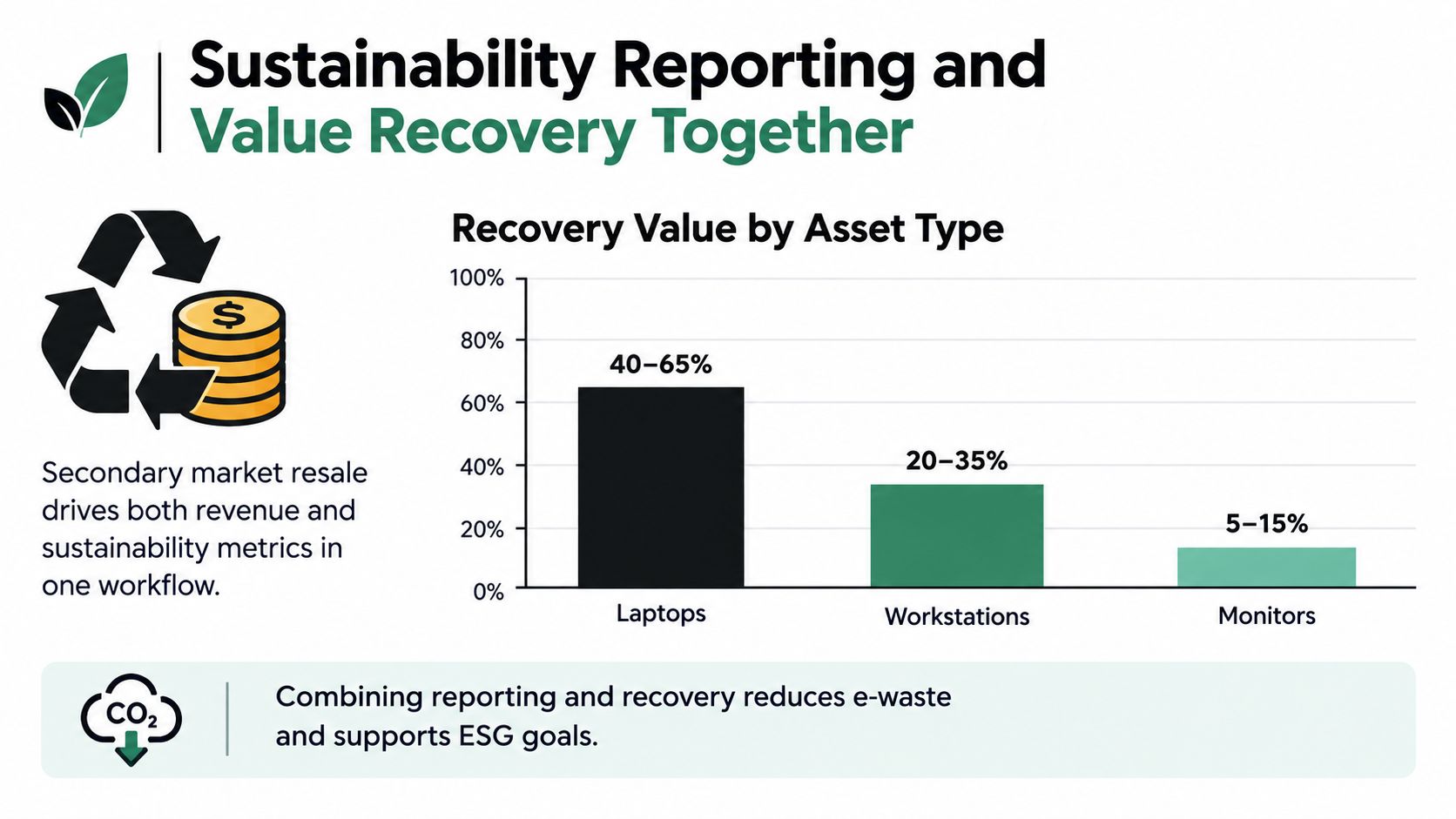
The fix is simple. Stop separating the asset disposition decision from the reporting decision. They are the same decision.
A retired laptop can create one of three outcomes. It can return cash through resale, support ESG goals through reuse or donation, or move to recycling with documented downstream handling. Strong programs decide that route asset by asset, based on condition, market demand, and reporting value, not on whatever the office has always done with old equipment.
Here is the mistake I see most often. Sustainability asks for weights and diversion numbers after the pickup. Finance asks for resale results a month later. IT asks whether anything with storage was destroyed. That setup guarantees rework, missing records, and internal arguments over whose numbers are right.
Run one ledger instead:
- IT needs proof of disposition tied to the specific asset record
- Finance needs recovery results tied to sale, credit, or scrap outcome
- Sustainability needs route-level reporting tied to reuse, donation, and recycling totals
If those records live in different systems or arrive on different timelines, the program will drift. Audits get messy. Quarter-end reporting slows down. Recoverable assets get thrown into low-value bulk loads because nobody classified them early enough.
Donation deserves a harder look than it usually gets. For lower-demand equipment with usable life left, donation can outperform resale in internal value because it supports digital inclusion, workforce programs, or community commitments while still keeping material in use longer. That only works if the chain of records stays intact from pickup through final handoff. A feel-good story with weak documentation does not help the sustainability team, and it definitely does not help legal.
The best ITAD programs produce one set of records that satisfies security, ESG reporting, and finance without forcing any team to build its own shadow process.
That is the convergence point. Business electronics recycling works best when data security controls decide what is safe, value recovery rules decide what is worth remarketing, and sustainability reporting captures the final outcome from the same operating record. That is how you turn end-of-life equipment from a cleanup project into a controlled business process.
Putting It All Together With Reworx Recycling
A workable rollout doesn't need to be dramatic. It needs to be disciplined. For a small or mid-sized business, I'd build the first ninety days around one site, one asset inventory, and one pilot pickup that proves the documentation chain.
Days 1 through 30
Start with an inventory audit. Count what's in use, what's in storage, what's already retired, and what still contains media. Then classify assets by likely route: resale, donation, parts harvest, or recycling.
At the same time, review who currently approves removals, who handles office cleanouts or facility cleanouts, and where undocumented handoffs happen. Most breakdowns appear there first.
Days 31 through 60
Draft the policy. Lock in chain-of-custody steps, sanitization rules, approved-vendor requirements, and documentation retention. Then run a pilot from a single site with a mixed batch of retired assets.
This is the point where using a partner like Reworx Recycling can be practical for businesses that need electronics recycling, secure data destruction, equipment decommissioning, pickups, and donation-oriented routing in one operating flow. The right pilot should test serial capture, certificate quality, pickup execution, and downstream reporting without overcomplicating the first run.
Days 61 through 90
Roll the process out to additional sites once the pilot paperwork is clean. Move to a quarterly or otherwise recurring pickup cadence that matches your refresh pattern. Keep the process tight enough that no location becomes a dead-storage zone for retired electronics.
The artifacts you should expect from a mature program are straightforward:
- Serialized sanitization records tied to individual assets
- Weight or shipment records for outbound loads
- Disposition reporting that separates reuse, refurbishment, and recycling
- A clear exceptions log for missing serials, damaged labels, failed drives, or unresolved custody issues
What usually fails instead? Brokered loads, handoffs no one documented, and certificates issued without verifiable serial capture. That's not a program. That's a liability with a recycling label on it.
If you're responsible for laptop disposal, computer recycling, medical equipment disposal, laboratory equipment disposal, product destruction, or data center decommissioning, treat the first pickup as a test of the entire system. If the records are clean, the rest of the rollout gets easier. If they're sloppy, stop and fix the workflow before volume scales.
If your business needs a practical path for electronics recycling, IT equipment disposal, and secure end-of-life handling, Reworx Recycling offers pickups, data destruction, decommissioning support, and donation-focused recycling workflows that fit real business environments. Start with a site audit or a pilot pickup, get the chain-of-custody and reporting right, and use that first documented run as the template for every location that follows.