A storage room full of old laptops, a decommissioned server rack waiting for pickup, and a manager asking for a sustainability update. That's where circular economy practices usually start, not in a policy deck. The work feels ordinary at first, but the decisions around inventory, data handling, vendor handoff, and reuse determine whether retired equipment becomes cost recovery, community value, or a compliance headache.
For teams trying to make sense of the clutter, good inventory discipline helps. A practical inventory tool can keep the project from turning into guesswork, and inventory help from Orange Box is a useful reminder that asset tracking is a real operational task, not a side note. For organizations that want to connect sustainability with day-to-day execution, Reworx Recycling's sustainable business practices fits squarely into that same reality, because circularity only works when someone owns the workflow.
Why Circular Economy Practices Start With Everyday Operations
The first place circular work shows up is usually mundane. A school upgrades its computer lab, an SMB refreshes employee laptops, or a city department clears out a storage area before audit season. The equipment is still physically present, but the organization has already moved on, which is how value gets stranded in closets, cages, and off-site storage.
Circular economy practices turn that moment into a structured decision. The question isn't just, “What do we do with old hardware?” It's, “Which assets can be reused, which need secure IT asset disposition, which should be donated, and which should be recycled for material recovery?” That distinction matters because reuse, refurbishment, resale, ITAD, and recycling each have different operational requirements.
The baseline is simple. If a device still has working life, it should be routed toward reuse or refurbishment before anyone assumes it belongs in a shred bin. If it contains sensitive data, secure data destruction has to be planned before transport, not after a pickup is already on the truck. If the equipment has little resale value but can still serve a community organization, donation-based recycling can extend its life while supporting digital inclusion.
Practical rule: Don't treat end-of-life work as a cleanup task. Treat it like a controlled operational process with inventory, chain-of-custody, and a defined outcome for every asset.
This is also where the internal owner matters. In practice, IT, facilities, procurement, and finance all touch the same retired asset stream, and if no one coordinates the handoff, the equipment just sits. Teams that keep the process tight usually build a simple routing standard, then attach it to refresh cycles, move management, and office decommissioning.
Running a Baseline Audit Before Any Asset Moves
A circular program gets much easier when every device is classified before it leaves the room. A baseline audit gives IT, facilities, and procurement a shared starting point, so no one is guessing once assets start moving. The audit should answer four questions for each item. How sensitive is the data, what condition is the hardware in, what residual value might it still hold, and where should it go next.
Start with inventory. Capture the serial number, asset tag, user or department, device type, storage media type, and current status. Then separate the devices by data class. A laptop used by finance has a different sanitization requirement than a classroom monitor, and that difference drives the rest of the workflow. Teams that want a tighter checklist can use an IT equipment audit process to standardize what gets recorded before anything leaves the site.
A simple audit sequence
- Inventory first. List every asset that's leaving service, including peripherals, storage drives, and docked accessories.
- Classify the data risk. Identify devices that require secure data destruction before transport or resale.
- Assess hardware condition. Decide whether the unit is redeployable, refurbishable, or only fit for parts recovery.
- Choose the routing path. Assign each item to redeploy, donate, resell, ITAD, or recycle.
NIST Special Publication 800-88 is a useful anchor for the security side because it defines Clear, Purge, and Destroy levels and requires verification and documentation. That matters because a device's route depends on the data it holds, not just on whether it powers on. The internal audit should also note who signs off, who transports, and who receives the final destruction or processing record.
| Asset condition | Data sensitivity | Recommended pathway | Documentation needed |
|---|---|---|---|
| Working, clean, low-risk | Low | Redeploy internally or donate | Inventory record, transfer log |
| Working, modest wear | Medium | Refurbish or resale | Audit sheet, chain-of-custody, testing notes |
| Nonworking, storage drive present | High | Secure ITAD or destroy, then recycle | Sanitization certificate, destruction log |
| Older hardware, no practical reuse | Low to medium | Material recycling | Pickup record, downstream processing confirmation |
A strong audit also helps when leadership asks about cost recovery or donation eligibility. If the organization cannot show what moved, when it moved, and why, the circular program is already weaker than it should be.
Designing Procurement and Products for Circularity
Circular economy practices start before the purchase order is signed. Once procurement sets the terms, it decides whether a laptop, desk, or piece of equipment will be easy to recover later, or whether it will become a disposal problem that facilities and IT have to solve under pressure.
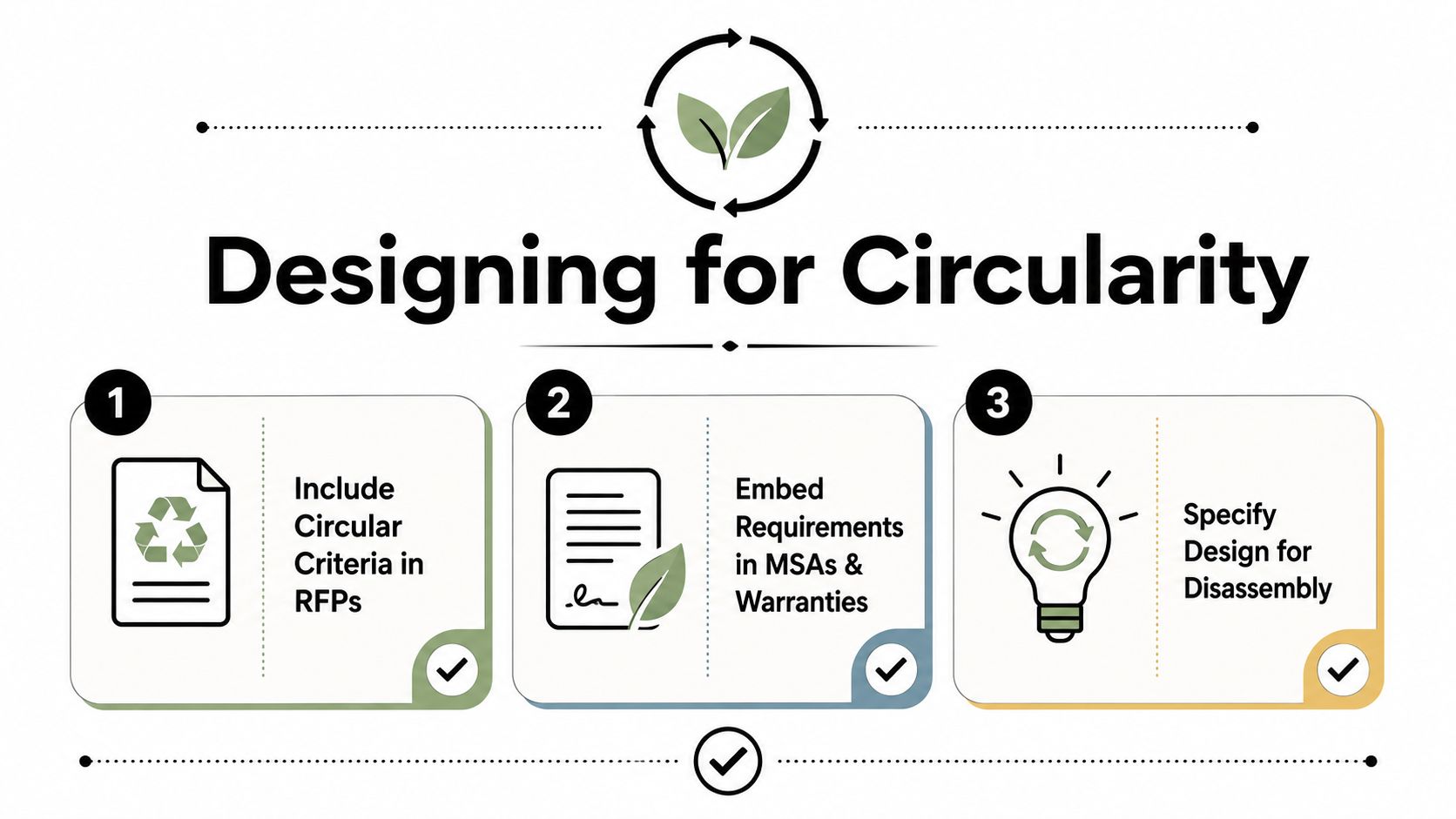
That is why RFPs should ask for specific operational terms, not vague sustainability language. Procurement teams can require takeback obligations, repair-friendly product design, clear data-destruction certificates, and recycled-content commitments where the market can support them. In schools and public agencies, those items can be built into scoring, so circularity is part of the buying decision rather than a statement in a policy binder.
Contract language that changes outcomes
- Takeback terms for end-of-life equipment, so assets do not sit unclaimed in storage or get stranded with the buyer.
- Service and warranty clarity that covers repair, parts replacement, and refurbishment support.
- Design for disassembly language, so vendors keep fasteners, batteries, and components accessible.
- Documentation requirements for sanitization, recycling, or donation, depending on the end path.
- Business model clauses that match the organization's reuse and return strategy, as outlined in this circular economy business models guide.
The product itself matters just as much as the contract. A device built with standard screws, replaceable batteries, and labeled components is easier to refurbish than one sealed shut for manufacturing convenience. Standardized chargers and modular parts also help downstream teams move faster when equipment is returned, repaired, or redeployed. In practice, that means fewer labor hours spent opening cases, tracing parts, or waiting on a vendor for proprietary components.
The trade-off is familiar to anyone running operations. More repairable products can cost more up front, and some vendors will resist contract language that limits their control over end-of-life handling. But if the organization is already paying for storage, pickup, secure processing, and replacement purchases, the true cost often shows up later. A practical way to screen those decisions is to ask what happens if the asset has to be moved through the used container buying guide, resold, or donated after internal use ends, because that routing depends on how the item was specified in the first place.
For organizations writing their first circular procurement clause, the goal is not perfection. It is to stop buying products that are hard to service, hard to document, and hard to route back into the economy. Clear contract terms reduce friction at end of life, and they give IT, facilities, and procurement a shared set of rules before the asset ever arrives.
Reuse, Refurbishment, Resale, and Recycling Compared
Not every retired asset should be treated the same way. A newer laptop with a healthy battery and no data risk belongs in a different stream than a broken desktop with an encrypted drive, and both differ from a fleet of devices that still have social value but little commercial resale value.
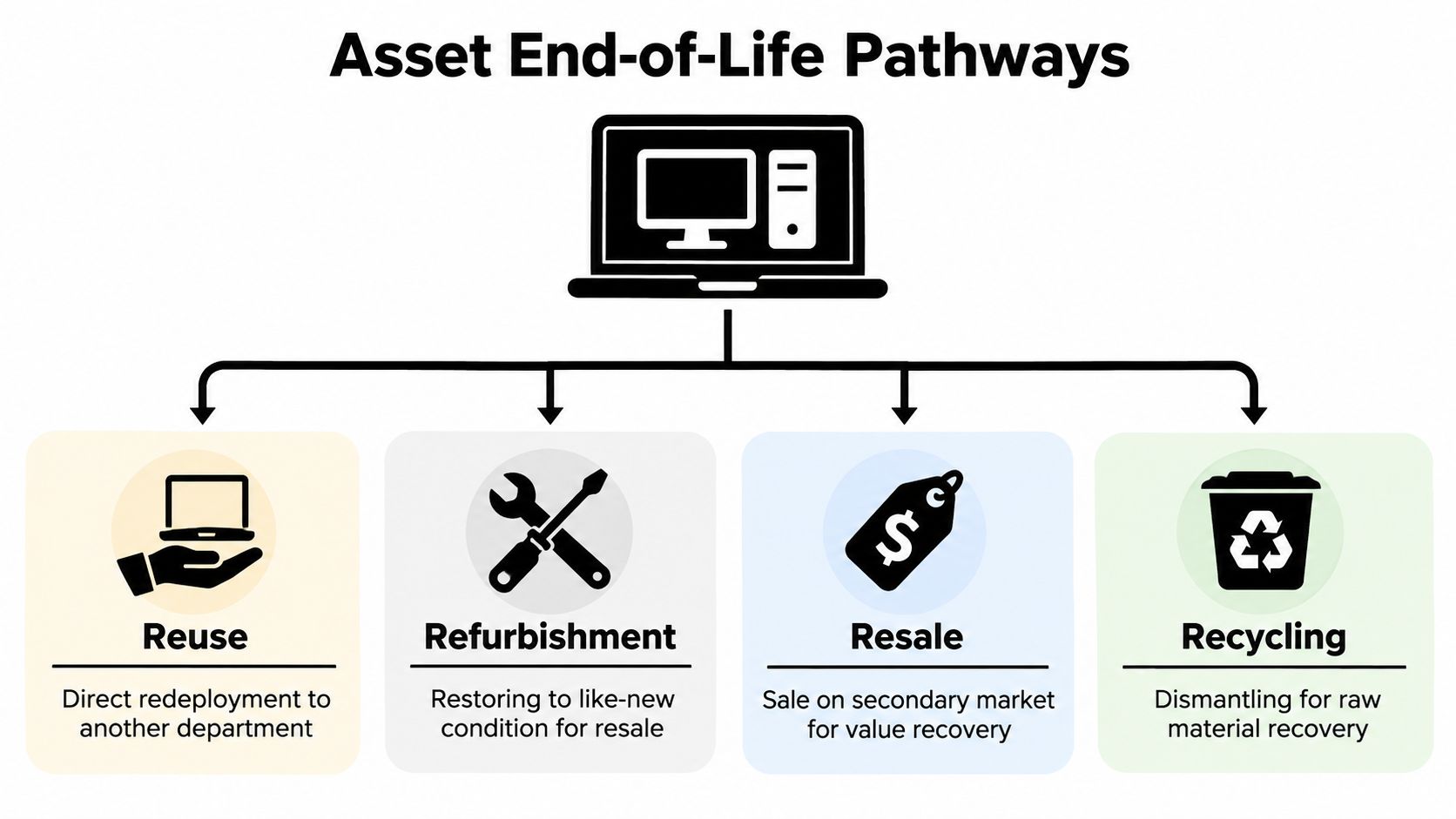
How the paths differ
Reuse works when another department can take the asset as-is or with minor setup. That's the fastest route and usually the least disruptive. Refurbishment makes sense when the unit needs testing, cleaning, or part replacement before it can be used again. Resale is the right fit when the market will still pay for the device and the organization wants to recover some residual value. Recycling is the backstop when reuse is no longer realistic.
Donation-based recycling sits between those choices in a useful way. It can extend device life, support workforce or digital inclusion goals, and still deliver verified processing at end of life. In a lot of SMB and public-sector cases, that's the most balanced option because it turns disposal into a community outcome instead of a pure cost.
If your team is looking at related storage or surplus equipment logistics, a used container buying guide is surprisingly relevant as a planning reference, because the same questions come up around condition, resale, and responsible handoff. The hardware world is different, but the decision logic is similar: route value where it still exists, and recycle only after better options are exhausted.
Not every item needs a second life in the same building. The real test is whether the next use is faster, safer, and more valuable than sending it straight to material recovery.
For leadership, the comparison is straightforward. Reuse is simplest, refurbishment captures more life, resale recovers some value, and recycling closes the loop when everything else is exhausted. The right choice depends on condition, data risk, and the organization's social or financial priorities.
Takeback, Reverse Logistics, and Partnership Architecture
A circular program can fail at the handoff stage even when the reuse plan is sound. A pickup has to match the asset count, serial numbers have to stay intact, and the receiving partner has to show what happened after the truck left. Without that operational backbone, the whole flow becomes guesswork.
What a workable logistics setup looks like
A small office cleanout may only need a scheduled pickup, palletization guidance, and a signed chain-of-custody form. A multi-site rollout needs route planning, insurance clarity, and a partner that can handle secure data destruction and downstream processing without creating extra work for facilities or IT. The process should be boring in the best way possible. Every asset gets tracked, every handoff gets recorded, and every exception gets flagged before the truck departs.
Organizations should ask partners how they handle certification, sanitization, and downstream transparency. R2v3, e-Stewards, and NIST-aligned sanitization are the names to look for in the documentation flow, not because acronyms are the goal, but because they point to a process that can stand up to review. If donation is part of the plan, the partner should also be able to explain how usable equipment is redirected without losing chain-of-custody discipline.
The choice between a commodity recycler and a donation-based social enterprise depends on the outcome you want. If the goal is only material recovery, a standard recycler may be enough. If you also want technology donations, digital inclusion, and workforce development to be part of the workflow, a donation-based model makes more sense because it keeps the asset stream tied to community benefit.
A partner like Reworx Recycling fits that latter path when an organization needs electronics recycling, IT equipment disposal, pickup coordination, and secure data destruction in the same program. For teams building the logistics layer, a reverse logistics service guide can help frame the moving parts, from collection schedules to downstream documentation. That kind of setup lets operations, procurement, and IT work from the same playbook instead of running separate vendor processes.
KPIs, Data Destruction, and Compliance You Can Defend
Circular work loses credibility when nobody can prove it worked. The reporting stack should stay short, concrete, and tied to source documents, not a pile of broad sustainability claims. If a manager cannot trace a number back to an inventory record or a destruction certificate, it will not survive audit season.
Keep the KPI set tight
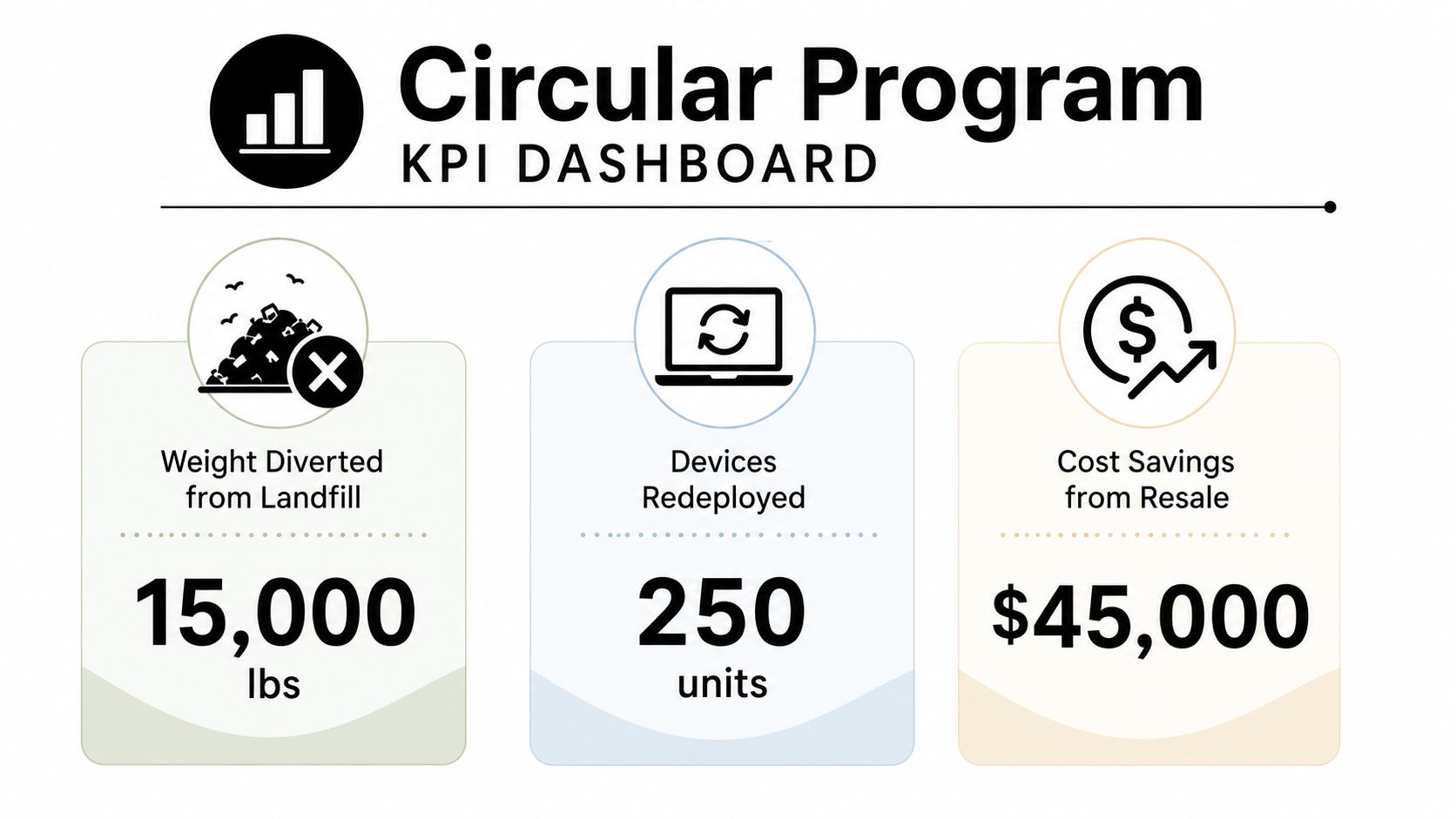
Track weight diverted from landfill, devices redeployed or donated, verified data sanitizations, recycled-content in new purchasing, and any operational savings your team can document. Circular success is best measured by keeping materials in use as long as possible while minimizing material input and consumption, so the metrics should reflect that operational reality rather than generic goodwill. The best dashboards are small enough to manage and detailed enough to defend.
NIST 800-88 gives IT and compliance teams a clear way to match sanitization to risk with Clear, Purge, and Destroy. That matters because not every asset needs the same treatment, but every asset does need the treatment that fits its data class. If the process includes hard drive destruction, use a secure data destruction service and document the result in a way that procurement, legal, and audit teams can all follow.
A separate operational point matters here. E-waste monitoring is used to improve the quality, collection, and interpretation of e-waste data, and to inform circular decisions on valuable materials, critical materials, energy efficiency, and carbon emissions saved, as the International Telecommunication Union explains. That kind of data discipline helps a circular program stay useful after staff changes.
A report without a source document is speculation, not a KPI.
Change Management and a 90-Day Rollout Plan
Most failures in circular programs come from weak adoption, not bad intent. Someone has to own the process, everyone who touches the equipment has to know the return path, and leadership needs the program framed in operational terms. If the only message is “be greener,” the workflow usually gets ignored.
The 90-day rollout that fits real operations
Weeks 1 to 2 should focus on ownership, policy alignment, and a baseline audit. IT tags the retired assets, facilities confirms storage and pickup access, and procurement reviews contract language so the vendor can support the chosen path. If the organization is a school, this is the point to line up timing around breaks. If it's a public agency, procurement calendars matter just as much as truck availability.
Weeks 3 to 8 are for vendor selection and a small pilot. Pick a limited asset stream, run it end to end, and test the paperwork before expanding. Chain-of-custody, sanitization verification, and pickup timing either hold up or show the gaps.
Weeks 9 to 12 should produce first reporting and a scale decision. Leadership doesn't need a glossy sustainability narrative at this stage, it needs a simple account of what moved, what was redeployed, what was donated, and what was recycled. If the pilot worked, expand it into ITSM, facilities calendars, and refresh planning.
For SMBs without a sustainability team, one owner and one vendor is enough to start. For larger organizations, the workflow should live inside existing ticketing and procurement systems so it doesn't depend on memory. The more routine it feels, the more likely it is to stick.
Reworx Recycling helps organizations turn retired electronics into a controlled, documented workflow that covers pickup, donation, secure data destruction, and responsible recycling. If your team is planning an office cleanout, a device refresh, or a decommissioning project, visit Reworx Recycling to schedule a pickup, donate old equipment, or line up a partnership that puts usable technology back into the community.