You're staring at a vendor questionnaire, and half the questions don't sound like they belong in your world. One line asks about climate risk governance, another wants emissions data, and a third asks how you handle retired laptops, data wipes, and downstream recycling. If you manage IT, facilities, procurement, or sustainability, that moment can feel sudden, but it's becoming normal.
ESG reporting requirements are no longer a niche sustainability topic. According to the CDSB and WBCSD Reporting Exchange analysis, there are now more than 1,750 sustainability reporting provisions across 60 countries, and the number of requirements has grown more than ten-fold since the 1992 Rio Earth Summit. The same analysis says over 1,000 reporting requirements now come from national and supranational bodies, and 69% of the cataloged requirements cover environmental topics, compared with 49% for social topics (CDSB and WBCSD Reporting Exchange analysis).
That shift explains why ESG now reaches beyond investor relations teams. A sustainability lead may be preparing for a formal filing, while a mid-sized supplier may be answering the same questions through a customer portal. The pressure comes from three sides at once, regulators want auditable data, investors want comparable disclosure, and procurement teams want to know whether vendors can support the buyer's own reporting obligations.
Reworx Recycling fits into that reality because hardware retirement, secure data handling, and disposal records can become part of the ESG story for IT-heavy organizations. The important point is simple, even if the paperwork isn't. A company doesn't have to be a giant public issuer to feel mandatory ESG reporting pressure anymore, because the requirement often arrives through contracts, questionnaires, and supply-chain due diligence.
Why ESG Reporting Requirements Matter to Every Business
A spreadsheet often appears before a regulation does. An IT manager receives a questionnaire from a major customer, sees requests for waste diversion, emissions, or proof of data destruction, and realizes the vendor relationship now depends on reporting discipline. A facilities director runs into the same pressure when procurement asks for recycling records, energy data, or end-of-life handling.
That shift changes the job. ESG reporting used to mean a public statement about values and sustainability goals. It now often means answering specific, document-backed questions that influence sales, renewals, and audits.
The regulatory field is no longer narrow
The reporting burden has expanded across regions and industries. The CDSB and WBCSD Reporting Exchange analysis shows more than 1,750 sustainability reporting provisions across 60 countries, with over 1,000 requirements coming from national and supranational bodies. Environmental topics make up the largest share of those requirements, so energy, waste, and resource-use data now sit close to the center of ESG work.
That matters for small and mid-sized businesses too. A company may never be named in a headline rule, yet still receive reporting demands from enterprise customers that need value-chain data for their own filings. For many suppliers, that makes a request that looks voluntary on paper feel mandatory in practice.
What sustainability reporting means in practice helps frame why these requests keep showing up in procurement and compliance conversations.
Practical rule: if a customer, lender, or public agency asks for ESG data more than once, treat that request like a standing compliance input, not a one-off questionnaire.
The old view was that ESG belonged to brand teams and annual reports. The current reality is more operational. It affects transaction readiness for organizations with hardware, facilities, logistics, or disposal obligations.
Why the pressure feels different now
KPMG reports that the EU's Corporate Sustainability Reporting Directive will make ESG and sustainability reporting mandatory for around 50,000 companies, including more than 3,000 in the United States with EU exposure (KPMG). That scale matters because global buyers now expect suppliers to keep pace, even when the supplier's home market is not the one writing the rule.
For businesses handling IT assets, office cleanouts, or electronics recycling, the questions usually start with something concrete. What happens to retired laptops, where do reused devices go, and can the company prove secure data destruction and recycling outcomes? Those questions now sit inside the reporting chain, and procurement teams often ask for that evidence long before a formal filing is due.
What ESG Reporting Actually Requires From Your Data
Think of ESG reporting less like a glossy annual report and more like financial reporting. A marketing-style summary can tell a good story, but it won't satisfy a reviewer who needs traceable numbers, documented methods, and a clear connection to operations. The modern standard is not “Can you describe your sustainability efforts?” It's “Can you prove how you calculated them?”
Audit-grade ESG data starts with traceability
The technical shift is from narrative to datapoint-level disclosure. Under the EU CSRD and ESRS regime, companies in scope must include sustainability information in annual reports, apply double materiality, and maintain structured links between disclosures, the relevant standard, and the calculation methodology (PwC; Harvard Corporate Governance Forum). That means the report is only as strong as the records behind it.
If your team can't answer basic source questions, the report is fragile. Where did the number come from, who touched it, what system stored it, and what method turned raw data into the final metric? Those details matter because ESG disclosure now needs to stand up to review in a way that resembles finance.
Double materiality changes the questions you ask
Double materiality means reporting both how sustainability issues affect the business and how the business affects people and the environment (Harvard Corporate Governance Forum). That matters for IT, facilities, and operations because the same activity can sit on both sides of the lens. A device refresh program can affect costs, risks, waste, reuse, and downstream impact all at once.
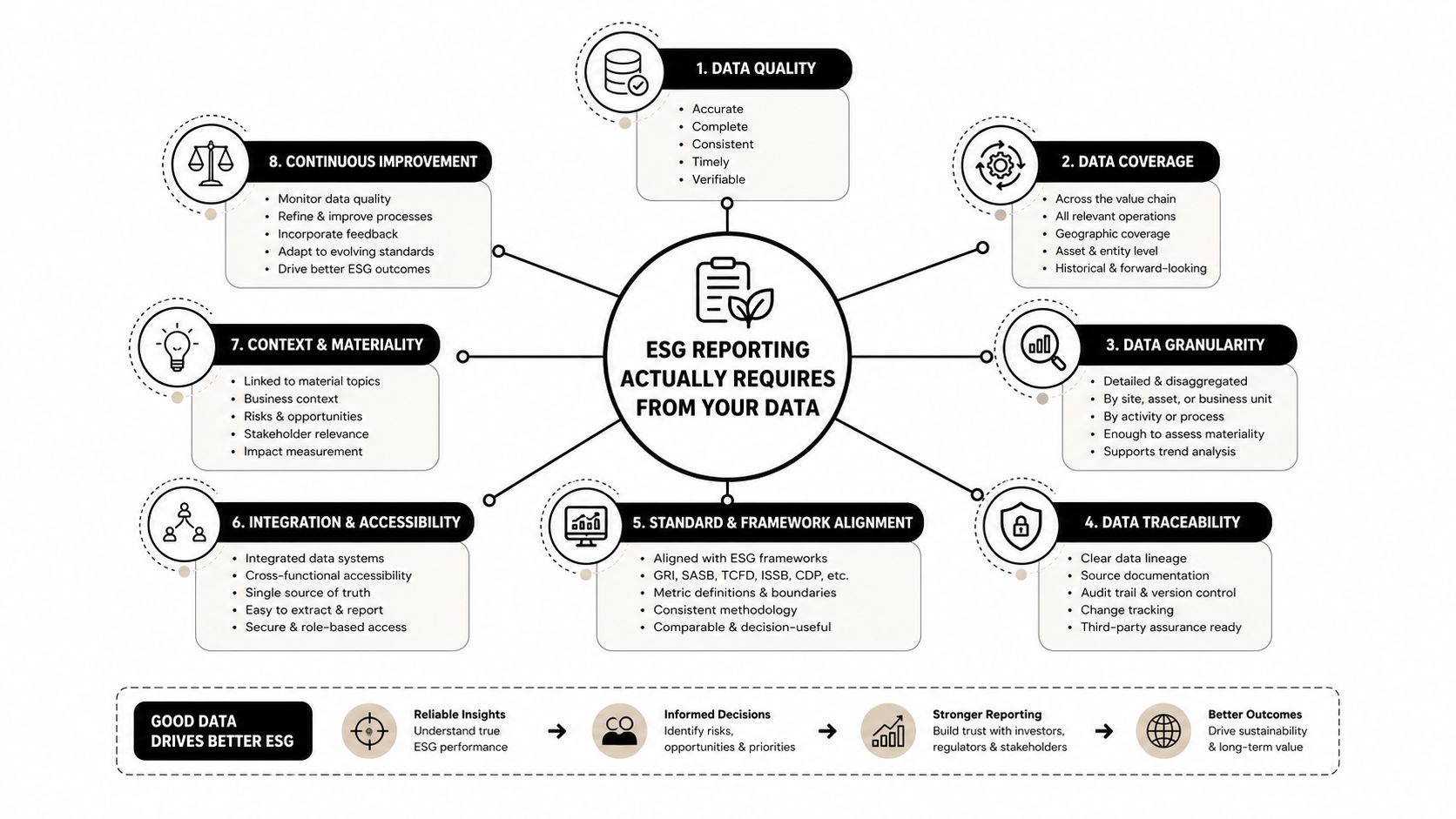
A useful mental model is this. If your current sustainability statement can't be traced back to source data, calculation notes, and version control, it's a communications asset, not audit-grade evidence.
The Reworx Recycling data risk assessment is relevant here because hardware disposal, secure wiping, and disposition records are part of the same evidence chain. ESG reporting increasingly rewards organizations that can show how environmental claims and data-handling claims are documented in the same workflow.
Global Frameworks That Shape ESG Reporting Requirements
A facilities manager replacing a building's lighting system, or an IT team retiring a laptop fleet, may discover that the reporting question is no longer local. A buyer, lender, or regulator can ask for the same activity to be described in different ways, which is why ESG reporting requirements often start with framework awareness before they ever reach the spreadsheet.
Four frameworks show up most often
The EU's CSRD and its ESRS standards are the most structurally demanding because they combine double materiality, annual report inclusion, and digital tagging. In practice, that means reporters need disclosures that connect impacts, risks, and methods back to evidence, not just narrative language. PwC notes that in-scope firms need a structured link between each disclosure, the applicable ESRS requirement, and the calculation method (PwC).
The ISSB standards, IFRS S1 and S2, are built for investor-focused disclosure. The SEC climate rules emphasize financially connected climate risk, governance oversight, and material Scope 1 and Scope 2 disclosures for accelerated filers where applicable (Datatracks). GRI sits differently. It is broader, impact-oriented, and often used alongside mandatory frameworks to answer stakeholder and supply-chain requests.
For a hardware-heavy organization, these frameworks can feel less like separate books and more like different readers asking about the same shelf of evidence. Finance wants material exposure. Procurement wants traceability. Operations wants a clear record of what happened to equipment, energy use, and waste.
Major ESG Reporting Frameworks at a Glance
| Framework | Primary Jurisdiction | Who It Applies To | Core Disclosure Focus |
|---|---|---|---|
| CSRD / ESRS | European Union | Large EU companies, certain listed SMEs, and some non-EU groups with significant EU turnover | Double materiality, sustainability impacts, climate, governance, digital tagging |
| ISSB IFRS S1 and S2 | Global baseline through adoption in many markets | Companies subject to investor-grade climate and sustainability reporting | Financially material sustainability and climate risk disclosure |
| SEC climate disclosure rules | United States | Registrants within the rule's scope, with filer-specific obligations | Climate risk, governance oversight, and material GHG disclosure |
| GRI | Global | Voluntary, widely used across sectors and jurisdictions | Broad stakeholder impact reporting and sustainability transparency |
The practical difference shows up in the data request. A CSRD report may ask how an equipment refresh affects both the company and the outside world. An ISSB report may focus on whether that refresh creates financially material climate or transition risk. A GRI request may be broader still, asking how the organization manages impact across employees, suppliers, communities, and waste streams.
For businesses with large fleets of laptops, servers, monitors, and network gear, the key point is straightforward. These frameworks reward clean source data, not polished language. If records for equipment retirement, energy use, reuse, or chain of custody are weak, every framework becomes harder to satisfy.
The extended producer responsibility perspective matters here because downstream responsibility for products and materials pushes more companies to document what happens after equipment leaves the building. That is the point where IT asset disposition, reuse, recycling, and reporting begin to overlap.
Mandatory vs Voluntary ESG Disclosure in Practice
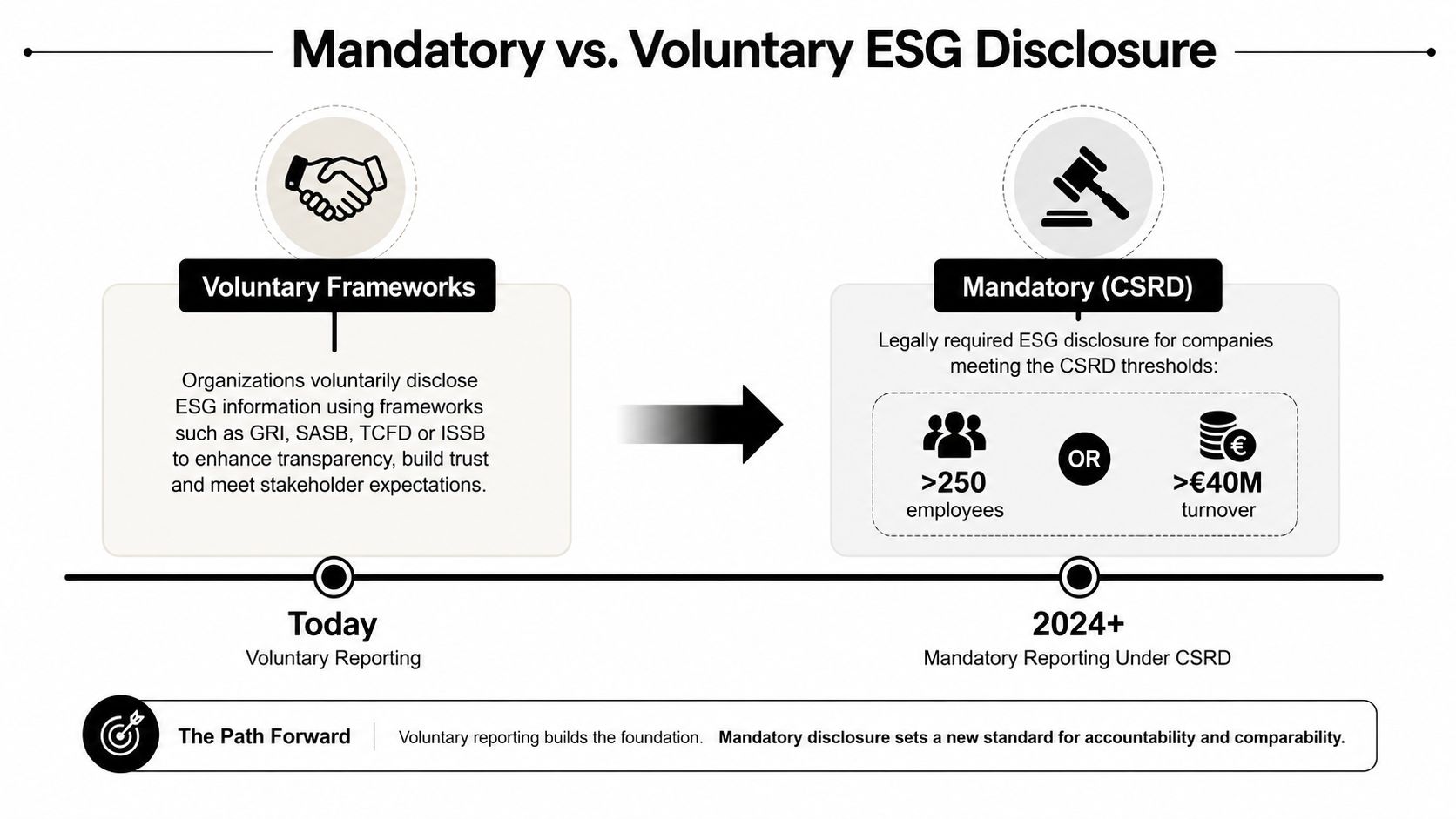
A lot of companies still talk about ESG as if it sits in one of two buckets, required or optional. That's too simple. In practice, a company may not be directly regulated, yet still face reporting demands from customers, investors, lenders, or public agencies that act like a mandatory system.
CSRD is the clearest example of hard obligation
The KPMG data gives a concrete sense of scale. Around 50,000 companies fall under CSRD, and the phased rollout begins with large public-interest entities with 500+ employees in 2024, then expands to other large companies in 2027 for reports due in 2028 (KPMG). PwC adds that the reporting model includes annual report integration, double materiality, and digitally structured disclosure under ESRS (PwC).
That structure matters because it creates a chain reaction. Once large buyers have to report, they need supplier data. Once they need supplier data, the questionnaire travels downstream.
Voluntary often turns into de facto mandatory
The Cooley analysis highlights the spillover issue clearly. CSRD extends into upstream and downstream value chains, and non-EU groups can be in scope if they generate over €450 million in EU net turnover for two consecutive years and have a significant EU presence (Cooley). Even where a company isn't directly caught, it can still be pulled into the reporting ecosystem through procurement and contract language.
That's the point many small and mid-sized suppliers miss.
- Customer questionnaires: Large buyers ask for carbon, waste, labor, and governance data because they need it for their own reports.
- Contract clauses: ESG and due-diligence language can become a condition of doing business.
- Assurance requests: Buyers may ask for documents that prove recycling, destruction, or emissions figures.
If a procurement team starts asking for the same ESG documents every quarter, the issue has moved from “nice to have” to “commercial requirement.”
For IT managers, facilities leaders, and vendor owners, the smart move is to answer the question before it arrives. Determine which disclosures you already have, which ones customers are likely to request, and which records need to be built now so they aren't assembled under deadline pressure later.
Key ESG Metrics for Hardware and E-Waste-Heavy Organizations
Most ESG guides focus on energy and carbon in the abstract. Hardware-heavy organizations need something more operational. When your footprint includes laptops, servers, printers, batteries, monitors, and decommissioned equipment, the most credible ESG metrics are the ones tied to asset handling, waste outcomes, and chain-of-custody records.
Start with emissions, then connect them to assets
The SEC climate summary in the provided source emphasizes climate-related risks, board oversight, and, for some filers, Scope 1 and Scope 2 emissions if material (Datatracks). CSRD goes further by requiring direct and indirect emissions alongside governance, transition plans, and risk management disclosures (PwC). For equipment-intensive organizations, those emissions figures are easier to defend when they are anchored to actual facility and asset data.
Scope 1 covers direct emissions from owned or controlled sources. Scope 2 covers purchased electricity. Scope 3 reaches into the broader value chain, including upstream manufacturing and downstream treatment of retired gear. That's where IT asset disposition, reuse, and recycling become reporting inputs instead of back-office afterthoughts.
The metrics your team will actually be asked for
For a recycler, school system, municipality, or enterprise IT group, the conversation usually lands on a few practical measures.
- Waste generated and diverted: How much material left the site, and how much avoided landfill disposal.
- Reuse and refurbishment: How many devices were redeployed, donated, or resold.
- Secure data destruction: How many drives or devices were wiped, shredded, or otherwise rendered unusable.
- Chain of custody: Can you trace the asset from pickup to final disposition?
- Downstream treatment: Can you document what happened after collection, not just that it was collected?
The environmental impact reporting page is relevant because ESG teams need the documentary side of this work, not just the physical pickup. For hardware-heavy organizations, the strongest ESG evidence often comes from serialized asset records, facility-level logs, and final disposition documentation.
A good rule is simple. If the metric can't survive a follow-up question from finance, legal, or a customer auditor, it isn't ready for ESG disclosure.
A business handling office cleanouts or data center decommissioning should also think about product destruction carefully. That process can support ESG narratives only if the underlying records are specific enough to show what was destroyed, what was reused, and what was recycled.
Building an ESG Data Pipeline and Assurance Workflow
A strong ESG report doesn't begin in the boardroom. It begins in the systems that already run the company, finance, procurement, HR, facilities, legal, and IT. If those teams store data in separate places, the reporting process becomes a stitching exercise unless someone designs the pipeline on purpose.
Build the workflow in the same order reviewers will inspect it
Start with the topics that are clearly material, then map where the evidence lives. CSRD's double materiality model requires companies to look at both financial exposure and impact on people and the environment (Harvard Corporate Governance Forum). That means the data map should start with the business process, not the reporting template.
Then identify source systems. Finance may hold spend and capex. Facilities may hold utility bills and waste logs. HR may hold workforce data. IT may hold device inventories and disposition records. Legal may hold contract language that affects supplier disclosures.
The PwC guidance is useful here because it frames ESG reporting as a controlled data pipeline with methodologies, source data, and version control (PwC). That's the right mental model. You're building repeatable evidence, not assembling a presentation.
Assurance makes process discipline unavoidable
ESG assurance is moving closer to financial reporting in how it expects documented process and internal controls. In the provided sources, the technical implication is clear, if a company can't trace each metric to a verifiable source and calculation method, it will struggle to meet CSRD-grade assurance expectations (PwC). That means version control, review checkpoints, and clear ownership are not optional.
A mid-sized company without a sustainability department can still do this in phases.
- Use what finance already trusts. Start with utility, spend, and asset records that already have owners.
- Standardize calculations. Document how each metric is derived.
- Add controls. Put review steps in place before data reaches the final report.
- Test for traceability. Make sure a reviewer can move from report number to source record quickly.
The chain of custody documentation link matters because hardware disposal and recycling records often become the easiest evidence to validate. If the documentation is clean, the ESG pipeline gets easier, not harder.
How Service Partners Strengthen Your ESG Reporting
The fastest way to make ESG reporting more credible is to stop treating vendors as separate from the process. For organizations that rely on electronics recycling, IT asset disposition, office cleanouts, or data center decommissioning, third-party service partners can supply the records that internal teams usually struggle to assemble on their own.
A good partner gives you more than pickup. It provides serialized asset tracking, chain-of-custody records, final disposition packages, and proof that devices were handled securely. Those records support both environmental reporting and data-security narratives, which is why procurement teams increasingly ask for them together.
The other value is social impact. Donation-based recycling can create reportable outcomes that go beyond waste diversion, especially when devices are refurbished for reuse or routed into community programs. Reworx Recycling is one option in this space, and its model combines electronics recycling with donation-based IT equipment disposition, secure data destruction, and documentation that can support ESG records. That matters because ESG teams rarely need another generic sustainability claim, they need evidence they can file, share, or attach to a supplier response.
The right service partner reduces reporting work by creating records at the moment of handling, not after the fact.
For IT and facilities managers, that changes the next quarter's priorities. Instead of asking whether the recycler is certified in the abstract, ask what records you'll receive, how assets are tracked, and whether the final paperwork supports audit review. Those questions are more useful than broad promises, because ESG reporting depends on documents, not slogans.
Turning ESG Readiness Into a Competitive Advantage
ESG readiness is no longer just a risk-management exercise. It's a sales-access issue. Companies that can answer customer questionnaires quickly, support procurement reviews, and back up their claims with documentation reduce friction in the buying process and avoid scrambling when a regulator, investor, or large customer asks for evidence.
The next 90 days are usually enough to make real progress if the work is focused. Confirm which reporting rules or customer requests apply to your organization. Map where your ESG-relevant data lives, especially waste, utilities, fleet, facilities, and asset disposition records. Review the questionnaires your team has received in the past year and flag the repeated questions. Then assign ownership for hardware end-of-life reporting so the same evidence can support recycling, data security, and ESG disclosure.
For hardware-heavy teams, the gap is often not ambition. It's documentation. A company can have a solid recycling practice and still fail a customer review if pickup records, disposition notes, and destruction certificates are scattered across inboxes and spreadsheets. Fixing that is straightforward compared with fixing it after an RFP is already due.
If your business needs a practical way to document electronics recycling, secure data destruction, donation-based recycling, or pickup scheduling, Reworx Recycling can help create the records that make ESG reporting easier to defend. Visit Reworx Recycling to review options for responsible equipment disposition and to plan a process your IT, facilities, and sustainability teams can use.