
An employee finishes a laptop refresh, puts three retired devices in the back seat, and plans to drop them off later. Then the day gets busy. The car sits overnight. Nobody logs the serial numbers. Nobody confirms whether the drives were wiped. By morning, a routine hardware swap has turned into a data security, compliance, and environmental risk.
That scenario isn't rare. In many organizations, old hardware leaves active use long before it enters a controlled IT asset disposition process. The gap between those two moments is where mistakes happen. A phone goes into general recycling. A desktop gets stored in an unsecured closet. A facilities team member moves pallets without clear chain-of-custody paperwork.
This is why training and education matter so much in ITAD. Policies alone don't protect devices. People do. When staff know what to do, when to escalate, and how to document each step, the organization lowers risk and handles e-waste responsibly.
Why E-Waste Training Matters Now More Than Ever
A disposal mistake usually looks small at first. Someone leaves an old company phone in a desk drawer after an office cleanout. A branch manager asks a local hauler to remove obsolete monitors without checking whether the vendor handles electronics recycling correctly. A lab coordinator sends aging equipment out with surplus furniture because nobody explained the difference between general disposal and controlled retirement.
Those aren't just process errors. They're failures in internal training.

Small mistakes create two different risks
The first risk is obvious. Devices can still hold sensitive data. Laptops, servers, copiers, medical devices, and network storage often contain information long after users think they're "empty."
The second risk gets less attention. Improper disposal feeds a much larger waste problem. Globally, 62 million tonnes of e-waste were produced in 2022, an 82% increase from 2010, and the total is projected to rise another 32% to 82 million tonnes by 2030, according to the Global E-waste Monitor 2024. For businesses, that means old hardware isn't a side issue anymore. It's part of operational risk management.
A practical training program connects those two realities. It teaches employees that secure data destruction, controlled pickup, and sustainable recycling are part of the same workflow. If your team treats them as separate tasks, gaps open quickly.
Practical rule: If a device has reached end of life, your staff should know exactly who owns it, where it is, and what retirement path it follows.
Why business leaders should care
For business owners and IT managers, the business case is simple. Training reduces improvisation. Improvisation is what causes lost devices, weak documentation, and vendor handoffs that nobody can audit later.
For sustainability leaders, training also strengthens environmental performance. Teams can't support donation-based recycling or responsible computer recycling if they don't know how to sort assets, identify reusable equipment, or route material to the right downstream process. The environmental impact of electronic waste becomes much easier to manage when employees understand their role before devices leave service.
This matters in every setting, from data center decommissioning to office cleanout projects, from laptop disposal to product destruction. Internal education turns a reactive process into a controlled one. That shift protects the business, supports compliance, and keeps discarded electronics out of the wrong stream.
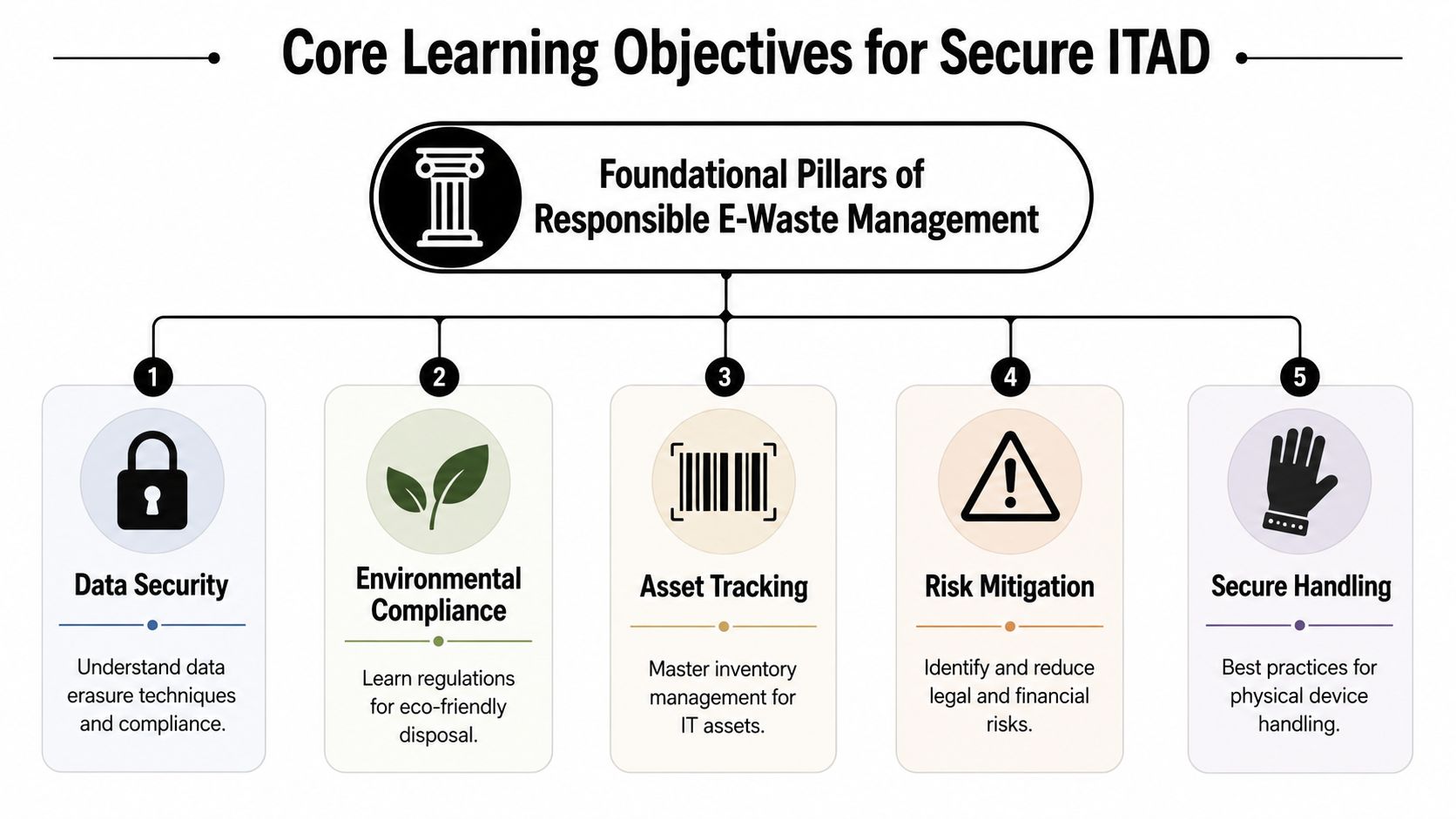
Core Learning Objectives for Secure ITAD
A sound ITAD program doesn't start with a truck or a shredder. It starts with clear learning objectives. If employees don't understand the core decisions behind secure handling, no procedure will hold up under pressure.
Data security and asset classification
The first objective is data security. Staff need more than a vague instruction to "wipe the drive." They need to understand when certified erasure is appropriate, when physical destruction is required, and how standards such as NIST 800-88 fit into retirement decisions.
That depends on asset classification. A low-risk monitor doesn't follow the same path as a storage array or an executive laptop. Faddom's ITAD best practices note that decision trees must be based on asset risk, and that this process fails when staff aren't trained to categorize assets correctly.
A useful way to think about this is through learning outcomes. In education design, outcomes define what a person should know or be able to do after training. That same principle applies here, and a concise guide for adult university applicants is a helpful reminder that good training starts by defining observable results, not just assigning reading.
Chain of custody and secure logistics
The second objective is chain of custody. Employees should know how to document every transfer point, from desk pickup to storage cage to outbound shipment. That record needs to be consistent enough for audits and simple enough that teams use it.
The third objective is secure logistics. Devices are often lost in the handoff stage, not in the destruction stage. The same Faddom guidance states that training on secure logistics reduces the probability of misplaced devices by enforcing chain-of-custody controls. That means teaching staff how to label assets, stage pickups, restrict access, and confirm counts before transportation begins.
For teams formalizing this process, strong chain of custody documentation gives managers a concrete benchmark for what complete tracking should look like.
If you can't reconstruct where a device went, who handled it, and what happened to its data, your ITAD process isn't complete.
Compliance, handling, and recycling judgment
A complete curriculum also needs three more objectives:
- Regulatory awareness: Employees don't need to become lawyers, but they do need to know that industries governed by privacy and record-handling rules can't treat retirement as informal junk removal.
- Physical handling discipline: Facilities teams should know how to package, store, and move devices without damaging equipment or breaking seals before disposition.
- Recycling judgment: Staff must recognize the difference between legitimate sustainable recycling, donation-based recycling, resale triage, and improper disposal channels.
These objectives work together. Data security without logistics control isn't enough. Logistics control without environmental compliance isn't enough either. Secure IT asset disposition depends on employees understanding the full chain, not just their narrow task.
Designing Role-Based Training Curricula
The biggest design mistake I see is giving everyone the same slide deck. That approach wastes time for some employees and leaves critical gaps for others. A receptionist, a data center technician, a procurement lead, and a facilities supervisor don't need identical training. They need connected training with role-specific depth.
That matters because investment in learning has real economic value. The World Bank states that there is a 9% increase in hourly earnings for every additional year of schooling, which reinforces the practical return on well-targeted training investments in the workplace through its education overview. In ITAD, the point isn't academic. Better training changes daily decisions.
Match the curriculum to the role
A role-based model keeps the core message consistent while adjusting the level of detail. Everyone should understand basic disposal rules. Only some teams need detailed instruction on secure data destruction, reverse logistics, or vendor controls.
Here is a working framework managers can adapt.
| Role | Key Training Modules | Learning Objective |
|---|---|---|
| IT staff | Data classification, NIST 800-88 aligned erasure practices, asset inventory control, secure data destruction verification | Correctly determine whether assets should be wiped, destroyed, remarketed, or held for further review |
| Facilities and logistics teams | Device handling, palletization, chain of custody, staging areas, pickup coordination, facility cleanout controls | Move retired equipment without loss, breakage, or undocumented transfers |
| Procurement and vendor management | Contract language, audit requirements, certificates, downstream accountability, social enterprise recycling review | Select and manage IT equipment disposal partners that meet security and sustainability requirements |
| Department managers | Office cleanout planning, laptop disposal escalation, employee communications, exception handling | Prevent ad hoc disposal and route all end-of-life assets into the approved process |
| General end-users | What not to do with old equipment, return procedures, storage rules, who to contact | Recognize responsibility for retired devices and avoid informal disposal |
What each group actually needs to learn
IT staff need procedural precision. They should be able to identify high-risk assets, validate data destruction paths, and reconcile equipment against records. That's where technical errors become legal and operational problems.
Facilities teams need habit-based training. They benefit from simple checklists, visual labels, and pickup workflows. Their job isn't to interpret privacy law. Their job is to protect custody and prevent uncontrolled movement.
Procurement teams need a different lens. They influence whether the organization works with certified, documented providers or with loosely defined haulers. The wrong contract can undermine every control built by IT.
Managers who oversee refreshes, moves, or consolidations also need guidance. Many ITAD breakdowns happen during office relocation, medical equipment disposal, laboratory equipment disposal, or product destruction events because local leaders create shortcuts on the fly. Clear role ownership prevents that.
For leaders refining responsibilities, this overview of IT manager responsibilities is useful because it ties governance to actual operational decisions, not abstract accountability.
Manager check: If two employees in different departments would answer "What do I do with this retired device?" differently, your curriculum isn't aligned yet.
A strong curriculum respects how work really happens. It doesn't drown everyone in policy language. It gives each role the exact knowledge needed to keep devices secure, compliant, and properly routed.
Implementing Your E-Waste Training Program
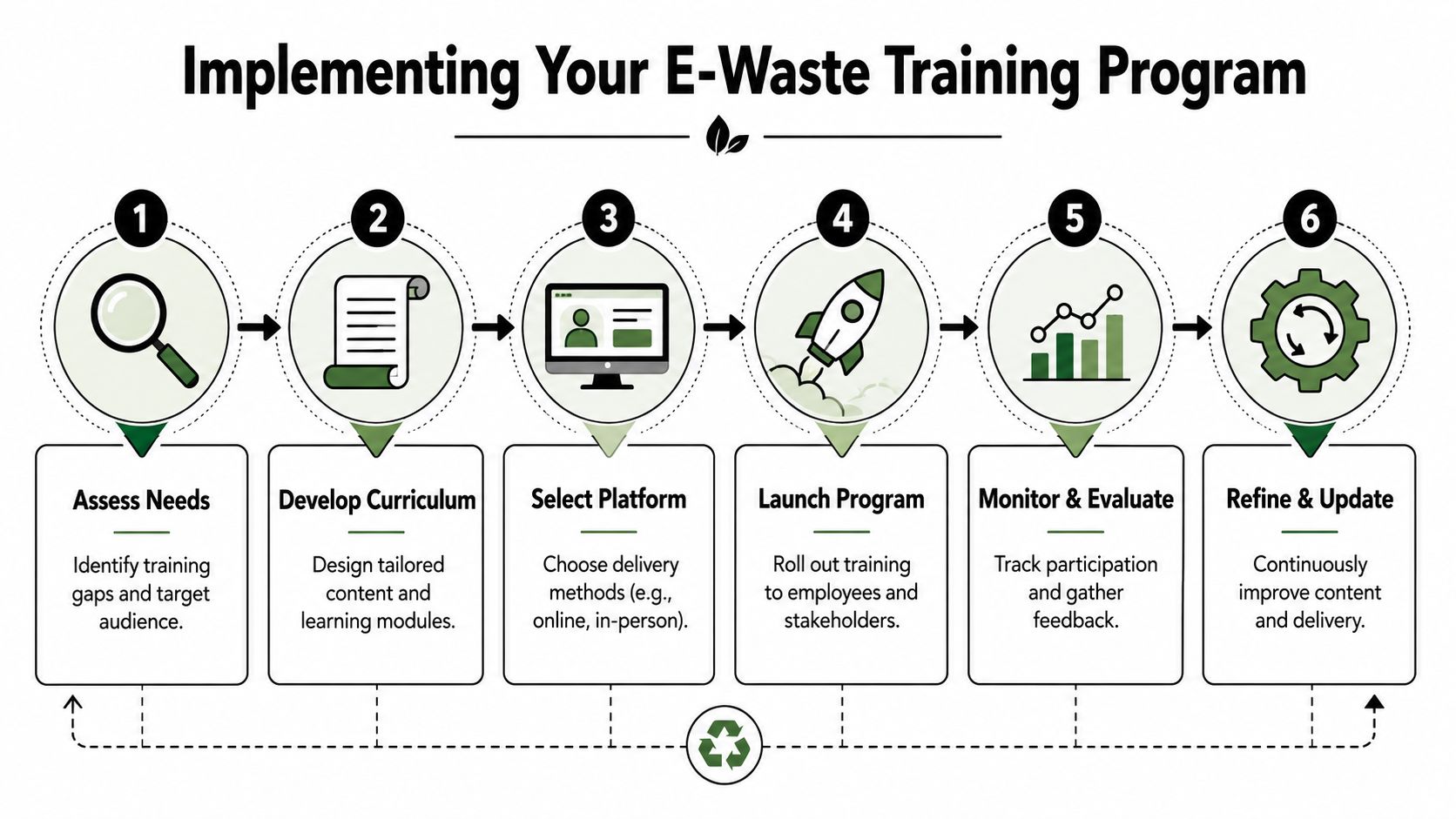
A training plan becomes real when managers assign owners, schedule delivery, and tie the content to operations. That's where many organizations stall. They agree the issue matters, then postpone rollout until the next refresh cycle, the next office move, or the next compliance review.
Delay is expensive in practical terms. The United States generates approximately 6.9 million tons of electronic waste annually, yet only 15% is formally collected and recycled, which means 85% is managed improperly, according to these e-waste facts and statistics. Internal training won't solve that by itself, but it does change what happens inside your organization.
Start with operational gaps
Begin with a short assessment. Look for points where devices leave control, where records go incomplete, and where staff make judgment calls without guidance. Focus on real workflows such as laptop disposal, branch closures, data center decommissioning, and medical equipment disposal.
Then define the minimum essential elements:
- Approved retirement paths: Staff need one clear route for each asset category.
- Named responsibility: Someone must own pickup approval, data destruction review, and final documentation.
- Escalation rules: Employees should know when to stop and ask instead of guessing.
Choose formats people will actually use
Not every audience needs a workshop. End-users usually need brief, repeatable guidance. IT and facilities teams often need hands-on instruction with labels, containers, serial reconciliation, and pickup procedures.
School leaders often use compliance tracking methods from other training contexts. The same logic behind tools that ensure teacher lesson compliance can help managers monitor whether required ITAD training has been completed, acknowledged, and refreshed on schedule. The principle is the same. Expectations must be visible, assigned, and checked.
You can structure delivery like this:
- Microlearning for employees: Short modules on what to return, where to store it, and what never goes in trash or general recycling.
- Scenario drills for managers: Walk through office cleanout, facility cleanout, and surplus events before they happen.
- Hands-on sessions for IT and logistics: Practice intake, labeling, secure packaging, and exception handling.
Use outside expertise where it saves time
Many organizations don't need to build every module internally. For specialized topics such as secure data destruction, chain-of-custody handling, donation-based recycling, and reverse logistics, an external ITAD partner can deliver practical training tied to actual end-of-life workflows. Implementation timelines help managers map that support to refresh schedules, closures, or year-end asset retirement.
One option is Reworx Recycling, which provides electronics recycling, IT equipment disposal, secure hard drive shredding, pickup services, and related guidance for organizations managing end-of-life technology. In practice, that kind of partner support is useful when internal teams understand their responsibilities but need a documented external process to complete the chain.
Implementation works best when training is treated like a control, not a campaign. Once it's part of onboarding, project planning, and refresh governance, employees stop improvising and start following a repeatable path.
Measuring Success and Reporting on Impact
If you only measure training completion, you won't know whether behavior changed. Completion tells you who watched the material. It doesn't tell you whether devices are being tracked better, whether exceptions are reported sooner, or whether departments are using approved retirement channels.
The stronger approach is to connect learning to operational evidence. That's where training and education become visible to executives, auditors, and sustainability teams.
Metrics that show behavior, not just attendance
Track indicators that reflect control quality:
- Documented asset transfers: Are handoffs being logged consistently from collection through final disposition?
- Exception reporting: Are employees flagging unidentified, damaged, or unusually sensitive devices instead of bypassing procedure?
- Destruction verification rates: Are certificates and internal records aligned for assets that require secure data destruction?
- Recovery and donation routing: Are reusable devices being separated from scrap streams for corporate donation programs or reuse pathways?
- Audit readiness: Can your team assemble the records needed to explain what happened to a batch of retired devices?
Evaluation discipline matters. If you need a general planning model, Model Diplomat's M&E framework insights are useful because they show how to connect activities, outputs, and outcomes instead of stopping at participation counts.
Training works when the records get cleaner, the handoffs get tighter, and fewer assets fall into gray areas.
Turn internal performance into ESG reporting
Reporting shouldn't stop at security or compliance. A mature ITAD training program also supports social responsibility. The Career Ladders Project notes a serious career-readiness gap for underserved students, with only 8% feeling fully prepared to make decisions about their future, as outlined in its policy-to-practice guide for historically underserved students. That matters for corporate reporting because internal disposal programs can connect to broader community outcomes when reusable equipment and responsible partnerships are built into the process.
If your organization combines secure retirement practices with donation and workforce-oriented community engagement, that creates a stronger ESG narrative. You're not just reducing disposal risk. You're showing that technology transitions can support digital inclusion and practical career exposure.
Use simple reporting language. Describe how your training improved control, how your IT asset disposition process reduced informal disposal, and how approved donation or reuse channels supported community benefit. Clear stories backed by operational records are more credible than polished slogans.
Building a Culture of Responsibility with Reworx
A strong ITAD program isn't a binder on a shelf. It's a culture. People know that old devices don't get tossed into closets, loaded into personal vehicles, or handed to unvetted vendors. They know retirement has rules, records, and assigned ownership.
That culture protects the business in ordinary moments. A rushed office cleanout. A laptop refresh across multiple locations. A warehouse purge. A school district surplus event. In each case, the primary safeguard is a trained employee who knows the approved path and follows it.
What a responsible culture looks like
You can usually spot it quickly:
- Employees escalate questions early: They ask before moving unusual equipment.
- Managers plan disposition in advance: Retirement is part of project design, not cleanup.
- Records follow the asset: Serial numbers, custody, and disposition don't get reconstructed later.
- Sustainability goals are operationalized: Donation, reuse, computer recycling, and secure data destruction are built into the workflow.
This is why training is an investment, not overhead. It reduces preventable risk, supports compliance, and helps the organization treat electronics as managed assets through the end of life.
For companies that want to formalize both operational controls and community benefit, partnering for impact with Reworx is a practical model to review. The value isn't just in moving equipment out of a building. It's in building a repeatable process that aligns electronics recycling, social enterprise recycling, and internal accountability.
When training, logistics, compliance, and social responsibility work together, ITAD stops being a back-end chore. It becomes part of how the organization manages risk and fulfills its obligations to customers, employees, and the wider community.
If your business is planning an office cleanout, laptop disposal project, secure data destruction initiative, or broader IT equipment disposal effort, Reworx Recycling offers a useful next step. Explore the company's recycling resources, schedule a pickup, donate old equipment, or start a conversation about building a more disciplined end-of-life process for your organization.